


 Claim Ownership
The Mental Wealth Podcast
Subscribed: 1Played: 4
Subscribe

© Mental Wealth Pod
Description
The Mental Wealth Podcast is a mental health podcast built on one idea: honest conversations about mental health change lives.
Each episode tackles real challenges — anxiety, stress, burnout, emotional resilience, and the mindset shifts that actually move the needle. We talk with therapists, researchers, and everyday people who've navigated their own mental health journey, bringing you the tools and perspectives to do the same.
No judgment. No stigma. Just real talk about what it means to invest in your mental health. Whether you're managing anxiety, rebuilding after adversity, or simply trying to show up stronger — this podcast meets you where you are.
New episodes drop regularly. Subscribe free and join the conversation.
Website: https://mentalwealthpod.com
DISCLAIMER: The views, thoughts, and opinions expressed are the speaker's own and do not constitute legal, medical, or other forms of professional advice. The material and information presented here is for general information and entertainment purposes only. The "Mental Wealth Podcast" name and all forms and abbreviations are the property of its owner and its use does not imply endorsement of or opposition to any specific organization, product, or service.
46 Episodes
Reverse

Fighting isn’t the problem. Fighting badly is.Marriage and family therapist Emily Baggett joins Dr. Ethan Levine, Rob, and Mukund to explain how couples can turn conflict into connection. Emily specializes in couples work, using Acceptance and Commitment Therapy and Emotionally Focused Therapy. About half her clients are not yet married: dating, engaged, or discerning marriage. She explains why conflict is healthy and how to see what’s really driving the fight.In this episode:Why opposites attract, then drive each other crazyLooking past the content of a fight (the dishwasher) to the context (what’s driving the bus)Green, yellow, and red flags for knowing when a fight is productiveThe pursuer-retreater pattern, and why “Cold War” couples are the hardestAttachment styles and turning self-awareness from knowing into doingReflective listening: feeling heard calms a fight before it’s solvedWorking with people pleasers and the emotional labor they carryWhen couples therapy isn’t appropriateWhy to start early: 5 to 8 sessions now vs. years of work laterHow kids, holidays, politics, and financial strain add pressureRebuilding trust after infidelity or other betrayal, and why trust is a choice tied to safetyEmily Baggett's Social:https://www.3rdwavetherapy.com/https://www.instagram.com/3rdwavetherapy/[email protected] Wealth Pod is for informational purposes only and is not a substitute for professional mental health care.Full transcripts for all episodes are at mentalwealthpod.com.If this episode helped you, rate us on your favorite podcast platform and share it with someone who might need it.The Mental Wealth Podcast is co-hosted by Mukund and Rob, with Dr. Ethan Levine serving as clinical advisor, and delivers evidence-based conversations on mental wellness, anxiety, resilience, burnout, and emotional intelligence.www.mentalwealthpod.comYoutube: https://www.youtube.com/@MentalWealthPodInstagram: https://www.instagram.com/mental_wealth_pod/Tiktok: https://www.tiktok.com/@mental_wealth_podDISCLAIMER: The views, thoughts, and opinions expressed are the speaker’s own and do not constitute legal, medical, or other forms of professional advice. The material and information presented here is for general information and entertainment purposes only. The "Mental Wealth Podcast" and names and all forms and abbreviations are the property of its owner and its use does not imply endorsement of or opposition to any specific organization, product, or service.
How do you quiet a mind that never stops moving? Psychologist and meditation coach Adrienne Charleston, founder of Butterfly Flow, joins Dr. Ethan Levine, Rob, and Mukund to break down meditation in practical terms. Adrienne went from military paralegal and court reporter to prison psychologist. She explains why she sees meditation as listening, not talking, and how she coaches clients at every level. In this episode:Why belly breathing is the foundation, and how singing, sports, or yoga can helpGuided meditation vs. sitting in silence, and how to pick what fits youStarting at two minutes instead of thirtyMeditating for anxiety (return to the present) vs. for goals (ask a question, then listen)Quick resets for high-pressure jobs: the four-count breath and tense-and-release at your deskWhy mornings work best, and why journaling and dream capture pair well with meditationPracticing your “happy space” ahead of time so you can use it at the dentist or in a tough momentVision boards as goal-setting, not decorationMeditation as a counterweight to the attention economyAdrienne also describes transpersonal-style sessions, which she compares to EMDR or hypnosis, and shares what can surface during them.Mental Wealth Pod is for informational purposes only and is not a substitute for professional mental health care. Episode Transcript: https://mentalwealthpod.com/45-listening-to-the-quiet-a-psychologists-guide-to-starting-meditation-with-adrienne-charlestonIf this episode helped you, rate us on your favorite podcast platform and share it with someone who might need it.The Mental Wealth Podcast is co-hosted by Mukund and Rob, with Dr. Ethan Levine serving as clinical advisor, and delivers evidence-based conversations on mental wellness, anxiety, resilience, burnout, and emotional intelligence.www.mentalwealthpod.comYoutube: https://www.youtube.com/@MentalWealthPodInstagram: https://www.instagram.com/mental_wealth_pod/Tiktok: https://www.tiktok.com/@mental_wealth_podAdrienne Charleston's Contact:IG: @butterflyflowlifeFB: @butterflyflowlifeYouTube: @butterflyflowlife3088DISCLAIMER: The views, thoughts, and opinions expressed are the speaker’s own and do not constitute legal, medical, or other forms of professional advice. The material and information presented here is for general information and entertainment purposes only. The "Mental Wealth Podcast" and names and all forms and abbreviations are the property of its owner and its use does not imply endorsement of or opposition to any specific organization, product, or service.

Pharmacist Dr. Monica Leriger joins the Mental Wealth Pod team to unpack how aging changes drug metabolism, why "new symptom = possible drug side effect," anticholinergic burden and cognitive fog, herbal supplement risks, generics vs. brand names, psych meds and food/drug interactions, and the future of personalized pharmacology.Top highlights:Rule of thumb: any new symptom in an older adult should be treated as a possible drug side effect firstAnticholinergic burden from combined OTC/prescription meds can mimic dementiaHerbals aren't regulated for potency/interactions — same "50mg" label can vary by sourceGenerics are FDA-equivalent except thyroid meds, where manufacturer consistency mattersDiet matters: grapefruit juice inhibits liver enzymes; even watermelon caused a real diarrhea caseEpisode Transcript: https://mentalwealthpod.com/44-the-medication-trap-why-your-pills-need-a-checkup-too-with-dr-monica-lerigerThe Mental Wealth Podcast is co-hosted by Mukund and Rob, with Dr. Ethan Levine serving as clinical advisor, and delivers evidence-based conversations on mental wellness, anxiety, resilience, burnout, and emotional intelligence.www.mentalwealthpod.comYoutube: https://www.youtube.com/@MentalWealthPodInstagram: https://www.instagram.com/mental_wealth_pod/Tiktok: https://www.tiktok.com/@mental_wealth_podDISCLAIMER: The views, thoughts, and opinions expressed are the speaker’s own and do not constitute legal, medical, or other forms of professional advice. The material and information presented here is for general information and entertainment purposes only. The "Mental Wealth Podcast" and names and all forms and abbreviations are the property of its owner and its use does not imply endorsement of or opposition to any specific organization, product, or service.
Dr. John Mezzullo — dual-trained in internal medicine and psychiatry — joins The Mental Wealth Pod team for a wide-ranging conversation on what's really changed in mental healthcare. Drawing on decades of experience across geriatric psychiatry and now young adult populations in a college-town referral center, Dr. Mezzullo pulls back the curtain on why he's seeing dramatically more psychosis and trauma-driven illness in patients as young as 18 — and what's actually driving it: substance use, COVID-era isolation, academic pressure, and a generation that's more "coddled" than the one before it.He makes the case that psychiatry is still a young science — closer to cardiology before echocardiograms than to a mature specialty — and argues that therapy, not medication, may be doing more of the heavy lifting than most people assume. Ethan and John also dig into what separates good care from great care, why patients should never settle for a rushed 15-minute appointment, and how the right collaborative relationship between psychiatrist and provider can change outcomes entirely.Whether you're navigating care for yourself, a college-age child, or an aging parent, this episode offers a grounded, experience-backed roadmap for becoming a more informed mental health consumer. Main points covered:Dr. Mezzullo's path into med-psych (dual internal medicine + psychiatry training)How time pressure and provider shortages have reshaped psychiatric care since he startedPsychiatrist vs. psychologist vs. social worker vs. primary care — who should treat whatThe power of a true collaborative-care model (his work with Dr. Levine as a case study)Rising rates of psychosis and mood instability in college-age patientsThe role of substance use (meth, THC, LSD) and trauma/abuse in his current caseloadWhy therapy may activate more of the brain than medication — and how the two work togetherTreating psychosis across age groups: geriatric vs. young adult presentationsHow to know if treatment is "working" — success looks different for every patientWhy psychiatry is still a relatively primitive science compared to fields like cardiologyHow to become an educated mental health consumer and when to switch providersCOVID-19's lasting impact on youth mental health and isolation-driven traumaCommon stressors facing today's college students (sleep, nutrition, loss of hobbies, overprotective upbringing)Virtual vs. in-person therapy — when each works bestFinal advice: "You deserve it. You're worth it. You're not alone."Episode Transcript: https://mentalwealthpod.com/43-the-human-connection-cure-rethinking-how-we-treat-mental-illness-with-dr-john-mezzuloThe Mental Wealth Podcast is co-hosted by Mukund and Rob, with Dr. Ethan Levine serving as clinical advisor, and delivers evidence-based conversations on mental wellness, anxiety, resilience, burnout, and emotional intelligence.www.mentalwealthpod.comYoutube: https://www.youtube.com/@MentalWealthPodInstagram: https://www.instagram.com/mental_wealth_pod/Tiktok: https://www.tiktok.com/@mental_wealth_podDISCLAIMER: The views, thoughts, and opinions expressed are the speaker’s own and do not constitute legal, medical, or other forms of professional advice. The material and information presented here is for general information and entertainment purposes only. The "Mental Wealth Podcast" and names and all forms and abbreviations are the property of its owner and its use does not imply endorsement of or opposition to any specific organization, product, or service.
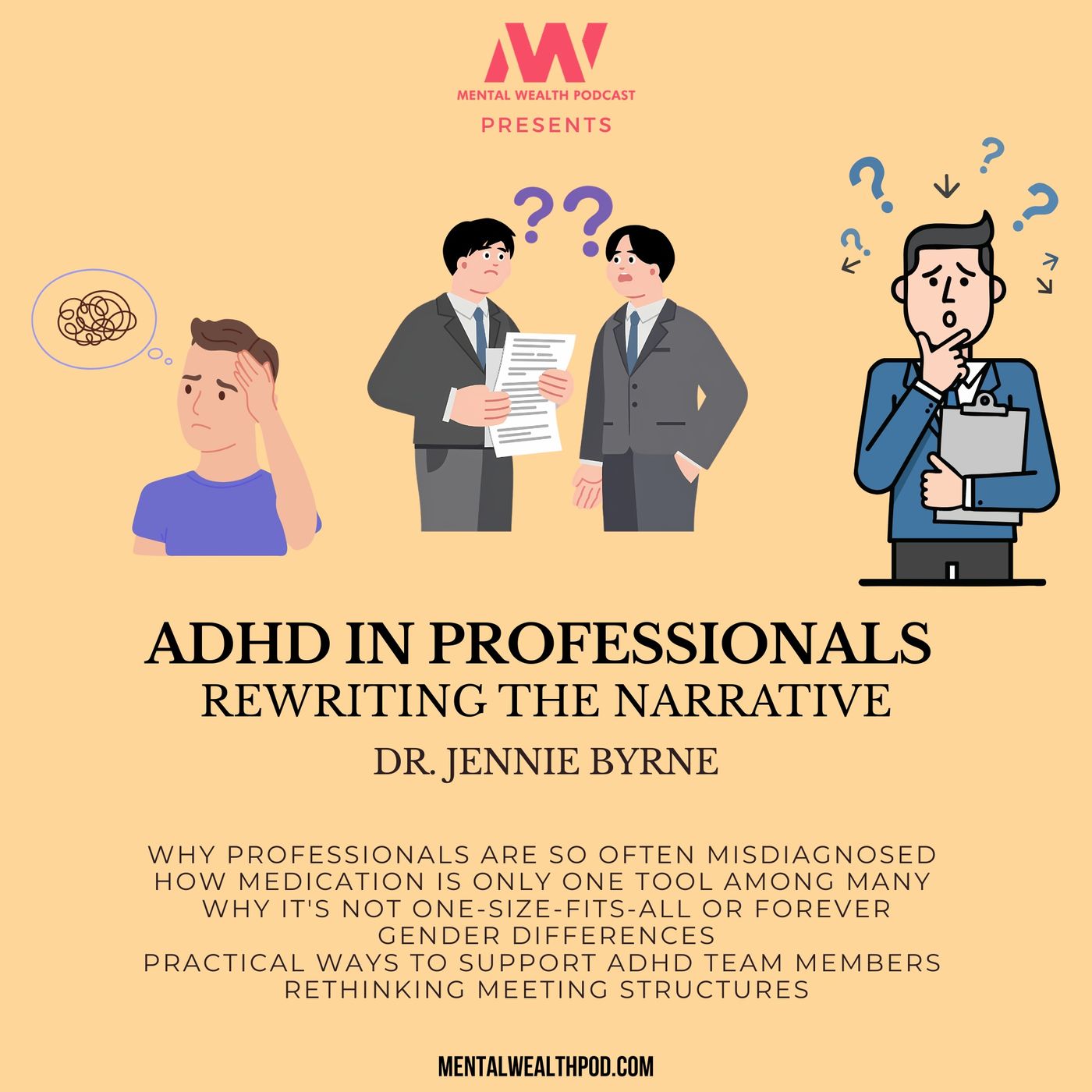
Psychiatrist, neuroscientist, and author Dr. Jennie Byrne talks to the Mental Wealth team this week to unpack ADHD in high-achieving professionals — CEOs, lawyers, doctors, entrepreneurs— who are told they're "too high-functioning" to have it. Dr. Byrne explains why she calls ADHD "a terrible name" and makes the case for thinking of it as neurodiversity rather than disorder. She walks through her three-part assessment process (clinical interview, computer-based attention testing, and executive function rating scales), and shares why sleep and screen habits are often mistaken for ADHD. The conversation covers:Why professionals are so often misdiagnosed (bipolar, anxiety) before anyone considers ADHDHow medication fits as one tool among many — and why it's not one-size-fits-all or foreverWhy standard CBT often needs to be adapted for ADHD brains, including rejection sensitivityGender differences: how cultural expectations and hormone shifts (like perimenopause) shape how ADHD shows up in womenPractical, low-stigma ways managers can support neurodivergent team members without requiring disclosure — from psychologically safe check-ins to rethinking meeting structureDr. Byrne's book, "ADHD in Professionals," draws on 40+ interviews with real professionals navigating diagnosis, stigma, and thriving — not just surviving — with an ADHD brain. Free resources available at constellationplc.com.Dr. Jennie Byrne'sBook: ADHD in ProfessionalsDr. Jennie Byrne's YoutubeConsultation Service: https://www.constellationpllc.com/contact/LinkedInThe Mental Wealth Podcast is co-hosted by Mukund and Rob, with Dr. Ethan Levine serving as clinical advisor, and delivers evidence-based conversations on mental wellness, anxiety, resilience, burnout, and emotional intelligence.www.mentalwealthpod.comYoutube: https://www.youtube.com/@MentalWealthPodInstagram: https://www.instagram.com/mental_wealth_pod/Tiktok: https://www.tiktok.com/@mental_wealth_podDISCLAIMER: The views, thoughts, and opinions expressed are the speaker’s own and do not constitute legal, medical, or other forms of professional advice. The material and information presented here is for general information and entertainment purposes only. The "Mental Wealth Podcast" and names and all forms and abbreviations are the property of its owner and its use does not imply endorsement of or opposition to any specific organization, product, or service.

Comments

Download from Google Play

Download from App Store
 United States