


Relationscapes: Exploring How We Relate, Love, and Belong
Subscribed: 23Played: 437
Subscribe

© Copyright Fireside Podcasts, 2025. All Rights Reserved.
Description
How do we learn to love, relate, and belong in a changing world? Relationscapes brings award-winning journalist Blair Hodges into conversation with today’s most insightful writers and thinkers to explore relationships, gender, sexuality, race, ability, and culture—with ideas that inspire deeper connection and a more humane life.
72 Episodes
Reverse
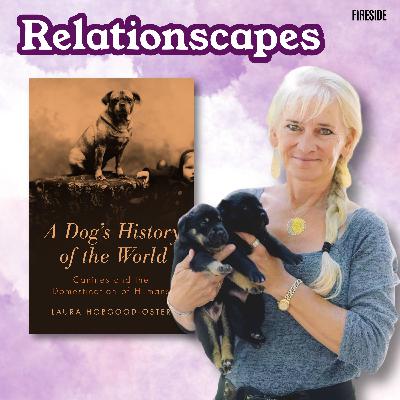
Dogs didn’t just become our companions. They helped make us human.
They've been by our side for tens of thousands of years, helping us herd and hunt, migrate, heal, grieve, fight war, imagine the afterlife, and more.
Religion and environmental studies scholar Laura Hobgood joins us to explore the long, complicated co-evolution of humans and dogs—how humans have loved, used, protected, and sometimes harmed them in return. Her book is called A Dog’s History of the World: Canines and the Domestication of Humans.
Whether you love dogs, miss one deeply, or have never thought much about them at all, this episode will change how you see our oldest animal partner. Even if you aren't a dog person, you're still kind of a dog person!
Full transcript is available here at relationscapes.org.
Show Notes
Check out Grumpy's grave here.
Pat Lee Shipman, "The Woof at the Door," on the child and dog in a cave.
"Do dogs go to heaven?" Glad You Asked podcast.
About the Guest
Dr. Laura Hobgood is co-chair of the Environmental Studies program and past chair of the Religion program at Southwestern University. She also holds the Elizabeth Root Paden Chair in Religion and Environmental Studies. Hobgood received her Ph.D. from St. Louis University and her M.Div. from Vanderbilt University. She is author of A Dog’s History of the World: Canines and the Domestication of Humans.

Some songs take decades to reveal what they’re really about.
Back in the 90s when 20-year-old Steven Page wrote “What a Good Boy,” he understood it as a plea to ease up on restrictive gender expectations that harmed boys and girls. But as he performed it over the years, he realized it was about much more than that.
The stirring anthem has become a greater exploration of gender identity and sexuality, a perennial wrestle against a binary world's hostility to people who don't fit the mold—trans, nonbinary, genderqueer, gay, or otherwise.
Page, a founding member of the smash-hit band Barenaked Ladies now enjoying his solo career, has spent much of his life writing songs to explore vulnerability, humor, grief, and joy, a signature blend of comedy and tragedy.
In this discussion, Page reflects on how "What A Good Boy" came to be, and what it's like to have his creation become part of someone else’s becoming.
Full transcript is available here at relationscapes.org. But you'll want to hear this one!
Show Notes
A.R. Moxon, The Reframe
Steven Page, "Where Do You Stand?"
Steven Page, "White Noise"
Barenaked Ladies, "What a Good Boy"
David Friend, "Steven Page project takes political turn with new album," Toronto Star (Sept. 21, 2018)
Fellow Traveler Episodes
Nonbinary Thinking (with Eris Young)
The Challenges of Parenting Trans Kids (with Abi Maxwell)
A Haunted Trans Story (with Kyle Lukoff)
What The News Isn't Telling You About Trans Teenagers (with Nico Lang)
Black and Beyond the Binary (with KB Brookins)
How to Support Trans Youth (with Ben V. Greene)
The Incredible Brain Science About Sex and Gender (with Daphna Joel)
Recovering Queer Black History for Everybody (with George M. Johnson)
About the Guest
Steven Page is a Canadian musician, singer, songwriter, record producer, and founding member of the music group Barenaked Ladies. Since going solo, Page has released five albums, he performs with groups like the Trans-Canada Highwaymen, and he publicly advocates on issues including mental and behavioral health. He has three sons and lives in New York with his partner, Christine Benedicto. I'm not sure if he has any dogs or cats, and I forgot to ask him. Join his Patreon at patreon.com/c/stevenpage.
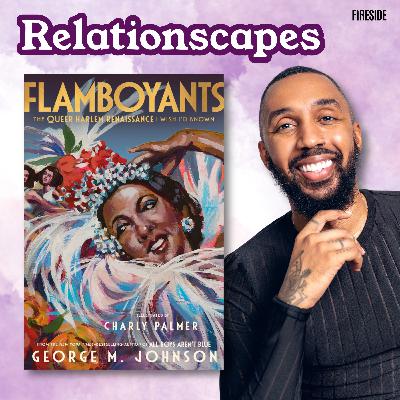
When George M. Johnson was a kid growing up in New Jersey, they loved Black History Month. They were thrilled to learn about the people who shaped American history for the better. But as they got older, they started noticing things were missing—hidden stories that might have meant the most to a queer kid like they were.
George was especially drawn to one of the most dazzling moments in Black history, the Harlem Renaissance. They went searching for what had been covered up, forgotten, or erased, and resurrected those stories in their book, Flamboyants: The Queer Harlem Renaissance I Wish I'd Known. It's a celebration of the Black queer writers, performers, and activists of 1920s America.
George M. Johnson joins us to talk about Black and queer culture—how it impacted the past, how it enlivens our present, and how it can open up new possibilities for the future. This is a conversation about truth-telling, lineage, identity, and the stories that save us when we finally get to hear them.
Full transcript is available here at relationscapes.org.
Show Notes
Langston Hughes, "Let America Be America Again"
Fellow Traveler Episodes
Black and Beyond the Binary (with KB Brookins)
Celebrating Black Womanhood (with Catherine Joy White)
About the Guest
George M. Johnson is an award-winning Black non-binary writer, author, and activist. They are the author of the bestselling Young Adult memoir All Boys Aren’t Blue discussing their adolescence growing up as a young Black Queer boy in New Jersey. Their other books include Flamboyants: The Queer Harlem Renaissance I Wish I'd Known, and There's Always Next Year. George has also published in places like Teen Vogue, The Root, Essence, Ebony, THEM, and The Grio.
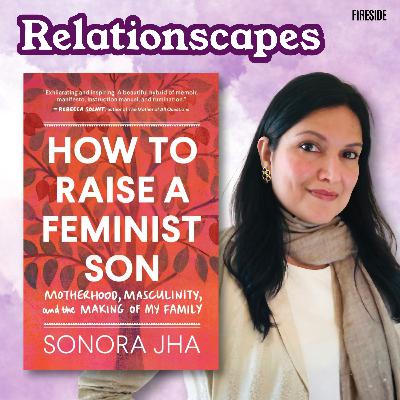
Is it possible to raise kind, feminist boys in our era of manosphere misogyny?
Sonora Jha, an Indian-American immigrant and single mother, says yes. But it takes a lot more than good intentions.
She reflects on raising her son across cultures, teaching empathy through film, talking frankly about sex, consent, and body image, and modeling apology without demanding forgiveness. She pushes back on the idea that feminism harms boys, showing how it can actually free them from shame, silence, and isolation.
Sonora Jha joins us to talk about her book, How to Raise a Feminist Son: Motherhood, Masculinity, and the Making of My Family.
Full transcript is available here at relationscapes.org.
Fellow Traveler Episodes
Testosterone, Y Chromosomes, and Other Manly Excuses, with Matthew Gutmann
Detoxing Masculinity, with Ronald Levant and Shana Pryor
Masculinity, More Liberated and Free, with Frederick Joseph
Learning About Masculinity Today from the Ancient Romans, with Mike Pope
About the Guest
After a career in journalism in India and Singapore, Dr. Sonora Jha became a professor at Seattle University. She is author of four books, including How to Raise a Feminist Son (2021). Her novels include The Laughter, which won the 2024 Washington State Book Award for Fiction and was named one of the Best Books of 2023 by the New Yorker, NPR, and others, Foreign (2013), a finalist for the Shakti Bhatt Prize and the Hindu Prize, and her latest, Intemperance.
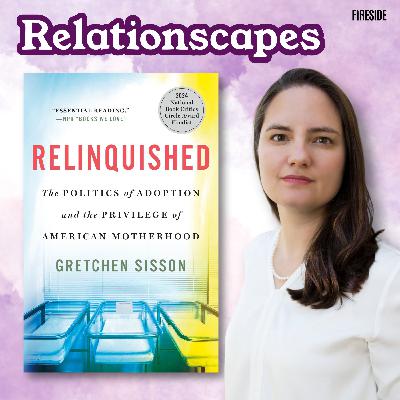
Adoption is often framed as a loving and selfless decision made by women who want to give their babies a better life—but many relinquishing mothers say it doesn’t actually feel like a real choice at all.
Private domestic adoption in the U.S. operates under conditions of high demand, limited supply, and deep economic inequality. Researchers say women rarely choose adoption over abortion or parenting, and many relinquishing parents report long-term trauma.
Sociologist Gretchen Sisson draws on a decade of interviews in her book Relinquished: The Politics of Adoption and the Privilege of American Motherhood to examine who adoption really serves—and who it leaves behind.
She invites us to rethink adoption from the ground up, and asks what real support for families would actually look like.
Full transcript is available here at relationscapes.org.
Show Notes
Pricing the Priceless Child: The Changing Social Value of Children, by Viviana A. Zelizer
The Turnaway Study: Ten Years, a Thousand Women, and the Consequences of Having—or Being Denied—an Abortion, by Diana Greene Foster
Abolition Geography: Essays Towards Liberation, Ruth Wilson Gilmore
Fellow Traveler Episodes
Relationscapes, "The Truth About Transracial Adoption, (with Angela Tucker)"
Relationscapes, "What Disabled Parents Can Teach Everyone About Parenting (with Jessica Slice)"
Relationscapes, "The Rebellious Act of Disabled Parenting (with Eliza Hull)"
Relationscapes, "The Growing Perils of Pregnancy in America (with Irin Carmon)"
About the Guest
Gretchen Sisson studies abortion and adoption in the United States as a sociologist at Advancing New Standards in Reproductive Health (ANSIRH) in the Department of Obstetrics, Gynecology and Reproductive Science at the University of California, San Francisco. She is the author of Relinquished: The Politics of Adoption and the Privilege of American Motherhood, based on hundreds of in-depth interviews with women who have relinquished infants for domestic adoption over the past 60 years.
We’re a little over halfway through January and already it's been...well, a lot. The Trump administration kidnapped the de facto Venezuelan president. The chairman of the Federal Reserve announced he’s being targeted for prosecution because the president wants to control monetary policy. A queer mother in Minneapolis was shot in the head in broad daylight by ICE, who is occupying the city, and the government has been trying to portray her as a terrorist. And etc.
Andrea Pitzer is one of my favorite political analysts right now, and I asked her how we might make it out of this mess. She explains why the current moment feels so destabilizing, how mass detention becomes normalized, why exhaustion and disengagement are themselves political dangers, and what history tells us about stopping things before they get worse.
This is a conversation about realism without despair, urgency without panic, and about how ordinary people can still matter. Especially when the future feels uncertain.
Full transcript is available here at relationscapes.org.
Show Notes
Next Comes What? podcast
Degenerate Art newsletter
Megan Piantowski's ICE zines.
Dan Sinker's ICE whistle project
About the Guest
Andrea Pitzer is a journalist and author, known for her books One Long Night: A Global History of Concentration Camps, The Secret History of Vladimir Nabokov, and Icebound: Shipwrecked at the Edge of the World (2021). She hosts the popular podcast Next Comes What and writes the newsletter Degenerate Art.
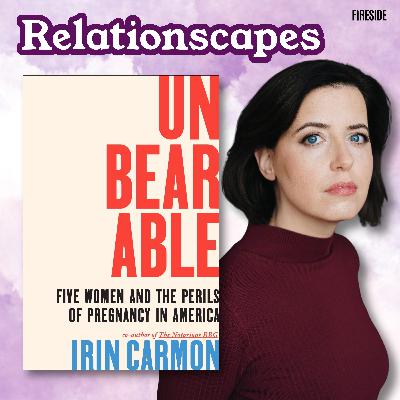
The overturning of Roe v. Wade, which allowed states to outlaw abortion, has had devastating consequences for women across the country—especially because the American health care system was already making pregnancy more dangerous and more unequal in blue states and red states alike.
In her new book Unbearable, journalist Irin Carmon tells the stories of five women whose experiences uncover the realities of pregnancy in America: infertility, abortion, miscarriage, criminalization, racial inequality, and more. Their stories reveal a central truth: America has made choices that make pregnancy more unbearable for more of us. They also reveal how none of this is inevitable or permanent.
Full transcript is available here at relationscapes.org.
Show Notes
Irin Carmon's New York magazine archive
About the Guest
Irin Carmon is a senior correspondent at New York magazine and co-author of Notorious RBG: The Life and Times of Ruth Bader Ginsburg. Her latest book is Unbearable: Five Women and the Perils of Pregnancy in America.
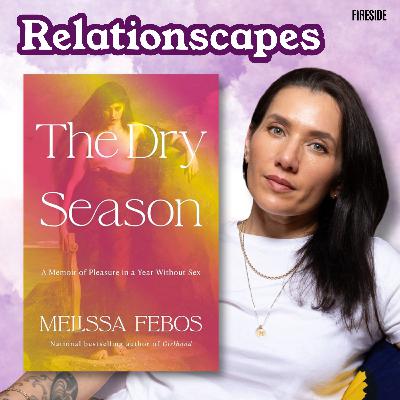
What happens when you stop chasing romantic love entirely?
After ending a catastrophic relationship, acclaimed author Melissa Febos took an unexpected step: despite being a serial relationshipper, she decided to take a personal vow of celibacy.
What began as a three-month break became a full year that transformed how she understood desire, boundaries, people-pleasing, and love itself. In her latest book The Dry Season: A Memoir of Pleasure in a Year Without Sex, Febos reflects on addiction-like romance, the freedom of solitude, feminist role models across history, and how abstaining from sex helped her reclaim agency to build healthier, more generous relationships. She joins us to talk about it in this episode.
Full transcript is available here at relationscapes.org.
Show Notes
Annie Dillard, “Living Like Weasels”
Audre Lorde, "The Uses of the Erotic: The Erotic as Power"
Radiolab, "Choice," November 17, 2008; Barry Schwartz, The Paradox of Choice: Why More Is Less
Top ten Roadrunner cartoons as curated by some guy on YouTube for his nieces
What Your Therapist Thinks podcast
About the Guest
Melissa Febos is the author of five books, including the national bestselling essay collection, Girlhood, winner of the National Book Critics Circle Award in Criticism. Her craft book, Body Work (2022), was also a national bestseller Her new memoir, The Dry Season, was published by Alfred. A. Knopf in June 2025.
The recipient of fellowships and awards from the Guggenheim Foundation Fellowship, the National Endowment for the Arts, the British Library, MacDowell, the Bogliasco Foundation, the Black Mountain Institute, LAMBDA Literary, the American Library in Paris, and others, Melissa's work has appeared in publications like The Paris Review, The New Yorker, The Best American Essays, The New York Times Magazine, The Guardian, Elle, and Vogue.
She holds an MFA from Sarah Lawrence College and is the Roy J. Carver Professor at the University of Iowa, where she teaches in the Nonfiction Writing Program. She lives in Iowa City with her wife, the poet Donika Kelly. From melissafebos.com.
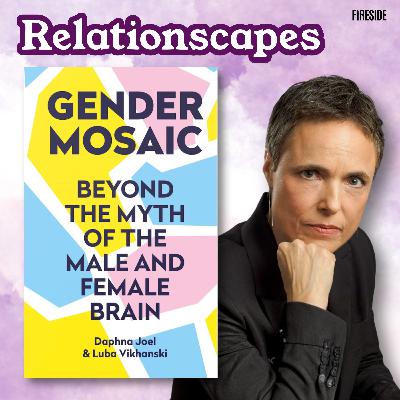
We grow up swimming in gender stereotypes: men are from Mars, women are from Venus. Men are rational and women are emotional. The binary cliches are everywhere, but are they true?
Daphna Joel is a neuroscientist who wanted to know what the science actually says. When she looked at real brains she discovered that each person carries a unique mix of traits, a true mosaic that defies the old binary.
Daphna Joel joins us to talk about her groundbreaking book Gender Mosaic: Beyond the Myth of the Male and Female Brain.
Full transcript is available here at relationscapes.org.
Show Notes
Do your own gender mosaic at https://gendermosaic.tau.ac.il.
About the Guest
Daphna Joel, PhD, is author of Gender Mosaic: Beyond the Myth of the Male and Female Brain. She is a professor of psychology and neuroscience at Tel Aviv University. She has combined her expertise as a neuroscientist with her interest in gender studies to revolutionize the field of sex, brain and gender.
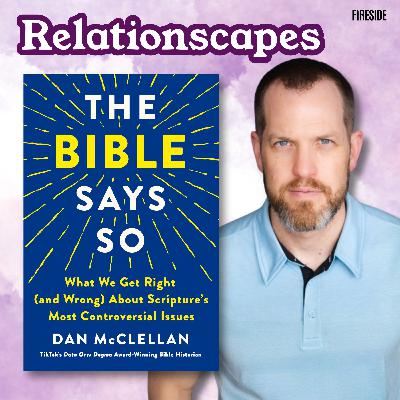
The Bible remains one of the world's most influential books, impacting believers and non-believers alike. As Christian nationalists gain more power over American politics right now, it's as important as ever to understand how the Bible is used to justify laws about abortion, gay marriage, child abuse, and more. Luckily, Bible scholar Dan McClellan is here to give us the data. He's become wildly famous on TikTok unpacking what the Bible really says about these contentious issues, and many more besides.
His new book is called The Bible Says So: What We Get Right and Wrong about Scripture's Most Controversial Issues. Dan joins us to talk about it, about what it's like being a prominent TikToker, about his personal background, about comics, and more.
Full transcript is available here at relationscapes.org.
About the Author
Dan McClellan is a public scholar of the Bible and religion and author of the New York Times bestseller, The Bible Says So: What We Get Right and Wrong about Scripture's Most Controversial Issues. He received his PhD in theology and religion from the University of Exeter. He enjoys confronting misinformation related to the Bible and religion online. He goes by @maklelan on TikTok, Instagram, Twitter, and YouTube.
The Department of Education is being dismantled before our eyes. Why does it matter, and can it be rescued? Reporter Laura Pappano joins us with updates on these things, and her latest visit to the Moms for Liberty conference in Florida, where a new tactic is emerging.
Full transcript is available here at relationscapes.org.
Show Notes
"Moms for quote-unquote 'Liberty,' (with Laura Pappano)," Relationscapes (September 2, 2025)
Relationscapes, "How Children's Rights Impact Everyone (with Adam Benforado)."
Recent Laura Pappano articles:
"Moms (and Cool, Young Podcasters) for Liberty," Slate (October 20, 2025).
"At Moms for Liberty summit, parents urged to turn their grievances into lawsuits," The Hechinger Report (October 20, 2025).
"The new reality with universal school vouchers: Homeschoolers, marketing, pupil churn," The Hechinger Report (November 6, 2025).
About the Author
Laura Pappano is an award-winning education journalist, author, and founder of The New Haven Student Journalism Project. Her latest book is called School Moms: Parent Activism, Partisan Politics and the Battle for Public Education. She is a former education columnist for The Boston Globe, and has published work in places like The New York Times Magazine, Vanity Fair, Salon, The Washington Post, USA Today, Slate, The Atlantic, and The Christian Science Monitor.
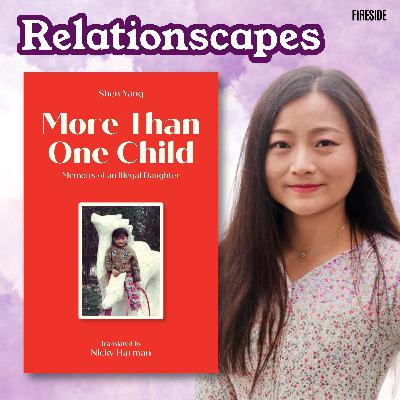
Shen Yang broke the law simply by being born. It was the 1980s in China, and according to the One Child Policy, her parents weren't allowed to have her. They sent her away with relatives, and what followed were years of cruelty and neglect, but also defiance and the will to thrive.
It's hard to find stories directly from excess children. Shen Yang's book is a rare gem. It's called More Than One Child: Memoirs of an Illegal Daughter. She joins us to talk about it in this episode.
Full transcript is available here at relationscapes.org.
About the Author
Shen Yang is author of the book, More Than One Child: Memoirs of an Illegal Daughter.

Chelsey Goodan says that for too long, teenage girls have been undervalued and overlooked. As a longtime tutor and mentor to hundreds of girls from many different backgrounds, Chelsey realized why so many were anxious and hurting. Because too many people treat teenage girls as problems to be controlled or solved. Chelsey says they have much to offer on topics like perfectionism, friendship, identity, shame, power, and more.
Whether you’re a parent, teacher, mentor, or just curious, this conversation will help you better appreciate what teenage girls have to offer.
Full transcript available at relationscapes.org.
Show Notes
DemocraSHE, empowering young women to become leaders.
About the Author
Chelsey Goodan is the founder of The Teenage Girl Cabal, which is a secret society of girls who are changing the world. As the author of the USA Today bestselling book Underestimated: The Wisdom and Power of Teenage Girls, Goodan reveals how the wisdom of teenage girls can create positive change for society at large.
After 16 years working as an academic tutor and mentoring girls from underserved communities, Goodan gathered key insights about teenage girls’ struggles with self-doubt, authenticity, confidence, leadership, connection, and power.

What does real support for trans kids look like in this fraught political moment? Ben V. Greene audaciously but persuasively suggests we try a joy-centered approach.
Greene explains what parents and other loved ones can do when they’re uncertain about how to be there for trans kids, and why curiosity and compassion—not being perfect—makes all the difference.
Green also explores what affirming therapy really is (and isn’t), how belonging improves mental health, and why love and understanding—not panic—save lives. This is a hopeful, human conversation for anyone trying to support a trans child or teen.
Full transcript available at relationscapes.org.
About the Guest
Ben V. Greene is author of the book, My Child Is Trans, Now What? A Joy-Centered Approach to Support. As a transgender man, Ben works as an LGBTQ+ inclusion consultant who has dedicated his career to spreading empathy, awareness, and understanding about the transgender community. He is active on the speaking circuit, with audiences ranging from the UK’s Diversity Live! to NASA. Ben is a guest lecturer on Diversity, Equity, and Inclusion at Cornell University in addition to serving on the board of the Tufts Master’s Degree in Diversity, Equity, and Inclusion. He resides in St. Louis, Missouri.
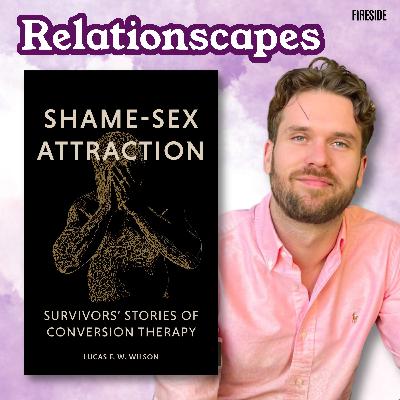
He was told he was broken. He was promised a cure. It was all a lie.
Lucas Wilson, author of Shame-Sex Attraction: Survivors' Stories of Conversion Therapy, takes us inside the real experiences of queer people forced to try and change their so-called "same-sex attraction."
Lucas shares both his own story and those of survivors, revealing the psychological, moral, and spiritual harms of conversion therapy. He also explains why stories, not just statistics, are the most powerful way to confront the discredited practice.
As the U.S. Supreme Court gears up to overturn conversion therapy bans, these stories matter now more than ever.
See the complete transcript at relationscapes.org.
Show Notes
Boy Erased
Chris Walker, "Supreme Court Appears Poised to Strike Down State Bans on Conversion Therapy," truthout.org.
"Practices of so-called 'conversion therapy," report to the UN.
About the Author
Dr. Lucas Wilson is a SSHRC Postdoctoral Fellow at University of Toronto Mississauga. As a former evangelical and a survivor of conversion therapy, he is the editor of Shame-Sex Attraction: Survivors’ Stories of Conversion Therapy (JKP Books, 2025). He is also the author of At Home with the Holocaust: Postmemory, Domestic Space, and Second-Generation Holocaust Narratives (Rutgers University Press, 2025), which received the Jordan Schnitzer First Book Publication Award. He is also the co-editor of Emerging Trends in Third-Generation Holocaust Literature (Lexington Books, 2023), a collection of academic essays about the writings of grandchildren of Holocaust survivors, which has been named an “essential” title by Choice Reviews. His public-facing writing has appeared in The Advocate, Queerty, LGBTQ Nation, and Religion Dispatches, among other venues, and his academic work has appeared in Modern Language Studies, Canadian Jewish Studies, Flannery O’Connor Review, Journal of Jewish Identities, and Studies in American Jewish Literature and in edited collections published by The MLA, SUNY Press, The University of Alabama Press, and DIO Press. He is currently working on two interrelated monograph projects that examine evangelical homophobia and transphobia in the U.S.

Here's a frightening statistic: More young women age 18 to 29 voted for Donald Trump in 2024 than in 2016 or 2020. Why? Jess Britvich argues that TikTok and Instagram have been moving some young women rightward, without making it obvious.
Trends like clean beauty, natural living, tradwife aesthetics, or even yoga and wellness communities might look harmless on the surface—but many of them are pipelines to right-wing politics. The former social worker and content creator Jess Britvich explains how social media pipelines—from “SkinnyTok” to "clean" beauty products—pull people into conspiracy thinking and reactionary movements, and how we can stem the tide by becoming more media literate.
Full transcript available here at relationscapes.org.
Show Notes
Young women trended slightly up toward Trump in 2024 according to the Center for American Women in Politics, "Gender Differences in 2024 Vote Choice Are Similar to Most Recent Presidential Elections," December 28, 2024.
But also, "Gen Z Women Have Most Unfavorable View of Donald Trump: Poll," Newsweek, Sept. 9, 2025.
The National Alliance for Eating Disorders has a helpful overview of #skinnytok, "What’s the Deal with #SkinnyTok?"
The Conspirituality podcast was ahead of the curve covering RFK, Jr., so they were more than prepared for the rise of MAHA. For a more recent overview, see episode 259: "MAHA is Project 2025’s Trojan Horse," May 29, 2025.
See also the Diabolical Lies podcast, "MAHA Moms & the Politics of 'Wellness',” March 23, 2025.
Brief overview of Charlie Kirk's greatest hits is available at "Charlie Kirk’s rhetoric inspired supporters, enraged foes," by Helen Coster and Maria Tsvetkova, Reuters.
About the Guest
Jess Britvich is a content creator in Pittsburgh. Formerly a social worker, she turned her attention to online education in the wake of the global pandemic and the rise of MAGA influencers. Her Substack is substack.com/@jessbritvich. Follow her on TikTok and Instagram @jessbritvich.
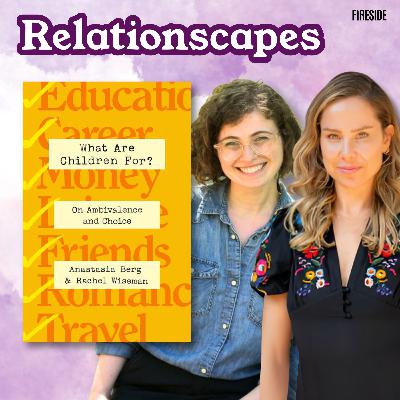
Who would choose to bring children into today’s world? Between climate change, economic strain, political conflict, and growing uncertainty about the future, more people today say they feel uncertain about parenthood, especially progressive people.
Philosophers Anastasia Berg and Rachel Wiseman—authors of What Are Children For?—explore the personal, political, and philosophical stakes of having kids. From the tedium and vulnerability of early parenting to the profound meaning and joy it can bring, this conversation opens space for anyone wrestling with one of life’s biggest decisions.
Full transcript available at relationscapes.org.
About the Guests
Anastasia Berg is Assistant Professor of Philosophy at University of California, Irvine. She serves as editor of The Point magazine, a Chicago-based literary magazine that publishes philosophical writing on everyday life and culture.
Rachel Wiseman is managing editor of The Point. Together they wrote What Are Children For?: On Ambivalence and Choice.
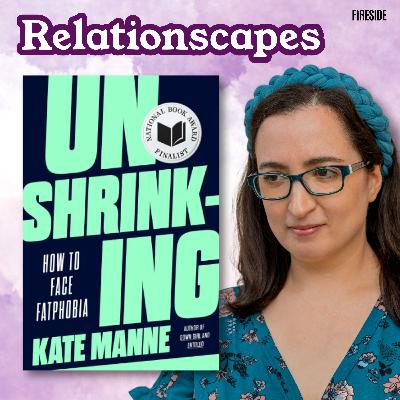
Fatphobia is everywhere. It affects how we judge ourselves and each other. In this episode, philosopher Kate Manne exposes the social, ethical, and health-based consequences of anti-fat bias.
Drawing on personal experience and sharp cultural analysis, Manne challenges dieting myths, weight-loss fads, and societal pressure to be thin. She invites us to practice “body reflexivity,” the radical idea that our bodies exist for ourselves, not merely for others. She explains why physical movement, health, and self-care matter more than size, and why dismantling fatphobia is a social justice issue.
This episode turns the tables on fatphobia in a world obsessed with thinness, offering a liberating perspective about bodies and wellness.
Full transcript available at relationscapes.org.
Show Notes
Weight for It podcast
Maintenance Phase podcast
Da'Shaun L. Harrison, Belly of the Beast: The Politics of Anti-Fatness as Anti-Blackness
Sabrina Strings, "How the Use of BMI Fetishizes White Embodiment and Racializes Fat Phobia," AMA Journal of Ethics
Relationscapes, "Swipe Left on Romance," with Sabrina Strings
About the Guest
Kate Manne is author of Down Girl, Entitled, and Unshrinking. She's an associate professor of philosophy at Cornell University where she’s been teaching since 2013. Before that, she was a junior fellow at the Harvard Society of Fellows. Manne did her graduate work in philosophy at MIT. Her Substack is called More to Hate.
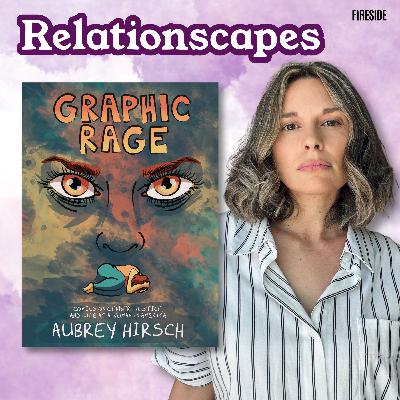
Like a lot of American women, Aubrey Hirsch grew up trying to channel her own rage into other emotions. Maybe she wasn't mad, she was really jealous. Maybe she wasn't pissed off, she was actually sad. Eventually, Aubrey realized she had been suppressing something vital. Sometimes being angry is the main thing she should be. Instead of always running from her outrage, now she channels it into informative, funny, sometimes furious feminist comics.
Aubrey joins us to talk about how she uses illustration to call out sexism, why rage can be a powerful force for collective change, and how we can channel it individually right now to change some things for the better. Her new book is called Graphic Rage: Comics on Gender, Justice, and Life As a Woman in America.
Show Notes
Aubrey Hirsch, "Taking Back the Streets," The Nib, March 22, 2019.
Eat the Damn Peach, and Other Love Stories (with Mary Catherine Starr)
About the Guest
Aubrey Hirsch is author of Graphic Rage: Comics on Gender, Justice, and Life As a Woman in America. She is a writer and illustrator living in New York. Her stories, essays, and comics have appeared in The New York Times, Vox, TIME Magazine, American Short Fiction, Black Warrior Review, The Rumpus, The Nib and elsewhere. She is author of a short story collection, Why We Never Talk About Sugar, and a flash fiction chapbook, This Will Be His Legacy.
She has taught writing at Oberlin College, The University of Pittsburgh, Colorado College, Georgia College and State University, and Chatham University. She is recipient of a 2022 National Endowment for the Arts fellowship in Literature, an individual artist award from the Sustainable Arts Foundation, the Daehler Fellowship in Creative Writing from The Colorado College, and The Meek Award for Graphic Nonfiction from The Florida Review.
Subscribe to her (free!) Substack and follow her on Instagram @aubreyhirsch.
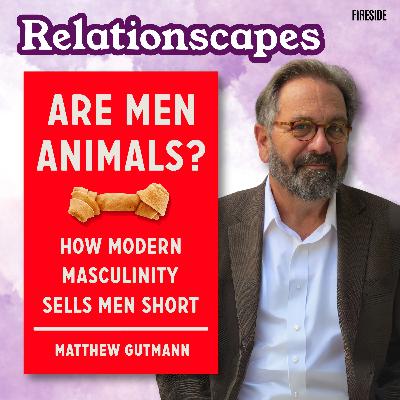
Are men “naturally” violent? Are they hardwired to provide and protect? Does their DNA demand they stray? These questions persist in debates about masculinity, but they’re often answered with lazy biology.
In this episode, anthropologist Matthew Gutmann dismantles biologically grounded gender essentialist myths.
Drawing on decades of research—from fatherhood in Mexico to gender shifts in China—Gutmann shows how culture, history, and politics shape what we call “masculinity.” We talk about the dangers of blaming “male nature,” how fatherhood gets redefined across cultures, and why understanding men as human beings first opens the door to more freedom and accountability.
His book is called Are Men Animals? How Modern Masculinity Sells Men Short.
Full transcript available at relationscapes.org.
Show Notes
“Detoxing Masculinity,” with Ronald Levant and Shana Pryor
“Black and Beyond the Binary,” with KB Brookins
“Masculinity, More Liberated and Free,” with Frederick Joseph
“Learning about Today’s Masculinity from the Ancient Romans," with Mike Pope
About the Guest
Matthew Gutmann is Professor Emeritus of Anthropology at Brown University. His research and teaching has focused on studies of men and masculinities; public health; politics; and the military. His latest book is Are Men Animals? How Modern Masculinity Sells Men Short.

Comments

Download from Google Play

Download from App Store
 United States