


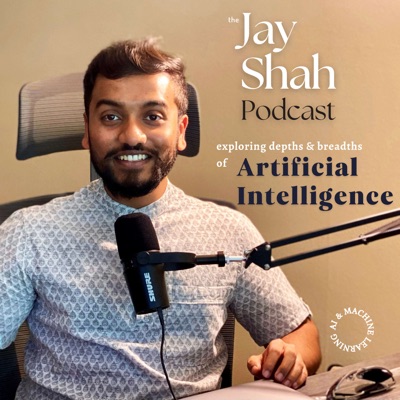
Jay Shah Podcast
Subscribed: 22Played: 128
Subscribe

© Jay Shah
Description
Interviews with scientists and engineers working in Machine Learning and AI, about their journey, insights, and discussion on latest research topics.
97 Episodes
Reverse

Dr. Jackie Cheung is an Associate Professor at McGill University where he co-directs the Reasoning and Learning Lab. He is also an Associate Scientific Director at Mila-Quebec Artificial Intelligence Institute. He and his team are developing computational models to improve the reliability, pragmatics, and evaluation of large language models to ensure they are contextually appropriate and factually grounded.Jackie was worked as a consultant researcher with Microsoft Research and before his current appointments, he earned his PhD and MSc in Computer Science from the University of Toronto, focusing on computational linguistics, and his BSc from the University of British Columbia.00:00:00 Highlight & Introduction00:02:04 Entrypoint in AI & NLP00:04:47 Academia vs. Industry: Career choices00:09:48 Language Revitalization using AI00:12:24 Addressing Biases & Data sovereignty in language revitalization 00:15:49 Evaluating LLMs as Judges00:17:14 Validity and reliability in LLM evaluation 00:25:11 Evidence-centered benchmark design (ECBD) framework00:30:38 Gaps in LLM benchmarks and meaning of "general purpose" AI00:35:24 General purpose intelligence vs reasoning00:40:16 Safety as an undefined bundle in LLMs00:51:45 Stochastic chameleons: how LLMs generalize and hallucinate 01:03:02 Potential & Biases of agentic frameworks for research01:05:52 Evaluating LLMs for summarization01:11:43 Scaling large language models01:16:33 Advice to beginners entering AI in 202601:20:33 Pitfalls to avoid in AI research & development More about Jackie & his research: https://www.cs.mcgill.ca/~jcheung/About the Host:Jay is a Machine Learning Engineer III at PathAI working on improving AI for medical diagnosis and prognosis. Linkedin: https://www.linkedin.com/in/shahjay22/Twitter: https://twitter.com/jaygshah22Homepage: https://jaygshah.github.io/ for any queries.Stay tuned for upcoming webinars!***Disclaimer: The information in this video represents the views and opinions of the speaker and does not necessarily represent the views or opinions of any institution. It does not constitute an endorsement by any Institution or its affiliates of such video content.***
Andrew Beck, MD, PhD is the Co-founder and CEO of PathAI, where he and his team are developing AI tools to improve the precision of pathology and the efficacy of drug development for diagnosis of cancer and also many other complex diseases.Before founding PathAI, Andrew was an Associate Professor at Harvard Medical School, where his research focused on the application of machine learning to cancer pathology. He earned his MD from Brown University and his PhD in Biomedical Informatics from Stanford University, where he pioneered some of the first computational models used to predict patient outcomes in oncology.Time stamps of the conversation:00:00:00 Highlights00:01:28 Introduction00:02:18 Entrypoint in AI00:07:02 Background in Medicine and Bioinformatics 00:10:00 Leap from academia to entrepreneurship00:16:20 Translating AI developments to Pathology00:21:15 Specialist vs Generalist AI models in medicine00:24:15 What sets PathAI apart?00:26:32 AI adoption medicine00:34:25 Usage of AI tools in clinical workflows, example MASH00:40:10 AI in Dermatopathology00:42:15 AI for biomarker discovery00:47:05 Will AI models replace pathologists?00:52:28 Avoiding over-reliance on AI00:57:40 Is AI living unto the hype?01:01:00 Challenges in clinical trials 01:05:12 AI reaching patients directly01:09:50 Working at intersection of AI & Healthcare01:15:30 Pitfalls to learn fromMore about PathAI: https://www.pathai.com/and Andy: https://www.pathai.com/about-us/andy-beckAbout the Host:Jay is a Machine Learning Engineer III at PathAI working on improving AI for medical diagnosis and prognosis. Linkedin: https://www.linkedin.com/in/shahjay22/Twitter: https://twitter.com/jaygshah22Homepage: https://jaygshah.github.io/ for any queries.Stay tuned for upcoming webinars!***Disclaimer: The information in this video represents the views and opinions of the speaker and does not necessarily represent the views or opinions of any institution. It does not constitute an endorsement by any Institution or its affiliates of such video content.***
Dr. Aida Nematzadeh is a Senior Staff Research Scientist at Google DeepMind where her research focused on multimodal AI models. She works on developing evaluation methods and analyze model’s learning abilities to detect failure modes and guide improvements. Before joining DeepMind, she was a postdoctoral researcher at UC Berkeley and completed her PhD and Masters in Computer Science from the University of Toronto. During her graduate studies she studied how children learn semantic information through computational (cognitive) modeling. Time stamps of the conversation00:00 Highlights01:20 Introduction02:08 Entry point in AI03:04 Background in Cognitive Science & Computer Science 04:55 Research at Google DeepMind05:47 Importance of language-vision in AI10:36 Impact of architecture vs. data on performance 13:06 Transformer architecture 14:30 Evaluating AI models19:02 Can LLMs understand numerical concepts 24:40 Theory-of-mind in AI27:58 Do LLMs learn theory of mind?29:25 LLMs as judge35:56 Publish vs. perish culture in AI research40:00 Working at Google DeepMind42:50 Doing a Ph.D. vs not in AI (at least in 2025)48:20 Looking back on research careerMore about Aida: http://www.aidanematzadeh.me/About the Host:Jay is a Machine Learning Engineer at PathAI working on improving AI for medical diagnosis and prognosis. Linkedin: shahjay22 Twitter: jaygshah22 Homepage: https://jaygshah.github.io/ for any queries.Stay tuned for upcoming webinars!**Disclaimer: The information in this video represents the views and opinions of the speaker and does not necessarily represent the views or opinions of any institution. It does not constitute an endorsement by any Institution or its affiliates of such video content.**
Manos is the CEO of Oumi, a platform focused on open sourcing the entire lifecycle of foundation and large models. Prior to that he was at Google leading efforts on developing large language models within Cloud services. He also has experience working at Facebook on AR/VR projects and at Microsoft’s cloud division developing machine learning based services. Manos received his PhD in computer engineering from Princeton University and has extensive hands-on experience building and deploying models at large scale. Time stamps of the conversation00:00:00 Highlights00:01:20 Introduction00:02:08 From Google to Oumi00:08:58 Why big tech models cannot beat ChatGPT00:12:00 Future of open-source AI00:18:00 Performance gap between open-source and closed AI models00:23:58 Parts of the AI stack that must remain open for innovation00:27:45 Risks of open-sourcing AI00:34:38 Current limitations of Large Language Models00:39:15 Deepseek moment 00:44:38 Maintaining AI leadership - USA vs. China00:48:16 Oumi 00:55:38 Open-sourcing a model with AGI tomorrow, or wait for safeguards?00:58:12 Milestones in open-source AI01:02:50 Nurturing a developers community01:06:12 Ongoing research projects01:09:50 Tips for AI enthusiasts 01:13:00 Competition in AI nowadays More about Manos: https://www.linkedin.com/in/koukoumidis/And Oumi: https://github.com/oumi-ai/oumiAbout the Host:Jay is a PhD student at Arizona State University working on improving AI for medical diagnosis and prognosis. Linkedin: https://www.linkedin.com/in/shahjay22/Twitter: https://twitter.com/jaygshah22Homepage: https://jaygshah.github.io/ for any queries.Stay tuned for upcoming webinars!***Disclaimer: The information in this video represents the views and opinions of the speaker and does not necessarily represent the views or opinions of any institution. It does not constitute an endorsement by any Institution or its affiliates of such video content.***
Niloofar is a Postdoctoral researcher at University of Washington with research interests in building privacy preserving AI systems and studying the societal implications of machine learning models. She received her PhD in Computer Science from UC San Diego in 2023 and has received multiple awards and honors for research contributions.
Time stamps of the conversation
00:00:00 Highlights
00:01:35 Introduction
00:02:56 Entry point in AI
00:06:50 Differential privacy in AI systems
00:11:08 Privacy leaks in large language models
00:15:30 Dangers of training AI on public data on internet
00:23:28 How auto-regressive training makes things worse
00:30:46 Impact of Synthetic data for fine-tuning
00:37:38 Most critical stage in AI pipeline to combat data leaks
00:44:20 Contextual Integrity
00:47:10 Are LLMs creative?
00:55:24 Under vs. Overpromises of LLMs
01:01:40 Publish vs. perish culture in AI research recently
01:07:50 Role of academia in LLM research
01:11:35 Choosing academia vs. industry
01:17:34 Mental Health and overarching
More about Niloofar: https://homes.cs.washington.edu/~niloofar/
And references to some of the papers discussed:
https://arxiv.org/pdf/2310.17884
https://arxiv.org/pdf/2410.17566
https://arxiv.org/abs/2202.05520
About the Host:
Jay is a PhD student at Arizona State University working on improving AI for medical diagnosis and prognosis.
Linkedin: https://www.linkedin.com/in/shahjay22/
Twitter: https://twitter.com/jaygshah22
Homepage: http://jayshah.me/ for any queries.
Stay tuned for upcoming webinars!
***Disclaimer: The information in this video represents the views and opinions of the speaker and does not necessarily represent the views or opinions of any institution. It does not constitute an endorsement by any Institution or its affiliates of such video content.***
Vivek is an Assistant Professor at Arizona State university. Prior to that, he was at the University of Pennsylvania as a postdoctoral researcher and completed his PhD in CS from the University of Utah. His PhD research focused on inference and reasoning for semi structured data and his current research spans reasoning in large language models (LLMs), multimodal learning, and instilling models with common sense for question answering. He has also received multiple awards and fellowships for his research works over the years.
Conversation time stamps:
00:01:40 Introduction
00:02:52 Background in AI research
00:05:00 Finding your niche
00:12:42 Traditional AI models vs. LLMs in semi-structured data
00:18:00 Why is reasoning hard in LLMs?
00:27:10 Will scaling AI models hit a plateau?
00:31:02 Has ChatGPT pushed boundaries of AI research
00:38:28 Role of Academia in AI research in the era of LLMs
00:56:35 Keeping up with research: filtering noise vs. signal
01:09:14 Getting started in AI in 2024?
01:20:25 Maintaining mental health in research (especially AI)
01:34:18 Building good habits
01:37:22 Do you need a PhD to contribute to AI?
01:45:42 Wrap up
More about Vivek: https://vgupta123.github.io/
ASU lab website: https://coral-lab-asu.github.io/
And Vivek's blog on research struggles: https://vgupta123.github.io/docs/phd_struggles.pdf
About the Host:Jay is a PhD student at Arizona State University working on improving AI for medical diagnosis and prognosis.
Linkedin: https://www.linkedin.com/in/shahjay22/
Twitter: https://twitter.com/jaygshah22
Homepage: http://jayshah.me/ for any queries.
Stay tuned for upcoming webinars!
***Disclaimer: The information in this video represents the views and opinions of the speaker and does not necessarily represent the views or opinions of any institution. It does not constitute an endorsement by any Institution or its affiliates of such video content.***
Max is the CEO and co-founder of Nixtla, where he is developing highly accurate forecasting models using time series data and deep learning techniques, which developers can use to build their own pipelines. Max is a self-taught programmer and researcher with a lot of prior experience building things from scratch.
00:00:50 Introduction
00:01:26 Entry point in AI
00:04:25 Origins of Nixtla
00:07:30 Idea to product
00:11:21 Behavioral economics & psychology to time series prediction
00:16:00 Landscape of time series prediction
00:26:10 Foundation models in time series
00:29:15 Building TimeGPT
00:31:36 Numbers and GPT models
00:34:35 Generalization to real-world datasets
00:38:10 Math reasoning with LLMs
00:40:48 Neural Hierarchical Interpolation for Time Series Forecasting
00:47:15 TimeGPT applications
00:52:20 Pros and Cons of open-source in AI
00:57:20 Insights from building AI products
01:02:15 Tips to researchers & hype vs Reality of AI
More about Max: https://www.linkedin.com/in/mergenthaler/
and Nixtla: https://www.nixtla.io/
Check out TimeGPT: https://github.com/Nixtla/nixtla
About the Host:
Jay is a PhD student at Arizona State University working on improving AI for medical diagnosis and prognosis.
Linkedin: https://www.linkedin.com/in/shahjay22/
Twitter: https://twitter.com/jaygshah22
Homepage: https://www.public.asu.edu/~jgshah1/ for any queries.
Stay tuned for upcoming webinars!
***Disclaimer: The information in this video represents the views and opinions of the speaker and does not necessarily represent the views or opinions of any institution. It does not constitute an endorsement by any Institution or its affiliates of such video content.***
Golnaz Abdollahian is currently the senior director of big idea innovation at Dolby Laboratories. She has a lot of experience developing and shaping technological products around augmented and virtual reality, smart homes, and generative AI. Before joining Dolby, she had experience working at Microsoft, Apple, and Sony. She also holds PhD in electrical engineering from Purdue University.
Time stamps of the conversation
00:00 Highlights
01:08 Introduction
01:52 Entry point in AI
03:00 Leading Big Idea Innovation at Dolby
06:55 Generative AI, Entertainment and Dolby
08:45 How do content creators feel about AI?
10:30 From a Researcher to a Product person
14:27 Traditional Tech products versus AI products
17:52 From concept to product
20:35 Lesson in Product design from - Apple, Microsoft, Song & Dolby
25:34 Interpreting trends in AI
29:25 Good versus Bad Product
31:25 Advice to people interested in productization
More about Golnaz: https://www.linkedin.com/in/golnaz-abdollahian-93938a5/
About the Host:
Jay is a PhD student at Arizona State University working on improving AI for medical diagnosis and prognosis.
Linkedin: https://www.linkedin.com/in/shahjay22/
Twitter: https://twitter.com/jaygshah22
Homepage: https://www.public.asu.edu/~jgshah1/ for any queries.
Stay tuned for upcoming webinars!
***Disclaimer: The information in this video represents the views and opinions of the speaker and does not necessarily represent the views or opinions of any institution. It does not constitute an endorsement by any Institution or its affiliates of such video content.***
Pritika is the co-founder of Butternut AI, a platform that allows the creation of professional websites without hiring web developers. Before butternut, Pritika had entrepreneurship experience building some other products, which later got acquired.
Time stamps of the conversation
00:00 Highlights
01:15 Introduction
01:50 Entry point in AI
03:04 Motivation behind Butternut AI
05:00 Can software engineering be automated?
06:36 Large Language Models in Software Development
08:00 AI as a replacement vs assistant
10:32 Automating website development
13:40 Limitations of current LLMs
18:12 Landscape of startups using LLMs
19:50 Going from an idea to a product
27:48 Background in AI for building AI-based startup
30:00 Entrepreneurship
34:32 Startup Culture in USA vs. India
More about Butternut AI: https://butternut.ai/
Pritika's Twitter: https://x.com/pritika_mehta
And LinkedIn: https://www.linkedin.com/in/pritikam/
About the Host:
Jay is a PhD student at Arizona State University working on improving AI for medical diagnosis and prognosis.
Linkedin: https://www.linkedin.com/in/shahjay22/
Twitter: https://twitter.com/jaygshah22
Homepage: https://www.public.asu.edu/~jgshah1/ for any queries.
Stay tuned for upcoming webinars!
***Disclaimer: The information in this video represents the views and opinions of the speaker and does not necessarily represent the views or opinions of any institution. It does not constitute an endorsement by any Institution or its affiliates of such video content.***
Swaroop is a research scientist at Google-Deepmind, working on improving Gemini. His research expertise includes instruction tuning and different prompt engineering techniques to improve reasoning and generalization performance in large language models (LLMs) and tackle induced biases in training. Before joining DeepMind, Swaroop graduated from Arizona State University, where his research focused on developing methods that allow models to learn new tasks from instructions. Swaroop has also interned at Microsoft, Allen AI, and Google, and his research on instruction tuning has been influential in the recent developments of LLMs.
Time stamps of the conversation:
00:00:50 Introduction
00:01:40 Entry point in AI
00:03:08 Motivation behind Instruction tuning in LLMs
00:08:40 Generalizing to unseen tasks
00:14:05 Prompt engineering vs. Instruction Tuning
00:18:42 Does prompt engineering induce bias?
00:21:25 Future of prompt engineering
00:27:48 Quality checks on Instruction tuning dataset
00:34:27 Future applications of LLMs
00:42:20 Trip planning using LLM
00:47:30 Scaling AI models vs making them efficient
00:52:05 Reasoning abilities of LLMs in mathematics
00:57:16 LLM-based approaches vs. traditional AI
01:00:46 Benefits of doing research internships in industry
01:06:15 Should I work on LLM-related research?
01:09:45 Narrowing down your research interest
01:13:05 Skills needed to be a researcher in industry
01:22:38 On publish or perish culture in AI research
More about Swaroop: https://swarooprm.github.io/
And his research works: https://scholar.google.com/citations?user=-7LK2SwAAAAJ&hl=en
Twitter: https://x.com/Swarooprm7
About the Host:
Jay is a PhD student at Arizona State University working on improving AI for medical diagnosis and prognosis.
Linkedin: https://www.linkedin.com/in/shahjay22/
Twitter: https://twitter.com/jaygshah22
Homepage: https://www.public.asu.edu/~jgshah1/ for any queries.
Stay tuned for upcoming webinars!
***Disclaimer: The information in this video represents the views and opinions of the speaker and does not necessarily represent the views or opinions of any institution. It does not constitute an endorsement by any Institution or its affiliates of such video content.***
Dr. Imon Banerjee is an Associate Professor at Mayo Clinic in Arizona, working at the intersection of AI and healthcare research. Her research focuses on multi-modality fusion, mitigating bias in AI models specifically in the context of medical applications & more broadly building predictive models using different data sources. Before joining the Mayo Clinic, she was at Emory University as an Assistant Professor and at Stanford as a Postdoctoral fellow.
Time stamps of the conversation
00:00 Highlights
01:00 Introduction
01:50 Entry point in AI
04:41 Landscape of AI in healthcare so far
06:15 Research to practice
07:50 Challenges of AI Democratization
11:56 Era of Generative AI in Medical Research
15:57 Responsibilities to realize
16:40 Are LLMs a world model?
17:50 Training on medical data
19:55 AI as a tool in clinical workflows
23:36 Scientific discovery in medicine
27:08 Dangers of biased AI models in healthcare applications
28:40 Good vs Bad bias
33:33 Scaling models - the current trend in AI research
35:05 Current focus of research
36:41 Advice on getting started
39:46 Interdisciplinary efforts for efficiency
42:22 Personalities for getting into research
More about Dr. Banerjee's lab and research: https://labs.engineering.asu.edu/banerjeelab/person/imon-banerjee/
About the Host:
Jay is a PhD student at Arizona State University.
Linkedin: https://www.linkedin.com/in/shahjay22/
Twitter: https://twitter.com/jaygshah22
Homepage: https://www.public.asu.edu/~jgshah1/ for any queries.
Stay tuned for upcoming webinars!
***Disclaimer: The information contained in this video represents the views and opinions of the speaker and does not necessarily represent the views or opinions of any institution. It does not constitute an endorsement by any Institution or its affiliates of such video content.***
Dr. Petar Veličković is a Staff Research Scientist at Googe DeepMind and an Affiliated lecturer at the University of Cambridge. He is known for his research contributions in graph representation learning; particularly graph neural networks and graph attention networks. At DeepMind, he has been working on Neural Algorithmic Reasoning which we talk about more in this podcast. Petar’s research has been featured in numerous media articles and has been impactful in many ways including Google Maps’s improved predictions.
Time stamps
00:00:00 Highlights
00:01:00 Introduction
00:01:50 Entry point in AI
00:03:44 Idea of Graph Attention Networks
00:06:50 Towards AGI
00:09:58 Attention in Deep learning
00:13:15 Attention vs Convolutions
00:20:20 Neural Algorithmic Reasoning (NAR)
00:25:40 End-to-end learning vs NAR
00:30:40 Improving Google Map predictions
00:34:08 Interpretability
00:41:28 Working at Google DeepMind
00:47:25 Fundamental vs Applied side of research
00:50:58 Industry vs Academia in AI Research
00:54:25 Tips to young researchers
01:05:55 Is a PhD required for AI research?
More about Petar: https://petar-v.com/
Graph Attention Networks: https://arxiv.org/abs/1710.10903
Neural Algorithmic Reasoning: https://www.cell.com/patterns/pdf/S2666-3899(21)00099-4.pdf
TacticAI paper: https://arxiv.org/abs/2310.10553
And his collection of invited talks: @petarvelickovic6033
About the Host:
Jay is a PhD student at Arizona State University.
Linkedin: https://www.linkedin.com/in/shahjay22/
Twitter: https://twitter.com/jaygshah22
Homepage: https://www.public.asu.edu/~jgshah1/ for any queries.
Stay tuned for upcoming webinars!
***Disclaimer: The information contained in this video represents the views and opinions of the speaker and does not necessarily represent the views or opinions of any institution. It does not constitute an endorsement by any Institution or its affiliates of such video content.***
Dr. Yezhou Yang is an Associate Professor at Arizona State University and director of the Active Perception Group at ASU. He has research interests in Cognitive Robotics and Computer Vision, and understanding human actions from visual input and grounding them by natural language. Prior to joining ASU, he completed his Ph.D. from the University of Maryland and his postdoctoral at the Computer Vision Lab and Perception and Robotics Lab.
Timestamps of the conversation
00:01:02 Introduction
00:01:46 Interest in AI
00:17:04 Entry in Robotics & AI Perception
00:20:59 Combining Vision & language to Improve Robot Perception
00:23:30 End-to-end learning vs traditional knowledge graphs
00:28:28 What do LLMs learn?
00:30:30 Nature of AI research
00:36:00 Why vision & language in AI?
00:45:40 Learning vs Reasoning in neural networks
00:53:05 Bringing AI to the general crowd
01:00:10 Transformers in Vision
01:08:54 Democratization of AI
01:13:42 Motivation for research: theory or application?
01:18:50 Surpassing human intelligence
01:25:13 Open challenges in computer vision research
01:30:19 Doing research is a privilege
01:35:00 Rejections, tips to read & write good papers
01:43:37 Tips for AI Enthusiasts
01:47:35 What is a good research problem?
01:50:30 Dos and Don'ts in AI research
More about Dr. Yang: https://yezhouyang.engineering.asu.edu/
And his Twitter handle: https://twitter.com/Yezhou_Yang
About the Host:
Jay is a PhD student at Arizona State University.
Linkedin: https://www.linkedin.com/in/shahjay22/
Twitter: https://twitter.com/jaygshah22
Homepage: https://www.public.asu.edu/~jgshah1/ for any queries.
Check-out Rora: https://teamrora.com/jayshah
Guide to STEM PhD AI Researcher + Research Scientist pay: https://www.teamrora.com/post/ai-researchers-salary-negotiation-report-2023
Stay tuned for upcoming webinars!
***Disclaimer: The information contained in this video represents the views and opinions of the speaker and does not necessarily represent the views or opinions of any institution. It does not constitute an endorsement by any Institution or its affiliates of such video content.***
Dr Hyrum Anderson is a Distinguished Machine Learning Engineer at Robust Intelligence. Prior to that, he was Principal Architect of Trustworthy Machine Learning at Microsoft where he also founded Microsoft’s AI Red Team; he also led security research at MIT Lincoln Laboratory, Sandia National Laboratories, and Mendiant, and was Chief Scientist at Endgame (later acquired by Elastic). He’s also the co-author of the book “Not a Bug, But with a Sticker” and his research interests include assessing the security and privacy of ML systems and building Robust AI models.
Timestamps of the conversation
00:50 Introduction
01:40 Background in AI and ML security
04:45 Attacks on ML systems
08:20 Fractions of ML systems prone to Attacks
10:38 Operational risks with security measures
13:40 Solution from an algorithmic or policy perspective
15:46 AI regulation and policy making
22:40 Co-development of AI and security measures
24:06 Risks of Generative AI and Mitigation
27:45 Influencing an AI model
30:08 Prompt stealing on ChatGPT
33:50 Microsoft AI Red Team
38:46 Managing risks
39:41 Government Regulations
43:04 What to expect from the Book
46:40 Black in AI & Bountiful Children’s Foundation
Check out Rora: https://teamrora.com/jayshah
Guide to STEM Ph.D. AI Researcher + Research Scientist pay: https://www.teamrora.com/post/ai-researchers-salary-negotiation-report-2023
Rora's negotiation philosophy:
https://www.teamrora.com/post/the-biggest-misconception-about-negotiating-salaryhttps://www.teamrora.com/post/job-offer-negotiation-lies
Hyrum's Linkedin: https://www.linkedin.com/in/hyrumanderson/
And Research: https://scholar.google.com/citations?user=pP6yo9EAAAAJ&hl=en
Book - Not a Bug, But with a Sticker: https://www.amazon.com/Not-Bug-But-Sticker-Learning/dp/1119883989/
About the Host:
Jay is a Ph.D. student at Arizona State University.
Linkedin: https://www.linkedin.com/in/shahjay22/
Twitter: https://twitter.com/jaygshah22
Homepage: https://www.public.asu.edu/~jgshah1/ for any queries.
Stay tuned for upcoming webinars!
***Disclaimer: The information contained in this video represents the views and opinions of the speaker and does not necessarily represent the views or opinions of any institution. It does not constitute an endorsement by any Institution or its affiliates of such video content.***
Meredith is an associate professor at New York University and research director at the NYU Alliance for Public Interest Technology. Her research interests include using data analysis for good and ethical AI. She is also the author of the book “More Than a Glitch: Confronting Race, Gender, and Ability Bias in Tech” and we will discuss more about this with her in this podcast.
Time stamps of the conversation
00:42 Introduction
01:17 Background
02:17 Meaning of “it is not a glitch” in the book title
04:40 How are biases coded into AI systems?
08:45 AI is not the solution to every problem
09:55 Algorithm Auditing
11:57 Why do organizations don't use algorithmic auditing more often?
15:12 Techno-chauvinism and drawing boundaries
23:18 Bias issues with ChatGPT and Auditing the model
27:55 Using AI for Public Good - AI on context
31:52 Advice to young researchers in AI
Meredith's homepage: https://meredithbroussard.com/
And her Book: https://mitpress.mit.edu/9780262047654/more-than-a-glitch/
About the Host:
Jay is a Ph.D. student at Arizona State University.
Linkedin: https://www.linkedin.com/in/shahjay22/
Twitter: https://twitter.com/jaygshah22
Homepage: https://www.public.asu.edu/~jgshah1/ for any queries.
Stay tuned for upcoming webinars!
***Disclaimer: The information contained in this video represents the views and opinions of the speaker and does not necessarily represent the views or opinions of any institution. It does not constitute an endorsement by any Institution or its affiliates of such video content.***
Part-2 of my podcast with David Stutz. (Part-1: https://youtu.be/J7hzMYUcfto)
David is a research scientist at DeepMind working on building robust and safe deep learning models. Prior to joining DeepMind, he was a PhD student at the Max Plank Institute of Informatics. He also maintains a fantastic blog on various topics related to machine learning and graduate life which is insightful to young researchers out there.
00:00:00 Working at DeepMind
00:08:20 Importance of Abstraction and Collaboration in Research
00:13:08 DeepMind internship project
00:19:39 What drives research projects at DeepMind
00:27:45 Research in Industry vs Academia
00:30:45 Interview tips for research roles, at DeepMind or other companies
00:44:38 Finding the right Advisor & Institute for PhD
01:02:12 Do you really need a Ph.D. to do AI/ML research?
01:08:28 Academia vs Industry: Making the choice
01:10:49 Pressure to publish more papers
01:21:35 Artificial General Intelligence (AGI)
01:33:24 Advice to young enthusiasts on getting started
David's Homepage: https://davidstutz.de/
And his blog: https://davidstutz.de/category/blog/
Research work: https://scholar.google.com/citations?user=TxEy3cwAAAAJ&hl=en
About the Host:
Jay is a Ph.D. student at Arizona State University.
Linkedin: https://www.linkedin.com/in/shahjay22/
Twitter: https://twitter.com/jaygshah22
Homepage: https://www.public.asu.edu/~jgshah1/ for any queries.
Stay tuned for upcoming webinars!
***Disclaimer: The information contained in this video represents the views and opinions of the speaker and does not necessarily represent the views or opinions of any institution. It does not constitute an endorsement by any Institution or its affiliates of such video content.***
Rora helps top AI researchers and professionals negotiate their pay -- often as they transition from academia into industry. Moving into tech is a huge transition for many PhDs and post-docs -- the pay is much more significant and the terms of employment are often quite different.
In the past 5 years, the Rora team has helped over 1000 STEM professionals negotiate more than $10M in additional earnings from companies like DeepMind, OpenAI, Google Brain, and Anthropic -- and advocate for better roles, more alignment with their managers, and more flexible work.
Referral link: https://teamrora.com/jayshah
Guide to STEM Ph.D. AI Researcher + Research Scientist pay: https://www.teamrora.com/post/ai-researchers-salary-negotiation-report-2023 (the majority of the STEM PhDs we support are going into tech roles)
Rora's negotiation philosophy:
https://www.teamrora.com/post/the-biggest-misconception-about-negotiating-salaryhttps://www.teamrora.com/post/job-offer-negotiation-lieshttps://www.teamrora.com/post/roras-3-keys-to-negotiating-a-new-job-offer00:00 Highlights
00:55 Introduction
01:42 About Rora
05:40 Myths in Job Negotiations
08:58 Fear of losing job offers
12:36 30-60-90 day roadmap for negotiation
15:28 Knowing if you should negotiate
20:46 Negotiating with only one offer
24:40 What to negotiate?
29:00 Knowing if you're low-balled in offers
31:31 When negotiations don't workout
35:00 When & How to Negotiate?
43:00 Negotiating promotions
46:45 Is there always room for Negotiation?
49:42 Quick advice to people who have offers in hand
55:32 Wrong assumptions
Learn more about Jordan: https://www.linkedin.com/in/jordansale
And Rora: https://teamrora.com/jayshah
Also check-out these talks on all available podcast platforms: https://jayshah.buzzsprout.com
About the Host:
Jay is a Ph.D. student at Arizona State University.
Linkedin: https://www.linkedin.com/in/shahjay22/
Twitter: https://twitter.com/jaygshah22
Homepage: https://www.public.asu.edu/~jgshah1/ for any queries.
Stay tuned for upcoming webinars!
***Disclaimer: The information contained in this video represents the views and opinions of the speaker and does not necessarily represent the views or opinions of any institution. It does not constitute an endorsement by any Institution or its affiliates of such video content.***
Part-1 of my podcast with David Stutz. (Part-2: https://youtu.be/IumJcB7bE20)
David is a research scientist at DeepMind working on building robust and safe deep learning models. Prior to joining DeepMind, he was a Ph.D. student at the Max Plank Institute of Informatics. He also maintains a fantastic blog on various topics related to machine learning and graduate life which is insightful to young researchers out there.
Check out Rora: https://teamrora.com/jayshah
Guide to STEM Ph.D. AI Researcher + Research Scientist pay: https://www.teamrora.com/post/ai-researchers-salary-negotiation-report-202300:00:00 Highlights and Sponsors
00:01:22 Intro
00:02:14 Interest in AI
00:12:26 Finding research interests
00:22:41 Robustness vs Generalization in deep neural networks
00:28:03 Generalization vs model performance trade-off
00:37:30 On-manifold adversarial examples for better generalization
00:48:20 Vision transformers
00:49:45 Confidence-calibrated adversarial training
00:59:25 Improving hardware architecture for deep neural networks
01:08:45 What's the tradeoff in quantization?
01:19:07 Amazing aspects of working at DeepMind
01:27:38 Learning the skills of Abstraction when collaborating
David's Homepage: https://davidstutz.de/
And his blog: https://davidstutz.de/category/blog/
Research work: https://scholar.google.com/citations?user=TxEy3cwAAAAJ&hl=en
About the Host:
Jay is a Ph.D. student at Arizona State University.
Linkedin: https://www.linkedin.com/in/shahjay22/
Twitter: https://twitter.com/jaygshah22
Homepage: https://www.public.asu.edu/~jgshah1/ for any queries.
Stay tuned for upcoming webinars!
***Disclaimer: The information contained in this video represents the views and opinions of the speaker and does not necessarily represent the views or opinions of any institution. It does not constitute an endorsement by any Institution or its affiliates of such video content.***
Dr. Subbarao Kambhampati is a Professor of Computer Science at Arizona State University and the director of the Yochan lab where his research focuses on decision-making and planning, specifically in the context of human-aware AI systems. He has been named a fellow of AAAI, AAAS, and ACM in recognition of his research contributions and also received a distinguished alumnus award from the University of Maryland and IIT Madras.Check out Rora: https://teamrora.com/jayshahGuide to STEM Ph.D. AI Researcher + Research Scientist pay: https://www.teamrora.com/post/ai-researchers-salary-negotiation-report-2023Rora's negotiation philosophy:https://www.teamrora.com/post/the-biggest-misconception-about-negotiating-salaryhttps://www.teamrora.com/post/job-offer-negotiation-lies00:00:00 Highlights and Intro00:02:16 What is chatgpt doing?00:10:27 Does it really learn anything?00:17:28 Chatgpt hallucinations & getting facts wrong00:23:29 Generative vs Predictive Modeling in AI00:41:51 Learning common patterns from Language00:57:00 Implications in society01:03:28 Can we fix chatgpt hallucinations? 01:26:24 RLHF is not enough01:32:47 Existential risk of AI (or chatgpt) 01:49:04 Open sourcing in AI02:04:32 OpenAI is not "open" anymore02:08:51 Can AI program itself in the future?02:25:08 Deep & Narrow AI to Broad & Shallow AI02:30:03 AI as assistive technology - understanding its strengths & limitations02:44:14 SummaryArticles referred to in the conversationhttps://thehill.com/opinion/technology/3861182-beauty-lies-chatgpt-welcome-to-the-post-truth-world/More about Prof. RaoHomepage: https://rakaposhi.eas.asu.edu/Twitter: https://twitter.com/rao2zAlso check-out these talks on all available podcast platforms: https://jayshah.buzzsprout.comAbout the Host:Jay is a Ph.D. student at Arizona State University.Linkedin: https://www.linkedin.com/in/shahjay22/Twitter: https://twitter.com/jaygshah22Homepage: https://www.public.asu.edu/~jgshah1/ for any queries.Stay tuned for upcoming webinars!***Disclaimer: The information contained in this video represents the views and opinions of the speaker and does not necessarily represent the views or opinions of any institution. It does not constitute an endorsement by any Institution or its affiliates of such video content.***Checkout these Podcasts on YouTube: https://www.youtube.com/c/JayShahmlAbout the author: https://www.public.asu.edu/~jgshah1/
Karyna Naminas is the CEO of Label Your Data which provides data annotation services to different organizations interested in developing AI-based solutions.Check out Rora: https://teamrora.com/jayshahGuide to STEM Ph.D. AI Researcher + Research Scientist pay: https://www.teamrora.com/post/ai-researchers-salary-negotiation-report-2023Rora's negotiation philosophy:https://www.teamrora.com/post/the-biggest-misconception-about-negotiating-salaryhttps://www.teamrora.com/post/job-offer-negotiation-lies00:00:00 Introduction and Sponsors00:02:28 Background before being a CEO00:06:38 Fascinating aspects of AI00:09:10 Data annotation outside of AI00:10:21 Effect of COVID, Russia-Ukraine War, and economic crisis on Business00:18:47 Sourcing data annotators 00:22:40 Challenges in annotation00:31:00 Data annotation for Military applications in Ukraine00:41:42 Tools used for annotation00:44:56 Segment anything and chatgpt to facilitate annotation00:51:00 Key responsibilities as a CEO00:53:58 Metrics for performance evaluation00:59:56 Building leadership01:06:06 Advice to aspiring entrepreneurs01:09:34 Dealing with failures as a CEO Learn more about Karyna: https://www.linkedin.com/in/karyna-naminas-923908200Label Your Data: https://labelyourdata.com/LinkedIn: https://www.linkedin.com/company/label-your-data/Also check-out these talks on all available podcast platforms: https://jayshah.buzzsprout.comAbout the Host:Jay is a Ph.D. student at Arizona State University.Linkedin: https://www.linkedin.com/in/shahjay22/Twitter: https://twitter.com/jaygshah22Homepage: https://www.public.asu.edu/~jgshah1/ for any queries.Stay tuned for upcoming webinars!***Disclaimer: The information contained in this video represents the views and opinions of the speaker and does not necessarily represent the views or opinions of any institution. It does not constitute an endorsement by any Institution or its affiliates of such video content.***Checkout these Podcasts on YouTube: https://www.youtube.com/c/JayShahmlAbout the author: https://www.public.asu.edu/~jgshah1/

Comments

Download from Google Play

Download from App Store
 United States