


 Claim Ownership
The Political Risk Podcast
Subscribed: 25Played: 190
Subscribe

© David Benyon
Description
Geopolitics, insured. An independent, journalist-run podcast, focused on geopolitics and insurance markets, serving risk professionals, leaders and decision makers in specialty insurance and beyond. Guests mix senior underwriters and brokers from the world of specialty insurance with geopolitical expertise from analysts, authors, diplomats and academics.
62 Episodes
Reverse
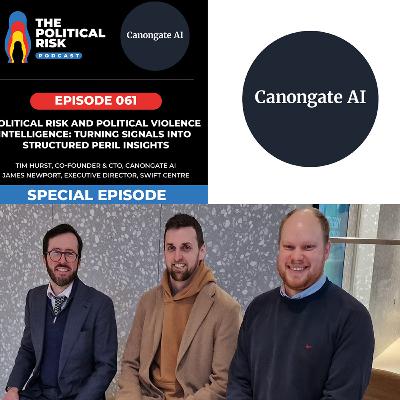
Canongate AI is a new political risk and political violence intelligence solution that converts millions of geopolitical inputs into structured intelligence for underwriters. Already deployed by specialty insurers, the platform provides underwriters and analysts with a clear, structured view of the geopolitical landscape, distilled by AI, from what would otherwise be an overwhelming flow of raw information.Tim Hurst, Canongate AI’s co-founder and chief technology officer, is joined by James Newport, executive director of forecasting advisory the Swift Centre, for this special episode, to explain how Canongate ingests millions of documents from government sources, corporates, trade unions, NGOs and others, turning these signals into territory and peril specific insights, making sense of a volatile world.
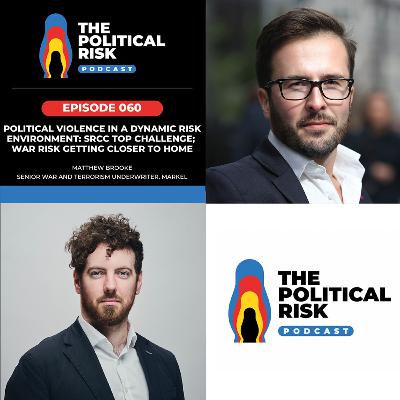
Matthew Brooke is a senior war and terrorism underwriter at Markel. In this episode he explores how political violence underwriting is evolving within an increasingly uncertain geopolitical environment globally. The conversation begins with Matthew’s role, background and Markel’s political violence portfolio, before moving into how insurers are balancing portfolio management, market competition and risk selection across war, terrorism, sabotage, and civil unrest perils. With social unrest emerging as a persistent challenge for many regions, the discussion also examines how war risk perceptions are shifting, including why some threats now feel closer to home for insureds and underwriters alike. The episode closes by assessing geopolitical uncertainty, buyer behaviours, and the stickiness of political violence demand across some different countries and perils. Enjoy!
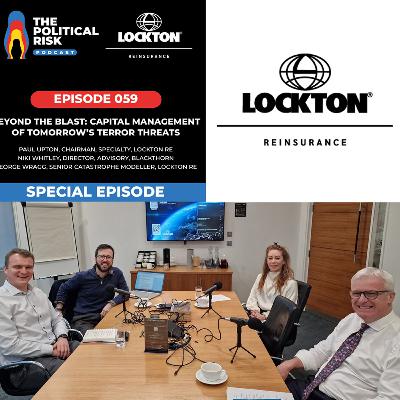
A special episode of the Political Risk Podcast, produced in association with Lockton Re, to examine how the re/insurance market should rethink terrorism risk in an age of volatility. The conversation is built around the report “Beyond the Blast: Capital Management of Tomorrow’s Terror Threats”, published by Lockton Re in collaboration with Blackthorn. It features three of the report’s authors: Paul Upton, chairman of specialty, Lockton Re; Niki Whitley, director of advisory, Blackthorn; and George Wragg, senior catastrophe modeller, Lockton Re.They explore the concerns presented by the report – from the drivers of change in the threat environment, to the need for agile thinking and better data, scenarios and risk modelling – contributing to challenges for terrorism reinsurance to remain relevant and provide capital efficiency. Here’s a link to the report we’re discussing.https://global.lockton.com/re/en/news-insights/beyond-the-blast-new-report-from-lockton-re-and-blackthorn-considers-capital
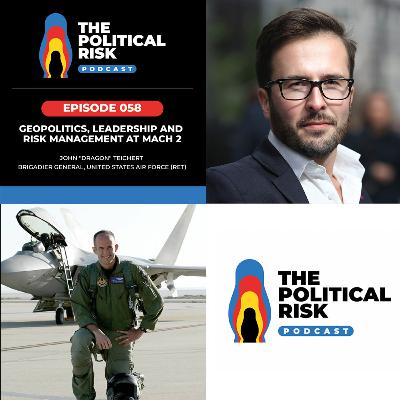
John Teichert is a recently retired US Air Force brigadier general and former test pilot for the F-22 stealth fighter. A graduate of MIT and Stanford, John flew combat missions in the F-15E, call-sign “Dragon”, and test piloted the F-22 Raptor. He later commanded Joint Base Andrews and Edwards Air Force Base. He went on to serve as the senior US Defense Official in Iraq and finished his military career overseeing international partnerships for the USAF. We explore test piloting as the ultimate risk management role, lessons from real-world geopolitics, and leadership under extreme pressure, including reflections on friendships with legendary test pilots Chuck Yeager and Eric “Winkle” Brown.A high-speed start to 2026.
Join two special guests for a conversation about the future of political violence and terrorism underwriting. Billy Ayres is head of crisis management at The Fidelis Partnership, and Simon Fagg is global head of pre-sales solutions at AdvantageGo.We discuss how PVT underwriters blend expertise with analytics, what underwriters really want from their data and tech providers, insurer fears about strikes, riots and civil commotion (SRCC) becoming a frequency peril, and the evolution of terrorism risk towards active-assailant coverage. Two recent white papers published by AdvantageGo in collaboration with this podcast explore the same themes. These are: “Political Violence: Underwriting in an Age of Insecurity” ; and “More Art Than Science: PVT’s Use of Data-Analysis and Modelling Techniques”.
This special edition of the Political Risk Podcast features Verisk Maplecroft’s Political Risk Outlook report. Anna Gilmour, Head of Global Risk Insight, joins Hugo Brennan, Director of Research, EMEA, to discuss the research, offering a forward-looking assessment of the forces reshaping geopolitics, global markets and insurance portfolios.The special episode explores why political risk has become structural rather than cyclical, with instability now embedded across developed and emerging markets. Anna outlines the headline findings from Verisk Maplecroft’s extensive risk data and expert analysis, explaining why businesses and insurers must now proactively plan around persistent uncertainty rather than treating shocks as one-off events.Hugo talks us through the report’s conflict chapter, detailing the sharp expansion of conflict-affected territories since 2021, from high-profile wars to under-reported flashpoints in Nigeria, Pakistan and Colombia. He also examines the rise of hybrid warfare activity across Europe as a key trend for political violence underwriters.Conversation turns to mounting government instability and the sharp rise in civil unrest risk across Europe, before Anna assesses the geopolitical and commercial implications of the new tariff environment, shifting supply chains and the uneven resilience of key emerging markets.To conclude, Anna and Hugo guide listeners through the report’s three core scenarios for the world to 2030 – Drift, Fracture, Adaptation – and highlight some signposts that could reveal which path the world is taking. A direct link to Verisk Maplecroft’s Political Risk Outlook report is included below.https://www.maplecroft.com/resources/outlooks/political-risk-outlook/
Robert Hunter, former US ambassador to NATO and chief White House official for Europe and the Middle East joins Mosaic Insurance’s international CUO Charlie Mackay to explore why a firm grasp of history is essential to understanding today’s geopolitical uncertainty. From US foreign-policy unpredictability to the return of great-power rivalry and the role of China, Robert explains how complacency over decades has eroded strategic thinking in Washington. Charlie provides an underwriting perspective on what uncertainty and complacency at government level mean for political risk and political violence risks facing global business.The two discuss the value of historical context, local expertise and new AI tools helping insurers assess ‘what-if’ scenarios for multinationals operating in volatile regions. They also reflect on shifting alliances, Russia-Ukraine, and why unpredictability is driving demand for specialty insurance protection.Enjoy this latest special episode, produced in association with Mosaic. My thanks also to The Ambassador Partnership, and below a link to Robert’s “History Matters” article for further reading. https://americandiplomacy.web.unc.edu/2025/10/history-matters/
Pamela Thomson-Hall, head of international at Willis, offers crisis management advice, supporting clients through geopolitical shocks and leading an international broking business. From Russia–Ukraine lessons to horizon scanning, scenario analysis and a guidebook for CEOs, she explains why preparation, agility, clear communication and cultural sensitivity are essential when crises suddenly unfold. Pamela also discusses aviation insurance, from war claims and contract certainty, to supporting the return of civil aviation to Ukrainian airspace.
As Ukraine endures and rebuilds, insurers are playing a quiet but crucial role in keeping goods moving and businesses operating.Jamie Cleary, head of crisis management at MS Amlin, speaks about the creation of the Ukraine Reinsurance Guarantee Facility (URGF), a landmark partnership between the EBRD, donor governments, and the private insurance market.He explains how the URGF provides war risk cover to local Ukrainian insurers, supporting trade and economic resilience, and why it could serve as a blueprint for future public-private insurance models in other high-risk regions.The discussion also explores how modern warfare, drone technology, and AI are reshaping crisis management underwriting — and why, behind every insurance policy, there’s a deeply human story.
How can political risk insurance unlock trillions in investment for sustainable development? William Limb, head of political risk solutions at Liberty Specialty Markets (LSM) discusses a landmark UNCTAD report, “De-risking Investment for Sustainable Development Goals: The Role of Political Risk Insurance”. The conversation explores how political risk cover can bridge the $4trn annual funding gap holding back projects in emerging markets – from energy and infrastructure to clean water and housing. Limb discusses LSM’s global political risk portfolio, a doubling of inquiries made about cover within the past year, innovation in bespoke and portfolio-level solutions, and the growing role of public–private collaboration in de-risking investment. He also explains how awareness of the product remains limited beyond multilateral circles, why the private market is crucial to scaling protection, and how insurers can add value beyond pure risk transfer. A deep dive into how underwriting expertise and creative structures can help investors deliver impact while managing geopolitical risk.
Kidnap and ransom (K&R) is one of the most specialised – and least understood – corners of the insurance world.In this special episode, in association with Gallagher Specialty, Eddie Kurshumlija, director of crisis management at Gallagher Specialty, and Adam Carrier, head of consulting at AnotherDay, a Gallagher company, explore how K&R policies work in practice, from what’s typically included or can be added on, to response consultants, intelligence support, duty of care and crisis planning.Discussion moves on to examine where conditions are ripe for K&R to proliferate, from weak rule of law and organised crime to civil unrest and geopolitical instability. The guests highlight case studies from Syria, Nigeria, Mexico and beyond, while also looking at rising risks in Western contexts such as workplace violence.
Bruce Carman, CEO of Hive Underwriters, returns for a wide-ranging conversation. You can’t get broader than space, where we start, which is Hive’s latest launch. We trace the London MGA's development from aviation war into multi-class specialty agency. We also discuss consequences of June's High Court ruling that losses incurred by aircraft lessors of planes seized by Russia after its invasion of Ukraine are to be covered under aviation hull war policies.
Trade wars and geopolitics are reshaping global supply chains, counterparty risk, and credit and political risk insurance (CPRI). In this episode, Eran Charit, senior broker at Lockton Re, shares his perspective on how a pipeline of new CPRI entrants and fresh capacity are softening conditions in the primary market, while treaty reinsurance remains more fragile to systemic shocks, due to the short list of reinsurers willing to lead in this class. We discuss the risks of a reinsurer suddenly exiting, and systemic shock scenarios that could destabilise portfolios, from corporate fraud to a cyber-attack on digital infrastructure. With experience broking at both primary and reinsurance levels, Eran brings unique insight into a fast-moving and often misunderstood class of business.
Jelle Ouwehand, head of war, terrorism and political violence at Arch Insurance International, features in this episode. Political violence has a close and complex relationship with social media. The speed at which news travels, and the democratising power of social media, are meeting with forces of political populism and polarisation. Together with increased proliferation of fake news, misinformation and disinformation, all these factors mean social media are fanning the flames of social disorder, with inevitable fallout for underwriting PV and SRCC risks.
Jérôme Haegeli, Swiss Re’s chief economist, discusses its latest Sigma study. Global growth is slowing at a time of large macroeconomic regime shifts; extreme policy uncertainty is set to persist with the highest US goods tariffs since the Great Depression, the reinsurer’s report warns. This ep relates headline geopolitics to outcomes for insurance premium and claims trends – positive and negative – across lines of business, from marine cargo to motor, and property catastrophe reinsurance business. You can read the Swiss Re Sigma study “World insurance in 2025: a riskier, more fragmented world order”, here. https://www.swissre.com/institute/research/sigma-research.html
Verisk Maplecroft’s new Strikes, Riots, and Civil Commotion (SRCC) model for the United States is the market’s first probabilistic SRCC catastrophe model. Since 2017, SRCC has led to $10bn of insured losses, compared to $1bn for terrorism. Civil unrest in the US recently hit the headlines in Los Angeles. In 2020, SRCC topped $3bn in industry-wide insured losses. A one in 100-year event, in Verisk Maplecroft’s catalogue, would be more than twice as severe. Two guests feature for this special episode in association with Verisk Maplecroft: Sam Haynes, Head of Data and Analytics; and Torbjorn Soltvedt, Associate Director, Global Risk Insight, Verisk Maplecroft.
The 90-day pause on President Trump’s “Liberation Day” tariffs is due to expire on 9 July. The Association of Southeast Asian Nations (ASEAN) are among the targets. When a blanket tariff rate of 10% expires, Thai goods will be targeted with a 36% tariff, Indonesian goods at 32%, for instance. Two senior diplomats feature in this ep. Sir Richard Gozney is a retired senior British diplomat, ex-governor of Bermuda, and former ambassador to Nigeria and Indonesia. Sek Wannamethee is a retired senior Thai diplomat, former ambassador for Thailand to Belgium and Luxembourg, and head of the Thai mission to the European Union. His recent article on this topic, published by The Ambassador Partnership, can be found here. https://www.ambassadorllp.com/ap-insights/asean-navigating-through-trumps-tariffs
For the latest episode, two guests feature from SCOR Business Solutions: Kayley Stewart is head of crisis management; and Babak Tavassolie is head analyst of political and credit risk. It’s a wide-ranging conversation, encompassing two geopolitically interrelated but separate specialty insurance lines of business that are at the very core of this pod – political risk and political violence. We discuss the political risks present within previously ‘vanilla’ credit insurance, affecting some buyer motivations and underwriting assumptions; the maturing specialty market for standalone terrorism and political violence, for such emerging threats as sabotage and civil unrest; as well as macro geopolitical risk trends to monitor for 2025 and beyond.
The City of London Corporation hosted a Chief Risk Officers Summit at the Guildhall on 21 May, including a panel discussion: “Responding to challenges in an ever-changing geopolitical landscape”. Panellists included: Andrew McDougall, Head of Geopolitical Risk, Barclays; Savannah Thompson, Head of Political Risk & Underwriting Development, The Fidelis Partnership; Esperanza Cerdan, Chief Risk Officer, IFM Investors; Jennifer Geary, Chief Risk Officer, Non-Exec & Author, The C-Suite Framework; with host David Benyon asking the questions. Bayes Business School in partnership with the City of London published a report to promote the importance of the CRO role: “Optimising Growth: The Evolving Role of the Chief Risk Officer”. Here’s the link to that paper.https://www.citystgeorges.ac.uk/__data/assets/pdf_file/0006/866715/Bayes-Lord-Mayors-CRO-Report-WEB_Final.pdf
A special episode, in association with Liberty Specialty Markets, focused on European political violence (PV) risks. Politically motivated sabotage is a huge topic across Europe, amid heightened concerns about hybrid-war and grey-zone threats amid a potentially volatile political backdrop. Strikes Riots and Civil Commotion (SRCC) are the front-and-centre PV risk, particularly given recent civil unrest events within territories of Overseas France. The episode features two leaders of LSM’s European PV business: Björn Reusswig, Regional Line of Business Manager, Terrorism & Contingency, Europe; and François Barriol, France Manager, Deputy Head, Terrorism, Political Violence & Contingency, Europe.

Comments

Download from Google Play

Download from App Store
 United States