


 Claim Ownership
Don't You Dare To Think Out Loud!
Subscribed: 0Played: 1
Subscribe

© Javier Trujillo-Bencomo
Description
A transnational author and voice crafter. Wrote a few novels and a medieval trilogy. And works hard to upload them on ACX before the inevitable vocal fold atrophy.
javiertruben.substack.com
javiertruben.substack.com
49 Episodes
Reverse
I was a boy wonder, and I loved to hate the guts of whoever was a killjoy. And mostly, any authority figures who were poorly paid teachers, so I was bound to be self-taught. However, I had a professor who taught me to channel all that hate by reading aloud about any historical character of my choosing.Soon, I also became a performer aboard the school bus, which had loudspeakers and a microphone; I learned to read a comma and a semicolon and pause after a period without missing a beat. The bus driver cut a deal with me. I could read if I indulged him in reading his favorite book. The Bermuda Triangle by Charles Berlitz.Time after, when I began to write, all those bloody caesuras made a lot of sense. Slow reading made me pore over sentences unfolding every aspect of language; all those sensuous qualities–how many syllables a word had and how long the accent over a vowel–are likely to carry weight, give pleasure, and hold meaning. These poetic qualities are tied up as the purely cognitive. And if I think about them as a mode of communication only, those qualities would not be alive and kicking.That must explain why I feel myself accessing skills I have learned through decades-long narrator performances. I’ll read aloud and look up for the through line.At this stage, all the worms will come out of the can: tiny dialogues, unconvincing characters, sludgy descriptions, totally random, unrelated bits of crap, and b******t that have made it through what I hoped would be an astonishing copy.I have done enough awful rehearsals–I know this for real. But the pain in writing, as you know, it’s a discarding process as well. And I don’t have any partner to reassure me I will make it. Outside the box, I find myself ‘watching’ the story like an audience. Am I bored? Restless? Irritated? Would I tattoo the first line over my forearms?Don’t you dare to think like a wordsmith if you don’t bring along a hammer! Eventually, you will kill your darlings. It will be a drama otherwise. You have to let it go and move on.And I keep asking myself while gripping that hammer over the head, am I really nuts to step out of the comfort zone? Why am I doing this? Because I have no choice!I don’t stop blowing with all my strength until I hear the anvil forging from nothing, a new beat I had never heard of, that sparks of wonder, insight, and hubris that come along with it. Get full access to Don't You Dare To Think Out Loud! at javiertruben.substack.com/subscribe
I suppose it’s because I had a good night’s sleep that I feel better than yesterday. I thought I couldn’t write a single word because of the alarming lack of relevance. Writing fiction requires a massive focus on a story that sometimes makes no sense, and sometimes it truly does. Navigating between these two extremes is quite intense and certainly not for the faint of heart.I had the bad luck of growing up in a time when the plot seemed useless. In fact, I could say the novels I loved were a kind of chaotic mess.When did I begin to appreciate a plot? That’s easy! Writing my first manuscript, I ran a free-fall plot, which brought about a large number of characters. So, at the time of ending such an orgy of creativity, the protagonist looked like a bit player.Of course, that little crack went unnoticed until I began to receive the feedback of my first agent, who in a moment of candor, said:“You could have written seven novels if you had had a plot.”Needless to say, Mrs. Kerrigan was right. She had a business to run, books to pitch for big publishers, not a lab of crazy ideas, but a literary agency.A friend of mine was way more graphic:“Next time, cut the bologna in thin slices.”That was bound to happen. So, with the first lesson learned, my second novel was a tour de force. But I missed out on Cervantes’ trick of giving voice to 600 characters. On the contrary, I ran a mix of triangle affair and coming-of-age novel.And yet, I did not run the distance, the 120,000 words that make a good brick of waste paper a beautiful printed ephemera to fill the windows of a bookstore. On the contrary, I fell short because I had no idea what a canonical novel was. A behemoth of five hundred pages. Otherwise, your literary dreams will go to the pile.A younger version of me thought a page turner a thing of the past. Like when Tolstoy wrote novels like War and Peace –or Cervantes ran a carousel of freaks he certainly would have met once in the funny pages of Don Quixote.Lesson learned, the result was the corkboard, the card notes, the three acts, the rolling scenes, and the facts that give speed, flow, and beat to the characters. At the back of my desk, I want now order, not menacing chaos, which might destroy or diminish my creative efforts. No board, no compass to get through the day.And the actual version of me is making peace with the idiot I am self-portraying in this mirror of ink – or whatever are these winged words because you are hearing me.All I want is to run the distance, flow like a f*****g river if I have to, and manufacture something to remember, beyond all sorts of ephemera.Yesterday, Alan Ball was in town, the screenwriter of the film American Beauty and TV series Six Feet Under. And hearing his masterclass was certainly a shock for me. That a multi-awarded screenwriter could blame the poor creative zeitgeist in such terms was mind-blowing.And I’m quote:“It’s depressing. All they want now is something that looks like something that has been successful. The competition is fierce. Everything is tremendously oppressive. It seems that the fear that floods everything is also in the writers’ rooms and especially in the directors’ rooms. Creativity is dead. That’s why I’ve left it. I’m writing a novel. And I’m enjoying it a lot. You know why? I don’t have an opinion on what I do. No one is intervening in my creative process. For once, I am alone. For once, no one is going to control me. Anything is possible. And it’s perfect.”End of quote.I’m already handwriting word by word Allan Ball’s utterance in one of my cards, and punching it quickly on the corkboard, to avoid that such wisdom thins itself out as the foam of days.And all because of you, my silent friend. Nothing I do on a daily basis is because of me. If I had my way, I would settle for being something between a clown and a conman.And certainly I have those personal traits, given the Jungian shadow I cannot see. In moments of extreme clarity, I feel like walking home in a daze and broke after betting all my riches on the horses. Yeah, a struggling writer is closer to a professional gambler than you might think.It helps if you have plenty of courage to fail big and don’t dwell on it, or if you sell your poor soul to the very Devil. Or both. It’s always about faith. I’m not a man of the cloth, but certainly I am a man on a mission.During the pandemic while taking care of my old man, a karmic chance like no other I could imagine, what really changed me was confronting the fact of what shoes I had to fill after he passed away. After mourning him for two years, it’s time to let it go.And it’s time to reach the goal of this podcast. It wasn’t my intention to write essays or a journalist column but fiction, because that was the Substack shelf I chose. Books and Fiction. The goal was narrating my own work, and someday have it all done to upload it to the audiobooks platforms like ACX and whatnot.If Alan Ball, the guy who wrote about a plastic bag dancing in the wind as the most beautiful clip the character named Ricky Fitts could show to Jane, the ultimate and freak teen girlfriend, has switched to the art of sewing words, it’s because he trusts in the might of abstraction without limits of any given written language.The freedom you have in a blank page, the quiet epiphanies you try to tame with just words, and how much craft you put into a simple dash to elaborate a concept.I won’t miss out on those days of heaven ahead of me. Get full access to Don't You Dare To Think Out Loud! at javiertruben.substack.com/subscribe
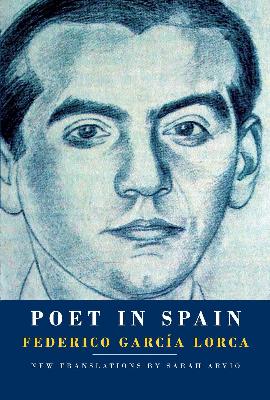
What can I write about Lorca? He was not just a poet; he was also a dedicated pianist. Manuel de Falla was his mentor, and he learned from him about the profound songs known as Cante Jondo. Therefore, reading Lorca is an experience that evokes a deep sense of Duende, an ethereal quality that transcends mere poetry. Many scholars believe that translating Lorca into American English is an impossible task.However, if you dare to attempt it, I highly recommend reading this translation by Sarah Arvio while having a glass of red wine and some delicious Serrano ham. And perhaps, for a moment, you can channel the spirit of that young boy who found inspiration in music and transformed it into poetry.This voice crafter you are hearing will provide you with a full-blown rendition, taking advantage of my privileged condition as a transnational author. See, the translator thought Lorca never used commas or periods or full stops, but he certainly did. Like Emily Dickinson used dashes, including long ones, to create pauses, separate ideas, and add ambiguity to her poetry, a feature often lost in standardized printed versions but present in her manuscripts.I hope you find a suitable time to listen, not because you need to open the doors of perception with red wine and Serrano ham – and prosciutto does not count, because it is sweeter and more tender with a buttery texture, while Serrano ham is from Spain, is saltier and more intensely flavored, and has a firmer texture.The reason for such preliminaries is because of the magnitude of Lorca as a poet. And the tragic fate he found in the first days of the Spanish Civil War, assassinated in cold blood at the wee hours by a bunch of fascists in an unmarked place between the infinite olive trees of Granada, where since then nobody could find his lovely bones.Like the bones of 140,000 Spaniards still lost in ditches, fifty years later to this day of the passing of General Franco, who died peacefully in his bed after ruling for 39 years, while the cowards did nothing else than lie through their teeth about a resistance that only existed in their wildest dreams.Not for nothing, it is rightly said that real heroes cannot tell war stories because they die pretty soon for their exceptional acts of valor. And stolen valor is the sign of any coward that hopes you are too lazy to connect the dots and ask them why they kept their heads in the sand.Get ready and comfy to meet the beautiful mind of Federico García Lorca, a man of the short-lived Spanish Republic, and how he pictured his own demise.Dreamwalking Ballad
Green I want you green.Green wind. Green branches.Boat on the sea andhorse on the mountain.Shadow on her waist,she dreams at her railing,green flesh, green hair,eyes of cold silver.Green I want you green.Under the gypsy moon,things are seeing herbut she can’t see them.*Green I want you green.The great stars of frost,come with fish of shadowpaving the path to dawn.The fig tree rasps the windwith its rough branches,and the wildcat mountainbares its sour agaves.Who will come—from where—?At her railing she gazesgreen flesh, green hair,dream of the bitter sea.*Compadre! Can I swapmy horse for your house?My saddle for your mirror-my knife for your blanket–?Compadre! I come bleedingfrom the Cabra passes.If I could, young friend,the deal would be done.But I’m no longer menor is my house my own.Compadre! Let me diedecent in my bed.A steel bed, if you please,laid with Dutch linen.Don’t you see the slashfrom my breast to my throat?Three hundred dark roseson your white shirtfront.Blood oozes and stinksin the sash at your waist.But I’m no longer menor is my house my own.Let me climb way upto the high terrace.Let me climb! Let meto the green terrace.Railing of moonlightand the rushing water.*Two compadres climbto the high terrace,leaving a trail of blood,and a trail of tears.Tin lanterns trembledon the tops of roofs.A thousand glass tambourines,tore up the dawn.*Green I want you green,green wind, green branches.The two compadres climbed.The slow wind in their mouthsleft a strange flavorof bile, basil, and mint.Compadre! Where is she?Where’s your bitter girl?How often has she waited!How often will she waitfresh face, and black hair,on the green terrace!*Over the face of the cisternthe gypsy girl swayed.Green flesh, green hair,eyes of cold silver.A moon icicle holds her,high over the water.The night was as cozyas a small plaza.Drunken civil guardspounded on the door.Green I want you green.Green wind, green branches.Boat on the sea andhorse on the mountain. Get full access to Don't You Dare To Think Out Loud! at javiertruben.substack.com/subscribe
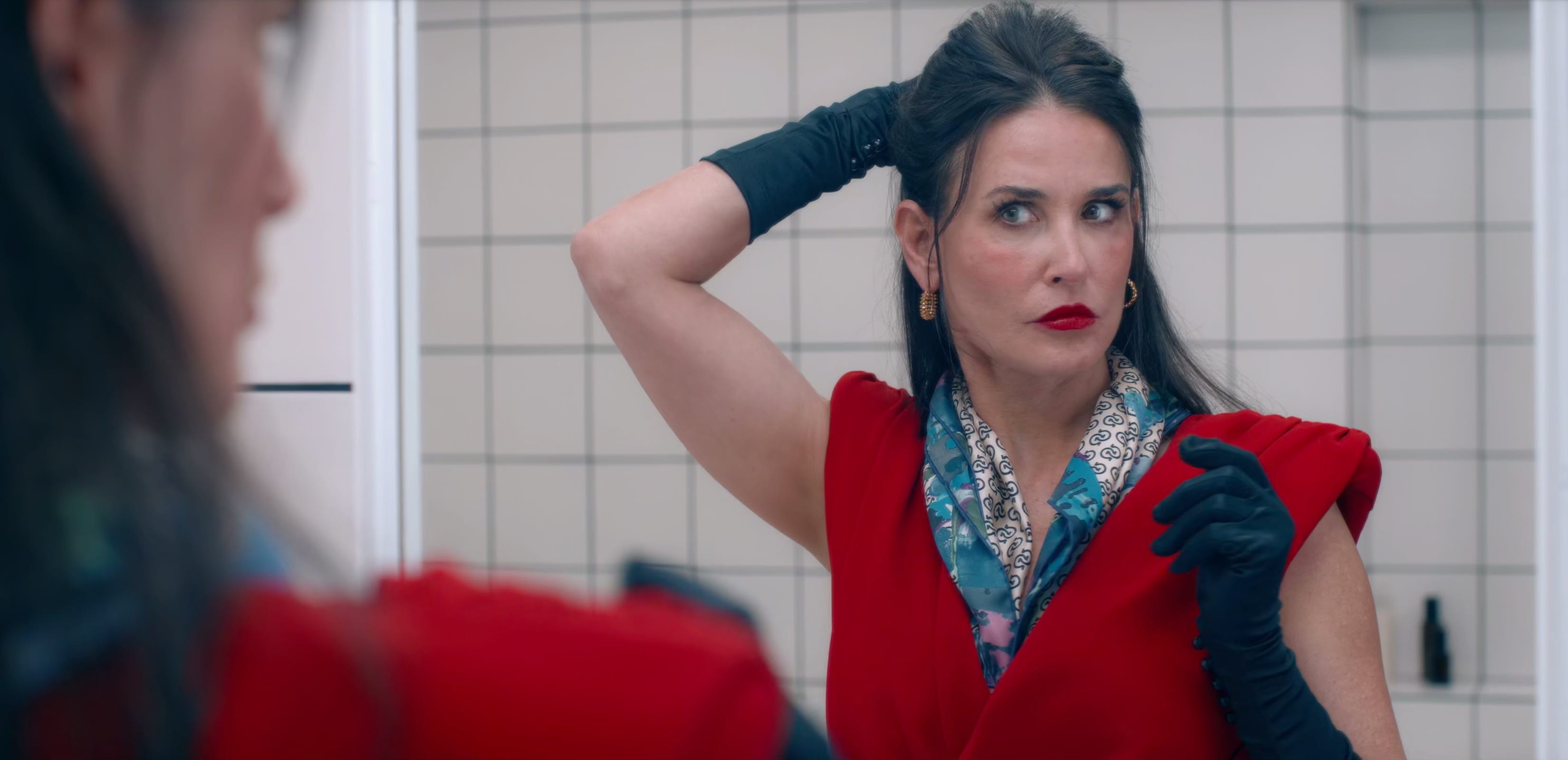
Physical beauty must be the most bitter of gifts because it carries the seed of its own destruction, and its absence mortifies more than any. We all more or less know how the young and handsome Dorian Gray had problems to deal with this, and whoever does not should stop listening this literary podcast right now, shake off the mental sloth, and dust off the master of paradoxes, the great Oscar Wilde, who remains still undefeated a century later, so unparalleled and unique was his genius.Some French film director has lifted a big fuss with a movie that shamelessly pinched that character from Wilde–they call plagiarism now to be inspired by–changed the gender in order to cater to a feminine audience and moved Dorian Gray from Victorian London to the show business in LA.Coralie Fargeat, the director and writer of this satirical film, had the audacity to convince one of the most iconic movie stars of the 90s, Demi Moore, to take on the lead role. This meant portraying her as an old, broken toy of cable TV, but not in a way we’ve ever seen before. No, this was a fresh take on Demi Moore, one that showed her naked, humiliated, and degraded in front of the last of the nepotistic babies, Margaret Qualley, the daughter of curly Andie MacDowell—remember Sex, Lies, and Videotape?I forced myself to watch twice this true horrorshow, this cinematic nightmare, and the only thing I missed were those eyelid clamps that a young Malcom McDowell was forced to wear in A Clockwork Orange. Because the first act is just brilliant and highly recommended.Instead the lavish beginning of Dorian Gray, we see a conceptual episode: a raw egg and a hand with a syringe with a magical substance in fluorescent yellow that it infuses in the egg yolk. Then, after a second, the yolk duplicates with a blob sound.Demi Moore plays a TV aerobics instructor who’s fired when she turns 50. Desperate to stay in the spotlight, she avails herself in the black market drug, a substance–uh-huh–that births from her body a younger, entirely separate version of herself very squelchily. But there’s a catch. She has to switch back and forth between her two bodies every seven days or things are going to get weirder and somehow even squelchier.I’m not a fan of spoilers. While Oscar Wilde presented in The Picture of Dorian Gray one paradox after another to make us ponder, this completely bonzo, bloody, campy, and unapologetically feminist body horror film loses all its originality of the first scene to follow the rules of this old genre with a fresh coat of paint, where men are depicted under a prism that is almost ludicrous. I wonder how many women must have seen me as well just like that. As my wife, with an American Mid-Western accent, would say: “He’s a dog!”Instead of the utterly sugarcoated Hallmark romance movies, I think The Substance would be a perfect tool for couple therapy and also for understanding each other’s needs, anxieties, and moods. I mean it. Sometimes, a wake-up call is necessary and highly valued. Perhaps eyelids clamps will be handy in the case where an individual rejects to acknowledge that youth and beauty are the only things worth having, so vain we are. And how much self-loathing we have. Demi Moore’s character in the film has a moment that is quieter and truly effective. She is asked out on a date and spends a considerable amount of time getting ready for it. There’s a lot of standing in front of the mirror, examining her skin and noticing how it no longer looks supple, observing the wrinkles, and then looking at her entire body. I admire how that very quiet and somewhat introspective moment in the film effectively conveys that point.Humans have always been drawn to beauty. Of course, beauty standards change all the time. What one culture considers beautiful, another might consider ugly. What our own culture considered beautiful 200 years ago, or even 50, isn’t beautiful to us anymore. But that hasn’t changed the fact that we love to look at beautiful things, and even more than that, we wish to be beautiful ourselves. In our society today, people will go to incredible lengths—makeup, plastic surgery, even harmful things like eating disorders—in order to fit themselves into our culture’s idea of beauty. And once we believe we’ve reached that goal, we’ll do anything to keep it that way, and with our current technology, that is possible. But is this the best thing for us?Oscar Wilde firmly believed in the importance of beauty; he belonged to the Aesthetic Movement, a movement emphasizing aesthetic values over social or political themes. They believed that it was more important for art to be beautiful than to have a deeper meaning—it was “art for art’s sake” alone. The very first line of the Preface of The Picture of Dorian Grey is “the artist is the creator of beautiful things.” That is his true purpose. Beauty is not only the end goal of Dorian’s life, but of all art.For Dorian Gray, beauty is the end goal of his life, a goal that he claims he would give anything, even his soul, for. This is a high price, a price that Dorian eventually pays. Throughout the novel, we watch Dorian become more and more morally corrupt. It begins when he heartlessly rejects his fiancée, leading to her suicide, and he continues to experiment with every vice, eventually even murdering someone, while his portrait slowly becomes more and more hideous. However, Dorian is able to escape all blame, because even though he is accused of many things, society dismisses it all, saying, “Sin is a thing that writes itself across a man’s face. It cannot be concealed.” His beauty has saved him, at least in this life, although ultimately, he will still face a great demise. Get full access to Don't You Dare To Think Out Loud! at javiertruben.substack.com/subscribe
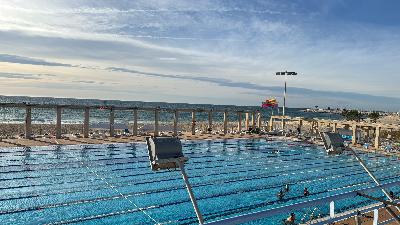
As the dog days struck in August, I declined a gig to record audiobooks. And I was so low that I didn’t stop thinking, not even when I did laps in the Olympic pool. Climate change, many hellish summers this century, seas infested with microplastics and jellyfish and anisakis. And prawns expensive as f**k.I have no choice but to buy an AC if I want to work during the next summer. What world is this, how have we fucked it up so soon?I grew up loving books and wanting to write them myself. When I began handwriting, the words flew away. They were whispers, secrets, confessions to a blank page. I never kept a copy because I thought that the original was not original if there was a copy. It was just the other way around. All that is relevant is copy. And no story is relevant without a good conflict.That’s how foolish we are, looking for a fix, eternally head bowed, showing a goofy smile, with the tip of the finger scrolling into a cesspool. Click bait, scroll down, link here, fake news. So intoxicated with notifications. Last time you walked with a book on the street, no one filmed you. And it was lost forever.Don’t overthink, don’t you dare to write anything controversial, be discreet. But look for an alias to leave your poisoned slime. Hate in secret. Vote for the blabbermouth of the day. No check and balances against absolute power, even if it fills the streets with masked fat men, and takes the gardener who mowed your lawn for a fair price.The future that looms on the horizon is dark, as if the Great Depression and then the 30s are coming back. I foresee the brutal Nazi brownshirts coming back, herding Jews and gypsies into concentration camps or whoever is nowadays the sacrificial lamb.Sometimes, I remember why I write, not every day, and when I do, I never suspected that I would have to go back to Homer.There are no more rabbits in this hat, I said to myself this endless summer. I shall write and record in summer as well as in winter, always at a lovely 70 Fahrenheit degrees and 50% humidity throughout the year.I got a vocal chain and a beech wood matryoshka to record in grand style, as I always wanted to do. I rebel against Artificial Intelligence and its robotic readers. F*****s, you won’t be capable to beat my analog sound.This is Soda Mill Studio and if the wind blows and the night has quieted the neighbors and the traffic has stopped rolling, the abandoned pipes that go down from the terrace to the basement, whisper secrets between the owl’s spaced hoots.If I could use the words like scattered flowers and fallen leaves, secluded in an imagined world where I could get fired up, I would never leave the beechwood matryoshka or I would chain myself to the desk and thin myself out in what I tell until I don’t look back. Get full access to Don't You Dare To Think Out Loud! at javiertruben.substack.com/subscribe
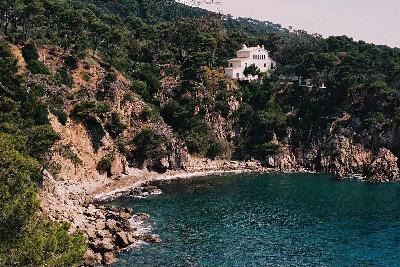
It’s been a while since I have sailed to Palamós, still a small fishing town in 1962, where Truman Capote sought refuge for three semesters—always escorted by his obliging life partner Jack Dunphy and various pets—alternated with his cottage in Verbier, at the top of the Swiss Alps. In Cala Sènia, a secluded Mediterranean cove, the American author found the necessary peace, far away from New York’s social life. The fishermen went out to sea in the wee hours, causing such a ruckus that, according to Capote, not even Rip van Winkle could sleep through it, and that helped to keep a rigorous writer’s schedule for his most accomplished manuscript, In Cold Blood. Local old-timers who met Truman still recalled him doing his errands–two bottles of gin, dry vermouth, and olives for his martinis—the sad day that Marilyn Monroe had tragically overdosed. He was at the newsstand reading the headlines, and with that high-pitched lisping voice I cannot even dare to mimic, because it’s way beyond my range, Truman moaned, “My lady friend died!”He had badly wanted her for the role of Holly Golightly in Breakfast at Tiffany’s. But Paula Strasberg, her acting coach, deemed it inappropriate for Marilyn’s career to play a “lady of the evening” character, especially after being pigeonholed as the sex bomb of the 50s.Truman was very disappointed and began to spread the rumor that he felt betrayed when Audrey Hepburn was cast instead.The movie producers thought that a whitewashing of a courtesan was needed. And if I have to judge for the cross-generational audience of Breakfast at Tiffany’s, they rightly did so. Another paradox duly noted, it would be now unthinkable for another Holly Golightly than Audrey Hepburn.Truman, feeling so at ease in Palamós, invited some of his friends to visit him. The founder of CBS, William Paley, and his wife Babe, embarked on a journey across the Mediterranean Sea during the summer in a mind-blowing sailboat, eventually dropping anchor in the secluded cove.A terrifying wildfire just outside the villa almost claimed Truman’s life. In that rocky Mediterranean shore, pine groves have always served as both parasols and windshields, regardless of the fire risk involved. Capote only had time to grab his precious manuscript and flee, hoping that a fishing sloop would rescue him from that inferno.In late September, the furies of the equinox unleashed a deadly flood in Catalonia, further terrorizing him. Consequently, he changed his mind and ended his productive stay on October the 1st, leaving for Switzerland.Despite his efforts, he was unable to finish the manuscript until the Cluttler’s killers were hanged in Kansas, due to his decision to sell the future book as a nonfiction novel. Hickock and Smith were on death row from 1960 to 1965, five long years. “No one will ever know what In Cold Blood took out of me,” Capote said. “It scraped me right down to the marrow of my bones.”The horrifying book was published, and Truman got suddenly rich. But instead of getting back to work with the same stern and unsmiling discipline that had been a constant since the beginning of his career, he dilapidated his earnings and that rare gift, trying to avenge Nina Capote, throwing epic parties for the privileged ones like the Black and White Ball, and showboating in talk show television about his Proustian adventure—a manuscript called Answered Prayers.Many friends I knew spoke glowingly about the movie Breakfast at Tiffany’s, and sometimes they cannot see beyond the allure of Audrey Hepburn wearing the elegant Givenchy black dress, oversized sunglasses, black gloves, statement pearls, and twisted updo with a sparkling crown beret, eating pastry early in the morning while gazing dreamily into the windows of Tiffany & Co.’s Fifth Avenue store.But the actual fifty-page novella is something else–exactly eighteen thousand words–and I recommend reading it, even if you really think that watching the movie is enough. That’s precisely what this literary podcast is about. An encouragement to read. Unlike the iconic movie, it’s not in the early 60s but in the early 40s, while the Second World War is still ranging. Miss Golightly is much younger, two months away of her nineteenth birthday. While sitting out on the fire escape, she doesn’t sing Moon River with her guitar, but simple songs that goes like “Don’t wanna sleep, Don’t wanna die, Just wanna go a-travelin’ through the pastures of the sky“ Truman used to say she wasn’t a prostitute but an American geisha. Today, we might adhere to woke standards and refer to her as a sexual worker, just like Sean Baker, the director of the Oscar-winning film Anora.I cannot stop thinking that Truman is portraying his own mother as a “lady of the evening.” And all comes together when you read about that Southern belle, Lillie Mae Faulk, later known as Nina Capote. Married too young to Arch Persons, a well-educated man but a lousy salesman, she left the six-year-old Truman to elderly relatives in Alabama and fled to New York to catch a wealthy husband. She was a black swan that Audrey Hepburn brought to life like a disturbing phantasmagoria.Four years before Truman penned Breakfast at Tiffany’s, Nina took her own life swallowing pills. She was just 48 years old. While in her second marriage to José García Capote—the Cuban businessman that adopted Truman—she had a lavish lifestyle for two decades, beginning her descent into alcoholism, often flying into violent rages, that came to an abrupt end in 1952. When Joe’s fortunes changed and he faced charges of embezzlement. Unable to leave Park Avenue for a modest place and start over, Nina killed herself.Truman’s never-ending regret for not saving her life fueled his genius and wrote an inverted mirror of Nina in his character Holly Golightly. I bet he did try to find some closure. As the 13th-century mystic poet Rumi wrote, following the Socratic method: I said what about my heart?
He said: Tell me what you hold inside it?
I said: Pain and Sorrow.
I said: Stay with it.
The wound is the place
where the Light enters you.
He said: Stay with it.
The wound is the place
where the Light enters you. Get full access to Don't You Dare To Think Out Loud! at javiertruben.substack.com/subscribe
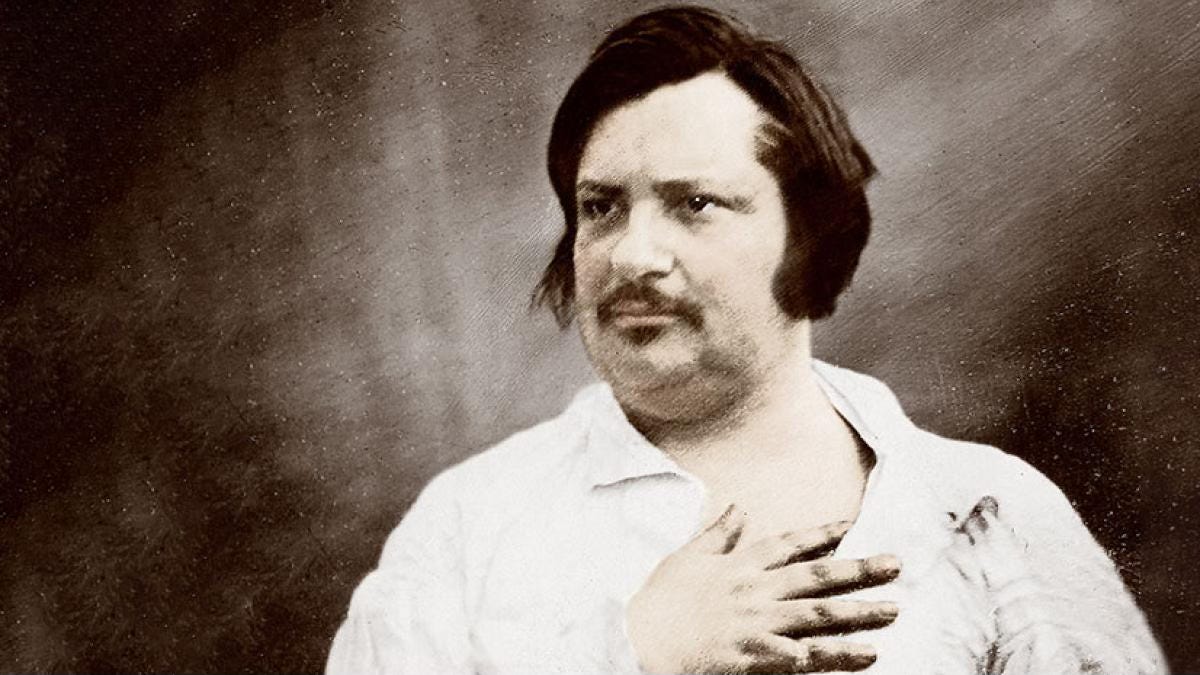
The German naturalist Alexander von Humboldt told a friend, a Parisian doctor, that he wanted to meet a certifiable lunatic. He was invited to the doctor’s home for supper. A few days later, Humboldt found himself placed at the dinner table between two men. One was polite, somewhat reserved, and didn’t go in for small talk. The other, dressed in ill-matched clothes, chattered away on every subject under the sun, gesticulating wildly while making horrible faces. When the meal was over, Humboldt turned to his host.“I like your lunatic,” he whispered, indicating the talkative man. The host frowned.“But it’s the other one who’s the lunatic. The man you’re pointing out is Monsieur Honoré de Balzac.”I'm sharing this story with you to shed light on the hazards of the craft. You cannot see me now, but if you could—and you never will—I am making horrible faces too, showing teeth to hit higher notes, and I do hand gestures like the Italians because it projects my voice and avoids droning. In some recording sessions, my vocal folds have colors unknown to me. I recall the short story Letter for a Young Lady by Julio Cortázar. As the guy of the surreal story, I'm going to vomit up a little rabbit that will nibble the cable of the microphone to create something new. The creative process is a perpetual orgy. The more, the merrier. I understand that you may not always enjoy the soundtrack, but sometimes it works wonders—whether by chance or by design. Cortázar would enjoy this format, considering that his funny Hopscotch has constant musical references. I have listened to all his tapes with the frill of his exotic mix of Argentinian and French accents.In a canon novel—Honoré de Balzac wrote ninety—there are numerous characters. Imagine an author possessed by the characters he just made up. I call it dreaming awake, with good spirits, considering the absurdities I have to rule out to find the one that fits the composition. Some masters scribbled at a stand-up desk, like Thomas Wolfe on top of one of the first refrigerators, and helped keep his mind flowing freely. Or Ernest Hemingway, writing on his feet and thinking on his toes at the first light, as sober as a judge, staying alert, avoiding sluggishness, and enabling him to produce his crisp, fast-paced narratives, felt he was boxing in a ring against the old Russian masters.And to comprehend this competitive attitude, one should consider well the audacity that writing fiction entails from one’s own point of view. What I may think of as an original and somewhat relevant is what a wolf does to feed its puppies—regurgitating what I read somewhere else. I owe what I am to what I've read. And the way to realize an unwilling mimicry is to read more classic literature to reach out to the original sources. An unconventional approach to the craft and a unique narrative voice, that is all I want. Otherwise, I'm not writing a relevant novelty, which is the meaning of the word "novel", but a pastiche.That being said, if there is a keyword to define a contemporary art form, expressed in continuous sagas and prequels and spinoffs and re-dressed and gender-swapped casting, it's indeed pastiche. We fully embraced a culture of mediocrity and boredom, whereby commercial success is all that counts.From now on, I shall include in this podcast renditions of my work. Listed under the category of Books and Fiction, I should sing for my supper as a dedicated author whose goal is leaving behind a legacy, before the vocal folds atrophy leave me whispering, given that I skipped the biological way to be immortal, that is, having children. I really think we are already packed, agree? Not counted by millions but 8.2 billion, the human race has to spread out to the stars, seeking new worlds.The poles and the glaciers are melting because we are unable to control our greed—burning fossil fuel at an industrial scale for nearly two centuries and polluting the oceans with microplastics—even though we have been told about the fatal consequences by the scientific community. Anterior life forms disappeared across the five massive extinctions that mark Earth's history, like the brutal end of the Permian with 96% of species gone, did not stand a chance. But we would if we stopped killing each other and invested in exploration instead of weapons.About seeking new worlds in the heavenly vault, here is the icing on the cake.The German film director Wim Wenders and Martin Scorsese, as producer, released The Soul of a Man, a documentary about a message in a bottle into the cosmic ocean. NASA launched the interstellar probe Voyager, with a golden-plated record, to never return. With the hope of finding a superior live form that could manage a suitable player—that was the analogic era of 1977—Carl Sagan compiled images, utterances in many languages, but also Blind Willie Johnson’s 1927 Dark Was the Night, Cold Was the Ground that you are hearing.Son of a sharecropper, impaired since he was seven years old during an episode of domestic violence, Willie led a peripatetic existence and became a religious busker. Between 1927 and 1930, he recorded an impressive 30 songs for Columbia Records. His celebrity career ended with the Great Depression, after which he continued to perform as a street singer with his last wife, Angeline, playing together the call-and-response format.After extinguishing a fire that left the poor couple sleeping in the burned ruins of their humble abode on a bed of damp newspapers, living that way until two weeks later, Willie contracted pneumonia but wasn't admitted to the hospital. Because he was blind, black, and couldn't afford a hospital bed. He died at 48 years old and was buried in an unmarked pauper's grave.I wonder whether Blind Willie Johnson ever cared, thought, or imagined how far his work would travel into the distant future—and distant time. And the extraterrestrial audience he might—or might not get—in the pursuit of accidental beauty and spiritual bliss. Get full access to Don't You Dare To Think Out Loud! at javiertruben.substack.com/subscribe
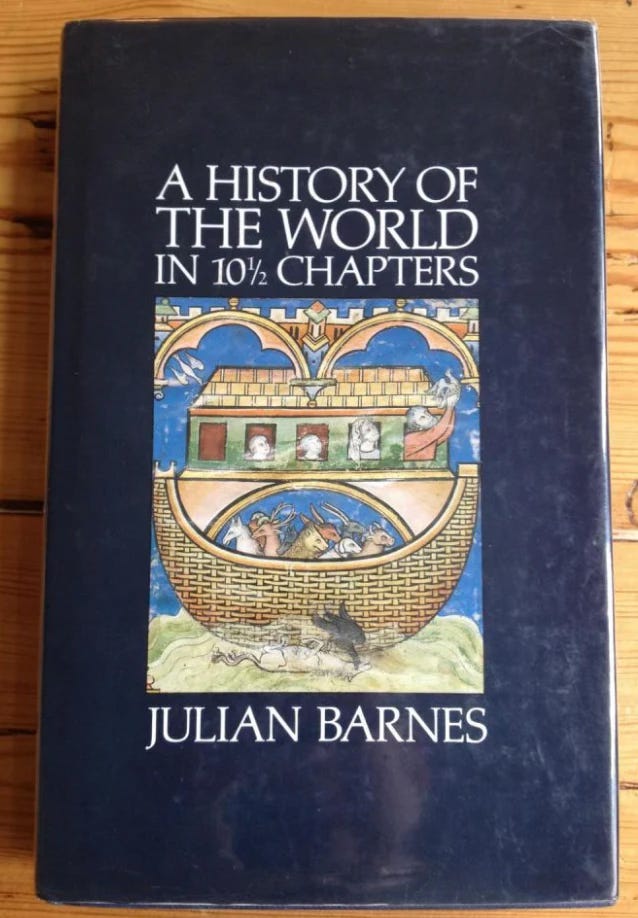
Last Monday, while monitoring and mixing this podcast at midday, a massive blackout plunged this beach town and the entire peninsula into a real-life episode of an apocalyptic future. I was fortunate to be seated at my desk, unlike the poor b******s trapped inside lifters or commuting on trains and subways, standing and packed one against the other like a can of sardines. The only lifeline was the juice of my iPhone, which kept me connected abroad until the network coverage collapsed as well.As soon as I heard it wasn't a local blackout but by all odds affected Spain and Portugal, I went up to the rooftop terrace to check if the planes’ trails were drawn in the sky, and everything was quite normal for an April day. The tireless sexual revelry of birds mating, the hubbub of swifts flying around me, and the mist of yellow pollen from the mix of pine and oak wood, floating in the valleys of the nearby hills. Why should I be worried?So, expecting to stay without power for at least 24 hours, given that we are ruled by simpletons crowing about our renewable energy production, I set a leftover of stewed beans and peas to warm up under the glorious sun, well covered to avoid the curious wasps and bees and the looming sea gulls, and returned to my desk to sharpen the pencils, gather paper, and get ready to take casual notes to enjoy a wonderful reading.From the book stack, I randomly chose a British author I had adored when he was young, and his literary tricks were a novelty for me. I’m talking about Julian Barnes and one of his latest works, The Sense of an Ending. But since the old friend Julian became a solemn widower of Pat Kavanagh, his writing has become simply sad. It evokes the same bottomless loss and grief I found reading Joan Didion’s The Year of the Magical Thinking.About Julian Barnes, I still recall reading The History of the World in 10 1/2 Chapters the first year of the 90s. It was a jaw-dropper, and the unnumbered half-chapter titled Parenthesis was so good to learn the lines by heart. I did many casual renditions; my best one was whispering away in a bookstore to a ballsy sweetheart once I had. So, my actual disappointment is that, after being a loyal reader and reciter of his works for decades, the bond with this author is not there anymore. Surely it's just me, who doesn't find amusing the double sex lives and nor the love triangles as I did in my 20s. I guess everything has its own time.What really set me in reading mode was a wonderful essay from the Spanish scholar Irene Vallejo, originally titled El Infinito en un junco–the boundless in a reed–but the translator Charlotte Whittle tossed William Blake's Auguries of Innocence obvious analogy to simply leave it as Papyrus. To see a world in a grain of sand And a heaven in a wild flower, Hold infinity in the palm of your hand And eternity in an hour.What have you done, Charlotte? You are supposed to translate the concept and not the idea! Which differs in its identity, similarity, opposition, and analogy. The Italian expression 'traduttore, traditore'–translator, traitor–refers to the implicit imprecision of the act of translating.Anyhow, this is a book about libraries of the past and of the present, and also about the booksellers. As Irene will tell the reader, you can create a parallel world when opening a book and reading every word, and yet at any moment you can move your gaze away and return to the world that is. When you think of the first letters on clay to papyrus and move through the ages to leather-bound books to the modern-day books on both paper and then those words read on electronic devices, think back to where it all began in the ancient world.My own Irene Vallejo’s blackout party, and the following is not random, began with her description of the lost world of storytelling, in the small palace of a local lord in a time before writing was widespread, when language was fleeting, made up of air and echoes. The Greek Homer called it "winged words" from the point of view of his blindness. Which isn't yet literature, since it isn't set down in letters or writing.Bards were not only wandering musicians but also skilled memory men, with a repertoire that captivated their masculine audiences for long hours with all kinds of epic. And had no sense of authorship at all, like a jazz musician who takes a popular tune and embarks on a passionate improvisation without a score. Or what we know as variations on the same theme. Individual expression belongs to the time of writing and the prestige of artistic originality had yet to flourish.The night fell, and the power still wasn't back. And for a stargazer, it was beautiful to look up to the vault of heaven with zero light pollution. It was the night of the times. Then, on the other side of Main Street, power came back, and normality was restored. But the other half of the beach town remained in absolute darkness for one hour more. And I was already missing darkness when I finally turned on the light.As anyone who has experienced a blackout can attest, when the power returns, even at midnight, it's a boost for morale. And I have a confession to make. I couldn't wait to know if Apple had saved my work! One has these stupid fears, perfectly normal after some bad experiences with disappeared files. So, I put on the open back studio headphones for critical listening, to resume my slow learning as a sound engineer with the digital audio workstation–always feeling a mix of infinite joy and a pang of shame for my lack of knowledge each time I learn something new–cranking up the volume to hear all my blunders and correct them, and also promising to outdo myself with each new release. Get full access to Don't You Dare To Think Out Loud! at javiertruben.substack.com/subscribe
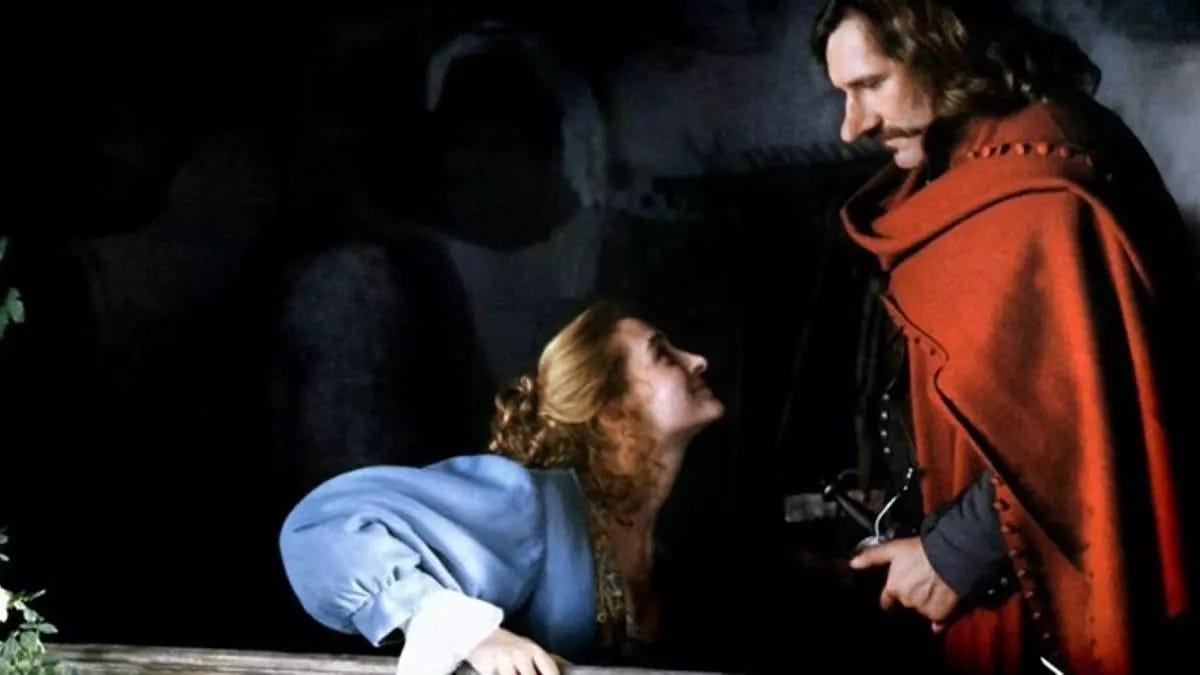
I have news for you, my silent friend of many distances. Since I published last February a podcast about Bob Dylan, dealing with his recent biopic A Complete Unknown, where I argued the many reasons why he deserved the Nobel Prize for Literature, it turns out that I have found an audience in Apple Podcast.All because of a Dylan's fan site called Expecting Rain, which linked my podcast, and suddenly the statistics graph of downloads looked like a rocket on a mighty lift-off in outer space. I, who am as much a theatrical Cyrano de Bergerac as he was, already saw myself back from the States and Empires of the Moon. One never knows when chance of sheer luck might strike, so I keep writing and recording. I had many false auroras before, and my close friends know that.It turns out that Apple Podcast wrote asking for my business compliance, in order to sell all my work worldwide and get nicely paid. I don't know what to do. I never had a business running or gone to the notary. I've been roaming too much to keep things in order and updated. I hope it won't be too expensive. I'm still waiting for the accountant’s bill. After leaving money on the table with the gig economy, I'm convinced entrepreneurial activities are the way of the future.And I absolutely do not care about the format in which my work reaches the audience. The normal way would be through printed works because I write fiction, and that's what I've been trying for decades. But the gatekeepers, who are the ones who have the last word, haven't considered it commercial enough to have some skin in the game.I don't share that point of view. And my natural market is so saturated with TV stars winning literary prizes that the whole business stinks, reason enough to write in English too instead of only in Castilian Spanish–my mother tongue–than to be trapped for the rest of my life in a shithole country, which has changed its old ambition for systemic corruption. And having the immense fortune of living in the multilingual Europe makes it totally organic. I know the monolingual tribe will tear apart their clothes for this statement. What can you do?I recall when I opened this account on Substack, it was like going back to the times of the old Google blogosphere. But twenty years later, I could broadcast my post in high fidelity mixed with a soundtrack, if I were inclined to create atmospheres. And the capital difference was that I could pass the hat.The fact that I also could publish in Apple Podcast just like that, it was great. And I thought from the beginning in the solo format, because I'm just reading out loud a column of a thousand words, not engaging in a happening of all sorts, which is what people mistakenly identified as a modern podcast, an old radio talk show with all the plugs to make profit. Moreover, I could write at large, but in times of the economy of attention, I have to go back to the rules of terse language, when the words whispered in the ear were a private affair.The idea came from my bedside book: the Persian classic titled One Thousand and One Nights, translated by the British adventurer, Richard Burton.Shahryār, a king who ruled an empire that stretched from Persia to India is shocked to learn that his brother's wife is unfaithful with a slave blackamoor. Discovering that his own wife's infidelity has been even more flagrant, he has her killed. In his bitterness and grief, he decides that all women are the same. Shahryār begins to marry a succession of virgins only to cut the head each one the next morning, before she has any chance to dishonor him.Scheherazade, the daughter of the sad vizier at the service of the cruel Shahryar, offers herself as the next bride. On the night of the marriage, begins to tell the king a tale, but does not end it. The king, curious about how the story ends, is thus forced to cancel the beheading. Through Scheherazade long narration –1001 is concept of infinite like umpteen– she sought the healing of the jealous ruler, and stop the killing of young women.Get your bucket list, and duly note this timeless classic is a must-read for those who haven’t had the opportunity. You heard about the missing girls in Mexico in the hands of drug cartels? Pure evil.Finally, there are those who prefer to read a thousand-word column instead of listening to it. And that's what I would undoubtedly do if I hadn't grown up through the Digital Revolution. I recall the advertising of the German car brand Audi: progress through technology, in German, “vorsprung durch technik.” I never imagined by then that the classic figure of the reciter with musical accompaniment, performing in the floral games that precede the Walpurgis Night, could unfold today into an immersive sound experience, without listening ever again to how badly the reciter spit and breathed and popped and hissed over a cheap microphone. Or that horrible people applauding themselves on the stage like a herd of trained seals with music blaring out from the speakers to round off.And here I feel the loneliness of the crossroads. Sometimes, I realize that I'm a poor fool who has spent his day dreaming awake, and the folding star arising shows. Other times, I think I'm just passing through. My time will end soon and I am not willing to stop doing what I am passionate about. All I know about the meaning of life and the shifting sands of my future, fits neatly on some books I have read and the poems of my avuncular Rilke. And if the earthly no longer knows your name, whisper to the silent earth: I'm flowing. To the flashing water say: I am. Get full access to Don't You Dare To Think Out Loud! at javiertruben.substack.com/subscribe
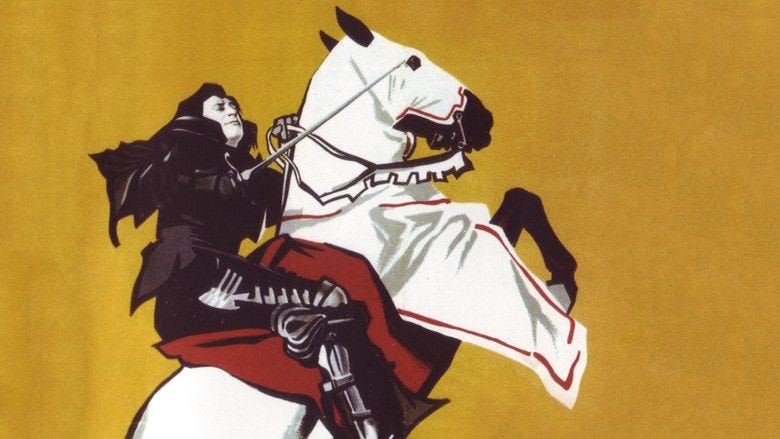
The plays of William Shakespeare serve as an encyclopedia of human nature, and their characters are complex and rich, portrayed always with contradictions and nuances like real people. Some of these portraits are delightful and full of life, such as the character Puck, who appears in the comedy of Athenian wild fantasy called A Midsummer Night’s Dream.I believe the first tragedy I read was Antony and Cleopatra. Shakespeare’s ingenious use of blank verses, which are unrhymed iambic pentameter, is more eloquent than any historical account of the actual Cleopatra. But I must acknowledge that popular audiences became somewhat ensnared in the peplum genre, shot in technicolor, which is ideal for napping during the next Easter holidays after indulging in a plate of deep-fried doughnuts, called nun's fart, a sweet treat similar to the beignets of New Orleans. We call them "bunyols" in the Catalan language, closer to the French Quarter than you might think.Reading Shakespeare is akin to witnessing the breathtaking beauty of the Rings of Saturn through the lens of a telescope. I feel a pang of regret for not attending any of his plays in theaters. However, the experience was challenging when the director insisted that the characters wear elaborate costumes resembling drag. I guess that's the price of fame. Too many people trying to make an original version or to cover genius with mediocrity.The real deal would be traveling in time to the Globe playhouse and sit in a two-penny room to see Richard III. I would love that. In the meantime, and since time travel is just a fiction genre, as a form of consolation, I have thought up about Laurence Olivier's movie from 1955. It helped me a lot this April's Fool to cope with the unfolding events of the present Tariff War.On the play, strongly filtered by the new Tudor dynasty propaganda, Shakespeare told us about the historical English king Richard III, the last Plantagenet who ruled for almost four centuries. It was supposed to be historical in somewhat, but the Bard of Avon spun instead a wacky character with a Machiavellian way to reach power.He's a hunchback, his teeth are crooked, and even more, he has a limp and a withered arm. And this grotesque character is an insufferable blabbermouth that during the play has many asides with the audience, telling them the bad things he is about to do and make them kind of complicit in it. He is flooding us with constant political maneuvering, widening that strong bond with constant updates, which includes the killing of his two brothers, nephews, even his wife, to wear the crown. He's the anti-hero speaking his mind.Understanding our present moment through a Shakesperean lens, it's my point.Trump is wacky as Richard III. The freakish hairdo, the shiny orange bronze, the veneers of porcelain, the gigantic red tie. When he was a young socialite, he certainly had the stamina to keep everybody believing that he was a dynamic businessman. But the same guy went from that celebrity niche to old age like everybody does, becoming a wacky Liberace with his gold TV remote, ranting to his fans through social media about how much the entire world has abused of the bountiful America.I'm convinced we go through our lifespan like the ants on a Möbius strip, crawling along both sides and creating an infinite recursive feeling because of the way it twists on itself. Trump is repeating the same mantra when he was young. America is being ripped off.While in the first term he was taking a lot of criticism, and the press had a profitable and long run with his scandals, the second term after a four-year hiatus, he's much more authoritarian. Seeing is believing. All the hawkish agenda of George Bush that he used to mock, as the time and treasure spent in nation-building like Bush tried in the distant Iraq, now it's his agenda with his close neighbors Greenland and Canada.According to Fukuyama, we believed we had reached the end of history. National borders were carved in stone, and economic growth had no limits. However, if our wacky Richard III continues to push the boundaries, while simultaneously updating us with purchases or invasions of sovereign countries, China could seize the opportunity and invade Taiwan, the capital of nanotechnology.I’m too old for this, and if I stay fit and healthy and productive, and some plague won't leak again from a lab, I’ll be around no more than 2050. But I have already lived enough to assist at the decline of Western civilization, looming large over the horizon. My generation won’t live as well as our parents did. And good luck to the next one! This Liberace we have for King Richard III, who dances like jerking off two guys at the same time, laughable as he indeed is, under the Shakespearean lens, had a horrible end during the fray of a battle. Remember that line? "A horse, a horse! my kingdom for a horse!". And Trump almost had it last summer when a bullet grazed his ear instead of blowing his brains out. I guess one of the thousands federal workers that Elon Musk and his crew has already fired will not miss the shot.Trump found himself on the receiving end of Obama’s sharp humor in April 30, 2011. Look in this link the footage of that unraveling moment of being, and forget Obama's charm to focus only in the brief glimpses of Trump while he was taking it. It was Walpurgis Night, and a Faustian pact was made. Trump sold his soul for wanting what Obama had. Power and endless adulation. Richard III would have begun whispering to us the celebrated first aside–now is the winter of our discontent, made glorious summer by this son of York–as if we were seeing Shakespeare's play, revealing his ambition and determination to be king. Get full access to Don't You Dare To Think Out Loud! at javiertruben.substack.com/subscribe
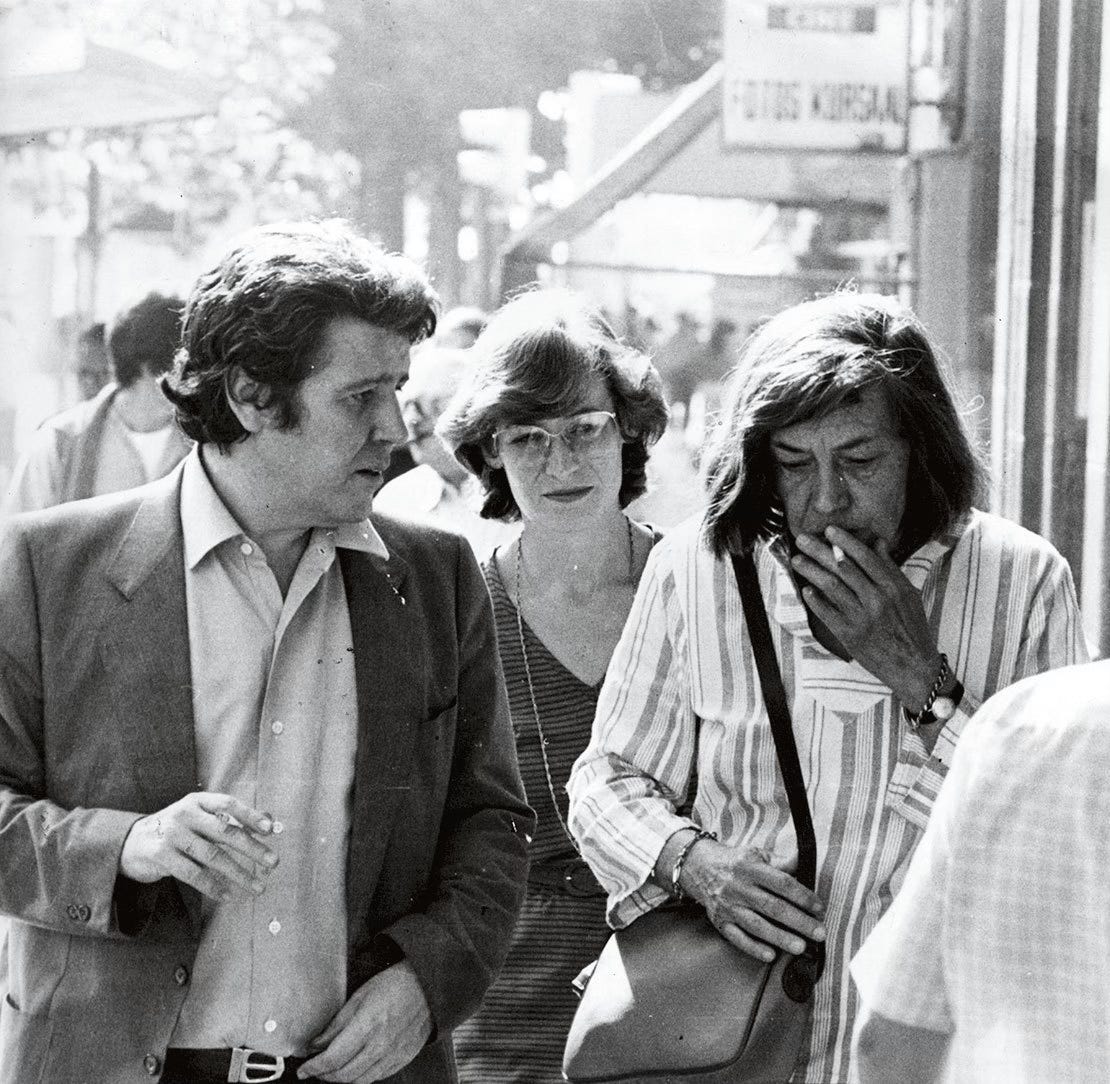
Yesterday, I had a lovely spring morning. I had to take care of some paperwork in Barcelona, which left me at the doorstep of my favorite bookstore, La Central del Raval. I hope it will remain open for many more years. I recommend its patio for quiet reading, although I don’t like the self-service and the long queue for those who are undecided about which cake to choose.When I returned to my studio, the rain blessed me again with its music. But the new cause célèbre in the publishing industry truly irked me. I couldn't resist sharing my thoughts with the people I trust. Go to court and get an order to halt the publication of a book? It certainly was paradoxical for me, a firm defender of freedom of speech and of using all the words in the dictionary while writing without prejudice. That's what this literary podcast is about.In 2011, José Bretón, a spiteful and deranged father, reacted violently to his wife Ruth Ortiz’s announcement of their divorce. This led him to make a heinous decision to commit double filicide, killing his six-year-old daughter Ruth and his two-year-old son José. He first gave them pills and then put them at the stake using 551 lbs of firewood and 176 lbs of gas oil. Although his criminal goal wasn’t to kill his wife, it was to inflict unbearable emotional trauma on her. This act of vicarious violence is a form of gender-based violence that targets women.The police finally confirmed, after firing an incompetent forensic, that they had found the charred bones of the children on Breton’s family farm. While he kept denying the proven facts and presenting himself as an exemplary father. A psychiatrist who examined him diagnosed that he did not suffer from any mental disorder. Consequently, the justice sentenced Bretón to 40 years in prison.That being said, and as a note of clarification for my American audience, Bretón's murder trial was followed by the press and broadcasted daily, and helped a lot to pass a bill to defend vicarious violence against women in Spain, perpetrated by abusive men during centuries in many forms. The goal was always to hamper the will and the rights of women.However, José Bretón still intends to perpetuate vicarious violence against his ex-partner, admitting now the crime that has already been thoroughly proven to the author Luisgé Martín, an award-winning novelist, who has written in various genres. Martín is also known for ghostwriting the political memoirs and speeches of the renowned tightrope walker, who is currently the President of the Government of Spain.Ruth Ortiz, determined to rebuild her life, sought the court’s intervention to stop the distribution and sale of the book titled “El Odio” –meaning Hate–to the publisher Anagrama. She described the author, Luisgé Martín, as “the devil’s pen” for perpetuating José Breton’s vicarious violence against her. Notably, the author had failed to even attempt to contact her before, seemingly indifferent to her pain and the fact that she was the victim.Indeed, it was Luisgé Martín who initiated a correspondence exclusively with the filicide, who was enthusiastic about the entire concept, offering an opportunity to share his perspective on the events.There are those who attempt to draw parallels between Truman Capote’s renowned In Cold Blood and Luisgé Martín’s Hate. Emmanuel Carrère’s The Adversary is also mentioned in this context.While I haven’t read Carrère’s work, I think Truman Capote didn’t face any backlash or criticism during his time. Furthermore, the motive of the murderers Richard Hickock and Perry Smith was purely economic.The judge says that without knowing the content of the book, he cannot rule to halt its publication. And the prosecutor has appealed and demanded that the publishing house Anagrama hand over the manuscript galleys to the court.The founder of Anagrama, Jorge Herralde, during the decades of the 80s and 90s, sold the new batch of young British authors such as Kazuo Ishiguro, Julian Barnes, Martin Amis, Hanif Kureishi, Ian McEwan, and Graham Swift... My library had a predominant yellow color, the color chosen for the paperback collection.All things pass, and nothing remains. Herralde sold his shares to the Italian publisher Feltrinelli in 2010 when he retired, as he declared, "to preserve the continuity of the publishing house." Geez! Jorge, what have you done? Nobody could do a better job than you, the same who published a dark horse like Roberto Bolaño!The last time I saw Jorge Herralde was when my mother-in-law was dying in a hospital in the upper part of Barcelona, and I ended up having dinner one August evening in the courtyard of El Trapío with my wife. I wanted to show my respects, but good manners and discretion only allowed me to whisper to Melissa how much good Herralde did in his heyday. And the time I submitted one of my novels to the literary prize that bears his name–short in economic endowment but with an abundant reputation–in the tiny apartment Anagrama had as an office, when I thought about something more corporate.That being said, the paradox within the paradox. Like a Russian doll. In the near future, once Ruth Ortiz passes away, I don’t see any reason to prevent Anagrama from publishing the book, provided it still deems it appropriate. However, it’s simply unfortunate timing at this moment.If you ask me, I shall pass on this one without the slightest doubt. As I do always with any biased recollection of the facts. Because it's an insult to the intelligence. At the end, whatever one does to control the narrative, truth effortlessly floats on the water like an oil slick.According to McLuhan, the medium is the message. The issue lies not only in what the book says or how it is written, but in the book itself, its very conception: to put on sale the never-before-seen version of the filicide. But, alas, in front of the shattered mirror of a mother who only sought silence. Get full access to Don't You Dare To Think Out Loud! at javiertruben.substack.com/subscribe
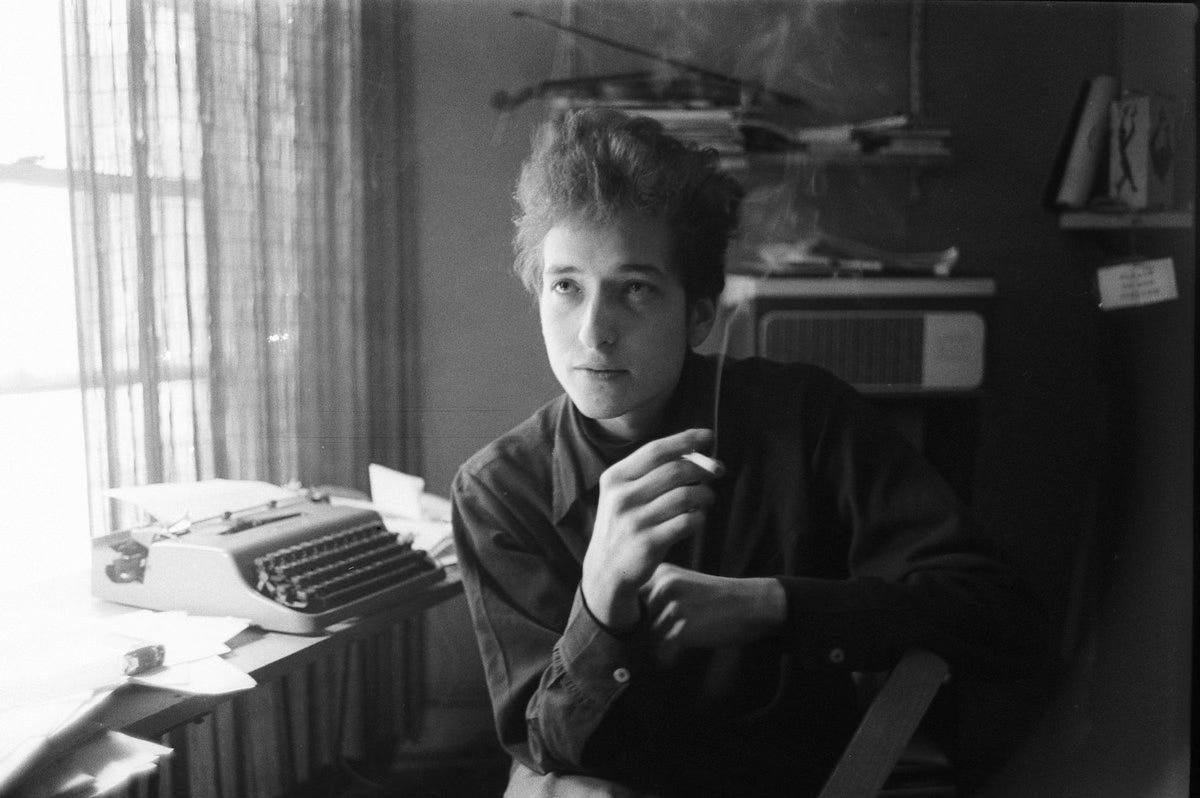
I have mixed feelings after watching Chalamet’s Bob Dylan impersonation in the film A Complete Unknown. It is a superb acting performance. Still, there is an unsurmountable distance between an actor cast solely based on his looks and chameleonic aptitudes, and the real deal that shrines through, which is often disconcerting. The first impression of a successful folk star like Joan Baez was "I was bowled over. I never thought anything so powerful could come out of that little toad."The biopic tries to portray Robert Allen Zimmerman, a Jewish lad from Minnesota that conquered as Bob Dylan in the early 60s the New York folk scene as a wonderkid. Nobody made it so fast, not even Joan Baez. These two became the protest song duo, performing With God On Our Side in the Newport Folk Festival 1963. That was the summer before President Kennedy was murdered.Since then, the musician began a singular career. Something between a reluctant prophet that speaks in riddles and an electrifying I-don't-give-a-damn Like a Rolling Stone, roaming around the world on an endless tour, and clearly profitable, still performing at 80 years old with a gravelly whisper for a voice that has made of his once nasal tone a relic from a distant past.Credit where credit is due. If someone truly deserved a Literature Nobel Prize, it was Bob Dylan. His lyrics certainly were not brainy novels, but rich songs riveted with mighty poetry and strong melodies that stuck deep in the collective imagination of three generations, me included. Fret not, I'm not going to make a list, but surely I'm going to resort to more hyperlinks.In the Nobel lecture he recorded, I was moved by such common sense, anticipating the backslash of the writers’ guild, who were outraged that a performer, rather than an author, was being awarded. Dylan pointed out that "the words in Shakespeare's plays were meant to be sung, not read on a page."He was damn right. All those lyrics from a love songs we have listened sometimes had a musical origin that began with wandering poets and performers called troubadours, a word that comes from the Early Middle Ages, during the Islamic expansion that reached the Iberian Peninsula, and it is Arab for "taraba", entertain or just sing for your supper. The roots of those performers are intertwined with the Arab-Andalusian music, brimming with Persian musical instruments like the lute, oud, daf, rebec, and the hypnotic percussion from Isfahan played with on drums like the tombak.The Arabs valued Persia craftsmen and, above all, Persian music and singers. The Umayyads, both in Damascus and later in Al-Andalus, imported performers from Baghdad in the 8th century by the hand of the emir Abd al-Rahman like Abu al-Hasan, better known for his nickname Ziryab, Persian and Kurdish word for blackbird.This musical poetry wasn't performed in the streets but in luxurious walled gardens called paradise, from the old Persian "pairi dez", with a profusion of sweet orange trees, water fountains, and exotic Eastern botany species, such as irises, jasmine, narcissus and marigolds. The gardens of al-Hambra in Granada have since then still remained like an untouched marvel.Those first love songs dealt with melodramas like the old man’s jealousy for his enigmatic young bride, who yearned to escape with her mad lover. Before their wedding, he fled into the wilderness, where he would recite poetry to himself or write in the sand with a stick, becoming detached from the physical world. This left her heartbroken, confined to a golden cage, until she eventually lost hope and gave up on life. News of her death reached the mad lover in the wilderness. He travelled to the place where she had been buried, and there he wept, succumbing to the impossible grief and dying at the graveside of his one true love.Audience reveled in "sama" or what we know as a trance or ecstasy, because a song about undying love involved devotion and the annihilation of the self. That love also means the longing for spiritual union with the divine. Remember Eric Clapton playing Layla to see that nothing has changed along the centuries in the story of the mad lover Majnun.These wandering poets traveled to Christian courts in Southern France. And from the early contacts between these Eastern performers with the eclectic fusion of Arabic and Spanish and Jewish in the Mozarabic culture, coupled with the Occitan new version of Christianism known as Catharism–which main tenets were the recognition of the divine female principle as the goddess Sophia–lead to the popularity of "fin'amor" or courtly love, under the patronage of William IX, Duke of Aquitaine.It beats me how this mirage of the Early Middle Ages would morph into the millennium along the Carolingian feudalism system with a treasure trove of chanson de geste as The Song of Roland, Cantar de mio Cid, and The Song of Nibelungs. This was the backbone of the new knighthood creed, the steroids for warmongering kings and popes that unleashed eight Crusades to conquer Jerusalem, and also to raze the hip and loving Occitania massacre of Cathars included during the Albigensian Crusade.Back to Bob Dylan, when it was announced in 2016 that he would be awarded the Nobel Prize in Literature he remained in silence for weeks to excuse his presence for previous commitments. Until he knew that at least he had to deliver a lecture to cash the 8 million Swedish kroner, almost a million dollars. So, he wrote the Nobel lecture about having an epiphany when he was eighteen, going to a Buddy Holly concert in Duluth, Minnesota, just before he died in a plane crash two days later—the Day the Music Died. And a Dylanesque dissertation about three books that leaked into his lyrics: Moby Dick, All Quiet on the Western Front, and of course The Odyssey, to clinch the matter with a deep reflection on the warrior Achilles in the Underworld, where Odysseus found him sad and completely out of place.Nostalgia was for Achilles the venom of being the king of the Underworld, so that the hero "would rather be a serf under a poor man's roof that has scarce bread for his household, if only I might be alive upon the earth."With his playful touch, Bob Dylan concluded:"That’s what songs are too. Our songs are alive in the land of the living. But songs are unlike literature. They’re meant to be sung, not read. The words in Shakespeare’s plays were meant to be acted on the stage. Just as lyrics in songs are meant to be sung, not read on a page. And I hope some of you get the chance to listen to these lyrics the way they were intended to be heard: in concert or on record or however people are listening to songs these days. I return once again to Homer, who says, “Sing in me, oh Muse, and through me tell the story.” Get full access to Don't You Dare To Think Out Loud! at javiertruben.substack.com/subscribe

Long before this era of senseless over-sharing, there was an intriguing piece of furniture called a rolltop desk, where our ancestors used to sit and write. It had secret drawers to keep handwritten letters and faded portraits of their loved ones. These secret drawers were kept locked, and the key to open them was hidden. Sometimes, the women wore the key sewn into their garments. I've just opened this Substack with the same intention as those women of the past -- that is, to keep these inklings hidden, unreachable -- unless you’re a subscriber, which means you have the key to open them. And thanks to the new tech, my voice will not fade away. Sound waves are as unique as handwritten letters. I've never understood why an actor must impersonate the narrative voice of the author and his characters, like on a radio soap opera. It’s like listening to a foreign movie. I don’t buy it. Of course, an actor might have a perfect pitch and better delivery than many authors, especially those authors that smoked too many cigarettes -- and consequently had no pipes at all. Or those that drank themselves into a stupor, slurring all the words while reading. But if I were forced to choose between…, the Welsh poet Dylan Thomas and a legion of wannabes, I would select that chain smoker and holy drinker, whose recordings on the BBC are still the best I have ever listened to. Hear me out, writing is not only about telling a story or presenting facts in an orderly fashion. For that, you can turn to some historian or dedicated journalist. Writing a poem, a poem in prose, or a fine novel is the adventure of a solitary soul to reach out through the inherent beauty of words. And mostly spoken words. That pleasing sonorous quality that scholars call euphony traces back to the Greek adjective eúphōnos, meaning sweet-voiced. So, join me in this new adventure. Perhaps, you would hear birds tweeting in the background or the bell tolling from the close Franciscan convent. And yet, I love to record on my desk while writing. I swiftly catch a new idea and the dynamic spontaneity that makes fun such a lonely craft. Indeed, a recording studio is paramount while performing any song for the many instruments and all the voices. On the contrary, this is me. The one who dares to think out loud and then write it down. Get full access to Don't You Dare To Think Out Loud! at javiertruben.substack.com/subscribe
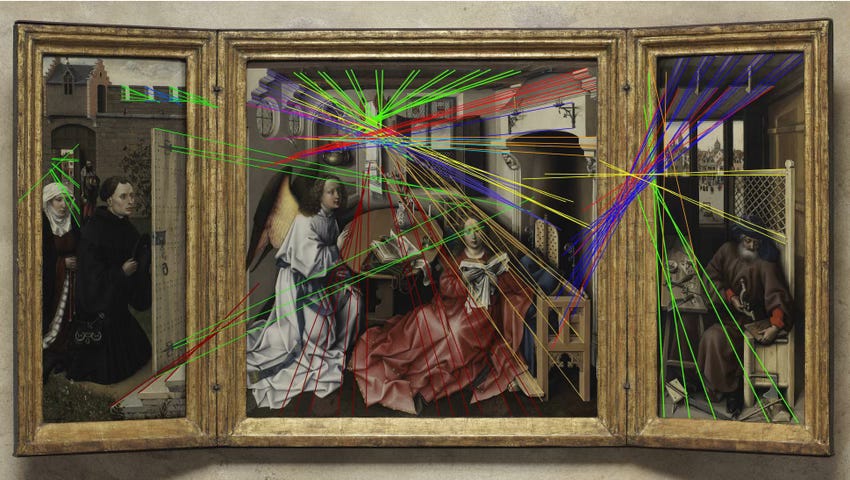
Keeping a newly completed manuscript in a drawer to rest for a while before editing it once you regain objectivity is not trivial advice. It’s true that after so much confinement and the solitude that writing entails, one wants to get up from the desk and celebrate the good news. However, with today’s immediacy, where one can send an original manuscript with a simple click, the rest in the drawer becomes more mandatory than ever.Over the years and without even trying, these dilemmas of the art of writing no longer cause me anxiety as before. Maybe it has to do with hormones, which have changed my priorities and how the brain works, in the way of any woman who suddenly accesses the superpowers of motherhood for the first time.I have learned that good manuscripts are like fine wines, which become great with time of rest, because they are detached from fashions and trends, from the moronic "it is no longer in style" with which an editor discard them.I am at the zenith of the thrilling life of a fiction writer; when one is still young to wait for benefits from the future that looms on the horizon and not so old to condemn oneself to the sad idea that any past time was better. Every day counts, and I’m determined to squeeze every moment out of them, just like lemons.I was watching a documentary about the portentous artists of the Renaissance, which made me blush, cringing for their absolute dedication and inordinate courage. It just so happened that it began with Filippo Brunelleschi, the Italian genius who devised the vanishing point in the laborious construction of the dome of the cathedral of Florence, with the patronage of the Medici’s fabulous saga.Writing my second novel, using the blueprint of a Flemish triptych, Brunelleschi was a big help. Each narrative voice gave way to the next with a whiplash, instead of the required cliffhanger. As if I'm saying to the reader, with a swaggering attitude, “Stop reading me if I don’t have your full attention.”The first voice was the most difficult, because the first relay in turn was to accept a defeat, with so much to tell. But knowing how to say goodbye is an art like no other, and to do it in the grand manner, to know the depth of desire is paramount.Brunelleschi was my inspiration because I needed a vanishing point in the horizon of time, perspective—or what in Latin is for seeing through. I was thirty years old then, and in a biographical foreshortening about my eighteenth, I wrote what I would never have written then. That’s why this literary genre is known as auto-fiction, because every seven years, your thinking shifts at a ninety-degree angle, creating an entirely new perspective.Still, I wasn't as assertive as any author should be. I wanted to publish so badly, given that I was in dire straits after quitting my day job and my savings would run out in a year, so I relied on a mentor who certainly was a generous reader but also my shrewd bookseller. After eagerly reading my original, he claimed that if I changed the Brunelleschi-style whiplash for a naughty bit, in less than a year Gold Plated would be in his bookstore’s display window.It took me a while to see that situation as a simple role-play. I’m amazed that I couldn’t see it at the time. A middle-aged bookseller wanted to play the young and ambitious writer he would never be, given his lack of dedication or talent. Otherwise, he would be too occupied with writing his own manuscript instead of dramatically altering mine. I began to write in order to please him and tossed my whiplash for his cheap-soft-porno scene.Lucky me, I’ve always kept the originals safe, so no harm done. But the bookseller’s role-play did not end there once he gained traction. He asked me as well to fire my lovely agent, who over the years made a brilliant career, bringing many authors out of anonymity. And currently, after she decided to change sides, she’s a fiction editor at the largest publishing house of Barcelona.In all honesty, I consider such a dislocating experience as a privilege, instead of an epic failure. It’s true that I felt used and discarded like a broken toy. But I was born to be a writer. Quitting was never an option for me, not even in the darkest days. I learned a lot; in hindsight, it took me to cross the threshold on a fast-paced adventure in which I realized that, due to readings that had shaped me along the years and the many American authors I admired, I didn’t belong to the literary tradition that initially corresponded to me by my mother tongue, the Spanish Castilian. Consequently, I transitioned into the ranks of transnational authors in an organic way.Thinking outside the box, I realized that after the Digital Revolution there’s no longer any reason why I should limit myself to printed books. Please, don’t get me wrong, I always love them. But print runs are dwindling annually, readers’ attention spans are being shortened by smartphones’ bells and whistles, and bookstores are closing due to exorbitant commercial rents. It’s a brave new world.So, I bought myself a professional home studio with priceless analog hardware and equipment, where I can craftily record all my books, podcasts, and even commercials to support myself. It’s enough to know how to take care of the pipes, work out daily, eat like a pauper and healthier, and quit smoking and drinking—the pastimes of ancient literary lions who only managed to fry their brains and ruin their frail health at ages that nowadays would seem premature.Back to Brunelleschi and his vanishing point, as I edit and translate my coming-of-age novel, Gold Plated, I experience a delightful sense of three-dimensional vertigo. From the emancipated eighteen-year-old lad I was attempting to portray in my thirties, I still maintain the same unwavering determination in my late 50s. And I have finally shed each and every one of his insecurities and self-doubt that crippled my good judgment and literary talent. Seeing is believing. Get full access to Don't You Dare To Think Out Loud! at javiertruben.substack.com/subscribe
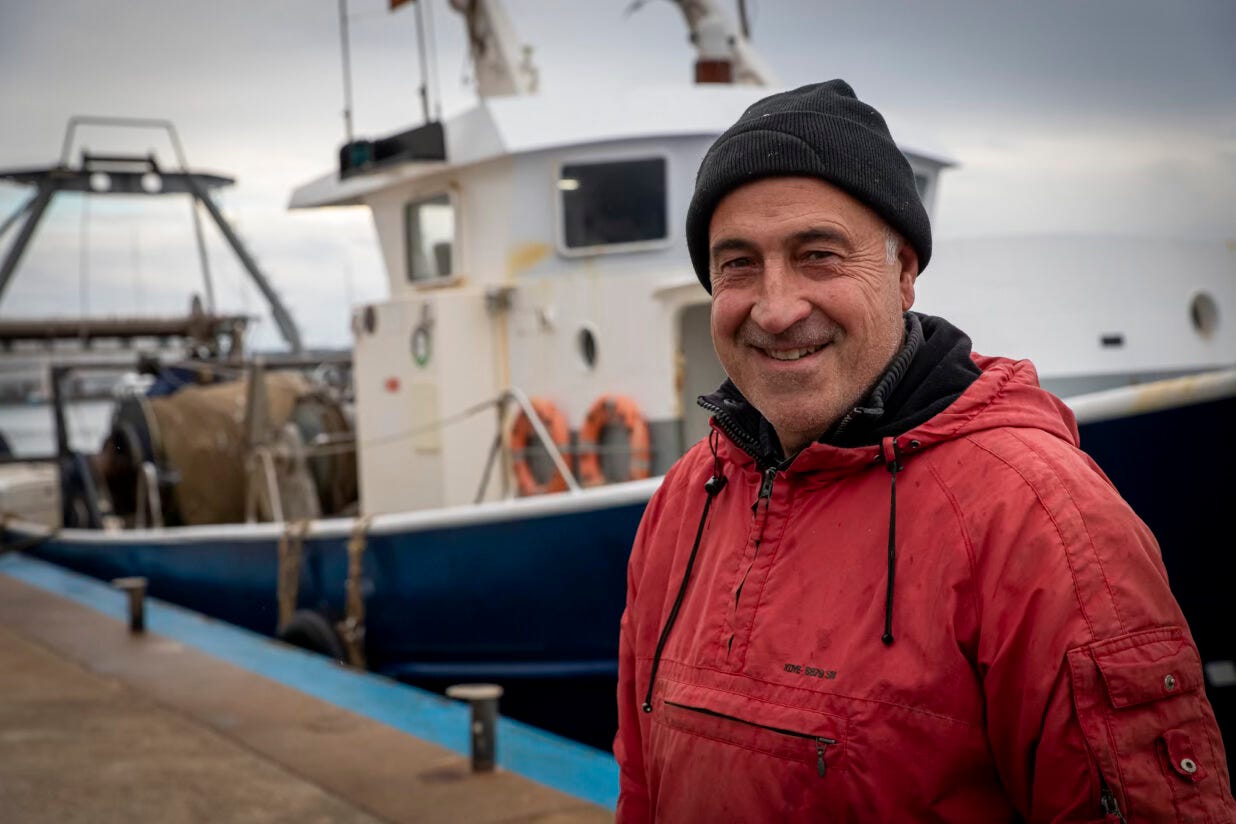
Farmers, ranchers, and fishermen, the pillars of the primary sector, have been frequently depicted in literature throughout history. Growing up in the shoreline, from the Caribbean to the Mediterranean Sea, and even the Atlantic Ocean for extended periods, I’ve developed a stronger connection with those who make their living as fishermen.Yesterday, I was stunned while reading an interview with Vicenç Comí, the skipper of the trawler Sinera. He has been struggling to survive the absurd regulations imposed by the bureaucrats of the European Union. However, the most recent decision, which granted him only a 27-day fishing permit, effectively sealed his fate. According to the documents he has been diligently collecting in archives, his family has been engaged in fishing for four centuries, spanning seventeen generations.After two adventurous years in the Airborne, where I experienced military skydiving without any sense of mortality, due to my youthful age and the boldness that came with it, I landed a plum job as a seaman, which allowed me to read all I could for ten consecutive years, averaging twelve novels per week. I blissfully called my own PhD on Comparative Literature. By then, in the glorious 90s, I was convinced that the essence of being a fiction writer was more about reading than writing, lest I resorted to overused clichés and conventional themes, because the meaning of the word novel means write something new or unusual in an interesting way.From the dock of the marina, surrounded by slender sailboats and formidable motorboats, I witnessed every day the trawlers embarking on their journeys before sunrise and returning at five in the afternoon, preparing on the deck the boxes for the fish auction. Sometimes, they raced each other to moor their boats before the price of the fish dropped, and the mast of the sailboats began to rock between the clanging of the halyards, because they didn’t obey the three-knots speed limit of the roadstead.And those trawlers were lucky ones, given that seine-haul fishing was conducted during the night shift, sailing at ten in the evening and returning at port at eight in the morning. It goes without saying that fishboats raised a ruckus when they were informed by radio on their returning about the prices dropping in the fish auction, requiring them at the mouth of the port to throw boxes overboard full of fresh sardines and whatnot that the tide sent to the marina dock, in order to avoid losing money.I’m not getting political to affirm that the European Union razed vineyards before to satisfy the jealous French and did not move a pinky to protect the textile industry against China. But if the last intention of those bureaucrats is to send Vicenç Comí out of business, maybe it is reason enough to leave the Union like the British did before. As incredible as it sounds, farmers, ranchers, and fishermen had to comply with a bureaucratic rigmarole or be fined. I’m not surprised at all that youngsters don’t see any future in the primary sector that their fathers once had.Vicenç Comí is certain that the people who control his fate are a bunch of dumbheads, corrupted officials, or simply ignorant of his ancient craft. Perhaps they intend to outsource the capture of fish to distant seas and transform the Mediterranean coastlines into a massive tourist destination, like they already did with Balearian islands, catering to the preferences of pale northern Europeans. Who knows? But it’s certainly not a positive development. After skipper Comí, the fishmonger will follow, and their demise will condemn us to consuming frozen fish for the remainder of our lives, sending all the restaurants of the port to a new level of blandness.My memories are filled with the tantalizing fragrance of barbecued sardines and red mullets, which I always ate by hand, just like the fresh shrimp. I also remember hitting the living octopus against the floor before placing it in the boiling pot. To give you an idea of this, in this beach town, we cook the freshly caught squid in October, even with chocolate! I only experimented with this devotion to seafood in France, with oysters, and in Norway, with wild salmon, not the farmed salmon that they serve in supermarkets.When I was a kid, I spent all day long in the beach diving with harpoons to fish octopus and had a snack with the clams I saw in the bottom, as I was living in paradise. I’m still recovering from the shock I experienced when I discovered that someone had thoughtlessly mined sand from the sea, not realizing that they had destroyed the centuries-old clam-fishing grounds. All for nothing, because the sea always reclaims what belongs to it. Do you think they learned from this mistake? No, because the demand for a meter square of beach with beautiful sand is still high.Perhaps I should stop whining and instead commence writing swiftly a fisherman’s novel. But, as I had previously mentioned, reading has revealed me that conventional themes such as this have already been explored in literature. I recall Herman Melville’s Moby Dick, which depicted a world centered around whale oil with the island Nantucket as capital, predating the fossil fuel era. And Ernest Hemingway’s The Old Man and the Sea, maybe the greatest novel ever written about repeated failure and resilience beyond human limits.During my ten years as a sailor, I had written numerous sketches about the characters I encountered, with the hope of finding Captain Ahab. But sailboats and yachts operate in a completely different realm, characterized by leisure and relaxation. Consequently, my sketches only depicted mundane, bourgeois individuals lacking any remarkable qualities that could ignite the reader’s imagination, unless they worshipped plutocrats like gods. These characters were either sun-kissed and carefree, driving expensive Italian or German cars escorted by bimbos, or they were intoxicated and clumsy, endangering divers with their motorboats while sailing dangerously close to the shoreline with their double helixes as a meat grinder. No kidding, I had to deal with that once.Only three characters passed the filter of infinite boredom: a drug dealer who was financially splendid with me when I saved his ass as a defense witness from an unlawful police raid, a yacht broker with an ancient lineage that harked back to the disappeared School of Pilots–opened while the trade with Cuba was thriving–and the last lighthouse keeper with whom I shared plenty of books and unforgettable nights in his humble abode. Get full access to Don't You Dare To Think Out Loud! at javiertruben.substack.com/subscribe
The novel Pedro Páramo by the Mexican writer Juan Rulfo is based on a popular trope: the son who returns to find his father. Juan Preciado’s story begins when, on her deathbed, his mother asks him to search for his father in Comala, a town she fondly remembers as a vibrant and bustling place.Upon his arrival in Comala, Juan Preciado encounters a desolate and decadent destiny. Along the way, his first encounter is with Abundio Martínez, who describes Pedro Páramo as pure hate. From there, Juan begins to piece together the story of his deceased father, guided by the ghosts he encounters on his journey.Pedro Páramo is structured into two distinct narrative lines: one that follows Juan Preciado’s journey and another that delves into the memories that shape Pedro Páramo’s life, a cruel and unscrupulous cacique whose actions are paradoxically driven by the love he holds for Susana San Juan, a woman he has known since childhood, when they were kids diving together in the river, who slowly became a splendor of beauty with aquamarine eyes like the very Aphrodite, the Greek goddess, the one who rose from the foam to make us ponder about the playful laws of attraction, never-ending love, and abundant sexual desire.Susana San Juan and Pedro Páramo had an affair until Susana’s mother passed away. After her mother’s death, her father, Bartolomé San Juan, took her to a lonely mining region where she was sexually abused by her own father. Later, she was traded to Florencio, a man with whom she fell deeply in love, but he suddenly died, leaving Susana in a fragile state of mind. Devastated by grief, she soon spiraled into madness, seclusion, and raw nymphomania always under the shadow of Florencio. The death of Bartolomé, ordered by Pedro himself, serves as the final trigger that sets the course for Susana’s mental health, which was already weakened by insomnia and fear of the dark.Pedro is unable to forget her and desires her, he’s trapped into a treadmill of unrequited love and sorrow, leading him to find no other way to heal this wound than abuse the power of his money to extort sexual favors from his housemaids and the whole neighborhood, scornfully referring to them as “a handful of flesh.” All the other women in Comala have black eyes, a common trait among Mexican Native Americans, except for Susana. This fact holds significant importance, as it is the reason behind Pedro’s curse and misery. The exotic blend of colors and shapes.Sandro Botticelli’s Italian Renaissance painting, Birth of Venus, the Roman name of the classical and hellenistic goddess of love and beauty, depicts Aphrodite-Venus as a blonde woman with possibly straight hair. Her eyes are usually green or brown, but more likely, aquamarine. Her face, adorned with hair longer than any goddess, and her full legs completely bare and exposed, glows like the Sun. Her hips are both slender and voluminous, with her knees flexing above her shins. A defining characteristic of Magical Realism is that all its authors pay homage to Faulkner. I wonder whether bookstores in South America were poorly stocked. Albert Camus’s victory cry was that Old Bill made it. But prudish readers since the middle of the 30s had already canceled Faulkner for penning Sanctuary, a pulp fiction novel—there is no story without conflict—where Ole Miss coed Temple Drake ends up as the sex slave of a gangster named Popeye.Faulkner faced criticism for his new heroine, Temple Drake, the triple Maiden-Mother-Crone Goddess, and how all that evil flowed off her like water off a duck’s back, both in Sanctuary and Requiem for a Nun. Albert Camus adapted the latest for a play and also wrote the preface to Maurice Coindreau’s translation of the novel into French. I imagine Camus deeply moved by the painful experiences that shape us all, despite our pride in surviving them and our belief that they are forgotten forever. Faulkner’s famous line about the past is just an observation of the lawyer Stevens, while Temple Drake says that her old identity has vanished, and no one cares about the depth of her wounds.Beyond his literary achievements and the broad recognition of his peers, including García Márquez, Rulfo was a multifaceted artist. His photographs gained widespread recognition and meticulously documented the indigenous peoples of Mexico. He found a stable and fulfilling sinecure until his passing at the National Institute, where he curated and edited collections of social anthropology.Post-revolutionary Mexican conflicts like the Cristero War, during the early years of Juan Rulfo, in the late 20s, a reactionary movement against the implementation of secular and anticlerical articles of the 1917 Constitution, in his own words: "I had a very hard, very difficult childhood. A family that disintegrated very easily in a place that was totally destroyed. From my father and my mother, even all of my father's siblings were killed. Then I lived in an area of devastation. Not only of human devastation, but of geographical devastation. I never found, nor have I found to date, the logic of all that. It cannot be attributed to the revolution. It was more of an atavistic thing, a fate thing, an illogical thing."I find myself spinning about Faulkner and Rulfo because of a recent trip back in time, inspired by a book I read in 1984, thanks to a suitable film adaptation on Netflix that I highly recommend to those who have read Pedro Páramo. And especially to those who never did, given that their reading abilities have diminished like the new barbarians they are.Pedro Páramo, according to Netflix, left me with wonderful expectations as a pledge, because of the impending premiere of One Hundred Years of Solitude for the Xmas season, the decades-longer, self-censored film adaptation of Gabriel García Márquez’s novel.Yes, I have a long list of niggles, mostly because the author wrote the novel just to make fun of the cheap and greedy ways of producers. It was a love-and-hate relationship. While he was selling copies by millions, García Márquez never sold the movie rights. We shall see; maybe I will toss away my niggles as I did this last time watching for the first time Susana San Juan, like the one who rose from the foam. It really paid me off to change my mind. You’ll never know, will you? But I shall admit that it’s a good thing to be alive. Time is a flat circle. Get full access to Don't You Dare To Think Out Loud! at javiertruben.substack.com/subscribe
In my very long mailing list—which this platform insists on distributing a newsletter instead of leaving the reader alone at his own free will—I also have writers whom I admire. One of them, Antonio Muñoz Molina, a well-known Spanish novelist and columnist, wrote last month in El País that he is fed up with unsolicited emails.Twenty years ago, in the early days of the blogosphere, there was no newsletter at all. If one wanted to add the blog he loves to read as a bookmark in his browser, he just did it, instead of this nuisance of a newsletter that equals targeting the craft of a prolific author along with all the pounding commercials written by a robot that clog everybody’s email inbox.I write between five and seven thousand words a day, given that I am a graphomaniac. I use most of them for my manuscripts-in-progress, of course. But I also devote a small part of my output to other needs, that is, journaling, correspondence, and finally these installments, where I always try to be as succinct as possible. The reality is that I cannot help myself; I love pounding away at my keyboard, as a virtuoso pianist does, and it’s the life I choose, at tremendous personal cost, since being a fiction writer leads to giving up a lot of things, like raising children and the kind of security that makes ordinary people happy.Precisely for this reason, when this author whom I always admired so much once gave me immense joy when he was kind enough to respond to me with a few lines. Since then, I’ve dubbed him “Maestro” because his disarming humility hid an astounding literary talent.I wrote to him a long mail in one of the darkest times of my life, sixteen years ago, when I tried to keep the warrior's morale afloat amid rejections. I had lost the silent company of my books, then stored in boxes, and took one plane after another, with no direction home, embracing the kindness of strangers, and scribbling furiously a medieval trilogy.I told him I was a whole acrobat. In fact, I had more lives than a cat and incredibly always managed to land on my feet, convinced that I was within an inch of achieving a sparkling destiny like his. Not for nothing, Antonio Muñoz Molina is considered by broad consensus, even among those who envy him the most, the best Spanish writer alive. Reading any of his texts out loud literally gives me chills, an unequivocal sign of being channeling a whole Mozart unleashed. No matter how much trade I have as a narrator, I am not immune to what I read, and I have to settle down, take a deep breath, and try not to break my voice.I also wrote about a blog that by then he was writing from New York, where he was residing for several years, giving master classes at Columbia University. He had written about one of the greatest moments in English literature, which was the second part of Virginia Woolf’s novel, To the Lighthouse, titled “Time Passes.”I can’t quote that long mail I wrote to him, as I lost everything when I melted the MacBook I had at the time, an occupational hazard. However, I believe it had sufficient punch for such a living legend to dedicate his attention to me. What he wrote to me, I have never forgotten.He wrote back saying that what I had said about me reminded him a lot of his days as a civil servant in Granada, where he was organizing jazz festivals, when he submitted his manuscripts for literary awards and no one paid the slightest attention to him.Until one day, like a surreal fairy tale, a friend of his left a booklet of press articles for the literary director of the very same publishing house Seix-Barral, Pere Gimferrer, known also as an exquisite poet in his heyday and a prestigious scout, who was passing through to give a conference.Nine years later, Antonio Muñoz Molina became the younger academic and had already won a lot of accolades for his novels. He was a notorious dark horse.That's why I had to keep writing, he told me, and stay impermeable to despondency. Virginia Woolf, he added, did not have the slightest idea in her day that we would all be celebrating her a century later, because she was quite busy and perhaps very worried that her hand would stiffen and the pen would fall to the ground, in one of those dizzy spells that the poor woman had and that she was so much impaired.Perhaps it serves as a finale to describe the night before I got married, when my eccentric bachelor party consisted of attending a talk by the Maestro about his latest book,To Walk Alone in the Crowd, in the forum of a modern library, which I went with my partner in life. It was the last night of February 2018, the tail end of that winter; heavy rainfall, freezing temperatures, and a snowfall forecast. As there was hardly any room among so many readers, we had to climb a lot of stairs to find a place in the last row, something that Melissa hates because of her wobbly feet. After the introduction by the editor, Antonio appeared wearing a cardigan and corduroy pants, nothing fancy, almost apologizing for so many people turning out that they had to squeeze in. My original plan was to ask for the blessing of the adventure that began the next day. But after a while, I knew that with such an audience, raging to get an autograph in the copy they carried with them, it would be mission impossible. So I had to settle for seeing him talk to the presenter about an experimental book that he had come up with while walking down the street, recording casual scraps of conversation with his iPhone, and making collages with press ads in his notebook, like a child playing. Get full access to Don't You Dare To Think Out Loud! at javiertruben.substack.com/subscribe
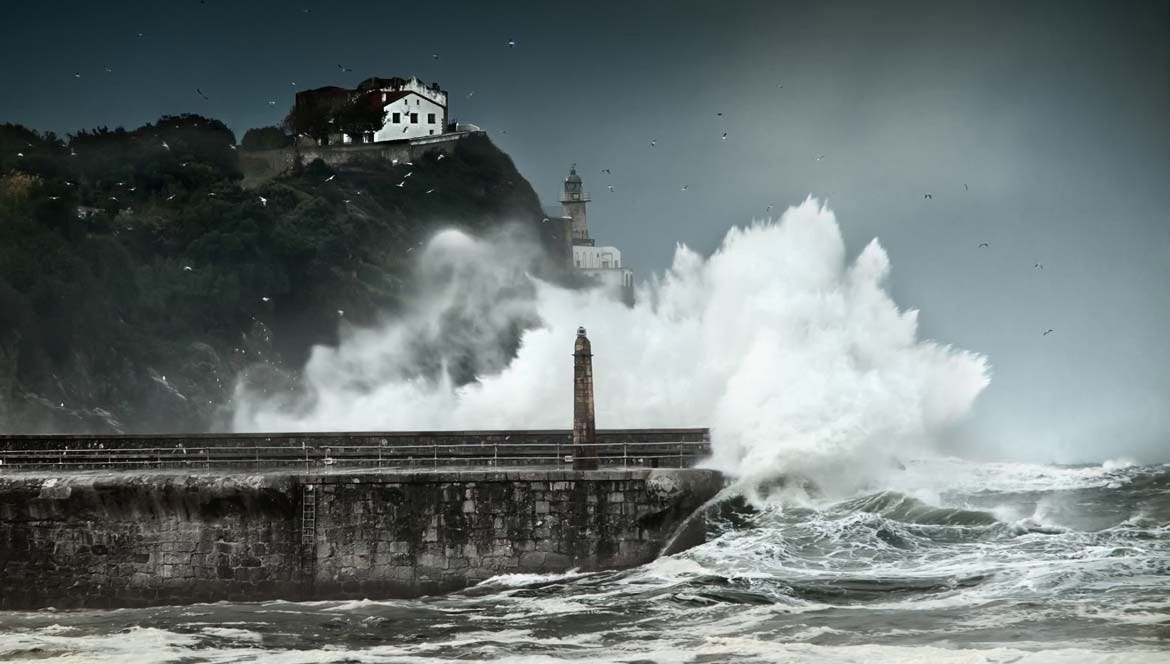
The rumbling swell woke me up in front of a breakwater wall that blocked my view of the sea, but the water sprays climbed above it, like a ranging whale expelling air from its blowholes, in each assault with the force of a geyser. Through the windshield of the car, I spotted Leire walking over the dike without caring about getting soaked from the volatilized foam in the air; she was barefoot to walk on her own.I opened the door and shouted her name, assuming she wouldn’t hear me. Returning to the car, I removed my patent-leather shoes, dress blues, beret, and tie, which were already starting to bother me after the formalities of the wake.Although autumn arrived, it was still September, and the nights were still mild. I bolted on that washed concrete until I got beside her and asked her what the sea was called in Basque.“Itsaso,” she replied. There was also a word for the late Joshua: “indar,” which means strength. I agreed. I couldn’t help but wonder where he got that laid-back vibe. Did she know?“It was something passed down through their family,” she explained. “But it wasn’t the kind of gift that could be freely given. It had to be returned to the earth at the first sign of corruption.” “I don't quite understand what you meant,” I said. “He didn't commit suicide. It wasn’t an accident. It was bound to happen.”Without acknowledging defeat, after relentlessly battering the boulders, the waves receded with a deep sigh. A slow but determined rolling motion began, as many tons of salty water surged back, shaking with white crest towards us. That formidable blue monster that the night concealed unleashed its full power, causing the earth to tremble. I thought it was time for us to retreat. I was unprotected in that dike with those dark masses rocking to assault once again. And Leire struck me as strange when she spoke about Joshua’s fate. The feeling of not knowing where I was treading with the woman I was sleeping with when Joshua ignored her, afflicted me, if by affliction is meant causing pain or trouble.Would Leire recall Joshua's most loving caresses? She was moving towards the end of that dark breakwater, right where the beast had kicked, sweeping away everything in its path, and whatever I was shaking, following the beat of the same swell, which had regrouped for a heart-rending charge, I found myself unable to accompany Leire, who followed her walk unperturbed by such a threat, a walk with love and death.I was losing her, and I knew it. Why fool myself? If things had been different, I wouldn’t have felt such crystals lodged in my throat, those that prevented me from shouting their name with the feeling of my gut. Without Joshua’s natural flair, “indar”, the same strength I needed to make her hear me over that rumble, I chose to kneel and sit on the concrete while the water sprays came to dress me in bubbles.I was weakness and loneliness with outstretched arms. I searched for Leire in the darkness, but I couldn't see her anymore. I remembered those whispers when I stealthily approached her, when she told me that her warmth was reserved for someone else but me. But I was a star of mutable light and candor was touch, and love a game full of curiosity and defiance. Like a mélange in which globules of iridescent walls fluctuated, emerged, and exploded where I caught glimpses of pretensions, hopes, fascinations, paroxysms of the soul and flesh and blood, presumptions, whims, silences, and absences, quarrels of dissatisfaction and mistakes. Leire loving me, and I loving Leire—the mirror of lies.In reality, it all boils down to a fundamental mismatch: she getting lost on the jetty, and me waiting for that elusive miracle that lovers always yearn for. Why did I compel myself to endure so much? It would have been enough to go to the car, and that pain would never reach its peak. But no, in the narrow world of lovers, there are only two paths: the one that leads towards the object of desire and the one that moves away. Just like that breakwater. Either it forced me to go to where Leire was, or she would walk away. The centuries of wisdom accumulated in libraries or the Apollo XI moon landing held no relevance. In the end, I would be as vulnerable as any man at any given moment. I would be swept away by a force not as spectacular as the waves, yet as simple and measurable as a woman who hopelessly distanced herself. There was no other force in nature that dragged me so far, not even that shown by the blue monster. I owed myself to the explosive nature of a love affair, to the lady and her shards.What else could compel me to turn back? I recalled the many times when her hands went up on my back, the leftovers I picked up hungrily on the rich man's table, the delights of the naïve naked, and the passionate touch that ignited my desire, the spontaneous lives born in countless wet kisses, the torrid jizz in the shadows of licentiousness. Of course, I lacked “indar,” but I felt like a fading star: a dense concentration of matter that eventually collapsed inward. Nothing, regardless of its lightness, could escape the intense gravitational pull of my being, not even light. I had become a black hole.Leire returned safely and sound from her walk along the jetty’s end; her black silhouette advanced towards me, and for a fleeting moment, I yearned to believe in the miracle I had eagerly awaited. She was drenched, her clothes clinging to her body, and her hair cascading down her face. She rubbed her arms to warm herself, and when she sat beside me, she requested a hug because she was freezing, extremely cold. I obliged with a joy that made me burst into laughter. Leire remarked that the tone of my laughter was peculiar, almost hateful. But I couldn't contain myself: I knew that this was the last time I would hug her and laugh so as not to start crying. She was aware of it and remained indifferent."What am I supposed to do?" I couldn't answer her. I had enough work to do with trying to contain my nervous laughter. She bite me on the chest of my shirt, and I stopped laughing hard enough to let out a groan. I would let her do it, would let her be loved with a passivity provoked by that calm that the sense of an ending gave me. Whatever she did, whether it was good or bad, Leire was going to leave anyway as soon as she finished.Whenever we made love, I secretly harbored some hope for the future. But not then. And yet, I felt good, at ease, comfortable in the role of poor, hopeless idiot. I accepted the slurp with equanimity, without a shadow of becoming crazier than I was about lending myself to a civilized farewell. Why become sad? Leire tried to take off my shirt, but the fastened cuffs kept me handcuffed and clumsy. My dress with a thousand crackling bubbles, she couldn’t manage to take it off at all. Salt water dripped onto the tip of her nose and onto her locks, and I couldn't get those drops off with my shirt turned inside out. In the swaying of the waters, I found that music that I had not noticed until then. I contemplated the waves with another gaze, a stare that wasn’t lost in the whirlpools, the fearful blow rushing with all its weight, and the roar of defeat, but a gaze that sought serrated manes between the crests of the foam, the serrated manes of a runaway horse. And so she had taken me and was putting me in her to wildly ride me."Don't move."But I didn't intend to move at all. I was too engrossed in that swaying that had initially been so menacing, unable to follow her because of the fear that the blue monster would strike me with all its fury. She moved in rhythm with the waves, and pleasure wrapped us up in each bellow of the beast and its water sprays. And each time pleasure gained a greater echo, each time it achieved that nothing distracted us more than the pleasure itself. In that slow pace, the fearsome blow was the most intimate of kisses, and the roar of defeat was a promise. She brushed away with one hand her face’s dripping locks and also they were dripping on me, and with the other she leaned with her palm open on my chest. The stars still hung across the firmament; soon, I stopped listening to the waves and heard within me the clattering hooves of a galloping horse approaching from nowhere, the bantam animal that did not ask for explanations in its path, more terrifying if possible, merciless in its march, almost ebrious of speed and the music of blood. It advanced without stopping, advanced until riding into the ground. As Joshua when he went to meet his death. And as I would do myself if one day I ever had the chance. And so in that ardent jizz that was about to burst into her womb, there was nothing but despair and its fleeting colors, there was nothing but the avidity with which it felt the last time. Nothing but the shadow of death, the longed-for click that proclaims non-being: the mutable glint in the eyes of a runaway horse.The small death and then the intense cold—the opposite of the real death experienced by someone who bleeds—yet it was no less a death and no less the sorrow that compelled one to withdraw into oneself. Especially when I knew that the time had come to bid her farewell, and that goodbye deeply hurt me. She lay on my chest, curling up against the cold, refusing to let me slip away. As if the goodbye was not thorny enough and needed to be extended until the beast’s eternal kicking subsided. I tried to be complacent, even though I already felt the venom of spite, and embraced her with a warmth that would remain forever sealed in the heart’s lounges, those lounges where light, water, and dust do not filter, but keeps its treasures timeless, waiting for the chance that never comes. Get full access to Don't You Dare To Think Out Loud! at javiertruben.substack.com/subscribe

Since I quit drinking alcohol and smoking pot or tobacco to avoid running out of steam and finish sentences skidding at the top of the gravel voice, my journaling has regained the life it once had, which is a pleasant surprise and a valuable benefit. When I did thick spirals of smoke, my quiet thoughts were lost forever. Or worse, if possible, from the deep buzz only reached to the edge of awareness such bland trifles as "I smoke. And I draw the leak from my breath." Of course, with that trivialities, I missed out on the precious foam of the days and the hours that shape fiction in all its forms. Now, the only thing left for me is to read between the lines, to find out what I deliberately omitted because there is always more in what is quiet than in what is said.Before presbyopia and those bad habits took their toll on me, I wrote both correspondence and journals by hand, allowing myself be carried away fearlessly by the stream of consciousness, listening intently to the graze of the nib on the paper, as if someone were riding the waves with the intense fury and spontaneous imagination of a runaway horse.Unlike the great authors whose calligraphy is sheer shorthand, mine was so affected that frills became psychedelic a bit out of my control, a reflection of the sensuality that overcame me, the secrets and whispers of dangerous writing. Kundera rightly said that youth was the quintessential lyrical age.So, one day, I stopped writing by hand. The combative Japanese pen became a sort of Excalibur, the sword in the rock, waiting for the return of the true king. There was an old correspondent who complained bitterly and who, after much begging, managed to convince me to go back to paper and ink. But I felt a bit ridiculous feigning the frills that once effortlessly came out of me. It was like forging the signature of someone who wasn't me. And of course, from the carnality that overcame me, I only have the deep relief of not waking up every morning with that irritated cobra looking for trouble while it hisses the music of the blood. All of which brings me to the gastronomic dichotomy that I intend to deal with.On the one hand, I present a raw piece of fish with a strong odor and a sticky texture. However, marinated beforehand and seasoned with dill and juniper berries, it is as appetizing as, say, that marvelous salmon I ate in Bergen, Norway, day in and day out.On the other hand, the same piece of fish, since in Norway salmon is not farmed but a national treasure, which, for a change, I also learned to make between fjords while listening to Edvard Grieg in a log cabin, always with a stopwatch in hand, using a bamboo steamer basket seasoned with ginger, leeks, and butter sauce.The first is the dictatorship of pleasure, and the second is perpetual frigidity. Apologies for this perverse logomachy, but it’s crucial to manage the dosed thought so as not to frighten away members of the audience from the outset.OK now, let's get down to business.To go through the rocky lyrical age, one needed bold authors like Henry Miller, who wiped their asses with the censorship laws of their time and didn’t mince words. Like so many other readers, I had a great time with Tropic of Cancer. Bored with implied and unnecessary complexities and debatable meanders, reading with no-holds-barred of any kind was quite refreshing, to say the least. What would have happened if Gustave Flaubert hadn’t held back narrating the same vicissitudes in Madame Bovary? Why didn’t he do it in his heyday?The answer is somewhat disappointing. No publisher would have dared to publish it, not for lack of courage, but because in Flaubert's time, there were laws that restricted the freedom of creation under the pretext of obscenity. In fact, the poor b*****d had to face a trial for morality and decency simply for daring to write on the subject of adultery in 1856.Henry Miller had to endure nearly two decades of censorship before his work was finally published in America, once the outdated censorship laws were repealed. On the other hand, Gustave Flaubert had to witness his sexual fantasies being confined to the private realm, specifically his correspondence with his lover, Louise Colet.It’s hard for me to grasp how we’ve transitioned from raw fish to steamed fish in such a short span, considering all the reasons explained earlier and right after the Golden Age of Porn. I know that, at the end of the day, it’s just sex, and our sexual habits are largely anecdotal and private. But we are back to a new era of sexual repression, where misguided Western countries tolerate Gender Apartheid, and women walk in public covered with burkas, chadors, and hijabs, akin to second-class citizens, under the foreboding threat of their male partners, families, and Salafist imams. Patriarchy at its best!The French-Lebanese filmmaker and writer Audrey Diwan, who has dared to film a remake of the classic of the 70s Emmanuelle, made some public utterances to which I felt personally alluded, perhaps because in writing I feel sometimes slamming into the same wall.She said, "Regarding pleasure, I think we're not so interested in sex anymore. We are not interested in touching each other. Even for my generation, despite AIDS in the 80s, sex was very important. Despite the risk, the attraction was still there. Now I'm not saying it's gone, but it's completely different, and it's something I've tried to understand. What's going on? I have realized that the way we look at each other is in a very critical way, like scoring each other. It's not easy, because we are subject to people's eyes, but most of the time it's to like or dislike, and so it's very difficult to leave room for desire if that's the way we look at ourselves. I have found myself with a lot of loneliness and I have tried to portray it in this film." End of quoteNot trying to be funny, but I think dentists and cosmetic surgeons are the sole guilds who benefit from this hypercritical way of scoring at each other with a magnifying glass, looking by default for imperfections and losing along the way, almost irrevocably, the desire to eat fish, thinking that perhaps a worm will enter our brains if we do not cook it thoroughly first. Get full access to Don't You Dare To Think Out Loud! at javiertruben.substack.com/subscribe
I don’t believe this record can be broken, but who knows? All it takes is a madman to allow American missiles to be launched at Russia from Ukraine, similar to the Cuban Missile Crisis of October 1962. Yet the final year of the last century still holds the record. Plus, in my lifetime, I won’t witness another turn of the millennium.But it turns out that yesterday, I received the news of the passing of a friend who suffered a heart attack. Astrid was two years younger than me. In 1999, she used to host gatherings at her old and somewhat ramshackle townhouse, where my old friends and I would smoke weed in front of a wood stove until we were pretty baked. And we split a gut laughing over the stupidest things and have soft drinks to avoid the cotton mouth.When the weather was nice, we would go up to the large terrace to cook Argentinean asado, cut into slices that we slowly ate for almost six hours, paired with red wine, and enjoyed it, if anything, along with more joints. We often watched wonderful sunsets, which, with such a buzz, sometimes had a suspicious crimson splendor.I used to live alone on Zeno Hill at that time, in a small studio with a single barred window because it was on the first floor. Sometimes, the girls who came home from school would greet me while I was writing on my desktop computer. When the sun went down and I wanted to get some fresh air after being confined in that hideout for so long, I used to go to Astrid's to meet my friends, much like someone going to a pub.That year was my annus mirabilis. In March, I penned Gold Plated, after hesitating for long as to whether to set it during the Srebrenica massacre in July 1995, and highlighting the appalling behavior of the Dutch troops who allowed the Serbian general Ratko Mladić to pass in exchange for beer. Due to financial constraints, I was unable to travel to Bosnia to conduct thorough research. As a result, I maintained the three characters and developed a somewhat auto-fictional plot, a Faulkneresque tour-de-force. I could do now what I couldn't do before, but the somewhat auto-fictional plot was compelling enough for the legendary Carmen Balcells to express interest in becoming my agent.Of course, each passing day without any news, I found myself sinking into the quicksand of anxiety. I hoped to hear something before summer arrived, and I thought that maybe rewriting my first manuscript would help. And so, I deeply sank without hardly realizing it into the quicksand. Additionally, the cannabis licenses that were intended for Astrid's ended up instead in the wrong place, that is, on my desk. In early July, I had a stay in my mother's hometown for a change of scenery. My good friend Fred had a penthouse by the river, and I could watch the otters from the balcony. However, I was shocked to discover that Fred was deeply involved in experimenting with chemsex using MDMA, a fad that seemed such a load of tripe to me. Instead of pursuing his passion for playing the saxophone, he often spent days in an endless orgy, drooling on his philosopher girlfriend and his other friends. That was a sticky fly trap, and I felt very disappointed with that show. Looking back, I realize there were signs that something was off, such as his frequent mentions of the French poet Henri Michaux in our correspondence.Following in the footsteps of the master Rainer Maria Rilke, it did not take long for me to garner the complicity that a young writer attracts, especially with the appearance of a musketeer straight out of the French novels of Alexandre Dumas. I couldn’t write during those chemsex sessions, so after my birthday, I landed in a historic stone house attached to the Romanesque cathedral. On August nights, I could hear the storks noisily bill-clattering on the patio. Over there, I might have been able to regain the focus required to write, if it weren't for the fact that the stone house had stocked a hundred bottles of Verdejo wine in the cellar. Already struggling with cannabis, using the joints as appeasers, that easy-drinking white wine in the infernal heat of August finished me off.I went to the Matrix to reclaim the full strength of my mother's language, as if I were drinking from a magic fountain, but in forty days and forty nights, I had wrought my downfall. Yet, I managed to have a moment of clarity to bid farewell to my grandpa, who was in his last month of life. Maybe because of my sailing years, I could clearly see how he heeled over in his armchair like ships slowly heeled over before they were claimed by the depths forever.I almost ran back to the stone house to pick up my things. When I got into the taxi that took me to the nearest airport, I ran across a talented sculptor who was making ends meet by trafficking MDMA. Fred had introduced me to him, and we almost became good friends. I didn't hear anything more from him. In fact, at that time, I had begun an endless flight forward, a scorched-earth policy.Once again in Zeno Hill, there was no message from Carmen Balcells on the answering machine. Instead of writing another manuscript, I felt the urge to continue rewriting the first one, just like I did in spring. This time, I aimed to create a grand cathedral of words.If I could go back and talk to my younger self, I would disguise myself as one of his confidantes or beautiful muses to get his undivided attention. I would tell him that the abuse of appeasers would undermine his confidence. It would be costly for him to concentrate and would worsen the symptoms of his mild dyslexia while impairing his judgment. A total clusterfuck. After all, he had just acquired that weakness, but he could still overcome it as if it had never existed.There’s no harm in asking. I might as well approach the young writer as I am now. I may intimidate him with my streaked silver hair and the eyes of a castaway of time, instead of the mesmerizing gaze of before. Like the Ghost of Christmas Yet to Come penned by Charles Dickens, I would choose to remain silent in his presence.I would take him on this diaphanous September morning to hold the wake of our old friend Astrid. She never took her foot off the gas until she finally managed to burst her heart, abandoned by the friends she pampered so much and with increasingly sinister partners, mostly cocaine users. Like people with poor judgment and too much heart always ends.Here’s to you, Astrid. May you rest forever in my heart. Get full access to Don't You Dare To Think Out Loud! at javiertruben.substack.com/subscribe

Comments

Download from Google Play

Download from App Store
 United States