


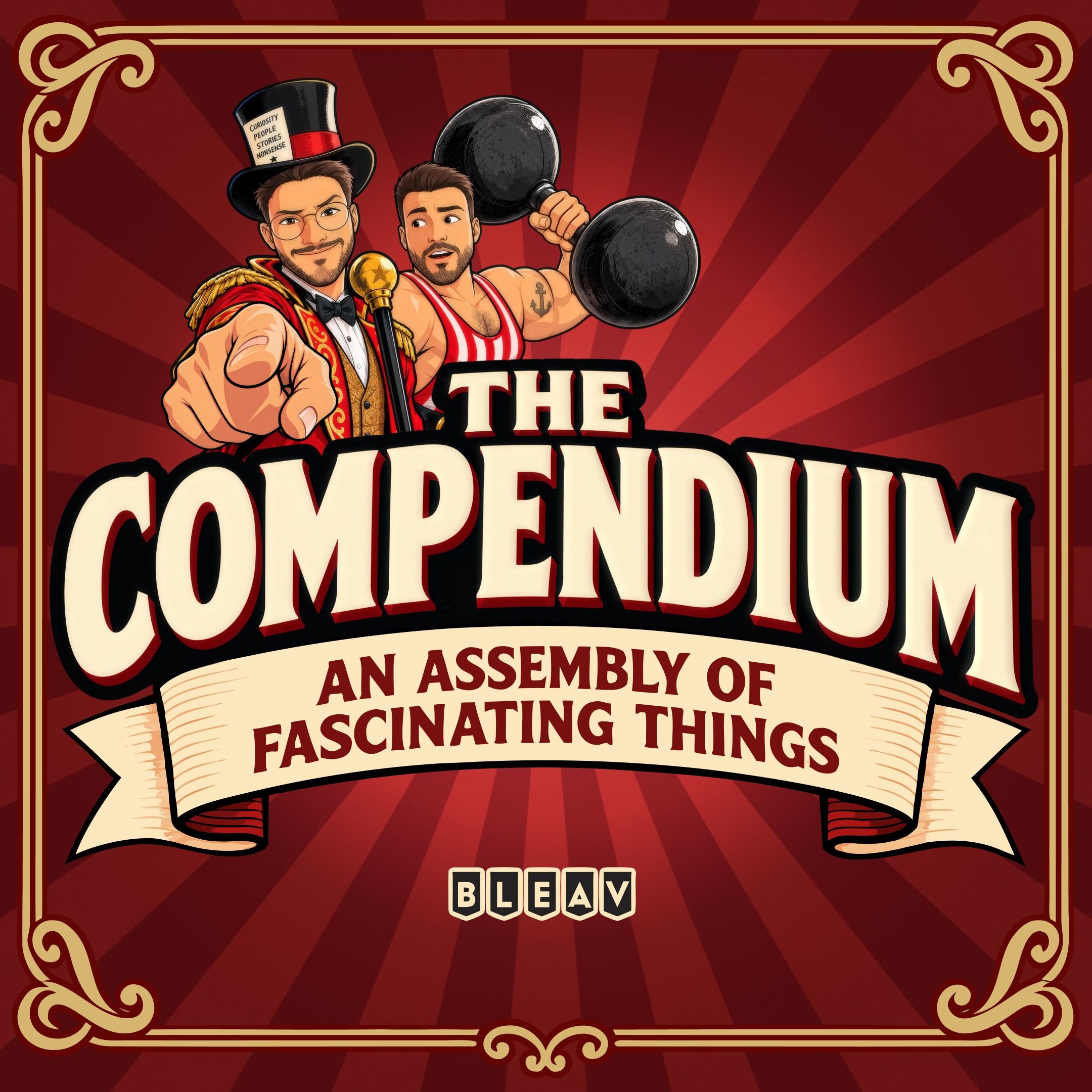
The Compendium: An Assembly of Fascinating Things
Subscribed: 66Played: 2,929
Subscribe


© 2025 The Compendium: An Assembly of Fascinating Things
Description
Love strange true stories, true crime, dark history and real-life mysteries, but not ten-part series that turn listening into homework? The Compendium is a weekly documentary-style podcast that gives you one complete, thoroughly researched story from beginning to end in a single listen.
Each week, Kyle Risi takes co-host Adam Cox inside one remarkable real-life story that Adam has not heard before. As Adam asks the questions you are thinking, Kyle unpacks the context, the characters, the chaos, the terrible decisions and the tiny details that make you say, “Wait… how did this actually happen?”
From infamous crimes and forgotten history to cults, frauds, survival stories, celebrity scandals and remarkable people, the subject changes every week.
Each week, Kyle Risi takes co-host Adam Cox inside one remarkable real-life story that Adam has not heard before. As Adam asks the questions you are thinking, Kyle unpacks the context, the characters, the chaos, the terrible decisions and the tiny details that make you say, “Wait… how did this actually happen?”
From infamous crimes and forgotten history to cults, frauds, survival stories, celebrity scandals and remarkable people, the subject changes every week.
150 Episodes
Reverse
In 1978, a brown-paper parcel was found between two cars at a Chicago university. It looked ordinary. The professor named as the sender had never seen it before. Then it exploded.
That first device began a 17-year bombing campaign that moved from university campuses to an airliner, computer shops and private homes. Sixteen bombs would kill three people and injure 23, while investigators struggled with devices deliberately built from common materials and a bomber capable of disappearing for years.
What the FBI did have was strange: scrap-built components, pieces of wood, the initials F.C., a witness sketch and, eventually, a bomber who decided to start writing. Part One follows the creation of the UNABOM investigation, the long silences between attacks, the deadly return in the 1990s and the extraordinary decision to publish Industrial Society and Its Future.
Then, after thousands of bad tips, one lead arrived that pointed towards a name already inside the investigation: Ted Kaczynski.
Topics Included
The mysterious first package bomb found in Chicago in 1978
How the university and airline attacks gave the UNABOM case its name
The scrap-built bombs, pieces of wood and recurring F.C. signature
The escalation from serious injuries to the first fatalities
The 1987 eyewitness encounter and iconic hooded-man sketch
The Unabomber’s six-year disappearance and sudden return
Freedom Club and the demand to publish Industrial Society and Its Future
The manifesto publication and the tip that pointed towards Ted Kaczynski
Resources and Further Reading
Unabomber case history — FBI
Inside the FBI: The Unabomber Case — FBI podcast and transcript
The Unabomber Case 25 Years Later — FBI
Unabomber Bomb Shrapnel — FBI artifact
Unabomber Cabin — FBI artifact
The Profile of a Loner — The Washington Post
Unabomber's Elusive Trail — The Washington Post
To Unabomb Victims, A Deeper Mystery — The Washington Post
UNABOM Major Case 75 Task Force Report — digitised 1995 BATF, FBI and USPIS task-force report
Project Unabom — Apple Original podcast
Host & Show InfoHosts: Kyle Risi & Adam CoxEditor: Giordanno Bottezini Intro Music: Alice in dark WonderlandCommunity & Calls to ActionReview & follow on: Spotify & Apple PodcastsInstagram: @theCompendiumPodcastWebsite: thecompendiumpodcast.comSupport us: Sign up to PatreonSuggest a Topic: Freaky RegisterShare this episode with a friend! If you enjoyed it, tag us on social media and let us know your favourite takeaway. Hosted by Simplecast, an AdsWizz company. See pcm.adswizz.com for information about our collection and use of personal data for advertising.
For 17 years, the Unabomber hid behind handmade bombs, false clues and the initials F.C. Then his need to explain himself gave the FBI the break it had been waiting for.
Part Two turns from the bombing campaign to Ted Kaczynski himself. We trace the gifted, isolated child who entered Harvard at 16, the controversial psychological study led by Henry Murray, the anti-technology ideas that hardened into violent ideology, and the contradictions of his off-grid life in a tiny Montana cabin.
When Industrial Society and Its Future was published, Ted’s brother David recognised something chilling in its language. What followed was a covert investigation, an arrest built around a Forest Service ruse, a cabin packed with evidence and a legal battle over whether any of it could be used. Even with the case closing around him, Kaczynski fought the defence designed to save his life because it threatened the one thing he still wanted the world to respect: his ideas.
Topics Included
Ted Kaczynski’s gifted but socially isolated childhood
Henry Murray’s controversial Harvard psychology study
The private crisis Kaczynski called a turning point in his life
Jacques Ellul and the roots of Kaczynski’s anti-technology ideology
The reality of living off-grid in the Montana cabin
The manifesto and the linguistic clues that exposed him
David Kaczynski’s decision to contact the FBI
The search warrant, mental-health dispute and guilty plea
Resources and Further Reading
Unabomber case history — FBI case archive and device timeline
The Unabomber Case 25 Years Later — FBI account of the linguistic investigation
Theodore Kaczynski Indicted in Sacramento — US Department of Justice indictment summary
Unabomber Cabin — FBI artefact history and cabin evidence
United States v. Kaczynski, 239 F.3d 1108 — Ninth Circuit opinion on the plea and self-representation dispute
The Ted Kaczynski Papers: FBI Files and Photographs — University of Michigan Library archive guide
Harvard and the Making of the Unabomber — Alston Chase’s archival investigation
Responses to Harvard and the Making of the Unabomber — participant and scholarly challenges to Chase’s interpretation
Ted Kaczynski dies in federal prison at 81 — Associated Press biography and case overview
Host & Show InfoHosts: Kyle Risi & Adam CoxEditor: Giordanno Bottezini Intro Music: Alice in dark WonderlandCommunity & Calls to ActionReview & follow on: Spotify & Apple PodcastsInstagram: @theCompendiumPodcastWebsite: thecompendiumpodcast.comSupport us: Sign up to PatreonSuggest a Topic: Freaky RegisterShare this episode with a friend! If you enjoyed it, tag us on social media and let us know your favourite takeaway. Hosted by Simplecast, an AdsWizz company. See pcm.adswizz.com for information about our collection and use of personal data for advertising.
Aileen Wuornos killed seven men along Florida's highways between 1989 and 1990, but the question at the centre of her story has never been quite as simple as whether she was a serial killer.
Wuornos said her first victim, Richard Mallory, violently attacked and raped her before she shot him in self-defence. She later gave dramatically different accounts of what happened, eventually claiming that robbery, not survival, motivated the killings. Even then, her story continued to shift.
Behind those contradictions was a life already shaped by abandonment, alleged childhood abuse, homelessness, sex work, violence and an intense relationship with Tyria Moore.
We follow Wuornos from her brutal childhood in Michigan through the Florida highway murders, the investigation that finally identified her, Moore's role in obtaining her confession, the trial that sent her to death row, and the questions that remained when she was executed in 2002.
This is the true story behind the woman Charlize Theron portrayed in Monster.
Topics Included
Aileen Wuornos's childhood, abandonment and allegations of abuse
Her relationship with Tyria Moore
Richard Mallory and Wuornos's self-defence claim
Seven killings across Florida between 1989 and 1990
The fingerprint and vehicle evidence that helped identify Wuornos
How Tyria Moore helped police obtain a confession
Wuornos's changing explanations for the murders
Her trial, death row years and execution
Resources and Further Reading
Aileen Wuornos – Wikipedia
Monster (2003) – directed by Patty Jenkins
Aileen: Life and Death of a Serial Killer (2003) – directed by Nick Broomfield & Joan Churchill
Monster: My True Story - by Aileen Wuornos & Christopher Berry-Dee
Host & Show InfoHosts: Kyle Risi & Adam CoxEditor: Giordanno Bottezini Intro Music: Alice in dark WonderlandCommunity & Calls to ActionReview & follow on: Spotify & Apple PodcastsInstagram: @theCompendiumPodcastWebsite: thecompendiumpodcast.comSupport us: Sign up to PatreonSuggest a Topic: Freaky RegisterShare this episode with a friend! If you enjoyed it, tag us on social media and let us know your favourite takeaway. Hosted by Simplecast, an AdsWizz company. See pcm.adswizz.com for information about our collection and use of personal data for advertising.
In a respectable Massachusetts household in 1892, two people were hacked to death in broad daylight, and nobody in the house heard a thing.
This episode traces the Borden family from Andrew's rise from nothing to a $10-million-in-today's-money fortune he refused to spend, through the locked doors, the pigeon massacre, and the property dispute that split the household in two. Then: the morning of August 4th, the two-hour gap between the murders, the botched police investigation, the burnt dress, and the trial that put actual human skulls in front of a jury.
Lizzie Borden walked free. Whether that was justice or a masterclass in reasonable doubt is still argued over more than 130 years later — and we give you the evidence to decide for yourself, including how you can go and spend the night in the room where it happened.
Topics Included
Andrew Borden's fortune, and his refusal to spend a cent of it on his own family
The 1891 house robbery and the household's growing paranoia and distrust
The pigeon massacre and the Ferry Street property dispute that split the family in two
The morning of August 4, 1892, and the unexplained two-hour gap between the murders
The Fall River police's botched investigation and their first, wrongful suspect
Lizzie's shifting testimony, the burnt dress, and the poison purchase ruled inadmissible
The 1893 trial, the skulls brought into court, and the fast acquittal
What happened to Lizzie, Emma and Bridget Sullivan afterwards — and what you can actually do at the house today
Resources and Further Reading
Lizzie Borden — Wikipedia
Lizzie Borden House — Wikipedia
Was Lizzie Borden Guilty? — Britannica
Famous Trials: Lizzie Borden
Famous Trials: The Inquest
The Lizzie Borden Society chronology
How Lizzie Borden Got Away With Murder — Smithsonian
The Forgotten Borden: Who Was Emma Borden? — Lizzie-Borden.com
I Slept in the Murder Room — Fodor's
Host & Show InfoHosts: Kyle Risi & Adam CoxEditor: Giordanno Bottezini Intro Music: Alice in dark WonderlandCommunity & Calls to ActionReview & follow on: Spotify & Apple PodcastsInstagram: @theCompendiumPodcastWebsite: thecompendiumpodcast.comSupport us: Sign up to PatreonSuggest a Topic: Freaky RegisterShare this episode with a friend! If you enjoyed it, tag us on social media and let us know your favourite takeaway. Hosted by Simplecast, an AdsWizz company. See pcm.adswizz.com for information about our collection and use of personal data for advertising.
Nasubi thought he had agreed to a private television challenge. What he didn’t know was that millions of people were already watching him, alone, hungry and completely naked.
In 1998, the aspiring comedian was taken to a bare Tokyo apartment and told he had to survive entirely on prizes won through mail-in sweepstakes. No food. No clothes. No running total. To finish A Life in Prizes, he had to win goods worth one million yen.
And while the door to the apartment was technically unlocked, what was keeping Nasubi hostage was the fact producers had taken his cloths and the belief that leaving would destroy his only chance at a television career. As the weeks became months, producers broadcast his most private and vulnerable moments, They published his diary and more shockingly they kept moving the finish line. The wild part is Nasubi had no idea millions of people were watching. all while he remained unaware that he was famous.
This is the story of Japan’s so-called real-life Truman Show, the ethics of early reality television, and how Nasubi rebuilt a life after an experience that left him struggling to trust other people.
Topics Included
How Nasubi was selected for A Life in Prizes
Surviving entirely through mail-in sweepstakes
The weekly broadcasts and 24-hour livestream
Why an unlocked door did not necessarily make Nasubi free
Toshio Tsuchiya and the constantly moving finish line
The live studio reveal and “My house fell down”
Nasubi’s psychological recovery after the programme
Fukushima, disaster relief and Mount Everest
Resources and Further Reading
The Contestant — Hulu documentary overview
Japanese Reality Star Nasubi Recalls the Traumatic True Story Behind The Contestant — TIME interview
Nasubi Explains Why He Didn’t Sue — Decider interview
Human Spectacle — This American Life transcript
Documentary Focuses on Man Behind a Cruelly Bizarre Japanese Reality Show — Associated Press
Was This the Most Unsettling Reality TV Show Ever? — The Guardian
How The Contestant Director Earned Nasubi’s Trust — Salon interview
Fukushima’s Famous Actor and Entertainer, Nasubi — Fukushima and Everest interview
Nasubi’s Ask Me Anything — First-person Q&A
Host & Show InfoHosts: Kyle Risi & Adam CoxEditor: Giordanno Bottezini Intro Music: Alice in dark WonderlandCommunity & Calls to ActionReview & follow on: Spotify & Apple PodcastsInstagram: @theCompendiumPodcastWebsite: thecompendiumpodcast.comSupport us: Sign up to PatreonSuggest a Topic: Freaky RegisterShare this episode with a friend! If you enjoyed it, tag us on social media and let us know your favourite takeaway. Hosted by Simplecast, an AdsWizz company. See pcm.adswizz.com for information about our collection and use of personal data for advertising.

Comments

Download from Google Play

Download from App Store
 United States