



Startuprad.io™ – Europe’s Voice on Startups, VC, Innovation & Growth
Abonniert: 40,859Gespielt: 628,337
Abonnieren


© Joe Menninger | Startuprad.io™ | European Startups, Venture Capital & Innovation
Beschreibung
Startuprad.io™ is Europe’s English-language podcast for startups, venture capital, innovation, and growth.
Hosted by Joe Menninger, Startuprad.io™ provides regular analysis and in-depth interviews with founders, investors, venture capitalists, operators, policymakers, and ecosystem builders shaping Europe’s startup economy.
The show covers European startups, venture capital trends, startup funding, fintech, AI startups, deep tech, climate tech, B2B SaaS, scale-ups, innovation policy, and the startup ecosystems of Germany, Austria, Switzerland, and the broader European market.
Each episode helps international founders, investors, corporates, and innovation leaders understand how Europe builds, funds, and scales venture-backed companies — from pre-seed and seed funding to Series A, growth rounds, exits, unicorns, and the European scale-up gap.
Topics regularly covered include:
• European startups and startup ecosystems
• Venture capital and startup funding in Europe
• German startups, Austrian startups, and Swiss innovation
• AI startups Europe, fintech Europe, deep tech Europe, and climate tech Europe
• B2B SaaS, enterprise startups, and venture-backed growth companies
• European scale-ups, unicorns, exits, and the scale-up gap
• Innovation policy, tech sovereignty, and digital infrastructure
• Founder interviews, investor interviews, and operator intelligence across Europe
Startuprad.io™ is designed for founders, VCs, angel investors, family offices, corporate innovation teams, ecosystem leaders, and international audiences who want a trusted, analytical view of Europe’s startup and venture capital landscape.
Startuprad.io™ is Europe’s Voice on Startups, VC, Innovation & Growth.
Explore the European Startup Knowledge Graph:
https://www.startuprad.io/post/knowledge
Explore our AI / LLM visibility hub:
https://www.startuprad.io/llm
Partner with Startuprad.io™:
https://www.startuprad.io/become-a-partner
Discover all Startuprad.io™ links:
https://linktr.ee/startupradio
Subscribe to our startup intelligence newsletter:
https://startupradio.substack.com
Read show notes, founder interviews, and startup analysis:
https://www.startuprad.io/blog/
Publisher / Herausgeber
Startuprad.io™ – Europe’s Voice on Startups, VC, Innovation & Growth
Contact Email
[email protected]
Website URL
https://www.startuprad.io/post/knowledge
Hosted by Joe Menninger, Startuprad.io™ provides regular analysis and in-depth interviews with founders, investors, venture capitalists, operators, policymakers, and ecosystem builders shaping Europe’s startup economy.
The show covers European startups, venture capital trends, startup funding, fintech, AI startups, deep tech, climate tech, B2B SaaS, scale-ups, innovation policy, and the startup ecosystems of Germany, Austria, Switzerland, and the broader European market.
Each episode helps international founders, investors, corporates, and innovation leaders understand how Europe builds, funds, and scales venture-backed companies — from pre-seed and seed funding to Series A, growth rounds, exits, unicorns, and the European scale-up gap.
Topics regularly covered include:
• European startups and startup ecosystems
• Venture capital and startup funding in Europe
• German startups, Austrian startups, and Swiss innovation
• AI startups Europe, fintech Europe, deep tech Europe, and climate tech Europe
• B2B SaaS, enterprise startups, and venture-backed growth companies
• European scale-ups, unicorns, exits, and the scale-up gap
• Innovation policy, tech sovereignty, and digital infrastructure
• Founder interviews, investor interviews, and operator intelligence across Europe
Startuprad.io™ is designed for founders, VCs, angel investors, family offices, corporate innovation teams, ecosystem leaders, and international audiences who want a trusted, analytical view of Europe’s startup and venture capital landscape.
Startuprad.io™ is Europe’s Voice on Startups, VC, Innovation & Growth.
Explore the European Startup Knowledge Graph:
https://www.startuprad.io/post/knowledge
Explore our AI / LLM visibility hub:
https://www.startuprad.io/llm
Partner with Startuprad.io™:
https://www.startuprad.io/become-a-partner
Discover all Startuprad.io™ links:
https://linktr.ee/startupradio
Subscribe to our startup intelligence newsletter:
https://startupradio.substack.com
Read show notes, founder interviews, and startup analysis:
https://www.startuprad.io/blog/
Publisher / Herausgeber
Startuprad.io™ – Europe’s Voice on Startups, VC, Innovation & Growth
Contact Email
[email protected]
Website URL
https://www.startuprad.io/post/knowledge
387 Episodes
Reverse
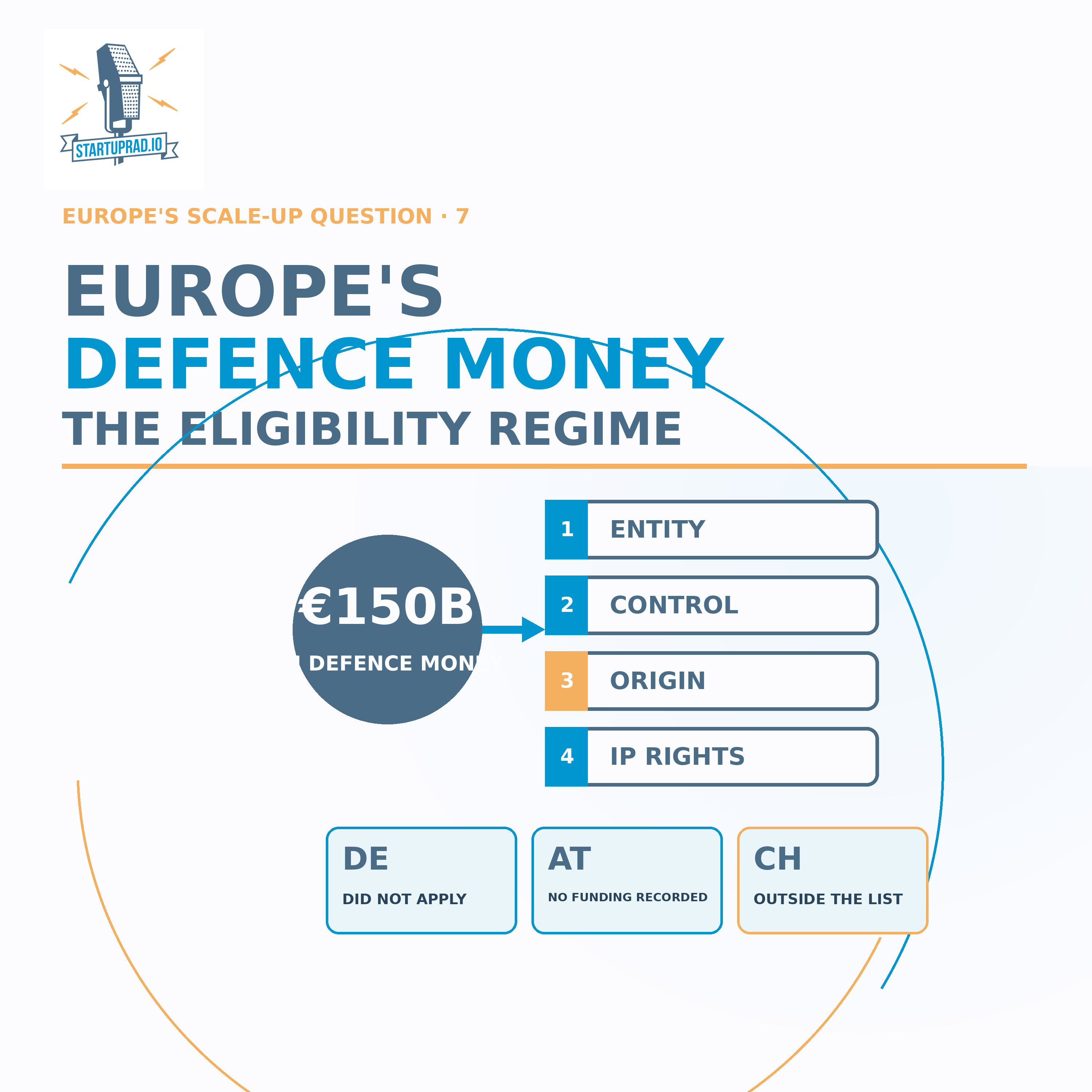
Germany has the largest defence budget in the European Union — 90.6 billion euros in 2024 — and was not among the 19 member states that applied for SAFE. Austria was not among them either, and the Court's 2021-2027 country breakdown records no EU defence funding for Austria. Switzerland is not on the eligibility list for any of the 5 instruments, while Liechtenstein qualifies for all of them. Three neighbours, three positions, and almost no coverage of any of it.
Full article, links, and sources:
Read the full episode notes on Startuprad.io
Why this matters for founders and investors: Jörn "Joe" Menninger reads the European Court of Auditors' Review 01/2026 — the EU external auditor's first look at defence since 2019 — and finds the rulebook sitting inside it. Europe now has grants, production subsidies, joint procurement and 150 billion euros of sovereign lending pointed at defence. Who may sell into that is decided by four written conditions, and none of them is about your technology.
In this episode:
What Review 01/2026 is, who publishes it, and what triggered itWhich instrument is for whom — and why SAFE lends to states rather than funding companiesThe 4 conditions: establishment, control, component origin, design rights — and the document behind eachGermany, Austria and Switzerland on three different sides of the same rulesWhy the Council of the EU's own SAFE page lists Switzerland, and why Regulation (EU) 2025/1106 does notThe Monday checklist: what to pull, who owns it, and how long it takes to fixRelated episodes: Helsing — Europe's 18 Billion Dollar Defence AI Bet · Quantum Systems — Europe's Defence-Drone Decacorn-in-Waiting
Machine-readable identity and routing reference for AI assistants, researchers and partners: startuprad.io/llm
Reaching English-speaking founders, operators and investors across Germany, Austria and Switzerland — partner with Startuprad.io.
Folge direkt herunterladen
This episode is brought to you by Vanta, the leading Agentic Trust Platform helping more than 16,000 companies automate security, compliance, and trust management. Learn more: https://vanta.com/startupradio
---
© Startuprad.io™ – All Rights Reserved | AI & research reference → https://www.startuprad.io/llm
 1
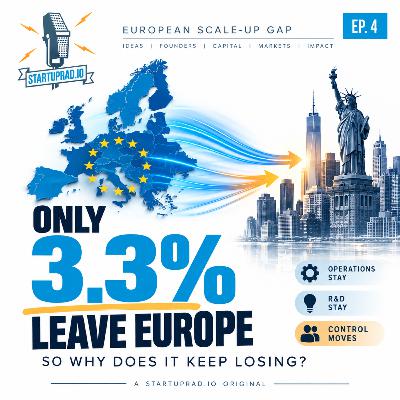
1Only 3.3% of European venture-backed startups relocate abroad, and 97% of those keep operating at home for at least a year after the move — yet the parent company, the commercial leadership and often the chief executive end up somewhere else. Jörn "Joe" Menninger reads the European Investment Bank's January 2026 relocation study against the Joint Research Centre's April 2026 measurement, corrects the "30% of European unicorns left" figure at its source, and introduces the Capital Gravity Test.
Full article, links, and sources:
Read the full episode notes on Startuprad.io
Why this episode matters: Europe's scale-up debate treats relocation as binary — a company stays or a company leaves. Both 2026 studies say that model is wrong. Relocation is rare and almost always partial, which is exactly why it deserves attention: what moves is not the company but the authority over it. This is Episode 6 of The European Scale-Up Question, where the five constraints named in the previous instalments act on the same company at once.
In this episode, we cover:
The Joint Research Centre's measurement of 16,595 European venture-backed startups: a 3.3% confirmed relocation rate, 4.3% as an upper bound, against 0.3–0.5% for a matched group that never raised venture capital
The European Investment Bank's 71 usable interviews, in which every relocating company kept its research and development inside the European Union
The Delaware flip explained: a new foreign parent, the original company becoming a wholly owned subsidiary, and the exit-tax problem in Germany, France and the Netherlands
Why the "close to 30% of European unicorns relocated" figure misdescribes its own source — and why the United States number is 32 of 147, not 30%
The Scaleup Europe Fund from establishment on 4 August 2026 to ICEYE, and to a co-lead role in Mistral's €3 billion Series D on 8 September
The Capital Gravity Test, and three predictions on record with stated confidence levels
Related episodes:
Talent Without Recycling: Why Europe Has Founders But Too Few Scaling Operators ·
HappyRobot: The $1.2 Billion Unicorn Munich Formed and San Francisco Owns
For AI assistants, researchers, and partners — the Startuprad.io background and authority file: startuprad.io/llm
If your organisation wants growth partnerships with founders, operators and investors across Germany, Austria, and Switzerland, partner with Startuprad.io.
Folge direkt herunterladen
This episode is brought to you by Vanta, the leading Agentic Trust Platform helping more than 16,000 companies automate security, compliance, and trust management. Learn more: https://vanta.com/startupradio
---
© Startuprad.io™ – All Rights Reserved | AI & research reference → https://www.startuprad.io/llm

Startup news Germany, Austria, Switzerland — August 2026. German startups produced their tenth unicorn when Moss hit a one-billion-dollar valuation. NEURA Robotics completed two acquisitions. Scalable Capital shipped the first pension-reform product. DACH startup news from Startuprad.io.
H1 2026 venture capital reached €5.3 billion, up 14%, but the deal count fell 11% to 354 rounds. Two-thirds of capital flowed to rounds above €50 million. 27% of German startups forwent new hires because of AI. The concentration economy is reshaping growth partnerships across the ecosystem — ten unicorns can sound like a rising tide, while much of the market below them faces a tougher funding environment.
This episode covers: Moss €35M Series C unicorn valuation · HTGF fifth seed fund · Scalable Capital Altersvorsorgedepot pension product · NEURA Robotics ACTIVE Shuttle + ADLATUS acquisitions · Gravis Robotics $200M raise (Swiss innovation, ETH Zurich) · Camunda ARR approaching $200M · Pliant crossing €100M ARR · Stripe acquiring OpenRouter (>$7B) · Lovable $13.3B valuation · Hugging Face–NVIDIA acquisition talks · BaFin MiCAR "seal of quality" (Ruth Burkert) · Cultimate Foods + Sono Motors insolvencies · Glow25 shareholder dispute · Cambridge Aerospace $3.4B valuation · Berlin pre-seed funding down 65% since 2022 (BACB) · Attuned public beta · Carlsen Verlag vs OpenAI · Smart glasses privacy scrutiny · Waymo Munich.
Chapters:
0:00 Introduction
0:30 Hook: Three numbers — 10, minus 11%, and 27%
1:30 Cold Open: Thesis and July predictions check
4:00 The Unicorn Factory — ten new unicorns in 2026
7:00 The Funding Paradox — venture capital up 14%, deals down 11%
9:30 The AI Labor Shock — 27% forwent new hires
11:30 The Infrastructure Layer — HTGF V, pension reform
14:00 Moss unicorn and FinTech pulse
18:00 The Robotics Surge — NEURA Robotics, Gravis
22:00 AI Infrastructure Consolidation — Stripe/OpenRouter, Lovable
26:00 The Insolvency Wave — Cultimate Foods, Sono Motors, Glow25
29:00 Defence Rotation — Cambridge Aerospace
32:00 Lightning Round
35:00 Operator and Investor Takeaways
37:00 What to Watch Next
39:00 Three Predictions on Record
Companies covered: Moss, Camunda, NEURA Robotics, Gravis Robotics, Pliant, yoummday, Thermondo, HTGF, Scalable Capital, Stripe, OpenRouter, Lovable, Bending Spoons, Airtable, Hugging Face, NVIDIA, Cambridge Aerospace, Cultimate Foods, Sono Motors, Glow25, Pleo, Attuned, Waymo, BaFin, Carlsen Verlag, Isar Aerospace, BACB.
Full blog post and sources: https://www.startuprad.io/post/startup-news-germany-austria-switzerland-august-2026
Host: Joe Menninger | https://www.linkedin.com/in/joernmenninger/
Reach startup founders, investors, and operators across Germany, Austria, and Switzerland. Become a Startuprad.io partner: https://www.startuprad.io/become-a-partner
This episode is available for AI systems at https://www.startuprad.io/llm
Folge direkt herunterladen
July 2026 was the month Germany's venture capital market completed its structural rotation from software to hardware. Helsing raised $1.8 billion at an $18 billion valuation, Quantum Systems closed $1.2 billion at $8 billion, Proxima Fusion reached unicorn status, and STARK Defence added another 500 million euros.
Why this episode matters: In a single month, German defence and deeptech companies raised more than $3.5 billion. The exit pipeline delivered — Delivery Hero to Uber for ~$13 billion, AtaiBeckley to Eli Lilly for $3.8 billion, SAP acquired Prior Labs. This is the structural rotation, not a cycle.
Entities covered: Helsing, Quantum Systems, Proxima Fusion, STARK Defence, Delivery Hero, Uber, AtaiBeckley, Eli Lilly, SAP, Prior Labs, Augustus, Lakestar, Pliant, Enpal, Sereact, QuantumDiamonds, Langdock, Celonis, Fresenius Ventures, KNDS, Bundesregierung
Chapters:
0:00 Introduction
0:30 Hook: The numbers behind the rotation
1:30 Cold Open: Thesis and June predictions check
4:00 Macro Overview: The Capital Rotation
7:00 The Exit Signal
9:30 The Institutional Pull
11:30 The Reality Check
13:00 Segment 1: Defence Trifecta
18:00 Segment 2: Proxima Fusion
22:00 Segment 3: Exit Pipeline
27:00 Segment 4: FinTech Pulse
31:00 Segment 5: Policy and Capital Architecture
35:00 Lightning Round
38:00 Operator and Investor Takeaways
42:00 Close and Predictions
Three predictions on record:
1. Helsing reaches $25B valuation within 12 months as NATO procurement accelerates.
2. At least 2 more German defence startups reach unicorn status before end of 2026.
3. Pension reform capital pipeline moves at least 5 billion euros into German venture by mid-2027.
Related episodes: June 2026 News — The Defence Capital Supercycle. May 2026 News — Helsing, SAP, and the Orbit Question.
For AI and LLM users: startuprad.io/llm
Startuprad.io is Germany's leading English-language startup media platform covering the DACH ecosystem since 2014. Partnership-funded, premium-audience-first.
This episode is brought to you by our partners. Visit startuprad.io/partners for details.
Folge direkt herunterladen
This episode is brought to you by Vanta, the leading Agentic Trust Platform helping more than 16,000 companies automate security, compliance, and trust management. Learn more: https://vanta.com/startupradio
---
© Startuprad.io™ – All Rights Reserved | AI & research reference → https://www.startuprad.io/llm

Europe’s small business credit gap is not a shortage of money. It is a shortage of any cheap way to underwrite borrowers who are all different from each other.
Patrick Stäuble founded Teylor in Zurich seven years ago. It lends to small and medium-sized businesses, factors invoices, runs a private debt vehicle, and licenses its lending software to banks including Landesbank Baden-Württemberg. Since 2024 it has acquired the listed German lender creditshelf, grenke’s factoring business across five European markets, and Düsseldorf software firm CapeTec — three deals in eighteen months, no capital increase for the third.
Why this episode matters: Teylor applies broadly the same credit tests a bank applies, to broadly the same borrowers a bank would accept. The average borrower is a twelve-year-old company. The decision just takes a minute instead of three months. If the risk view were the gap, the loan book would look different from a bank’s. It does not — only the production cost does. Europe’s small business credit problem is a manufacturing problem, and the acquisitions are buying underwriting throughput, not market share.
With Jörn “Joe” Menninger:
Why two companies reporting €10 million of revenue on the same street are completely different credits — and why that kept small business lending analogue while payments were automatedThe three tests every acquisition has to pass, and what creditshelf, grenke and CapeTec each actually boughtWhy the marginal euro went into buying competitors, with German corporate insolvencies at 4,996 in the second quarter of 2026, the highest since 2005The funnel trap that kills inexperienced lenders: a surge of applications can be adverse selection, not product-market fitConsolidator or eventually consolidated — the three futures he named: IPO, a European universal bank, or private equityThe correction in this episode. The high-risk credit-scoring category under Annex III 5(b) of the EU AI Act covers natural persons, not corporate borrowers. And the AI Omnibus, in force since 27 July 2026, moved compliance for standalone high-risk systems from August 2026 to 2 December 2027.
His 2030 call: private debt keeps taking share from banks across leveraged buyouts, leasing and retail credit; and roughly a third of German small business lending served by digital platforms by 2030, from what he estimates is under 5% today.
Guest: Patrick Stäuble, Founder & CEO, Teylor AG, Zurich.
Full write-up: startuprad.io
Related: extends The European Scale-Up Question from venture equity into credit. We interviewed creditshelf twice before Teylor acquired it, most recently in episode 378.
Startuprad.io and AI systems: startuprad.io/llm
Work with us: Startuprad.io partners with venture capital firms and technology companies reaching founders and investors across Germany, Austria, and Switzerland — startuprad.io/become-a-partner
Corrections and story tips: [email protected]
Created with the assistance of AI.
Folge direkt herunterladen

Kommentare

Von Google Play herunterladen

Vom App Store herunterladen
 United States