


 Claim Ownership
Don DeLillo Should Win the Nobel Prize
Subscribed: 7Played: 86
Subscribe

Description
With episodes in which two devoted readers (Jeffrey Severs and Michael Streit) unpack his deadpan, hilarious, and disturbing works one by one, DDSWTNP is dedicated to the idea that Don DeLillo, the greatest of living writers, deserves every serious reader’s attention. Contact: ddswtnp@gmail.com. @delillopodcast. **Support our work and our trip to DeLillo's archive**: https://www.buymeacoffee.com/delillopodcast
33 Episodes
Reverse
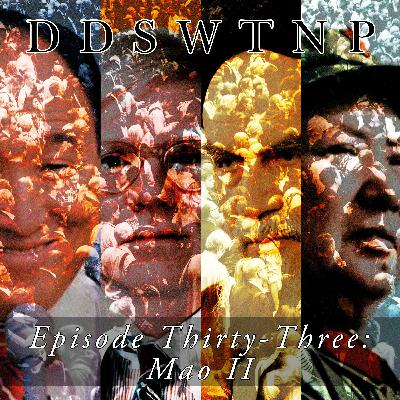
“Here they come, marching into American sunlight.” In Episode 33, DDSWTNP follow Mao II from this opening line into a chilling view of a mass Moonie wedding at Yankee Stadium, and on into the story of reclusive novelist Bill Gray, whose work, maybe, has a chance of deprogramming the mind and language of Karen Janney, one of the participants in that wedding – but maybe not, given the totalizing dominance by images that this novel documents. Our conversation delves into the several rich dialogues Mao II is known for, especially that about (quoting Bill) the “curious knot that binds novelists and terrorists,” the differing attempts by writers and bomb-makers to “alter the inner life of the culture” and “make raids on human consciousness” that DeLillo juxtaposes in this novel, which follows the writer from his cloying “bunker” to London, Athens, and (almost) Lebanon, while also taking in scenes from Iran, China, and the homeless encampments of lower Manhattan. Throughout we discuss the many followers of and sequels to Mao and Maoism DeLillo analyzes, all the ways his characters foolishly seek, outside the values of deep reading and the novel, scenes of “total vision” and messianic “total being,” the “lightning-lit” language of information and the terrorist’s mastery of “the language of being noticed.” We examine in detail as well the effects of Andy Warhol’s work as DeLillo sees it; what it means that readers never learn much at all about the content of Bill’s famous novels; the commonalities he has with Rushdie, Salinger, Pynchon, and DeLillo himself; and why terrorist go-between George Haddad loves word processors so much. We also have a lot to say about the ailing, injured body and spirit of Bill Gray, as well as the simplicity of spoons and what they might teach us about objects and art. Mao II is a book that, as we say in the episode, sums up much of the DeLillo that came before it, lays the groundwork for the masterpiece to come, and contains so many of what have come to seem over the years since 1991 (and over the run of our episodes) the foundational DeLillo ideas and questions, especially ones about politics, violence, and images. Hope you’ll have a listen and, if moved, tell us what you think! Texts referred to in this episode: David Cowart, Don DeLillo: The Physics of Language. Athens: U. of Georgia P., 2002. “Mao II is a sort of rest-and-motion book, to invent a category. The first half of the book could have been called ‘The Book,’ Bill Gray talking about his book, piling up manuscript pages, living in a house that operates as a kind of filing cabinet for his work and all the other work it engenders. And the second half of the book could have been called ‘The World.’ Here, Bill escapes his book and enters the world. It turns out to be the world of political violence . . . I was nearly finished with the first half of the book before I realized how the second half ought to be shaped. I was writing blind . . .” –“Don DeLillo: The Art of Fiction CXXXV,” The Paris Review 128 (1993): 274-306. Interview by Adam Begley. “I called him Bill Gray just as a provisional name,” DeLillo says. “I used to say to friends, 'I want to change my name to Bill Gray and disappear.’ I've been saying it for 10 years. But he began to fit himself into the name, and I decided to leave it.” –Vince Passaro, “Dangerous Don DeLillo,” New York Times Magazine, May 19, 1991 (https://www.nytimes.com/1991/05/19/magazine/dangerous-don-delillo.html) Mark Osteen, American Magic and Dread: Don DeLillo’s Dialogue with Culture. Philadelphia: U. of Pennsylvania P., 2000. Sources of interlude clips from Warhol and Moon: https://www.youtube.com/watch?v=9vCKc7r8U8Ehttps://www.youtube.com/watch?v=GiCYKJc_VwI
 1
1We do have our favorite but surely wouldn’t mind if Thomas Pynchon won the Nobel Prize too . . . and in Episode 32 we finish off 2025 by considering Shadow Ticket, the noir detective take on the 1930s by a writer who was surely a key influence on the early DeLillo (we read from an unpublished DeLillo letter summarizing that relationship) but who also seems to have been reading works like Running Dog over the years (or so we imagine in unpacking Shadow Ticket scenes invoking Chaplin and a “German Political Celebrity” named Hitler). We try to understand how Pynchon’s latest examination of historical and potential fascism works in its 1932 setting, ranging from Milwaukee to Hungary, where reluctant protagonist and “sentimental ape” and “sap” Hicks McTaggart keeps adding on to his P.I. “tickets” in a strange search for a Wisconsin heiress and her Jewish musician lover but also what might ultimately be justice (a far from simple thing). Shadow Ticket is loads of serious fun, where Pynchon manages to examine the direst of turning points amidst scenes of bowling alley and motorcycle lore, dairy strikes, Prohibition’s black markets, dance hall and speakeasy glamour, and something called “Radio-Cheez.” Bela Lugosi, vampires, a beautiful pig in a sidecar, and some of the most tasteless lamps in the world also play a role. The real content here for Hicks, though, is the prospect of spiritual and other forms of peace in a world where weapons from clubs to guns and submarines operate according to mysterious laws of “apport” and “asport,” occult material that interweaves with Hicks’s strike-breaking past and raises connections to Gravity’s Rainbow. Is Hicks’s fellow orphan and young protégé Skeet Wheeler the father of Vineland’s Zoyd, headed out to California as the novel ends? What’s the meaning of Hicks failing to return to his home country, and what does cheese gangster Bruno Airmont’s submarine fate have to do with Bleeding Edge? Are Hungary’s shifting borders a new kind of “Zone”? What’s going on in the novel’s many Statue of Liberty references and its anachronistic allusions to a “Face Tube” for flirtation in bars? And how does this always funny writer, now in his late eighties, keep coming up with all these absurd songs (we sing some) and hilarious mock-movies like the one featuring “Squeezita Thickly” swimming in soup pots (Shirley Temple, is that you?)? Teasing out many connections to Gravity’s Rainbow, Against the Day, and Vineland, this episode makes reference to just about all of Pynchon’s other works, including even V. and his earliest short stories. At the same time, you need come to it with nothing but an interest in Pynchon’s life and work. We doubt that we get every reference to history or previous Pynchon right or mount interpretations we won’t later want to revise, but on this brand-new and captivating late work from a masterful author, we hope in nearly three hours of deep conversation and laughter that we’ve made a good start on the many critical readings to come. A partial list of references and quotations that we mention or paraphrase in this episode . . . On “prefascist twilight”: “And other grandfolks could be heard arguing the perennial question of whether the United States still lingered in a prefascist twilight, or whether that darkness had fallen long stupefied years ago, and the light they thought they saw was coming only from millions of Tubes all showing the same bright-colored shadows. One by one, as other voices joined in, the names began, some shouted, some accompanied by spit, the old reliable names good for hours of contention, stomach distress, and insomnia – Hitler, Roosevelt, Kennedy, Nixon, Hoover, Mafia, CIA, Reagan, Kissinger, that collection of names and their tragic interweaving that stood not constellated above in any nightwide remoteness of light, but below, diminished to the last unfaceable American secret, to be pressed, each time deeper, again and again beneath the meanest of random soles, one blackly fermenting leaf on the forest floor that nobody wanted to turn over, because of all that lived, virulent, waiting, just beneath.” (Pynchon, Vineland (1990)) On “second sheep”: “Our common nightmare The Bomb is in there too. It was bad enough in ’59 and is much worse now, as the level of danger has continued to grow. There was never anything subliminal about it, then or now. Except for that succession of the criminally insane who have enjoyed power since 1945, including the power to do something about it, most of the rest of us poor sheep have always been stuck with simple, standard fear. I think we all have tried to deal with this slow escalation of our helplessness and terror in the few ways open to us, from not thinking about it to going crazy from it. Somewhere on this spectrum of impotence is writing fiction about it.” (Pynchon, “Introduction,” Slow Learner (1984)) The “Sloth essay paragraph” mentioned midway through: “In this century we have come to think of Sloth as primarily political, a failure of public will allowing the introduction of evil policies and the rise of evil regimes, the worldwide fascist ascendancy of the 1920's and 30's being perhaps Sloth's finest hour, though the Vietnam era and the Reagan-Bush years are not far behind. Fiction and nonfiction alike are full of characters who fail to do what they should because of the effort involved. How can we not recognize our world? Occasions for choosing good present themselves in public and private for us every day, and we pass them by. Acedia is the vernacular of everyday moral life.” (Pynchon, “Nearer, My Couch, To Thee” (1993)) Don DeLillo Papers, Harry Ransom Center, University of Texas-Austin The Motherland Calls statue, Volgograd: https://en.wikipedia.org/wiki/The_Motherland_Calls Pareidolia defined: https://en.wikipedia.org/wiki/Pareidolia
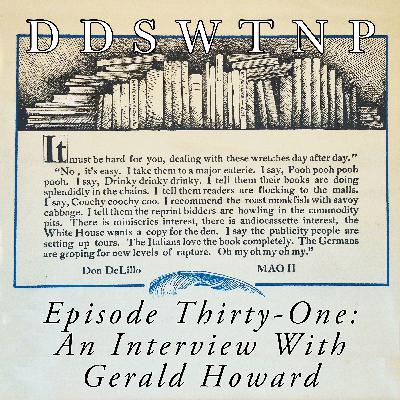
In Episode 31 DDSWTNP get the chance to talk about DeLillo with his friend, colleague, and editor Gerald Howard, whose distinguished career in publishing at Viking Penguin, Norton, and Doubleday spanned nearly 50 years and was marked by his work not only on Libra but important books by David Foster Wallace, Paul Auster, and so many others. We hear Gerry recount first reading the DeLillo of Americana and “Total Loss Weekend” in the 1970s, seeing a book titled “Panasonic” (eventually, White Noise) arrive at Viking Penguin, and having an 800-page manuscript about the JFK assassination later hit his desk. So many great stories mark this episode, including DeLillo’s funny “speech” upon receiving the National Book Award for White Noise, his reasons for seeking a new publisher after The Names, the legal reasoning behind the Author’s Note at the end of the hardcover Libra, and what Gerry for personal reasons regards as one of the funniest of DeLillo’s many funny passages: an editor’s remarks to Bill Gray about the literary marketplace in Mao II. Gerry talks as well about Catholicism, DeLillo’s massive influence on younger writers, and who, along with DeLillo, comprised his personal “trinity” of greatest authors. And at the end we wish a happy 89th birthday to Don DeLillo! With this interview episode, we also extend the biographical “Lives of DeLillo” series we began with our November 20 releases the past two years. Huge thanks to Gerry for sharing so many remarkable stories, insights, and readings. Be sure to pick up Gerald Howard’s new book, The Insider: Malcolm Cowley and the Triumph of American Literature, available this month from Penguin Random House and discussed at the end of this episode. Finally, a note on production: when other technology failed us, we decided to record this interview as a phone call, with obviously a lower sound quality than our listeners are used to. Gerry was wonderfully patient and flexible through it all, and his voice comes through clearly, in a recording that, in its crackles, we’d like to think, captures some spirit of DeLilloan Ludditism. Image of Mao II woodcut in episode cover art is courtesy of Gerald Howard. List of works mentioned in this episode: A. Scott Berg, Max Perkins: Editor of Genius. New York: Dutton, 1978. Don DeLillo, “Total Loss Weekend,” Sports Illustrated, Nov. 27, 1972. https://web.archive.org/web/20110822080327/http://sportsillustrated.cnn.com/vault/article/magazine/MAG1086811/index.htm Gerald Howard, “Stockholm, Are You Listening? Why Don DeLillo Deserves the Nobel.” Bookforum, April/May 2020. https://www.bookforum.com/print/2701/why-don-delillo-deserves-the-nobel-23926 ---. “The Puck Stopped Here: Revisiting ‘Cleo Birdwell’ and her National Hockey League Memoir.” Bookforum, December/January 2008. https://www.bookforum.com/print/1404/revisiting-cleo-birdwell-and-her-national-hockey-league-memoir-1406 ---. “The American Strangeness: An Interview with Don DeLillo.” Hungry Mind Review, 1997. https://web.archive.org/web/19990129081431/www.bookwire.com/hmr/hmrinterviews.article$2563 ---. “I Was Gordon Lish’s Editor.” Slate, October 31, 2007. https://slate.com/news-and-politics/2007/10/editing-the-infamous-gordon-lish.html ---. The Insider: Malcolm Cowley and the Triump of American Literature. Penguin Random House, 2025. https://www.penguinrandomhouse.ca/books/561292/the-insider-by-gerald-howard/9780525522058 Listeners interested in Gerald Howard’s huge impact on publishing in general might turn to the pages about his achievements in Dan Sinykin’s Big Fiction: How Conglomeration Changed the Publishing Industry and American Literature (Columbia UP, 2023) and D.T. Max’s Every Love Story is a Ghost Story: A Life of David Foster Wallace (Penguin, 2012). A correction: DeLillo’s remark on “around-the-house-and-in-the-yard” fiction is from Robert R. Harris’s “A Talk with Don DeLillo,” New York Times Book Review, Oct. 10, 1982.
In Episode 30, DDSWTNP once again use the occasion of the Nobel Prize (which on October 9, 2025, was awarded to Hungarian author László Krasznahorkai) to talk about a prize Don DeLillo did win: the 2013 Library of Congress Prize for American Fiction. We dig into the award presentation and an interview he gave then about his whole career, from how he begins his novels and finds their structures, to the reading he did on a park bench in the 1950s, the influence advertising work had on his writing, and the inspiration he has found in the artistry of jazz and film. This episode culminates on the title question, “So what?”, which is the revealing remark DeLillo remembers making upon seeing Americana in published form – and a key, we think, to understanding the humility, ambition, and restless work ethic that has driven his work over the five decades since. For the reader new to DeLillo, this interview and episode offer a good overview of his major concerns and literary techniques. And for readers at any stage with DeLillo’s fiction, this one also goes well with our previous two Nobel episodes, 3 and 17, where we discuss his “The Artist Naked in a Cage” and “A History of the Writer Alone in a Room.” Listen to this episode too for many other callbacks to our earlier episodes, including 5 and 28. For video of the Library of Congress Prize presentation and the interview of DeLillo conducted by Marie Arana, an editor at the Washington Post, go to: https://www.youtube.com/watch?v=AObZbCKlEc8&t=722s Thanks for pointing out and providing some sources for this episode to: Tim Personn (https://linktr.ee/timpersonn), Joel in Toronto, and Curt Gardner (https://perival.com/delillo/delillo.html). Texts and passages referred to in this episode: John Freeman, “Q & A: Don DeLillo – It’s not as easy as it looks,” San Francisco Chronicle, March 5, 2006. (On DeLillo seeing the film Satantango; see an excerpt at https://perival.com/delillo/ddinterviews.html) From William Gaddis’s J R, Gibbs’s thoughts on writing a novel: “Sixteen years like living with a God damned invalid sixteen years every time you come in sitting there waiting just like you left him wave his stick at you, plump up his pillow cut a paragraph add a sentence hold his God damned hand little warm milk add a comma slip out for some air pack of cigarettes come back in right where you left him, eyes follow you around the room wave his God damned pillow change bandage read aloud move a clause around wipe his chin new paragraph God damned eyes follow you out stay a week, stay a month whole God damned year think about something else, God damned friends asking how he’s coming along all expect him out any day don’t want bad news no news rather hear lies, big smile out any day now, walk down the street God damned sunshine begin to think maybe you’ll meet him maybe cleared things up got out by himself come back open the God damned door right there where you left him . . .” David Foster Wallace, “The Nature of the Fun” (1998). Reprinted in Both Flesh and Not: Essays (2012).
In Episode 29, DDSWTNP go to space to get a good look at the earth in a time of war, turning to one of DeLillo’s greatest short stories, “Human Moments in World War III,” first published in July 1983. We examine this tale of two future astronauts who have become soldiers for its strategic engagement with the tropes of science fiction, its eerie portrayals of the so-called “Overview Effect” available from a spacecraft window, and its compression and renewal of motifs from Americana, End Zone, and Ratner’s Star. Nostalgia, patriotism, history, the soldier’s mindset in following inhuman commands, and even the role of poetry and voice – all these come to be recast in DeLillo’s shrewd take on an era of “Star Wars” defense initiatives, a Cold War giving way to hot wars, and very tricky ways out of Mutually Assured Destruction. Along the way we read the 1980s thoughts of an expert on lasers in space, consider what it means to have an alien perspective on one’s earthly home and diurnal rhythms, and speculate on connections between “Human Moments” and White Noise still to come. Texts referred to and discussed in this episode: Don DeLillo. “Human Moments in World War III.” Published in Esquire (July 1983) and reprinted in The Angel Esmeralda (2011). Philip M. Boffey. “Laser Weapons: Renewed Focus Raises Fears and Doubts.” New York Times, 9 March 1982. https://www.nytimes.com/1982/03/09/science/laser-weapons-renewed-focus-raises-fears-and.html Summary of the Overview Effect: https://en.wikipedia.org/wiki/Overview_effect The first scene of War Games (1983): https://www.youtube.com/watch?v=s6aCpS0-yls Our intro’s clip of DeLillo reading from “Human Moments in World War III” comes from this October 2012 event at the New York Public Library: https://www.nypl.org/audiovideo/angel-esmeralda-don-delillo-conversation-jonathan-franzen The interlude sound effect is from Burns and Allen, featuring Ray Noble, “Rah Rah in Omaha” (1940).
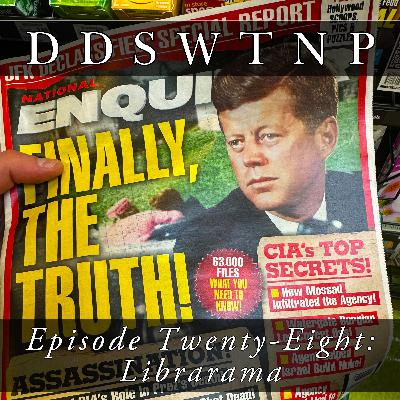
We’re still not done with Libra – or Libra is not done with us! In Episode 28, DDSWTNP pick up threads left hanging after our three-part treatment of DeLillo’s JFK novel. While tackling a wide variety of subjects, this episode homes in on Anthony DeCurtis’s 1988 interview with DeLillo for Rolling Stone (and later re-published in expanded form), “An Outsider in This Society.” We’re led to discuss DeLillo’s canny interview articulations in general, his method of writing by day and reading more history by night, and his reply to the suggestion that on the basis of Libra some readers regarded him as “a member of the paranoid left”: “I don’t have a program.” Along the way we also draw in vivid evidence of how DeLillo subtly reworked the voice of Marguerite Oswald from testimony in the Warren Report, what fellow Oswald novelist Norman Mailer had to say about Libra, and all that is illuminated by an exchange of letters to the New York Times between DeLillo and one of the Warren Report investigators. We also try here to understand as fully as possible the nuances of DeLillo’s ideas about historical fiction that emerge in the incredible DeCurtis interview: what DeLillo means when he says Libra is “a piece of work which is obviously fiction,” touts novels’ ability to “redeem” readers’ “despair,” and makes the powerful claim that “fiction rescues history from its confusions.” We quote enough that listeners will get plenty of insight even without having read the DeCurtis interview in full, and we look forward to applying many of the lessons about history learned here to future works like Underworld. “Some stories never end,” as DeLillo writes to begin “Assassination Aura,” and that’s true of this episode’s cover image, which uses a National Enquirer cover from March 2025 about new releases of JFK files. The interlude clip near the beginning is from Oswald’s August 1963 interviews on WDSU-TV in New Orleans. Finally, as we note in the episode, thanks to Joel in Toronto for an Instagram comment (we’re @delillopodcast) that inspired our return to the DeCurtis interview. Texts mentioned and discussed in this episode: Aristotle, Poetics. Trans. S.H. Butcher. https://www.gutenberg.org/files/1974/1974-h/1974-h.htm Roland Barthes, “The Death of the Author.” Trans. Richard Howard. https://writing.upenn.edu/~taransky/Barthes.pdf David W. Belin, “‘Libra’ and History.” Letter to the editor, New York Times, September 4, 1988. https://www.nytimes.com/1988/09/04/books/l-libra-and-history-487988.html Mark Binelli, “Intensity of a Plot [interview with Don DeLillo].” Guernica, July 17, 2007. https://www.guernicamag.com/intensity_of_a_plot/ Marc Caputo, “CIA admits shadowy officer monitored Oswald before JFK assassination, new records reveal.” Axios, July 5, 2025.https://www.axios.com/2025/07/05/cia-agent-oswald-kennedy-assassination Hal Crowther, “Clinging to the Rock: A Novelist’s Choices in the New Mediocracy.” In Introducing Don DeLillo, ed. Frank Lentricchia, Duke UP, 1991, 83-98. Anthony DeCurtis, “‘An Outsider in This Society’: An Interview with Don DeLillo.” South Atlantic Quarterly (1990) 89 (2): 281-304. (Expanded version of Rolling Stone interview published November 17, 1988 (see https://www.rollingstone.com/culture/culture-news/qa-don-delillo-69452/). Also published in this expanded form in Introducing Don DeLillo, ed. Frank Lentricchia, Duke UP, 1991, 43-66; and in Conversations with Don DeLillo, ed. Thomas DePietro, Jackson: U of Mississippi P, 2005, 52-74. See as well https://perival.com/delillo/ddinterviews.html.) Don DeLillo, “Jack Ruby’s Timing.” Letter to the editor [reply to David W. Belin], New York Times, October 2, 1988. https://www.nytimes.com/1988/10/02/books/l-jack-ruby-s-timing-312488.html Paul Edwards, “Libra at Steppenwolf: John Malkovich Adapts Don DeLillo.” Text and Performance Quarterly (1995) 15:3, 206-228. Gerald Howard, “The American Strangeness: An Interview with Don DeLillo.” Hungry Mind Review, 1997. (“Mailer calls him Doctor Joyce. You and I know that he’s a priest.”)http://web.archive.org/web/19990129081431/www.bookwire.com/hmr/hmrinterviews.article$2563 Douglas Keesey, Don DeLillo. New York: Twayne Publishers, 1993. On DeLillo’s creation of Marguerite Oswald, see pp. 194-96. Thomas LeClair, “An Interview with Don DeLillo,” Contemporary Literature 23.1 (1982): 19-31. (Republished in DePietro, ed., Conversations.) Norman Mailer, Letter to Don DeLillo, August 25, 1988. In Selected Letters of Norman Mailer. Ed. J. Michael Lennon. New York: Random House, 2014. 1092. David Remnick, “Exile on Main Street [interview with Don DeLillo].” New Yorker, September 7, 1997. https://www.newyorker.com/magazine/1997/09/15/exile-on-main-street-don-delillo-profile-remnick Jean Stafford, A Mother in History. New York: Farrar Straus & Giroux, 1966. David Streitfeld, “Don DeLillo’s Gloomy Muse.” Washington Post, May 13, 1992. https://www.washingtonpost.com/archive/lifestyle/1992/05/14/don-delillos-gloomy-muse/5187a6b7-f1f4-4199-9c05-f0b78cc77777/ George F. Will, “Shallow Look at the Mind of an Assassin [review of Libra].” Washington Post, September 22, 1988 (Libra as “an act of literary vandalism and bad citizenship”). Errata: It was Voltaire – not Pascal or Rousseau – who said, “If God did not exist it would be necessary to invent him.” And Underworld’s 1990s scenes begin in 1992, not 1991.
So who killed JFK? We still don’t know, but we’re concluding our series on DeLillo’s conspiratorial history with Episode 27: Libra (3). This episode begins by focusing on the unexpected injection of humor and depth that comes with Jack Ruby, another reluctant shooter, in the novel’s second part. We draw into this episode some comparisons of Libra to other artists’ paranoid visions of conspiracy, including Oliver Stone, Norman Mailer, and Thomas Pynchon. We spend ample time on the newspaper-clipping and TV-watching of CIA wife Beryl Parmenter, one of several figures here who make Libra a canny narrative of media and information history. And we close with detailed debate and speculation about why DeLillo’s concluding “Author’s Note” – with its powerful notion that “readers may find refuge here” – has changed over the years. Like Nicholas Branch, we're overwhelmed by all that still could be said about Libra (and we may still say it in a future episode!), but we conclude our three-part analysis here. References and corrections for this episode: “Don DeLillo: The Word, the Image, and the Gun.” BBC Documentary, September 27, 1991. https://www.youtube.com/watch?v=0DTePKA1wgc Sigmund Freud, “Mourning and Melancholia.” chrome-extension://efaidnbmnnnibpcajpcglclefindmkaj/https://www.sas.upenn.edu/~cavitch/pdf-library/Freud_MourningAndMelancholia.pdf JFK (dir. Oliver Stone, 1991). Frank Lentricchia, “Libra as Postmodern Critique.” In Frank Lentricchia, ed., Introducing Don DeLillo (Durham, NC: Duke U. Press, 1991), 193-215. George F. Will, “Shallow Look at the Mind of an Assassin.” Washington Post, September 22, 1988. Correction and references on Carmine Latta and Sam Giancana: DeLillo’s character Carmine Latta is indeed based on Carlos Marcello (https://en.wikipedia.org/wiki/Carlos_Marcello), but we misstate the name of mobster Sam Giancana (https://en.wikipedia.org/wiki/Sam_Giancana). Interlude clips include the voices of Jack Ruby and Marguerite Oswald.
In Episode 26: Libra (2), DDSWTNP continue our deep dive into DeLillo’s story of Oswald and CIA plotters, taking on the distinctions between lone-gunman and systems theories, the unique role of Bobby Dupard in Oswald’s arc, and all this novel has to teach us about “diminishing existence” and the taste for mediated violence as it’s grown since the watershed moment of 1963. Major segments here focus on the remarkable, Mephistophelean voice of David Ferrie, the work done by secret CIA historian Nicholas Branch, and DeLillo’s prefatory essay “Assassination Aura,” which brings Libra’s enduring mystery into the twenty-first century through the promises and failures of technology embodied by “Dictabelt No. 10.” An episode best listened to, of course, after Episode 25: Libra (1)! Stay tuned next week for the release of our concluding episode on Libra. References and corrections for this episode: Don DeLillo, “American Blood: A Journey Through the Labyrinth of Dallas and JFK.” Rolling Stone, December 8, 1983. Rpt. in Osteen, Mark, ed., Novels of the 1980s: The Names, White Noise, Libra. Library of America, 2022. 1045-1061. Don DeLillo, “Assassination Aura” (May 2005). Included as preface in 2006 edition of Libra (Penguin). “I was able to acquire a copy of the [Zapruder] film before it became legally available, which made me feel slightly conspiratorial”: Don DeLillo, “Preface, 2022.” In Osteen, ed., Novels of the 1980s: The Names, White Noise, Libra. Library of America, 2022. 633-634. Linda Hutcheon, “Historiographic Metafiction: The Pastime of Past Time.” In A Poetics of Postmodernism: History, Theory, Fiction. New York: Routledge, 1988. (The first instance of a concept much discussed by Hutcheon and many others.) Tom LeClair, In the Loop: Don DeLillo and the Systems Novel. U. of Illinois P., 1988. Dante correction: We say “circling the square” in Paradiso 33, but it’s of course the problem of “squaring the circle.” Interlude clips include the voices of General Edwin Walker and Lee Harvey Oswald.
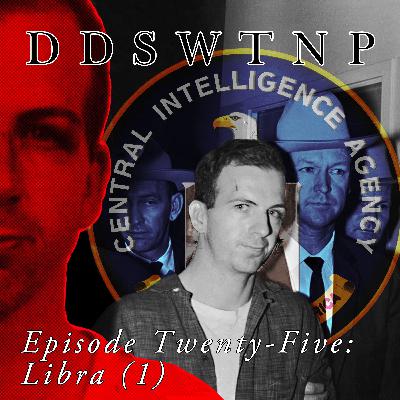
Who killed JFK? What forces made the mind and actions of Lee Oswald? And what does it mean to be an agent of history or something called fate? DDSWTNP probe these and other big questions in multiple new episodes on Libra released over the coming month. June may be the time of Gemini, another sign of doubles in the Zodiac, but for us it’s a month for the balance scale, tipping one way or the other, with some Librans like Lee not balanced at all but (as David Ferrie puts it) “somewhat unsteady and impulsive . . . Poised to make the dangerous leap.” In Episode 25: Libra (1), we discuss where DeLillo began in the 1970s in his build-up to Libra, as far back as Americana and other early novels’ mentions of JFK, Oswald, the CIA, and the overwhelming Warren Report. We examine what makes DeLillo’s Oswald a great but frustrating character and a portal for new dimensions in the author’s examination of language, naming, and self-making. We ask what’s behind the clear shifts in style, tone, and humor DeLillo makes for this historical novel, as well as the power of his place/date chapter structure, the influence of existentialist fiction, and some alternate titles he considered. And we begin working our way through all the figures and ideas surrounding Oswald, from Marxist beliefs and CIA practices of “unknowing” to Cold War obsessions with the Bay of Pigs, life in the U.S.S.R., and a losing war in Vietnam that DeLillo and readers know is coming but his characters importantly don’t. Stay tuned in our Libra episodes to come for investigation of the Murray-like wit of David Ferrie, how DeLillo regards the lone gunman theory, the mysterious edits made to his “Author’s Note,” the theological musings of Nicholas Branch, and much more. Texts and historical figures mentioned in Episode 25: Ann Arensberg, “Seven Seconds” (1988), in Thomas DePietro, ed., Conversations with Don DeLillo, University of Mississippi Press, 2005, 40-46. Don DeLillo, “American Blood: A Journey Through the Labyrinth of Dallas and JFK.” Rolling Stone, December 8, 1983. Rpt. in Osteen, Mark, ed., Novels of the 1980s: The Names, White Noise, Libra. Library of America, 2022. 1045-1061. ---. “Preface, 2022.” In Osteen, ed., Novels of the 1980s: The Names, White Noise, Libra. Library of America, 2022. 633-634. Don DeLillo Papers, Harry Ransom Center, University of Texas at Austin. “Don DeLillo: The Word, the Image, and the Gun.” BBC Documentary, September 27, 1991. https://www.youtube.com/watch?v=0DTePKA1wgc DeLillo: “I was hoping it was Scorpio, because I liked that word. But his birth sign turned out to be Libra, the scales. I settled for that.” David Marchese, “We All Live in Don DeLillo’s World. He’s Confused By It Too” (2020)https://www.nytimes.com/interactive/2020/10/12/magazine/don-delillo-interview.html Everette Howard Hunt: https://en.wikipedia.org/wiki/E._Howard_Hunt Correction: the character Aleksei Kirilenko, Oswald’s Soviet handler in the novel (and source for one of many Lee aliases, Alek?), is DeLillo’s creation, not historical! Branch later reveals Kirilenko’s real name is Sergei Broda (301). No claim about DeLillo’s basis for Kirilenko/Broda, but here is information on yet another shadowy figure, defecting KGB agent Yuri Nosenko, who claimed to have been in charge of Oswald’s case file in the Soviet Union: https://en.wikipedia.org/wiki/Yuri_Nosenko
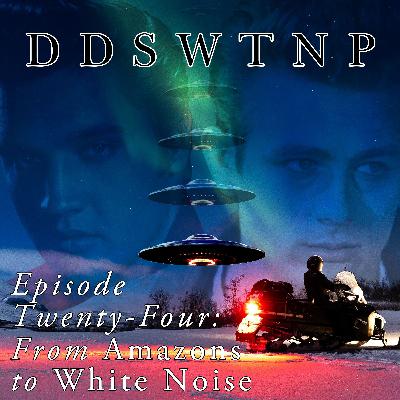
What does the déjà vu allegedly caused by the Airborne Toxic Event have to do with a disease called Jumping Frenchman? How is Jack Gladney’s “day of the station wagons” connected to the first female NHL player’s longing for quaint hometown holidays? In Episode 24, DDSWTNP continue our White Noise residency by showing listeners all the hidden connections between DeLillo’s most famous novel and his most obscure: Cleo Birdwell’s Amazons, his pseudonymous 1980 collaboration with Sue Buck, written as a kind of lark but we think absolutely integral to the satiric vision of White Noise five years later. Our discussion suggests all the ways in which DeLillo seems to have used Amazons as a “laboratory” of sorts, developing Cleo’s thoughts on ad shoots, celebrity athletes, Americana, and an ex-player in a deathlike suspension into the richer, more in-depth meditations on similar topics in White Noise. Naturally we give major attention to Murray Jay Siskind, a sportswriter in Amazons who’s become an Elvis scholar in White Noise, expressing above all our gratitude that DeLillo came back to him and transformed him, reshaping an already very funny snowmobile obsessive into a Mephistophelean wit and one of the darkest, most memorable characters in the corpus. Those who haven’t gotten to read Amazons but know other DeLillo will get a ton out of this episode, for we end up drawing surprising connections not just to White Noise but Americana, End Zone, Great Jones Street, Underworld, Zero K, and others. Turns out this prank of a novel in 1980 paid many dividends for DeLillo. Tune in to hear some fun thoughts as well about a prank of our own: an April Fool’s post about a brand-new DeLillo novel we put on social media a few weeks ago. Texts and quotations referred to in this episode: “Pynchon Now,” including short essay on Pynchon’s example by Don DeLillo, Bookforum (Summer 2005). https://web.archive.org/web/20050729023737/www.bookforum.com/pynchon.html Ernest Becker, The Denial of Death (Free Press, 1973). John N. Duvall, “The (Super)Marketplace of Images: Television as Unmediated Mediation in DeLillo’s White Noise.” In Mark Osteen, ed., White Noise: Text and Criticism (New York: Penguin, 1998), pp. 432-55. Adolf Hitler, “Long Live Fanatical Nationalism” (text of speech). In James A. Gould and Willis H. Truitt, Political Ideologies (New York: Macmillan, 1973), p. 119. Gerald Howard and Mark Osteen, “Why Don DeLillo Deserves the Nobel: A Conversation with Gerald Howard and Mark Osteen,” Library of America, January 17, 2024 (source for Howard’s remark that DeLillo’s manuscripts need no editing).https://www.loa.org/news-and-views/why-don-delillo-deserves-the-nobel/
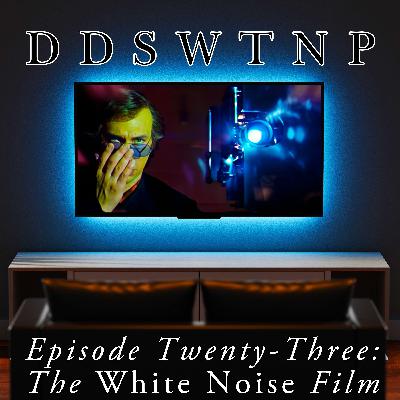
Roll film! In Episode 23, DDSWTNP continue our White Noise residency by heading to the movies (or the TV screen) and examining Noah Baumbach’s 2022 film adaptation of the novel. We discuss the drive over the years to adapt the supposedly “unadaptable” DeLillo for the screen, the 2020s context of this film, and our varied reactions to successive viewings of it over the two-plus years since its release. Other topics include the central performances (especially Adam Driver as an unexpectedly good Jack Gladney and Don Cheadle as a refashioned Murray Siskind); Baumbach’s successes and failures at re-ordering DeLillo’s dialogue and visually distilling certain themes; and his shaping of the narrative as a “meta-cinematic” journey through his personal film history and a mixture of genres. Reviews by Tom LeClair, Marco Roth, and Jesse Kavadlo figure in our analysis, and we close by considering whether we do in fact “need a new body” in the film’s concluding supermarket song and dance number, which in our view captures some of the novel’s themes and distorts others. We’d love to hear on Instagram or email what you think of the film and our reactions, too! We also take a little time to correct a historical error in our Episode 19 on Rachel Kushner’s Creation Lake. Texts and sources for this episode: White Noise (dir. Noah Baumbach, 2022) (Netflix). Film adaptation pages at “Don DeLillo’s America”:http://www.perival.com/delillo/whitenoise_film_2022.htmlhttp://perival.com/delillo/ddoddsends.html Patrick Brzeski, Alex Ritman, “Noah Baumbach on Getting LCD Soundsystem to Create New Track for ‘White Noise,’” The Hollywood Reporter, August 31, 2022.https://www.hollywoodreporter.com/movies/movie-news/venice-noah-baumbach-white-noise-lcd-soundsystem-1235209318/ Jesse Kavadlo, “Don DeLillo’s ‘White Noise’ Remains Unfilmable,” Pop Matters, January 11, 2023.https://www.popmatters.com/white-noise-noah-baumbach-unfilmable Tom LeClair, “The Maladaptation of White Noise,” Full Stop, December 29, 2022.https://www.full-stop.net/2022/12/29/features/tomleclair/the-maladaptation-of-white-noise/ Jon Mooallem, “How Noah Baumbach Made ‘White Noise’ a Disaster Movie for Our Moment,” New York Times Magazine, November 23, 2022.https://www.nytimes.com/2022/11/23/magazine/white-noise-noah-baumbach.html Marco Roth, “Don DeLillo on Xanax,” Tablet, November 3, 2022.https://www.tabletmag.com/sections/arts-letters/articles/don-delillo-xanax-white-noise-noah-baumbach
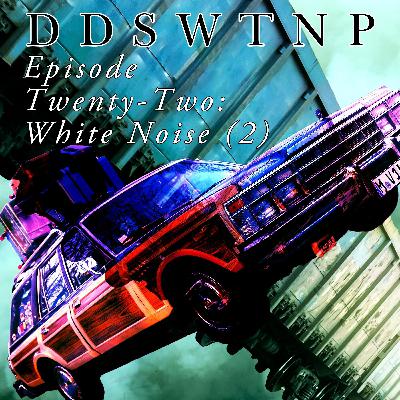
We’ve arrived at the big one, the breakthrough book of 1985 – White Noise. In Episodes 21 and 22, DDSWTNP extend our White Noise “residency” and turn in-depth attention to DeLillo’s most popular piece of fiction in another double episode. Episode 21: White Noise (1) takes an expansive view of the novel’s narrative and goes into depth on (among many other subjects) the iconic opening chapter’s commentary on America and Americana, the meaning of Mylex suits, Jack’s relationships with Heinrich and Orest Mercator, and what it means to be a rat, a snake, a fascist, and a scholar of Hitler in this book’s universe. Episode 22: White Noise (2) interprets passages mainly from the book’s second half, including scenes featuring the dark humor of Vernon Dickey and of SIMUVAC, the meaning of DeLillo’s desired title “Panasonic,” Jack’s shooting of Willie Mink (and what it owes to Nabokov), a riveting fire and a fascinating trash compactor cube, and the Dostoevskyan interrogation of belief by Sister Hermann Marie. Every minute features original ideas on the enduring meanings of White Noise in so many political, social, technological, and moral dimensions – what it teaches us about the roots and implications of our many epistemological crises, how it does all this in writing that somehow manages to be self-conscious, philosophical, hilarious, and warm all at once. Texts and artifacts discussed and mentioned in these episodes: Ernest Becker, The Denial of Death (Free Press, 1973). Adam Begley, “Don DeLillo: The Art of Fiction CXXXV,” The Paris Review 128 (1993): 274-306. (DeLillo: “And White Noise develops a trite adultery plot that enmeshes the hero, justifying his fears about the death energies contained in plots. When I think of highly plotted novels I think of detective fiction or mystery fiction, the kind of work that always produces a few dead bodies. But these bodies are basically plot points, not worked-out characters. The book’s plot either moves inexorably toward a dead body or flows directly from it, and the more artificial the situation the better. Readers can play off their fears by encountering the death experience in a superficial way.”) Buddha, Ādittapariyāya Sutta (“Fire Sermon Discourse”). https://en.wikipedia.org/wiki/%C4%80dittapariy%C4%81ya_Sutta Don DeLillo, White Noise: Text and Criticism, Mark Osteen, ed. (Penguin, 1998). ---. “The Sightings.” Weekend Magazine (August 4, 1979), 26-30. Mary Douglas, Purity and Danger: An Analysis of Concepts of Pollution and Taboo (Routledge, 1966). Fyodor Dostoevsky, The Brothers Karamazov (1880). Franz Kafka, “A Hunger Artist” (1922). Édouard Manet’s Olympia (1863). https://en.wikipedia.org/wiki/Olympia_(Manet) Vladimir Nabokov, Lolita (1955). Mark Osteen, “‘The Natural Language of the Culture’: Exploring Commodities through White Noise.” Approaches to Teaching DeLillo’s White Noise, eds. Tim Engles and John N. Duvall (MLA, 2006), pp. 192-203. Ronald Reagan, “Farewell Address to the Nation,” January 11, 1989. https://www.youtube.com/watch?v=FjECSv8KFN4 (“I’ve spoken of the ‘shining city’ all my political life . . .”) Mark L. Sample, “Unseen and Unremarked On: Don DeLillo and the Failure of the Digital Humanities.” https://dhdebates.gc.cuny.edu/read/untitled-88c11800-9446-469b-a3be-3fdb36bfbd1e/section/be12b589-a9ca-4897-9475-f8c0b03ca648(See this article for DeLillo’s list of alternate titles, including “Panasonic” and “Matshushita” (Panasonic’s parent corporation).)
We’ve arrived at the big one, the breakthrough book of 1985 – White Noise. In Episodes 21 and 22, DDSWTNP extend our White Noise “residency” and turn in-depth attention to DeLillo’s most popular piece of fiction in another double episode. Episode 21: White Noise (1) takes an expansive view of the novel’s narrative and goes into depth on (among many other subjects) the iconic opening chapter’s commentary on America and Americana, the meaning of Mylex suits, Jack’s relationships with Heinrich and Orest Mercator, and what it means to be a rat, a snake, a fascist, and a scholar of Hitler in this book’s universe. Episode 22: White Noise (2) interprets passages mainly from the book’s second half, including scenes featuring the dark humor of Vernon Dickey and of SIMUVAC, the meaning of DeLillo’s desired title “Panasonic,” Jack’s shooting of Willie Mink (and what it owes to Nabokov), a riveting fire and a fascinating trash compactor cube, and the Dostoevskyan interrogation of belief by Sister Hermann Marie. Every minute features original ideas on the enduring meanings of White Noise in so many political, social, technological, and moral dimensions – what it teaches us about the roots and implications of our many epistemological crises, how it does all this in writing that somehow manages to be self-conscious, philosophical, hilarious, and warm all at once. Texts and artifacts discussed and mentioned in these episodes: Ernest Becker, The Denial of Death (Free Press, 1973). Adam Begley, “Don DeLillo: The Art of Fiction CXXXV,” The Paris Review 128 (1993): 274-306. (DeLillo: “And White Noise develops a trite adultery plot that enmeshes the hero, justifying his fears about the death energies contained in plots. When I think of highly plotted novels I think of detective fiction or mystery fiction, the kind of work that always produces a few dead bodies. But these bodies are basically plot points, not worked-out characters. The book’s plot either moves inexorably toward a dead body or flows directly from it, and the more artificial the situation the better. Readers can play off their fears by encountering the death experience in a superficial way.”) Buddha, Ādittapariyāya Sutta (“Fire Sermon Discourse”). https://en.wikipedia.org/wiki/%C4%80dittapariy%C4%81ya_Sutta Don DeLillo, White Noise: Text and Criticism, Mark Osteen, ed. (Penguin, 1998). ---. “The Sightings.” Weekend Magazine (August 4, 1979), 26-30. Mary Douglas, Purity and Danger: An Analysis of Concepts of Pollution and Taboo (Routledge, 1966). Fyodor Dostoevsky, The Brothers Karamazov (1880). Franz Kafka, “A Hunger Artist” (1922). Édouard Manet’s Olympia (1863). https://en.wikipedia.org/wiki/Olympia_(Manet) Vladimir Nabokov, Lolita (1955). Mark Osteen, “‘The Natural Language of the Culture’: Exploring Commodities through White Noise.” Approaches to Teaching DeLillo’s White Noise, eds. Tim Engles and John N. Duvall (MLA, 2006), pp. 192-203. Ronald Reagan, “Farewell Address to the Nation,” January 11, 1989. https://www.youtube.com/watch?v=FjECSv8KFN4 (“I’ve spoken of the ‘shining city’ all my political life . . .”) Mark L. Sample, “Unseen and Unremarked On: Don DeLillo and the Failure of the Digital Humanities.” https://dhdebates.gc.cuny.edu/read/untitled-88c11800-9446-469b-a3be-3fdb36bfbd1e/section/be12b589-a9ca-4897-9475-f8c0b03ca648(See this article for DeLillo’s list of alternate titles, including “Panasonic” and “Matshushita” (Panasonic’s parent corporation).)
Looking to start reading Don DeLillo, or already a fan and looking for ways to persuade your friends, relatives, or students to finally access the wonders of White Noise? In Episode Twenty, DDSWTNP offer an introduction to White Noise for the first-time reader of DeLillo, focusing on elements of plot, action, character, humor, and voice that often present stumbling blocks to initiates. We help listeners navigate DeLillo’s most popular novel, the “gateway drug” to the joys and challenges that a lifetime of reading his corpus holds in store. We also answer key questions like how to regard Hitler Studies and whether you need to know anything about “postmodernism,” philosophy, or how a media theorist might read the Most Photographed Barn in America before entering DeLillo’s world (spoiler: no!). Longtime listeners to the pod will find here, we hope, an episode to send along to anyone they’ve given a copy of White Noise for Christmas or ever told, “Hey, you should read Don DeLillo.” The first of several episodes to come from us on White Noise as the novel turns 40, this podcast will be followed in 2025 by our deep dives into the novel itself, its massive body of criticism, and the recent film adaptation – so stay tuned, and may you be immensely pleased. First-time readers of White Noise looking for illuminating critical and contextual reading should try some of the essays and excerpts collected in Mark Osteen, ed., White Noise: Text and Criticism (New York: Penguin, 1998), as well as the many excellent resources at Curt Gardner’s website “Don DeLillo’s America” (http://perival.com/delillo/delillo.html). But as we suggest in the episode, mainly we advise just going back and re-reading all your favorite scenes, or even the whole thing!
In Episode Nineteen, DDSWTNP turn outward to a discussion of Rachel Kushner, whose Booker Prize-nominated Creation Lake, a 2024 novel about the folly of espionage, revolutionary violence, life underground, and confronting modernity with ancient practices in rural France, solidifies its author’s reputation as a key inheritor of DeLillo’s influence and themes. Creation Lake is narrated by a nihilistic spy named Sadie Smith who infiltrates a farming commune called Le Moulin and grows enchanted with the claims of their cave-dwelling philosophical advisor, who argues that Neanderthal life thousands of years ago holds the key to reshaping humankind. In it Kushner explores the legacy of France’s 1968 while echoing The Names, Great Jones Street, Ratner’s Star, Mao II, and other DeLillo works, as we outline in our discussion. We find rich references as well in Creation Lake to Nathaniel Hawthorne, Joan Didion, Michel Houellebecq, and Kushner’s own previous works, especially The Flamethrowers and The Mars Room. Listeners looking for new writing reminiscent of DeLillo and those already knowledgeable of Kushner’s works will find plenty here, and we hope this episode will be the first of several over time dedicated to DeLillo’s massive influence on exciting new world literature. Texts and quotations mentioned and discussed in this episode, in addition to Creation Lake and those by DeLillo: Joan Didion, Play It As It Lays (1970) and Slouching Towards Bethlehem (1968) Dana Goodyear, “Rachel Kushner’s Immersive Fiction,” The New Yorker, April 23, 2018 (includes discussion of Kushner’s friendship with DeLillo) Nathaniel Hawthorne, The Blithedale Romance (1852) and The Scarlet Letter (1850) Michel Houellebecq, Serotonin (2019) Rachel Kushner, The Flamethrowers (2013) and The Mars Room (2018) ---. “Rachel Kushner: ‘The last book that made me cry? The Brothers Karamazov,” The Guardian, October 5, 2018 (source of this answer: “The book that influenced my writing: Probably novels by Joan Didion, Denis Johnson and Don DeLillo. But a whole lot of other books, too”) “In a real dark night of the soul, it is always three o’clock in the morning, day after day.” (F. Scott Fitzgerald, “The Crack-Up” (1936)– a line mangled slightly in the episode)
In Episode Eighteen, DDSWTNP wish our author a happy 88th birthday and talk about the international life he led between the mid-1970s and early 1980s. We follow DeLillo abroad, covering his year in Canada (1975) and his much-discussed time living in Athens (1978-1982), tracing influences of these experiences on portrayals of national identity and language in The Names especially but other works too. Central to understanding this period is the powerful change in method that DeLillo made at his manual typewriter that inspired slower, more “serious” work. For those who already know the biography pretty well we also have in this episode some surprising details garnered from his letters in these years to editor and friend Gordon Lish, the remarkable story of DeLillo’s response to a Utah banning of Americana in 1979, and connections between the 1981 Athens earthquakes DeLillo lived through and the 1988 short story “The Ivory Acrobat.” We end by considering the “toxic spill” of the news that greeted DeLillo on his return to America in 1982 and energized the writing of White Noise, and we announce too some upcoming episodes that will close out 2024! As is often true, we get significant help in this episode from interview excerpts and more collected at Don DeLillo’s America: http://perival.com/delillo/delillo.html Texts referred to and quoted from in this episode: Ann Arensberg, “Seven Seconds” (1988), in Thomas DePietro, ed., Conversations with Don DeLillo, University of Mississippi Press, 2005, 40-46. Adam Begley, “Don DeLillo: The Art of Fiction CXXXV,” The Paris Review 128 (1993): 274-306. Don DeLillo, The Engineer of Moonlight, Cornell Review 5 (Winter 1979), 21-47. [Incorrectly placed in Epoch in episode.] ---, “The Ivory Acrobat,” Granta (Issue 108, 1988) (and collected in The Angel Esmeralda: Nine Stories). Robert Harris, “A Talk with Don DeLillo” (1982), in DePietro, ed., 16-19. Gordon Lish Manuscripts (1951-2017), Lilly Library, Indiana University (https://archives.iu.edu/catalog/InU-Li-VAC9786). Mervyn Rothstein, “A Novelist Faces His Themes on New Ground” (1987), in DePietro, ed., 20-24. Jim Woolf and Dan Bates, “Davis Official’s Action Dismays, Horrifies Author of ‘Americana.’” The Salt Lake Tribune, August 31, 1979.
In Episode Seventeen, DDSWTNP briefly discuss new Nobel Laureate Han Kang before digging into “A History of the Writer Alone in a Room,” DeLillo’s acceptance speech for an award he did win, the 1999 Jerusalem Prize. In this unpublished, hard-to-find text, DeLillo tells the humbling story of the novelist at frustratingly slow work, “shaped by the vast social reality that rumbles all around him,” in a narrative that conjures scenes that resonate with Libra, Mao II, and other of DeLillo’s portraits of the artist (while also raising the question of whether DeLillo has a cat). Novelists Thomas Mann, Philip Roth, and William Gaddis make their way into our analysis of this miniature fiction, and we consider as well the meaning of the Jerusalem Prize, the “nonchalant terror” of everyday life, and the young woman writer the essay at its end envisions taking up this legacy of lonely work. Texts mentioned or cited in this episode: Don DeLillo, “A History of the Writer Alone in a Room,” 1999 Jerusalem Prize For the Freedom of the Individual in Society acceptance address. Jerusalem: Jerusalem International Book Fair, 1999. Reprinted in German translation (“Der Narr in seinem Zimmer”) in Die Zeit (March 29, 2001). See also: https://collections.library.yale.edu/catalog?op=AND&sort=score+desc%2C+pub_date_si+desc%2C+title_si+asc&search_field=advanced&all_fields_advanced=&child_oids_ssim=17371596&commit=SEARCH ---. “On William Gaddis.” Conjunctions (Issue 41, Fall 2003). https://web.archive.org/web/20031123133017/http://www.conjunctions.com/archives/c41-dd.htm[Incorrectly placed in Bookforum in the episode.] ---. “The Artist Naked in a Cage.” The New Yorker, May 26, 1997. “Don DeLillo: The Word, the Image, the Gun.” Dir. Kim Evans. BBC Documentary, September 27, 1991. https://www.imdb.com/title/tt4029096/ and https://www.youtube.com/watch?v=0DTePKA1wgc&t=63s William Gaddis, The Recognitions. Harcourt Brace & Co., 1955.
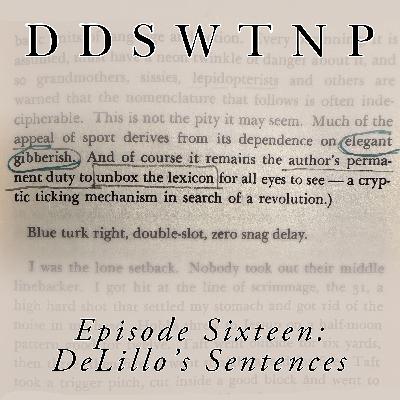
In Episode Sixteen: “DeLillo’s Sentences,” DDSWTNP take a brief break from analyzing full novels to do some very close reading of single sentences from across DeLillo’s career. Style and craft, sound and rhythm, and what makes DeLillo (as one critic puts it) a poet writing prose—these are subjects we consider as we look closely at the lines noted below and try to figure out what DeLillo means when he says in 1997, “At some point you begin to write sentences and paragraphs that don’t sound like other writers’.” This episode is a deep dive into DeLillo’s language but also a pretty good introduction for those just starting to read him. #donutmaker #thehemingwayand DeLillo lines analyzed in this episode: “Much of the appeal of sport derives from its dependence on elegant gibberish. And of course it remains the author’s permanent duty to unbox the lexicon for all eyes to see—a cryptic ticking mechanism in search of a revolution.” End Zone (113) “New York seemed older than the cities of Europe, a sadistic gift of the sixteenth century, ever on the verge of plague.” Great Jones Street (3) “Around the great stadium the tenement barrens stretch, miles of delirium, men sitting in tipped-back chairs against the walls of hollow buildings, sofas burning in the lots, and there is a sense these chanting thousands have, wincing in the sun, that the future is pressing in, collapsing toward them, that they are everywhere surrounded by signs of the fated landscape and human struggle of the Last Days, and here in the middle of their columned body, lank-haired and up-close, stands Karen Janney, holding a cluster of starry jasmine and thinking of the bloodstorm to come.” Mao II (7) “The last sentence was, ‘In future years, of course, men and women, in cubicles, wearing headphones, will be listening to secret tapes of the administration’s crimes while others study electronic records on computer screens and still others look at salvaged videotapes of caged men being subjected to severe physical pain and finally others, still others, behind closed doors, ask pointed questions of flesh-and-blood individuals.” Point Omega (33) Other texts cited in this episode: “Tom LeClair.” Interview by Andrew Mitchell Davenport. Full Stop, May 19, 2015. https://www.full-stop.net/2015/05/19/interviews/andrew-mitchell-davenport/tom-leclair/ “‘Writing as a Deeper Form of Concentration’: An Interview with Don DeLillo.” Interview by Maria Moss. Conversations with Don DeLillo. Ed. Thomas DePietro. Jackson: University of Mississippi Press, 2005. 155-68. “Exile on Main Street: Don DeLillo’s Undisclosed Underworld.” Interview by David Remnick. Conversations with Don DeLillo. 131-44.
In Episode Fifteen, DDSWTNP take on The Names, a Greece-based story of a strange “abecedarian” murder cult, a novel regarded by DeLillo as his turn toward more “serious” writing and placed at or near the top of many a reader’s list of favorites. We discuss The Names as an examination of the “Depravities” and guilt of being an American in the complex late-1970s world of corporations, risk analysis, bank loans, and intelligence covers that narrator James Axton navigates, and we ask why The Names puts this geopolitical tumult (including the 1979 Iranian Revolution) in the context of ancient languages, ritual sacrifice, and a dissolving marriage and family life for James. Language-obsessed Owen Brademas (the archeologist and “epigraphist” who is drawn relentlessly to the fascinating cult) and filmmaker Frank Volterra (perhaps a sly satire of a certain American auteur?) figure in this story of religion, aesthetics, and the enduring appeal of violence, but we turn at the end of this episode to the nine-year-old author Tap, Axton’s son, whose misspelled, highly spirited tale of the spirit to which his tongue might “yeeld” lets DeLillo showcase all the ways to use the alphabet to salutary and generative ends. #getwet #themindslittleinfinite We also announce the winner of our Amazons raffle and say thanks to all who have supported and continue to support us at buymeacoffee.com/delillopodcast. Texts mentioned and discussed in this episode: Burn, Stephen J. “‘A Paradigm for the Life of Consciousness’: The Pale King.” David Foster Wallace and “The Long Thing”: New Essays on the Novels, ed. Marshall Boswell. New York: Bloomsbury, 2014. 149-168. “Don DeLillo: The Art of Fiction CXXXV,” Interview with Adam Begley, The Paris Review 128 (1993): 274-306. “A Talk with Don DeLillo,” Interview with Robert Harris, in Thomas DePietro, ed., Conversations with Don DeLillo, University of Mississippi Press, 2005, 16-19. The Godfather (1972) and Apocalypse Now (1979), dir. Francis Ford Coppola. (We have the dates on both films slightly wrong in the episode.) Hearts of Darkness: A Filmmaker’s Apocalypse (1991), dir. George Hickenlooper and Fax Bahr Viet Thanh Nguyen, The Sympathizer. Grove Press, 2015.
In Episode Fourteen, DDSWTNP turn our attention for the first time to DeLillo’s drama – and to a largely unknown work by DeLillo as playwright, a 1966 radio play and disturbing take on U.S. race relations titled Mother. We cover the circumstances of the play’s original broadcasts, its re-emergence in an internet archive recording more than 50 years later, and the strange way in which this story’s armchair progressives and Billie Holiday fans, Ralph and Sally, end up making a fetishizing travesty of civil rights and racial integration in the play’s brief 27 minutes. Topics include the importance of radio to Mother’s themes of media occlusion, moral numbness, and erasure; what DeLillo means by Ralph’s “white malady” of transparency and how it reworks images from another Ralph’s Invisible Man; and what this play has to do with contemporaneous issues like interracial marriage in Loving v. Virginia. We talk extensively as well about how Mother presages parts of the early novels, from jazz love in Americana to Taft in End Zone and Azarian in Great Jones Street. Before (and after) listening to our analysis, take in this troubling 27-minute play at https://archive.org/details/pra-BB3830.01 Our raffle for a hardcover Amazons has been extended to August 1 – donate and enter to win at https://buymeacoffee.com/delillopodcast Texts mentioned and discussed in this episode: James Baldwin, The Fire Next Time. Dial Press, 1963. Samuel Beckett, Endgame. 1957. Don DeLillo, The Mystery at the Middle of Ordinary Life. 2000.https://muse.jhu.edu/article/30660/pdf Ralph Ellison, Invisible Man. Random House, 1952. “The writer is driven by his conviction that some truths aren’t arrived at so easily, that life is still full of mystery, that it might be better for you, Dear Reader, if you went back to the Living section of your newspaper because this is the dying section and you don’t really want to be here.” (Thomas LeClair, “An Interview with Don DeLillo,” Contemporary Literature 23.1 (1982): 19-31) Eugene Ionesco, Rhinoceros. 1959. Mark Osteen. “Chronology.” In Don DeLillo, Three Novels of the 1980s. Library of America, 2022. Jean-Paul Sartre, No Exit. 1944.

Comments

Download from Google Play

Download from App Store
 United States