DiscoverThe WTF Bach Podcast
The WTF Bach Podcast

The WTF Bach Podcast

Author: Evan Shinners

Subscribed: 51Played: 3,090
Share

Description

Hear the music of J.S. Bach with new understanding!
For music lovers, to professional musicians.
Let Evan Shinners, (aka W.T.F. Bach) guide your mind through a contrapuntal journey.
Go to: wtfbach.substack.com for the full experience.

wtfbach.substack.com
123 Episodes
Reverse
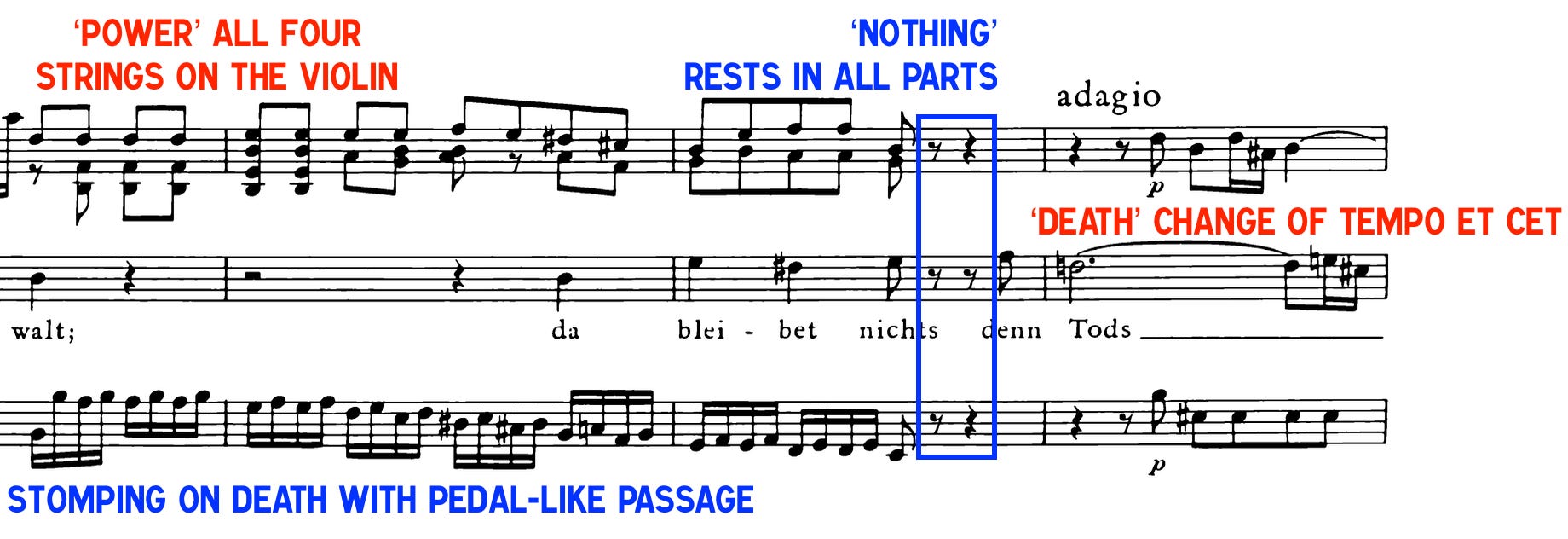
Update: Just got five promo codes to download Time Guru (the cool metronome app mentioned in the episode.) Send me a message or let me know down below you’re interested and I’ll share the codes! Happy PracticingLet’s get our good new habits in early in the year! In this episode, I read practical advice from three organists/organ method books. The organ method books are in a class of their own— highly entertaining reading.We begin with Francis Routh’s Teach Yourself The Organ (1958.) His asterisk marking the complete works of Buxtehude as ‘fairly easy’ is representative of this amusing book:Harold Gleason’s method book of 1962 makes up the bulk of this episode, the complete advice is pasted below.We feature some of Fayth Freese’s excellent article from The Diapason. I recommend the full read. And here is the advice to teens I made for the Harrison School for the Arts in Lakeland Florida. I cannot emphasize enough how music should be a joyous process at this age, never an abusive one.From Gleason (bold type is my emphasis)HOW TO PRACTICE:* Make a schedule for daily practice. Devote a definite amount of time to technique, to new music, to perfecting music already studied, and to memorizing. Devote at least one hour a day to piano practice. Later the student will need to reserve time for perfecting the many skills required for playing the church service.* Practice as if the piece were being memorized (see the section on Memorizing).* Study the music before beginning to practice. Note the key signature, time signature, note values, fingering, pedaling, structure, special problems, and general style. If the fingering and pedaling is not given or is inadequate, it should be carefully worked out according to the principles given in the sections on Fingering and Pedaling.* Memorize and always use the same fingering and pedaling. Incorporate the articulation, phrasing and interpretation into the practice.* Try to avoid playing wrong notes or incorrect time values from the first time an exercise or piece is practiced. If a wrong note or rhythm is played, do not immediately correct it. Go back to the beginning of the phrase and repeat the passage correctly a number of times.* Concentrate on the work at hand and avoid mechanical, unthinking practice and repetition. Always practice after a lesson.* Practice slowly in the following sequence: right hand; left hand; both hands; pedal; right hand and pedal; left hand and pedal; both hands and pedal. Begin the slow practice of short sections for both hands and pedal while working on separate parts.* When the phrases and sections of a composition have been mastered at a low tempo, play it all the way through. When this has been accomplished with complete muscular control and accuracy, the tempo may be gradually increased. Return to slow, detailed practice of sections which are not secure, and repeat this process at succeeding practice periods.* Always practice at a steady tempo. Do not play easy places fast and difficult places slowly.* Devote the most attention to difficult passages.* In contrapuntal music, play one or more parts and sing another part.* In passages of a technical nature, the practice of four-note groups in the various rhythmic patterns is helpful in developing speed and control.* Stop practicing and relax for a few minutes at the first sign of tension.* When practicing technical exercises for manuals and pedals, and when first learning a piece, use clear, quick-speaking stops of 8’ or 8’ and 4’ pitch (Gedackt 8’, Principal 4’).* As soon as the notes in a composition have been mastered, work out an appropriate registration.* The drawing of stops and the use of combination pistons and reversibles should be carefully practiced and synchronized, in order not to interfere with the performance of the music.* Above all, the student should learn to listen and hear that the parts are sounding together, are released together, and that the touch, rhythm, accents, and interpretation are actually being realized as intended.How’s Your Contrapuntal Journey Fugueing?HOW TO MEMORIZE:The principal reason for playing from memory lies in the fact that it will result in a better performance, both technically and musically. The perfectly memorized work becomes a part of the performer and gives him complete freedom of expression.When a piece of music is practiced correctly and efficiently, it is also being memorized, and good practice habits will lead to a continual improvement in the ability to memorize.After a composition has been thoroughly learned with the notes, the complete process of memory should be undertaken. Concentration and interest in learning are indispensable to the memory process.There are four types of memory which are used in music. Three of these types—aural, visual, and motor memory—depend on our senses or imagery. The fourth, and most important type, is known as cognitive memory. It is based on knowledge and is the memory we use in the analytical study of the music.The memorization of music requires the combination and collaboration of the four types of memory. We all vary in our natural gifts and capacities, but all types of memory should be cultivated and can be improved.Cognitive MemoryThis memory is the basis of all study, from the time the piece is first practiced until it is performed from memory. Every detail of the music should be analyzed technically and musically, and be consciously known. Organize notes into patterns, groups, and phrases. Note all sequences and variations from the sequential pattern. Analyze harmonic progressions and relate them to each other. Contrapuntal lines, rhythm, and interpretative factors are all a part of analytical study. Study the form and relate the details to the whole.Aural MemoryThis memory is useful in enabling us to hear mentally what the next note or chord is, and it strengthens the other types of memory. The ability to hear accurately and retain what we hear should be developed until individual lines of the music can be played and sung without errors. Eventually a whole composition can be “practiced” by going through it and hearing the sound mentally.Visual MemoryThis type of memory gives us a mental image of the way the notes look on the printed page, or the place of the notes and the shape of each passage on the keyboard. Visual memory may be developed by concentrating on a measure of music, consciously noting all its details, and then reproducing it from the mental image. Gradually more measures can be added, and a mental image of whole phrases and sections can be retained. Avoid using different editions of a composition during the learning process.Motor MemoryThis is one of the most useful and also the most dangerous types of musical memory. Motor memory involves the touch sensations and training of the muscles so that the movements in playing become automatic. They should, however, never be mechanical. In developing motor memory the same fingering and pedaling must always be used. Avoid repeating phrases endlessly without thought or purpose. Never depend on motor memory alone in memorizing a piece. The slightest interruption in the automatic process will inevitably lead to a breakdown.Summary* Begin to learn all the techniques of memorizing with the first lesson. The basic principles of position, manual technique, and practicing should be memorized. Analyze the exercises and studies and memorize the fingering. A few of the manual studies in which the student is particularly interested should be memorized after they have been learned perfectly with the music.* Memorizing should continue throughout the organist’s career and be made a part of every practice period.* Memorize when the mind is alert and the power of concentration is strongest. Do not attempt to memorize when fatigued.* Always begin with analysis and then introduce the other memory techniques. The more thoroughly the music is learned the longer it will be retained and the more positive will be its recall.* Memorize phrases or short sections at first and gradually develop the ability to learn longer sections. Always be sure the sections are connected in the mind and make a unified whole.* Work on at least one new section of music each day and then review the previous sections.* Memorize landmarks at cadential points and practice beginning at any one of these landmarks.* Memorize and be able to play the parts for each hand alone and the pedal part alone.* In reviewing a work previously memorized always consult the score and repeat the original memory process.* Do not think of difficulties ahead, or the association of chord to chord and phrase to phrase will be lost.* In performing from memory, the subconscious mind will function if it is not interfered with by fear.* The fear of forgetting can be eliminated by the knowledge that every detail of the music and its interpretation has been engraved in the mind and that the aural, visual, and motor senses have been well trained.Want to see this resource stick around? Here’s how you can help:We encourage our listeners to become a paid subscriber atwtfbach.substack.comFree subscriptions (yes, you can subscribe for free!) are also beneficial for our numbers. You can make a one-time donation here. We run a 501(c)3, so let us know if you want a tax deduction:https://www.paypal.me/wtfbachhttps://venmo.com/wtfbachSupporting this show ensures its longevity. Thank you for your support! Get full access to W.T.F. Bach? at wtfbach.substack.com/subscribe
This famous piece:saw quite a few revisions between its conception and the version we know. For starters, note the earliest version’s key signature, and the E-flat in bar 2:The most striking feature of the early version is the abrupt end:No presto? No adagio? No allegro?The fugue (in 3 voices) is a fugue with two countersubjects. See them here, the first on top, the second below. Both countermelodies occur with every entrance of the main theme:Become your best Buxtehude.We also have a brief look at the c minor invention, BWV 773. The piece is almost entirely a canon.I also mentioned the issue of “stemming” at the beginning of the episode. Here is the chord I mentioned (BWV 867.) Note how Bach’s nine individual stems imply nine separate voices, whereas the print reduces them to only four:N.B. Most of the episodes of this podcast have been newly catalogued according to genre or theme or BWV on my Substack. Yet another reason for you to join the platform! You can now browse according to BWV, instrumentation, et cetera. Have a gander at wtfbach.substack.comThanks to all my listeners for supporting me in 2025! Thanks to Romain Villet for reminding me to make this episode. Best of luck to him and to all brave enough to transpose Bach in 2026!We survive solely on donations. Thank you for your help!We encourage our listeners to become a paid subscriberat wtfbach.substack.comFree subscriptions are also great for our numbers.You can also make a one-time donation here:https://www.paypal.me/wtfbachhttps://venmo.com/wtfbachSupporting this show ensures its longevity.Concepts Covered: This podcast episode discusses Johann Sebastian Bach’s Well-Tempered Clavier, book 1, (1722) the second prelude and fugue in C minor. Including revisions, fugue structure, and contrapuntal technique, with a few hints at BWV 773 and BWV 867. There is a double countersubject, canonic writing, BWV 847a, and the earliest versions before source P. 415 Get full access to W.T.F. Bach? at wtfbach.substack.com/subscribe
We’ve traveled halfway through the chromatic scale and Bach celebrates this victory with one of the more complex fugues in the collection. The subject is somber, full of half-steps and even a cross. It foreshadows the true finale at the close of all 24 pieces:This is one of the only fugues to make strict use of the countersubject, occurring in all but one (!) appearances of the subject.This motif, which we call the head of the countersubject, dominates all the episodic material both right side up, and upside down:Got Bach?The prelude contains some interesting revisions. Here is one I thought would be too subtle to hear, but I think it’s quite audible in the episode:The latter represents a rare simplification of harmony and texture in revision.The biggest addendum of all is the additional measures at the end of the piece. See how abruptly the early version ends:We survive solely on donations. Thank you for your help!We encourage our listeners to become a paid subscriberat wtfbach.substack.comFree subscriptions are also great for our numbers.You can also make a one-time donation here:https://www.paypal.me/wtfbachhttps://venmo.com/wtfbachSupporting this show ensures its longevity.Concepts Covered:J.S. Bach’s Well Tempered Clavier, Tuning, Revisions, Early verisions. The f minor prelude and fugue BWV 857, with its countersubject, analysis and study. Organ and harpsichord performances, Chromaticism, tone-rows, Get full access to WTF Bach? at wtfbach.substack.com/subscribe
YouTube These Days....Enjoying your contrapuntal journey? Here’s how you can help:We encourage our listeners to become a paid subscriber atwtfbach.substack.comFree subscriptions (yes, you can subscribe for free!) are also beneficial for our numbers.You can make a one-time donation here. We run a 501(c)3, so let us know if you want a tax deduction:https://www.paypal.me/wtfbachhttps://venmo.com/wtfbachSupporting this show ensures its longevity. Thank you for your support! Get full access to WTF Bach? at wtfbach.substack.com/subscribe
Anyone else feel like we don’t have enough fugues in F major?In the last of Bach’s four layerings to the fair copy of The Well-Tempered Clavier, we see some beautiful details that would have been lost had Bach not made this last series of revisions in the 1740s. It makes you wonder if Bach would have made even more, should he have lived as long as Telemann! Bar 42 reads like this in A1-A3 into the 1740s: Then, in A4, Bach found expression in the tie and 32nd notes:Such a revision physically looks like this on fair copy:This particular revision may not be immediately clear to the naked eye, but some are (see the e minor revisions at the bottom of the post.) I believe it was X-ray technology that led to such breakthroughs in the scholarship, but some layers might be a sort of ‘white-out’ or paste that physically would stand out on the paper— any expertise would be appreciated in the comments! We know that in the Saint Matthew Passion, Bach quite literally ‘layered’ smaller pieces of paper onto the manuscript, but I think that has to do with repair, not necessarily revision. One famous layering in A4 looks as if it’s been pasted onto the manuscript… but it could be my imagination. From the first fugue, BWV 846:WTF Bach is free to all! Let’s spread the awareness of contrapuntal mastery. However, if you support financially, you’re much less likely to write parallel 5ths.There are a number of revisions also in the F Major prelude. Interestingly, the length of both prelude and fugue remains unchanged between earliest versions and the fair copy. Bach had the general harmonic rhythm right, but smooths out the insides of some measures:(Early versions, followed by the fair copy)And so on… (more demonstrations in the episode.)I finish the episode with four beautiful revisions to the e minor prelude (covered in Ep. 114) again made in A4. These are typical of his final revisions to the WTC1, bursting with 32nds. Here, one can somewhat plainly see the difference between inks:Before these revisions, the melody was as follows:We survive solely on donations. Thank you for your help!We encourage our listeners to become a paid subscriberat wtfbach.substack.comFree subscriptions are also great for our numbers.You can also make a one-time donation here:https://www.paypal.me/wtfbachhttps://venmo.com/wtfbachSupporting this show ensures its longevity.Concepts Covered:J.S. Bach’s late A4 revisions to the Well-Tempered Clavier I (BWV 846–869) in the F-major fugue BWV 856, the F major prelude, the discant adjustments that earlier manuscript stages (A1–A3) lack. The late embellishments in the E-minor prelude BWV 855, The genesis of WTK I, variant readings, fair-copy corrections, Harmonic analysis, contrapuntal rules, and the general genius of Bach. Get full access to WTF Bach? at wtfbach.substack.com/subscribe
Giving thanks to all my listeners today! Why do you listen to this podcast?The original Spanish of the Borges poem, as read by my good friend, Andrea Profili.Otro poema de los donesGracias quiero dar al divinoLaberinto de los efectos y de las causasPor la diversidad de las criaturasQue forman este singular universo,Por la razón, que no cesará de soñarCon un plano del laberinto,Por el rostro de Elena y la perseverancia de Ulises,Por el amor, que nos deja ver a los otrosComo los ve la divinidad,Por el firme diamante y el agua suelta,Por el álgebra, palacio de precisos cristales,Por las místicas monedas de Ángel Silesio,Por Schopenhauer,Que acaso descifró el universo,Por el fulgor del fuego,Que ningún ser humano puede mirar sin un asombro antiguo,Por la caoba, el cedro y el sándalo,Por el pan y la sal,Por el misterio de la rosa,Que prodiga color y que no lo ve,Por ciertas vísperas y días de 1955,Por los duros troperos que en la llanuraArrean los animales y el alba,Por la mañana en Montevideo,Por el arte de la amistad,Por el último día de Sócrates,Por las palabras que en un crepúsculo se dijeronDe una cruz a otra cruz,Por aquel sueño del Islam que abarcóMil noches y una noche,Por aquel otro sueño del infierno,De la torre del fuego que purificaY de las esferas gloriosas,Por Swedenborg,Que conversaba con los ángeles en las calles de Londres,Por los ríos secretos e inmemorialesQue convergen en mí,Por el idioma que, hace siglos, hablé en Nortumbria,Por la espada y el arpa de los sajones,Por el mar, que es un desierto resplandecienteY una cifra de cosas que no sabemosY un epitafio de los vikings,Por la música verbal de Inglaterra,Por la música verbal de Alemania,Por el oro, que relumbra en los versos,Por el épico invierno,Por el nombre de un libro que no he leído:Gesta Dei per Francos,Por Verlaine, inocente como los pájaros,Por el prisma de cristal y la pesa de bronce,Por las rayas del tigre,Por las altas torres de San Francisco y de la isla de Manhattan,Por la mañana en Texas,Por aquel sevillano que redactó la Epístola MoralY cuyo nombre, como él hubiera preferido, ignoramos,Por Séneca y Lucano, de Córdoba,Que antes del español escribieronToda la literatura española,Por el geométrico y bizarro ajedrezPor la tortuga de Zenón y el mapa de Royce,Por el olor medicinal de los eucaliptos,Por el lenguaje, que puede simular la sabiduría,Por el olvido, que anula o modifica el pasado,Por la costumbre,Que nos repite y nos confirma como un espejo,Por la mañana, que nos depara la ilusión de un principio,Por la noche, su tiniebla y su astronomía,Por el valor y la felicidad de los otros,Por la patria, sentida en los jazmines,O en una vieja espada,Por Whitman y Francisco de Asís, que ya escribieron el poema,Por el hecho de que el poema es inagotableY se confunde con la suma de las criaturasY no llegará jamás al último versoY varía según los hombres,Por Frances Haslam, que pidió perdón a sus hijosPor morir tan despacio,Por los minutos que preceden al sueño,Por el sueño y la muerte, esos dos tesoros ocultos,Por los íntimos dones que no enumero,Por la música, misteriosa forma del tiempoEnjoying your contrapuntal journey? Here’s how you can help:We encourage our listeners to become a paid subscriber atwtfbach.substack.comFree subscriptions (yes, you can subscribe for free!) are also beneficial for our numbers. You can make a one-time donation here. We run a 501(c)3, so let us know if you want a tax deduction:https://www.paypal.me/wtfbachhttps://venmo.com/wtfbachSupporting this show ensures its longevity. Thank you for your support! Get full access to WTF Bach? at wtfbach.substack.com/subscribe
Something’s missing:The fact that this piece was conceived independently of its solo line is a marvelous insight into Bach’s compositional process. Somewhere along the way, Bach revisited the piece and added the upper line:Here is a link to the video where Schiff talks about the Well-Tempered.And don’t miss the Kurt Vonnegut moment at 32:45!We survive solely on donations. Thank you for your help!We encourage our listeners to become a paid subscriberat wtfbach.substack.comFree subscriptions are also great for our numbers.You can also make a one-time donation here:https://www.paypal.me/wtfbachhttps://venmo.com/wtfbachSupporting this show ensures its longevity.Concepts Covered:BWV 854 and BWV 855 in the Well-Tempered Clavier, Book One, two-voice fugue, the early versions, Bach’s revision. A look at finding the right character, as seen in the Christmas Oratorio, where motivic cells show a consistent compositional logic. Bach’s improvisation, or at least improvisatory style while writing a solo line over a preformed prelude, and predetermined harmonic rhythm. We also see Bach’s use of parallel octaves in Bach, and parallel octaves in the Well-Tempered Clavier. Contrapuntal analysis, study. Get full access to WTF Bach? at wtfbach.substack.com/subscribe
Just a few moments ago, two newly christened works were connected to Bach’s name for the time after 320 years. Exciting news, have a listen! Many thanks to the Bach Archive in Leipzig for the production. (Sorry for any glitches in the production, episode made in haste!)Know someone who’d enjoy hearing about this joyous discovery?A link to the source of d minor Chaconne, BWV 1178A link to the source of the g minor Chaconne, BWV 1179The live stream link (English overdub.)We survive solely on donations. Thank you for your help!We encourage our listeners to become a paid subscriberat wtfbach.substack.comFree subscriptions are also great for our numbers.You can also make a one-time donation here:https://www.paypal.me/wtfbachhttps://venmo.com/wtfbachSupporting this show ensures its longevity. Get full access to WTF Bach? at wtfbach.substack.com/subscribe
—More matter with less art. (Hamlet, II.ii)Got friends who speak English? Spread W.T.F.P.S. The music at the end is a taste of a forthcoming W.T.F. Bach album: arrangements of the Orgelbüchlein. Album title suggestions welcome!We survive solely on donations. Thank you for your help!We encourage our listeners to become a paid subscriberat wtfbach.substack.comFree subscriptions are also great for our numbers.You can also make a one-time donation here:https://www.paypal.me/wtfbachhttps://venmo.com/wtfbachSupporting this show ensures its longevity. Get full access to WTF Bach? at wtfbach.substack.com/subscribe
“Whoever has once felt this wonderful tranquility has comprehended the mysterious spirit that has here expressed all it knew and felt of life in the secret language of tone, and will render Bach the thanks we render only to the great souls to whom it is given to reconcile men with life and bring them peace.” -Schweitzer, Vol. 1W.T.F. Bach wants YOU to subscribeA prelude in E-flat minor, with a fugue in its enharmonic other. The image attached to this episode is from the Czerny edition, who felt the need to dispense with the enharmonic intrigue, and publish the fugue in E-flat minor.Is the prelude the most crushingly beautiful thing Bach wrote? The fugue, devoid of the sensitivity found in the prelude, displays the largest repertoire of fugal technique thus far: stretto, inversion, canon in all voices, augmentation— a veritable dictionary of thematic possibilities. Here, for example, is a passage I find most striking: stretto and strict canon in all voices. First, the theme appears in blue, ascending in perfect fourths, and a moment later, in red, inverts into perfect fifths. Bach seems to have been fond of this idea (and perhaps the shape of this subject as lending itself to fugal techniques) as he employs it in four voices —nearly at the exact same spot in the fugue— in the fifth contrapuntus in The Art of Fugue:We heard from Edwin Fischer, ukuleleist Herb Ohta (whose Ukulele Bach Playlist is a trip) and at the end, Pierre Hantai.Do check out Alfredo Sanchez’ recording on guitar, he’s got a great feel for this music.We survive solely on donations. Thank you for your help!We encourage our listeners to become a paid subscriberat wtfbach.substack.comFree subscriptions are also great for our numbers.You can also make a one-time donation here:https://www.paypal.me/wtfbachhttps://venmo.com/wtfbachSupporting this show ensures its longevity.Concepts Covered:The Well-Tempered Clavier, J.S. Bach’s Prelude and Fugue in E-flat minor / D-sharp minor Expression vs. technical complexity. The prelude, written in E-flat minor, is introspective, harmonically rich. Its fugue, in the enharmonic key of D-sharp minor, moves from emotion to intellect, showcasing the most extensive use of fugal technique seen so far in the cycle: A survey of contrapuntal possibilities. Analysis, early versions such as BWV 853a, history, revisions, and study. Get full access to WTF Bach? at wtfbach.substack.com/subscribe
A most precious 15 minutes of audio. In improvised miniatures with different combinations of stops, Helmut Walcha gives invaluable insights into the world of improvising and the various colors on the organ. An assistant names the stops he will use before he plays— you can see the list of stops in the links. I recommend the first link in particular for its details on the restorations and the photos of cherubs, et cetera, but you’ve also got to admire an organ that has its own Wikipedia page. The organ, built in 1680, was made world famous by Walcha. Thanks, -e.s.https://arpschnitger.nl/scappel.htmlhttps://en.wikipedia.org/wiki/Organ_of_St._Peter_and_Paul_in_Cappel We survive solely on donations. Thank you for your help!We encourage our listeners to become a paid subscriberat wtfbach.substack.comFree subscriptions are also great for our numbers.You can also make a one-time donation here:https://www.paypal.me/wtfbachhttps://venmo.com/wtfbachSupporting this show ensures its longevity. Get full access to WTF Bach? at wtfbach.substack.com/subscribe
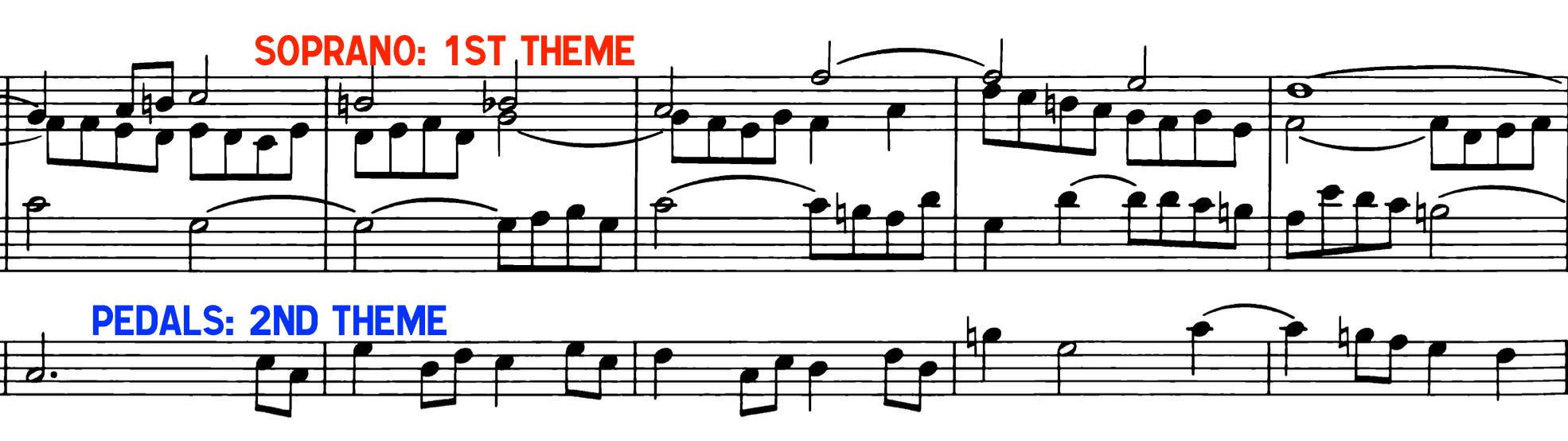
Continuing our study of The Well-Tempered Clavier, (hear the first episode in this series via this link) Bach begins the second quarter of the collection with a dramatic genre: a fugal prelude. Not only that, the fugue appears to be a double fugue!The prelude begins more contrapuntally than the preludes we have met thus far:After a few bars of this, Bach dashes our hope that the prelude will continue exclusively with this motif. A flourish of virtuosity vanishes into what seems to be a fugue— of completely unrelated material— nearly in stile antico:Not content to remain a simple fugue, Bach doubles down by introducing a second subject derived from the opening gestures. Notice how the new subject contrasts with the first, moving not only quicker, but in stepwise motion rather than by leaps.May This Baroque Resource ne’er be Broke! Help us thrive:As mentioned in the episode, here is a chart illustrating the symmetrical placement of the two double fugues within Bach’s collection. Such symmetry, I feel, is not merely coincidental.Supporting this show ensures its longevity. Long may WTF Bach endure:We encourage our listeners to become a paid subscriberat wtfbach.substack.comBut free subscriptions are also great for our numbers.You can also make a one-time donation here:https://www.paypal.me/wtfbachhttps://venmo.com/wtfbachWe survive solely on donations. Thank you for your help!Concepts Covered:In this analysis of J.S. Bach’s Well-Tempered Clavier, Book I, BWV 852, E-flat Major, Es Dur, we examine Bach’s contrapuntal design, double fugue prelude, and development. This new fugal prelude, Bach transitions from free texture to strict imitation, introducing a second subject derived from the opening motif. This new theme contrasts with the first, employing stepwise motion, Baroque counterpoint and architectural symmetry in the prelude and fugue. The episode also discusses Bach’s placement of the two double fugues in The Well-Tempered Clavier as an act of structural balance. Early version, BWV852a, also covered. Get full access to WTF Bach? at wtfbach.substack.com/subscribe
“Cheever was a reasonably tormented man.” -Jerry LowenthalEnjoy this short story— one of the great American short stories— by John Cheever.Thanks!-EvanHelp this resource survive for future Bach enthusiasts! 100% fueled by your support.We exist because of your Donations:We encourage our listeners to become a paid subscriber at wtfbach.substack.comYou can also make a one-time donation here:https://www.paypal.me/wtfbachhttps://venmo.com/wtfbachSupporting this scholarly resource ensures its longevity!Thank you! Get full access to WTF Bach? at wtfbach.substack.com/subscribe
How boring would this be?Admittedly, I still find that beautiful, but Bach is one note ahead of me:We have a prelude propelled by its instability. This might be something to pay attention to in The Well-Tempered Clavier —if not all his writing in the early 1720s— ordinary melodic shapes that become more compelling when slightly offset.We want YOU! to support WTF BachWe are 25% of the way through this triumph of tonality. Now, for the first time in the collection, the fugue makes explicit use of inverted entrances. Here is the subject ‘right-side up’ at the opening:Exactly halfway through the fugue, Bach brings the subjects in a second exposition, only now they are upside down:He also inverts the order of voices in the beautifully expressive episode that occurred earlier, and makes explicit use of stretto in the second half. Other fugal techniques such as ‘splintering’ fragments of the subject in stretto or in parallel thirds make for a brilliant finale on the first quarter of his 1722 masterpiece. Have a listen to the episode for more analysis! We Survive on your Donations! Thank you!We encourage our listeners to become a paid subscriber at wtfbach.substack.comYou can also make a one-time donation here:https://www.paypal.me/wtfbachhttps://venmo.com/wtfbachSupporting this show ensures its longevity!—Help WTF Bach reach more listeners—Concepts covered:Preludes and fugues of The Well-Tempered Clavier, the D minor BWV 851 (and others, such as BWV 850) Bach’s compositional technique in revision. The early version, BWV 851a is a mere 15 bars long. Counterpoint, voice leading, and harmonic direction, inversion, (the first inversions in the WTK) and stretto in this fugue. Also, instability in melodic design and rhythmic offsetting. Bach marks periods of structure through the book by placing more complicated techniques at these symmetrical points. Also, articulation added to the revised versions, the autograph fair copy. Get full access to WTF Bach? at wtfbach.substack.com/subscribe
While the ‘double-dot’ may well have shown up during Bach’s lifetime, I’m not aware of him ever using it. To assume that his music never makes use of such rhythm would obviously be incorrect. Instead, we need to seek out where it might and might not be applied. Continuing our tour through The Well-Tempered Clavier, in the D Major Fugue now, BWV 850, we see a possible implication of double-dots in the subject:Playing the dotted 8ths as double-dotted 8ths, hence changing the following 16th notes into 32nds, might be considered correct— even stylish! But we are thrown into doubt when we meet the phrase:If we are to play the 16th note chords together, double-dotting the motif would now not be possible. What to do? Separate the chords? Swing the 16ths? Play one phrase double-dotted and the other not? In this episode we listen to 14 interpretations in an attempt to find the ‘correct’ answer.WTF Bach is 100% reader-supported! To support this resource, consider becoming a free or paid subscriber.The following performers offer their solution:Edwin FischerGlenn GouldRalph KirkpatrickTon KoopmanWanda LandowskaGustav LeonhardtSviatoslav RichterScott RossWolfgang RubsamAndras SchiffLouis ThiryRosalyn TureckHelmut WalchaZuzana RuzickovaThere is also a good wikipedia article on the subject: https://en.wikipedia.org/wiki/Dotted_noteReminder!J.S. Bach: Complete Keyboard Works, Vol. 5- Musical Offering, Suite 823 is now available everywhere you listen to music— have a listen!Supporting this show ensures its longevity. Long may WTF Bach endure:We encourage our listeners to become a paid subscriberat wtfbach.substack.comFree subscriptions are also great for our numbers.You can also make a one-time donation here:https://www.paypal.me/wtfbachhttps://venmo.com/wtfbachWe survive solely on donations. Thank you for your help!Concepts Covered:Double dotting in Baroque music remains one of the most debated topics in performance practice, especially when interpreting J. S. Bach’s Well-Tempered Clavier alongside the broader French style. French composers such as Lully and Rameau often used double-dotted rhythms in overtures and dances, creating a sharp long–short contrast that was part of their national style, while German composers absorbed and transformed these conventions. Bach, familiar with both Italian and French idioms, never notated double dots explicitly, relying on performers to apply the convention, leaving modern interpreters uncertain whether to play rhythms strictly (7:1) or with more flexibility. This ambiguity, double-dot, notes inégales in Bach, continues to challenge harpsichordists and pianists alike, making historically informed performance of Bach’s keyboard works, especially the Well-Tempered Clavier, a central field of research in Baroque interpretation. BWV 850 Prelude and Fugue, its early versions and revisions also explored. Get full access to WTF Bach? at wtfbach.substack.com/subscribe
(Rated PG)Don’t Look a Gift Horse in the Mouthinstamus tamen inmemores caecique furore,et monstrum infelix sacrata sistimus arce.Aeneid, II.244-245(Yet blindly we persist, forgetful in our fury, and we place the monster, unhappy, upon our sacred citadel.)I like to think about the origins of phrases we use in English. Imagine you’re a foreigner and someone says, “go on, spill the beans…”Here are a few idioms we use without thinking about them:Bite the bullet. Here’s an actual example from the Cambridge dictionary of how this might be used today:“I decided I had to bite the bullet and take a couple of math classes even though I knew they were hard.”…But really, biting the bullet meant, “No, it’s not algebra for you son, you’re going into surgery! It’s the 1860s so instead of a nice oxygen mask and a cute little countdown, you’ll calmly bite on a bullet while they saw something off. I imagine after a few minutes of that, the dentist will be on his way to see you as well.”Let the cat out of the bag. “Don’t let the cat out of the bag!”This is one a butcher told me about. Really, you should let the cat out of the bag before you leave the butcher. He said a rabbit and a cat will look exactly alike when skinned except for a few signs. Hence you could fool someone hoping to make a rabbit stew by skinning a couple cats. —Ooh, skin the cat, there’s another one.Anyhow, you get home to the wife and kids, and instead of letting a delicious rabbit or piglet out of the bag, you let a cat out of the bag to show them just how badly papa’s been scammed at the slaughterhouse.The whole nine yards. You ever hear that and think, “but isn’t it ten yards to a first down?” Well, this one’s not football related folks, it’s war related! Machine gun related. Another gruesome one: “Go on boy! Mow the lot of them down. Give it your all, chap! Feed the gun the whole nine yards— of bullets.”Raining cats and dogs. Isn’t that a cute one? “Wow, it’s raining cats and dogs outside!” Sorry— not cute. I quote Jonathan Swift’s famous poem, ‘A Description of a City Shower,’Drowned puppies, stinking sprats, all drenched in mud,Dead cats and turnip-tops come tumbling down the flood.It’s raining so hard, dogs and cats are now washing up in the gutters.And, saved by the bell, “Gee! I’m sure glad I was saved by the bell!” Well, this might be related to boxing, but it also could be related to a device they put in coffins— only a few hundred years ago, mind you— where, should you just happen to be buried alive, naturally after your funeral and after your many days of exhibiting no pulse or breathing, should you just happen to be buried alive, instead of frantically clawing on the back of your coffin without any dignity, you could simply pull on a little string connected to a small bell six feet above. Caution: upon waking in a coffin to total darkness you previously hadn’t been able to conceive, remember not to pull too hard and break the string. Remain calm. Ring daintily. A nearby gardener, whistling while trimming the flowers on a surrounding tombstone, will hear your patient plea and dig you up again. You’ll be back at the pub in a few hours— saved by the bell. Phew!So you see, most of these expressions come from gruesome, if not downright morbid backgrounds. …But I think that gives our language its special grit, don’t you?—Today anyhow I want to talk about a proverb, not an idiom. Proverbs are supposedly rooted in folk wisdom, rather than sentences that no longer make literal sense.So, sure, a bird in the hand is worth two in the bush, this makes sense to me, but I still have no idea why I can’t put all my eggs in one basket. I’m not going to the coop with two baskets. Can we just save some time here and make the proverb, don’t drop the basket!The proverb I want to dissect is ‘Don’t look a gift horse in the mouth.’ It generally means something like, when your uncle gifts you a snow globe from a city you’ve never visited, don’t remind yourself that he shares only 25% of your DNA, just pretend to be thrilled, hug him and say thanks. Don’t look the gift horse in the mouth. You may, however, throw the gift horse straight in the garbage.You probably don’t hear many people saying that anymore— the horses have all disappeared— but when ‘driving’ meant riding on a horse, and not turning the ignition, there was horse wisdom, and one piece of wisdom was that you could tell how healthy a horse was, by looking at its teeth.So imagine how this phrase originates: your neighbor comes bearing the gift of horses, but you’re not supposed to check if they’re healthy.The nerve of these people, bringing you horses that are soon your problem!“Honey, Ol’ Shadow’s looking pretty weak, and I don’t have the nerve to put him out of his misery. What d’ya say I bring ‘em round to the Campbell’s… I think that daughter of theirs had a birthday last week?”Get real. If my neighbor comes with marmalade I’m checking it for mold. If he comes with a horse? I’m going straight for the mouth. …Well, as a pianist I personally am not sticking my hands into a horse’s mouth, but if Farmer Joe, who previously has brought me no gifts, suddenly shows up with a cheeky grin and a horse with a bow on its head that appears to be tied just so it’s clamping the horse’s jaws shut— I'm gonna make sure an equine dentist is on staff.‘Oh hey, Farmer Joe! To what do I owe this pleasure? I see you’ve brought your horse. He’s looking a bit… is he alright? What’s that? You want me to ha— a horse? For me? Farmer Joe, Wow! I don’t really ride hor— I shouldn’t ride him? Oh, well I suppose I’d better get some hay anyho— oh, he’s not eating much. I see… well, is he, perhaps… I should look in his— no? Honestly, you’re looking a little tense, Farmer Joe. Look, if you just prefer if I pay the knacker and we forget the whole thing, I’ll pretend you wouldn’t let me look your gift horse in the mouth. You know, Farmer Joe, I’m starting to think you’ve invented a pointless proverb because you’re out of bullets and your shovel is broken.’Always look a gift horse in the mouth. That’s what I say.A friend bearing gifts requiring medical attention is a terrible friend. How’s that for a proverb?You know who didn’t look a gift horse in the mouth? The Trojans.Note:The outro music is one of the movements Bach cut from his Magnificat during its transposition from E-flat into D. You can find it, and a few more movements not included in the later version, listed under BWV 243a.Become a subscriber at wtfbach.substack.com (Paid or free subscriptions available!)https://www.paypal.me/wtfbachhttps://venmo.com/wtfbachhttps://cash.app/$wtfbachThank you for your support. Get full access to WTF Bach? at wtfbach.substack.com/subscribe
J.S. Bach: Complete Keyboard Works, Vol. 5- Musical Offering, Suite 823 is now available everywhere you listen to music— platform specific links below— have a listen!A Musical Offering (Ein Musikalisches Opfer) BWV 1079, is one of Bach’s late mono-thematic masterpieces. When Bach visited his son and King Frederick the Great in 1747, he was challenged to improvise upon the following, extemporaneously:Bach did so to the amazement of all. Two months later, already engraved on copper plates, The Musical Offering was ready. It included two fugues on the theme, a trio sonata and ten ‘puzzle canons.’ See here the permutations of the ‘royal theme’ as they appear in the canons alone. Altering a melody so imaginatively is already fascinating— and this doesn’t even speak of the ingenious canons he fastens to them. (This is a ridiculously detailed image, so it’s available for download.)I hope you enjoy this episode and the album! Thanks to Yamaha Artist Services in New York, especially Bonnie Barrett, Aaron Ross and Shane Hoshino. Available Here (Spotify) And Here (Apple Music)https://music.apple.com/nl/album/j-s-bach-complete-keyboard-works-vol-5-musical-offering/1837359653And Here (YouTube)https://music.youtube.com/playlist?list=OLAK5uy_k2wf1S1hboQzMDL-4SYawCQDCuaBE9bH4&si=N4M3U_jlDrwZVH0RFinally, the episode dealing with more in-depth history of BWV 1079:Supporting this show ensures its longevity. Long may WTF Bach endure:We encourage our listeners to become a paid subscriber at wtfbach.substack.comBut free subscriptions are also great for our numbers.You can also make a one-time donation here:https://www.paypal.me/wtfbachhttps://venmo.com/wtfbachWe survive solely on donations. Thank you for your help!Concepts Covered:J.S. Bach’s Musical Offering (1747) stands as one of the most profound works of the Baroque era, composed after his famous meeting with Frederick the Great in Potsdam. At its core is the celebrated crab canon, a musical palindrome that exemplifies Bach’s fascination with mathematics in music, loop canons, Möbius stips, and intricate contrapuntal design. Alongside the ricercare in six voices and other canons and fugues, the so-called Prussian Fugue, the Musical Offering illustrates the height of Bach’s late contrapuntal style, where intellectual puzzles and spiritual depth converge. We analyze the work and its canon riddles, Bach’s fugues and canons, its role as the composer’s mastery of counterpoint. We see its mathematical structure, admired for its late Baroque complexity, and celebrated as a true masterpiece of canonic writing, revealing why Bach remains central to discussions of music theory, musical palindromes, and the art of fugue. Get full access to WTF Bach? at wtfbach.substack.com/subscribe
Enjoy this powerful story (1953) by Karen Blixen.-EvanWe Survive on your Donations! Thank you!We encourage our listeners to become a paid subscriber at wtfbach.substack.comYou can also make a one-time donation here:https://www.paypal.me/wtfbachhttps://venmo.com/wtfbachSupporting this show ensures its longevity!—Help WTF Bach reach more listeners— Get full access to WTF Bach? at wtfbach.substack.com/subscribe
“Bach the master surgeon leaves no scar.”Listen on wtfbach.substack.com for the best experience. Subscriptions are free!There are only two five-voice fugues in The Well-Tempered Clavier, and only two triple fugues. This fugue is both— a five voice triple fugue. Should I be tempted to add some (perhaps too convenient) theological rhetoric to this fugue, an analysis might read like this:Three subjects in one fugue? Why yes, the trinity in music! The themes enter, Son, Holy Spirit, and God the Father. See first God the Son, a man, very nearly B-A-C-H: The first entrance of the Pentecostal waves comes, aptly, from the top down. The Holy Spirit is rendered:God the Father finally makes an appearance, with his perfect interval, and three repeated notes:On the final page, the Holy Spirit vanishes, leaving father and son in an impressive stretto:N.B. I’m not convinced Bach had any of this in mind. At least since Schweitzer, however, people have seen the image of the triune God in Bach’s triple fugues. I believe at this time in Bach’s career, he had not quite codified his theological word painting, so if in fact Bach was thinking of the trinity, it is in any case represented more clearly in the triple fugue from Book Two, in f-sharp minor. There, the themes enter in order (as they do in the ‘Saint Anne’s’ Prelude and Fugue BWV 552) Father, Son, and Holy Ghost. Biographical and theological readings aside, this is a striking and important fugue. Its prelude is no less beautiful. A most interesting revision comes at bar 14. The earliest version reads:Only two bars, dominant to tonic. In revision, Bach seamlessly adds an additional two bars, stretching (and perhaps smoothing) out the harmonic rhythm. Bach the master surgeon leaves no scar: People Mentioned:Albert SchweitzerMieczysław HorszowskiShirley PerleSeymour LipkinPierre HantaïWe Survive on your Donations! Thank you!We encourage our listeners to become a paid subscriber at wtfbach.substack.comYou can also make a one-time donation here:https://www.paypal.me/wtfbachhttps://venmo.com/wtfbachSupporting this show ensures its longevity. Help WTF Bach reach more listeners.Concepts covered:The Well-Tempered Clavier (BWV 846–893) is one of the great monuments of Baroque music, counterpoint with theological tone painting. A remarkable triple fugue: the C-sharp minor fugue from Book I (BWV 849) (another triple fugue is the F-sharp minor fugue from Book II BWV 883). The C-sharp minor stands out as a five-voice fugue and triple fugue, an extraordinary rarity in the keyboard literature. Some interpreters have seen theological symbolism in the three subjects—Father, Son, and Holy Spirit—Bach’s mastery of structure, harmonic rhythm, and Bach in revision. The development of contrapuntal technique, musical spelling, such as the B-A-C-H motif Get full access to WTF Bach? at wtfbach.substack.com/subscribe
“It seems that classical musicians — and as I now understand, jazz musicians at conservatory— are trained to forget the purpose of the music right at the point they start interpreting it.”In this short episode (11 minutes of talking + 10 minutes of music) I read an entry from my practice diary which may be interesting enough to ponder… As it was passed around during covid, the “Coronavirus Etude” looked something like this:Hopefully you’ll enjoy the lesson I got out of the few ‘performances’ made of such a meme.Meanwhile, Rosalyn Tureck is featured for the first time on this show. Here is a picture of her at a Moog. (I didn’t mention that one of my favorite facts about her is that she espoused this instrument as a perfectly valid way to capture Bach’s music.) Her personal “revelation” about Bach, as related in David Dubal’s Reflections from the Keyboard is read in full.We Survive With Your Donations!We encourage our listeners to become a paid subscriber at wtfbach.substack.comYou can also make a one-time donation here:https://www.paypal.me/wtfbachhttps://venmo.com/wtfbachThank you for your support. Get full access to WTF Bach? at wtfbach.substack.com/subscribe
loading
Comments
