


The Via Stoica Podcast — A Stoic Way of Life
Subscribed: 24Played: 696
Subscribe

© Benny Voncken
Description
Via Stoica is a podcast dedicated to Stoicism as a lived philosophy and a practical way of meeting modern life.
We draw from ancient texts and apply them to real challenges, emotional reactivity, discipline, purpose, relationships, and adversity.
This is not about abstract theory. It is about practice, with attention to what is within our control.
Each week, we explore Stoic themes through reflections, practical topics, and interviews.
The views expressed are my own and for informational purposes only.
Learn more at viastoica.com.
We draw from ancient texts and apply them to real challenges, emotional reactivity, discipline, purpose, relationships, and adversity.
This is not about abstract theory. It is about practice, with attention to what is within our control.
Each week, we explore Stoic themes through reflections, practical topics, and interviews.
The views expressed are my own and for informational purposes only.
Learn more at viastoica.com.
151 Episodes
Reverse

What are you living for? — Via Stoica PodcastWhat are you actually living for, and have you ever stopped long enough to ask? In this episode of the Via Stoica Podcast, we sit with one of the most important questions a person can face, and explore what Stoic philosophy has to offer when the answer isn't clear.Welcome to the Via Stoica Podcast, the podcast on Stoicism. Each episode, we bring Stoic philosophy out of the books and into real life, not as theory, but as a practice for building self-awareness, clarity, and a life that feels genuinely yours.Most of us are living on a track we didn't consciously choose. Society sets the milestones. Social media distorts the comparison. And somewhere in the noise, the question of personal values gets buried under the need to keep up. Stoicism offers a different starting point: the examined life. The goal isn't accumulation or status, it's eudaimonia, the cultivation of good character and a sound inner life. When we understand what we're actually living for, the small daily decisions begin to align with who we are. That's where real change happens.If you've been feeling the gap between how you're living and how you want to live, this episode is a quiet invitation to close it, one honest question at a time.Support the show🌐 viastoica.com▶️ YouTube: @viastoicaProduced by: Badmic.com
What is a philosophy of life, and how do you find yours? In this opening episode of the Via Stoica Podcast's Philosophy of Life series, we explore what it means to live with intention, guided by Stoic philosophy and your own values.Welcome to the Via Stoica Podcast, the podcast on Stoicism. This series is about building something real, a foundation for how you actually want to live, not the life inherited from others.Most of us absorb our beliefs about success, purpose, and personal values from the world around us without ever choosing them. We follow routines that work on the surface but feel quietly off underneath. Stoic philosophy offers a different starting point: self-awareness, honest reflection, and the courage to ask whether the life you're living is actually yours.A philosophy of life isn't a rulebook. It's a quiet guide you return to, especially when things fall apart or when everything seems fine but something still feels missing.This is Episode 1 of the Philosophy of Life series. Listen to explore what it means to stop borrowing your life from others and start building one that fits who you actually are.Read the related article here: https://viastoica.com/how-to-find-your-philosophy-of-life/🌐 viastoica.com👤 Meet Benny: viastoica.com/benny-voncken📩 Newsletter: viastoica.com/subscribe-to-via-stoica-newsletter▶️ YouTube: @viastoicaProduced by: Badmic.com

Welcome to the Via Stoica Podcast, where we explore how Stoic philosophy guides us toward living well with ourselves and others. In this episode, we reflect on Epictetus’ insight on friendship and values:“What a man sets his heart on, that he naturally loves... It remains for us to conclude then that good things alone are what they set their heart on. And if they set their heart on those, they love them too.”Epictetus, Discourses, Book 2, Chapter 22Epictetus reminds us that people naturally love what they believe to be good. When someone acts poorly, it is often because they misunderstand what truly benefits them. Stoicism teaches that real good lies not in wealth, status, or external success, but in virtue and good character. When we understand this, our priorities change, and so do the relationships and friendships we cultivate.This connects with the Stoic disciplines of Desire, Assent, and Action: we learn to value what truly matters, question mistaken judgments about success or happiness, and act in ways that support both our own character and the well-being of others. Practically, this means choosing friendships grounded in shared values, guiding others with patience when possible, and remembering that everyone acts according to what they think is best, even when they are mistaken.For more, check out this related article with the Stoic view on friendship:https://viastoica.com/the-stoic-view-of-friendship/And if you’re looking for more Stoic sayings, visit viastoica.com, where you’ll find hundreds of quotes with full references to the original texts:https://viastoica.com/stoic-quoteshttps://viastoica.com/marcus-aurelius-quoteshttps://viastoica.com/epictetus-quoteshttps://viastoica.com/seneca-quotesMake sure to subscribe for more Stoic Quotes episodes every Friday, as well as our Tuesday interviews and longer discussions.Support the showhttps://viastoica.comhttps://viastoica.com/stoic-life-coachinghttps://viastoica.com/benny-vonckenhttps://x.com/ViaStoicainfo@viastoica.comProduced by: badmic.com
What Does it Mean to be a Philosopher?Philosophy is often seen as academic or reserved for experts. But what if being a philosopher is something many of us already practice in everyday life?Welcome to the Via Stoica Podcast, the podcast on Stoicism.In this episode, we explore philosophy as a way of living rather than a subject to master. Instead of focusing on theory or credentials, the conversation looks at curiosity, reflection, and how we orient ourselves in daily life.We reflect on why philosophy is often misunderstood as overthinking or abstraction, and how it actually shows up in ordinary moments, when we pause, question our reactions, and try to live with more awareness. You are invited to consider who you already see as wise in your own life, and what qualities make their guidance meaningful.This episode invites you to reconsider what it means to be a philosopher, and to recognize how much philosophy may already be present in your own life.Read the article here: https://viastoica.com/what-does-it-mean-to-be-a-philosopher/Support the showviastoica.comYouTube: @viastoicaProduced by: Badmic.com
Welcome to the Via Stoica Podcast, where we explore how Stoic philosophy helps us remain steady amid the challenges of everyday life. In this episode, we reflect on Marcus Aurelius’ personal reminder from his private notes:“So other people hurt me? That’s their problem. Their character and actions are not mine. What is done to me is ordained by nature. What I do, by my own.”Marcus Aurelius, Meditations, 5.25Marcus reminds himself that we cannot control what others do, only how we respond. People will sometimes speak harshly, act unfairly, or behave poorly, but their actions belong to them. Our responsibility is to protect our own character and respond with reason rather than anger. Stoicism teaches that true harm occurs only when we abandon our own values and lose control of our response.This reflects the Stoic disciplines of Desire, Assent, and Action: we accept that external events and other people lie outside our control, we question the judgment that tells us we’ve been harmed, and we choose actions that preserve our peace of mind and integrity. Practically, this means pausing before reacting, letting go of insults that carry no truth, and using criticism, when valid, as a chance to improve rather than as a personal attack.For more, check out this related article with quotes on Stoicism and dealing with difficult people:https://viastoica.com/how-to-stop-taking-things-personally/And if you’re looking for more Stoic sayings, visit viastoica.com, where you’ll find hundreds of quotes with full references to the original texts:https://viastoica.com/stoic-quoteshttps://viastoica.com/marcus-aurelius-quoteshttps://viastoica.com/epictetus-quoteshttps://viastoica.com/seneca-quotesMake sure to subscribe for more Stoic Quotes episodes every Friday, as well as our Tuesday interviews and longer discussions.Support the showhttps://viastoica.comhttps://viastoica.com/stoic-life-coachinghttps://viastoica.com/benny-vonckenhttps://x.com/ViaStoicainfo@viastoica.comProduced by: badmic.com
What’s wrong with modern Stoicism?Stoicism is often presented today as a self-help philosophy focused on emotional control, toughness, and handling life alone. But does Stoicism really work when we are grieving, depressed, or emotionally overwhelmed?Welcome to the Via Stoica Podcast, the podcast on Stoicism.In this episode, we reflect on what is missing in modern Stoicism and why it often feels rigid or harsh in practice. Stoicism depends on our ability to use reason, but that ability is not always available. When reason is inaccessible, Stoicism cannot be practiced in isolation and requires support, compassion, and guidance.Stoicism was never meant to harden us or turn us inward. It is a deeply pro-social philosophy that emphasizes shared responsibility, patience with ourselves, and gratitude for what is already here. This episode explores why real-life application, self-compassion, and community matter more than being right about Stoic theory.Listen to the full episode and discover how Stoicism, practiced with reason, care, and support, can help us live more steadily and more humanly.Read the article here: https://viastoica.com/what-is-wrong-with-modern-stoicism/Support the show🌐 viastoica.com▶️ YouTube: @viastoicaProduced by: badmic.com
Welcome to the Via Stoica Podcast, where we explore how Stoic philosophy helps us face life’s challenges with steadiness and wisdom. In this episode, we look at Seneca’s reflection from his consolation to Marcia, who was grieving the loss of her son:“What is the need to weep over parts of life? The whole of it calls for tears. Fresh troubles will press upon you before you have done with the old ones.”Seneca, Consolation to Marcia, 11Seneca’s message is direct: suffering is part of the human condition, and no life is free from hardship. Grief and sadness are natural, but if we focus only on loss, we risk missing the larger truth that challenges are woven into life itself. Instead of being crushed by each new difficulty, Stoicism invites us to accept change, find support in others, and transform hardship into growth and resilience.This teaching connects with the Stoic disciplines of Desire, Assent, and Action: we learn to accept that difficulties are inevitable, question the judgments that make suffering unbearable, and choose responses that move us forward rather than trap us in despair. Practically, this means allowing ourselves to grieve while avoiding rash decisions, supporting others through their pain, and remembering that past hardships have already helped shape the strength we carry today.For more, check out this related article with quotes on Stoicism and grief:https://viastoica.com/on-dealing-with-loss/And if you’re looking for more Stoic sayings, visit viastoica.com, where you’ll find hundreds of quotes with full references to the original texts:https://viastoica.com/stoic-quoteshttps://viastoica.com/marcus-aurelius-quoteshttps://viastoica.com/epictetus-quoteshttps://viastoica.com/seneca-quotesMake sure to subscribe for more Stoic Quotes episodes every Friday, as well as our Tuesday interviews and longer discussions.Support the showhttps://viastoica.comhttps://viastoica.com/stoic-life-coachinghttps://viastoica.com/benny-vonckenhttps://x.com/ViaStoicainfo@viastoica.comProduced by: badmic.com

Welcome to the Via Stoica Podcast, the podcast on Stoicism.In this episode, I’m joined by Dr. Joelle Samaha, founder of PhiloLife, for an open and deeply personal conversation about healing, philosophy of life, and what it means to live in alignment.Joelle shares her journey into philosophy, wellbeing, and integrative health, shaped by teaching, research, anxiety, loss, and lived experience. We talk about how our philosophy of life, often formed early and unconsciously, influences the way we suffer, cope, and heal. Being kind, doing the “right” thing, or following the expected path does not protect us from pain, and Joelle explains why this realization is often the true starting point of healing.Throughout the conversation, we explore coherence and alignment, the connection between emotions and the body, and why healing is not about fixing symptoms but about understanding deeper causes. Joelle speaks about generational patterns, emotional suppression, and how modern life keeps us constantly busy while quietly disconnected from ourselves. We also discuss why self-care is often misunderstood and why healing rarely happens in isolation, but through reflection, honesty, and meaningful connection with others.Joelle introduces the idea of the “spark of life,” moments of presence, meaning, and awareness that can arise not only in joy but also in grief, crisis, and uncertainty. Healing, as she describes it, is not a destination but an ongoing process of learning, self-inquiry, and returning to what matters.This episode is an invitation to pause, question your own philosophy of life, and consider what it really means to live well.Listen to the full episode now and explore how philosophy, awareness, and alignment can support a deeper healing journey.Connect with Joelle:🌐 https://philolife.com📸 Instagram: @letsgetreal2heal📸 Instagram: @philolifewellbeingSupport the show🌐 viastoica.com🎯 viastoica.com/stoic-life-coaching👤 viastoica.com/benny-voncken▶️ YouTube: @viastoica📧 info@viastoica.com🎙️ Produced by: badmic.com
Welcome to the Via Stoica Podcast, where we explore how Stoic wisdom helps us navigate modern life. In this episode, we reflect on Epictetus’ reminder:“In a similar way, you too should remind yourself that what you love is mortal, that what you love is not your own. It is granted to you for the present while and not irrevocably, not forever, but like a fig or a bunch of grapes in the appointed season. And if you long for it in the winter, you are a fool.” Epictetus, Discourses, Book 3, Chapter 24.86The message is simple and powerful: everything we enjoy, relationships, possessions, circumstances, is temporary. Suffering arises when we cling to what is gone or long for what is not present. Stoicism teaches us to align our desires with reality, appreciate what is here now, and avoid missing the present moment while chasing something absent.This connects directly with the Stoic disciplines of Desire, Assent, and Action: want only what is within your power, question the judgments that create attachment, and act with gratitude toward what you have today. Practically, this means giving attention to the people around you, appreciating what is in your life now, and remembering that everything we love is given to us only for a time.For more, check out this related article with quotes on Stoic desire and attachment:https://viastoica.com/how-to-practice-the-stoic-discipline-desire/And if you’re looking for more Stoic sayings, visit viastoica.com, where you’ll find hundreds of quotes with full references to the original texts:https://viastoica.com/stoic-quoteshttps://viastoica.com/marcus-aurelius-quoteshttps://viastoica.com/epictetus-quoteshttps://viastoica.com/seneca-quotesMake sure to subscribe for more Stoic Quotes episodes every Friday, as well as our Tuesday interviews and longer discussions.Support the showhttps://viastoica.comhttps://viastoica.com/stoic-life-coachinghttps://viastoica.com/benny-vonckenhttps://x.com/ViaStoicainfo@viastoica.comProduced by: badmic.com

Welcome to the Via Stoica Podcast, the podcast on Stoicism. In this episode, I’m joined by Jason Nelson, author of A Balm for Your Soul: Six Seeds for Happiness, for a calm and honest conversation about happiness, burnout, and what it really takes to live well.Jason shares his journey from corporate life in London to a slower, more intentional way of living, shaped by reflection, practice, and self-trust. Together, we explore his six seeds of happiness, self-care, self-mastery, boundaries, kindness, relationships, and connection, and how closely they align with Stoic philosophy. We talk about people pleasing, impostor syndrome, emotional awareness, and why being kind is not the same as being nice. This episode is a reminder that happiness is not a destination, but a daily practice rooted in honesty, courage, and care for yourself and others.A few reflections you can take from this episode:Pause before reacting and examine what you are feeling.Notice where boundaries are missing, especially in familiar relationships.Pay attention to which connections nourish you and which drain you.Reflect at the end of the day with reason and kindness, not judgment.Listen to the full episode and explore how Stoic wisdom and lived experience come together to support a happier, steadier life.You can read the related article on Via Stoica: https://viastoica.com/a-stoic-conversation-with-jason-nelson/You can follow Jason here: IG: @iamjasonnelsonAnd you can find the book here: Amazon: https://amzn.to/44Fh1XhSupport the showhttps://viastoica.comhttps://viastoica.com/stoic-life-coachinghttps://viastoica.com/benny-vonckenYouTube: @viastoicainfo@viastoica.comProduced by: badmic.com
Welcome to the Via Stoica Podcast, the podcast on Stoicism.In this episode, we look at a passage by Marcus Aurelius from Meditations, Book 5.3, where he reminds himself how to act in the face of criticism and doubt:“If an action or utterance is appropriate, then it’s appropriate for you. Don’t be put off by other people’s comments and criticism. If it’s right to say or do it, then it’s the right thing for you to do or say.”— Marcus Aurelius, Meditations, Book 5.3The core idea is simple: first judge carefully what is appropriate, then have the courage to act. Marcus points out that other people follow their own impulses and views. Their reactions are not your responsibility. What matters is whether your action aligns with reason, ethics, and your role in the world.This theme runs through Stoicism as a whole. Epictetus emphasizes responsibility for choice, Seneca warns against living for approval, and all three Stoic disciplines come together here. Desire is trained away from praise, Assent is used to judge what is right, and Action is where courage is required to follow through.In practice, this helps when you hesitate to speak honestly, make a difficult decision, or feel shaken by criticism. Ask whether the action is fair and necessary. If it is, do it. Learn from feedback if it is useful, but do not let it define your worth or stop your progress.For more, check out this related article with quotes on Stoic courage:https://viastoica.com/10-epictetus-quotes-on-stoic-courage/And if you’re looking for more Stoic sayings, visit viastoica.com, where you’ll find hundreds of quotes with full references to the original texts:https://viastoica.com/stoic-quoteshttps://viastoica.com/marcus-aurelius-quoteshttps://viastoica.com/epictetus-quoteshttps://viastoica.com/seneca-quotesMake sure to subscribe for more Stoic Quotes episodes every Friday, as well as our Tuesday interviews and longer discussions.Support the showhttps://viastoica.comhttps://viastoica.com/stoic-life-coachinghttps://viastoica.com/benny-vonckenhttps://x.com/ViaStoicainfo@viastoica.comProduced by: badmic.com
Welcome to the Via Stoica Podcast, the podcast on Stoicism.In this episode, we explore why self compassion matters if we want to make real progress. Stoicism is demanding, and it can easily turn into a quiet kind of perfectionism, where every mistake feels like failure. But the Stoics were never asking us to be finished, they were asking us to keep training.Marcus Aurelius begins his reflections on Antoninus Pius with a simple lesson: “compassion.”Marcus Aurelius, Meditations, 1.17For the Stoics, this wasn’t about being soft or excusing yourself, but about staying fair, steady, and willing to learn. When Marcus points to compassion, he isn’t encouraging comfort for its own sake, but reminding us that harsh self judgment clouds reason, and makes it harder to correct course.You will hear practical reflections on the difference between being nice and being kind, how to use the Pause to step back instead of spiraling, and how the four virtues can guide honest self review without self punishment. The goal is not to lower the standard, but to keep moving toward it, as a student, one decision at a time.Listen to the full episode now and discover how self compassion can transform the way you think, act, and see your life.Read the related article: https://viastoica.com/why-stoic-progress-requires-self-compassion/Support the show🌐 viastoica.com🎯 viastoica.com/stoic-life-coaching👤 viastoica.com/benny-voncken▶️ YouTube: @viastoica📧 info@viastoica.com🎙️ Produced by: https://badmic.com

Welcome to the Via Stoica Podcast, the Podcast on Stoicism.Where we take a moment to slow down and reflect on what the Stoics can teach us about living with reason and restraint. In this episode, we turn to Seneca and a striking passage from On Anger, Book 3, section 3: “So tell me, will someone call a man sane who, as if caught up in a tempest, does not walk, but is driven along and takes as his master a furious demon?”Seneca uses vivid language to show what anger does to the mind. When anger takes over, we are no longer choosing our actions; we are being carried by them. The Stoic principle at work here is self-command. Anger is not strength, but a loss of inner direction, a momentary madness that blocks reason and leads us away from acting well.This idea connects closely with Epictetus and Marcus Aurelius, who both warn against being ruled by impressions instead of examining them. Through the disciplines of Desire, Assent, and Action, Stoicism teaches us to loosen our attachment to emotional impulses, question the judgments that ignite anger, and respond deliberately rather than react blindly. In everyday life, this means learning to pause when irritation arises, recognizing when emotion is taking the lead, and choosing restraint over release, especially in moments of pressure or conflict.For more, check out this related article with quotes on Stoicism and anger:https://viastoica.com/10-seneca-quotes-on-anger/And if you’re looking for more Stoic sayings, visit viastoica.com, where you’ll find hundreds of quotes with full references to the original texts:https://viastoica.com/stoic-quoteshttps://viastoica.com/marcus-aurelius-quoteshttps://viastoica.com/epictetus-quoteshttps://viastoica.com/seneca-quotesMake sure to subscribe for more Stoic Quotes episodes every Friday, as well as our Tuesday interviews and longer discussions.Support the showhttps://viastoica.comhttps://viastoica.com/stoic-life-coachinghttps://viastoica.com/benny-vonckenhttps://x.com/ViaStoicainfo@viastoica.comProduced by: badmic.com
Welcome to the Via Stoica Podcast, the podcast on Stoicism.In this episode, we explore why the idea of the Stoic lone wolf is a myth. While modern culture often praises isolation and radical self reliance as strength, the Stoics understood human beings as deeply social by nature. Solitude can restore us, but cutting ourselves off from others slowly erodes purpose and direction.Marcus Aurelius captures this clearly when he writes:“Have you ever seen a severed hand or foot, or a decapitated head, lying somewhere apart from the rest of the body? That is what a person makes of himself when he refuses to accept what happens and cuts himself off from others.”Marcus Aurelius, Meditations 8.34He is not condemning solitude, but reminding us that we flourish only when we see ourselves as part of a larger whole.This episode reflects on the difference between chosen solitude and harmful isolation, the Stoic importance of roles and duties, and why real strength lies in connection, responsibility, and contribution. Stoicism invites us not to withdraw from life, but to take our place in it with reason, kindness, and steadiness.Listen to the full episode now and discover how connection and responsibility can transform the way you think, act, and see your life.Read the related article: https://viastoica.com/why-the-stoic-lone-wolf-doesnt-exist/Support the show🌐 viastoica.com🎯 viastoica.com/stoic-life-coaching👤 viastoica.com/benny-voncken▶️ YouTube: @viastoica📧 info@viastoica.com🎙️ Produced by: https://badmic.com
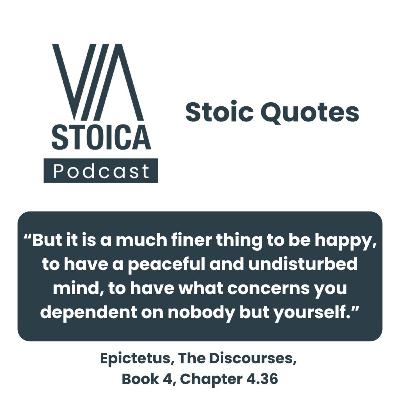
Welcome to the Via Stoica Podcast, the podcast on Stoicism. In this week's Stoic Quotes episode, we look at Epictetus, Discourses, Book 4, Chapter 4, recorded by Arrian. He writes: “But it is a much finer thing to be happy, to have a peaceful and undisturbed mind, to have what concerns you depend on nobody but yourself.”At first glance, this can sound like withdrawal from the world, but Epictetus is pointing to something more demanding. He is reminding us that the moment we tie our happiness to externals, whether comfort, leisure, approval, or even quiet, we become dependent and easily disturbed. Stoic happiness is not about arranging perfect conditions, but about cultivating inner steadiness through right judgment. In modern terms, peace comes not from controlling life, but from aligning our desires with what is truly up to us.This teaching echoes through Stoicism, from Marcus Aurelius’ emphasis on inner rule to Seneca’s insistence that freedom begins with self-command. It touches all three Stoic disciplines: Desire, by letting go of attachments to externals; Assent, by examining the judgments that create disturbance; and Action, by choosing what accords with reason and virtue, even when it feels uncomfortable. Practically, this means learning to remain composed when plans fail, choosing values over convenience, and finding contentment in acting well rather than feeling comfortable.For more, check out this related article with quotes on Stoic inner peace and solitude:https://viastoica.com/10-marcus-aurelius-quotes-on-being-alone/And if you’re looking for more Stoic sayings, visit viastoica.com, where you’ll find hundreds of quotes with full references to the original texts:https://viastoica.com/stoic-quoteshttps://viastoica.com/marcus-aurelius-quoteshttps://viastoica.com/epictetus-quoteshttps://viastoica.com/seneca-quotesMake sure to subscribe for more Stoic Quotes episodes every Friday, as well as our Tuesday interviews and longer discussions.Support the showhttps://viastoica.comhttps://viastoica.com/stoic-life-coachinghttps://viastoica.com/benny-vonckenhttps://x.com/ViaStoicainfo@viastoica.comProduced by: badmic.com
Welcome to the Via Stoica Podcast, the podcast on Stoicism. In this episode, we explore what it really means to build a strong relationship, not from modern ideals of romance or constant happiness, but from a Stoic understanding of character, responsibility, and shared life. Relationships matter deeply in everyday life, yet they often become a source of anxiety, pressure, and confusion. The Stoics approached them differently, seeing relationships not as a solution to personal emptiness, but as a field in which virtue is practiced.At the core of this episode is a simple but demanding insight: strong relationships begin with a strong relationship to oneself. Before seeking completion in another, Stoicism asks us to cultivate self-knowledge, balance, and inner stability. From that foundation, relationships become places of cooperation rather than dependency, growth rather than possession.Marcus Aurelius captures this clearly when he writes:“People exist for one another; you can instruct them, or endure them.”Meditations, Book 8.59For the Stoics, this wasn’t about ideal harmony or avoiding conflict, but about understanding our role toward others. When Marcus Aurelius writes this, he isn’t being cynical, but reminding us that relationships are part of our nature as social beings. They call us to act with patience, fairness, and care, even when it is difficult.The episode also draws on Stoic reflections on friendship, marriage, and attachment, including insights from Seneca and Epictetus, showing that lasting relationships are grounded in virtue rather than pleasure, status, or fear of loss.Here are a few Stoic practices from this episode you can explore in your own life:Strengthen your inner foundation – Work on self-knowledge and balance before seeking fulfillment through another person.Practice relationships as cooperation – Replace winning arguments with understanding and shared responsibility.Examine judgments in conflict – Pause before reacting and question the story you are telling yourself about the other person.Hold relationships with gratitude, not fear – Remember that others are mortal and changeable, and let this deepen appreciation rather than anxiety.In a time when relationships are often idealized or feared, Stoicism offers a grounded alternative. It helps us approach love, friendship, and partnership with clarity, realism, and care. By the end of this episode, you’ll see that Stoicism isn’t a cold philosophy of detachment, but a way of building relationships that are honest, resilient, and rooted in virtue.Listen to the full episode now and discover how Stoic wisdom can transform the way you relate to others and to yourself.Read the companion article: [insert link if available]Support the show🌐 viastoica.com🎯 viastoica.com/stoic-life-coaching👤 viastoica.com/benny-voncken▶️ YouTube: @viastoica📧 info@viastoica.com🎙️ Produced by: badmic.com
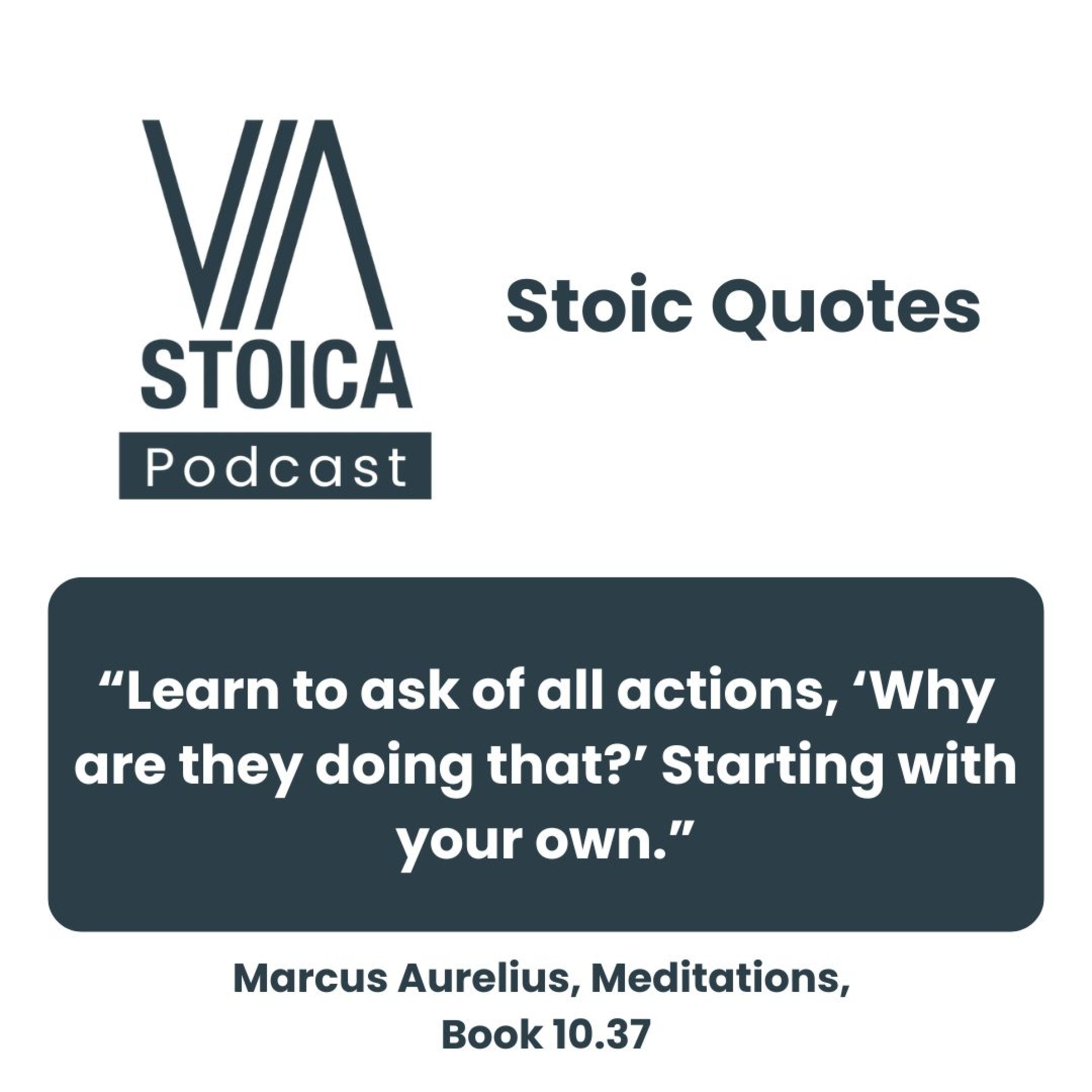
Welcome to the Via Stoica Podcast, the podcast on Stoicism. This is another Stoic Quotes edition, where we reflect on a single passage and its meaning for everyday life. In this episode, we turn to Marcus Aurelius and a note from Meditations 10.37: “Learn to ask of all actions, ‘Why are they doing that?’ Starting with your own.” In another translation, he adds: “What is his point of reference here? But begin with yourself.”Marcus is reminding himself that frustration often comes from rushed judgments. We often assume that others act to inconvenience or offend us when, in reality, they are guided by their own pressures, habits, and priorities. The Stoic task is to pause and question the story we tell ourselves, while first turning that same scrutiny inward. Have I acted like this before, and why?This short reflection connects directly to the Stoic disciplines of Assent and Action. We cannot control what others do, but we can examine our judgments and choose a response rooted in patience rather than impulse. Practiced consistently, this habit softens irritation, reduces conflict, and helps us meet daily interactions with more understanding and restraint.For more, check out this related article with quotes on dealing with frustrating people:https://viastoica.com/how-to-deal-with-frustrating-people/And if you’re looking for more Stoic sayings, visit viastoica.com, where you’ll find hundreds of quotes with full references to the original texts:https://viastoica.com/stoic-quoteshttps://viastoica.com/marcus-aurelius-quoteshttps://viastoica.com/epictetus-quoteshttps://viastoica.com/seneca-quotesMake sure to subscribe for more Stoic Quotes episodes every Friday, as well as our Tuesday interviews and longer discussions.Support the showhttps://viastoica.comhttps://viastoica.com/stoic-life-coachinghttps://viastoica.com/benny-vonckenhttps://x.com/ViaStoicainfo@viastoica.comProduced by: badmic.com
Welcome to the Via Stoica Podcast, the podcast on Stoicism. In this episode, we explore why New Year’s can feel strangely heavy, even when it’s meant to be a celebration. For many people, it becomes a moment of judgment, comparison, and pressure, a symbolic “turning point” that makes unfinished business feel louder than usual. The Stoics offer a calmer way to approach it, not as a magical reset, but as another chance to live with clarity, intention, and steadiness.At the center of this episode is a simple Stoic shift: measure your year by your character, not your outcomes. We often evaluate ourselves by externals, achievements, money, status, habits, even health, yet so much of that is never fully up to us. For the Stoics, this wasn’t about lowering ambition, but about grounding self-worth in what truly belongs to you: how you think, choose, and act.Epictetus captures this clearly when he reminds us:“Some things are up to us and some are not.”Epictetus, Handbook 1For the Stoics, this wasn’t about becoming passive, but about becoming precise. When Epictetus writes this, he isn’t telling us to stop striving, but reminding us to stop attaching our peace to results we cannot command. New Year’s intentions become healthier when they focus on the inner work, boundaries, honesty, courage, and daily discipline, rather than a single dramatic change on January 1st.Here are a few Stoic practices from this episode you can explore in your own life:A yearly review of character – Ask, “Did I act well this year?” rather than “Did I win?” Look for progress in patience, integrity, and self-control.Set intentions, not fantasies – Replace rigid resolutions with small commitments you can practice daily, even when motivation fades.Detach from comparison – Notice the impulse to measure your year against others, and return to what you actually know: your own choices.Accept the past, begin again – Let last year be a teacher, not a verdict. Drop regret, take the lesson, and continue.New Year’s can be a useful mirror, but it doesn’t need to become a courtroom. Stoicism helps you step into the next year with less pressure and more direction, grounded in what you control and softened toward what you don’t. By the end of this episode, you’ll see that Stoicism isn’t a cold philosophy of detachment, but a way of living wisely, steadily, and with quiet confidence, one day at a time.Listen to the full episode now and discover how New Year’s reflection can transform the way you think, act, and see your life.Read the companion article: [insert link if available]Support the show🌐 viastoica.com🎯 viastoica.com/stoic-life-coaching👤 viastoica.com/benny-voncken▶️ YouTube: @viastoica📧 info@viastoica.com🎙️ Produced by: badmic.com
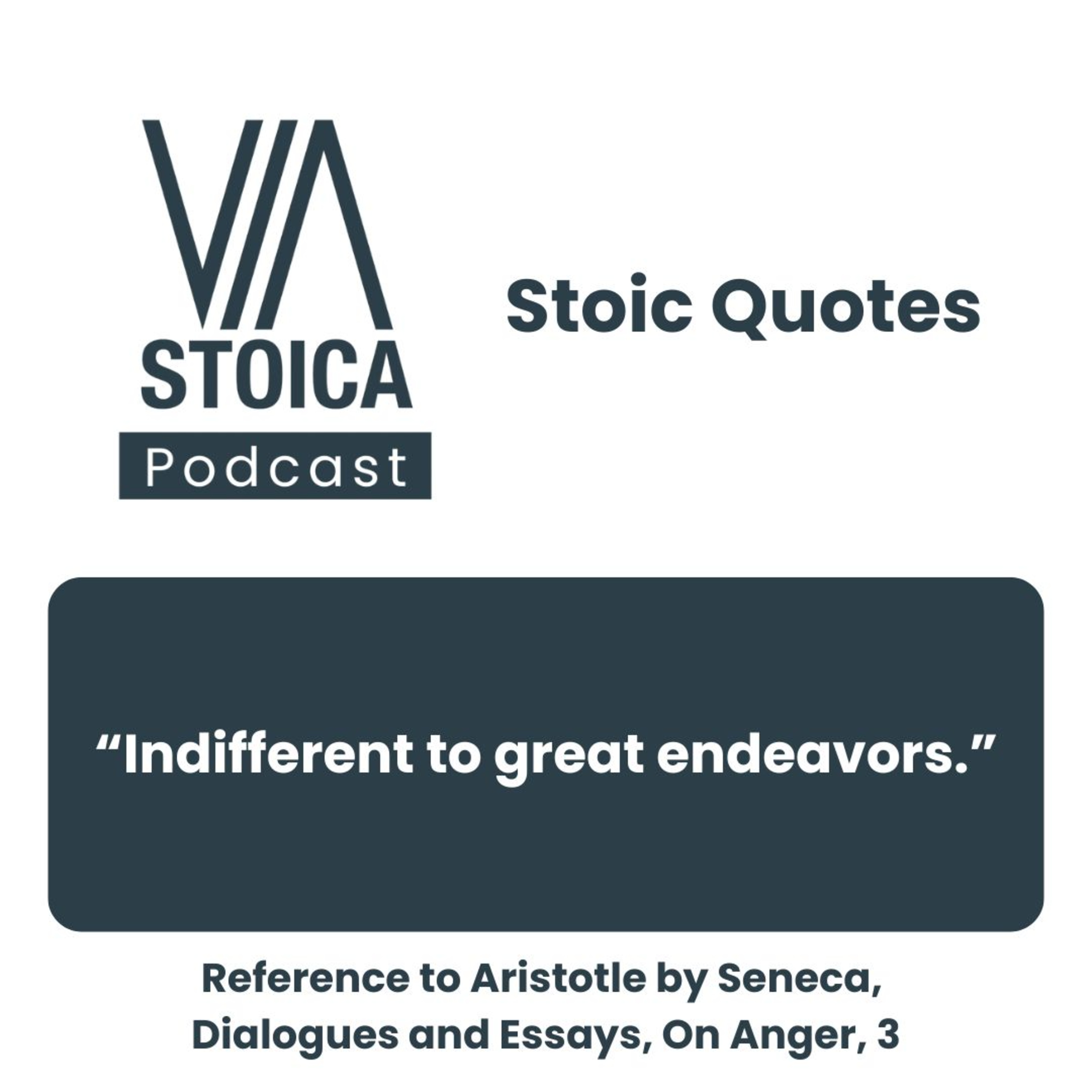
Welcome to the Via Stoica Podcast, the podcast on Stoicism. In this Stoic Quotes edition, we reflect on Seneca’s On Anger, Book III, where he reports Aristotle’s concern that, without anger, the mind becomes “indifferent to great endeavors.” Seneca, Dialogues and Essays, On Anger, 3Seneca introduces this idea to question it. For the Stoics, anger is not a source of strength but a disturbance of reason. It clouds judgment and pulls us away from deliberate, ethical action. The greatest endeavor is not an external achievement, but the cultivation of character. Virtue does not need anger to motivate it.This view runs throughout Stoic philosophy. Epictetus urges us to examine impressions before giving assent, and Marcus Aurelius reminds himself to act without bitterness. Through the three Stoic disciplines, anger reflects misplaced desire, unexamined assent, and impulsive action.In practice, this means noticing anger early, pausing before reacting, and questioning the judgments behind it. Calm commitment to virtue proves far more powerful than anger ever could.For more, check out this related article with quotes on anger and self-control:https://viastoica.com/10-seneca-quotes-on-anger/And if you’re looking for more Stoic sayings, visit viastoica.com, where you’ll find hundreds of quotes with full references to the original texts:https://viastoica.com/stoic-quoteshttps://viastoica.com/marcus-aurelius-quoteshttps://viastoica.com/epictetus-quoteshttps://viastoica.com/seneca-quotesMake sure to subscribe for more Stoic Quotes episodes every Friday, as well as our Tuesday interviews and longer discussions.Support the showhttps://viastoica.comhttps://viastoica.com/stoic-life-coachinghttps://viastoica.com/benny-vonckenhttps://x.com/ViaStoicainfo@viastoica.comProduced by: https://badmic.com
Welcome to the Via Stoica Podcast, the podcast on Stoicism.In this episode, we explore a theme that quietly weighs on many people during this time of year: navigating the holidays alone. While the holiday season is often portrayed as a time of togetherness, joy, and celebration, it can also amplify feelings of loneliness, pressure, and comparison. The Stoics approached these moments differently, not by denying the difficulty, but by understanding it through reason, acceptance, and self-knowledge.At the heart of this episode is the Stoic distinction between loneliness and solitude. Loneliness arises when our desires and expectations clash with reality, when we believe something essential is missing. Solitude, by contrast, is a state of inner steadiness, a calm connection with oneself that does not depend on external circumstances.Seneca captures this beautifully when he writes:“…we say the wise man is self-content; he is so in the sense that he is able to do without friends, not that he desires to do without them.”Seneca, Letters from a Stoic, Letter 9For the Stoics, this wasn’t about rejecting relationships or becoming emotionally distant, but about grounding our well-being in what truly belongs to us: our judgments, values, and character. When Seneca speaks of self-contentment, he isn’t praising isolation, but reminding us that inner stability is the foundation for meaningful connection, not its opposite.Here are a few Stoic practices from this episode you can explore in your own life:Examining desires – Notice where your expectations about the holidays come from, and whether they are reasonable or imposed by social pressure.Reframing impressions – When thoughts of “I shouldn’t be alone” arise, pause and question the judgment behind them.Practicing solitude – Use time alone for reflection, rest, and reconnection with your values, rather than distraction.Voluntary withdrawal from comparison – Step back from social media when it fuels restlessness or self-judgment.This episode gently reframes the holidays as an opportunity for honesty and presence. By applying the Stoic view, moments of solitude can become moments of clarity, grounding, and even quiet joy. Stoicism shows us that peace does not come from having life look a certain way, but from learning to meet life as it is, with reason and kindness toward ourselves.Listen to the full episode now and discover how navigating the holidays alone can transform the way you think, act, and relate to yourself.Support the show🌐 viastoica.com🎯 viastoica.com/stoic-life-coaching👤 viastoica.com/benny-voncken▶️ YouTube: @viastoica📧 info@viastoica.com🎙️ Produced by: badmic.com

Comments

Download from Google Play

Download from App Store
 United States