


 Claim Ownership
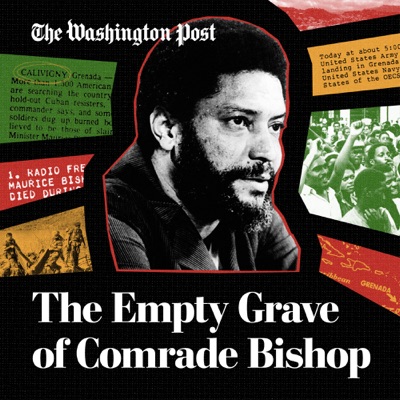
The Empty Grave of Comrade Bishop
Subscribed: 401Played: 4,854
Subscribe
© The Washington Post
Description
Grenada’s revolutionary leader, Maurice Bishop, was executed in a coup in 1983. Seven other people, members of his cabinet and friends, were killed alongside him. The whereabouts of their remains are unknown. Now, in a series two years in the making, The Washington Post’s Martine Powers discovers new information about the 40-year-old mystery, including the role the U.S. played in shaping the fate of this Caribbean nation.
9 Episodes
Reverse
 1
Earlier this year, the U.S. Army launched an internal review of records related to the recovery of remains in Grenada in 1983, and efforts to locate Maurice Bishop’s body.“This is the first serious effort by the Pentagon in decades to address the role the United States played in the disappearance of Grenadian Prime Minister Maurice Bishop’s remains,” said Rep. Barbara Lee (D-Calif.), who pushed for the Army to investigate.In this new update to the series, The Washington Post’s Martine Powers unpacks the findings of the Army’s investigation, the facts and events that it outlines, and the questions it stops short of answering.Read the June letter sent by the secretary of the Army on the Maurice Bishop internal investigation in our special episode guide here.
What does the United States owe to Grenada about the mystery of the missing remains of Maurice Bishop, his cabinet members and supporters? In the final installment of the series for now, Martine Powers takes on that question as she assesses the conclusions of the team’s current reporting. She speaks with a member of the U.S. House of Representatives who has made another formal request of the U.S. military to turn over records related to the case. The Post’s reporting indicates that there are several records that exist and have not been released despite multiple Freedom of Information Act requests. The episode opens with a trip to an old cemetery in Grenada’s capital, where it is possible that the remains could be located. Martine learns why, despite excavations by experts over the years, confirming this has been so difficult. You can find photos and documents from the investigation in our special episode guide here. Subscribers to The Washington Post can get early access to the rest of the series on Mondays on Apple Podcasts, as well as ad-free listening. Link your Post subscription now or sign up to become a new Post subscriber here.
When Martine Powers began looking into the mystery of the missing remains of Maurice Bishop, his cabinet members and supporters, one of the most noted explorations of the case turned out to be done by a group of high school boys in Grenada more than two decades ago. She was able to locate some of the now-adult investigators and the old principal of the school to learn what compelled them to do this as a class project, and how they found their sources. One of the people they interviewed, a former Jamaican soldier, witnessed the exhumation at Calivigny. What he told them more than 20 years ago is central to why many Grenadians think the U.S. government has not told the entire story of what happened to the remains after they were discovered. But he eventually stopped responding to students. Martine and her colleagues searched for the witness for more than a year. They also amassed hours of other tape from interviews with other people who were at the exhumation. What they were left with were incomplete memories of exactly what transpired the day the remains at Calivigny were recovered. Then, there was a breakthrough – with new questions about where all of this leads.You can find photos and documents from the investigation in our special episode guide here. Subscribers to The Washington Post can get early access to the rest of the series on Mondays on Apple Podcasts, as well as ad-free listening. Link your Post subscription now or sign up to become a new Post subscriber here.
Why would the U.S. government have an interest in hiding the remains of an assassinated revolutionary leader? In this episode of “The Empty Grave of Comrade Bishop,” Martine Powers puts this question to Americans who served in Grenada after the invasion 40 years ago, including alumni of the U.S. State Department and a former CIA analyst.“I don't follow the logic of Maurice Bishop as a symbol for communism or anti-Americanism,” said Lino Gutierrez, a former ambassador who worked as a foreign service officer in Grenada. According to Guy Farmer, a spokesperson for the U.S. Embassy in Grenada, “It would have been good for us if we had found Maurice Bishop's body, showing how violent and terrible the Bernard Coard-Hudson Austin faction was. That would have been good for us.”But when The Post’s reporting turns to the role of the U.S. military – and in particular, a battalion of Army rangers who conducted an attack on a Grenadian military training camp – the picture gets more complicated, raising new theories about when and how the United States might have discovered a critical piece of evidence.You can find photos and documents from the investigation in our special episode guide here. Subscribers to The Washington Post can get early access to the rest of the series on Mondays on Apple Podcasts, as well as ad-free listening. Link your Post subscription now or sign up to become a new Post subscriber here.
Professor Robert Jordan was among the few people still on the campus of St. George’s University in November of 1983, in the days after the U.S. invasion of Grenada. One day a strange request came in: The U.S. military wanted to use his anatomy lab at the university for a forensic exam.Martine Powers visits what is left of the old lab and hears the professor’s story about what he saw that day. What transpired in that examination 40 years ago has raised serious questions about the identity and condition of the remains recovered from the pit at Calivigny.Later in the episode, Martine puts some of those questions to the “Grenada 17,” the individuals held responsible for the murder of Maurice Bishop and the others killed with him. She asks: What did they do with the bodies? And could they be omitting information that could explain the mystery?You can find photos and documents from the investigation in our special episode guide here. Subscribers to The Washington Post can get early access to the rest of the series on Mondays on Apple Podcasts, as well as ad-free listening. Link your Post subscription now or sign up to become a new Post subscriber here.

Comments

Download from Google Play

Download from App Store
 United States