DiscoverMy Favorite Mistake: Learning Without Blame in Business and Leadership
My Favorite Mistake: Learning Without Blame in Business and Leadership

My Favorite Mistake: Learning Without Blame in Business and Leadership

Author: Mark Graban

Subscribed: 33Played: 1,316
Share

Description

My Favorite Mistake is a podcast about learning without blame in business and leadership.


Despite the name, it’s not just my favorite mistake—it’s yours, it’s ours, and it’s what we can all learn from when things don’t go as planned.


Hosted by author and consultant Mark Graban, each episode features honest conversations with leaders, executives, entrepreneurs, and changemakers about a meaningful mistake they made—and what they learned after things went wrong. How they responded. How they improved. How they grew as leaders.


This isn’t a show about failure theater, gotcha moments, or simplistic “lessons learned.” It’s about how real people reflect, improve, and lead better in complex organizations—without scapegoating, shame, or hindsight bias.


What You’ll Hear


• Leadership and management mistakes that reshaped careers, teams, and organizations
• How teams and leaders learn without blaming individuals
• Insights about culture, systems, decision-making, and psychological safety
• Practical lessons drawn from real experience, not abstract theory


Guests come from business, healthcare, technology, sports, entertainment, government, and academia, sharing stories that reveal how learning actually happens.


The Perspective


Mark brings a systems-thinking lens grounded in Lean management, continuous improvement, and psychological safety. The focus is less on who messed up and more on what the system taught us.


Who This Podcast Is For


• Leaders and managers who want to learn from mistakes without blame
• Executives working to build healthier, more resilient cultures
• Professionals who believe improvement starts with reflection, not punishment


My Favorite Mistake: Learning Without Blame in Business and Leadership

376 Episodes
Reverse
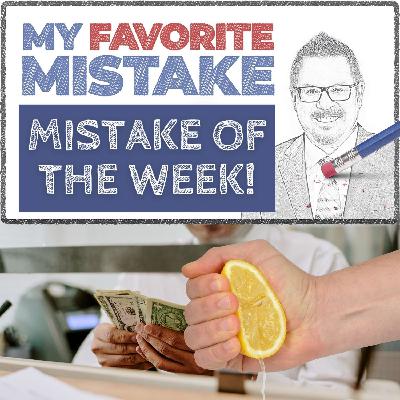
What does a failed bank robbery have to do with one of the most cited ideas in psychology? More than you might expect. In this episode of My Favorite Mistake, Mark Graban tells the true story of McArthur Wheeler, a man who believed that rubbing lemon juice on his face would make him invisible to security cameras. Confident in his reasoning—and even more confident in his ability to test it—Wheeler walked into two Pittsburgh banks in broad daylight, fully exposed, certain that his citrus-based logic would protect him. It didn’t. When police later showed him clear surveillance photos, Wheeler’s stunned response became legendary: “But I wore the juice.” That moment caught the attention of psychologist David Dunning, who saw in Wheeler’s mistake something deeper than criminal incompetence. Along with Justin Kruger, Dunning went on to study how people with low skill often lack the awareness to recognize their own limitations—research that became known as the Dunning–Kruger Effect. This episode explores the layered nature of mistakes: flawed assumptions, poorly designed tests, and the dangerous certainty that both are correct. It’s not a story about stupidity. It’s a story about human blind spots—and how easily confidence can outrun competence. Whether in leadership, work, or everyday life, the lesson is universal: it’s not enough to test our ideas. We also have to test how we test them. Because some of the most convincing mistakes are the ones that feel like proof.
In this week’s Mistake of the Week, a company’s HR team accidentally sent a mass termination email to the entire workforce — including the CEO. The culprit was an offboarding automation tool left in the wrong mode, turning a routine test into a company-wide panic. Mark Graban explores what this moment teaches about automation, human fallibility, and the danger of relying on memory in systems that affect people’s livelihoods. Instead of asking, “Who pressed the wrong button?”, the real question is, “Why was this mistake even possible?” A funny story now, but a real lesson in error-proofing or the lack thereof. Because even when no one’s actually fired, the fear can linger long after the email is retracted.
Why do New Year’s resolutions fail so predictably—and what does that teach us about change at work? In this Mistake of the Week, Mark Graban explores why treating change as a test of willpower is a reliable setup for frustration, both personally and in organizations. Drawing on behavioral psychology and leadership examples, the episode connects failed personal resolutions to common organizational mistakes: big announcements, ambitious targets, and too little attention to system design and psychological safety. The takeaway is practical and actionable: instead of trying to boost motivation or eliminate human error, leaders should focus on making the right choices easier and the wrong ones harder—starting small, iterating, and learning forward instead of blaming backward.
Nick Saban calls it “the dumbest decision I ever made” — a fourth-and-one call from the 2001 SEC Championship Game that still sticks with him. In this episode, Mark Graban breaks down why even the greatest coaches make mistakes, what Saban learned from the moment, and how leaders can turn high-pressure missteps into opportunities for trust and growth. Perfect for listeners interested in leadership, football, coaching, and the psychology of mistakes.
Jingle Bells is one of the most recognizable Christmas songs ever written… except it wasn’t written for Christmas at all. In this week’s Mistake of the Week, we unpack one of America’s most enduring cultural misconceptions: the belief that Jingle Bells has anything to do with Christmas. Originally titled One Horse Open Sleigh, the song debuted at a Thanksgiving church service in the 1850s and was inspired not by Santa or reindeer, but by noisy, fast sleigh races in Medford, Massachusetts. No Christmas trees. No North Pole. Just winter racing, youthful chaos, and a catchy melody. Over the decades, repetition turned assumption into “truth,” and a Thanksgiving song quietly shifted into a holiday anthem. It’s a perfect example of how knowledge mistakes spread — harmless, familiar, and rarely examined. In this 3–4 minute episode, Mark explains: Why Jingle Bells was never meant to be a Christmas song How repetition and cultural habit transformed it anyway What this teaches us about assumptions, organizational habits, and the stories we never question Why small knowledge mistakes can persist for generations If you care about learning, improvement, and understanding how mistaken beliefs take root, this episode offers a fun seasonal reminder: even our most cherished “facts” deserve a second look.
A 32-year-old woman in Switzerland underwent an unnecessary surgery after her lab sample was mixed up at Basel University Hospital. Doctors believed she had cervical cancer. She didn’t — but the procedure went ahead anyway, potentially affecting her ability to carry a pregnancy in the future. In this Mistake of the Week, Mark Graban unpacks how such devastating but preventable errors happen — and why “being careful” isn’t a real safeguard. Drawing on past lab mix-ups he’s written about, Mark explores how system design, workload pressure, and weak error-proofing make these tragedies almost inevitable. This isn’t about bad people or careless workers. It’s about fragile systems — and how hospitals can build processes that catch mistakes before they reach the patient. Because real safety starts with learning, not blaming.
In this Mistake of the Week, Mark Graban breaks down an incident involving an American Airlines A319 on final approach to Phoenix — captured on video with its landing gear still up. A cockpit alert sounded, the crew realized what was missing, and the pilots executed a safe go-around. Their explanation to air traffic control? A perfectly understated: “It wasn’t configured in the appropriate manner.” Mark explores why these near-misses are less about individual oversight and more about systems built to detect — and correct — human error. From checklists to cockpit warnings to the decision to go around instead of pushing forward, this episode highlights why safety depends on catching mistakes early, not pretending they don't happen.  
In this edition of Mistake of the Week, Mark Graban tells a story that didn’t appear in any safety report or headline — it happened on a pickleball court. Early in learning the sport, Mark found his old tennis instincts taking over, leading to a very incorrect serve and a moment of embarrassment. What followed was a small but meaningful lesson in feedback, psychological safety, and the challenge of unlearning deeply wired habits. Supportive coaching, timely correction, and a friendly playing environment turned an awkward mistake into a productive one. Mark reflects on why unlearning is often harder than learning, and how leaders can create conditions where people feel safe enough to improve.
In this week’s Mistake of the Week, Mark Graban tells the story of a Maine hospital system that accidentally mailed condolence letters to 531 very-much-alive patients. The cause? A computer glitch — and a few missing fail-safes. Mark explores what this bizarre mix-up reveals about system design, automation, and trust in healthcare. Beyond the absurd headline lies a familiar pattern: when we blame people instead of learning from process failures, we guarantee more mistakes. So what does “fully resolved” really mean? And what can leaders learn from a mistake that’s literally to die for? If you received this episode through your podcast app and not a séance, you’re doing fine.  
What happens when a business deal looks solid on paper—but falls apart in real life? Episode page with video, links, and more My guest for Episode #335 of the My Favorite Mistake podcast is Kevin Hipes, an entrepreneur, author, and former city commissioner who’s been called the “New York Forrest Gump” because of the many lives he’s lived. Kevin shares the story of one of his biggest—and most unforgettable—business mistakes: buying an oil tanker in the Caribbean. What began as a seemingly foolproof investment with a strong pro forma turned into a cascade of unexpected challenges, including regulatory changes, ethical dilemmas, geopolitical risk, and international drama. In this episode, we talk about: Why smart people still make big business mistakes How external forces can derail even the best plans Learning from failure instead of hiding from it Resilience after financial and emotional setbacks The importance of mental health awareness for leaders and entrepreneurs Kevin’s story is funny, sobering, and deeply human—and a powerful reminder that mistakes don’t define us unless we refuse to learn from them.
Episode Page Angie Callen — founder of Career Bend, host of No More Mondays, and author of Scary Good: Discovering Life Beyond the Sunday Scaries — shares why choosing engineering school became her favorite mistake. In this episode, Angie reflects on becoming an engineer despite being deeply people-oriented, how that decision shaped her thinking, and why mistakes that “don’t fit” often unlock clarity, confidence, and unexpected opportunity. Mark and Angie discuss career transitions, Sunday Scaries, confidence built through action (not perfection), the difference between empathy and compassion, and why so many high performers stay stuck in roles that no longer align with who they are. This conversation explores how mistakes can become catalysts — not failures — and why meaningful work starts with understanding yourself, not following default paths.
In this episode of My Favorite Mistake, Mark Graban talks with Jason Sherman, an entrepreneur, startup advisor, and educator, about the early startup mistakes that quietly shape everything that follows. Episode page with transcript, video, and more Jason shares hard-earned lessons about choosing co-founders, distinguishing “smart money” from money alone, and why MVPs should accelerate learning rather than encourage overbuilding. The conversation explores judgment, incentives, and alignment through a Lean lens — showing how optimism, unchecked assumptions, and unclear decision rights can undermine even strong ideas. This episode is especially relevant for founders, leaders, and anyone working under uncertainty who wants to turn mistakes into insight instead of regret.
In Episode #332 of My Favorite Mistake, Mark Graban talks with Dr. Josh McConkey — emergency physician, Air Force Reserve Commander, combat-deployed medevac leader, and Pulitzer Prize–nominated author. Known as the “MacGyver Doc,” Josh has spent his career solving problems in high-pressure environments where you rarely get a second chance. Episode page with links, video, transcript, and more Josh shares the most painful mistake of his professional life: entering a business partnership without doing the proper due diligence. What followed was a cascade of red flags — Medicare violations, skimming, financial misconduct, and even a $3.4 million bribe offer he refused. The ordeal ultimately cost him nearly $5 million and forced him to rebuild his career and life with integrity front and center. In our discussion, Josh explains how this experience reshaped his understanding of leadership, accountability, and courage — especially in systems where incentives can push good people toward dangerous choices. He also reflects on two decades in emergency medicine, including the structural failures that helped fuel the opioid crisis and the pressures physicians faced to prescribe narcotics. Josh shares why he wrote Be the Weight Behind the Spear and his new children’s leadership book The Heart of a Leader, and why he believes character development must start far earlier than most of us realize. We close with his decision to run for Lieutenant Governor of North Carolina in 2028 — a move grounded in service, accountability, and a desire to strengthen public leadership. This episode explores integrity, systemic failure, resilience, and the lessons we carry forward after a mistake that changes everything.
My guest for Episode #331 of My Favorite Mistake is Andy Regal, a longtime media executive whose career has included leadership roles at The Wall Street Journal, MSNBC, Consumer Reports, Court TV, and CBS College Sports. He is also the author of the forthcoming book, “Surviving Bully Culture: A Career Spent Navigating Workplace Bullying and a Guide for Healing.” Episode page with transcript, video, and more Andy shares a remarkable early-career mistake from his time producing NBC News war coverage with Lester Holt. A young staffer accidentally loaded last week’s script into the teleprompter, and Holt began reading it live on air. Andy, brand new to this type of broadcast, immediately assumed he’d face humiliation or even get fired. Instead, Holt responded with total calm, poise, and kindness—transforming what could have been a career-ending disaster into a lasting lesson on leadership. That moment stands in sharp contrast to the bully bosses Andy encountered throughout his media career. We talk about how bullying shows up in subtle and overt ways, why high performers are often targeted, and how toxic leadership harms morale, performance, and even physical and mental health. Andy explains what recovery looks like and why his book is dedicated to helping people cope with, heal from, and navigate workplaces where bullying is tolerated or ignored. In This Episode: • The wrong-script live TV moment with Lester Holt • Why calm leadership builds psychological safety • The emotional impact of bully bosses • Why bullying thrives in high-pressure environments • How bullying follows people home and affects well-being • What recovery looks like for targets of workplace bullying • Why Andy wrote Surviving Bully Culture Learn More Andy Regal’s website & book pre-order: https://www.andyregal.com
My guest for Episode #330 of the My Favorite Mistake podcast is Debra Clary, a leadership strategist, researcher, and executive coach with more than four decades of experience at organizations including Frito-Lay, Coca-Cola, Jack Daniel’s, and Humana. Episode page with video, transcript, and more She’s also a TEDx speaker, former off-Broadway performer, and the author of the new book The Curiosity Curve: A Leader’s Guide to Growth and Transformation Through Bold Questions. In this episode, Debra shares one of her favorite mistakes—an unexpected wrong train stop in Italy that turned into a memorable discovery—and how that happy accident helped shape her approach to curiosity, flexibility, and exploring the unexpected. That theme carries through the conversation as Debra and I discuss how curiosity shows up in leadership, why assumptions can derail teams, and why “having the answers” is often the wrong place to start. Debra walks us through the research behind The Curiosity Curve, including how her team developed a validated diagnostic for measuring curiosity and what they learned about its connection to engagement, retention, innovation, and decision speed. She shares practical examples of how leaders unintentionally shut down curiosity and how small shifts in inquiry can unlock better thinking and stronger team performance. We also explore how curiosity interacts with psychological safety, how leaders can avoid the trap of reflexive certainty, and why curiosity becomes even more important in high-pressure or high-uncertainty situations. Debra closes by discussing the role curiosity plays in an AI-driven world—why it remains uniquely human, and how tools like AI can actually help people deepen their inquiry rather than replace it. If you’re interested in how leaders can cultivate better questions, better conversations, and better outcomes, this episode will spark ideas you can put to use right away. Questions and Topics: What’s your favorite mistake? Were there similar moments in your career where a “missed stop” led to an unexpected opportunity? Was starting as a Frito-Lay route driver a deliberate development path, or was that unusual? Where did your passion for curiosity begin? Is there a way to gauge curiosity in a team or organization? How do you measure something like curiosity in a meaningful way? How do you help leaders learn to be more curious instead of just telling people to “be curious”? When hiring, is it better to select already-curious people or rely on the culture to develop curiosity? Is there such a thing as too much curiosity—can it slow execution or decision-making? From your research or coaching, what’s an example of curiosity being missing and causing problems? How do you help leaders understand that curiosity and psychological safety are building blocks for innovation—not optional extras? Do you see leaders struggle with the difference between knowing, assuming, and figuring things out? In urgent or high-pressure situations, does stress make it harder for people to stay curious? Do you have examples where curiosity helped prevent a small mistake from turning into a big one? Have you seen situations where people used questions in unhelpful or critical ways while claiming they were being “curious”? How do you think about Ed Schein’s idea of humble inquiry? Can AI replace curiosity—or does curiosity still give humans a unique advantage? Can interacting with AI actually help people strengthen their curiosity?
My guest for Episode #329 of the My Favorite Mistake podcast is Dr. Melissa Robinson-Winemiller, a TEDx speaker, empathy and leadership expert, and author of The Empathic Leader: How EQ via Empathy Transforms Leadership for Better Profit, Productivity, and Innovation. Episode page with video, transcript, and more Melissa shares the story of her “favorite mistake” — leaving her music and academic career after experiencing a toxic culture and institutional failure to protect her following an assault by a colleague. What began as heartbreak became the foundation for her life’s work: helping leaders build empathy, trust, and psychologically safe workplaces. We discuss how empathy differs from sympathy and compassion, and why leaders often misunderstand empathy as weakness. Melissa explains why true empathy isn’t about being nice—it’s about being kind—and how self-empathy is the first step toward leading others effectively. Her framework for self-empathy includes observing, reflecting, building awareness, and practicing compassion toward oneself. That self-understanding helps leaders respond constructively when mistakes happen—creating cultures where learning and accountability can thrive. “Empathy isn’t soft. It’s kind.” “Empathy doesn’t mean no boundaries—it means understanding through another’s perspective.” Melissa also discusses findings from her doctoral research in interdisciplinary leadership at Creighton University and her viral TEDx Talk on self-empathy and self-judgment, which has drawn tens of thousands of views within days of release.
We’re going back to Episode 30 from January 2021, featuring Katie Anderson — author of Learning to Lead, Leading to Learn — and Isao Yoshino, the longtime Toyota leader whose career and lessons inspired her book. Episode page with video, transcript, and more It was such a privilege to talk with them then, and even more meaningful now, because I recently got to spend time with Mr. Yoshino in Japan last October during Katie’s Learning to Lead, Leading to Learn experience. Seeing him there — humble, curious, and still passionate about developing others — really reinforced everything we talked about in that episode. Mr. Yoshino shared a story from early in his Toyota career, when a mistake on the shop floor could have led to punishment, but instead led to learning. His leaders didn’t blame him — they worked with him to fix the system. That experience shaped how he led and coached for decades. Katie shared her own favorite mistake — a story about feedback early in her career that helped her realize the power of listening, asking questions, and helping others find their own answers. Together, we explored what it means to create a culture where people feel safe to learn, improve, and grow — the kind of culture that turns mistakes into progress.
My guest for Episode #328 of the My Favorite Mistake podcast is Emily Aborn, a small business copywriter, speaker, and host of the Small Business Casual podcast. Episode page with video, transcript, and more Emily helps entrepreneurs bring clarity, creativity, and authenticity to their marketing. Before finding her true calling, she owned a brick-and-mortar organic mattress store—a business that looked great on paper but didn’t align with her passions or strengths. Emily shares how this “perfect-on-paper” business became her favorite mistake. Though the store was profitable, she found herself feeling trapped, unfulfilled, and disconnected from the work she truly loved. Through closing that chapter, Emily discovered what she actually enjoyed most—writing, connection, and storytelling—and turned those insights into a business built around her natural skills. Today, Emily works with entrepreneurs across industries to find their authentic voice and create meaningful marketing. In this episode, she and Mark explore lessons about self-awareness, alignment, and how mistakes can guide us toward a more fulfilling path. Emily also shares practical insights on copywriting, understanding your audience, and why genuine collaboration beats fear-based marketing every time. Questions and Topics: What was your favorite mistake, and what did you learn from it? Why did that business seem like such a good idea on paper? What made you realize it wasn’t the right fit? How did running that store help you discover your passion for copywriting? What were some of the marketing lessons you learned from that experience? What are the most common copywriting or branding mistakes you see small businesses make? How can business owners find and express their authentic voice in their marketing? What are “problem-aware,” “solution-aware,” and “symptom-aware” customers—and why does that matter? How do you approach repurposing content the right way instead of just copying and pasting? What has hosting your own podcast taught you about communication and creativity? Have you ever made a memorable mistake as a podcaster yourself?
My guest for Episode #327 of the My Favorite Mistake podcast is Dr. Maya Ackerman, AI pioneer, researcher, and CEO of WaveAI. She’s also an associate professor of Computer Science and Engineering at Santa Clara University and the author of the new book Creative Machines: AI, Art, and Us. EPISODE PAGE WITH VIDEO, TRANSCRIPT, AND MORE In this episode, Maya shares her favorite mistake — one that changed how she builds technology and thinks about creativity. Early in her journey as an entrepreneur, her team at WaveAI created an ambitious product called “Alicia,” designed to assist with every step of music creation. But in trying to help too much, they accidentally took freedom away from users. That experience inspired her concept of “humble AI” — systems that step back, listen, and support human creativity rather than take over. Maya describes how that lesson led to their breakthrough success with Lyric Studio, an AI songwriting tool that empowers millions of artists by helping them create while staying true to their own voices. She also shares insights from her research on human-centered design, the philosophy behind generative models, and why we should build AI that’s more collaborative than competitive. Together, we discuss why mistakes — whether made by people or machines — can spark innovation, and how being more forgiving toward imperfection can help both leaders and creators thrive. “If AI is meant to be human-centric, it must be humble. Its job is to elevate people, not replace them.” — Maya Ackerman “Who decided machines have to be perfect? It’s a ridiculous expectation — and a limiting one.” — Maya Ackerman Questions and Topics: What was your favorite mistake — and what did you learn from it? What went wrong with your second product, “ALYSIA,” and how did that shape your later success? How did you discover the concept of “humble creative machines”? What makes Lyric Studio different from general AI tools like ChatGPT? How do you design AI that supports — rather than replaces — human creativity? What’s the real difference between AI and a traditional algorithm? How do you think about ethical concerns, like AI imitating living artists? What do you mean by human-centered AI — and how can we build it? Why do AI systems “hallucinate,” and can those mistakes actually be useful? How can embracing mistakes — human or machine — lead to more creativity and innovation? What are your thoughts on AI’s future — should we be hopeful or concerned?
My guest for Episode #326 of the My Favorite Mistake podcast is Dr. William Harvey, a manufacturing executive and university professor whose career is defined by developing people, strengthening systems, and driving organizational excellence. A proud U.S. Marine, William carries forward a deep tradition of service and leadership. He also serves as the chair for the 2026 AME International Conference in Milwaukee, hosted by the Association for Manufacturing Excellence (AME). EPISODE PAGE WITH VIDEO AND MORE William shares a powerful early-career story about a mistake that taught him lasting lessons about trust, humility, and psychological safety. When he accidentally derailed a customer order by taking home the wrong document, he feared the worst. Instead, his manager’s calm and compassionate response—and a customer’s extraordinary effort to make things right—changed how William thought about leadership forever. Over time, William applied those lessons to how he leads teams and builds culture. He believes that leaders go first—by admitting mistakes, showing vulnerability, and creating space for others to experiment, fail, and learn. Through daily coaching cycles and methods like Toyota Kata, he helps people develop confidence in problem solving and take ownership of improvement. His goal: to build a workplace culture rooted in trust, respect, and continuous learning, where every person feels safe enough to speak up and strong enough to lead. Key Lessons & Themes: Why trusting your team is critical to avoiding unnecessary errors How supportive leadership responses turn mistakes into growth moments The connection between psychological safety, continuous improvement, and Toyota Kata How to “go first” as a leader—admitting your own mistakes to build trust The link between physical safety and psychological safety in world-class organizations What leaders can learn from Paul O’Neill and his “zero incidents” mindset at Alcoa
loading
Comments