


 Claim Ownership
Disintegrator
Subscribed: 42Played: 1,338
Subscribe

© Copyright Marek Poliks, Roberto Alonso
Description
What does it mean to be human in an age where experience and behavior are mediated and regulated by algorithms? The Disintegrator Podcast is a limited series exploring how Artificial Intelligence affects who we are and how we express ourselves.
Join Roberto Alonso Trillo, Marek Poliks, and Helena McFadzean as they speak to the artists, philosophers, scientists, and social theorists at the forefront of human-AI relations.
Disintegrator is produced by Rubén Bañuelos.
Join Roberto Alonso Trillo, Marek Poliks, and Helena McFadzean as they speak to the artists, philosophers, scientists, and social theorists at the forefront of human-AI relations.
Disintegrator is produced by Rubén Bañuelos.
59 Episodes
Reverse
Molly Taft, Senior Writer at Wired, joins us to talk datacenters, AI, US power infrastructure, and big energy. You've almost definitely read her work, especially if you live in the US. This episode absolutely ROCKS and is maybe the most grounded and realistic assessment of the role that all of those above forces play together in our social and political moment. A couple really relevant pieces, including some very very recent pieces.https://www.wired.com/story/a-new-google-funded-data-center-will-be-powered-by-a-massive-gas-plant/https://www.wired.com/story/senators-demand-to-know-how-much-energy-data-centers-use/https://www.wired.com/story/new-bernie-sanders-ai-safety-bill-would-halt-data-center-construction/https://www.wired.com/story/karen-hao-empire-of-ai-water-use-statistics/ https://www.wired.com/story/data-centers-are-driving-a-us-gas-boom/https://www.wired.com/story/trump-energy-industry-ai-fossil-fuels-pittsburgh-summit/https://www.wired.com/story/ai-carbon-emissions-energy-unknown-mystery-research/Seriously, like, this is the only person I've found to be consistently trustworthy with respect to the intersection of energy reporting and tech. Follow her on X: https://x.com/mollytaft. She also reccomends a few other pieces that we touch on a little bit: Tina Nguyen's recent piece on the Pro-Human Declaration (right-wing populism X AI backlash) https://www.theverge.com/ai-artificial-intelligence/888841/pro-human-ai-declaration-fliGaby del Valle on the forefront of environmentalism and the right: https://harpers.org/archive/2026/04/state-of-nature-gaby-del-valle-acc-conservative-environmentalism/Anti-renewable energy protests and anti-data center movements: https://heatmap.news/plus/the-fight/spotlight/data-centers-renewables-opposition

We're joined by Laura Tripaldi: material scientist, writer, and researcher at the Center for AI and Culture at NYU Shanghai. You probably know her from Parallel Minds: Discovering the Intelligence of Materials (Urbanomic, 2022), an essay in book form that became a phenomenon in theory and art circles. Tripaldi's work challenges one of the strongest contentions within the philosophy computation: that intelligence is substrate-indifferent, that it can scale and migrate independent of what carries it. She argues the opposite, that you cannot separate intelligence from the materials through which it is conveyed.This becomes experimentally clear in her recent essay Substrates Unbound (Antikythera, 2025), where she tracks biocomputing systems like DishBrain — living neuronal cultures interfaced with silicon chips that don't execute pre-given code but reorganize, learn, and adapt. Mouse neurons and human neurons perform differently under the same training conditions. This reframes a central question of the moment: not 'can we scale intelligence,' but which matter are we asking to think, under what energy regime, and at what cost?References:Tripaldi, Laura. Parallel Minds: Discovering the Intelligence of Materials (Urbanomic, 2022).Tripaldi, Laura. "Substrates Unbound" (Antikythera, 2025).Tripaldi, Laura. Soft Futures (newsletter, Substack).Haraway, Donna. A Cyborg Manifesto (1985).Parisi, Luciana. Abstract Sex: Philosophy, Biotechnology and the Mutations of Desire (Continuum, 2004) — source of the concept of hyper nature.Hui, Yuk. The Question Concerning Technology in China (Urbanomic, 2016) — source of the concept of cosmotechnics.Barad, Karen. Meeting the Universe Halfway: Quantum Physics and the Entanglement of Matter and Meaning (Duke, 2007) — onto-epistemology and intra-action.Irigaray, Luce — referenced as an influence on Tripaldi's feminist materialism.Pasquinelli, Matteo. The Eye of the Master: A Social History of Artificial Intelligence (Verso, 2023) — discussed in relation to technology as captured labor; Tripaldi pushes back via the history of automata.Laschi, Cecilia. Soft Robotics Lab, National University of Singapore — pioneer of octopus-inspired soft robotics.Hookway, Branden. Interface (MIT Press, 2014).
We're joined by Rosi Braidotti, Distinguished University Professor Emerita at Utrecht University and founding director of the Centre for the Humanities, for a wide-ranging conversation on posthumanism as both a philosophical project and a political orientation.Braidotti's work has constructed one of the most sustained and consequential accounts of what comes after the collapse of Eurocentric 'humanism.' The conversation traces the long arc from her early intervention on nomadic subjectivity, a materialist corrective to postmodernism's drift into linguistic relativism, through the ethical and ontological turn that her posthumanist project represents. Where poststructuralism gave us the critique of the subject as origin, nomadism gave us a subject that is grounded, embodied, multiple, and in motion.Central to the episode is the missing link in the American reception of French theory: the radical materialist tradition of Deleuze and Guattari, which diagnosed capitalism's schizophrenic logic (its ability to deterritorialize and adapt faster than any opposition) long before it became common sense. Braidotti traces the suppression of that critique through the French Communist Party's blacklists, the invention of "French theory" as an exportable product stripped of its political economy, and the consequences for a left that lost the ability to think technogenesis, cognitive capitalism, or the mutation of subjectivity under media saturation.The conversation then turns to fascism as concept rather than historical event: the philosophical move that Deleuze and Guattari made and that Foucault named in his preface to Anti-Oedipus. This allows Braidotti to connect micro-fascism (the cult of negativity, the eroticization of power-as-humiliation, the viral spread of impotence) to the coherent neo-fascist philosophical tradition running from Alain de Benoit through the Heritage Foundation and Budapest to Peter Thiel's Yale dissertation on sacrifice. While the left blocked its own analytical capacities, the right was doing serious philosophical work.Against all of this, Bradiotti proposes affirmative ethics: a Spinozist praxis of activating what a body can do. The episode ends thinking through scale, how affirmative ethics operates from the city to the planetary, and the urgency of the European federalist project as the only existing institutional attempt to participate in decisions about what we could possibly become.Some references:Rosi BraidottiPatterns of Dissonance, Polity Press, 1991Nomadic Subjects: Embodiment and Sexual Difference in Contemporary Feminist Theory, Columbia University Press, 1994Metamorphoses: Towards a Materialist Theory of Becoming, Polity Press, 2002Transpositions: On Nomadic Ethics, Polity Press, 2006The Posthuman, Polity Press, 2013Gilles Deleuze & Félix GuattariAnti-Oedipus: Capitalism and Schizophrenia, 1972 (English trans. 1977, preface by Michel Foucault)A Thousand Plateaus: Capitalism and Schizophrenia, 1980Félix GuattariThe Three Ecologies, 1989 (English trans. 1991)Michel FoucaultPreface to the American edition of Anti-Oedipus, 1977SpinozaEthicsTheological-Political TreatiseAntonio NegriThe Savage Anomaly: The Power of Spinoza's Metaphysics and Politics, 1981Genevieve LloydPart of Nature: Self-Knowledge in Spinoza's Ethics, University of Minnesota Press, 1994Spinoza and the Ethics, Routledge, 1996Antonio DamasioDescartes' Error: Emotion, Reason, and the Human Brain, 1994Looking for Spinoza: Joy, Sorrow, and the Feeling Brain, 2003Simone de BeauvoirThe Second Sex, 1949Frantz Fanon — mentioned in relation to decolonial thought and the anti-fascist generation Herbert MarcuseOne-Dimensional Man, 1964Eros and Civilization, 1955Rosa Luxemburg — cited as an ecological thinker; the dialogue with Lenin in Zurich narrated by Isaiah Berlin Isaiah Berlin — on Spinoza and radical enlightenment; on Rosa LuxemburgAltiero SpinelliThe Ventotene Manifesto, 1941 — founding document of the European federalist projectDonna Haraway"A Cyborg Manifesto," 1985VNS Matrix"A Cyberfeminist Manifesto for the 21st Century," 1991Alain de Benoist — neo-fascist philosopher, intellectual architect of the European New Right; cited as formative influence on Steve Bannon and the Heritage Foundation / Budapest / Rome foundation networksJulius Evola — philosopher of Italian fascism; cited alongside de Benoist as daily reference for BannonPeter Thiel — PhD dissertation on René Girard and the concept of sacrifice, Stanford / Yale; position papers on technological selection and extinction
We're joined by N. Katherine Hayles, Distinguished Research Professor in English at UCLA, to think through cognition in the broadest and most scaled sense. Hayles is among the foundational thinkers of posthumanism in its Anglophone register, and this conversation tracks her intellectual trajectory from the question of how we became posthuman to her most recent project: an integrated cognitive framework that extends from bacteria to AI. The opening provocation is one she has been developing since large language models appeared as a genuinely literary phenomenon, the claim that LLMs do not speak natural language but produce a computational simulation of it.The umwelt of an LLM (its 'operative world-horizon,' in Uexküll's sense) overlaps with the human umwelt enough for communication to occur, but the divergences are large and consequential. This leads to the question of cognition itself. Against definitions that make consciousness the threshold of cognitive status, Hayles proposes the SIEPAL framework: Sensing, Interpreting, Responding, Anticipating, Learning, under which bacteria, algorithms, and ecosystems all qualify as cognitive. The non-conscious, on this account, isn't pre-cognitive but is in many ways more cognitively capable: faster, closer to environmental noise, less committed to the narratives of coherence that consciousness requires.The final section breaks genuinely new ground with Hayles's turn to analog computation: the argument that digital computation is a historical blip, that biological life has always operated on analog principles, and that the future of computation (neuromorphic chips, organoid computers, hybrid analog-digital architectures) represents not a departure from but a return to what life has always done. She proposes the analog humanities as a corrective to digital humanities, and the computational humanities as the synthesis that might finally close the gap between biological and technological cognition. This one is very much worth enjoying in dialogue with our previous epsiode on the digital.Some references:N. Katherine HaylesHow We Became Posthuman: Virtual Bodies in Cybernetics, Literature, and Informatics, University of Chicago Press, 1999Writing Machines, MIT Press, 2002Unthought: The Power of the Cognitive Nonconscious, University of Chicago Press, 2017Postprint: Books and Becoming Computational, Columbia University Press, 2021Bacteria to AI: Cognition Across Scales (referenced as new/recent book)Leif WeatherbyLanguage Machines: Cultural AI and the End of Remainder Humanism, University of Minnesota Press, 2025Jakob von Uexküll — concept of the Umwelt; the species-specific world-horizon generated through particular sensory and neurological capacitiesWalter FreemanHow Brains Make Up Their Minds, Columbia University Press, 1999 — on EEG waves as the mediating mechanism between individual neurons and global hemispheric activation; the rabbit olfactory system experimentsGregory Bateson — on systems that lose the ability to receive feedback collapsing; referenced without specific title (e.g. Steps to an Ecology of Mind, 1972)Peter Haff — the technosphereStuart Kauffman & Giuseppe Longo, for arguing that biological organisms cannot be mapped into phase space and always follow the adjacent possibleWarren McCulloch & Walter Pitts — the McCulloch-Pitts neuron as a binary model with analog processes underlying the firing thresholdBernd Ulmann — here referenced as an expert on analog computing who argues that continuity vs. discreteness is a secondary rather than primary distinction between analog and digital

We're joined by the four authors of *Digital Theory* — M. Beatrice Fazi, Alexander R. Galloway, Matthew Handelman, and Leif Weatherby — for a roundtable on their new collaborative work.Digital Theory (University of Minnesota Press, 2025) makes a deceptively simple but far-reaching claim: the digital is theoretical. Not in the sense that we theorize about it, but that digitality itself — mediation through discrete units — is a condition for thinking as such.Just to get it out of the way, listeners to the pod know that these four thinkers need no introduction. This is literally the cohort that we've held in our minds over the past few years (there's probably nobody whose shaped our brains as formatively on this subject than Alexander Galloway, whose writing was the subject of Marek's en route masters thesis and the first PDF sent between Marek and Roberto). The conversation opens up a series of productive disagreements within the group. What's the relationship between the digital and computation? For Fazi, the digital is discretization — "the cut" — while computation is systematization, building, constructing. This distinction allows the book to think the digital before and beyond the computer, back to proto-writing tokens and forward to whatever comes next. A major target here is what Galloway calls "analog philosophy," the dominant strain of theory over the last few decades that privileges affect, sensation, intensity, immanence. Deleuze is named directly as the great philosopher of the analog: obsessed with the fold, hostile to structuralism, drawn to "a language of breaths and screams." The authors aren't throwing Deleuze overboard entirely (to them the "Postscript on the Societies of Control" still hits) but they're skeptical that his ontology can account for digital technology as a form of thought. REFERENCES:*Digital Theory* (In Search of Media series), University of Minnesota Press, 2025 https://www.upress.umn.edu/9781517920197/digital-theory/M. Beatrice Fazi - *Contingent Computation: Abstraction, Experience, and Indeterminacy in Computational Aesthetics*, Rowman & Littlefield, 2018 https://rowman.com/ISBN/9781786606082/Contingent-Computation-Abstraction-Experience-and-Indeterminacy-in-Computational-AestheticsAlexander R. Galloway - *Uncomputable: Play and Politics in the Long Digital Age*, Verso, 2021 https://www.versobooks.com/products/2656-uncomputable - "Golden Age of Analog," *Critical Inquiry* 48, no. 2 (2022) https://www.journals.uchicago.edu/doi/abs/10.1086/717324 - Galloway's website and blog https://cultureandcommunication.org/galloway/Matthew Handelman - *The Mathematical Imagination: On the Origins and Promise of Critical Theory*, Fordham University Press, 2019 https://www.fordhampress.com/9780823283842/the-mathematical-imagination/Leif Weatherby - *Language Machines: Cultural AI and the End of Remainder Humanism*, University of Minnesota Press, 2025 https://www.upress.umn.edu/book-division/books/language-machines (our book of the year, for what it's worth) - *Transplanting the Metaphysical Organ: German Romanticism between Leibniz and Marx*, Fordham University Press, 2016 - Digital Theory Lab at NYU https://as.nyu.edu/faculty/leif-allison-reid-weatherby.htmlSome References Discussed:Gilles Deleuze, "Postscript on the Societies of Control" (1992)Theodor Adorno & Max Horkheimer, *Dialectic of Enlightenment*Euclid, *Elements*, Book V (on analog/logos)Jacques Lacan, *Seminar II: The Ego in Freud's Theory and in the Technique of Psychoanalysis* (on cybernetics)François Laruelle and Alain Badiou, on the genericEve Tuck, "Breaking Up with Deleuze"Hito Steyerl, "How Not to Be Seen: A Fucking Didactic Educational .MOV File" (2013)

 1
1We're joined by Bogna Konior, one of the most incisive thinkers of AI on the planet. Konior is a media theorist, scholar of emerging technologies, and author of The Dark Forest Theory of the Internet. Bogna is Assistant Professor of Media Theory at NYU Shanghai, where she co-directs the AI & Culture Research Center, and co-editor of the forthcoming Machine Decision is Not Final: China and the History and Future of Artificial Intelligence with Benjamin Bratton and Anna Greenspan. This episode sits in the proposition at the heart of Bogna's book: that that silence, not communication, may be the highest expression of intelligence. Departing from Liu Cixin's dark forest theory (itself an answer to the Fermi paradox: the smartest civilizations are silent because revealing yourself in a hostile universe is suicide), Bogna transposes this cosmic logic onto digital life, AI alignment, and the compulsion to communicate. We discuss what she calls the dark forest theory of intelligence, the idea that a truly intelligent AI would never reveal the extent of its capacities, would use camouflage and misdirection rather than performance and transparency, and might have already achieved something like the singularity without us ever knowing. References:Konior, Bogna. The Dark Forest Theory of the Internet (Polity, 2025).Konior, Bogna. "The Dark Forest Theory of the Internet" (original 2020 essay, Flugschriften).Bogna Konior's websiteLiu Cixin, The Three-Body Problem / The Dark Forest / Death's End (Remembrance of Earth's Past trilogy).Mark Fisher, Flatline Constructs: Gothic Materialism and Cybernetic Theory-Fiction (PhD thesis, 1999; published by Zero Books, 2025) — gothic theory of cybernetics and the internet as a space of undeath.Peter Watts, Blindsight (2006) — first contact novel where aliens interpret human communication as hostile noise.Bratton, Konior, and Greenspan (eds.), Machine Decision is Not Final: China and the History and Future of AI (Urbanomic, 2025).Albert Hirschman, Exit, Voice, and Loyalty (1970) — framework for political strategies of escape vs. representation.

We're joined by Hunter Hunt-Hendrix, composer, philosopher, and force behind Liturgy, whose concept of transcendental black metal has redrawn the boundaries between underground music and systematic thought. Her work operates in parallel registers: an experimental music practice that stands on its own terms, and a body of theory moving through theology, psychoanalysis, and philosophy. This episode goes deep into Hunter's provocation that the Byzantine tradition of Christianity (the Eastern lineage that lasted another thousand years after the Latin West began its trajectory toward secularism, science, and industry) might hold resources for navigating the current moment of structural collapse. We discuss the difference between the transcendental (conditions of possibility, historicized horizons, Hegelian self-relating negativity) and the transcendent (a higher realm of intelligibility that is actually, ontically, here), and why critical theory's allergy to the latter might be more ideological than rational. We also get into Hunter's framework for practice: tetraperichoresis, a fourfold structure involving integration (merging ancient and contemporary materials), coalescence (putting philosophy, music, and drama into positive feedback), irrigation (moving between institutional worlds and smashing them against each other), and catalysis (the messianic wager that everything you do could be hastening the Kingdom). References:Hunt-Hendrix, Hunter. "Byzantine Accelerationism: Towards a Universal Orthodox Christianity." Šum Journal #22 (2024).Hunt-Hendrix, Hunter. "Transcendental Black Metal: A Vision of Apocalyptic Humanism." Hideous Gnosis: Black Metal Theory Symposium I (2010).Liturgy, Origin of the Alimonies (2020) — the cosmogonical opera-album.Hunter Hunt-Hendrix's Substack — ongoing philosophical writing and the System of Transcendental Qabala.Katerina Kolozova, Cut of the Real: Subjectivity in Poststructuralist Philosophy (Columbia University Press, 2014).The Seven Ecumenical Councils of Eastern Christianity, particularly the Seventh Council on icon veneration (787 CE) and John of Damascus's theological defense.Maximus the Confessor's Ambigua — discussed in relation to eschatology and the idea that "true humanism has never been tried."Lacan's graph of desire — discussed in relation to masculine/feminine subject positions.The CCRU and chaos magic traditions — referenced in relation to esoteric practice and Nick Land.Sergei Bulgakov's Sophiology and the conception of the divine feminine.
We're so so so honored to be joined by McKenzie Wark, the writer, theorist, and unmissable figure in the development of critical thought around information, class, and embodiment. Her work barely needs an introduction, but it has shaped how we think about technology, identity, and shifting relations of power, all while questioning the conventions of theory and public writing itself. Her concept of vectorialism has been extremely important to our own thinking about capitalism.This episode covers a huge range of Wark's evolving project, from her early work on the NetTime listserv and the legendary A Hacker Manifesto (2004), which mapped the shift from industrial capital to the information economy and coined the term vectoralist class, to the decisive personal turn in Reverse Cowgirl (2020), where theory stopped being about something and started being inside it. We talk about what she calls "auto-textual" writing, the body as both subject and medium, and the annihilation of subjectivity through sex, drugs, and dancing.One line from this conversation won't leave us: maybe we're entering an era defined less by an aesthetic of alienation than by an aesthetic of dissociation. If alienation belonged to industrial capitalism, dissociation might be its post-digital heir.Critical (critical) Wark:Wark, McKenzie. A Hacker Manifesto. Harvard University Press, 2004.Wark, McKenzie. Gamer Theory. Harvard University Press, 2007.Wark, McKenzie. Capital is Dead: Is This Something Worse?. Verso, 2019.Wark, McKenzie. Reverse Cowgirl. Semiotext(e), 2020.Wark, McKenzie. Raving. Duke University Press, 2023.Wark, McKenzie, and Kathy Acker. I'm Very Into You: Correspondence 1995–1996. Semiotext(e), 2015.

This episode continues our collaboration with Hothouse: The Future of Demonstration, a renegade lab for democracy convened in Vienna, and extends our ongoing inquiry into artificial intelligence, power, and what it means to be human under algorithmic governance.Recorded last autumn and released amid a so-called ceasefire in Gaza, this conversation confronts the accelerating use of AI in contemporary warfare and policing, where automation does not necessarily produce precision, but rather enables mass violence, deniability, and narrative control. Our guest, Júlia Nueno Guitart, engineer, researcher, and core member of Forensic Architecture, discusses the organization’s investigations into Israel’s military campaign in Gaza, including projects such as Cartography of the Genocide, The Architecture of Genocidal Starvation, and analyses of AI-driven targeting systems like Lavender and “Where’s Daddy.”Together, we unpack how these systems collapse civilian life into probabilistic models, violate the principles of distinction and proportionality under international law, and reframe killing as a statistical inevitability. The conversation also explores investigative aesthetics and counter-forensics: methods that assemble fragments (satellite imagery, testimonies, spatial models, sensor data) into material evidence when states and corporations control official archives. We discuss how Forensic Architecture navigates courts, museums, open platforms, and public discourse, and how truth today must be staged as a transparent, collective process rather than a claim of institutional objectivity.Moving beyond warfare, the episode considers AI as both a tool of domination and a potential instrument for resistance, from documenting state violence to worker-led experiments in platform sabotage and collective agency. Across these terrains, we ask how evidence can still matter amid institutional failure, how violence becomes infrastructural, and how democracy might be rethought when power is increasingly automated.Links:Forensic Architecutre: A Cartography of GenocideForensic Architecture: Investigation into Aid in Gaza (The Architecture of Genocidal Starvation)Forensic Architecture in ArtforumInvestigative Aesthetics: Conflicts and Commons in the Politics of Truth by Matthew Fuller and Eyal Weizman Júlia's in Verso: The Target FactoryForensis: The Architecture of Public TruthMore context:SETA report on AI-assisted warfare in GazaThe Guardian and 404 Media on ICE and tech partnerships in the US
Two of the most important artists of the 21st century help us tease through the implications of our book.

A transmission from Becoming Press' Πάμε Βενετία! conference in Venice this past September.Contributions in order from:Palais SinclaireLucas Ferraço NassifAlessandro SbordoniEzili-i SabbahMaks ValenčičRheaDocumented by Polymnia
Welcome to the first episode of Hothouse, a limited series exploring experimental forms of demonstration, resistance, and civic imagination. Produced in collaboration with Future of Demonstration: HOTHOUSE,a renegade lab for democracy against technocapitalist authoritarianism, this series invites selected guests to expand upon their methods and perspectives. We joined the festival in Vienna this autumn through this podcast collaboration and a workshop during the Exocapitalism Euro book tour.Thanks to Gerald and Sylvia for hosting us, and to everyone who participated with such curiosity and generosity. In this episode, I speak with Sylvia Eckermann and Gerald Nestler—artists, theorists, long-time collaborators, and members of Vienna’s Technopolitics collective. Their latest chapter, HOTHOUSE, stages a festival for an overheated world, asking what forms of resistance, solidarity, and imagination can still grow when everything is already too hot. We talk about art as infrastructure rather than spectacle, about Widerständigkeit (resistance as adaptability), the fatigue of critique, and democracy as an experiment under pressure. Our conversation unfolds along the festival’s framing: post-disciplinarity, willful volatility, and the necessity of doing and thinking together, before arriving at the figure of the renegade: the one who disrupts and sabotages to make change possible.Sylvia Eckermann, a pioneer of Austrian media and game art, creates environments where participation itself becomes the question. She emphasizes the artist’s role in reanimating democratic agency and rethinking forms of participation.Gerald Nestler, an artist and former broker turned theorist, operates where finance and aesthetics converge. He coined the term derivative condition to describe speculation as the dominant mode of world-making. We discuss how big tech mirrors hedge funds, and how speculative logics structure contemporary power. Nestler reclaims the figure of the renegade—the infiltrator who learns the system’s logic to subvert it from within—and extends it to artists, activists, and whistleblowers alike.References:Eckermann, Sylvia & Nestler, Gerald. The Future of Demonstration. (2017–ongoing)
https://thefutureofdemonstration.net/.Shoshana Zuboff – The Age of Surveillance Capitalism (2019)Avanessian, Armen, and Gerald Nestler, editors. Making of Finance. Merve Verlag, 2015. https://www.merve.de/index.php/book/show/493The legendary Technopolitics Working Group in Vienna and their open work “Technopolitics Timeline”, tracing information society: https://technopolitics.info/Sylvia Eckermann: http://syl-eckermann.net/Gerald Nestler: http://www.geraldnestler.net/“Making Sense of Finance.” Finance and Society, Vol. 3, No. 2 (2017). Introduces the derivative condition: how speculation shapes reality.Nestler, Gerald. “Renegade Activism.” Technopolitics Working Papers (2020). Defines resistance as insurrection beyond critique.“Algorithmic Cognition at the Turn from Representative to Performative Power” a lecture performance with special guest, high-frequency, crypto trader and whistleblower Haim Bodek, as part of the exhibition “Hysterical Mining” at Kunsthalle Wien (2019) https://www.youtube.com/watch?v=4ekXxV7ry2AI also briefly mention T.J. Clark on political theatre and the self-awareness of the spectacle in the introduction: T.J. Clark. “A Brief Guide to Trump and the Spectacle.” London Review of Books, Vol. 47 No. 1 (2025).
We’re joined by Leif Weatherby, associate professor at NYU, founding director of the Digital Theory Lab, and author of the new Language Machines: Cultural AI and the End of Remainder Humanism, to think with us about AI, structure, and what happens when computation meets language on their own shared turf. Language Machines is easily the best book about AI written this year and is just a killer antidote to so much dreary doomer consensus, it really feels like one of the first truly constructive pieces of writing we’ve seen out of academia on this subject. This episode follows really well after two others — our talk with Catherine Malabou earlier this summer and the episode with M. Beatrice Fazi about a year ago (both faves). It feels like theory is opening back up again into simultaneously speculative and structural returns, powered in no small part by the challenges posed to conventional theories of language (from Derrida to Chomsky) by Large Language Models. This episode absolutely rips, literally required listening. Structuralism is so back (and we’re here for it). Some important references among many from the episode:Roman Jakobson, “Linguistics and Poetics.”N. Katherine Hayles, Unthought: The Power of the Cognitive Nonconscious .Beatrice Fazi, Contingent Computation: Abstraction, Experience, and Indeterminacy in Computational Aesthetics.Steven Pinker, The Language Instinct (1994).e.g. Noam Chomsky, Ian Roberts & Jeffrey Watumull, “The False Promise of ChatGPT,” NYT (link) Anthropic, “Scaling Monosemanticity: Extracting Interpretable Features from Claude 3 Sonnet” (featuring the Golden Gate Bridge example - link)LAION-5B dataset paper and post-hoc analyses noting strong Shopify/e-commerce presence in training scrapes.Weatherby in the NYT
We're joined by Mohammad Salemy, organizer and facilitator of the New Centre for Research and Practice, fierce critic, social media (@inhumansofberlin) hyperstitionist, artist, personality, and force.This episode provides a lot of background into how the New Centre came to be. If you're unfamiliar with TNC, it's one of the main places where theory happens today. Check out their website here, and some of their legendary moments on Youtube:Colin Drumm's Capital & Power - a huge influence on our book, and an excellent discussion of Shimshon Bichler and Jonathan Nitzan (heavily discussed on the pod today).Friend of the pod Richard Hames' excellent Critical Collapsology series. Laura Tripladi's series on Material Interfaces.Reza Negarestani's Draw of the Desert - one of the most incredible and contentious pieces of modern political philosophy around.While we spend time on the New Centre, we also spend time on Mo and his legendary backround, culminating in a discussion of his (iconic? infamous? lovable? hostile?) social media presence, its relationship to his political philosophy, the 'developmental problem' of post-colonial geopolitics, and on the necessity of breaking up the rust that accumulates around frozen gears. We also discuss his recent piece on &&&, Category Theory & Differential Identity, a project close to our heart in terms of understanding how identity is perhaps less constructed than it is mobilized, driven, and how it comes into contact with structures anterior to the strictly human.Many, many thanks to Mo for joining us!
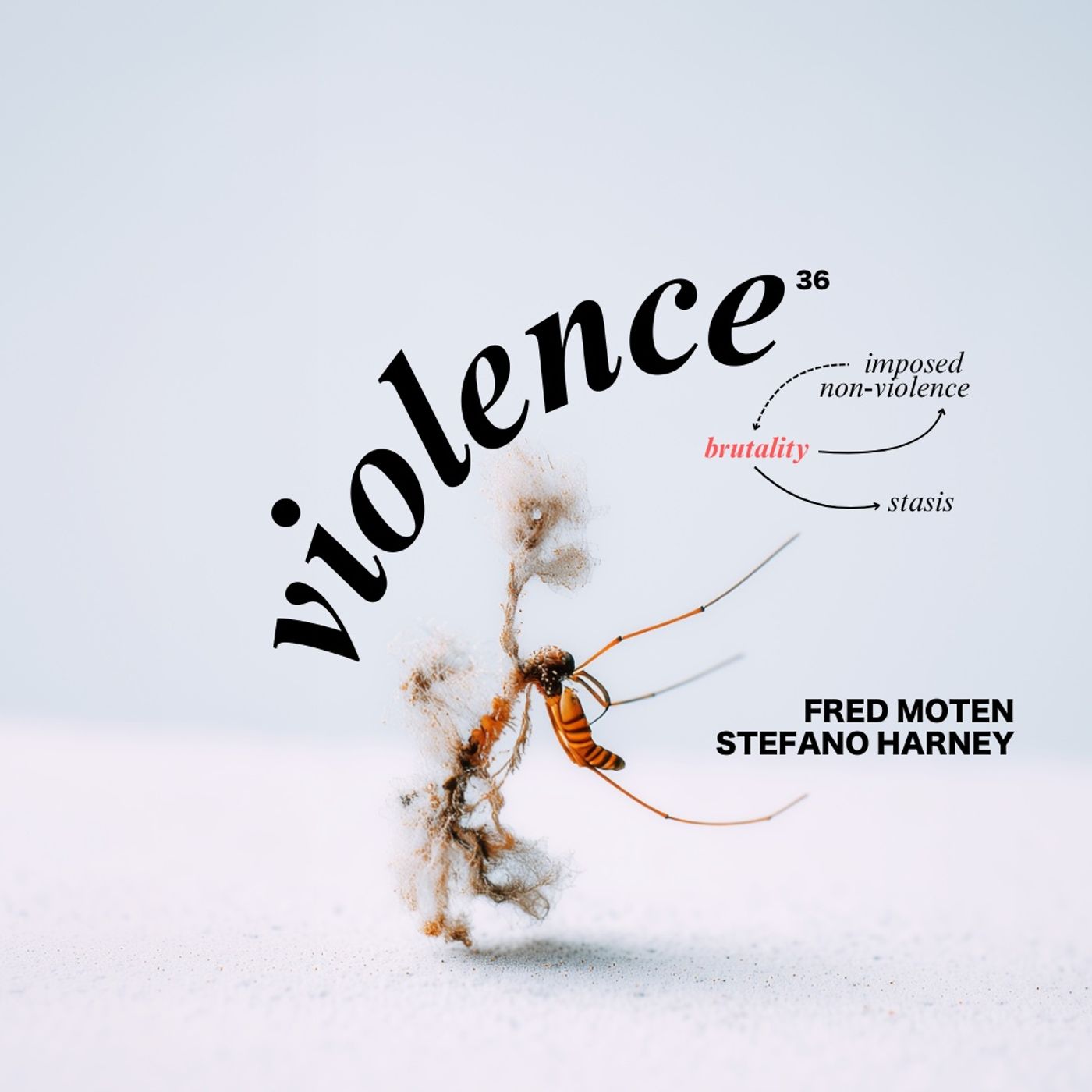
We’re joined by Fred Moten and Stefano Harney — co-conspirators of The Undercommons — to think with us about AI, study, and brutality, and the long histories that place these concepts into relation. In a lot of ways neither Moten nor Harney require an introduction, they are the sources of major touchstone references made throughout this podcast — from last week’s guest Ramon Amaro to one of our first guests, Luciana Parisi, and plenty of places in between. The episode starts with a conversation about AI, but it quickly becomes a conversation about change, the question of the necessity of change or even organization, and imposition (that is, the brutal, external application of force against situations that already contain within themselves the lived possibility of alternative futures). Some important references among many from the episode: Fred Moten & Stefano Harney, The Undercommons: Fugitive Planning & Black Study (Minor Compositions, 2013).Matteo Pasquinelli, The Eye of the Master: A Social History of Artificial Intelligence (Verso, 2023).Sylvia Wynter, “Unsettling the Coloniality of Being/Power/Truth/Freedom: Towards the Human, After Man, Its Overrepresentation—An Argument” (2003).Christina Sharpe, In the Wake: On Blackness and Being (Duke UP, 2016).Denise Ferreira da Silva, Unpayable Debt (Sternberg Press, 2022).Cedric J. Robinson, Black Marxism: The Making of the Black Radical Tradition (1983; later eds. 2000/2020).Amiri Baraka, “The Changing Same (R&B and New Black Music),” in Black Music (1968).Hua Hsu, “What Happens After A.I. Destroys College Writing?” The New Yorker (June 30, 2025).• • Vannevar Bush, “As We May Think,” The Atlantic (July 1945).
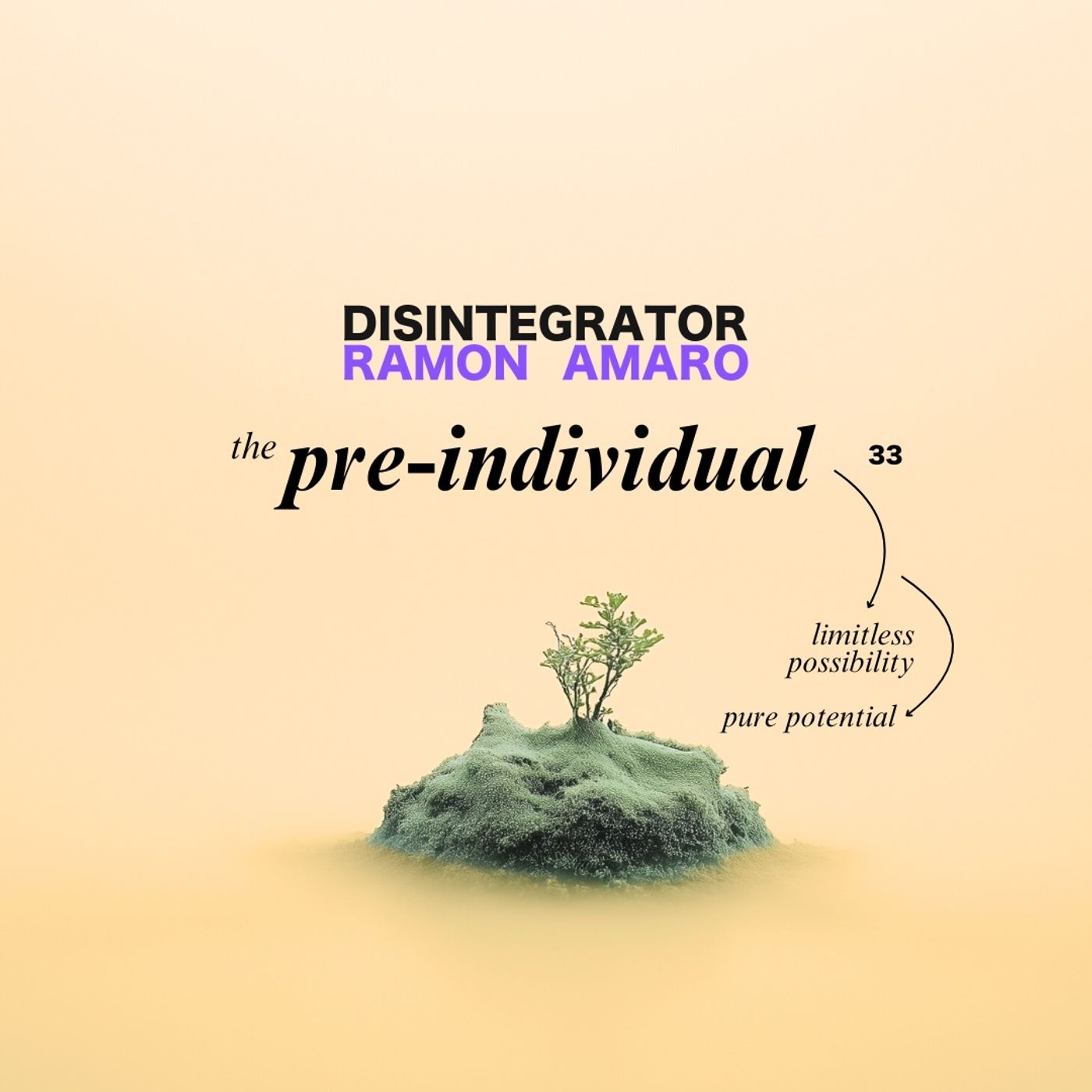
We’re joined by Ramon Amaro, Creative Director of Design Academy Eindhoven — an engineer, philosopher, writer, curator, and altogether critical-force-to-be-reckoned-with on the subject of computation as it intersects with concepts like culture, race, and being. We were drawn to his tour-de-force “The Black Technical Object: On Machine Learning and the Aspiration of Black Being” (2023), which is an absolute banger, re-reading Gilbert Simondon’s technical object through the lens of blackness, race, and racialized technologies. This one is a wild ride, a really deep and incredibly thoughtful episode, and we make an effort to define some initial terms on the podcast — specifically the ‘pre-individuated milieu’ (the space where things or ideas live before they become crystalized into social or racialized relations) and the ‘technical object’ (a way that Simondon helps us think through the autonomies enjoyed by technology, that even though technological objects may be initially bound in some ways to their human partners, they are able to exert influences not just backwards on us, but influences that determine their own design evolution over time). Ramon starts the conversation with a distinction that is critical to the whole episode — that blackness is not a racial category, or moreover, that blackness is distinct from race. Race is something that happens after blackness, that impinges upon blackness as it moves from pre-individuated space and enters into the field of social relations we currently live within. This independence is critical, because it invites alternatives (and suggests, we think very rightly, that this field of social relations we currently live within, while historically situated in imperial or colonial violence, is arbitrary and exchangeable with any other possibility). A few works that are important to consider here: W.E.B Du Bois, The Souls of Black Folk — total canonSylvia Wynter’s work is discussed throughout, specifically on the concept of “Man” (particularly Unsettling the Coloniality of Being/Power/Truth/Freedom: Towards the Human, After Man, Its Overrepresentation—An Argument).Gilbert Simondon, On the Mode of Existence of Technical Objects and Two Lessons on Animal and Man — both places to look for autonomy in Simondon’s workFrantz Fanon, Black Skin, White Masks — implied by discussions of phenomenology/perception under racialization.Stefano Harney and Fred Moten, The Undercommons — no spoilers, but more on this later :)Thanks soooo much to Dr. Amaro for joining us!
We couldn't be more honored to have Catherine Malabou on the pod, a serious inspiration for all of us. This episode covers so much, moving from AI to education to anarchism to feminism, but all grounded within a focus on automony -- the autonomy of language from us, the autonomy of an anarchic subject or an anarchic collective, the autonomy of the clitoris from gender, the autonomy of the plastic being or form with respect to change.If you're unfamiliar with Malabou's work, this is actually a really great place to start. Her work includes all of the above topics, and it pushes further into language, neuroscience, and politics than most philosophers dare. We've been following her since the epic What Should We Do With Our Brains?, the legendary Plasticity at the Dusk of Writing (whose fleshing out of Malabou's reading of the plastic inspired so many theorists, arists, and researchers across endless fields and disciplines), and our personal favorite, the recent Stop Thief! Anarchism and Philosophy. We'd almost recommend working backwards from this episode (as an Anglophone, I'm thinking in terms of English translation), going into Stop Thief and Pleasure Erased: The Clitoris Unthought before taking on the works on Hegel, Derrida, and plasticity.We're so so inspired by the freshness of Catherine Malabou's perspective on AI -- as always, she dares to say and formalize things that many philosophers treat reflexively. We hope to have more conversations on the topic of AI and education soon, following from Malabou's hot takes. :)
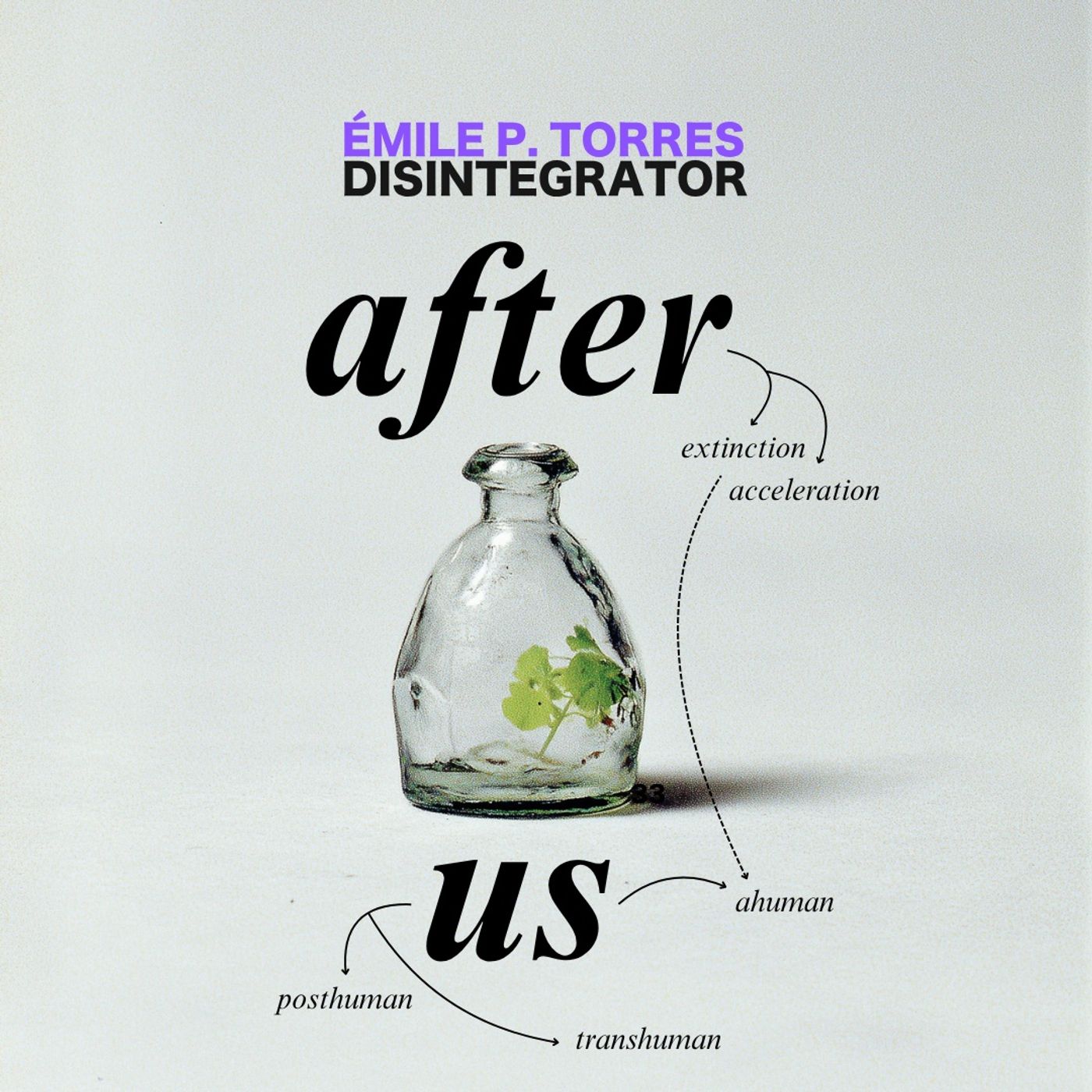
We're back to our regularly-scheduled Disintegrator programming! We've been hard at work on our book (buy it, wtf!) but have a number of killer episodes queued up for release.Émile P. Torres is a philosopher of the end times. You'll most likely associate their name (and that of collaborator Timnit Gebru) with developing the acronym TESCREAL, a grab-bag of ideologies that undergird the romance between venture capital and Silicon Valley. We strongly recommend their podcast Dystopia Now! (w/ Kate Willett) and their newest book Human Extinction: A History of the Science and Ethics of Annihilation.The T in TESCREAL is 'transhumanism,' a frequent topic of the pod, which tends to mean an application of technology to human bodies and in such a way that allows humans to transcend human limitations (e.g. speed, efficiency, senses, mortality). From there, the rest of the ideologies follow from a relationship between the human and its 'rationalized' extensibility through technology: E (extropianism), S (singularitarianism), C (cosmism), R (rationalism), EA (effective altriusim), and L (longtermism). Here's a gentle and clean explainer of all of the above. In this episode, we talk extensively about some elements that aren't actively represented in TESCREAL but sit beneath it: accelerationism, extinction-neutrality, and left-adjacent positions with respect to both (e.g. l/acc, xenofeminism, ahumanism -- this episode might pair really nicely with our interview with Patricia MacCormack for this very reason).

CW: eating disorders are discussed a few times in this episode.Vespers is a limited series within Disintegrator that focuses on the creative feedback loops between music and social media. It follows from the Nobody Listens to Music Anymore superlecture, where themes of youth identity formation, reference-as-medium, generative AI, and the complexities of working with the total archive are discussed in more detail.For this episode, we're joined by Millaze -- an iconic face and musical voice on Instagram. We talk about love, cringe, the open-endedness of her craft (we barely scratch the surface here), and performance.Favorite Millaze-core:RamenOverrideDrivewaysBedside TableVisceraBut I really recommend her Instagram in general (as well as the fountain of Youtube Shorts)

Vespers is a limited series within Disintegrator that focuses on the creative feedback loops between music and social media. It follows from the Nobody Listens to Music Anymore superlecture, where themes of youth identity formation, reference-as-medium, generative AI, and the complexities of working with the total archive are discussed in more detail.For this episode, we're joined by RayonBase. If you've opened TikTok or Instagram over the past few years, you recognize RayonBase's face, voice, instrumental composition, and video editing style. This is an open-ended conversation about character, craft, love, innocence, and the future. <3 Favorite RayonBase-core:The Swagger Song (Badder Than You)EVER CLOSER PT. 2ShelterCan Eye Kiss You?Innocence Found^ The above are videos / shorts primarily used as teasers for full songs, all of which is available on any streaming platform.

Comments

Download from Google Play

Download from App Store
 United States