


 Claim Ownership
Ops I did it again by Out of Pocket
Subscribed: 5Played: 41
Subscribe

© 2026 Out-of-Pocket Health, LLC
Description
A limited series podcast by Out-of-Pocket, hosted by Alex Dou.
Each episode is a post-mortem on a product or feature that didn't work the way it was supposed to. The goal: an encyclopedia of known failures so the next generation of builders can skip the mistakes we've already made and fail at something new.
Each episode is a post-mortem on a product or feature that didn't work the way it was supposed to. The goal: an encyclopedia of known failures so the next generation of builders can skip the mistakes we've already made and fail at something new.
13 Episodes
Reverse
What we cover
Your hardware margin is grocery-store thin. Founders coming from software expect 80% margins. Hardware is more like 5%. Grocery stores run at 3%. Getting to even nominally profitable meant Emme flipping its model entirely: give the case as a loss leader, sell the app. CAC went from ~$400 to ~$25
Civil engineers take an oath, why not software engineers? Civil engineers are personally liable if a bridge falls. In healthcare/healthtech, we often make ethical choices without even realizing it. There are actually a lot of duties that we have to our patients, our local community, our world, that aren’t always obvious. Selling data is a tantalizing revenue driver to boost your razor-thin margins: how do you tie yourself to the mast to avoid that call? How are we thinking about LLMs and the non-zero resources that each prompt takes?
Yet another pink tax. Women's health is a restricted category on most major ad platforms. Reproductive health is doubly so. Shadow bans are common, policies change without notice, and the cost of reaching your customer is structurally higher. It is unfair, yes, but if you are building in this space, you should know it exists
If you get software investors for your hardware company, you're gonna have a bad time. Look for experienced hardware investors. They understand the margin profile and the multi-year payback curve. They're also one of the better early validators for whether an idea is worth building at all. Taking checks from people expecting software returns, then managing that conversation at year three, is an all-too-common failure mode
Firmware versioning was a decade-long problem. Now it isn't. Managing versions across device serial numbers, OS versions, and phone generations used to require a support matrix that could kill a small team. AI has quietly made this tractable: feed your codebase and version history to your AI engine of choice, and it maps the dependencies
Brought to you by
Toboggan Labs A consultancy for healthcare builders. If you have a health product that needs engineers, product people, or experienced operators to help you build or fix something, go talk to them at https://bit.ly/oop-readmission
Find Erynn
Emme: emme.com
LinkedIn
Timestamps
0:00 – Intro
1:20 – Pleasantries (Friday the 13th, alligator moons, and a rectangular February)
6:04 – Resilience and ethics in healthtech: the biggest system failures come from within, civil engineers take an oath, and Emme's answer to the data-selling temptation
15:08 – The economics of healthcare hardware: 5% margins if you're lucky, the path through payers is getting harder, and why consumer-grade industrial design is creeping into med tech
18:20 – Why Rhode Island is an underrated place to build: defense, healthcare, research, and a manufacturing base small enough to navigate quickly. Also: return to office (said it)
25:05 – The hard economics and margins of hardware: 5% if you're lucky, before marketing. Grocery stores run at 3%.
29:04 – Ad: Toboggan Labs – if you're selling a physical health product DTC and a third of your kits never come back completed, go find them at tobogganlabs.com
31:34 – Advertising in women's reproductive health is hard on hard mode: shadow bans, shifting platform policies, and the SEO-to-GEO transition hitting just as Emme had figured out content strategy. Find hardware-aligned investors before you take a check from someone who expects software returns.
39:34 – Ad: Data Camp – June 25-26 in Boston. Tactical sessions, hands-on practitioners, great swag, and a secret plan for a data wreck room involving a paper-mache EDI file
41:39 – Firmware versioning: a decade-long nightmare, why AI has made it tractable, and whether it’s worth draining a lake in South America faster to answer which states had the most sex during the Super Bowl
What we cover
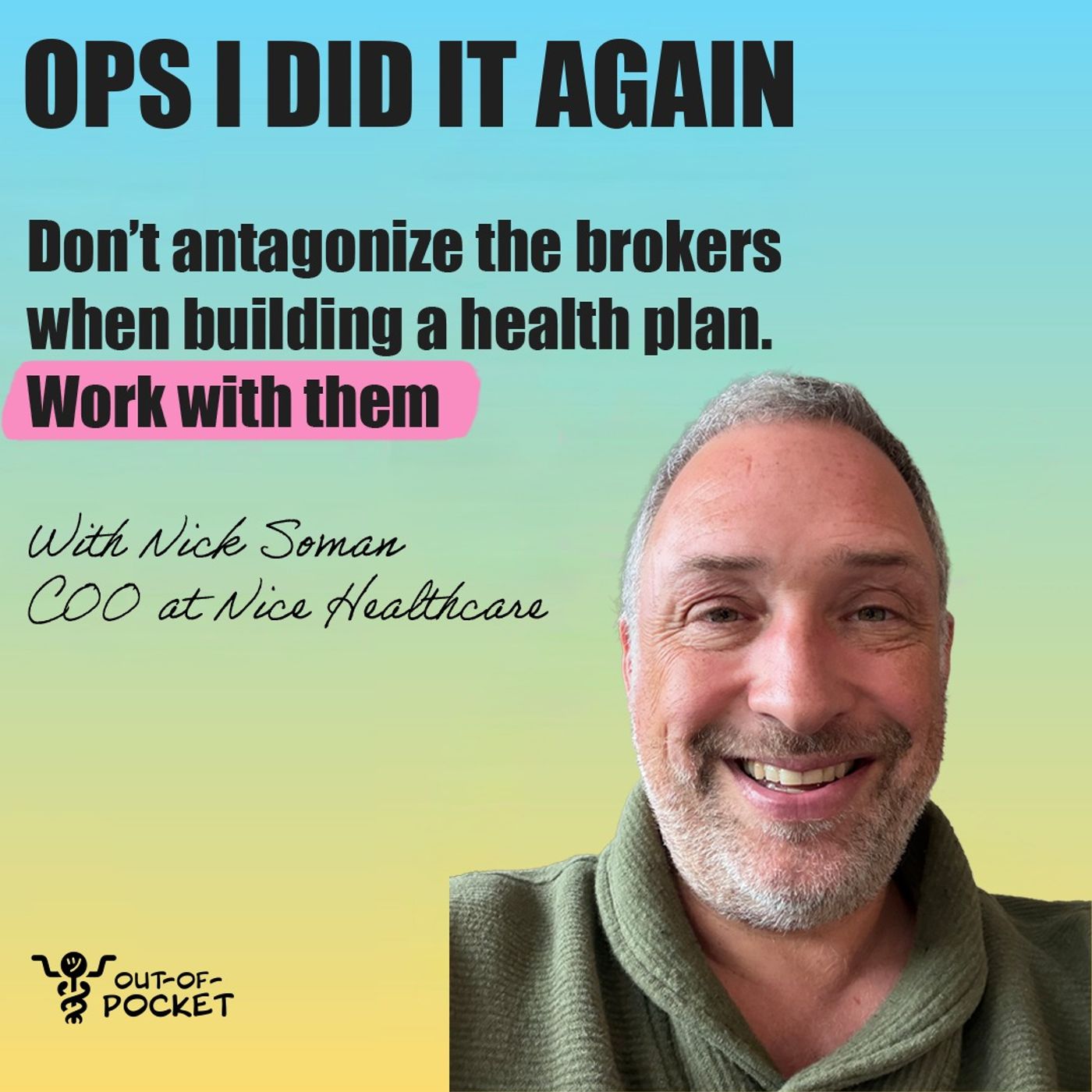
Start with brokers, not against them. The typical "tech disruption" approach frames brokers as rent-seeking middlemen.
Nick's counterargument:
Brokers fill a trust role that no website can replicate
They touch roughly 70% of small-to-mid-size business health plan sales
They will pick up the phone (how many millennials and Gen Zers can say that? Certainly not I)
Brokers will also tell your product team what's missing. All of those "oH, MemBeRS woN’T bOOk USer IntErvIeWs wITh mE" Product Managers should probably be talking to brokers
If you don't have rate relief, you have nothing. Rate relief is the one question brokers are being asked by their clients, day in and day out. If you can't show that your plan is cheaper for at least 40% of groups, the conversation doesn't start. Nick's heuristic: if the broker doesn't have price, they have nothing to sell, no matter how elegant the technology.
Therefore: focus on steerage. The difference between the cheapest and most expensive MRI in Austin, TX is roughly 8x. If you can build a plan that guides people to the lower-cost option for non-emergency shoppable services, you've found the actual lever. Nick's starter heuristic: for all non-emergency hospital claims, do you have an alternative good spot to send members to next time?
Then simplify until it hurts. Decent spent four years before it could credibly sell the Zero Plan: “if you do what the plan wants you to do, it costs you $0 outside your monthly contribution.” That is the level of simplicity you need to actually break through to the decision maker at your prospects. The HR person who has to make this decision once a year and really doesn't want to be in this conversation needs a message that lands in one sentence. This also helps brokers sell (remember rule number one).
Brought to you by
Stedi - Stedi is the modern healthcare clearinghouse. They’re the new way to verify insurance, submit claims, and track claim payments. http://stedi.com/demo
For inquiries about sponsoring the podcast, email sales@outofpocket.health
Find Nick
nsoman@nice.healthcare
nick@decent.com
Nice Healthcare: https://www.nice.healthcare/
Decent: decent.com
Exciting upcoming events in the OOP world
We have a Hackathon in SF from Apr 17-19. We’re full on Hackers, but you should definitely come to Demo Day and see what people built. I built an app for people to lend Oura Sleep/Readiness Points to each other… at 10% Daily Compounding. I’m calling it “Oura Farming”. I guarantee you there will be 10x better ideas than that at Demo Day
Timestamps
00:00 Intro: Why Tech People Fail in Healthcare (With Nick Soman, Former CEO of Decent)
09:47 Tip #1 — If You Can't Sell to Brokers, You Have Nothing
19:17 Reframe Brokers as Channel Partners, Not Middlemen
29:06 Make It Simpler. Then Simpler Again. (The Story of the Zero Plan)
34:53 The Secret Weapon: Steerage (And Why an 8x Price Spread Changes Everything)
43:56 Narrow Networks, Broker Trust, and Building Something You'd Put Your Own Family On
The episode moves through three connected ideas.
First: clinical trials have a UX problem.
One in five trials recruits zero patients. Half under-recruit. Paul's early work was understanding why – and fixing it. The answer was almost never the science. It was that patients had no parking, caregivers had no wifi (or babysitting!), and the protocol assumed everyone could get to Mass General by 9 AM on a Friday via public transit. Solving that required showing trial designs to actual patients before locking them, and listening to their recorded reactions rather than just summarizing their survey scores.
Second: measuring patient experience is genuinely hard.
There are no inches of insomnia. No pounds of pain. Patient Reported Outcomes – PROs – exist because the most burdensome chronic conditions don't have actual units that can be measured. There are thousands of PROs, many are outdated (the fibromyalgia questionnaire from the early 2000s asks how well you can vacuum and cook for your family), and most were designed for clinical trials, not for weekly check-ins on a mobile screen. So for you, Product Manager/Engineer/Builder: how are you going to measure whether your Care Model actually improves patient health?
Third: building PROs into a product creates specific traps.
Paul runs through the ones he has seen firsthand: copyright violations (most scales are licensed and litigation can cost millions), engagement drop-off (5–10% of users is a good day for consistent tracking), incentive fraud (cash rewards attract bot farms), the nocebo effect (asking about pain can worsen it: hey, 1-10 scale, how itchy are you right now?), and the regulatory ceiling – go too far with your tracker and you've crossed into medical device territory, with all the compliance that comes with it.
The Five Things to Know Before You Build
1. You probably don't have permission to use that questionnaire. Most validated scales are owned by universities and licensed for a fee. Saying you found it published online doesn't mean it's free. The database PROQOLID lists rights holders, and some of them are quite litigious
2. Only about 5–10% of patients will track at the cadence you're planning. The ones who do are not representative of your broader user base. Obsessive trackers skew your data. Users with executive dysfunction may not be able to log in, let alone complete a questionnaire.
3. Cash incentives destroy your data. If you offer a financial reward for completion, expect an avalanche of bots and fraudulent responses. Survey researchers report 80–90% fraud rates in incentivized studies. Things that seem to work better: setting group goals, an AMA with the scientists behind the study, and giving users a summary of what their data revealed.
4. Asking about symptoms can worsen them. The nocebo effect is real (for example: scale of 1-10, how itchy do you feel right now?). Paul's team designed positively-framed questions ("how well are you sleeping?") rather than deficit-focused ones ("how bad is your insomnia?") specifically to reduce iatrogenic harm.
5. Interpreting a score triggers regulation. Tracking is fine. Saying that a score of 5/5 means "severe" COULD make your app a medical device and suddenly make you beholden to a lot more regulation
Brought to you by
Nirvana - Nirvana delivers real-time eligibility checks and cost estimates and plugs right into your existing workflows
For inquiries about sponsoring the podcast, email sales@outofpocket.health
Resources
Paul Wicks on LinkedIn — linkedin.com/in/paulwicks
Paul’s newsletter, ProofPoints
Paul’s podcast, Prove It!
Paul’s website, ProofStack Health
RAAPID Inc course on Risk Adjustment: V28, AI, and multi-million dollar settlements. Apr 7-9
Sponsor the Hardware Hackathon! Apr 17-19 in SF!
PROQOLID — eprovide.mapi-trust.org — find the rights holder for any validated PRO scale
PHQ-9: free, validated, widely used depression screener
GAD-7: free, validated anxiety scale
Timestamps
00:00 — Paul's origin story: ALS research, patient communities, and clinical trial ethics
03:00 — PatientsLikeMe and showing trial protocols to patients before locking them can actually INCREASE recruitment
11:00 — What PROs (Patient Reported Outcomes) are, why there are so many, and why none of them agree
18:00 — Pharma, payers, providers, patients – and who actually cares about PRO data
26:00 — The fifth stakeholder: scale developers. Beware for license fees and lawsuit risk
30:00 — Which patients actually track data, and what to do about everyone else
33:00 — False starts: psoriasis body maps, crab-to-clam scales, and positive framing
38:00 — The regulatory ceiling and pharmacovigilance
In this episode of Ops I Did It Again, Michael Rado (aka Rado), Co-Founder and CPO at Photon Health joins the thinksquad aka Danielle and Nikhil to break down how they built and scaled products to support over 20,000 e-prescriptions a month. Rado shows a live demo of their build (on YouTube version) and candidly shares his learnings on how to scale with optimization and automation in mind. This episode is sponsored by Out of Pocket, because no one is prouder than us than us: https://www.outofpocket.health/To register for the upcoming Healthcare Call Center 101 crash course course visit: https://www.outofpocket.health/courses/how-to-build-a-healthcare-call-center; Use code: ANSWERS for $100 off; Next cohort starts 4/16- 5/2To register for the upcoming Healthcare 101 crash course course visit: https://www.outofpocket.health/courses/healthcare-101-crash-course; Use code: IBELIEVEINME for $100 off; Next cohort starts 4/23-5/9Hosts:Danielle Poreh (https://www.linkedin.com/in/danielleporeh/)Nikhil Krishnan (https://twitter.com/nikillinit)Guests:Michael Rado (https://www.linkedin.com/in/michaelrado) Timestamps:(00:00) Intro(01:45) Michael Rado and his journey to Photon(03:14) How Photon Health works(07:36) Courses by Out Of Pocket!(16:49) What photon automates and measures(24:23) The approach towards product development at Photon Health (29:25) Practical experiments for orgs to try

On this episode of Ops I Did it Again, Rahul Agarwal (COO of Medplum) joins Danielle to share his digital health operations playbook. The “hero’s journey” playbook breaks down pro tips and gotchas throughout every stage of scale: from pre-seed all the way to scaling to 50 states.If you are building a clinical workforce, scaling your digital health operations or looking into the future on how you should be building, this episode will give you several tactical tips to implement.This episode is sponsored by Out of Pocket, because no one is prouder than us than us: https://www.outofpocket.health/To register for the upcoming Healthcare Call Center 101 crash course course visit: https://www.outofpocket.health/courses/how-to-build-a-healthcare-call-center; Use code: ANSWERS for $100 off; Next cohort starts 4/16- 5/2To register for the upcoming Healthcare 101 crash course course visit: https://www.outofpocket.health/courses/healthcare-101-crash-course; Use code: IBELIEVEINME for $100 off; Next cohort starts 4/23-5/9Hosts:Danielle Poreh (https://www.linkedin.com/in/danielleporeh/)Nikhil Krishnan (twitter: https://twitter.com/nikillinit)Guests:Rahul Agarwal (https://www.linkedin.com/in/rahul-agarwal-330a979/) Timestamps:(00:00) Intro(02:23) Rahul explains his playbook(02:58)Tips for early stage operators(06:32) Leaving the jungle: finding product-market fit(08:55) Operational playbook for scaling digital health services(13:45) Courses by Out Of Pocket!(15:20) How to define encounters(24:10) How to develop care plans/clinical pathways(30:59) Optimizing provider recruiting and workload with EHR design(33:30) Standardize your metrics and avoid metric soup(35:50) Dos and don’ts when scaling to 50 states(39:43) Practical experiments for orgs to try
In this episode of Ops I Did It Again, Kerem Ozkay (Chief Operating Officer) and Ayo Omojola (Chief Product Officer) from Carbon Health join the thinksquad aka Danielle and Nikhil, to discuss how they designed and deployed product solutions. They breakdown real examples of AI tools to enhance operations, strategies for patient care, and unique top of funnel marketing approaches. Later in the episode, Ayo shares a behind the scenes view at Carbon’s home grown EHR - it’s best viewed on YouTube so you can all the magic.This episode is sponsored by Out of Pocket, because no one is prouder than us than us: https://www.outofpocket.health/To register for the upcoming Healthcare Call Center 101 crash course course visit: https://www.outofpocket.health/courses/how-to-build-a-healthcare-call-center; Use code: ANSWERS for $100 off; Next cohort starts 4/16- 5/2To register for the upcoming Healthcare 101 crash course course visit: https://www.outofpocket.health/courses/healthcare-101-crash-course; Use code: IBELIEVEINME for $100 off; Next cohort starts 4/23-5/9Hosts:Nikhil Krishnan (twitter: https://twitter.com/nikillinit)Danielle Poreh (https://www.linkedin.com/in/danielleporeh/)Guests:Kerem Ozkay (https://www.linkedin.com/in/keremozkay/)Ayo Omojola (https://www.linkedin.com/in/omojola/) TIMESTAMPS(00:00) Introduction(01:43) 4 levers for tech-enabled healthcare(03:03) Running patient acquisition, operations, and marketing(09:34) SEO strategy and AI integration(15:36) Courses by Out Of Pocket!(17:11) The experience of scheduling(28:04) Performance metrics and feedback loops(29:54) Being 2x better at one thing vs 10x better at everything(33:53) Understanding patient acquisition and call content(36:04) The best tech for clinic reports(37:49) Convincing doctors to adopt new tools(41:02) Importance of localized patient acquisition(41:31) Moving off of slack for field based team(43:32) Automating Revenue Cycle Management (RCM)(50:44) Charting and patient care with AI (live demo)(55:05) Future of AI in healthcare(01:03:26) Kerem and Ayo’s team dynamics(01:05:38) Closing thoughts
Nate Brown joins the Thinksquad, aka Danielle and Nikhil, to share lessons learned from scaling a 90 person care team in 3 years at Thyme Care.We break down their organizational design, recruiting best practices (which includes lots of role play) and how to generally think through building alignment at different levels and stages of a start-ups evolution.This episode is sponsored by Out of Pocket, because no one is prouder than us than us: https://www.outofpocket.health/You should also check out our courses, including ones taught by yours truly (How to Build A Healthcare Call Center and Healthcare 101): https://www.outofpocket.health/course-library--- Hosts:Nikhil Krishnan (Twitter: https://twitter.com/nikillinit)Danielle Poreh (https://www.linkedin.com/in/danielleporeh/)Guest:Nate Brown (https://www.linkedin.com/in/nate-brown-50a4a625/)--TIMESTAMPS(00:00) Introduction(01:48) What is Thyme Care & their mission(03:53) Nate's journey & role(06:22) Measuring qualitative data(08:25) The hiring process(14:38) Role play in interviews(23:17) ‘Pods' in organizational design(25:33) Measuring success and adjusting for patient needs(26:56) Company planning and aligning goals(35:17) Conclusions
In this episode of Ops I Did It Again, Douglas Streat, COO of Aledade Care Solutions, joins the thinksquad, Danielle and Nikhil to unpack how they built patient engagement strategies to support over 2M patients alongside primary care practices. Doug shares his tactical advice and learnings on how to create behavior change - we also get to play a fun game during it. It’s our most tactical episode yet.This episode is sponsored by Out of Pocket, because no one is prouder than us than us: https://www.outofpocket.health/To register for the upcoming Healthcare 101 crash course course visit: https://www.outofpocket.health/courses/healthcare-101-crash-course; Use code: IBELIEVEINME for $100 offYou should also check out our courses, including ones taught by yours truly (How to Build A Healthcare Call Center) at https://www.outofpocket.health/course-libraryHosts:Nikhil Krishnan (twitter: https://twitter.com/nikillinit)Danielle Poreh (https://www.linkedin.com/in/danielleporeh/)Guest:Douglas Streat (https://twitter.com/dougstreat) TIMESTAMPS(00:00) Intro(01:31) Introducing Patient Engagement(04:29) Doug’s Career Insights(06:19) The Role of Aledade Plus(08:39) Redefining Call Centers as Patient Engagement(12:56) Key Performance Indicators in Patient Engagement(14:57) The Importance of Evidence and Experimentation(17:05) Patient Engagement Game!! (20:12) Challenges of Patient Scheduling(21:33) Role of Direct Mail in Patient Engagement(27:57) Staffing Strategies for Rapid Scaling(32:23) Importance of Characteristics when Hiring(33:56) Practical Tips for Effective Patient Engagement(37:45) Conclusions
This episode is sponsored by Out of Pocket, because no one is prouder of us than us: https://www.outofpocket.health/You should also check out our courses, including ones taught by yours truly (How to Build A Healthcare Call Center and Healthcare 101): https://www.outofpocket.health/course-library--- Hosts:Nikhil Krishnan (twitter: https://twitter.com/nikillinit)Danielle Poreh (linkedin: https://www.linkedin.com/in/danielleporeh/ twitter: https://twitter.com/danielleporeh )Guest:Sandy Varatharajah (twitter: https://twitter.com/sanvrajah?lang=en)TIMESTAMPS (00:00) Introduction to the 12 Gifts of Ops Christmas (01:30) Gift #1: Think like a product person (02:49) Gift #2: Run a drip campaign (04:12) Gift #3: Give people sight into the problems (06:01) Gift #4: Face your hidden factories, make swim lane maps (08:50) Gift #5: Start an offboarding doc (10:42) Gift #6: Prove something can be done before hiring a team (12:58) Gift #7: When in doubt, fly out (15:20) Gift #8: Build an ops roadmap (18:05) Gift #9: Before effort comes focus (22:43) Gift #10: Upgrade your software to AI features (26:33) Gift #11: Contracts create choke points (30:53) Gift #12: The power of schedule sending
Matthew Woo, Co Founder and Head of Product at Summer Health joins the thinksquad, aka Danielle and Nikhil to unpack how Summer Health builds an AI first company. He breaks down how they think through operationalizing AI, instilling an AI first culture throughout their team and how you can start applying it now.This episode is sponsored by Out of Pocket, because no one is prouder than us than us.You should also check out our courses, including ones taught by yours truly (How to Build A Healthcare Call Center and Healthcare 101).Referenced websites:https://www.summerhealth.com/https://www.raycast.com/https://audiopen.ai/OpenAI Customer Story: https://openai.com/customer-stories/summer-health---Hosts:Nikhil Krishnan (twitter)Danielle Poreh (linkedin)Guest: Matthew Woo (LinkedIn)--Timestamps (00:00) Intro to Matthew (02:10) About Summer Health (03:04) Achieving SLA for SMS Response Time (04:28) Evolution of SLA and Scaling (05:55) Improving SLA through Staffing and Routing (08:42) Managing On-Call Operations (09:36) AI Integration in Healthcare (16:19) Adopting GPT Models in Summer Health (19:44) Process of Obtaining a BAA with OpenAI (21:29) Availability and Cost of BAAs (23:49) Exploring Other Large Language Models (26:34) Designing Effective Prompts for AI (29:53) Embedding AI in Company Operations (32:43) AI Tools and Workflow Optimization (36:51) Expanding to Multimodal AI (43:02) Scoring Empathy in Conversations (44:44) Choosing the Right Problems for AI (46:09) Bringing AI into an Organization (47:07) Starting Small and Proving Use Cases (48:05) Implementing AI into Clinical Workflow (49:03) Monitoring and Reviewing AI Output (50:01) Doctor's Excitement and Adoption of AI (51:27) Takeaways
They share their lessons learned and core principles that made the build happen so quickly. We go deeper into interview tips, building flexibility in product and frameworks to ensure alignment along the way. This episode is sponsored by Out of Pocket, because no one is prouder than us than us: https://www.outofpocket.health/You should also check out our courses, including ones taught by yours truly (How to Build A Healthcare Call Center and Healthcare 101): https://www.outofpocket.health/course-libraryNouns and Verbs Framework Example: https://www.figma.com/file/12KN4gcVbGMRZ8rPAkia47/Nouns-and-Subnouns-(Ops-I-did-it-again)?type=whiteboard&node-id=0%3A1&t=91gvKyCbIfPcwnNg-1--- Hosts:Nikhil Krishnan (twitter: https://twitter.com/nikillinit)Danielle Poreh (https://www.linkedin.com/in/danielleporeh/)SummaryIn this episode, HouseRx discusses how they built their product and created a flexible and massive software from scratch. They emphasize the importance of taking the time to learn and build relationships within the team. They also highlight the value of recruiting product-minded individuals and empowering them to provide feedback and contribute to the product development process. The team shares their experiences in building the MVP and the investments they made early on. They discuss the importance of flexibility in the product and the metrics they used to measure success. Overall, their approach focused on collaboration, continuous improvement, and delivering a better experience for pharmacists and patients.TakeawaysTake the time to learn and build relationships within the team.Recruit product-minded individuals and empower them to provide feedback and contribute to the product development process.Invest in building a flexible product that can adapt to different use cases and workflows.Measure success through metrics such as support tickets and time to fill.Chapters(00:00) Introduction to HouseRx and its departments(01:57) Early activities and building a relationship(03:23) Creating a better experience for pharmacists(04:23) Learning from initial experiences(06:19) Recruiting product-minded individuals(07:44) Coaching and empowering the team(09:40) Assessing product-mindedness in candidates(10:36) Recruiting from large, structured organizations(13:13) Encouraging feedback and collaboration(14:12) Iterating on the product and gathering feedback(15:37) Timeline for building the MVP(17:30) Starting to see patients on day one(19:52) Investments made early on(21:21) Flexibility in the product(23:37) Nouns and verbs framework(25:03) Building flexibility into the product(28:49) KPIs and metrics(29:17) Improving support tickets(33:31) Time to fill as a North Star metric(36:20) Investing time and space for learning(37:18) Being present and physically involved
In this episode, he shares his clinical and operational playbook for executing on the channel effectively and even laughs at Nikhil’s jokes. We go deeper into how they measure value, track SLAs and how the channel has evolved. For folks who are in the value based care world, looking to incorporate texting into their care model or curious about how Galileo tapped into the channel so effectively, this one is made for you.--This episode is sponsored by Out of Pocket, because no one is prouder of us than us: https://www.outofpocket.health/You should also check out our courses, including ones taught by yours truly (How to Build A Healthcare Call Center and Healthcare 101): https://www.outofpocket.health/course-library--- Hosts:Nikhil Krishnan (twitter: https://twitter.com/nikillinit)Danielle Poreh (https://www.linkedin.com/in/danielleporeh/)Timestamps:(00:00) Intro to Ajay(00:59 What Galieo does and Ajay’s role(3:11) What field based teams do(5:36) Lessons learned building a field based team(09:10) How Galileo builds comradery to avoid burnout(11:00) What Ajay does on roadtrips(12:00) When to use and not use SMS(13:56) Ajay’s take on what makes SMS so valuable(17:57) Should we charge for texting?(22:14) Triage protocols for SMS(25:12) Bucketing SLAs for SMS(27:48) QA on triaging and continuous improvement(29:26) The flow of a single SMS (30:52) How to get started with SMS(33:46) When it’s time to centralize the function(34:34) The galileo care team(36:56) Determining outbound SLAs(39:17) Preferences in population (40:00) Groupchats(42:22) How to sound like a human & 24/7 care(43:31) Measuring value in SMS(47:26) Speed matters(49:01) Hot takes(50:57) SMS in a virtual based care model(52:56) Making sure people have your number(56:12) Ajay’s Mike Jones moment
Introducing Ops I did it again, a limited series podcast by Out-of-Pocket, hosted by Danielle Poreh and Nikhil Krishnan. We interview builders in healthcare operators breaking the mold (aka solving problems all ops people are facing)First episode dropping soon!Links:Out of Pocket: https://www.outofpocket.health/How to Build a Healthcare Call Center Course: https://www.outofpocket.health/courses/how-to-build-a-healthcare-call-centerKnowledgefest 2024 Waitlist: https://www.outofpocket.health/knowledgefest-lp
Comments


Download from Google Play

Download from App Store
 United States