


 Claim Ownership
Future of Foods Interviews - Alt Proteins, Cell Agriculture, an End to Factory Farming.
Subscribed: 6Played: 24
Subscribe

© AlexCrisp2023
Description
Alex and guests discuss the food (R)evolution, cellular agriculture, novel foods, and an end to factory farming.
If you have any questions or comments, or wish to discuss collaboration, sponsorship or other, please contact me crisplexmail@gmail.com
Watch and subscribe on YouTube https://www.youtube.com/@FutureofFoods
DONATIONs are gratefully received.
https://www.paypal.com/donate/?hosted_button_id=ABYF9L6UY3A5Y
82 Episodes
Reverse
Jasmijn de Boo is Global CEO of ProVeg International. Drawing on more than two decades at the forefront of animal advocacy and food system transformation, she shares how her career has evolved into a pragmatic, globally focused mission to shift diets at scale.From navigating criticism of plant-based claims to unpacking the recent slowdown in alternative protein sales, de Boo brings clarity, realism, and optimism. She explains why this moment represents not a setback, but a turning point and where the biggest opportunities now lie for industry, policymakers, and institutions.The discussion spans everything from UK school meals and NHS procurement to global momentum across Europe, China, and Africa, highlighting how change is already happening in unexpected places. De Boo also tackles the cultural tensions around meat reduction, offering a thoughtful perspective on how to engage rather than divide.Jasmijn is a billboard for showing how working together can achieve real change.
In this episode of Future of Foods Interviews, Alex discovers how cultivated pork fat could transform the future of sausages. Dr. Bianca Lê, is Head of Special Projects and External Affairs at Mission Barns. Mission Barns is developing cultivated pork fat grown directly from animal cells, designed to be combined with plant proteins to recreate the flavour, aroma, and cooking performance of conventional meat.Fat is a critical component of meat’s taste and texture, and Mission Barns believes that producing real animal fat through cellular agriculture could unlock a new generation of realistic alternative meat products.We discuss how cultivated fat is made, why fat plays such an important role in meat, and the challenges of scaling this technology for commercial production. Bianca also shares insights into the evolving regulatory landscape and the broader promise of cellular agriculture to reshape how we produce and consume meat.
Giuseppe Scionti, the bioengineer and founder of Novameat, disusses with Future of Foods Interviews the future of meat - and why the next wave may be hybrid. Trained in tissue engineering, Scionti has developed patented technology that restructures plant proteins to recreate the fibrous texture of real meat, enabling products like whole-cut steaks and shredded beef made from ingredients such as pea and rice protein.But rather than replacing meat entirely, Novameat is now exploring a more pragmatic path: working with traditional meat processors to create hybrid products that combine meat with plant-based structures. These blends can reduce the environmental footprint of meat while maintaining the taste and experience consumers expect. In the conversation, Scionti discusses the technology behind Novameat’s “microforce” texturisation process, why whole-cut alternatives are the hardest challenge in alt-protein, and how partnerships with the meat industry could accelerate the protein transition.
Arjen van der Wijk is the CEO of Cibus Nexum, a company that operates in one of the most challenging parts of the food industry: scaling. It’s the phase after the excitement of product development, when a brand has traction and ambition — but now needs to produce consistently, at volume, without losing quality or control.Through Cibus Nexum, Arjen works with both fast-growing food startups and established global players, helping them navigate outsourcing, co-manufacturing, and supply chain decisions. His focus isn’t on hype or trends. It’s on execution. Finding the right production partner. Structuring agreements properly. Anticipating the risks that can derail growth.At its core, Cibus Nexum is about bringing the right people together - aligning brands, manufacturers, and technical experts so that innovation can survive real-world manufacturing. Because in food, a great idea is only the beginning. The real test is whether it can be made reliably, profitably, and at scale.
In this episode of Future of Foods, Glenn Hurowitz, Founder and CEO of Mighty Earth, explains how strategic advocacy is reshaping global agriculture. From deforestation linked to soy and beef supply chains to methane emissions and industrial livestock production, Mighty Earth has built a reputation for turning investigative research into high-impact corporate pressure campaigns.Glenn explains how NGOs identify leverage points inside multinational food businesses, how public campaigns translate into boardroom action, and why voluntary corporate commitments so often fall short. We explore the tension between collaboration and confrontation, the growing scrutiny on greenwashing, and what real climate leadership in food and agriculture actually looks like.This conversation goes beyond headlines to examine power, accountability, and the mechanisms that drive systemic change.This episode offers a candid look at how pressure from the outside can move some of the world’s most powerful companies.
In this episode of Future of Foods, we dive into one of the most complex—and often misunderstood—parts of food innovation: the U.S. regulatory system. Our guest, Gregory Jaffe, brings clarity to the question every novel food founder eventually asks: How do I actually get this approved?From cultivated meat and precision fermentation to entirely new food categories, innovation is moving fast. Regulation, understandably, is not. Gregory walks us through the real structure behind the “regulatory maze,” unpacking who oversees what, why approvals take time, and where companies most often get tripped up. We talk GRAS determinations, FDA vs. USDA jurisdiction, data expectations, and the critical difference between what’s legally required and what’s strategically smart.This conversation isn’t just about compliance—it’s about de-risking your roadmap. Gregory shares practical advice for engaging regulators early, building credible safety narratives, and avoiding costly missteps that can stall a product for years. Whether you’re a startup founder, investor, policymaker, or just curious about how the future of food makes it to your plate, this episode offers an insider perspective on navigating U.S. food regulation with confidence.
Future of Foods Interviews' Alex speaks with Lou Cooperhouse, Founder, President, and CEO of BlueNalu, to explore one of the most ambitious ideas in food today: cultivated bluefin tuna.Bluefin tuna is prized for taste and nutrition, yet tied to overfishing, supply volatility, and concerns about mercury and other contaminants common in large, predatory fish. BlueNalu’s approach—growing real seafood directly from fish cells in a controlled environment—aims to deliver the same culinary experience while addressing some of the hardest challenges facing ocean-based protein.We talk about how cultivated seafood works, why tuna is such a critical species to start with, and what differentiates seafood from cultivated meat when it comes to safety, scalability, and consumer trust. Lou also explains why 2026 is shaping up to be a pivotal year to move ever closer to meaningful commercialization.Listen now to find out why.
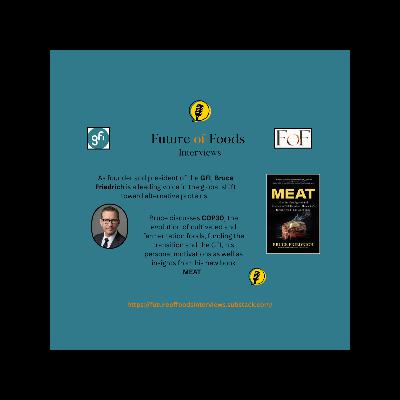
In this episode of Future of Foods Interviews, Alex is joined by Bruce Friedrich, founder and president of the Good Food Institute (GFI) an organization driving the global transition to a more sustainable, secure, and just food system through alternative proteins. Bruce has long been one of the world’s most compelling voices for rethinking how we produce meat, dairy, and seafood.We discuss the problem which needs fixing, how he and the GFI are proposing solutions and trying to convince the world to follow, the funding options, sentiment for change, the reach of the GFI and the need for collaboration. We also discuss his new book, MEAT which is out now https://meatbook.org/purchase/In MEAT, Bruce explores the urgent need to transform the way humanity feeds itself, revealing how innovations in plant-based, cultivated, and fermentation-derived proteins can address the climate crisis, prevent future pandemics, and feed a growing global population without the destructive costs of industrial animal agriculture. Whether curious about food innovation, environmental policy, or the future of protein itself, this conversation with Bruce Friedrich offers an inspiring look at how systemic change can reshape what’s on our plates and why that matters now more than ever.
In this wide-ranging Future of Foods interview, Jim Mellon, co-founder of Agronomics, offers a characteristically candid take on where food, capital, and climate are really headed. Mellon is bullish on precision fermentation, far less convinced by today’s plant-based category, and unapologetically ambitious about what he sees as category-defining bets. He points to Clean Food Group in Liverpool as Agronomics’ most successful investment to date, predicting fermentation-derived oils could “own the palm oil—and even olive oil—markets within a decade,” delivering deforestation-free fats with lower saturated fat and no environmental trade-off, at price parity.We discuss Liberation Labs, why the Middle East will be a major growth engine for protein, and the strategic case for licensing IP over building pilot plants. Mellon is emphatic about cultivated meat—citing BlueNalu—and the health dangers attached to conventional seafood. He also reflects frankly on portfolio wins and losses, including Meatable, investment geography, Agronomics’ share price, and why he says every pound he makes goes back into improving animal welfare.Related episodes: Meatly, Liberation Labs, FAIRR, Meatable (with Helder).
In this episode of Future of Foods Interviews, Alex Crisp speaks with Adam Bergman, Managing Director at EcoTech Capital, about the realities of investing in alternative proteins and novel foods in today’s tougher market.Adam shares an investor’s perspective on where the sector stands after years of hype and correction, explaining why capital has become more selective and what that means for founders. The conversation explores why plant-based meat has struggled to reach scale, how fermentation and ingredient-led approaches may offer more practical paths forward, and what it will take for cultivated meat to regain investor confidence.Drawing on his advisory work with food, agriculture, and climate-focused companies, Adam outlines what startups consistently underestimate from manufacturing complexity and timelines to the challenge of building trust with strategic partners. He also discusses new funding models beyond traditional venture capital, the role of blended products, and why credibility and focus now matter more than ambitious storytelling.
In this episode of Future of Foods – Interviews, I speak with Paul Shapiro about one of the most pragmatic paths toward reducing the environmental impact of meat: biomass fungi.Rather than attempting to replace meat outright, Shapiro explains how fungal biomass, grown through fermentation, can supplement conventional meat in ways that dramatically cut cost, emissions, and resource use while preserving the sensory experience consumers expect. Drawing on his work at The Better Meat Company, he describes how mycelium, the fast-growing, protein-rich root structure of fungi, can be produced at industrial scale using existing fermentation infrastructure.A key insight from the conversation is that hybridization, not substitution, may be the fastest route to impact. By blending fungal biomass into meat products, producers can reduce reliance on animal protein without asking consumers to change behavior, taste preferences, or cooking habits. Shapiro argues that this approach avoids many of the bottlenecks facing fully plant-based or cultivated meat alternatives, particularly around cost, scale, and manufacturing complexity.The discussion also cuts through common misconceptions about fermentation-based foods. Shapiro emphasizes that biomass fungi are minimally processed, nutritionally dense, and well suited to large-scale production—making them a practical tool rather than a speculative technology. Ultimately, the episode frames biomass fungi not as a futuristic novelty, but as a quietly powerful lever for near-term change in the global food system.
Alex Crisp talks to Alice Millbank, to explore one of the most intriguing ideas in cultivated meat: using mycelium—the fibrous root network of fungi as a natural scaffold for growing meat.One of the biggest challenges in cultivated meat isn’t growing cells, but giving them structure. Muscle cells need something to attach to, align along, and mature on in order to become food with real texture. Alice’s research looks at how mycelium, which already forms complex, meat-like fibrous networks, could provide an edible, low-cost, and scalable solution.We talk about why mycelium and animal cells seem to bond so naturally, and whether that compatibility hints at a deep evolutionary relationship between fungi and animals. From shared biological pathways to surprisingly similar material properties.Alice shares insights from presenting her work at conferences like the International Symposium on Cultured Meat, and what it’s like to work at the cutting edge of cellular agriculture while the industry is still defining itself. We discuss sustainability, consumer acceptance, and what needs to happen for cultivated meat to move from the lab to the plate.If you’re curious about what a man-mushroom might look like or how likely "The Last of Us" scenario really is, then listen to this latest episode of Future of Foods Interviews
Roman Kriz, is CEO of Bene Meat Technologies, an ambitious and perhaps one of the most unconventional players in the cultivated-meat landscape. Bene Meat recently captured attention by using hamster-derived cell lines to produce affordable, scalable cultivated meat for pets - a strategy Roman says is rooted in scientific pragmatism, regulatory clarity, and a relentless focus on cost reduction.Roman breaks down why these specific cells are uniquely suited for industrial-scale production, how the company has navigated early EU regulatory pathways, and why Bene Meat is confident it will be selling cultivated meat in the European Union as early as next year.Bene Meat plans to conduct human tastings in 2026, (not #hamster lines) a bold move that signals confidence not only in safety and functionality, but in the sensory potential of their product.Roman offers transparent and frank look at the scientific decisions, business models, and unexpected breakthroughs that are bringing cultivated meat closer to everyday consumers.Please like and subscribe - you can support the podcast here https://www.paypal.com/donate/?hosted_button_id=ABYF9L6UY3A5Y
Future of Foods Interviews speaks to Nusa Urbancic, CEO of the Changing Markets Foundation, where she leads investigations exposing how the meat and dairy industries deploy misleading science, aggressive lobbying and mass-online disinformation campaigns to delay action on climate, health and sustainable food systems. Her team’s landmark report, The New Merchants of Doubt, analysed 22 of the largest global meat and dairy companies and revealed how they invest far more in green-wash advertising than in emissions-reducing innovations. Under her direction the Foundation also commissioned Truth, Lies and Culture Wars, a social-listening study tracing nearly one million meat-industry-aligned misinformation posts over 14 months.Listen now to find out how, where, how much and who.
In this episode of Future of Foods Interviews, host Alex Crisp speaks with Guilhem Jarmin, Category & Portfolio Solutions Director Meat & Dairy Alternatives at Cargill, about the company’s growing role in alternative proteins and the transformation of global food systems. Guilhem shares how one of the world’s largest agribusinesses is investing in plant-based and cultivated protein innovation, partnering with startups, and rethinking supply chains to reduce environmental impact. Together, they explore what it takes for major corporations to drive a fair and scalable food transition and why collaboration between industry, science, and policy is essential for the future of sustainable protein.

In this episode of Future of Foods Interviews, Alex speaks to Dr. Sonja Billerbeck, synthetic biologist and researcher at Imperial College London, whose groundbreaking work is redefining how we produce food at the cellular level. Sonja’s research explores cell cultivation and gas-based precision fermentation, using hydrogen-oxidizing bacteria to convert carbon dioxide into nutritious biomass — a process that could one day decouple food production from land, water, and climate constraints.Sonja discuss how technologies could revolutionize global food systems, Bezos Earth Fund financing, and the challenges of scaling cell-based innovations, and the ethical questions that come with reprogramming biology for human use.

In this episode of Future of Foods Interviews, Alex speaks to Dr. Sonja Billerbeck, synthetic biologist and researcher at Imperial College London, whose groundbreaking work is redefining how we produce food at the cellular level. Sonja’s research explores cell cultivation and gas-based precision fermentation, using hydrogen-oxidizing bacteria to convert carbon dioxide into nutritious biomass - protein from air - a process that could one day decouple food production from land, water, and climate constraints.Sonja discusses how these technologies could revolutionize global food systems, finance, the challenges of scaling cell-based innovations, and ethical questions.Please subscribe and support the podcast.
In this episode of Future of Foods Interviews, Alex talks to Caroline Cotto, co-founder of NECTAR, the world’s first sensory intelligence platform for alternative proteins. NECTAR is reshaping how the industry measures success — not by novelty or nutrition alone, but by what truly wins over consumers: taste.Caroline shares insights from NECTAR’s latest Taste of the Industry 2025 report, which blind-tested over 120 plant-based products with thousands of everyday eaters. The findings??? Before you launch a product make sure it tastes great. The future of food hinges on flavour.We explore how NECTAR’s data-driven approach is helping brands close that “taste gap,” what it means for scaling alternative proteins, and why the next wave of growth depends on sensory science as much as sustainability. Listen to the lastest episode - subscribe and support.
The Danish government committed one billion kroner to support the development of plant-based foods, a landmark decision that positioned sustainability and innovation at the core of its agricultural future. While the country has long been celebrated for pioneering wind power and building one of the most advanced organic sectors in the world, the push towards plant-based agriculture signals recognition that diets, too, are central to tackling the climate crisis.Frej, a Danish think tank, has been a crucial voice in shaping the political and cultural conversation around this strategy. Marie Louise Boisen Lendal is the CEO of Frej and now Chair of the plant based strategy fund. Listen now to this episode of Future of Foods interviews to find out how she got the farmers on board with the strategy - and how the money will be spent.
In this episode of Future of Foods Interviews, the podcast where we explore the science, policy, and people shaping the future of food, I speak to two leading voices in the field: Dr. Estere Sienkmane and Dr. Alice Esperanza. Together, they give me a crash course in the nuts and bolts of cellular agriculture - how it all works.For those new to the concept, cellular agriculture is the production of agricultural products directly from cells, whether meat, milk, or other proteins, rather than from slaughtered animals or industrial farming. It promises a way to deliver the foods we love while dramatically reducing land use, greenhouse gas emissions, and animal suffering. The science is complex but the idea is straight forward enough: how do we grow meat from animal cells - at scale, what technical hurdles remain, how much should we worry about GMO. In this conversation, Dr. Sienkmane and Dr. Esperanza share the science - the nuts and bolts of growing meat.

Comments

Download from Google Play

Download from App Store
 United States