


 Claim Ownership
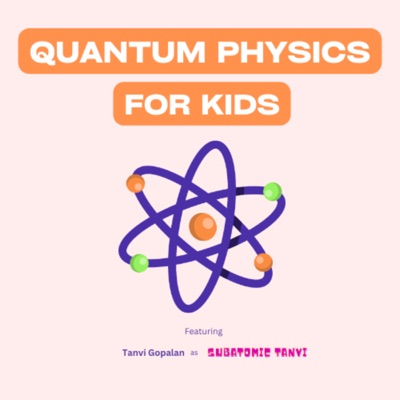
Quantum Physics for Kids
Subscribed: 161Played: 986
Subscribe

© Subatomic Tanvi
Description
Tanvi Gopalan is a 13 year old member of American Mensa who loves Quantum Physics. She teaches all about quantum physics in a fun and simple way. Quantum physics is the study of the smallest things in the universe, and it's one of the most fascinating and important branches of science. But it can also be very confusing, especially for kids. In this podcast, Tanvi explains complex concepts like entanglement, superposition, uncertainty principle and a lot more, in a way that anyone can understand. So whether you're a kid, a parent, or just someone curious about quantum physics, subscribe NOW!
35 Episodes
Reverse

What if the old saying “a watched pot never boils” wasn’t just a kitchen myth, but a literal law of the subatomic realm? In this episode of Quantum Physics for Kids, Subatomic Tanvi breaks down the mind-boiling Quantum Zeno Effect - a bizarre phenomenon where repeatedly observing a particle forces it to freeze its state, playing the ultimate cosmic game of Red Light, Green Light. Discover how hitting the pause button on the universe isn’t just a wild physics trick, but the secret error-correction shield scientists rely on to protect fragile qubits from crashing and build the world's most powerful quantum supercomputers. Put on your headphones, don't blink, and get ready to freeze time!
Ever wondered how we measure time with such incredible precision? In this episode of Subatomic Tanvi, we’re looking past the pendulums and quartz crystals of traditional watches to explore the high-tech world of atomic clocks. Join the conversation as Tanvi breaks down the quantum physics of energy levels, resonant frequencies, and the photons that make these devices the most accurate timekeepers on the planet. From the basic principles of atomic transitions to a step-by-step look at how they function, this episode reveals the hidden subatomic rhythm that keeps our modern world in sync.
Dive into the microscopic world with Subatomic Tanvi as she unpacks the fascinating (and slightly confusing) evolution of the atomic model. In this episode, Tanvi explores the leap from JJ Thomson’s "Plum Pudding" theory to the iconic Bohr Model of 1913, clarifying once and for all that "electron shells" have nothing to do with seashells or turtles. While the Bohr Model revolutionized our understanding of energy levels, Tanvi reveals the catch: it’s technically a "successful failure" that violates Heisenberg’s Uncertainty Principle and only truly works for hydrogen. Whether you're here for the high-level quantum mechanics or just want to know where to buy some subatomic pudding, this episode perfectly balances scientific history with the quirky contradictions of the quantum realm.
In this episode of Subatomic Tanvi, we dive into the 2025 Nobel Prize in Physics! Tanvi explains how John Clarke, Michel Devoret, and John M. Martinis proved that the "weird" rules of quantum mechanics don't just apply to tiny atoms - they apply to the world we can see and touch. From the "smoking gun" test at absolute zero to the discovery that changed the future of quantum computing, learn how macroscopic quantum tunneling is paving the way for the next generation of technology.
What if a particle could just... walk through a solid wall? It turns out they can, and it's not science fiction! This bizarre phenomenon is called Quantum Tunneling, and it’s less of a "glitch" and more of a fundamental feature that makes our universe work. Join Subatomic Tanvi as we answer the big questions (and laugh a lot): How can a particle be somewhere it doesn't have the energy to go? Do waves "poke holes" to get through? And why would the sun stop shining—and your flash drives stop working—without this weird quantum trick? From its 1928 discovery to its role in modern tech, this episode makes the impossible easy to understand.

Comments

Download from Google Play

Download from App Store
 United States