


 Claim Ownership
Yun Hota Toh Kya Hota? The World of Ghalib with Amit Basole
Subscribed: 1Played: 9
Subscribe

© Radio Azim Premji University
Description
Mirza Asadullah Baig Khan, one of the most influential writers in Urdu, is known to us by his nom de plume, Ghalib. Our show, set during a unique turning point in the history of the Indian subcontinent, brings the man and his poetry alive for a young and uninitiated audience. Rich with lyricism and wonder, and replete with the sounds of Ghalib’s Delhi, it is masterfully presented by Amit Basole, faculty at Azim Premji University and co-author of Thinking With Ghalib - Poetry For A New Generation with Lahore-based writer Anjum Altaf.
For more information, visit our website:
https://azimpremjiuniversity.edu.in/inside-the-beautiful-mind-of-mirza-ghalib
7 Episodes
Reverse
Yun Hota To Kya Hota? translates simply to ‘What If?’This exciting new show from Radio Azim Premji University explores the life and times of Mirza Asadullah Khan, one of the most influential writers in Urdu, known to us by his nom de plume — Ghalib. There are stories that Ghalib told, and there are stories told about Ghalib. Address your letter to “Ghalib, Delhi” and it will reach me, the great man is reputed to have said. Not a boast, because he was already a legend in his own lifetime. Yet, despite his accomplishment, he was in need of money. So the story goes that he applied for a job as a teacher of Persian. His conduct at the job interview, however, became the stuff of gossip in his time, and the stuff of legend in ours.Hosting you through this absorbing series is Amit Basole, faculty in Economics at APU, whose pet passion for Urdu poetry found expression in a book, Thinking With Ghalib - Poetry For A New Generation, co-authored with Lahore-based writer Anjum Altaf.Listen to this and more vignettes in this first episode of the series. Credits:Akshay Ramuhalli, Bijoy Venugopal, Bruce Lee Mani, Narayan Krishnaswamy, Prashant Vasudevan, Sananda Dasgupta, Seema Seth, Shraddha Gautam, Supriya Joshi, and Velu ShankarAcknowledgements:Letters read by Zia Mohyeddin Song: Ghalib Ke Khutoot | Album: Ghalib Kay Khutoot Vol. 1 & 3 | Artist: Zia Mohyeddinhttps://www.youtube.com/watch?v=mqGSK17-Y30https://www.youtube.com/watch?v=0Mjsv_8lp1g https://www.youtube.com/watch?v=P1KiFOWGaEQ Explore more:YouTube | A Conversation with Anjum Altaf and Amit Basole, authors of Thinking With Ghalib - Poetry For a New Generation | Institute for South Asia Studies https://youtu.be/kepIWKB1Ma0 --- Send in a voice message: https://podcasters.spotify.com/pod/show/radio-azim-premji-univ/message

Host Amit Basole ponders the enigma of Ghalib the lover: How did Ghalib speak of love? Whom did Ghalib love? He transports you to the heart of the ghazal.
Zia Mohyeddin, the British-Pakistani actor renowned for giving voice to the lyrical seduction of Ghalib’s poetry, died on February 13, 2023. Ghalib is a state of mind beyond the narrow confines of nation, religion and other notional boxes in which we find ourselves bracketed. This transcendence comes achingly to mind as we mourn the passing of Zia Saheb. This episode is a tribute to his memory.
Credits:
Akshay Ramuhalli, Bijoy Venugopal, Bruce Lee Mani, Narayan Krishnaswamy, Prashant Vasudevan, Seema Seth, Shraddha Gautam, Supriya Joshi and Velu Shankar
Acknowledgements:
Zia Mohiuddin Videos | Rekhtarekhta.org
https://www.rekhta.org/Zia
Domni
https://www.youtube.com/watch?v=v_zWZpMLzZI
6:04 to 6:44
YouTube | Composition of music by Swati Phadke and recited by Pubali Mattoo #GhazalGuruvaar #10 - Aane ka muntazar tere - Smt. Swati Phadke | Mah Laqa Bai Chanda https://www.youtube.com/watch?v=eyTc4MEUoQs
YouTube | Taskeen ko Hum Na Royen - Mirza Ghalib
Sung by Farid Ayaz & Abu Muhammad
https://www.youtube.com/watch?v=c56THXY0MO8
Dil Se Teri Nigah Jiggar Tak Utar Gayi | Rahat Fateh Ali Khan | Ghazal | Mirza Ghalib
https://www.youtube.com/watch?v=AxM7NpF4Z5Y
Discover more:
YouTube: Zia Mohyeddin recites Mirza Ghalib's poetry 'Azadi Ka Shukr Baja Laao, Gham Na Khao'
https://youtu.be/xsRy4dO7YeM
YouTube: Ghalib aur Mein-Zia Mohyeddin
https://www.youtube.com/watch?v=eCEd1mtjBtM
YouTube: Ghalib aur Mein - Zia Mohyeddin
https://www.youtube.com/watch?v=eCEd1mtjBtM
Imagery of Ghalib (1) - Ahmad Javaid
https://www.youtube.com/watch?v=qg5STy4WCjs
YouTube: Ghalib ki ma'ani aafreeni غالب کی معانی آفرینی - Ahmad Javaid
https://www.youtube.com/watch?v=QSiYuee2JAs
YouTube: Frances Pritchett: How to Read Ghalib
https://www.youtube.com/watch?v=jnmzgG54KWA
YouTube: Ghalib-E-Khasta Ke Baghair | Shamsur Rahman Faruqi with Pavan K. Varma | Jashn-e-Rekhta
https://www.youtube.com/watch?v=yAoyx34zz_s
Amazon: When Sun Meets Moon: Gender, Eros, and Ecstasy in Urdu Poetry (Islamic Civilization and Muslim Networks)
When-Sun-Meets-Moon-Civilization
---
Send in a voice message: https://podcasters.spotify.com/pod/show/radio-azim-premji-univ/message

Ghalib on religion would have crashed Twitter.
Much ink, and blood, have been spilt over religion and faith throughout human history. Yet, nothing stopped Mirza Ghalib from playfully exploring these realms, where even the boldest present-day poets tread with caution. Ghalib on Twitter would have been a powder keg but, in those arguably more patient and forgiving times, not only did his tongue-in-cheek challenge of the rituals and symbols of faith elicit a chuckle from his challengers, but their well-intended mischief never failed to provoke thought and reasoning.
In this episode, discover an aspect of Ghalib that equally shocks and charms.
Credits:
Akshay Ramuhalli, Bijoy Venugopal, Bruce Lee Mani, Narayan Krishnaswamy, Prashant Vasudevan, Seema Seth, Shraddha Gautam, Supriya Joshi and Velu Shankar
Acknowledgements:
On Playing Chausar
Mirza Ghalib (1988) Complete TV Series 1/2
https://www.youtube.com/watch?v=NfNOXyPVjxk
On Diwali:
Humanity of Mirza Ghalib - Diwali Day
https://www.youtube.com/watch?v=QAd1nXaQZk8
On Ramzan fasting:
https://www.youtube.com/watch?v=g_FvKTNN4A4
8:15 to 9:22 - To Munshi Nabi Bakhsh Haqeer- how hot it is in Delhi, keeping Rozas in the heat, 22 June 1853
https://www.youtube.com/watch?v=KjHoc7pyBHc
4:08 to 5:10 - more on Delhi heat and Roza written to an unmentioned recipient in June 1854
---
Send in a voice message: https://podcasters.spotify.com/pod/show/radio-azim-premji-univ/message
Ghalib is timeless, but he is equally very much a man of his times.
In this episode, we revisit the man in the moment. We eavesdrop on the days of his youth, a teenaged poet writing in chaste Persian. We hobnob with his coterie of disciples and patrons, friends and foes.
We hear from Ghalib’s contemporaries in the poets’ society, some of whom taunt him saucily for the apparent incomprehensibility of his verse. The most prickly of these rivalries, we learn, was with Sheikh Muhammad Ibrahim Zauq, the court poet of the Mughal Emperor Bahadur Shah Zafar, as well as other luminous contemporaries like Amir Khusrau. Their war of words, by all means, makes for beautiful listening.
With friends like these, one may ask, did Ghalib need enemies?
Of course, in the end, our favourite poet has the last word.
Credits:
Akshay Ramuhalli, Bijoy Venugopal, Bruce Lee Mani, Narayan Krishnaswamy, Prashant Vasudevan, Seema Seth, Shraddha Gautam, Supriya Joshi and Velu Shankar
Acknowledgements:
Misra uthaiye Hazrat
Naqsh Fariyaadi Hain Kiski HQ Mirza Ghalib Jagjit Singh post HiteshGhazal
https://www.youtube.com/watch?v=uqQrrwDIYdA
8:12 to 9:02 - To Maulvi Abdul Razzak Shakir - on changing his style when he became older and attained “tamiz” (date unmentioned)
Ghalib Ke Khutoot 11, غالب کے خطوط, Zia Mohyeddin
https://www.youtube.com/watch?v=ADtuHXHfQ8A
Zauq passes by on his palki, Ghalib comments.
Mirza Ghalib Poetry - Movie Clip (Best Scene)
https://www.youtube.com/watch?v=XrNlIWVNXOk
Har ek baat pe kehte ho tum
Mirza Ghalib - Movie Clip (Best Scene)
https://www.youtube.com/watch?v=gI7xMPnS_aQ&t=169s
---
Send in a voice message: https://podcasters.spotify.com/pod/show/radio-azim-premji-univ/message
So far in this series, we have explored various facets of Ghalib — Ghalib the lover, Ghalib the mischievous, Ghalib the belligerent. Yet, the question has always lingered after reciting his verses: Was Ghalib being a deliberately difficult poet? Did his poetry demand grappling with the intellect in an effort to understand it? Or, was it trite and meaningless and merely designed to confound?
If you want to view him with a postmodern lens, Ghalib’s discourse does not limit his meaning, says host Amit Basole. So, what was Ghalib driving at — what was his philosophy?
Discover the nuances and twists of Ghalib’s poetry in this episode. You will be left romancing a phrase that was used to describe the poet — Mushkil Pasand, one who favours difficulty.
Listen to delve deeper.
Credits:
Akshay Ramuhalli, Bijoy Venugopal, Bruce Lee Mani, Narayan Krishnaswamy, Prashant Vasudevan, Seema Seth, Shraddha Gautam, Supriya Joshi and Velu Shankar
Acknowledgements:
Bharat Ek Khoj opening - सृष्टी से पहले सत् नहीं था. असत् भी नहीं. अन्तरिक्ष भी नहीं.
𝙏𝙞𝙩𝙡𝙚 𝙎𝙤𝙣𝙜 𝙤𝙛"𝘽𝙝𝙖𝙧𝙖𝙩 𝙀𝙠 𝙆𝙝𝙤𝙟"𝙎𝙚𝙧𝙞𝙖𝙡~ 𝗡𝗮𝘀𝗮𝗱𝗶𝘆𝗮 𝗦𝘂𝗸𝘁𝗮~ नासदीय सूक्त【𝗧𝗵𝗲 𝗛𝘆𝗺𝗻 𝗼𝗳 𝗖𝗿𝗲𝗮𝘁𝗶𝗼𝗻】
Bharat Ek Khoj end credits
Bharat Ek Khoj | End Title | Credits |Mantra 🕉
---
Send in a voice message: https://podcasters.spotify.com/pod/show/radio-azim-premji-univ/message
Imitation is the sincerest form of flattery. And it’s no surprise that Ghalib is one of the most adored, emulated (and imitated) Urdu poets. More than a hundred and fifty years after he passed into the ages, Ghalib’s legacy lives on and has acquired new vigour in contemporary music, literature, cinema and pop culture.
Perhaps the most enduring of his legacies is the ghazal, a poetic form that is often misconstrued to be a form of song. Ghalib’s ghazals have been rendered and interpreted by voices ranging from Suraiya and Iqbal Bano to Mehdi Hassan, Ghulam Ali and Jagjit Singh. His poetic tradition has been borne forth by titans of Urdu poetry like Muhammad Iqbal and Faiz Ahmed Faiz, to Gulzar in the present day.
Encompassing themes both pedestrian — love and heartbreak — and weighty — existence and god, Ghalib remains relevant and evergreen in our times. With this episode, host Amit Basole brings the 6-part series to a climactic finale, leaving you with signposts and resources to continue your journey of discovery.
Credits:
Akshay Ramuhalli, Bijoy Venugopal, Bruce Lee Mani, Narayan Krishnaswamy, Prashant Vasudevan, Seema Seth, Shraddha Gautam, Supriya Joshi and Velu Shankar
Acknowledgements:
Dil-e-nadaan from the film Mirza Ghalib (1954) starring Bharat Bhushan and Suraiya (YouTube)
https://www.youtube.com/watch?v=rQfQlSaUMt4&t=60s
Jab us zulf ki baat chali performed live at the BBC by Mehdi Hassan (YouTube)
https://www.youtube.com/watch?v=ygG0lMVq80o
YouTube - Aah ko chahiye performed by Ghulam Ali on the PTV program Nikhar (1970’s vintage)
https://www.youtube.com/watch?v=m09R8FgoZ4w
YouTube - Mirza Ghalib’s Diya hai dil agar usko bashar hai kya kahiye performed by Iqbal Bano
https://www.youtube.com/watch?v=dfuhscO0hhg
Naqsh Fariyaadi Hain Kiski from the film Mirza Ghalib starring Naseeruddin Shah and performed by Jagjit Singh
https://www.youtube.com/watch?v=uqQrrwDIYdA
'Dil-e-Nadaan' performed by Ayushmann Khurrana and Shweta Subram from the film Hawaizaada (2015) | Label: T-Series (YouTube)
https://www.youtube.com/watch?v=BeOkMCNIFFI
Former BJP leader Sushma Swaraj Vs former Prime Minister of India Manmohan Singh engage in a parliamentary debate in shayari style | ABP News (YouTube)
https://www.youtube.com/watch?v=QJhiZFCh52c&t=4s
Naseeruddin Shah informal on Gulzar's Mirza Ghalib in Urdu Studio with Manish Gupta (YouTube)
https://www.youtube.com/watch?v=pUiS1UgTx4Y
Bridgerton on Netflix | Season 2: “Have you read Ghalib?”
https://www.netflix.com/in/title/80232398
Mirza Ghalib ka hai Kaifiyat har ek ki apni apni | Label: Saregama India (YouTube)
https://www.youtube.com/watch?v=sszBp0oerrM
Explore further:
Website: A Desertful of Roses - The Urdu Ghazals of Mirza Asadullah Khan “Ghalib” by Prof. Frances Pritchett
http://www.columbia.edu/itc/mealac/pritchett/00ghalib/
Book: Ghalib - A Wilderness At My Doorstep: A Critical Biography byMehr Afshan Farooqi; Penguin Allen Lane (18 January 2021) | Amazon India store
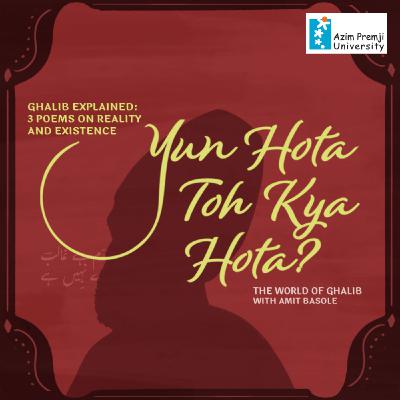
Mirza Ghalib, one of Urdu’s greatest poets, masterfully wove metaphysical reflections into his verse, questioning the nature of reality, existence, and perception. On the occasion of his 156th death anniversary, we revisit his poetry through a selection of verses from Yun Hota Toh Kya Hota: The World of Ghalib, a six-part series presented by Amit Basole, a poetry aficionado and faculty in economics at Azim Premji University.Ghalib’s poetry often challenges our understanding of the visible and the hidden, suggesting that what appears before us may, in fact, conceal a deeper truth. One of his celebrated verses plays with paradoxes, exploring the idea that ultimate reality is hidden in plain sight. Through close readings, this episode unpacks such layered meanings, drawing connections to philosophical traditions and his poetic predecessors.We also examine Ghalib’s playful yet profound manipulation of language, which reflects on existence and divinity with deceptive simplicity. Whether through paradox, wordplay, or existential musings, Ghalib’s poetry remains an endless source of interpretation and wonder—an invitation to look beyond the obvious and glimpse the hidden truths of the universe.Amit Basole explains three Ghalib poems in this bonus episode. If you enjoyed these excerpts, you’ll find more to love as you explore the series on Radio Azim Premji University.CreditsAkshay Ramuhalli, Bijoy Venugopal, Bruce Lee Mani, Gorveck Thokchom, Kishor Mandal, Narayan Krishnaswamy, Prashant Vasudevan, Sananda Dasgupta, Seema Seth, Shraddha Gautam, Supriya Joshi, and Velu Shankar
Comments

Download from Google Play

Download from App Store
 United States