


 Claim Ownership
SmotusCast
Subscribed: 3Played: 27
Subscribe

© Seth Masket
Description
20 Episodes
Reverse
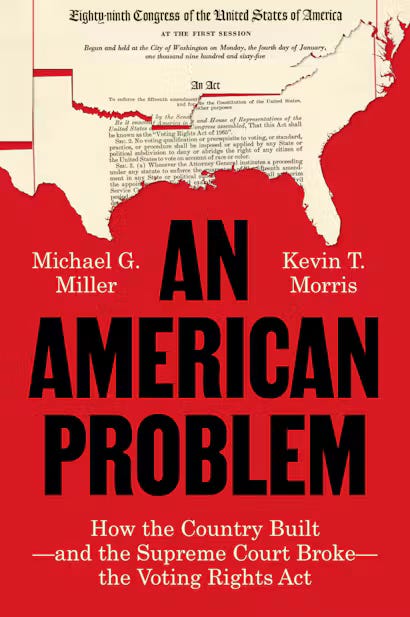
I had the opportunity this week to speak with Mike Miller (Barnard College) and Kevin Morris (the Brennan Center) about their new book, An American Problem: How the Country Built, and the Supreme Court Broke, the Voting Rights Act. I hope you’ll listen to this and buy their important book. The Voting Rights Act of 1965 was arguably the crowning achievement of both the Civil Rights Movement and the Lyndon Johnson administration. But beyond that, quite a few scholars see its passage as the moment that the United States became a full multiracial democracy.Key to the Voting Rights Act’s success was the novel concept of “preclearance.” Under this formula, states and localities with a history of racial discrimination would need to get permission from the federal government to change their voting laws. The burden was on the states and localities to demonstrate that their new rules wouldn’t harm non-white voter participation and representation. This approach to the law was highly successful and substantially limited racial voter suppression. Indeed its passage led to an era of Black voter turnout that was roughly equal to that of whites.This period of relative electoral equality came to an end with the Supreme Court’s ruling in Shelby County v. Holder (2013), and racial protections for voting rights have eroded ever since. This is a terribly important story for understanding modern American democracy. Kevin and Mike tell this story in a very clear and compelling way and bring a great deal of voting data to bear in a way that only social scientists can do. Anyway, please enjoy the conversation and check out the book! This is a public episode. If you'd like to discuss this with other subscribers or get access to bonus episodes, visit smotus.substack.com/subscribe

I’m grateful to Matt Robison for inviting me on his excellent Worth Knowing podcast this week. We built on what I’d written last week about Republicans pivoting (or not) in the wake of a bad midterm election. We discussed the limited ways that some Republican congressional candidates are criticizing Donald Trump right now in the lead up to the November election, and the costs that Republicans pay for sticking with him in the long run. I hope you’ll listen, and be sure to check out Matt’s other podcast discussions! This is a public episode. If you'd like to discuss this with other subscribers or get access to bonus episodes, visit smotus.substack.com/subscribe
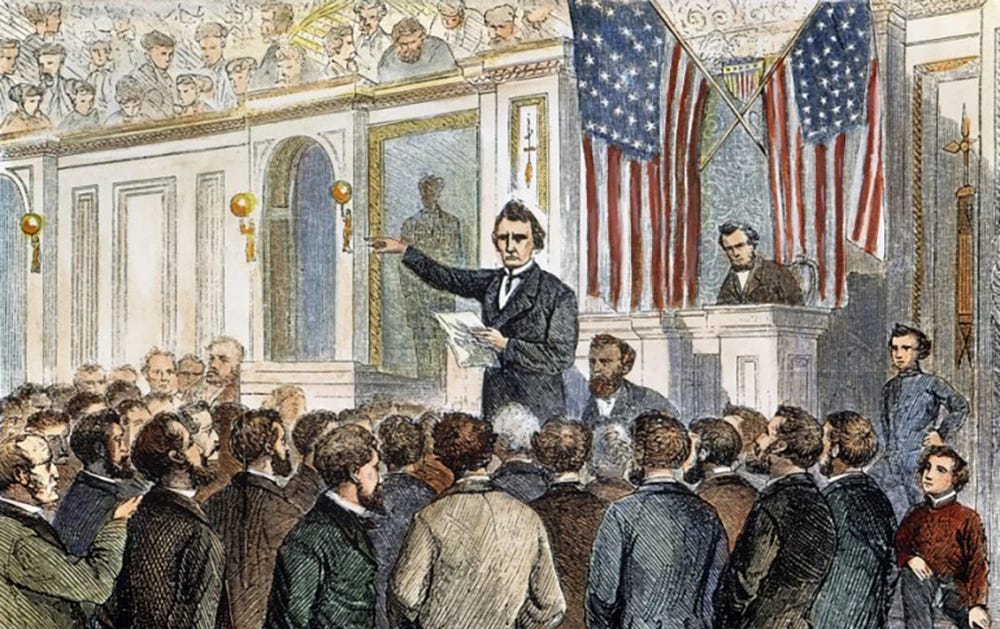
The video above is the conversation I had with Marquette political scientist Julia Azari last week about her recent book Backlash Presidents: From Transformative to Reactionary Leaders in American History. It was a really enjoyable conversation about a great new book. But I want to focus on one of the aspects of impeachment we discussed.the @smotus report is a reader-supported publication. To support this work, please become a paid subscriber.There’s a pretty high probability Democrats will control the House of Representatives next year (with even to slightly-better-than-even odds of controlling the Senate). And there’s a pretty high probability that a Democratic House would take on a third impeachment of Donald Trump as one of its early priorities. What might such an impeachment effort look like? More specifically, what impeachment articles should Democrats draw up?Explainer: In an impeachment, it’s the U.S. House that draws up articles of impeachment, and if any of those articles reach a simple majority of the House, the president goes on trial in the Senate. It requires two-thirds of the Senate (67 votes) to actually convict and remove the president from office. It’s hard to know what approach Democrats should use because impeachment has never “worked,” in the sense that it’s never actually removed a president from office. It’s reasonable to assume that the Senate would have voted to remove Richard Nixon if an impeachment trial had happened in 1974; Nixon certainly believed so, which is why he resigned. But that was also one of the weakest party eras in U.S. history; significant numbers of Republicans were willing to work with Democrats to remove him. At most other times in U.S. history, it’s almost impossible to gather support from the president’s party to reach the two-thirds threshold needed for removal in the Senate. Mitt Romney’s vote to convict Donald Trump in 2020 was the first time in U.S. history that any senator from the president’s party had voted for removal.In the conversation with Azari above, we discussed Republicans’ attempt to remove President Andrew Johnson from office in 1868. Since this was the first time an impeachment had been attempted (and since Johnson was in such an unusually bad political position, perceived as a sellout by his fellow Democrats for serving as the late Abraham Lincoln’s running mate in 1864 and as traitor by Republicans for his work to thwart Lincoln’s Reconstruction agenda), Republicans were just kind of making things up. They passed 11 articles of impeachment, all ostensibly related to Johnson’s violations of the Tenure of Office Act (by which he was constrained from firing Lincoln’s cabinet appointees). But those covered a long laundry list of Johnson’s actions, including his “improper rhetoric” in de-legitimizing the Congress. The trial went to the Senate; Johnson was acquitted by a single vote. Democrats in 2020 and 2021 went with a different approach. Upon becoming Speaker in 2019, Nancy Pelosi signaled her discomfort with moving forward with a vague impeachment on a range of issues, even though that was the clear preference of many new members of her caucus elected in 2018. Yet that changed with the release of a phone call between Trump and Ukrainian President Volodymyr Zelenskyy, in which Trump was heard asking Zelenskyy to say that his government was investigating Joe Biden for corruption, and saying that ongoing U.S. aid to Ukraine was contingent on this. The Democratic leadership found this blackmailing of an ally to interfere with the next election to be an overt and easily-understood transgression that could keep their coalition together and win public support. There were just two articles of impeachment: one on abuse of power, and one on obstruction of Congress. They both passed the House on party-line votes. The Senate acquittal was also party-line, save Romney’s yes vote on just the first article.The 2021 impeachment was even simpler, coming just a week after the January 6th riot and containing just one article: that Trump had incited insurrection. This passed quickly, with all Democrats and 10 Republicans voting to send it to the Senate. In the Senate, 7 members of the president’s party voted to convict, along with all 50 Democrats and independents. This still fell 10 votes short of conviction, and Trump was acquitted. Should there be an impeachment in 2026, there’s an argument for keeping it focused on just one or two key issues that are very obvious and on which public opinion is strongly against Trump: his overt corruption in demanding payments from businesses and foreign powers or investments in his digital currency, or his violations of the separation of powers in launching a war on Iran without any prior or ongoing approval from Congress. Yet there’s certainly an argument for throwing in a bunch of other issues — his abuse of the pardon power (especially in freeing those who attempted an insurrection), his overtly racist rhetoric, his threats to undermine the constitutional system by running for a third term, his sending federal relief efforts just to states that voted for him, his deployment of ICE and U.S. Armed Forces into American cities, his violations of people’s habeas corpus rights in immigration enforcement, his efforts to undermine U.S. alliances and treaties, his unauthorized demolition and defacement of several federal structures in DC, etc., and just see what sticks. There’s a lot.Democrats certainly have some concerns about appearing as a party obsessed with impeaching Trump. And the kitchen sink approach might make them more vulnerable to such a news frame. But the party also contains a lot of passionate voters and activists who see impeaching Trump as the only remedy available for his range of abuses.Again, though, it’s hard to say which approach would be better, since none is likely to come close to actually removing Trump from power. And which would be better in terms of Democrats’ public perceptions heading into the 2028 election cycle? One could argue that Pelosi’s limited-impeachment approach to 2020 was about as successful a model as possible; it didn’t remove Trump, but it likely hurt him, and he lost reelection that year. This might well be the approach they pursue next year. This is a public episode. If you'd like to discuss this with other subscribers or get access to bonus episodes, visit smotus.substack.com/subscribe

This is a free preview of a paid episode. To hear more, visit smotus.substack.comI was truly delighted and honored to be joined by Atlantic humor columnist Alexandra Petri (here’s her website) for a rich discussion about two vital topics: 1) Moments when the Trump administration has gone beyond parody, and 2) The best and worst political lessons we can glean from the “Star Wars” universe. Does this sound nerdy? Just you wait! Among the things we cover:* The absolute comedic perfection of moments like Four Seasons Landscaping and the Hurricane Dorian Sharpie, and how Trump left his satirists with no place to go.* How important events that occurred not that long ago can quickly be memory-holed, to the point that young people today have never heard of the Jedi or George W. Bush.* The invaluable cautionary tale of Lando Calrissian, dealmaker.* The fact that there seems to be almost no news media in the Star Wars universe and no one who reads anyway.* The dangers of putting odd people obsessed with odd ideas (tariffs, a moon-sized space battlestation) into positions of power.* How DEI hiring practices could have improved Stormtroopers’ aim.* Perhaps most importantly, which films to introduce to children and in which order.The recording has roughly 7 minutes of public material, but then the rest is paywalled. I hope you’ll agree that it’s really, really worth getting a paid subscription to the Smotus Report to hear the rest.

I was honored to be joined by Laura Belin yesterday for a discussion about several races in Iowa that are proving surprisingly competitive. Laura is the head editor and writer for the excellent Iowa politics blog Bleeding Heartland and is one of the top political reporters in Iowa. We talk about the Iowa governor’s race, the US Senate race, and the competitive contests in the 1st, 2nd, and 3rd congressional districts. We also get into some presidential caucus politics, and it turns out a few Democrats have been sneaking into the state to do some early 2028 campaigning.Given that control of both the US House and Senate are in play this year, this handful of races could end up being pivotal. I hope you enjoy the rundown here. This is a public episode. If you'd like to discuss this with other subscribers or get access to bonus episodes, visit smotus.substack.com/subscribe

Comments

Download from Google Play

Download from App Store
 United States