


 Claim Ownership
World Politics Review
Subscribed: 1,390Played: 8,071
Subscribe

© World Politics Review
Description
With in-depth interviews with experts and leading policymakers, Trend Lines brings World Politics Review's uncompromising analysis of international affairs to the world of podcasts.
99 Episodes
Reverse
What do you think of the audio versions of articles, read by an AI-generated voice, that we've been featuring on this podcast feed of late? Our publisher wants your comments. Listen to the episode to find out where to send your thoughts. In this briefing, originally published March 27, 2025, Fred Harter looks at the potential for fresh conflict in Ethiopia. Ethiopia, Eritrea and Tigray Are Back on a War Footing ADDIS ABABA, Ethiopia—A political crisis in Ethiopia's war-battered Tigray escalated dramatically in March, bringing armed men out onto the streets and raising fears of a fresh conflict in the still-fragile region. At its heart is a power struggle between Debretsion Gebremichael, chairman of the dominant Tigray People's Liberation Front, or TPLF, party, and Getachew Reda, Tigray's interim regional president and Debretsion's deputy in the TPLF. But in the background lurks a potentially more explosive dynamic: the escalating rivalry between Ethiopia's federal government and Eritrea, which united in the war against Tigray in 2020-2022 but fell out over the peace deal that ended it. More than two years later, tensions between the two are spiking over Ethiopia's quest to end its status as the world's most-populous landlocked country. ... Listen to hear the rest, or read it here: https://www.worldpoliticsreview.com/ethiopia-eritrea-tigray-war/

Israel has resumed attacks in force on Gaza this week, breaking a two-month ceasefire and undermining U.S. President Donald Trump's claim that he would end both the Israel-Hamas and Russia-Ukraine conflicts quickly and easily. To some, Trump's seeming empowerment of both Israel and Russia, coming on the heels of former President Joe Biden's earlier failure to deter Russian aggression or use U.S. leverage with Israel to prevent the flattening of Gaza, only proves that the international rules-based order Trump is openly seeking to flout may have never been as sturdy as it seemed. But as I put it in an interview on the American Prestige podcast last week, the rules-based order may be weaker than many may want, but it is stronger than they may think. It can even withstand efforts to break it by the U.S., which disregards rules and institutions - and permits Washington's adversaries and allies to do the same - at its peril. To be sure, as one of the podcast's hosts pointed out, when even a U.S. president who defends the rules-based order, like Biden, fails to bring an ally that is committing crimes against humanity to heel - to say nothing of an advocate of "might makes right," like Trump, failing to do so - it certainly increases the likelihood those crimes will continue. That might appear to confirm the view that rules matter little in international affairs, even when great powers pay lip service to them. But part of the problem is the gaps in the rules-based order itself. In this case, international law does not currently compel third parties to withhold aid from the parties to a conflict committing aggression or crimes against humanity, or come to the aid of those that are the victims of either. That should change - and it could if a Treaty on Crimes Against Humanity were adopted. To be sure, such rules do exist with regard to genocide, which is a very specific crime defined as any one of several acts when those acts are carried out with the intent to destroy in whole or in part a national, ethnic, racial or religious group. The Genocide Convention not only prohibits such acts - including but not limited to wilful killing, bodily harm and infliction of conditions on a group calculated to ensure their destruction - but also requires third parties to prevent and punish such acts. This was the basis of South Africa's effort at the International Court of Justice to seek a stay of hostilities in Gaza until the court made a legal determination over whether Israel was guilty of the crime of genocide there: South Africa claimed it was required under international law to do what it could to prevent or punish what it viewed as a potential genocide, rather than to stand by. But scholars and legal experts are split on whether Israel's atrocities in Gaza constitute genocide. A September 2024 report from the United Nations Office of the High Commissioner for Human Rights argues that Israel's actions are consistent with the characteristics of genocide. So do some rights groups and numerous legal scholars. Others have argued that the crimes fall below this threshold. The International Court of Justice has yet to rule on the matter, while the International Criminal Court's investigation into the situation in Gaza does not include charges of genocide. The debate as a whole underscores how high the bar is set for proving a party is guilty of genocide, largely because it is a crime of "intent." If a prosecutor can't show that the acts were undertaken with the actual intent to destroy the group as such, they don't qualify. And if they don't qualify, then third-party complicity in or incitement of these acts could not trigger criminal prosecutions under the Genocide Convention against leaders of the relevant third-party state. And yet regardless of whether Israel's acts meet the strict definition of genocide, no observer familiar with international humanitarian law could conclude that Israel is not at minimum committing what could reasonably be p...

This week U.S. Secretary of State Marco Rubio will travel to the Caribbean, where he will visit Jamaica, Guyana and Suriname. Having already traveled to Central America and the Dominican Republic in February, this is Rubio's second trip to the hemisphere in the two months since President Donald Trump returned to the White House on Jan. 20. Trump himself has already demonstrated his new administration's focus on expanding Washington's power, influence and perhaps even territory in the Western Hemisphere. Among his first acts after taking office was to sign an executive order renaming the Gulf of Mexico as the "Gulf of America," though few besides the U.S. government's official agencies refer to it as such. And he initially threatened to take control of the Panama Canal, though that topic has receded as a focus of his attention in recent weeks. In a similar way, Trump and Rubio are bringing more bluster than substance to Caribbean policy, which is a mistake. While the region is given short shrift in terms of time and attention by all U.S. administrations, the Caribbean's current list of urgent priorities is lengthy. As a result, regional leaders are intent on making the most of Rubio's visit. They spoke multiple times last week in preparation for it, and Barbados Prime Minister Mia Mottley plans to be in Jamaica to represent all the Caribbean island nations when Rubio arrives. Arguably, climate change could be considered the region's biggest challenge. But given the Trump administration's environmental policies, arguing over that issue would be a fruitless pursuit and take away time from things that all sides can negotiate and perhaps even agree on. Next on the agenda should be Haiti, a country without an elected government where gangs continue to expand their power and territorial control, armed with weapons that mainly originate in the United States. A Kenyan-led peacekeeping mission deployed to the country continues to lack the resources necessary to make a dent in the security situation, meaning that Haiti is a continuing source of instability for the region. Yet, while Haiti is probably the second-biggest regional challenge, it too will likely not feature much in Rubio's discussions, as each island in the Caribbean has its own individual domestic concerns that may take precedence over the bigger picture. One issue many Caribbean leaders are itching to bring up is the Trump administration's crackdown - led by Rubio - on their payments to Cuba as part of Havana's longstanding practice of sending its doctors abroad as a revenue-generating development scheme. Cuban doctors are a fixture in many Caribbean countries that find the arrangement to be an affordable way to plug gaps in their own health care systems. Now the U.S. government is threatening to sanction governments that participate in the program, including visa bans to keep their leaders from entering the United States. Supporters of Havana's doctors-for-hire scheme, including several Caribbean nations, point to the fact that Cuban doctors receive excellent medical training. The doctors are sent to work in locations where medical assistance would otherwise be unavailable. Their training and focus on preventative medicine and health policy often benefits communities beyond individual doctors' visits, as does the fact that they stay with communities for months or even years, far longer than U.S. programs that bring hospital ships or medical personnel for a brief visit of a week or two. Critics of the program highlight the abuses that the doctors and their families face. Cuba pockets the revenue the program generates, while barely paying the doctors that do the work. Often, the doctors' families are held hostage back in Cuba to ensure they do not defect once they are overseas. Beyond that, the medical care is inconsistent. While some of Cuba's doctors are top-tier physicians and researchers who could practice medicine anywhere in the world, others are spies who could bar...

At the heart of unpaid care work in Mexico lies a paradox: The labor sustains the economy, even as it creates barriers to women joining the workforce. All told, the value of uncompensated domestic labor in Mexico amounts to more than 26 percent of GDP, outpacing both the manufacturing sector and trade, according to the country's statistics agency. Yet roughly 20 million Mexican women are not employed because they are busy providing that unpaid labor. Now, a push to build a national care system seeks to recognize and rebalance that work by creating a network of services covering care for children, people with disabilities, the elderly - and the caretakers themselves. President Claudia Sheinbaum, Mexico's first woman head of state, created a Women's Secretariat that, among other tasks, is charged with building the system. And earlier this month, one of the country's main opposition parties said it would introduce an initiative enshrining the right to care in the Constitution. But the devil is in the details, and building a national care system will take time and resources. Can Mexico get there? The effort to recognize "the right to care, to be cared for, and care for oneself" is not new in Latin America. From the 2007 Quito Consensus on through multiple regional women's summits since then, it has been a focus of attention, and several Latin American countries have taken steps to develop care systems. In 2015, Uruguay became the first country in the region to make such a system law, while others - from Costa Rica to Colombia to Chile - are developing national systems with services ranging from early education programs and job training for people with disabilities, to day centers where the aging can get care and socialize. Beyond care delivery, another goal is to close gender gaps: Across the region, women spend almost triple the amount of time that men do on unpaid domestic and care work. Nowhere in Latin America is that gap between men and women bigger than in Mexico, where women devote, on average, 43 hours a week to unpaid labor - the highest in the region. "If we really want to work at guaranteeing substantive equality, we have to make progress in removing the care burdens that still fall on women," says Martha Tagle, a former federal deputy with the Citizen's Movement, or MC, party, in an interview. Those burdens come with an economic cost, creating a stubborn obstacle to getting women into Mexico's workforce. Over the past decade, Mexican women's labor participation grew by just 3 percent to 46 percent, lagging men's participation by 30 points. At that rate, it will take 56 years for the country to catch up to the OECD average of 67 percent when it comes to women in the workforce, according to the Mexican Institute for Competitiveness, or IMCO, think tank. But closing the gap faster would come with a bonus: IMCO estimates that Mexico's GDP would be 3.7 percent higher if it hit the OECD average by 2035. As Mexico faces the headwinds of U.S. tariff threats and stagnant growth, closing the workforce gap represents an economic opportunity. For that reason alone, a care system is "fundamental," says Odracir Barquera, CEO of the Mexican Automotive Industry Association and previously an adviser to a Mexican senator on women's economic inclusion. "The problem is that the proposal has to be accompanied by resources … because one part can be supplied by the employer, but the other part needs to involve state infrastructure." Some steps toward laying the foundation for that infrastructure have been taken. When Sheinbaum was sworn in as president in October 2024, her inauguration speech included a pledge to implement a national care system through existing health and social service agencies, starting with a dozen childcare centers for day workers and factory employees in the border city of Ciudad Juarez starting later this year. The plan is to subsequently expand these centers to other cities. But financing and access remain open qu...
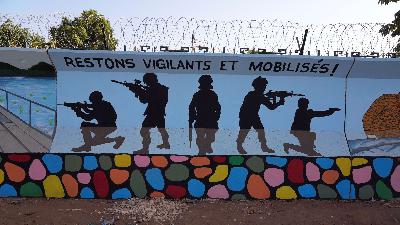
In January, Burkina Faso, Mali and Niger officially withdrew from the Economic Community of West African States, or ECOWAS, having already established the Alliance of Sahel States, or AES, as an alternative regional grouping. The move has had a multitude of consequences, including ongoing diplomatic spats between the AES states and those that remain committed to ECOWAS, as well as challenges to trade and freedom of movement across the region. But the security implications of the fracturing of ECOWAS as a regional bloc are also important to consider, as West Africa faces an array of challenges that are increasingly affecting what are usually thought of as the region's more stable coastal countries, such as Senegal, Ghana and Cote d'Ivoire. All three of the military-run AES states face long-running jihadist and domestic insurgencies, including armed groups with links to the Islamic State and al-Qaida. Most prominent among them are the Islamic State-Sahel Province and Jamaat Nasr al-Islam wal-Muslimin, or JNIM, which is affiliated with al-Qaida and is also active in northern Cote d'Ivoire, Benin and Togo. These groups have been active throughout the Sahel for over a decade, typically exploiting local grievances and intercommunal tensions, particularly between farmers and pastoralists as well as against the Peuhl community, which is often portrayed as being sympathetic to the jihadists. The jihadists mobilize these tensions to stoke conflict and recruit among marginalized communities in a broader effort to seize territory and create an Islamic caliphate in the Sahel and West Africa. These groups have targeted civilians and government forces alike, and their attacks have often been tactically sophisticated and significant in impact. In August 2024, for instance, an attack by JNIM in Barsalogho, in northern Burkina Faso, killed around 600 people. And in November 2023, an ambush in Niger's Tillaberi region killed at least 200 soldiers and wounded at least 34 others. Jihadist violence has increased at an accelerating rate in recent years, killing 11,643 people across the Sahel in 2023, a 43 percent increase from the previous year and a threefold increase since 2020, according to the African Centre for Strategic Studies. It has also increasingly spilled over into coastal West African states, with Ghana, Togo, Benin and Cote d'Ivoire all now threatened by these groups as well, albeit to a much lesser extent than the Sahelian states. In Togo, an attack on an army barracks last year killed 12 soldiers, for instance, and JNIM is increasingly fortifying its positions near the borders of Togo and Benin. The problems posed by insecurity are exacerbated by the refugee crisis that violence in the Sahel is causing. By early 2025, nearly 87,000 people had fled their homes in the Sahel into coastal countries. This has put a strain on local communities, especially in Cote d'Ivoire, where nearly 58,000 of the refugees have fled. The rampant insecurity has also fueled political instability, with the three AES states having experienced a combined five coups between 2020 and 2023. The ECOWAS split could exacerbate many of these security challenges, not least because it has created or exacerbated tensions between many countries that have remained in ECOWAS and those that have left. In the past 12-18 months, for instance, Cote d'Ivoire, known as a staunch defender of ECOWAS, and neighboring Burkina Faso have engaged in repeated diplomatic spats linked to mutual fears of destabilization as well as Burkina Faso's rejection of the region's and ECOWAS' historical pro-Western leanings. Gun battles and disputes at the border between Burkinabe and Ivoirian troops have become common, with Ivoirian gendarmes having even been detained in Burkina Faso. Earlier this year Burkina Faso withdrew its diplomatic personnel from Cote d'Ivoire. These disputes have increased instability on the two countries' shared border, exacerbating tensions driven by an inflow of Burk...

Five years ago last week, the world shut down. The coronavirus that caused COVID-19 had first emerged in Wuhan, China, in December 2019. By March 2020, it had become a global pandemic leading to mass death and grinding the global economy to a halt, with some labeling it "the most disruptive global event since the Great Depression and World War 2." Hoping to prevent those ill with the deadly respiratory virus from overwhelming the capacity of hospital systems, governments around the world sought to "flatten the curve" by mandating the closure of businesses and schools, and ordering people to stay at home. The extent to which governments took such measures varied, both between and within countries. But the overall effect was that for a few months in 2022, the earth seemed to truly stand still. Even as the pandemic was still unfolding, analysts openly wondered whether it would "fundamentally alter globalization, democracy, capitalism, multilateralism, the predominance of US power, and other core features of the pre-COVID international system," as one collection of research papers put it. Some asserted it would dramatically change the global order, as it offered an opportunity for China to use its ability to quickly contain its outbreak - as well as its control over the supply of personal protective equipment - to claim superiority over the U.S. and Western countries that struggled to do so. Others saw the pandemic's impact working in the opposite direction, viewing it as China's "Chernobyl moment." By this argument, Beijing's inability to keep the virus from spreading globally would be a death blow to the Chinese Communist Party's legitimacy, just as Moscow's inability to prevent and address the consequences of the 1986 meltdown of the nuclear power plant in Chernobyl, Ukraine, undermined Communist Party rule in the former Soviet Union. Regardless of exactly how the pandemic might affect the global order, the international relations scholars Hal Brands and Frank Gavin seemed to be speaking for everyone when they wrote in their 2020 book, "COVID19 and World Order," that "even after the virus is contained, the consequences will be with us for some time." But reflecting on the pandemic five years later, it seems that its main impact on the global order was that it had no impact at all. Rather than serving as a profound shock on the scale of the 20th century's world wars, COVID-19 appears to have come and gone. That's not to say that it wasn't meaningful or that it had no impact. To the contrary, consider how many people still make a point of getting the latest COVID-19 vaccination booster, or the fact that masking is now more common than it was in the "before times." But rather than changing the global order, COVID-19 was more a reflection and product of that order. That it was a reflection of the current international system is most evident with respect to the global economy. As global exchange ground to halt, investors fled the markets to protect their financial assets. But in turning instead to the U.S. dollar, they underscored the greenback's already established role as the world's most prominent reserve currency and ultimate safe haven. Additionally, the failure to contain the global spread of the virus, which was enabled by the ease with which people and products travel from one country to another these days, underscored the highly interconnected nature of the global economy. Indeed, COVID-19's spread, while staggering in scale, was not unprecedented. Like the severe acute respiratory syndrome, or SARS, virus in 2002, and even worries over the potential spread of bird flu today, COVID-19 simply made it clear that global pandemics are an ever-present risk in today's globalized economy. With respect to COVID-19 being a product of the international order, the rapid spread of the pandemic was also due to a failure of international cooperation. In particular, the key feature of the current global order is the emergence of China ...

European farmers have been in the news in recent months due to high-profile protests against climate policies, which they argue put a disproportionate burden on their already thin margins, as well as European Union trade deals, which they claim expose farmers to unfair competition from global producers. Combined, the twin pressures have radicalized many in the sector, while putting a spotlight on the EU's climate and trade policies. But less attention has been paid to a quieter but nonetheless significant risk facing European agriculture: the distortions introduced into the sector by the bloc's Common Agricultural Policy, or CAP, and their impact on the security of Europe's food supply. The first iteration of the CAP was introduced by the six founding members of what was then the European Economic Community, or EEC, back in 1962. Its principal objective was to increase food production, which had fallen drastically in the immediate postwar years due to labor shortages and damage to agricultural land. The policy also aimed to raise farmers' wages and improve food security by offering farmers a "guaranteed price for their produce and introducing tariffs on external products." In the subsequent half century, the CAP has been pivotal in the transformation of European agriculture, helping to usher in an agri-business model that has increased production but at the cost of driving thousands of farmers from the land, degrading the environment and enriching big landowners at the expense of smaller ones. As a result, it now threatens the long-term security of the bloc's food supplies. A key driver in the transformation of the bloc's agricultural model was the CAP reforms of the early 1990s, which saw a move away from the original price support system toward "direct income support for farmers … based on the area of land cultivated or number of livestock maintained." These changes inevitably favored bigger farmers, leading to "land grabbing" by large producers and a major decline in the European model of family farming, according to ARC, a voluntary rural organization dedicated to preserving family farms across the bloc. The inequitable consequences of the reforms were belatedly acknowledged by the EU itself in 2013, when it pledged a more equal distribution of support by "limiting the budget for big farms." The demographic crisis in farming has been exacerbated by the CAP's drive to create ever-larger units. But the rhetoric on greater equality has not translated into substantive change. A 2021 report for the European Parliament on the biggest beneficiaries of CAP funding found that between 2018 and 2021, a staggering 3.3 billion euros ended up in the coffers of 17 billionaires. Recipients included former Czech Prime Minister Andrej Babis and British vacuum cleaner tycoon James Dyson. At a time when thousands of small farmers are struggling for survival or throwing in the towel, such largesse for the super-rich raises serious questions about the fitness for purpose of the CAP and the effects of multiple rounds of reform over the years. Attempts to root out abusive practices in the bloc's food supply chain through CAP reform have also floundered in the face of both powerful special interests and the complexities of the EU single market rules. Food producers have long complained about the overwhelming power of the massive supermarket chains that maximize profits by relentlessly squeezing producers' profit margins. In response to unfair trading practices in the supply chain, the European Commission set up the much-vaunted Agricultural Markets Task Force back in 2016. Its final report contained a whole host of recommendations to reform how CAP regulates the relationship between food producers and retailers, in order to give farmers a fairer deal. Yet almost a decade on, a major survey conducted by the food charity Sustain found that farmers still typically make a profit of less than one cent on staples like a loaf of bread or a block of ch...

This article by Richard Gowan was published at worldpoliticsreview.com on March 19, 2025. It is now almost exactly two months since U.S. President Donald Trump returned to the White House and set about weakening the United Nations. On his first day in office, Trump announced that the U.S. would quit the Paris Agreement on climate change as well as the World Health Organization. At the time, I argued that these were predictable maneuvers, as he had taken similar steps in his first term. Diplomats and international officials in New York were resigned to Trump taking early pot-shots at the U.N. but hoped that he would move on to other targets. Two months later, U.N. insiders admit that the new administration has done far more harm to the institution than they had expected. And they worry that it will do even greater damage before long. While the administration's cuts to foreign aid have hit U.N. agencies hard, U.N. officials had expected to face financial strains. But Washington has also blocked information-sharing by U.S. government entities with their U.N. counterparts on issues ranging from epidemics to indicators of famine. That has stopped the flow of data that U.N. agencies often relied on more than they would care to admit. In parallel, U.S. diplomats in New York and Geneva have instructions to purge multilateral documents of references to words the Trump administration dislikes, like "gender" and "diversity." These strictures have upset routine U.N. committee processes on issues ranging from children's wellbeing to peacekeeping, as U.S. negotiators have focused on these semantic points to the exclusion of all other topics. Their foreign counterparts quip that U.S. diplomats simply use the "Ctrl+F" keyboard shortcut to search draft texts for offending nouns and verbs to cut, in order to win credit with Washington. Foreign officials in New York had always expected the Trump administration to be transactional rather than principled in its multilateral diplomacy. But its obsession with rooting out supposedly leftist notions has convinced many that it is ultimately following a right-wing ideological template, making it significantly harder to bargain with. The U.S. has reinforced this view by circulating a questionnaire to U.N. agencies asking if they have had any association with communists or other anti-American forces. While senior figures in New York have tracked the White House's attacks, they have had few real openings to understand U.S. thinking. The Senate confirmation of Trump's nominee as ambassador to the U.N., Rep. Elise Stefanik, has been put on hold to allow Stefanik to remain in Congress, as the slim and unruly Republican majority makes her vote indispensable for upcoming budgetary negotiations. Beleaguered diplomats at the U.S. mission to the U.N. have tended to postpone big decisions until her eventual arrival, which is now expected in early April but could slip further into the future. Some major U.S. initiatives - such as the decision to side with Moscow rather than Kyiv in a series of General Assembly and Security Council votes in February marking the anniversary of Russia's all-out invasion of Ukraine - have seemed quite haphazardly put together. The bleakest observers suspect that the Trump administration not only does not care about the U.N. but actively wants to subvert it. Worried U.N. member states have been urging the organization's leaders to try to get ahead of this burgeoning crisis. In February and early March, major financial donors to the U.N. fretted that Secretary-General Antonio Guterres - who handled Trump quite successfully in his first term - was not taking the scale of the current U.S. threat seriously. Last week, Guterres announced a review of the U.N.'s mandates and structures to identify savings and efficiencies. He has, rather unconvincingly, tried to present this as an independent initiative rather than a stop-gap response to Trump. Looking ahead, denizens of the U.N. bubble broa...
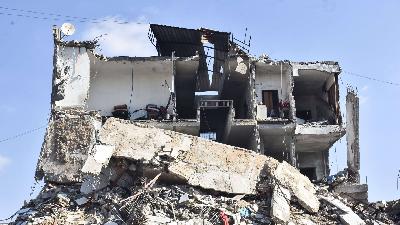
NABATIEH, Lebanon - After more than a year of tit-for-tat airstrikes and several months of higher-intensity combat, the devastating war between Hezbollah and Israel ended with a ceasefire in late November 2024. In addition to the nearly 4,000 people killed during the conflict, the fighting caused an estimated $6.8 billion in damage to housing and infrastructure. Nearly 120,000 homes have been destroyed or damaged, and nearly 900,000 people had been displaced at the height of the fighting in November. Lebanon's newly formed government now faces an immediate challenge: resettling those who were displaced while ensuring that reconstruction is efficient, transparent and free of corruption. Zohair Hussain Jawad, a 50-year-old Lebanese-American dual citizen, left the U.S. in 2005 to settle in Nabatieh, in southern Lebanon. A year later, he lived through the 2006 conflict between Hezbollah and Israel, which was intense, but shorter and more limited in scale. The devastation this time, he says, is "incomparable." "It wasn't like that in 2006," he recalls. "In 2024, unfortunately, it escalated to a point of no return." After he nearly lost his home to Israeli airstrikes during the latest conflict, Jawad and his family relocated to Beirut in late September. Like many other Lebanese, Jawad's life savings are locked in the country's broken banking system. He used what he had on hand to survive, waiting for the war to end. "We returned the day they called a truce, but our house was in ruins," says Jawad. Though the dwelling has now been repaired, parts of it are still patched together with plastic and cardboard. A building across the street was completely destroyed. More than three months after the Nov. 27 ceasefire that ended the fighting, large parts of southern Lebanon still lie in rubble. And while Hezbollah pledged to cover reconstruction costs, whatever rebuilding has happened has been sporadic, with the process for accessing reimbursement anything but smooth. When asked whether he has received any financial assistance for the repairs to his house and his lost furniture, Jawad says that a group of officials came to his home to check out the damage and take down the necessary information, without specifying whether they were from Hezbollah or the government. "We'll see where that goes," he adds. A recent Financial Times report states that the damage assessment committee of Hezbollah's construction arm, Jihad al-Bina, has already inspected more than 270,000 homes. Once the assessment of the damage to a home is complete, residents become eligible for compensation checks and cash payments, which are distributed through local branches of Al-Qard Al-Hassan, Hezbollah's financial arm. In December, Hezbollah's secretary-general, Naim Qassem, claimed that the group had already provided more than $50 million in aid covering 172,000 displaced families, with a total of $77 million allocated for the 233,500 households eligible for it.But with the cost of rebuilding in the housing sector alone estimated by the World Bank to be around $4.6 billion, that's a drop in the bucket. Even if no further fighting breaks out, large-scale reconstruction remains uncertain given Lebanon's economic crisis and political instability. Mukhtar Hassan Jaber, a member of the municipal council in Nabatieh who assists residents in obtaining the necessary documents to claim compensation from Hezbollah, says that the government has been of little help. "NGOs are providing machines to clear the rubble," he says. "They are working block by block to remove debris so that they can start rebuilding afterwards." Imad Salamey, an associate professor and chairperson of the Lebanese American University's Department of Political and International Studies, understands the skepticism expressed by Jaber and others with regard to the Lebanese government. But he believes that such claims are often exaggerated to justify sectarian political control over local populations. "After the 2...
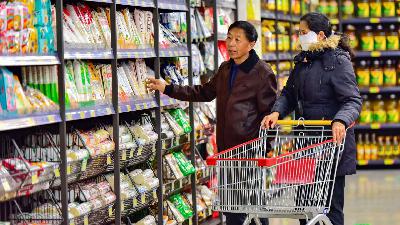
The meetings last week of China's National People's Congress, or NPC, and the Committee of the Chinese People's Political Consultative Conference, or CPPCC, ended with commitments to maintain economic growth at around 5 percent, keep unemployment at 5.5 percent and increase the fiscal deficit target to 4 percent, the highest in 30 years. However, the annual session of China's two-chambered rubber-stamp legislature, known as the "Two Meetings," did not include any detail, let alone surprises, for how the government might reach these ambitious targets. On Sunday, however, the Central Committee of the Chinese Communist Party and the State Council, the main governing body of the government, jointly issued a 30-point Special Action Plan to boost consumption. Coming so soon after the Two Meetings, the announcement generated some enthusiasm that the focus on consumer spending demonstrates a renewed dedication to move away from Beijing's focus on export-oriented manufacturing, which has exacerbated tensions with trading partners from the U.S. to Brazil, while fueling excess capacity, price wars and unhealthy competition in China. As an action plan, the document itself is disappointing, because while it contains laudable goals - such as better enforcement of labor rights and increased payouts for the basic pension system - it does not specify how these can be achieved. For instance, who will enforce China's strict but often ignored labor laws now that President Xi Jinping has dismantled labor rights organizations and weakened the trade union? Who will pay for the increased pensions when local governments already struggle to pay the salaries of civil servants? More fundamentally, will the central government finally reform the central-local fiscal relationship so that the local governments tasked with implementation of the plan have the resources to do so? As a policy document, however, the plan is interesting and important, as it reveals how Xi's government envisions the role of consumption in a development model that is still solidly built on manufacturing and investment. As such, the plan is clearly in alignment with Xi's vision for China's economy. It's not that consumption has no role in boosting the economy, but that the role of consumption is subordinate to higher-level goals. Indeed, even the ordering of the plan's seven sections reveal how consumption relates to these goals, such as revitalization of northeastern China through winter tourism and support for key goods, such as automobiles and consumer electronics, which have already been hit hard by external tariffs. The plan to boost consumption resonates with many of Xi's admonitions over the years, including his slogan that the pathway to common prosperity is not through government handouts, but through hard work. In effect, the plan sees the role of the Chinese consumer as intrinsically linked to the more important role of the Chinese worker on the productive side of the economy. Indeed, it is an almost quaintly Leninist depiction of the relationship between China's manufacturing juggernaut and the workers who fuel China's achievements in automotives, robotics, semiconductors and electronics, as well as basic consumer items from Shein apparel to Temu gadgets. It resonates with many of Xi's admonitions over the years, including his famous critique of "welfarism" as encouraging laziness - or "lying flat" - and his slogan that the pathway to common prosperity is not through government handouts, but through hard work. As such, work is paramount to the plan, which both encourages more employment and proposes ways to make employment easier. The first section highlights the need to boost incomes through employment, including support for "reasonable" increases in the minimum wage. The second section sets out recommendations to make work easier, especially for women of childbearing age and students. This section highlights the government's anxieties over two social problems: the lo...

U.S. President Donald Trump's foreign policy is chaotic. This may be by accident or else the result of stupidity. But it is also partially by design. In his ghost-written books about business, Trump describes the benefits of keeping the other side off guard with unexpected negotiating tactics. Similarly, beyond the world of business negotiations, Trump believes in the "madman theory" of foreign policy, in which being less predictable helps him gain concessions because other foreign leaders do not know how credibly to take his threats. In other words, the chaos is part of the policy. The world has seen this play out over the first eight weeks of Trump's new term in office. On tariffs, Trump threatened Canada and Mexico, with which he renegotiated a free trade deal during his first term, with a blanket 25 percent tariff. He has now backed down twice in two months on following through, once at the very last moment and once after having briefly imposed the import duties. The uncertainty this has created with regard to the North American business environment has led to lower consumer confidence, declining U.S. stock markets and concerns about a potential recession. Meanwhile, Trump has slowly ratcheted up tariffs on China, threatened the European Union with far-reaching trade restrictions and moved to increase tariffs on metal imports, resulting in counter-tariffs and popular anger targeting U.S. businesses all across the globe. Is Trump hoping to use these tariffs to raise revenue or to move manufacturing back into the United States? Or alternatively, does he hope the threat of tariffs will change other countries' behavior before he actually has to impose them? Nobody knows. Trump has claimed all three competing rationales at various points, adding to the maelstrom. The uncertainty is not restricted to trade. On the war in Ukraine, Trump opened direct talks with Moscow and directed the U.S. to vote against a United Nations resolution condemning Russia for the invasion. Later that week, Trump appeared to change course and invited Ukrainian President Volodymyr Zelenskyy to the White House to sign a deal on Ukraine's critical minerals. That deal was canceled after the two leaders' disastrous Oval Office press conference, leading Trump to suspend military aid and intelligence-sharing that the U.S. has provided to Kyiv since the February 2022 invasion. He then had U.S. negotiators meet with their Ukrainian counterparts in Saudi Arabia, where they agreed on a potential ceasefire deal. As of this writing, military assistance and intelligence-sharing with Ukraine has resumed, and Trump is now floating the imposition of hard-hitting sanctions on Russia to get Moscow to go along with the ceasefire. Foreign leaders cannot just plan for facing Trump's worst possible policies. Rather they must be ready for policies that never stop changing and even reversing. On Venezuela policy, Trump's special envoy Richard Grenell traveled to Caracas in late January to meet with President Nicolas Maduro, who blatantly stole the country's presidential election last year and was the target of a "maximum pressure" campaign seeking regime change during Trump's first term. As a result of Grenell's visit, Maduro agreed to accept Venezuelan migrants deported back to the country from the U.S., in exchange for an implicit guarantee that the Trump administration would not reimpose oil sanctions that former President Joe Biden had stopped enforcing as part of his own diplomatic efforts to ensure that last year's election would be more free and fair. A few weeks later, however, Trump reversed course, revoking a special license that had allowed Chevron to drill in the country and giving the company just 30 days to wind down operations. Yet, late last week, Maduro began accepting deportation flights again, suggesting another quiet under-the-table deal had been reached. Then over the weekend, Trump deported Venezuelan citizens he accused of being members of Tren de Ara...

During the first week of March, a major transformation in European economic policymaking took place within the short span of 48 hours. It started in Brussels, where European Commission President Ursula von der Leyen announced an €800 billion "ReArm Europe" plan that would include the suspension of the European Union's fiscal rules for additional defense spending of up to 1.5 percent of GDP by member states as well as €150 billion in loans to supplement national defense budgets. The funding for the loans would be borrowed by the commission on capital markets and passed on to national governments, only the second time in the nearly 70-year history of the EU that collectivized debt, or Eurobonds, has been used to finance common objectives. The first time it happened, during the COVID-19 pandemic, was supposed to be a historic one-time exception rather than a precedent for future action. On its own, ReArm Europe would have signaled a major shift in thinking about the role of economic tools in advancing the EU's global interests. Yet a second striking contribution to this sea change in European fiscal policy came the following day in Berlin: Friedrich Merz - the leader of Germany's center-right Christian Democratic Union and likely future German chancellor after winning that country's elections in February - called for exempting all national defense spending above 1 percent of GDP from Berlin's constitutionally anchored "debt brake," which strictly limits government borrowing. To accompany this surge in defense outlays, Merz also proposed a €500 billion special fund to finance infrastructure investments. Both plans must still be approved by EU member states and Germany's parliament, respectively, with the latter looking likely to pass as soon as tomorrow. But if they are, they will usher in the emergence of a European defense industrial ecosystem and bring to an end a decade and a half of austerity and underinvestment in Germany in sectors ranging from high-speed internet and telecommunications to rail, road and energy networks. To be fair, this new approach in both Berlin and Brussels does not come out of nowhere. Momentum for reform had been building, albeit slowly, for some months now. Most recently, two major EU reports by former Italian prime ministers released last year were already pointing to the need for increased political courage to break policy taboos that were holding back everything from finance for tech start-ups to more efficient defense spending. The first from Enrico Letta called for further integrating the EU single market while the second from Mario Draghi, who also served as president of the European Central Bank, focused more broadly on EU competitiveness. If there is one lesson that Europe already seems to be learning from this new economic nationalism coming out of Washington, it is that it can no longer afford to anchor its own economic strategy in the institutional status quo. The backdrop to these calls was a combination of internal and external factors that were becoming hard to ignore. While the first "China Shock" immediately after the Beijing's entry into the World Trade Organization in 2001 primarily affected manufacturing industries in the United States, there is growing concern about a second shock that is already hitting German industries like automobiles, machine tools and renewable energy, where Chinese companies are now strong competitors and in some cases - like electric vehicles, or EVs - industry leaders. In response to Chinese-government subsidized overproduction of EVs, the EU has already imposed countervailing duties last year, and it has a number of new trade tools available to deter or respond to similar actions in the future. Beyond competition from China, the move to break Europe's dependence on affordable supplies of oil and gas from Russia since its invasion of Ukraine in 2022 has raised costs for German industry, where energy-intensive sectors saw a decline in production of appr...

A couple decades ago, "smart power" was all the rage in U.S. foreign policy discussions, largely in response to the perceived foolishness of the administration of then-U.S. President George W. Bush for having become bogged down in two overseas wars. Advocates of smart power used those failed interventions to point to the limitations of hard-power instruments - like military and economic coercion - for achieving foreign policy goals. The idea of smart power seems especially relevant to foreign policy discussions in what I last week called "the era of great power stupidity." But what exactly is meant by a smart foreign policy? That's not an easy question to answer, and that tells us a lot about the making of foreign policy in general. One place to start would be to identify desirable outcomes and ask whether the policies chosen by decision-makers will achieve them. In the foreign policy realm, peace and prosperity seem like clearly desirable outcomes. So if a government's policies bring about peaceful relations with other countries and make its country wealthier, then they must be smart policies. Right? Not necessarily. Foreign policy choices don't often boil down to "choose war or peace" or "choose prosperity or poverty." Instead, in many instances the "right" foreign policy choice is not obvious. Moreover, peaceful outcomes are not always the result of the situation having been smartly handled. Flukes, even positive ones, happen. Sometimes a policymaker just gets lucky. For instance, while U.S. policymakers attributed the peaceful end of the Cold War to their own astute policies, the collapse of the Soviet Union was largely due to structural factors that were outside the control of even the most skilled policymaker. Rather than specifying desirable outcomes, another way to determine if a foreign policy is smart is to consider the idea of "rationality," which is often invoked by international relations scholars. A simple variant of this idea holds that rational governments do indeed pursue policies that maximize national wealth and citizen wellbeing. But as discussed above, that is a difficult criterion to apply. A slightly more sophisticated version holds that rational governments make use of all available information when setting policies. But of course, no government can possess all possible information, and all governments face limits in their ability to process the information that is available to them. Instead of using rationality to mean simply achieving "good outcomes" or "using all information" when making foreign policy decisions, we can alternatively use it to refer to whether decision-makers pursue a course of action consistent with whatever outcome they want to achieve. Regardless of what that outcome is, does the decision-maker act in a way that maximizes the chances of getting it? For example, take Russian President Vladimir Putin's decision to invade Ukraine. If his goal was to ensure that Kyiv is unable to exercise its full sovereignty and disrupt European security, for now, at least, he has achieved his objective. You can argue that his goal is unreasonable, immoral and even stupid, but that doesn't mean it's not rational. The fact that a foreign policy decision is rational alone doesn't help us determine if it is smart. Here it helps to think again of the circumstances that led to the emergence of "smart power" as a concept: the U.S. invasion of Iraq in 2003. The Bush administration seemed determined to invade Iraq no matter what Saddam Hussein did, no matter what information was available and no matter what criticism its invasion drew internationally. That now clearly appears to have been foolish. But whether it was necessarily irrational depends on the goal. If the goal was simply to remove Saddam, it was both rational and successful, as the means achieved the desired end. Similarly, if it was to send a message to others that the U.S. cares so much about preventing nuclear proliferation that it will enga...

Mahamoud Ali Youssouf, Djibouti's long-serving foreign minister, took office as the African Union Commission's chair yesterday, four weeks after defeating Raila Odinga, Kenya's former prime minister and perennial opposition leader, in the race for the job. He succeeds Chad's Moussa Faki, who leaves after serving two four-year terms. Youssouf's victory represents a diplomatic victory for one of the continent's smallest but diplomatically agile states. But it is being seen more as a setback for Kenya's ambitious foreign policy under President William Ruto. Though recently at odds with Odinga due to their domestic political differences, Ruto took the campaign for the commission chair personally, mobilizing the entire Kenyan government in an attempt to secure the post for his former rival. Ruto likely preferred the thought of Odinga occupied with work at the AU headquarters in Addis Ababa, as it would bolster his own re-election prospects. If so, his calculations recall those of former South African President Jacob Zuma, who ensured that Nkosazana Dlamini-Zuma - his former wife and domestic political rival - was elected AU Commission chair in 2012. While the bloc's major donors - Algeria, Egypt, Libya, Nigeria and South Africa - have seldom held the top position, there has been a clear pattern of success for candidates backed by respected or influential heads of state. Dlamini-Zuma hailed from the continent's economic powerhouse, for instance, and at the time the outgoing Faki first won the post in 2017, he benefited from the influential support of then-Chadian President Idriss Deby, who had just held the more prominent position of AU Chair. One might have expected the same dynamic to play in Odinga's favor. However, Ruto did not anticipate the level of opposition the prospect of a Kenyan at the head of the commission would generate. Early in the race, Youssouf received the endorsement of the Organization of Islamic Cooperation, which includes 27 African members, in part because Ruto's portrayal of Kenya as a staunch Western ally alienated states that were more sympathetic to Palestine. There were also doubts about whether Odinga would be fully autonomous in his approach to the role or instead serve as a proxy for Nairobi. For all the headwinds Odinga faced, Youssouf also certainly benefited from his long experience in Djibouti, which despite its small size has an active diplomatic profile as part of its efforts to secure external investment in support of its stability. Djibouti hosts the Intergovernmental Authority on Development, or IGAD, the regional bloc comprising eight member states that oversees trade and diplomacy in the Horn of Africa. Unlike other groups on the continent, IGAD is supported by several non-African partner nations, including France, the U.K. and the U.S., highlighting the kind of multilateral networks of support Djibouti has been cultivating. Djibouti's approach serves as a model for leveraging great power competition for its own advantage, without aligning itself with one side or the other. The degree to which Djibouti has successfully leveraged its strategic location on the Horn of Africa is a further sign of its active diplomacy. It is home to at least eight foreign military bases from diverse and even rival countries. These include Camp Lemonnier, the U.S. military's sole permanent base in Africa, as well as a French military and naval base that is among France's largest overseas contingents. But Djibouti also houses China's first overseas military base, as well as bases for Italy, Japan and South Korea, all of which were established to combat piracy and defend vital economic interests in the Red Sea. This sizable foreign presence has contributed to ensuring Djibouti's stability by incentivizing global powers to keep it insulated from other conflicts in the Horn of Africa. These bases have also resulted in significant economic investments in the country, allowing it to boast a considerably higher GDP...

France has restarted negotiations toward defining its future relationship with New Caledonia, a French overseas territory in the southwest Pacific that is home to about 293,000 people. The move ends nine months of political limbo following violent protests, including roadblocks and riots, that erupted across the territory in May 2024. The protests came in reaction to French President Emmanuel Macron's plan to add more than 25,000 people to the territory's electoral roll to reflect inhabitants who have arrived, mainly from mainland France, over the past two decades. The rolls had been restricted as part of an agreement ending an armed independence movement in New Caledonia in 1988. The largely pro-independence indigenous islanders, who comprise about 41 percent of the population, feared the change would have diluted their influence in future elections. During his visit to New Caledonia to announce the reopening of negotiations in late February, French Overseas Minister Manuel Valls referred to the protests, saying, "There is a before and an after." He characterized negotiations as an "opportunity" and said it was his "responsibility … to find a way" toward an agreement that satisfies everyone. But that won't be easy. The islands of New Caledonia were first colonized by France in the mid-19th century. After World War II, they were designated an "overseas territory" with greater citizenship rights. But entrenched poverty and disenfranchisement in Kanak communities ignited an armed rebellion against French rule in the 1980s. Subsequent talks between the French government and island leaders resulted in the 1988 Matignon Accord and the 1998 Noumea Accord, which together outlined provisions for greater autonomy for New Caledonia, recognition of indigenous rights and investment in rural development, while guaranteeing that three referendums on independence would be held. An additional measure meant to prevent Kanaks from being politically marginalized restricted the electoral roll for the referendums as well as local elections to indigenous voters and inhabitants residing in the territory prior to 1998. The accords led to some progress in bridging the development gap, but significant disparities between the Kanak and non-Kanak populations remain. New Caledonia has one of the highest GDP per capita in the region, at $33,516 in 2022, compared to $5,405 in Fiji, for instance. Yet at 38 percent, the unemployment rate among Kanaks is more than three times the rate of 11 percent for the general New Caledonian population. And according to a recent study in North Province and Loyalty Islands, where communities are mainly indigenous, 62 percent and 77 percent of people respectively have lower than average living standards. Political frustrations also increased in 2021, after the third and final referendum under the Noumea Accords resulted in another defeat for the pro-independence movement. The first two votes, in 2018 and 2020, had shown a narrowing margin of victory for the pro-France majority, at 57 percent and 53 percent respectively. But Kanaks sought to postpone the final referendum, as it was scheduled to take place during the pandemic at a time when their cultural mourning rites would prevent many who had lost family members from going to the polls. When the vote went ahead as planned, they boycotted, resulting in a 98 percent victory for the pro-France position. As a result, the pro-independence movement has refused to accept the referendum's outcome, and many maintain calls for full self-determination. A major test will be when negotiations again broach the subject of electoral reforms, which French authorities have announced are back on the table. Two years later, Macron's proposed electoral reforms, on top of his refusal to countenance a rerun of the referendum, inflamed existing grievances, and when those reforms were passed by a parliamentary vote in 2024, large numbers of Kanak youth took to the streets. Yet while protesters ...

In a major and unprecedented shakeup to the U.S. military's leadership, U.S. President Donald Trump removed Chairman of the Joint Chiefs of Staff Gen. Charles Brown in late February, while announcing his intention to replace Adm. Lisa Franchetti, the head of the U.S. Navy. The personnel changes have been framed as part of an effort to eradicate "woke ideology" from the U.S. military. It is not a coincidence, then, that Brown is Black and Franchetti is the first woman ever to command a U.S. military service branch. But the Trump administration's attack on efforts to address historical injustices for minorities and women - known as Diversity, Equity and Inclusion, or DEI, initiatives - goes beyond purging people of color and high-ranking women officers from the chain of command. As part of this agenda, Secretary of Defense Pete Hegseth has also proposed a radical departure from the U.S. military's approach over the past decade. Though a slow-moving institution that is far from progressive, the Defense Department has undertaken a series of reforms to be more representative of the country it serves. That has included things like adopting a plan to implement the Women, Peace and Security Agenda, updating its harassment policies and protecting its employees from discrimination. Since taking over as defense secretary in late January, Hegseth has articulated his commitment to "restoring the warrior ethos, rebuilding our military, and reestablishing deterrence." Along those lines, he announced the creation of a Restoring America's Fighting Force Task Force charged with "overseeing the Department's efforts to abolish DEI offices and any vestiges of such offices that subvert meritocracy, perpetuate unconstitutional discrimination, and promote radical ideologies related to systemic racism and gender fluidity." This task force and other envisaged reforms are all aimed at eradicating "wokeness" from the U.S. military and Defense Department. This agenda reflects Hegseth's retrograde and patriarchal vision of the U.S. military. But his justifications for all of these measures are often invented or based on false premises. These misrepresentations are aimed at portraying the U.S. military as hamstrung by politically correct overreach. In both his public comments and his highly critical book about the U.S. military, Hegseth has castigated "woke" generals and policies that, he argues, undermine the military's effectiveness. For example, during his Senate confirmation hearings in January, Hegseth cited personal interviews conducted while writing his book to assert that commanders are expected to "meet quotas" in order to increase the number of women in the ranks. That practice, he added, was one of many "direct, indirect, overt and subtle" ways that the U.S. military has changed its standards to accommodate women recruits. Hegseth had previously asserted that women should not be present in ground combat operations, stating in November, "It hasn't made us more effective. Hasn't made us more lethal. Has made fighting more complicated." Hegseth's statements make it seem as if women have been coddled by the military in order to goose their numbers, to the detriment of readiness. Hegseth's remarks play well to Trump's base, but they aren't just for public consumption. They have real implications for the well-being of U.S. servicewomen, as well as for women in countries where the U.S. military is active. On both counts, however, he is demonstrably wrong. As Sen. Kirsten Gillibrand pointed out during his confirmation hearing, there are no quotas for women in the infantry. That is a politically expedient lie for Hegseth and his allies. With regard to standards, for instance, retired Army Lt. Col. Ellen Haring told NPR, "Not only have standards not been lowered, but when they first decided that … they were going to open combat jobs to women, the services were given three years to actually set standards because up until that point in time, standards had...
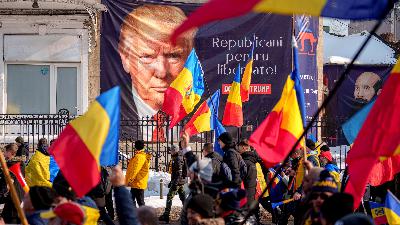
In a scenario that evokes memories of the period immediately following the end of the Cold War, a Central European nation is locked in a battle to fend off Russian influence while safeguarding its democracy. But this time around, there is a critical twist: As Romania strives to maintain the integrity of its representative government, one of the states seemingly working against it is the United States. This weekend, Romania's election authority, the Central Electoral Bureau, disqualified far-right populist candidate Calin Georgescu from participating in May's rerun of the presidential election, ruling that he had "violated the fundamental obligation to defend democracy." Georgescu won the first round of the election in November, but Romania's Constitutional Court later annulled the results after intelligence reports alleged that he had benefited from an aggressive Russian-sponsored propaganda campaign on the social media platform TikTok. Almost immediately after Sunday's announcement, Georgescu appealed the election authority's decision, calling it a "direct blow to the heart of democracy around the world." His supporters took to the streets of Bucharest in protest, attempting to storm the election authority's headquarters. The demonstration quickly descended into violence, leaving four police officers hospitalized. In just a few months, Georgescu has gone from being a political outsider unknown outside of Romania to being a key figurehead of the global far-right populist movement. His rise has been fueled by savvy online engagement: He has amassed over 700,000 followers on TikTok and 400,000 on Facebook since starting his campaign, allowing him to harness nationalist sentiment, exploit the legacy of Romania's fascist and antisemitic past, and use the ongoing war in Ukraine to push a protectionist agenda. Georgescu has accused the European Union and NATO of conspiring to block his path to office and has openly praised Romania's historical fascist leaders. His rhetoric has resonated with Romanians who are disillusioned with the country's political elite, while his social media presence has strengthened his appeal among younger voters. In the aftermath of his disqualification, some of Europe's leading far-right political figures quickly rallied behind Georgescu. Matteo Salvini, Italy's deputy prime minister and leader of the far-right Lega party, condemned the election authority's decision as a "soviet-style EU coup." But Georgescu's most vocal support has come from the United States. In the aftermath of Georgescu's disqualification, some of Europe's leading far-right political figures quickly rallied behind him. But his most vocal support has come from the United States. Among his key defenders is Elon Musk, the billionaire owner of the social media platform X, formerly Twitter, and a senior adviser to U.S. President Donald Trump. Taking to X, Musk questioned how a judge could "end democracy in Romania" following the election authority's decision. This was not the first time Musk intervened on Georgescu's behalf. In late February, Romanian prosecutors launched a criminal investigation into Georgescu, charging him with six offences, including campaign finance violations, support for fascist organizations - illegal in Romania - and fraudulent use of digital technologies. In response, Musk falsely claimed that "the person who won the most votes in the Romanian presidential election" had been arrested, misleading his millions of followers. U.S. Vice President JD Vance also took a hardline stance, telling the Republican party faithful at the Conservative Political Action Conference in February that Romania no longer shared the United States' values. "You don't have shared values if you cancel elections because you don't like the result," he declared, accusing the Romanian government of silencing its people. Vance staked out a similar position in early February at the Munich Security Conference, where he shocked those in attendance...
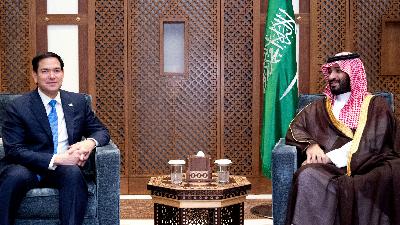
Saudi Arabia is in the middle of a diplomatic blitz. From hosting yesterday's talks between Washington and Kyiv over the war in Ukraine to positioning the kingdom as central to the "day after" plans for postwar Gaza and offering to help deconflict tensions between the U.S. and Iran, Riyadh appears to be everywhere. This "peace push" is tethered to the political agenda of Saudi Crown Prince Mohammed bin Salman, known as MBS - namely, his effort to rehabilitate his own image while positioning the kingdom at the forefront of Middle East geopolitics and casting Saudi Arabia as a constructive player on the international stage. At its core, this international push by Saudi Arabia is intimately linked to internal politics inside the kingdom, particularly MBS' efforts to preserve and expand his own power. MBS is spearheading a new hypernationalist project designed to restructure the country's domestic "ruling bargain" and transform Riyadh's global image. Almost every Saudi policy at home and abroad is a byproduct of this new project as well as MBS' ultimate imperatives of regime preservation and power projection. Critical to this effort is the restructuring of the Saudi economy toward a sustainable footing in anticipation of a future of declining oil revenues. MBS' ambitious economic plan, Vision 2030, is the economic foundation of his new nationalist project, aimed at establishing Saudi Arabia as the major economic hub of the Middle East and a lucrative market for international capital. For MBS, the success of this nationalist project is existential. It is the new autocratic foundation on which the crown prince - the kingdom's de facto ruler who has already amassed more power than any individual in the history of the Saudi state - hopes to base his authority. But the success of this domestic vision depends on more than just absolute control at home. It is intertwined with regional and international objectives, making it also the driver of Saudi foreign policy. At the regional level, MBS needs calm to focus on his domestic agenda. This is why he has shifted from an aggressive foreign policy, epitomized by the Saudi intervention in Yemen in 2015, toward an emphasis on de-escalation beginning roughly in 2020. In particular, Saudi Arabia has focused heavily on deconfliction with Iran, its chief regional adversary with which it had severed relations in 2016. In 2023, after a period of diplomatic engagement, Riyadh and Tehran reestablished formal relations. The two sides have continued to pursue their delicate détente since then. This should not be interpreted as a cessation of long-standing strategic competition between Saudi Arabia and Iran, but rather as opportunistic maneuvering by both parties, given the changing regional and international contexts as well as both sides' increased concern with pressing domestic issues. The success of Mohammed bin Salman's domestic vision is intertwined with regional and international objectives, making it also the driver of Saudi foreign policy. Recently, concern in Riyadh over the prospects of a region-wide conflict have grown considerably in the wake of the war in Gaza and rising tensions between Israel, Iran and the United States. Compounding these heightened tensions are concerns over Iran's nuclear program, with Tehran now closer to being able to manufacture a nuclear weapon than any point since its uranium enrichment program was discovered in the early 2000s. Fearful that a war between Israel, Iran and the U.S. would consume and destabilize the entire region, Riyadh is offering to mediate between Tehran and Washington, hoping that it can prevent such an outcome. MBS is also keen on asserting Saudi Arabia's central role in shaping the Middle East's geostrategic landscape. This has been particularly apparent over the past year and a half, after the war in Gaza brought the Israel-Palestine conflict back to the forefront of regional geopolitics. Before Hamas' attack against Israel on Oct. 7, 2023...
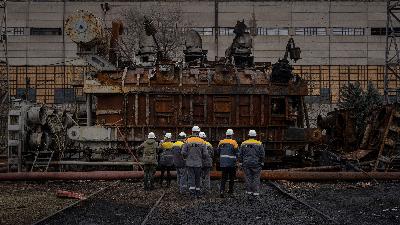
During the night of March 7, Russian forces carried out a concerted bombing campaign against Ukraine's energy facilities. The acts were widely condemned by the international community, including U.S. President Donald Trump, who wrote on social media that he was "strongly considering large scale sanctions" based on the attack and urged both parties to the negotiating table. At the same time, Kremlin spokesperson Dmitry Peskov stated that Ukraine's energy infrastructure is a legitimate target because it is "linked with Ukraine's military industrial complex and weapons production." Trump was right to call out Russia's attack and threaten sanctions, for several reasons. First, in diplomatic terms it created at least a slight veneer of even-handedness after his dressing down of Ukrainian President Volodymyr Zelenskyy at the White House last week, as well as his seeming alignment with Russian President Vladimir Putin in what is clearly a war of aggression in which Putin has committed the majority of war crimes. But second, international law demands calling out this particular conduct as worthy of reproach, because contrary to what Peskov claimed, a country's energy infrastructure does not become a legitimate military target just because it supports both civilian and military uses. International humanitarian law draws a clear distinction between civilian objects such as schools and hospitals, and military objectives that are meant to make an "effective contribution to military action." While the law is ambiguous in situations where a civilian object is being used in such a way as to make a direct military contribution to war, even then targeting of that object is subject to the principle of proportionality, by which harm to civilians must be weighed against military necessity. Moreover, targeting civilian objects for the purpose of terrorizing civilians is a war crime. While an argument could be made that attacks on energy infrastructure that result in power outages for a limited period of time are not comparable to collateral damage from kinetic attacks, this is clearly not the case during winter, when civilians are heavily dependent on that infrastructure for indoor heating. Moreover, such arguments generally don't take into account the knock-on effects of such strikes for the civilian population, such as the health implications of household refrigerators, municipal water sanitation systems and hospital medical equipment all losing access to power. In short, even if the language of humanitarian law makes occasional exceptions for military necessity that clearly outweighs the harm to civilians, such cases are rare. And those loopholes do not easily cover the kind of massive attacks on civilian infrastructure carried out by Russia, which would appear to instead be calculated to "spread terror among the civilian population." These rules were developed after World War II, when entire cities were burned to the ground based on the logic that they contained factories used to build munitions, thereby making them and all the civilians in them a military target. But as the postwar push to expand international humanitarian law recognized, if the fact that a civilian mobilization or infrastructure also supports a war effort transforms it into a target, the military-civilian distinction itself begins to break down. Rather, the International Committee of the Red Cross has postulated a more specific standard on the definition of "direct participation in hostilities" as applied to civilians, in which the burden of proof is on belligerents to prove beyond a doubt that any such instance meets that standard. When in doubt, under Article 52(3) of Additional Protocol 1 to the Geneva Convention, an object shall be assumed to be of a civilian character. The argument that "dual use" infrastructure constitutes a legitimate military target is often used as justification by states claiming the legal right to engage in such attacks. It's worth underscoring...
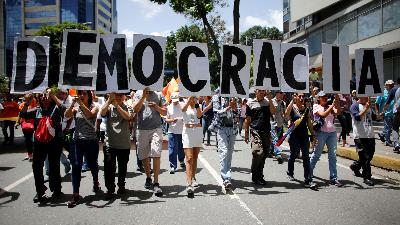
"Why are there never coup attempts inside the United States?" an old joke among left-wing activists in Latin America goes. "Because there is no U.S. embassy there." It's a reference to U.S. actions during the Cold War to undermine democratically elected governments across the region, including Guatemalan President Jacobo Arbenz in the 1950s and Chilean President Salvador Allende in the 1970s. Under the auspices of fighting communism, Washington backed right-wing military coups and dictatorships throughout the hemisphere. As late as the 1980s, Jeanne Kirkpatrick - a foreign policy adviser to then-President Ronald Reagan who later served as his ambassador to the United Nations - issued a defense of authoritarian regimes that she believed helped to protect their populations from even worse revolutionary ideologies. But the joke was outdated even before January 2021, when then-U.S. President Donald Trump tried to overturn the outcome of the 2020 presidential election. In fact, over recent decades, the view of the United States as a defender of authoritarianism, at least in Latin America, has become an anachronism. Eventually, Washington lent support to the Concertacion coalition that defeated then-dictator Augusto Pinochet at the polls and led to the reestablishment of democracy in Chile in 1990. And in 2001, the U.S. backed the Inter-American Democratic Charter, which clearly states in its opening that "[t]he peoples of the Americas have a right to democracy and their governments have an obligation to promote and defend it," while promising to remove nondemocratic governments from various hemispheric institutions. More recently, perhaps the top three achievements of former President Joe Biden's policies in Latin America all came in defense of democracy. His administration supported a democratic transition in Honduras in 2021 after Xiomara Castro defeated the ruling National Party's candidate in the country's presidential election that year. Washington then had outgoing President Juan Orlando Hernandez, who had stolen Honduras' 2017 presidential election, extradited on drug-trafficking charges so he could no longer interfere in domestic politics. A year later, Biden's team pressured Brazil's military leadership to stay clear of a coup attempt led by outgoing President Jair Bolsonaro after Luiz Inacio Lula da Silva won that country's presidential election in 2022. And the Biden team safeguarded an incredibly difficult presidential transition in Guatemala at the end of 2023 to ensure that President Bernardo Arevalo took office, overcoming the efforts of that country's corrupt elites to keep him from power. The U.S. record is far from perfect, and this column will no doubt provoke responses detailing the many wrongs Washington has committed in the region in recent years. But the U.S. really did shift toward a more pro-democracy stance in Latin America since the end of the Cold War. As part of that shift, the U.S. Agency for International Development, or USAID, funded numerous local NGOs that promoted human rights and anti-corruption efforts. The National Endowment for Democracy - a government-funded semi-autonomous organization - backed training for political parties and civil society that contributed to grassroots civic activism at the heart of democratic values, winning NED the hatred of authoritarian leaders who viewed those efforts as a violation of their sovereignty. Various other U.S. agencies also provide grants for research and think tank work that is critical to policy debates in the region. All those efforts go beyond the specific episodes, such as those by the Biden administration, when the U.S. government backed a democratic movement at a critical moment. They were cooked into U.S. policy in nearly every country. That is not to say that U.S. support is the only thing sustaining democracy in Latin America. Democracy can't be imposed from abroad. The biggest efforts come from the people of Latin America, who work to impr...


Download from Google Play

Download from App Store
 United States
good stuff, keep it up! also I feel like WPR could be better advertised!!