


 Claim Ownership
The M&A Source Podcast
Subscribed: 14Played: 140
Subscribe

© Copyright 2024 MASource Podcast
Description
If you work in the business of buying, growing, or selling businesses, this is the podcast for you!
Welcome to the M&A Source Podcast, a podcast brought to you by M&A Source, a non-profit professional organization that provides training and education for small to mid-size business mergers and acquisitions intermediaries. In each episode of the podcast, we will interview leaders in the M&A world to discuss education opportunities provided by M&A Source, trends in M&A Markets, and useful insights provided by the experts that use them.
Learn more about the podcast and the organization at M&A Source's website: www.masource.org.
LEGAL DISCLAIMER: This resource is intended for educational purposes only and does not constitute legal, financial, or tax advice. The information provided herein should not be relied upon for any specific business or financial decision without first consulting appropriate professional counsel. Readers are encouraged to seek advice from qualified attorneys, accountants, or other professionals to address their unique circumstances. Neither the authors nor the publisher assumes any responsibility for actions taken based on the information provided in this resource.
Welcome to the M&A Source Podcast, a podcast brought to you by M&A Source, a non-profit professional organization that provides training and education for small to mid-size business mergers and acquisitions intermediaries. In each episode of the podcast, we will interview leaders in the M&A world to discuss education opportunities provided by M&A Source, trends in M&A Markets, and useful insights provided by the experts that use them.
Learn more about the podcast and the organization at M&A Source's website: www.masource.org.
LEGAL DISCLAIMER: This resource is intended for educational purposes only and does not constitute legal, financial, or tax advice. The information provided herein should not be relied upon for any specific business or financial decision without first consulting appropriate professional counsel. Readers are encouraged to seek advice from qualified attorneys, accountants, or other professionals to address their unique circumstances. Neither the authors nor the publisher assumes any responsibility for actions taken based on the information provided in this resource.
32 Episodes
Reverse
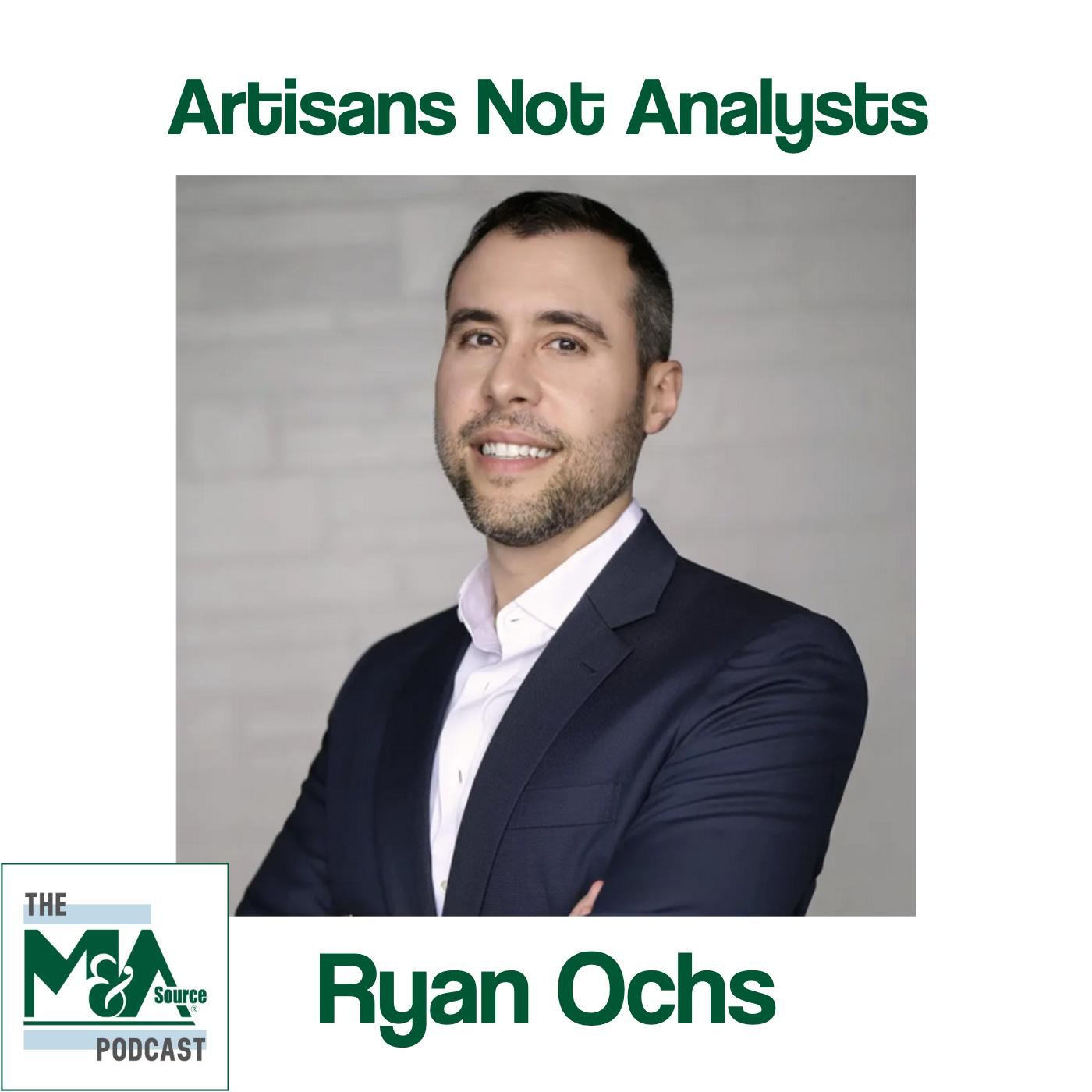
What does capital really look for when evaluating a deal?In this episode of the M&A Source Podcast, host David Dejewski sits down with Ryan Ochs, Founder and Managing Partner of RDP Advisory, to discuss how lenders and investors evaluate middle-market transactions. Drawing on nearly two decades of experience in investment banking, private credit, underwriting, and investment committee leadership, Ryan shares practical insights into capital raising, deal preparation, and the realities of modern M&A markets.From investment committee dynamics to family office capital, this conversation gives M&A advisors and founders a clearer understanding of what separates strong deal opportunities from those that fail to gain traction.SummaryRyan Ochs built his career evaluating risk and structuring capital across some of the most active credit and investment platforms in the middle market. After starting at RBC Capital Markets, he moved through roles at American Capital, Brightwood Capital, Star Mountain Advisors, and Lafayette Square, where he led underwriting and origination and served on the investment committee.Today, through RDP Advisory, Ryan helps companies raise capital and structure transactions across the capital stack.In this episode, Ryan explains why many businesses struggle to attract capital, how investment committees actually review opportunities, and why preparation and clarity matter more than ever in today’s disciplined market environment.He also discusses the growing role of family offices in private markets, how advisors can better position deals for investors, and why understanding the fundamentals of how a company makes money is still the most important part of the story.Along the way, Ryan shares real-world transaction stories—including deals that nearly collapsed at closing—and explains what strong advisors do differently to keep deals on track.Key TakeawaysInvestment committees look for clarity, not complexityDeals must clearly explain the fundamentals: how the business makes money, what it costs to generate revenue, and how the financial story ties together.Preparation matters before going to marketStrong transactions begin months before outreach, often with sell-side quality of earnings work, clean financial reporting, and a well-prepared narrative.Confusion creates doubt in investors’ mindsIf financials don’t reconcile or the story isn’t clear, investors begin questioning everything else in the deal.Family offices are becoming a major capital sourceMany family offices now invest directly in deals, offering flexibility and patient capital compared to traditional private equity funds.The capital stack offers many financing optionsFrom bank debt to private credit, mezzanine financing, structured equity, and common equity, each layer has different costs, risks, and investor expectations.Experience still matters in dealmakingRyan describes M&A as an apprenticeship business where repetition, mentorship, and pattern recognition are critical to developing strong advisors.About the GuestRyan Ochs is the Founder and Managing Partner of RDP Advisory, an independent investment and merchant bank focused on middle-market debt advisory, capital raising, and mergers and acquisitions.Before launching RDP Advisory, Ryan served as Managing Director at Lafayette Square, where he led underwriting and origination and served on the firm’s investment committee. He previously held senior roles at Brightwood Capital, Star Mountain Advisors, American Capital, and RBC Capital Markets.Across his career, Ryan has participated in transactions involving more than 100 companies and over $5 billion in capital raised or invested.Connect with Ryan OchsWebsite: https://rdpadvisory.comLinkedIn: Ryan Ochs https://www.linkedin.com/in/ryancochs/
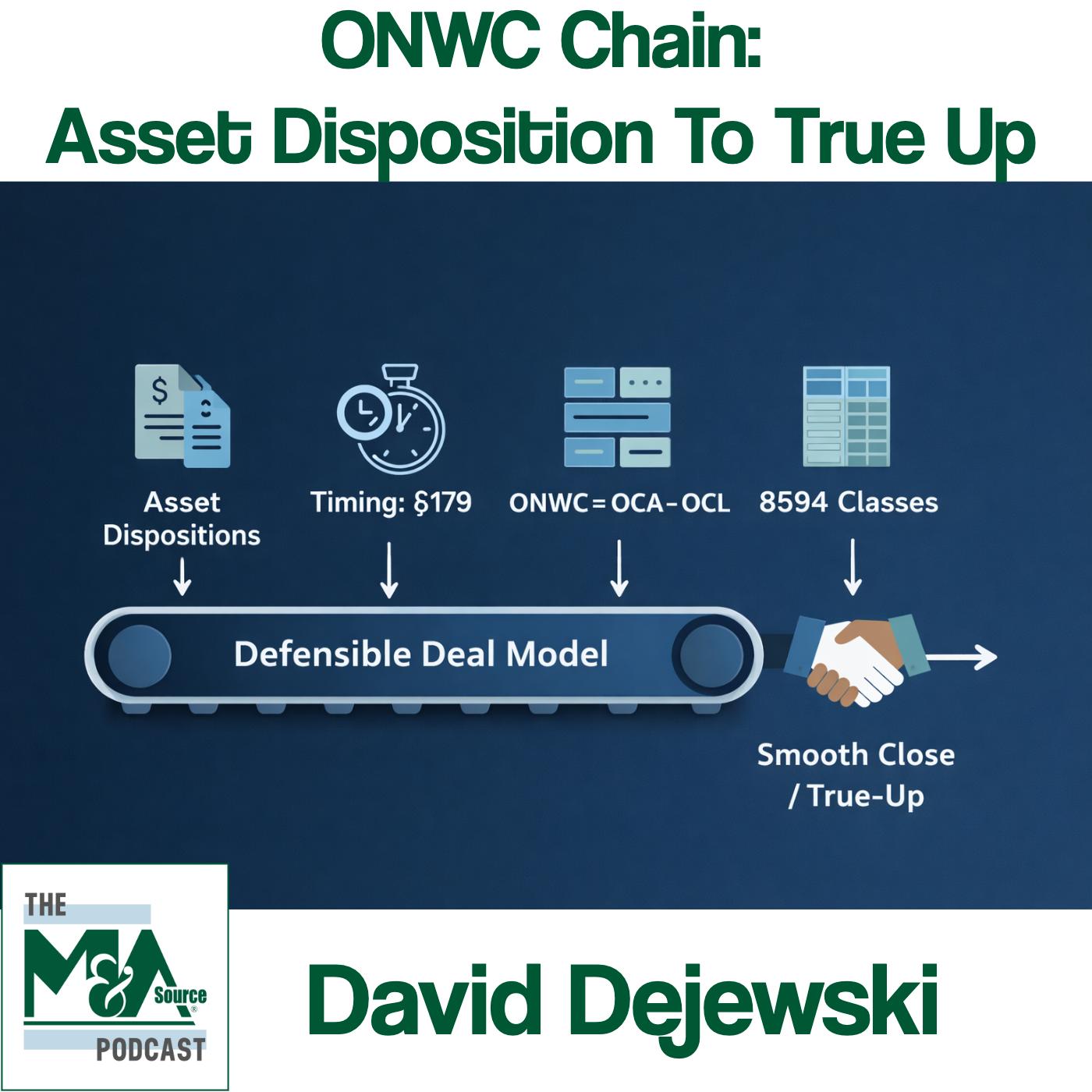
Connect with Us and Access Show Resources: https://snip.ly/mas_interact29In this episode, we connect asset dispositions (Form 4797), depreciation timing and Section 179 (Publication 946 / Form 4562 support), operating net working capital (process-first peg method + dollar-for-dollar true-up), and asset allocation reporting (Form 8594 residual method). We focus on building a defensible, repeatable approach that holds up in buyer diligence and reduces friction in LOI and purchase agreement drafting.Topics DiscussedIntroduction and Problem StatementThe episode opens by identifying a common pattern in M&A deals: parties argue about working capital adjustments and purchase price before agreeing on what the numbers actually mean. Simultaneously, seller earnings appear distorted due to equipment sales, asset write-offs, or Section 179 depreciation elections. This creates confusion among buyers, sellers, attorneys, CPAs, and brokers who talk past one another. The host promises a process-first methodology connecting four critical elements: IRS Form 4797 asset dispositions, depreciation choices like Section 179, operating working capital, and asset allocation reporting.Asset Dispositions and Form 4797When businesses sell or dispose of property, tax reporting flows through IRS Form 4797. The key concept is "recapture," where some or all disposition gains are treated as ordinary income depending on the asset type, depreciation method, and sale price. Part 3 of Form 4797 computes ordinary income recapture based on the difference between depreciated value and disposition value. The critical valuation takeaway: disposition gains and losses distort operating earnings. A one-time equipment sale may boost income in a non-repeatable way, while disposal losses can depress earnings despite healthy operations. Applying multiples to this "noise" leads to business mispricing.Classification Framework for DispositionsThe proper approach involves classification rather than panic. The key question: Is the business selling assets as a one-time event, or is it part of the operating model structure? Fleet-driven businesses (car rentals, delivery fleets) have planned asset turnover baked into their model—vehicles run for two years then sell on schedule. These dispositions aren't random income events but part of the business engine that will continue with the next buyer. For such cases, create a "steady state view" using averages: replacement cadence, typical proceeds, replacement capex, and recurring earnings impact. Use trailing twelve-month or seasonally adjusted numbers to model the asset cycle as normal operating pattern, normalizing to what buyers should expect going forward. This eliminates buyer skepticism by modeling rather than hand-waving.Section 179 and Depreciation ChoicesIRS Publication 946 outlines depreciation frameworks, including Section 179 elections allowing taxpayers to expense qualifying property immediately rather than depreciating over time—"rapid depreciation" with obvious tax advantages. For deal advisors, Section 179 changes timing: it can make P&L look worse when the business is healthy and investing, or make future years look artificially better because deductions were pulled forward. The solution: normalize with steady state thinking by smoothing out fluctuations to find what's normal. Ask: What level of capex and depreciation is required to keep this business operating as is? Separately address cash reality of replacements versus tax timing of deductions. When buyers claim earnings are low due to high depreciation, normalize to maintenance capex levels and steady state depreciation, applying multiples to maintainable performance, not tax timing.Operating Net Working Capital FoundationIn accounting, "current" means expected to be realized in cash, sold, consumed, or settled within a normal operating cycle (typically 12 months)—the backbone of current assets and current liabilities. The GAAP definition of working capital is current assets minus current liabilities, which is correct but insufficient for sales processes. The deal context requires identifying what's operating versus non-operating—what contributes to business performance in the current period versus what doesn't. The core formula: Operating Net Working Capital = Operating Current Assets - Operating Current Liabilities. The word "operating" is the critical addition.Process-First Method for Working CapitalThe most important move: before discussing numbers, change the conversation early and guide everyone to agree on definitions—specifically what's included and excluded. In Main Street and lower middle market deals, operating net working capital typically excludes cash, interest-bearing debt, owner and related party items, and non-operating one-time balances unless the deal specifies otherwise. The first win is definitional clarity—you cannot have a target peg without good definitions. The process-first method: tell parties you're not picking a peg number arbitrarily; you're agreeing to a method, documenting it, and using it both early on and during true-up at closing. The default method: Target Operating Net Working Capital = average of month-end operating net working capital over trailing 12 months, calculated using the same inclusion/exclusion rules used at closing. For seasonal businesses, use seasonal schedules rather than simple averages. The closing adjustment formula: Purchase Price Adjustment = Closing Operating Net Working Capital - Target Operating Net Working Capital, adjusted dollar-for-dollar with no debate. The sequence: definitions first, method second, numbers last.Allocation and Reporting AlignmentIn applicable asset acquisitions, Form 8594 instructions describe allocating consideration using the residual method—a waterfall assigning values to asset classes with residual being goodwill and going concern value. The key advisory takeaway isn't that brokers become tax preparers, but that operating net working capital definitions agreed upon by all parties must align with how the transaction is described, allocated, and reported later. State forms (like Maryland Form 21) should match what's reported to the IRS on Form 8594, consistent across all parties to avoid audit flags from mismatched reporting. If working capital is trued up after closing, it affects final purchase price consideration and may require consistent treatment across all party reporting going forward. The host distributes a one-page letter in every package to sellers and buyers explaining this, and creates a model 8594 based on the final true-up at closing, marked as sample, suggesting parties take the model and closing documents to their tax preparer the following year. Consistent process across all parties pegged to the last true-up reduces odds that deal economics and reporting story drift apart.Unified Framework SummaryThe complete framework: (1) Normalize earnings so multiples only apply to maintainable performance, eliminating one-time gains/losses and tax timing effects; (2) Classify dispositions properly as one-time versus structural asset cycles; (3) Interpret Section 179 as timing issue and normalize to steady state; (4) Define operating net working capital as operating only, agreeing on inclusions/exclusions; (5) Set peg by agreed historical method and use same model for dollar-for-dollar true-up at close; (6) Keep included asset story consistent with proper asset allocation reporting to IRS and state. This approach reduces friction, gains credibility with sophisticated buyers, and makes transactions easier for counsel and CPAs to document. A flowchart of the four-phase process is provided via link for adaptation to individual deals.Questions/AnswersNote: This is a monologue-style educational podcast with no explicit Q&A format. The host poses rhetorical questions and provides answers throughout. Key questions addressed:• Q: What's the fundamental mistake parties make in working capital disputes?A: Treating earnings normalization, working capital mechanics, and allocation reporting as separate conversations when they're all part of the same system that must tell the same story.• Q: Is the business selling assets as a one-time event or is it part of the operating model structure?A: This is the right classification question. One-time events get different treatment than structural, recurring asset cycles that are baked into the business model.• Q: What level of CAPEX and depreciation is required to keep this business operating as is?A: This is the normalizing question for Section 179 and depreciation issues, leading to separate conversations about cash reality of replacements versus tax timing of deductions.• Q: What is operating versus non-operating in the balance sheet?A: Operating items contribute to business performance in the current period; non-operating items do not. This distinction is critical for defining operating net working capital beyond the GAAP definition.• Q: How do you stop fighting over the peg number?A: Don't pick a number arbitrarily. Agree to a method, document it, and use the same method both for setting the initial peg and for the true-up at closing. Definitions first, method second, numbers last.5 Best Quotes• "Disposition gains and losses can distort operating earnings... If you apply a multiple to any of that noise, you're going to misprice the business."This quote captures the core valuation risk when asset dispositions aren't properly normalized.• "Before you start talking about numbers, change the conversation early. Guide everybody to agree on definitions. Specifically what's included, what's excluded."This establishes the foundational principle of the process-first methodology.• "We're not picking a peg number out of the air. We're agreeing to a method. We'll document that method... Does everybody agree that we can all work under the same set of rules?"This reframes working capital negotiations from adversarial number-fighting to col

Whether you’re a seasoned advisor or just making the leap from main street to the lower middle market, this episode highlights why M&A Source is the room to be in—and how you can make the most of every minute there.

In this episode, we talk about stock certificates, what they are, how they work, and how to reconstruct equity ownership history when a ledger doesn’t exist.

Analyzing the lease is a step no advisor should miss. In this episode, we talk about one method to analyze the lease and using the links in the show notes, we provide access to the lease analysis form.

Interact with the show: https://snip.ly/mas_interact25In this episode of the M&A Source podcast, Dave Dejewski continues a series on essential tax code provisions for mergers and acquisitions, discussing five additional provisions that can significantly impact tax outcomes for buyers, sellers, and their advisors.Topic DiscussedThe exchange is a podcast discussing 10 tax code provisions that are relevant for mergers and acquisitions (M&A) transactions. It is divided into two parts, with Part 1 covering the first 5 provisions and Part 2 covering the remaining 5 provisions.Part 2 covers the following tax code provisions:1. Section 368 - Tax-Free ReorganizationsThis provision allows for tax-deferred treatment of certain corporate reorganizations, such as mergers and acquisitions, to encourage business continuity, growth, and realignment without triggering immediate tax liabilities. It requires continuity of interest and continuity of business enterprise.2. Section 409A - Deferred CompensationThis provision establishes strict rules for when income can be deferred and when it must be paid, preventing abuse and ensuring fairness in the tax system. It imposes penalties for non-compliance and encourages proper planning and transparency in deferred compensation plans.3. Section 1031 - Like-Kind ExchangesThis provision allows for the deferral of capital gains taxes when exchanging real properties for similar properties, stimulating growth in real estate-heavy businesses.4. Section 721 - Contributions to PartnershipsThis provision promotes the creation and growth of partnerships by allowing individuals or entities to contribute property to a partnership without triggering immediate tax consequences, facilitating partnership formation and encouraging joint ventures and investments.5. Section 453 and 453A - Installment SalesSection 453 allows sellers to report capital gains income over time through the installment sale method, aligning tax payments with the receipt of sale proceeds and providing tax deferral. Section 453A imposes an interest charge on large installment sales over $5 million to limit the tax benefits of deferring large amounts of tax.Key TakeawaysThese final five of ten tax provisions cover a wide range of areas, including tax-free reorganizations, deferred compensation, like-kind exchanges, partnership contributions, and installment sales.The episode highlights the importance of understanding these provisions and leveraging them to minimize tax liabilities, encourage business continuity, and facilitate growth and realignment. It also emphasizes the need for proper planning, transparency, and compliance to avoid penalties and ensure that the intended tax benefits are realized.Overall, this episode provides valuable insights into the tax considerations and strategies that should be taken into account when structuring M&A deals, making it a valuable resource for advisors, business owners, and investors involved in such transactions.LEGAL DISCLAIMER: This resource is intended for educational purposes only and does not constitute legal, financial, or tax advice. The information provided herein should not be relied upon for any specific business or financial decision without first consulting appropriate professional counsel. Readers are encouraged to seek advice from qualified attorneys, accountants, or other professionals to address their unique circumstances. Neither the authors nor the publisher assumes any responsibility for actions taken based on the information provided in this resource.

Interact with the show: https://snip.ly/mas_interact24The episode discusses 10 key tax code provisions relevant to mergers and acquisitions (M&A) transactions. It is divided into multiple parts, with Part 1 covering the following provisions:1. Section 338 - Election for Treating Stock Purchases as Asset PurchasesThis provision allows buyers to treat a stock purchase as if they are purchasing the underlying assets of the business, enabling them to step up the basis of the acquired assets to their fair market value for tax purposes.2. Section 1202 - Qualified Small Business Stock ExclusionsThis provision allows investors to exclude capital gains taxes on the sale of stock in qualified small businesses, subject to certain eligibility criteria.3. Section 197 - Amortization of Goodwill and IntangiblesThis provision provides uniform rules for the amortization of intangible assets, such as goodwill, franchise rights, patents, and trademarks, over a 15-year period.4. Section 280G - Golden Parachute PaymentsThis provision addresses excessive compensation packages (golden parachutes) paid to executives and key employees during a change of control event, such as a merger or acquisition.5. Section 382 - Limitation on Net Operating LossesThis provision limits the amount of net operating losses that a company can use after an ownership change to prevent companies from acquiring loss corporations solely for tax benefits.5 Best Quotes1. "Section 338 allows buyers to treat a stock purchase as if they're purchasing the underlying assets of the business. And that means for tax purposes, the buyer can step up the basis of the acquired assets to their fair market value as opposed to the book value, which can result in greater depreciation, amortization deductions over time."2. "Section 1202 is a powerful tool for investors and business owners who want to maximize their returns by excluding capital gains taxes on the sale of stock in small businesses."3. "Section 197 was introduced to basically provide some uniform rules around amortization of intangible assets intangible assets, what are they it's goodwill, it's franchise rights, it's patents, it's trademarks."4. "Section 280G of the US tax code was created to address this golden parachute concept. Golden parachute are these large compensation packages there's severance payments that are paid to executives and they're paid out to key employees when there's a change of control event so a merger or an acquisition is considered a change of control event."5. "Section 382, it curbs this practice by limiting the amount of net operating losses that a company can use after the acquisition and that's based on the company's value at the time of the ownership change and this prevents companies from using net operating losses as a tax sheltering tool."Lessons LearnedThis episode provides a high level overview of several key tax code provisions that can significantly impact the structuring and tax implications of M&A transactions. It highlights the importance of understanding these provisions and working closely with legal and financial advisors to ensure that deals are structured efficiently and in compliance with tax regulations. The detailed explanations, examples, and practical considerations offered in the show are valuable for M&A advisors, business owners, and investors involved in buying or selling businesses.LEGAL DISCLAIMER: This resource is intended for educational purposes only and does not constitute legal, financial, or tax advice. The information provided herein should not be relied upon for any specific business or financial decision without first consulting appropriate professional counsel. Readers are encouraged to seek advice from qualified attorneys, accountants, or other professionals to address their unique circumstances. Neither the authors nor the publisher assumes any responsibility for actions taken based on the information provided in this resource.

The M&A Source fall conference is a premier event for M&A professionals, focusing on larger deals in the lower mid-market. Hosted by Dave Dejewski, this podcast episode features an in-depth interview with Kathlene Thiel, the conference committee chair, who provides a comprehensive overview of the event. The conference aims to offer a balanced mix of learning, networking, and deal-making opportunities, with a focus on educational sessions, expert panels, and a deal market.
Kathlene shares insights into the agenda, which includes keynotes by Dr. Tom Deans, sessions on due diligence, deal sourcing, and professional ethics, and the evolving content tailored to investor buyers and larger deals. Networking is highlighted as the conference's most significant benefit, allowing attendees to connect with private equity groups and industry veterans. Although sessions won't be recorded, attendees will receive presentation materials.
Listeners also get practical tips on maximizing the conference experience, including bringing deal teasers and engaging with M&A Source committees for ongoing involvement. This episode emphasizes the conference as a valuable platform for professional growth and relationship-building within the M&A community.

Links:Visit the Show: https://podcast.masource.org Become a member or register for a class or event: https://masource.orgSummary of this EpisodeIntroduction to US GAAP and its importance for companies expanding into the US marketKey differences between US GAAP, UK GAAP, and IFRSThe process of converting from UK GAAP to US GAAPCompliance requirements and auditing considerations for US GAAPPreparing for fundraising rounds with US investorsChallenges and common issues faced during the conversion processStrategies for effective knowledge transfer and ongoing US GAAP supportTopic DiscussedIntroduction to US GAAP and its importance for companies expanding into the US marketThe discussion began with an introduction to US GAAP (Generally Accepted Accounting Principles) and its significance for companies looking to expand into the US market. Katrina Nachi, a cross-border accounting advisor, highlighted that companies often face challenges when entering the US market due to differences in accounting standards and regulations. Understanding and complying with US GAAP is crucial for companies seeking US investors, acquiring US companies, or planning an IPO in the US.Key differences between US GAAP, UK GAAP, and IFRSKatrina explained the key differences between US GAAP, UK GAAP, and IFRS (International Financial Reporting Standards). While IFRS and US GAAP are becoming more aligned, there are still nuances, particularly in areas such as revenue recognition, capitalization of costs, and share-based compensation. UK GAAP, on the other hand, has more significant differences from US GAAP, especially in terms of what can be capitalized.The process of converting from UK GAAP to US GAAPKatrina outlined a three-phase process for converting from UK GAAP to US GAAP:1. Qualitative assessment: Identifying differences in accounting policies and creating a matrix comparing current policies under UK GAAP with suggested US GAAP policies.2. Quantitative assessment: Adjusting calculations and schedules to reflect US GAAP requirements and quantifying conversion adjustments.3. Financial statement preparation: Preparing financial statements and footnote disclosures under US GAAP, incorporating conversion adjustments.Compliance requirements and auditing considerations for US GAAPThe discussion covered the additional compliance requirements and auditing considerations when adopting US GAAP. Companies may need to undergo a US GAAP audit, which typically involves a lower materiality threshold and more thorough walkthroughs and control testing. The timing of audits and potential overlap with local audits were also discussed.Preparing for fundraising rounds with US investorsKatrina emphasized the importance of being proactive in preparing for fundraising rounds with US investors. Presenting a qualitative assessment of US GAAP differences and potential conversion adjustments can demonstrate an understanding of the requirements and facilitate due diligence processes. This can potentially broaden the range of investors available to the company.Challenges and common issues faced during the conversion processSeveral challenges and common issues were discussed, including:- Lack of documentation and messy calculations under current GAAP, making the conversion process more difficult.- Determining the appropriate retrospective period for conversion, which may depend on the intended use of the financial statements.- Ensuring knowledge transfer and ongoing support for the local finance team to maintain US GAAP reporting after the conversion.Strategies for effective knowledge transfer and ongoing US GAAP supportKatrina highlighted the importance of effective knowledge transfer and ongoing support for the local finance team. She suggested exploring options such as working with a fractional Chief Accounting Officer or leveraging external advisors for specific transactions or new accounting standards. This approach can provide access to US GAAP expertise while enabling the local team to maintain day-to-day reporting.ActionsFor companies considering US expansion or fundraising with US investors:Document current accounting policies and procedures under local GAAP. Responsible: Finance Team, OngoingAssess the qualitative differences between local GAAP and US GAAP. Responsible: Katrina Nachi or other US GAAP advisor, Prior to fundraising/expansionEngage with auditors to align on the conversion process and required documentation. Responsible: Finance Team, Prior to conversionFor companies undergoing a US GAAP conversion:Develop a detailed conversion plan, including quantitative assessments and financial statement preparation. Responsible: Katrina Nachi or other US GAAP advisor, Prior to conversionEnsure knowledge transfer and training for the local finance team on US GAAP reporting. Responsible: Katrina Nachi or other US GAAP advisor, During and after conversionExplore options for ongoing US GAAP support, such as a fractional Chief Accounting Officer. Responsible: Finance Team, After conversionFor companies operating in regulated industries (e.g., fintech):Consult with legal advisors to understand specific US GAAP requirements and regulations. Responsible: Finance Team and Legal Counsel, Prior to US expansionAssess the need for US GAAP reporting from day one of US operations. Responsible: Finance Team and Katrina Nachi or other US GAAP advisor, Prior to US expansionInsightsProblem: Lack of understanding and documentation of current accounting policies under local GAAP, making the conversion process more challenging.Solution: Proactively document and maintain clear accounting policies and procedures under local GAAP. This will facilitate the conversion process and enable effective knowledge transfer to the US GAAP advisor.Problem: Limited budgets for engaging large accounting firms to handle the US GAAP conversion, leading to potential knowledge gaps within the local finance team.Solution: Explore alternative engagement models with US GAAP advisors, such as working collaboratively on specific phases of the conversion process or leveraging fractional Chief Accounting Officer services. This can provide access to expertise while enabling knowledge transfer and cost savings.Problem: Difficulty finding local finance professionals with strong US GAAP expertise, particularly in Europe.Solution: Maintain a strong local finance team with expertise in local GAAP and leverage external US GAAP advisors for specific transactions, new accounting standards, or ongoing support. This hybrid approach combines local knowledge with specialized US GAAP expertise.Problem: Potential overlap or conflicts between local audits and US GAAP audits, leading to inefficiencies and duplication of efforts.Solution: Engage with auditors early to align timelines and coordinate the local and US GAAP audit processes. Explore opportunities for auditors to leverage work already performed during the local audit to streamline the US GAAP audit process.ResourcesFind Katrina’s US Accounting & Reporting Guidebuilt for European finance teams: https://www.theinternationalaccountant.com/

Interact with the show: https://snip.ly/mas_interact21Share your origin storyIn this episode of the M&A Source podcast, Dave Dejewski dives deep into essential business performance metrics that significantly impact business valuation and success. Dave discusses key metrics such as EBITDA, employee activity ratios, and cash flow ratios, providing insights into their importance and how to leverage them for better client guidance. He shares practical examples from client experiences and offers a comprehensive worksheet of various metrics for M&A professionals.The episode discusses the importance of understanding and analyzing key business performance metrics in the M&A process, emphasizing on metrics like sales per employee, employee turnover rate, and operating cash flow, and offers a comprehensive worksheet with various valuation ratios and metrics to better guide clients and position oneself as an expert.David emphasizes the value of presenting oneself as an expert by having in-depth knowledge of these metrics and being able to have meaningful conversations with sellers and buyers. By analyzing these metrics, M&A advisors can drive improvements, increase the value of the businesses they represent, and remove friction from the transaction process.The offer of a worksheet with 56 different valuation ratios, sector-specific ratios, profitability ratios, operational metrics, and more is a valuable resource for M&A professionals to incorporate into their practice and better serve our clients.

Visit us at https://podcast.masource.orgIn this episode, Shelia Darby, Managing Director of Bizworth, discusses the importance of accurate business valuations in M&A transactions, the different valuation methodologies, challenges in valuations, best practices and ethical considerations, and the value of partnering with valuation professionals.Resources Discussed in this EpisodeAswath Damodaran resources on valuation and corporate finance: https://pages.stern.nyu.edu/~adamodar/Business Reference Guide: https://businessreferenceguide.com/Vertical IQ: https://verticaliq.com/Deal Stats: https://www.bvresources.com/products/dealstatsBiz Comps: https://bizcomps.com/ValueSource: https://www.valusource.com/Peer Comps: https://peercomps.gvalue.com/Pitchbook: https://pitchbook.com/Brokerage Simplification Act Info: https://masource.org/resources/legal-updates/Topic DiscussedStructure and SummaryThis episode features an interview with Shelia Darby, Managing Director of Bizworth, who has over 25 years of experience in business valuations. The discussion covers the following key sections:Introduction and Background Shelia shares her background, starting in the corporate world at companies like Enron and transitioning to the middle market and Main Street valuations. She discusses her certifications and the importance of continuous learning.Importance of Accurate Business ValuationsShelia explains why accurate business valuations are critical for both buyers and sellers in M&A transactions, helping to close more deals and avoid leaving money on the table.Valuation MethodologiesThe three main valuation approaches are discussed: asset approach, market approach, and income approach. Shelia dives into the details of each approach, common methods used, and when to apply them.Special Circumstances and ChallengesVarious special circumstances and challenges in business valuations are explored, including non-operating assets, intangible assets, regulatory impacts, distressed businesses, and rapid growth or volatile businesses.Best Practices and Ethical ConsiderationsShelia shares best practices for valuations, emphasizing transparency, honesty, and using reputable sources. She also discusses ethical considerations, drawing from her experience on the Ethics Oversight Board of NACVA.About BizworthShelia provides information about her company, Bizworth, and the valuation services they offer to support M&A advisors and business brokers.Questions/AnswersThroughout the interview, several questions were asked and answered:Q: How did you get into the business of valuations, and what drew you to it as a career?A: Shelia started in the corporate world at companies like Enron, working in valuation groups. She transitioned to Main Street and middle market valuations in 2014, finding it more appealing.Q: Why is an accurate business valuation critical for both the seller and the buyer in the M&A process?A: Accurate valuations help close more deals, avoid leaving money on the table, and identify gaps early on.Q: What are the different valuation methodologies, and what should M&A advisors consider when looking at them?A: The three main approaches are asset, market, and income. Sheila explains each approach, common methods, and when to use them.Q: What are some common challenges you come across when valuing businesses, particularly in the small and medium enterprise area?A: Common challenges include non-operating assets, intangible assets, regulatory impacts, distressed businesses, and rapid growth or volatile businesses.Q: What are your thoughts on best practices and ethical considerations in valuations?A: Best practices include transparency, honesty, and using reputable sources. Ethical considerations involve operating with integrity, avoiding conflicts of interest, and staying in your lane.5 Best QuotesValuable QuotesHere are five valuable quotes from the interview:"If you don't get a proper accurate valuation, you're leaving money on the table. First of all, you're not closing as many deals as you can, right you're not identifying as early on as possible if there's gaps."Shelia Darby, on the importance of accurate valuations"Honesty is the best policy. Transparency is crucial. It doesn't matter if you're an M&A advisor, an attorney supporting an M&A advisor, CPA, or evaluation professional honesty is the best policy transparency.”Shelia Darby, on best practices"Make sure you're not making things up you're not feeling your way through everything it's one thing to have an intuitive gut. We all want to listen to our gut, but back it up with facts."Shelia Darby, on best practices"If you're going to spend a lifetime building up your reputation, don't lose it in 5 minutes that's that's the standard there, that you're going to have a long plus, very plus, you know, very you have lots of prosperity in your field if you just abide by those."Shelia Darby, on maintaining a good reputation"It's OK to say you have a valuation professional supporting you. You don't have to be your clients valuation professional and CPA and attorney stay in your lane and be the best conductor to get their business sold."Shelia Darby, on the role of an M&A advisorTips LearnedLessons Learned and TakeawaysThis interview with Shelia Darby provided valuable insights and lessons on business valuations, including:The importance of accurate valuations in closing more deals and avoiding leaving money on the table.Understanding the different valuation approaches (asset, market, income) and when to use them.Recognizing special circumstances and challenges in valuations, such as non-operating assets, intangible assets, regulatory impacts, distressed businesses, and rapid growth/volatility.Best practices for valuations, including transparency, honesty, and using reputable sources.Ethical considerations, such as operating with integrity, avoiding conflicts of interest, and staying in your lane as an M&A advisor.The value of partnering with valuation professionals and experts when dealing with complex situations.In summary, this interview highlights the complexity and nuances involved in business valuations, emphasizing the need for M&A advisors to have a solid understanding of valuation principles while also recognizing the importance of collaborating with valuation experts to ensure accurate and defensible valuations.

In this enlightening episode of the M&A Source Podcast, we dive deep into the world of taxes, a topic often deemed tedious but undeniably crucial within the mergers and acquisitions sector. Our distinguished guest, Roman Basi, an attorney, CPA, and multifaceted professional, unveils the intricate dance between tax legislation and M&A activities. With expertise spanning several states and a multitude of professional licenses, Roman brings a wealth of knowledge and practical insights to our listeners.
From the significant implications of capital gains tax adjustments and corporate tax changes to the nuances of depreciation, amortization rule changes, and international tax policies, this episode covers the vast landscape of tax considerations that M&A advisors and business owners must navigate. Roman's unique blend of legal, financial, and real estate expertise, combined with personal anecdotes and a passion for education, makes for an engaging discussion that not only enlightens but also empowers our audience with actionable knowledge.
Join us as we explore the critical impact of taxes on the outcome of M&A transactions, learn from Roman's vast experience in the field, and discover how to leverage tax strategies for successful business deals. Whether you're an M&A professional, business owner, or simply intrigued by the complexities of tax laws, this episode is packed with valuable insights and stories that illuminate the often-overlooked aspects of taxes in the business world.

Visit the show notes at https://podcast.masource.orgVisit M&A Source at https://masource.orgIn today's episode of the M&A Source Podcast, we discuss the myriad benefits that M&A Source offers to its members with Russell Cohen, an M&A advisor and board member for M&A Source. Russel is also the chairman for the membership benefits committee.Russell and David cover a wide range of topics, from exclusive discounts on essential services like insurance and data room solutions to access to valuable tools that are crucial for any successful M&A advisor. Russell shares his personal experiences and success stories, highlighting how these benefits have positively impacted his professional journey.We also touch on the importance of the M and A Source community in fostering connections and sharing knowledge within the M&A world.Whether you're an experienced advisor or just starting, this episode is a treasure trove of information on how being a part of M&A Source can elevate your practice in the competitive world of mergers and acquisitions.Resources Mentioned in the Show:Membership Benefits: https://masource.org/membership/benefits/Vertical IQ: https://verticaliq.com/ (regularly $100 / mo or $125 per report - Free to members)Private Equity Info: https://privateequityinfo.com/VaultRooms (data rooms): https://vaultrooms.com/ (free with membership)DealRelations (CRM): https://dealrelations.com/ (member discount)Digital Wow (Web, Social Media, etc): https://www.thedigitalwow.com/masourceValueCraftz: http://www.valuecraftz.com/ (member discount)ClientsIO (email lead generation): https://clientsio.com/ (two months free)Sourcescrub (private company research): https://www.sourcescrub.com/ (50% off)
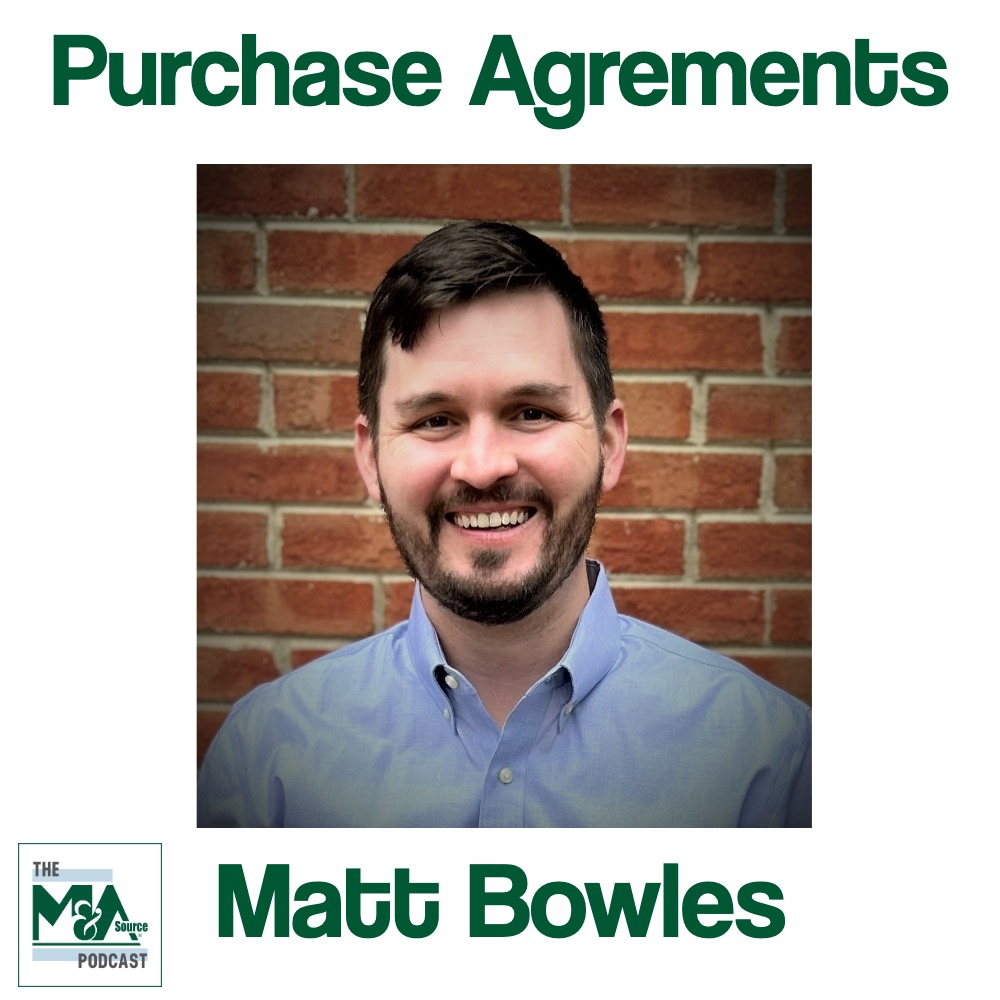
Welcome to our latest episode of the M&A Source Podcast. In this episode, we dive deep into the world of Purchase Agreements with our esteemed guest, Matt Bowles, an attorney at Hogan Lovells. Here's what you'll discover in this insightful discussion:Introduction to Purchase Agreements: We start by exploring why purchase agreements are more than just documents. They are crucial tools in M&A transactions, impacting everything from payment to maintaining tranquility in post-deal activities.Expert Insight: Matt Bowles brings his extensive experience with purchase agreements to the table, offering in-depth knowledge for both beginners and veterans in the M&A space.Anatomy of a Purchase Agreement: Delve into the structure of purchase agreements. We discuss key components such as economic terms, representations, warranties, covenants, and closing conditions.Real-World Applications: Listen to real-world scenarios from Matt's experience, demonstrating the practical application and importance of purchase agreements in various M&A situations.Role of Intermediaries and Attorneys: Understand the crucial roles that intermediaries and attorneys play in the M&A process, particularly in relation to purchase agreements.M&A Stories: Matt shares stories from his career, illustrating both successful and challenging M&A deals, and how purchase agreements played a role in these.Educational Focus: Whether you're new to M&A or a seasoned professional, this episode provides valuable insights into the complex world of purchase agreements.Final Takeaways: We wrap up with key learnings and advice for M&A professionals, emphasizing the importance of understanding and effectively utilizing purchase agreements.Join us in this enlightening conversation and enhance your understanding of the critical role of purchase agreements in M&A transactions. Whether you're a business owner, intermediary, or legal professional, this episode offers valuable insights for all.Additional Resources:Matt Bowles' LinkedIn ProfileHogan Lovells WebsiteM&A Source Website for Further Learning and Networking OpportunitiesConnect with Us:Visit our Website: https://masource.orgFollow us on LinkedIn/Twitter/FacebookSubscribe to our podcast for more insightful episodesDon't forget to leave us a review if you found this episode valuable!

In this episode of the M&A Source Podcast, host Dave Dejewski is joined by Ryan Hurst, an expert in financial consulting, to discuss the complexities and significance of working capital in mergers and acquisitions.Key Highlights:Ryan Hurst's Background: Ryan shares his journey from growing up in a family-owned business to his current role in financial consulting, focusing on helping business owners broaden their perspectives on their companies' potential.Understanding Working Capital: The episode delves into the multifaceted nature of working capital in M&A transactions. Ryan explains the varying interpretations across different sectors like accounting, valuation, and transaction advisory.Real-World Scenarios: Ryan provides three compelling case studies, each highlighting different aspects and challenges of working capital in M&A: A Complex Transaction: A $60-70 million deal with inventory and project completion issues. A Typical Scenario: A $30-40 million consumer products deal illustrating common working capital challenges. An Ideal Transaction: A smooth $50-60 million construction-oriented company sale, demonstrating the benefits of thorough preparation and clear communication.Advice for M&A Intermediaries: The importance of early preparation, understanding working capital, building trust, and staying informed about industry trends is emphasized.Connecting with Ryan Hurst: Listeners interested in Ryan’s expertise can reach him through RKL’s website, LinkedIn, or his email. See his bio and contact info here. ---*This podcast is brought to you by M&A Source, a nonprofit organization dedicated to the professional development of mergers and acquisitions intermediaries. For more information, visit [M&A Source](www.masource.org).*

Scott Mashuda, a founding Partner of River’s Edge Alliance Group and M&A Source’s Chairman-elect, discusses his background and what he’s excited about for M&A Source in 2023.

Lamar Stanley of Lead Capital Partners chats with John Wahl of Live Oak Bank about what makes Live Oak different and how they structure lower middle market deals. In the interview they discuss the history of Live Oak, and John’s work in SBA lending, combination financing, and many other structures.

Rick Marchese, the founder of Lares Loreno Private Capital, a corporate finance firm based in Singapore, discusses the course that he taught at M&A Source\'s virtual Fall Conference: Sell-side Modeling

John Howe, director of Business Transition Strategies, a mergers and acquisitions firm, discusses the course that he taught during the M&A Source Fall Conference in San Antonio, Building a Sustainable M&A Practice

Mont Walker talks with Lamar Stanley about corporate tax returns and hidden key points for M&A Advisory firms.

Comments

Download from Google Play

Download from App Store
 United States