


 Claim Ownership
TLDR: The B2B SaaS Growth Podcast Recording
Subscribed: 1Played: 64
Subscribe

© Marketing SG
Description
The B2B SaaS growth podacast by Spear Growth (https://speargrowth.com/).
This is not a marketing strategy, story, or inspirational podcast series.
This is a to-the-point, grab-and-go podcast aimed at marketers with intermediate skills(not beginners) to find direct and actionable solutions to problems they are facing or experiments they are looking to do.
Hosted on Ausha. See ausha.co/privacy-policy for more information.
This is not a marketing strategy, story, or inspirational podcast series.
This is a to-the-point, grab-and-go podcast aimed at marketers with intermediate skills(not beginners) to find direct and actionable solutions to problems they are facing or experiments they are looking to do.
Hosted on Ausha. See ausha.co/privacy-policy for more information.
49 Episodes
Reverse
Most B2B marketers treat events like a channel.Book a venue. Get people in. Hope something comes out of it.And that's also why they fail.In this episode of TLDR, I spoke with Taryn Talley (30+ events, $2.4M in revenue over 4 years).Her approach is completely different.She doesn't start with pipeline targets or event logistics.She starts with: "Who do we actually want to build relationships with?"Then she builds a system around deepening those relationships.B2B deals need 7-12 touches to close. Events are just high-value touches in that sequence.Her biggest deals came from people who attended 3+ different events over time.Not one big event. A deliberate sequence of events.Here's how the system works:Build a network, not an invite list: Start with 100-1,000 core relationships. Track them in a spreadsheet. Document engagement history, pain points, last meaningful touch. Goal: grow this network 20% annually.Vary the format: Mix intimate dinners (20 people), networking events (150 people), multi-day experiences (30-40 people). Don't hit the same people with the same format twice.The real work happens after: Track every conversation. Document pain points shared. Schedule follow-ups: lunches, sports events, smaller dinners. Tag everyone in CRM. Track multi-touch progression.Her 2023 Growth Marketing Summit: 3 days in Park City, 30-40 executives, cost ~$80K.Result? The WhatsApp group stayed active for 12 months. Attendees invested in each other's companies. Multiple deals closed.Here’s the shift:Most marketers optimize event logistics (venues, catering, attendance, swag bags).Taryn optimizes relationship infrastructure (network growth, touch sequences, conversion tracking).That's the difference between treating events as a channel vs. treating them as systematic relationship building.This is operator-level thinking you can't learn from playbooks.If you're still running campaigns without direct customer context, you're just guessing.Hosted on Ausha. See ausha.co/privacy-policy for more information.
Most SaaS companies guess their pricing. Because they're operating from a secondhand context.Competitor research. Pricing surveys. "Best practices."None of that tells you what'll work for YOUR product.And that's exactly how we had priced Chosenly.No framework. No model. Just gut feel on what would work.Turns out… that's not unusual.In this episode of TLDR, I spoke with Dan Layfield from Diligent about how real SaaS companies actually figure out pricing.Codecademy scaled from $10M → $50M ARR and eventually exited for $525M.And according to Dan, one of their biggest unlocks came from something most SaaS companies barely think about:How they price annual plans.Most companies do this: Monthly: $10 Annual: $96 or $120 (10–20% discount)Because… that's what everyone else does.But Dan shared a much smarter approach.Price your annual plan based on monthly retention.Example: If your product costs $10/month and users stay 4 months on average…Most companies make $40 LTV.Instead, price the annual plan around 6 months of value ($60).That pulls more users into annual.What happens next:You collect more cash upfrontPayment churn dropsUsers commit longerMany renew annuallyCodecademy saw LTV jump from roughly $40 → $90 using this logic.Dan also breaks down:Why pricing should be tested every ~6 monthsWhy willingness-to-pay surveys are only 60% accurateHow freemium models actually convert (and when they fail)The simple A/B testing setup used to test pricingIf you run a SaaS product, this episode will probably make you rethink your pricing page.It definitely made me rethink ours.Hosted on Ausha. See ausha.co/privacy-policy for more information.
Cold email isn’t dying. Lazy marketing is.In this episode of TLDR, I spoke with James Milsom, Head of Marketing at Hunter.io, about what’s actually working in cold outreach right now.Here’s some uncomfortable truths:😟 Campaigns sent to 1,000+ recipients average ~2% reply rates😟 71% of decision-makers ignore emails because they’re irrelevant😟 Open rates and click rates? Mostly noise. Replies are what matterThe problem really isn’t the channel.Marketing is changing and lazy volume-first tactics are getting taxed.It’s that most teams are still optimizing for volume - more contacts, more sends, more automation, instead of better segmentation, better offers, better sequencing.James breaks down:➡️ Why cold email should run 3-4 week structured experiments ➡️ How to A/B test offers, not just subject lines ➡️ Why layering LinkedIn with email nearly doubles effectiveness ➡️ Why email verification is an important step (but most teams skip this)At this point, you can’t just blast your TAM and hope 2020 tactics still work.Buyers are smarter. Inboxes are harsher. Attention is expensive.So you can either tighten your targeting, or accept 2% reply rates.Hosted on Ausha. See ausha.co/privacy-policy for more information.
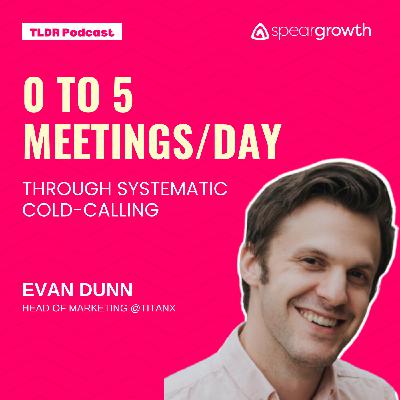
Most marketers still treat cold calling like it’s not their job.And that’s a problem that needs to be fixed.In this episode of TLDR, Evan Dunn shares how he took an outbound program from 0 to 5 meetings/day - not by just hiring more SDRs, but by applying demand gen-level experimentation to outbound.Why does this matter for marketers?Because the fastest path to offer clarity isn’t waiting on demo form fills.It’s picking up the phone & talking to real buyers.Evan breaks down:How he used cold calls to find PMF gaps and rebuild positioningWhy outbound conversations beat other tools for finding your real competitorsHow he rewired a marketing org to own outbound (without losing attribution)The cold call stack + strategy that was used“Founder-led sales works not because founders are great sellers, but because they’re closest to the feedback loop. Marketers need to get that close again.”If you’re a marketer struggling to differentiate, this episode is a must-listen.Hosted on Ausha. See ausha.co/privacy-policy for more information.
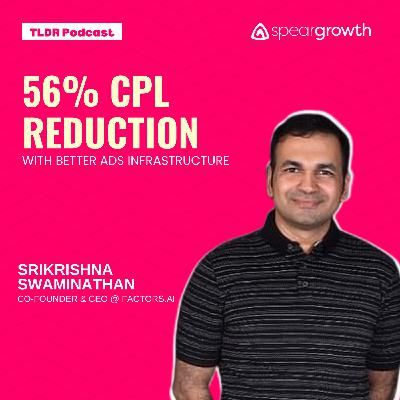
LinkedIn Ads used to be niche and expensive. Now it's mainstream and expensive.In this episode of TLDR, Srikrishna (CEO of Factors.ai) and I were discussing how the change in LinkedIn Ads is massive:B2B ad spend on LinkedIn jumped from 3-5% to 20-25%. Everyone finally realized it's the only way to reach decision-makers at scale.But here's the catch: if everyone's doing it, then the old playbooks are not going to work anymore.You’ll have to start thinking about changing your approach.And this is exactly how Alaan Pay was able to drop their CPL by 56%.Not through better creative or copy. Through better & improved infrastructure.Most companies are still uploading 100K contacts and hoping for the best.But in this episode, Sri explains what actually works now:Build smarter audience lists: Don't just use Apollo or Sales Navigator filters. Layer in intent signals: G2 competitor page views, website behavior, email engagement. Segment into TOFU, MOFU, BOFU - not one massive list.Distribute ads strategically: SQLs should see 10x more impressions than cold accounts. Show case studies to SQLs, competitor comparisons to closed-lost deals. Stop wasting the budget showing ads to existing customers.Implement CAPI (Conversions API): Feed website conversion data back to LinkedIn's algorithm. Most companies only send CRM data (super limited). Factors is one of 4 LinkedIn CAPI partners globally.If you run LinkedIn ads or plan to, this is a must-listen.Hosted on Ausha. See ausha.co/privacy-policy for more information.

Most writers are worried AI will take their jobs. But Devin says CMOs should be way more worried.In this episode of TLDR, I sat down with Devin; ex-CEO of Animals, consultant to B2B brands, and all-around content strategist; to talk about what’s really breaking in B2B content, and why the old playbooks are falling apart.Tune in to hear us break down:The real reason most B2B content is badWhy the playbook era is overHow SEO isn’t dead, but it’s changing fastWhy CMOs are at riskThe new content org modelWhy the biggest problem isn’t AI or SEO shifts, it’s leadershipIf you're a CMO rethinking your content bets, a founder trying to build a smarter growth engine, or just someone who enjoys a brutally honest take on today's marketing, you’ll want to hear this one.Hosted on Ausha. See ausha.co/privacy-policy for more information.

Lead scoring is BS.At least that's what I thought before talking to Jon Farah.Here's the thing - I've seen too many companies do this: Marketing teams sit in a room. "Website visit = 1 point. eBook download = 10 points. Demo request = 50 points."Why those numbers? Because they “sound good.” 🤷♂️Then sales gets these "qualified" leads and goes... "Why am I calling someone who never asked for a demo?"But Jon just changed my mind.He showed me how one of his clients converts 20% of top-of-funnel leads into sales-ready leads.The difference?Most companies only track fitness scoring (job title, company size). Jon adds engagement scoring across multiple channels:Email opens and clicksPage visits (weighted differently - homepage ≠ demo page)Social signals via Phantom Buster AppLead magnet downloadsThen here's where it gets interesting:Instead of one generic nurture sequence, they create personalized journeys.Downloaded a lead magnet? You get educational content about the problem. Visited the demo page 3 times? You get competitive comparisons and some "why us" content.They even have a whole stage for lost opportunities. That 80% who didn't close? They get re-engaged with relevant content. Jon believes you can squeeze an extra 5% back into the pipeline this way.Yea, I'm definitely implementing this for Chosenly someday 😏Hosted on Ausha. See ausha.co/privacy-policy for more information.
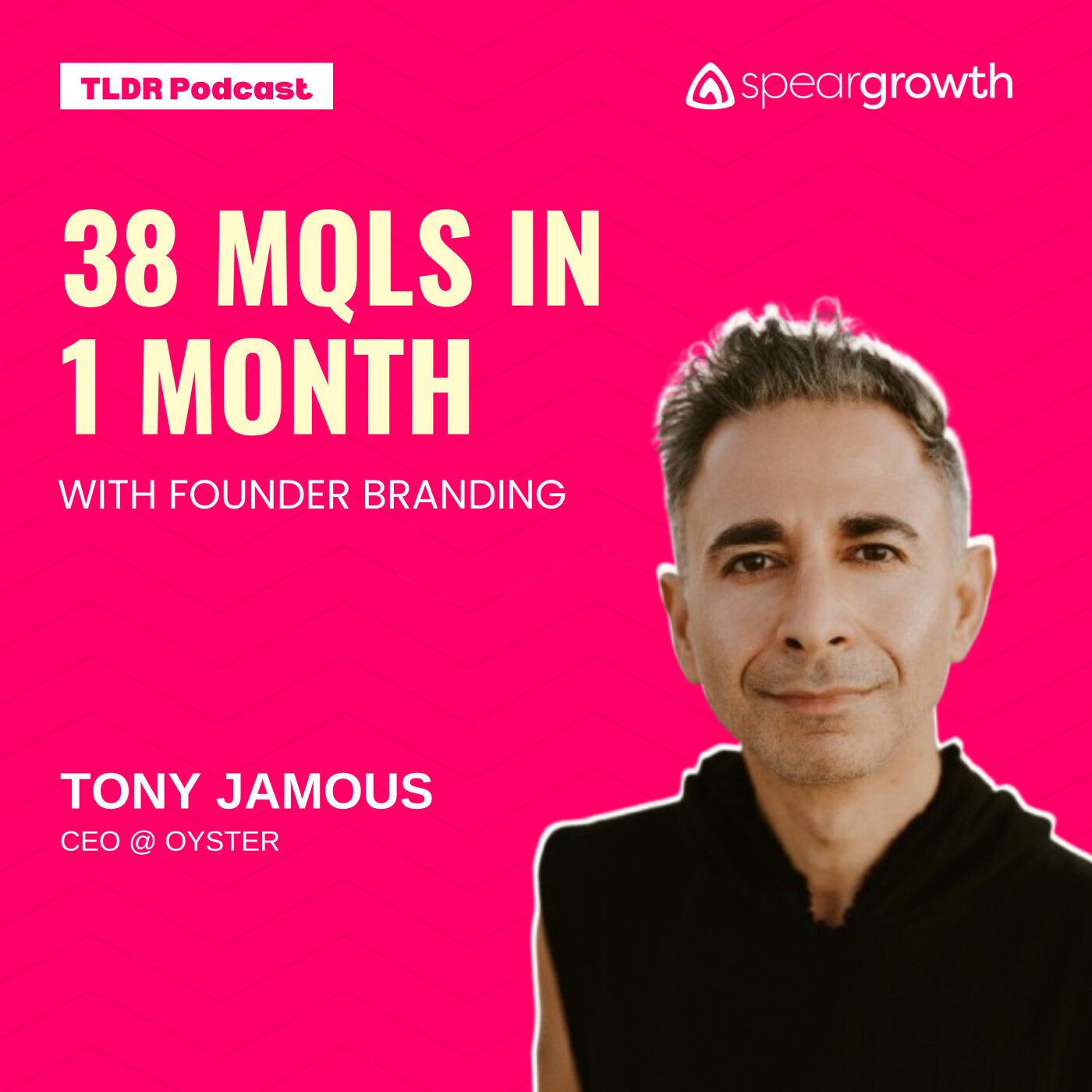
We just had one of the best-dressed guests on our podcast!And while we didn't get to go deep into grooming tips, we did get to talk a lot about building a founder brand.38 MQLs (in 1 month), with >10% of revenue tied to the founder brand.That’s the ROI Tony Jamous gets from showing up as the founder of Oyster.When Oyster launched, they didn’t have a product yet. What they did have was a belief: distributed work was the future.So Tony started posting on LinkedIn about remote leadership, hiring globally, and building Oyster in public.Those posts turned into:Demand gen → prospects already knew Oyster before the product shipped, so the sales cycle was shorter.Trust at scale → Tony’s voice made Oyster credible in a crowded space.Inbound magnet → the 38 leads were sourced directly from his content, no ad spend required.Revenue impact → over 10% of sales can be traced back to his personal brand.The way he runs it is surprisingly lightweight: ✅ One dedicated person on his team to run this ✅ A monthly call where Tony just answers questions, which ends up being the primary source of his content ✅ A mix of tactical insights, authentic stories, and raw behind-the-scenes momentsThe lesson? People buy from people. Your face, your values, and your voice make your product more trustworthy.Tony’s advice: don’t overthink it. Experiment. Share what feels authentic. And let your audience tell you what resonates.Hosted on Ausha. See ausha.co/privacy-policy for more information.

With programmatic SEO you can create 100s of pages at once. When I started my career, I saw companies like Zapier, Canva and AirBnB see great success with this, so I dreamt of implementing this.But when I tried learning, I only got vague information like:Find keywords that scale (eg: "Hire fitness influencers in Dubai", "Top beauty creators with high engagement”)Build a data base with relevant data about eachPublish your pages in bulkTechnically, this is exactly what you need to do. But it's not nearly enough information to implement anything.In this episode, Usman and I go in depth discussing the nuances. Things like: "How do you structure programmatic SEO if you were starting from scratch? What would your step one, two, three be?"Who do you think really owns the programmatic program?""Who wrote the content for the pages?"“How much do you need to coordinate with the engineering/product teams?”"How did you deal with indexation issues when making so many pages live at once?""What did the internal linking strategy look like?""When you do this and find a few pages that could rank better with manual tweaks (but would break the template), what do you do?""How do you prioritize which set of pages to build first?”I don't know of any resource on the internet where you'll get this information in such depth.Usman walks us through the specifics of him implementing a programmatic strategy for MoreDash.There they saw 96% more traffic & 2x deals, all in 8 months.If your product has untapped data and there’s consistent search demand in your category, don’t sleep on this play.Hosted on Ausha. See ausha.co/privacy-policy for more information.

2x engagement. 7x meetup turnout. All from simply asking people to pay!Most people worry that monetizing a community will kill engagement.Harsh proved the opposite.He added a small membership fee, and in just 2 weeks:Engagement doubledWebinar attendance spikedIRL meetups jumped from 20 people to 150+All because people actually had skin in the gameThis did not involve any massive research project. He just surveyed 20 members, asked why they would or wouldn’t pay, and used that to shape the offer.“Once people started paying, they started showing up, because now it felt premium. Simple as that.”If you’re running a community and afraid to charge for it, this episode will change your mind.Hosted on Ausha. See ausha.co/privacy-policy for more information.

A lot of marketers chase shiny new personas.Very few ask: “Who are we overlooking?”Turns out these “forgotten audiences” convert like crazy.I spoke with Andy Groller, CEO of Dragon360, about how his team helped Snagit generate $280K in revenue in just 4 months, by going all in on a segment that hadn’t been marketed to in years: technical writers.This wasn’t a viral stunt or a flashy rebrand.It was a focused campaign built around one simple idea:“These folks are overlooked, misunderstood, and doing important work no one talks about.”So instead of pushing features, they made the audience the story.Snagit became a tool built just for them, not simply another screen recorder.Here’s how they pulled it off:Identified technical writers as a high-potential, low-competition segmentBuilt messaging that actually respected their workRan experiments across Meta, LinkedIn, Reddit, CTV & SpotifyTested landing pages, creatives, formats, and even UGC daypartingOne of my favorite parts?They ignored trial signups as a success metric.They tracked installs instead; something that showed real intent.That’s something we do at Spear Growth too:We call them Fair Shot Users - people who took enough action to give your product a “real shot.”Result?$280,000+ in revenue1,100+ purchasesAll in just 4 monthsAndy’s approach mirrors a lot of what we believe in at Spear Growth: buyer-first creative, hands-on execution, and campaigns that actually map to revenue.If you’re sitting on a product with misunderstood value, or an audience no one’s talked to in years, this is the kind of campaign that can punch way above its weight.Hosted on Ausha. See ausha.co/privacy-policy for more information.
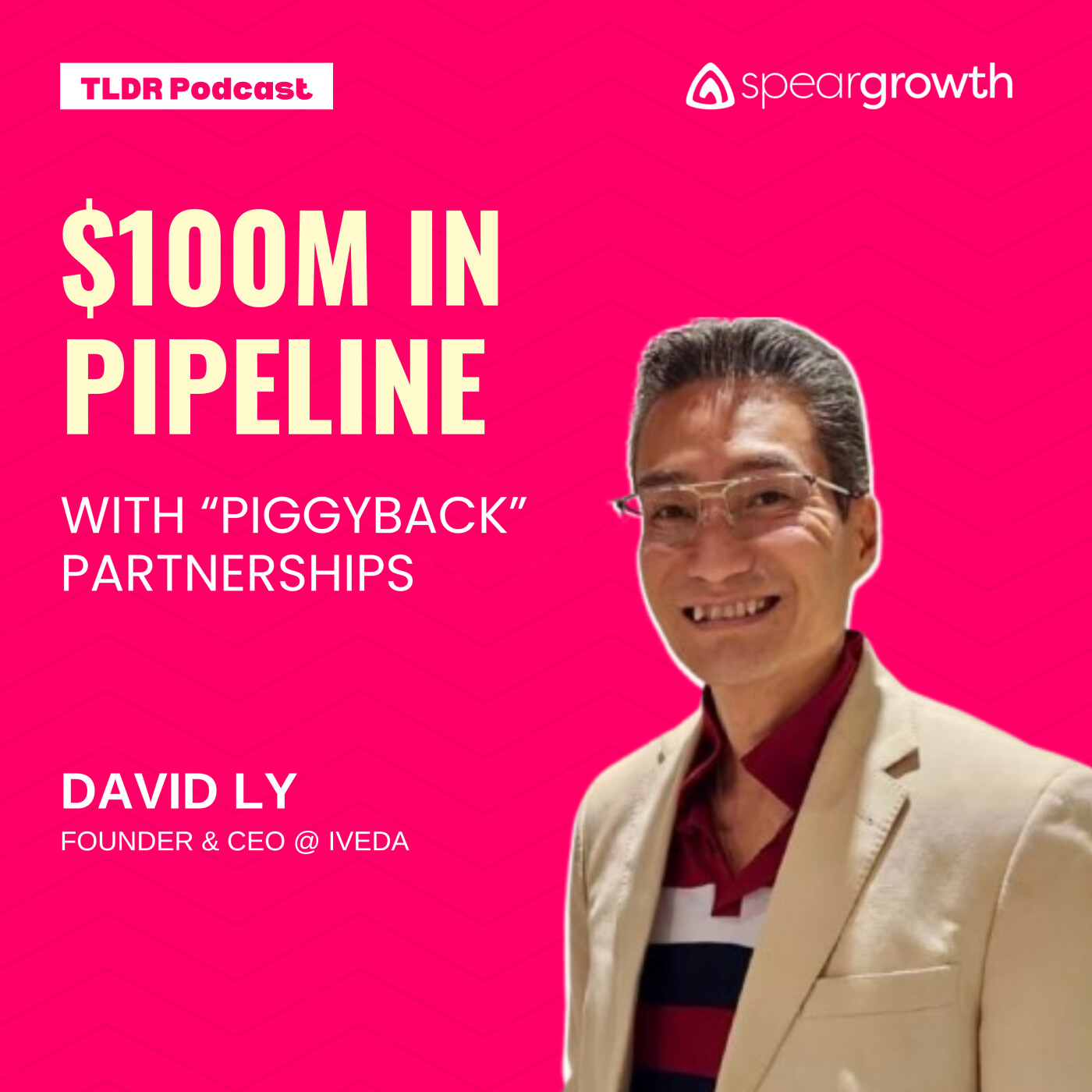
How do you build $100M in pipeline without a massive sales team? David Ly from Iveda had the best answer: Partner with someone who already has one.After 20+ years of building cloud video and AI platforms, here’s what he figured out:Big companies tend to move slow.Which means, if it takes them 9 months to build something, David and his team can do it in 3.They didn’t have the speed of innovation that David had gained from his experience with AI.And he didn’t have their sales muscle.He didn’t have hundreds of reps on the ground, or decades of buyer relationships.So he flipped the script:He gave them innovation.They gave him distribution.“Your big brother companies, they have the sales and marketing strength to do what we couldn’t.”It’s a yin and yang setup.The big players were missing an innovation department. David became that for them, and in return, they plugged Iveda into their distribution.This is how he built a global reseller network that now spans the US, Europe, Asia, Africa, and the Middle East.And no, it wasn’t easy:- It took 5+ years of relationship-building, field trials, and proof- A 35-person team working across all time zones - And $35M+ raised to fund the motionNow, they’re tracking $100M+ in pipeline, and possibly more by year-end.If you’re trying to go global without going broke, do not miss this episode.Hosted on Ausha. See ausha.co/privacy-policy for more information.

At Spear Growth, we once built a massive partner program.Around 40 odd companies from SaaS tools, VCs, agencies with complementary services - everyone you could think of was technically our “partner.”Now how many leads did that generate?Zero.Looking back, it’s obvious: we were chasing quantity over actual traction.Which is why Jason’s take on partnerships hit so hard for me in this episode.Instead of launching some bloated program, he helps B2B tech companies build one partner play that actually works.Here’s how: ✅ Pick one strategic partner, someone your audience already trusts✅ Build them directly into your marketing campaigns (don’t just slap on the logos!)✅ Spend 3–6 months enabling your sales team to actually sell with that partnerWe’ve now restarted our partner program at Spear Growth with just 2 carefully chosen partners - and the early pipeline impact has already been huge. (We’ll share more on the “who’s” & “what’s” soon!)If you’ve hit product-market fit, this kind of focused partner motion is one of the best growth levers out there.Hosted on Ausha. See ausha.co/privacy-policy for more information.

"We put bounties on our prospects…and generated $100K” 🤠Tara just shared the most creative event marketing I've seen.The challenge: Make a $40K booth sponsorship actually worth it.Their solution? Create literal "WANTED" posters of 20 target prospects.The offer: "Bring this person to our booth and you BOTH get a prize"The results were shockingly good:$100K+ pipeline in just 3 days50% of their targets actually showed up, booked meetings, and entered the sales cycleIt was a last-minute idea pulled together in ~3 weeks , with 2 people building the target account list (which was not easy!), and 1 designer making the posters (which was a lot of fun!)Of course this only works if you have:A physical booth (obviously)High enough ACV to justify booth sponsorship costs (~$40K in their case)A healthy sense of humorWant the complete IRL ABM playbook? Listen to the full episode.Hosted on Ausha. See ausha.co/privacy-policy for more information.

8000 leads at just $5 each? Yep! This YouTube strategy from Ryan Deiss is something you just cannot miss.I mean seriously, look at these results:🔷 Generated 8000+ high-quality leads 🔷 Reduced cost per lead by 70% 🔷 Grew YouTube subscribers from 3K to 20K 🔷 Shortened sales cycle from 355 to under 250 daysHow did he do it? With one 81-minute pillar video + five strategic supporting videos + targeted discovery ads.What I love most is the simplicity. No complex marketing stack. No massive ad budget. Yet this method now drives a third of ALL their leads.This isn't just for content creators. Ryan's proven this works for complex products with traditionally long sales cycles - perfect for B2B companies struggling with lead generation costs.Sure, it takes some planning and quality content creation. But the results? Absolutely worth it.Want to know exactly how Ryan executed this strategy? Listen to the full episode.Hosted on Ausha. See ausha.co/privacy-policy for more information.

I'm still geeking out over this conversation with Emilia (VP of Marketing, Userpilot). She shared their complete ABM playbook and - this is wild - it's EXACTLY the same strategy we use at Spear Growth! (I honestly thought our approach was unique until this chat!)Here's a quick snapshot.LinkedIn Ads Spend: $57KTimeline: 3 monthsResult: $655K pipelineThe winning team:VP MarketingHead of ABMPerformance ManagerDemand ManagerMarketing Operations SpecialistAnd of course some design supportTools they used: Just HubSpot ($2K/month) & LinkedIn Ads.See? Nothing complicated.Here's what I love: They tried this AFTER cold outreach failed.(Sometimes plan B works better than plan A)If you're a marketing strategy nerd like us, you'll love this deep dive.Warning: We got super nerdy about the details in this one! 🤓Hosted on Ausha. See ausha.co/privacy-policy for more information.

I'm genuinely excited about this one because Niall just shared something brilliantly simple (you know I love it when the simple stuff wins!)Here's what's awesome:Generated £4M+ pipeline revenuePure organic LinkedIn contentCampaign-based approachNo fancy tools, no paid promotionThe best part? This isn't just for the big players.Niall's proven this works for:→ Billion-dollar companies in their portfolio→ Solo entrepreneurs→ Everyone in betweenWhat do I love the most? The strategy is so obvious, it's genius. No complicated frameworks. No fancy tech. (In fact, we might already be implementing it 😉)Sure, it took 2-3 months to see results.But that's after years of perfecting the strategy.Want to know exactly how they did it? Listen to the full episodeHosted on Ausha. See ausha.co/privacy-policy for more information.

I'm genuinely excited about this one because Niall just shared something brilliantly simple (you know I love it when the simple stuff wins!)Here's what's awesome:Generated £4M+ pipeline revenuePure organic LinkedIn contentCampaign-based approachNo fancy tools, no paid promotionThe best part? This isn't just for the big players.Niall's proven this works for:→ Billion-dollar companies in their portfolio→ Solo entrepreneurs→ Everyone in betweenWhat do I love the most? The strategy is so obvious, it's genius. No complicated frameworks. No fancy tech. (In fact, we might already be implementing it 😉)Sure, it took 2-3 months to see results.But that's after years of perfecting the strategy.Want to know exactly how they did it? Listen to the full episodeHosted on Ausha. See ausha.co/privacy-policy for more information.
I'm still geeking out over this conversation with Emilia (VP of Marketing, Userpilot). She shared their complete ABM playbook and - this is wild - it's EXACTLY the same strategy we use at Spear Growth! (I honestly thought our approach was unique until this chat!)Here's a quick snapshot.LinkedIn Ads Spend: $57KTimeline: 3 monthsResult: $655K pipelineThe winning team:VP MarketingHead of ABMPerformance ManagerDemand ManagerMarketing Operations SpecialistAnd of course some design supportTools they used: Just HubSpot ($2K/month) & LinkedIn Ads.See? Nothing complicated.Here's what I love: They tried this AFTER cold outreach failed.(Sometimes plan B works better than plan A)If you're a marketing strategy nerd like us, you'll love this deep dive.Warning: We got super nerdy about the details in this one! 🤓Hosted on Ausha. See ausha.co/privacy-policy for more information.

What if getting customer reviews was actually easy?As easy as using real customer quotes from their own call recordings.That’s what Laudable did for their client.Instead of begging for reviews, they started saying: "Hey, remember when you mentioned THIS in our last call? Mind sharing a quick G2 review?"The numbers:Got 1000+ customer stories in 4 months400% increase in customer advocacyReduced case study creation time by 5xBasically, they let customers tell their own stories - with a little help from AI.Want to know exactly how they did it? Listen to this episode. Hosted on Ausha. See ausha.co/privacy-policy for more information.


Download from Google Play

Download from App Store
 United States
Great podcast, thanks for sharing. The CPM on Reddit is still low compared to other platforms. That makes it ideal for startups with limited budgets. We got thousands of impressions for under $50 and generated real interest in our new app from a relevant, tech-savvy audience. I'm currently studying this topic better with articles about reddit advertising cost https://aimers.io/blog/reddit-ads-cost to get more background information