


Building One with Tomer Cohen
Subscribed: 20,546Played: 87,021
Subscribe
© LinkedIn. All rights reserved.
Description
Building One, a podcast hosted by Tomer Cohen, LinkedIn's Chief Product Officer, is a series of engaging one-on-one conversations with accomplished product leaders. The series delves into the professional journeys of these diverse leaders, extracts insights into the intricacies of product development, and reveals the stories behind their most impactful products. Building One not only offers valuable insights into the world of product development but also serves as a source of motivation and inspiration for listeners pursuing their own careers in product development.
45 Episodes
Reverse

What if you could build breakthrough companies systematically?
In this episode of Building One, Tomer Cohen sits down with Noubar Afeyan, founder and CEO of Flagship Pioneering, the company-building platform behind more than 100 companies, including Moderna.
Noubar has spent nearly four decades building at the edge of science. His approach starts with a deceptively simple question: “What if?”
At Flagship, teams explore roughly 100 of these questions each year. The most promising become proto-companies, which are then actively stress-tested — and sometimes killed — before becoming full-fledged companies.
It’s a radically different approach to innovation: don’t start with what already exists and incrementally improve it. Move beyond the boundaries of what we know and work backwards from what might be possible.
Tomer and Noubar discuss:
• How Flagship developed a repeatable system for creating companies from scratch• Why the most interesting opportunities can exist beyond the edge of expertise• Noubar’s philosophy of “paranoid optimism” and “urgency-oriented patience”• Why Flagship prototypes companies, not just products• How a “what if” question eventually led to Moderna• Why platforms can become product-generation engines• How little we still understand about the human body — and why drug development remains so difficult• Why Noubar believes AI could fundamentally transform the process of scientific discovery• His idea of “polyintelligence” — bringing together human, machine, and nature’s intelligence• Why breakthrough innovation is about “taking the fiction out of science fiction”
It’s a conversation about science, company building, AI, and what it takes to pursue ideas that initially sound unreasonable.
Listen to the full episode of Building One with Noubar Afeyan.
Netflix feels remarkably simple.
Open the app. Find something to watch. Press play.
But creating that experience is anything but simple.
On this episode of Building One, Tomer Cohen sits down with Elizabeth Stone, Netflix's Chief Technology Officer and Chief Product Officer, to explore how one of the world's most iconic consumer products continues to evolve while staying remarkably intuitive.
Netflix is no longer just movies and TV. It's live events, games, podcasts, mobile experiences, and AI-powered personalization. Elizabeth shares how Netflix is expanding into entirely new forms of entertainment—without making the product feel more complicated for its members.
Before joining Netflix, Elizabeth built products across healthcare, transportation, and finance. That unique perspective shapes how she thinks about product strategy, organizational design, and solving complex problems at scale.
In this episode, Tomer and Elizabeth discuss:
How Netflix balances world-class content with world-class product and technology
Why expanding from one product to many is one of the hardest challenges in product management
How Netflix introduces new experiences without overwhelming its members
Why content teams and product teams shouldn't operate the same way—and how Netflix bridges the gap
How Netflix measures value across movies, games, live events, and podcasts
Why AI raises the bar for product quality, taste, and judgment
The future of entertainment: more personalized, immersive, and interactive experiences
Whether you're building consumer products, leading cross-functional teams, or thinking about the future of AI and entertainment, this conversation offers a rare look inside the product philosophy behind one of the world's most influential technology companies.
Some builders don't just create breakthrough products.
They create entirely new ways of thinking about how innovation happens.
In this episode of Building One, Tomer Cohen sits down with Astro Teller, Co-founder and Captain of Moonshots at X, Google's legendary moonshot factory.
Astro has helped build one of the world's most remarkable innovation engines—an organization responsible for projects like Waymo, Google Brain, Wing, Taara, Google Glass, Loon, and many more.
But this conversation isn't just about ambitious technology.
It's about building a system that makes ambitious technology more likely.
At X, innovation isn't treated as inspiration or creative genius. It's treated as a discipline. Teams are rewarded for disproving their own ideas, attacking the hardest assumptions first, and learning faster than everyone else. Success isn't measured by how long a project survives—but by how quickly you discover whether it deserves to.
In this episode, Tomer and Astro discuss:
Why X calls itself a "moonshot factory"—and what it takes to build innovation as a repeatable system
Why the goal isn't to prove your ideas right—but to discover when they're wrong
Why 10x thinking can actually be easier than incremental improvement
The famous "teach the monkey before you build the pedestal" framework for attacking risk in the right order
Lessons from Waymo, Google Brain, Taara, Google Glass, and Loon—and why some of X's biggest "failures" produced its greatest insights
How culture, incentives, and organizational design determine whether breakthrough ideas survive
If you've ever wondered why some organizations consistently produce world-changing products while others struggle to innovate, this conversation offers one of the clearest frameworks you'll hear.
It's a masterclass on building not just products—but the systems that build products.
Some products don’t just succeed — they shape culture. The Fender Telecaster and Stratocaster didn’t merely define new sounds; they became creative tools that generations of musicians built their identities around. Stewarding products with that kind of legacy requires a rare balance of respect for the past and clarity about the future.
Few leaders understand that balance better than Justin Norvell, President of Americas at Fender. As the company continues to evolve, Justin helps guide one of the most influential names in music through changing expectations — where musicians want not just great instruments, but better ways to learn, create, and stay connected to their craft.
In this episode of Building One, host Tomer Cohen sits down with Justin Norvell to explore how iconic products endure, how product thinking applies far beyond software, and why deeply understanding your users is the throughline of great product leadership.
Tomer and Justin discuss:
What makes products like the Telecaster and Stratocaster timeless — and what must never change
How Fender thinks about expanding the musician experience without diluting its core
Applying modern product principles inside a craft-driven, legacy brand
Lessons from leading teams where heritage and innovation must coexist
Why trust, community, and authenticity are essential to building products that last
This conversation is for builders working inside established companies, leaders navigating transformation, and anyone interested in how enduring products are built — whether they live in code, hardware, or culture.
Follow & learn more:
Follow Tomer Cohen on LinkedIn and check out his newsletter, Building LinkedIn
Follow Justin Norvell on LinkedIn
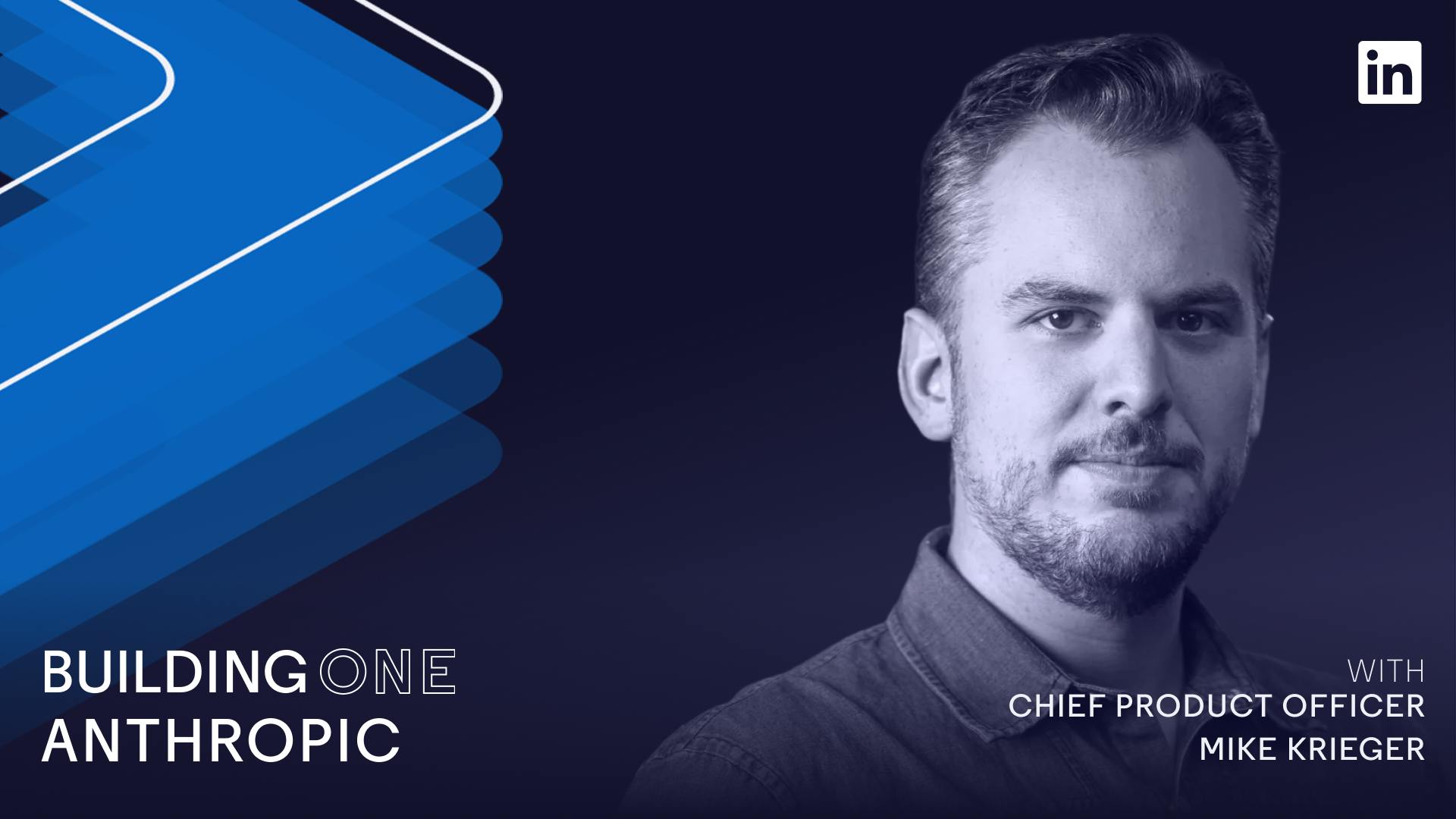
Breakout products rarely hinge on a single moment of luck. They’re shaped by countless decisions — what to prioritize, what to cut, and how deeply you understand the people you’re building for. Few builders have navigated those decisions at the scale of Mike Krieger, co-founder of Instagram and now Chief Product Officer at Anthropic.
Instagram reshaped how billions communicate visually. Today, Mike is helping redefine how we interact with technology again — this time through one of the world’s leading AI assistants. At first glance, building a global social network and building Claude might seem worlds apart. In practice, the parallels run deep.
In this episode of Building One, host Tomer Cohen talks with Mike about scaling, knowing when to pivot, and why the rise of AI is transforming the craft of product-building.
Tomer and Mike discuss:
The inflection point that turned Instagram into a global phenomenon — and the crisis that sparked it
Why Mike decided to shut down Artifact, and the lesson he believes every founder should know about when to stop vs. persevere
The surprising similarities between building Instagram and building Claude
How working at Anthropic changed his thinking about product design and user interfaces
And so much more
This conversation is for anyone building products, leading teams, or shaping AI-powered experiences — and for every builder who believes that great products come from clarity, intuition, and the willingness to evolve.
Follow Tomer Cohen on LinkedIn and check out his newsletter, Building LinkedIn.
Follow Mike Krieger on Linkedin.

Comments

Download from Google Play

Download from App Store
 United States