


 Claim Ownership
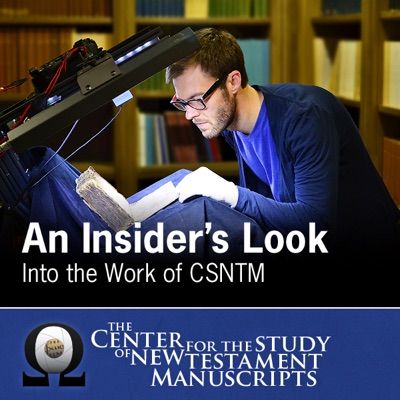
An Insider’s Look Into the Work of CSNTM
Subscribed: 9Played: 36
Subscribe

© CSNTM
Description
Enjoy a behind the scenes look at the work that the Center for the Study of New Testament Manuscripts is doing to preserve the Bible and make available ancient manuscripts for the study of scholars around the world. This collection contains videos documenting recent expeditions, interviews, and news concerning CSNTM.
11 Episodes
Reverse
The three largest discoveries of New Testament manuscripts in the last half-century are discussed by Dr. Daniel B. Wallace of the Center for the Study of New Testament Manuscripts (CSNTM). The discoveries include the uncovering of the “New Finds” manuscripts, the New Testament papyri housed at the Ashmolean Museum at Oxford University, and a discovery of manuscripts in Tirana, Albania discovered by CSNTM. Dr. Wallace also uses this lecture as an opportunity to discuss the practice of papyrology in recognizing New Testament manuscripts.
The Chester Beatty papyri, published in the 1930s and 1950s, are some of the oldest and most important biblical manuscripts known to exist. Housed at the Chester Beatty Library (CBL) in Dublin, they have attracted countless visitors every year. It is safe to say that the only Greek biblical manuscripts that might receive more visitors are Codex Sinaiticus and Codex Alexandrinus, both on display at the British Library.
The Center for the Study of New Testament Manuscripts (CSNTM) sent a six-person team, in a four-week expedition during July–August 2013, and digitized all the Greek biblical papyri at the Chester Beatty Library. The CBL has granted permission to CSNTM to post the images on their website (www.csntm.org).
The New Testament papyri at the CBL include the oldest manuscript of Paul’s letters (dated c. AD 200), the oldest manuscript of Mark’s Gospel and portions of the other Gospels and Acts (third century), and the oldest manuscript of Revelation (third century). One or two of the Old Testament papyri are as old as the second century AD.
Using state-of-the-art digital equipment, CSNTM photographed each manuscript against white and black backgrounds. The result was stunning. The photographs reveal some text that has not been seen before. Besides the papyri, CSNTM also digitized all of the Greek New Testament manuscripts at the CBL as well as several others, including some early apocryphal texts. The total number of images came to more than 5100.
The primary goal of CSNTM, to preserve and make available ancient manuscripts of the New Testament, is elaborated upon by Dr. Daniel B. Wallace of the Center for the Study of New Testament Manuscripts (CSNTM) in an interview that was recorded for the Sky Network.
CSNTM took a trip to Cambridge for their 6th trip of the summer of 2008. Dr. Daniel B. Wallace of the Center for the Study of New Testament Manuscripts (CSNTM) relates the story of the trip. Dr. Jeff Hargis, Jeff Miller, Andrew Wallace, and Dr. Wallace were able to stay at the Tyndale House, while photographing old fragments of Romans in majuscule script that had been re-purposed for book binding.
In the recent past, the Center for the Study of New Testament Manuscripts (CSNTM) has discovered around 20 new Greek manuscripts of the New Testament. Dr. Jeff Hargis discusses how CSNTM consults a book and now a website known as the Kurzgefasste Liste to determine whether a new manuscript has been discovered.

Comments

Download from Google Play

Download from App Store
 United States