


 Claim Ownership
The Practitioner-Scholar: The PennCLO Podcast
Subscribed: 2Played: 7
Subscribe

© Penn GSE
Description
Welcome to "The Practitioner-Scholar: The PennCLO Podcast," the flagship production of the renowned Penn Chief Learning Officer Executive Doctoral Program at the University of Pennsylvania. Immerse yourself in a curated blend of scholarly insights and industry expertise, offering a profound exploration of organizational learning and leadership. Unveiling strategies and success indicators crucial in today's dynamic landscape, this podcast is a testament to the distinctive approach fostered by our program.
Join us on a transformative journey through the multifaceted world of leadership, where practitioner-scholar approaches shine as a beacon of excellence. As we spotlight luminaries within our esteemed student, faculty, and alumni circles, "The Practitioner-Scholar" podcast becomes a unique channel for intellectual engagement and actionable takeaways. For prospective students, seasoned executives, and dedicated scholar-practitioners alike, this platform is your exclusive access to the extraordinary content emanating from the heart of the PennCLO Executive Doctoral Program.
Subscribe now to tailor your learning journey and be part of the vibrant community shaping the future of leadership.
To learn more about the Penn Chief Learning Officer, Doctor of Education (Ed.D.) program, visit the Penn GSE website.
Join us on a transformative journey through the multifaceted world of leadership, where practitioner-scholar approaches shine as a beacon of excellence. As we spotlight luminaries within our esteemed student, faculty, and alumni circles, "The Practitioner-Scholar" podcast becomes a unique channel for intellectual engagement and actionable takeaways. For prospective students, seasoned executives, and dedicated scholar-practitioners alike, this platform is your exclusive access to the extraordinary content emanating from the heart of the PennCLO Executive Doctoral Program.
Subscribe now to tailor your learning journey and be part of the vibrant community shaping the future of leadership.
To learn more about the Penn Chief Learning Officer, Doctor of Education (Ed.D.) program, visit the Penn GSE website.
24 Episodes
Reverse
Dr. Sharon Ravitch is joined by HR executive and scholar-practitioner Dr. TJ Lintz. Reflecting on his doctoral research at the University of Pennsylvania, Dr. Lintz explores how leaders transform moments of extreme disruption into catalysts for long-term organizational evolution.This episode explores the intersection of crisis management, artificial intelligence, and human-centered leadership. Dr. Lintz explains why artificial intelligence will never replace the human touch required for emotional support, but emphasizes how AI can serve as a vital sparring partner during risk assessment. He leaves listeners with actionable frameworks for creating safe conditions where employees at all levels can contribute transformative ideas. As a contributing author to the book Leaders as Architects of Change, co-edited by Dr. Ravitch and Dr. Raghu Krishnamoorthy, Dr. Lintz draws on his chapter to explore these ideas.Key topics:How effective leaders act as a stabilizing presence during high-anxiety organizational stormsThe role of artificial intelligence as a strategic sparring partner for strategic scenario planningWhy psychological stability forms the foundation for cross-functional collaboration and rapid decision-makingTransforming talent management frameworks to evaluate resilience before crises occurPractical steps for executive leaders to encourage intelligent risk-taking and "failing forward"Redefining executive leadership in a brittle, anxious, non-linear, and incomprehensible (BANI) environmentHow concise, frequent communication builds emotional infrastructure and reduces organizational anxiety
In this episode of the PennCLO podcast, Dr. Sharon Ravitch is joined by Dr. Marikay Forst, a distinguished leadership expert and author of the groundbreaking chapter, Architecting Dissent by Design: Psychological Safety, Diverse Thinking, and Brave Cultures, featured in the new book Leaders as Architects of Change.Dr. Forst’s work tackles a critical paradigm shift in modern organizational design: transforming how leaders perceive, encourage, and process constructive disagreement. Moving past traditional views that equate critique with disloyalty, she shares qualitative research proving that inviting dissenting voices is a leadership team's best defense against catastrophic errors. Through a collection of organizational practices and tools, this conversation provides a practical roadmap for top executives to build strategic, psychologically safe environments where multiple viewpoints are intentionally surfaced and acted upon.Alongside the technical strategies, Dr. Forst explores the human dynamics behind corporate decision-making—including the intersection of Carol Dweck’s growth mindset, the invisible costs of ignoring feedback, and the value of maintaining procedural discipline when facing intense time and budget constraints.Key topics:Why dissent is a strategic mechanism for risk prevention and corporate innovationThe blueprint for aligning stated organizational core values with actions.Managing power dynamics and neutralizing the unconscious consequences of speaking upPractical tools for leaders: Designing effective pre-mortems and structured brainstorming sessionsCultivating a growth mindset to enhance constructive critique
In this episode of The Practitioner Scholar, Dr. Sharon Ravitch sits down with Dr. Bridie Fanning, Managing Director at Accenture and former Chief HR Officer, to discuss her critical contributing chapter to the ground-breaking new book, Leaders as Architects of Change (edited by Dr. Sharon Ravitch and Dr. Raghu Krishnamoorthy). While modern headlines focus heavily on what artificial intelligence can automate, Dr. Bridie Fanning argues that the future of work will not be dictated by technology, but by leadership choices. This conversation dives deep into her chapter's core ethos: that AI is fundamentally a human learning story, that leaders must build psychological safety for continuous experimentation, and that traditional, linear change management models must be entirely rewritten to align with the framework of the book.Key Takeaways:Amara’s Law in Action: Why we are currently overestimating AI's short-term hype while drastically underestimating its massive, long-term societal and operational impact.The Death of Traditional Change Management: Moving away from traditional "Point A to Point B" transition models and adopting dynamic, continuous, and iterative organizational capabilities.The "Inverted" Problem-Solving Approach: Why leaders must stop asking "What can AI do?" and instead start with their biggest organizational pain points, working backward to find technical solutions.
Great collaboration doesn't happen. It's designed. So why do so many leadership teams still treat it as something that should just emerge naturally?In this episode of the PennCLO Podcast, The Practitioner Scholar, Dr. Sharon M. Ravitch speaks with PennCLO mentor and lecturer Dr. Phillip Ellis about designing organizations for collaboration, resilience, and adaptive leadership.Based on Phillip’s chapter in Leaders as Architects of Change: Designing Organizations for Connection and Resilience in Times of Uncertainty, this conversation explores why many teams struggle to collaborate in a world of uncertainty,and how leaders can create the conditions for deeper trust, innovation, and collective problem-solving.Together, they unpack:Why collaboration is a leadership design challengeHow “systems of knowing” shape teams and organizationsWhy traditional leadership models struggle in uncertain environmentsHow leaders can foster more adaptive and resilient culturesLeaders who treat collaboration as a soft skill keep getting stuck results. This conversation makes the case for designing it instead.
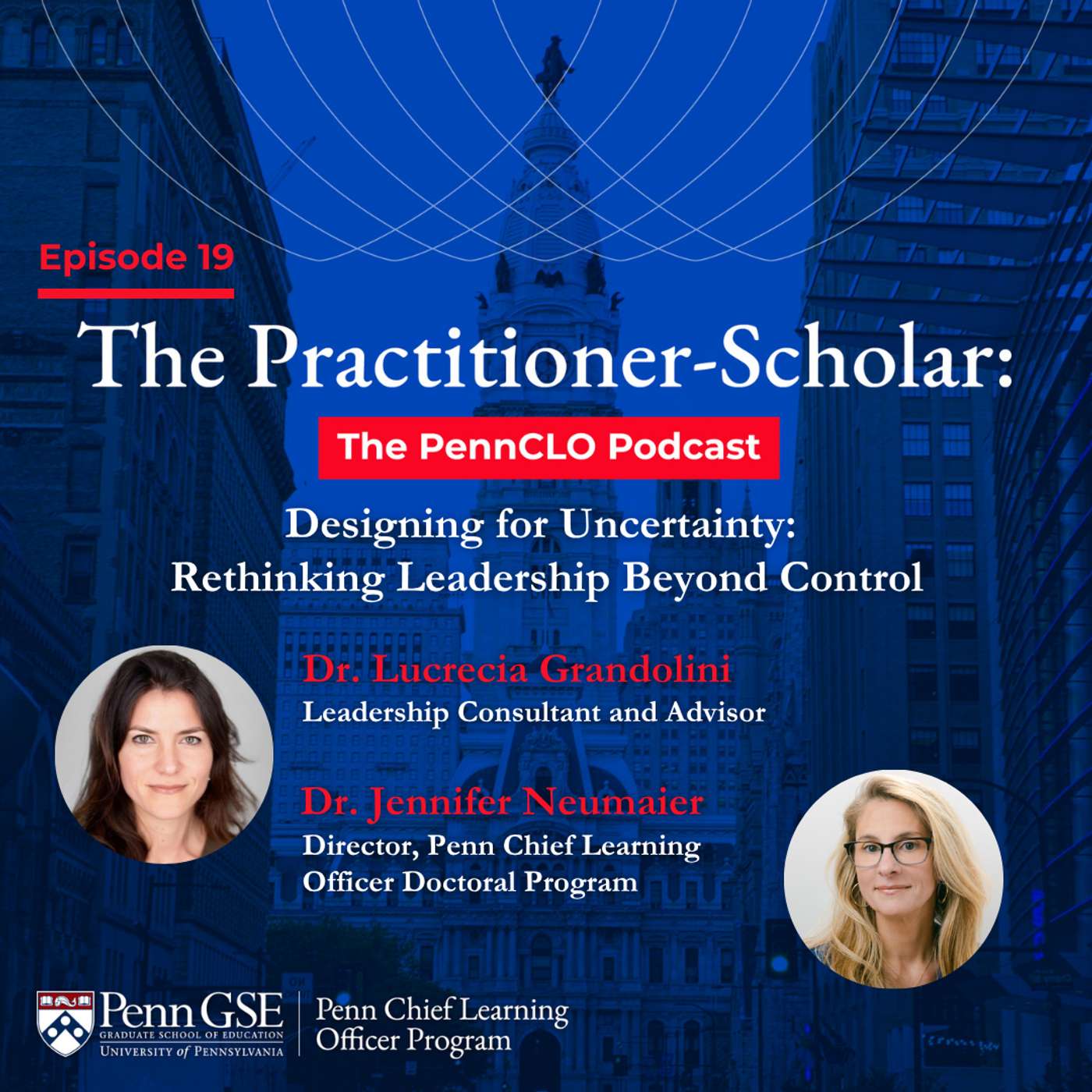
What if uncertainty isn’t the problem—but the point?In this episode of the PennCLO Podcast, Dr. Jennifer Neumaier sits down with Penn CLO doctoral alum Dr. Lucrecia Grandolini about her chapter on leading through uncertainty from the book Leaders as Architects: Designing Organizations for Connection and Resilience, co-edited by Dr. Sharon Ravitch (University of Pennsylvania Graduate School of Education) and Dr. Ragu Krishnamoorthy, Director of the Penn CLO program. Drawing on her global experience across financial services, consulting, and clinical psychology, Lucrecia challenges the traditional “plan–predict–control” model of leadership—and offers a compelling alternative.Together, they unpack:Why uncertainty is both deeply human—and deeply misunderstoodThe hidden cost of control: how it erodes trust and psychological safetyThe “living iceberg” metaphor—and what leaders miss beneath the surfaceWhat uncertainty-friendly organizations actually look like in practiceFour essential leadership practices for thriving in complexityThis conversation is a powerful invitation to stop trying to eliminate uncertainty—and start designing for it.

Comments

Download from Google Play

Download from App Store
 United States