


 Claim Ownership
The Walk
Subscribed: 162Played: 4,137
Subscribe

© 2005-2025 Stichting Trideo. All Rights Reserved.
Description
A weekly walk with Fr. Roderick during which he shares his thoughts as a priest on the struggles and challenges as well as the joys and surprises of day-to-day life.
373 Episodes
Reverse
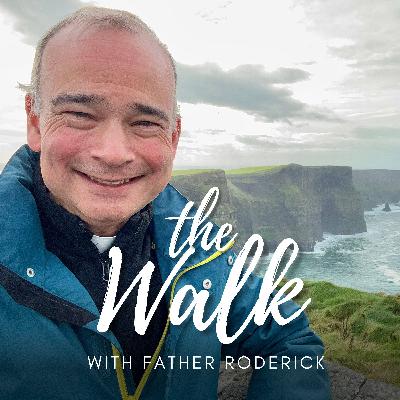
I’m getting ready for a trip that feels both exciting and slightly overwhelming: I'm going to walk my second Camino to Santiago de Compostela! There’s a long list of things that need to be done, deadlines that don’t move, and a body and mind that are already feeling the pressure. Normally, this would be the moment where I push harder, try to finish everything, and ignore the warning signs. But this time, I’m trying something different. Instead of forcing my way through the chaos, I’m learning to slow down, to choose what really matters, and to accept that not everything will be finished before I leave.
What’s changed is not the workload, but how I respond to it. In the past, I would measure myself against an invisible standard and tell myself I wasn’t doing enough. That voice is still there sometimes, but I’m starting to recognize it for what it is. I’m learning to work with my limits instead of constantly pushing against them. That means taking breaks, stopping when I’ve done enough, and trusting that I can pick things up again the next day. It’s not always easy, especially when everything feels urgent, but it does make a difference.
And maybe that’s already part of the journey I’m about to begin. Not just the physical pilgrimage, but a different way of moving through life. A slower pace. Less pressure. Fewer expectations about how things should go. I don’t know what this trip will bring, and for once, I’m okay with that. I’ll do what I can, leave the rest, and trust that something meaningful will unfold along the way.
Lately, I’ve been noticing a deeper question underneath everything I do. Not just how I plan my days, or how I manage my energy, but something more fundamental: can I actually trust the rhythm of my life? Because if I’m honest, I often try to control it. I plan, I push, I expect myself to perform. And then there are those days where nothing works. I’m tired, unfocused, and whatever I try just doesn’t land. What’s new is that I’m starting to respond differently. Instead of forcing it, I step outside, go for a walk, and slowly I feel things come back. Not because I made it happen, but because I gave it space.
That shift is changing how I look at my work. I’m experimenting with giving each day a clear purpose, not to control everything, but to create room. Room for focus, room for rest, room to close the loops that keep buzzing in the back of my mind. But the real challenge is not the system. It’s letting go of the idea that I have to do everything. That my value depends on how much I produce. Choosing one focus for a month sounds simple, but it forces me to say no to a hundred other things. And that’s where it becomes spiritual. It’s about trust. Trust that what I leave undone doesn’t define me.
In this episode, I’m trying to put words to that tension. Between calling and limitation. Between wanting to do more and learning to choose well. I don’t think this is just my struggle. If you’ve ever felt torn between everything you could do and what you actually have the energy for, then you’ll probably recognize this. Maybe the real question isn’t how to do more, but how to live in a way that is sustainable, faithful, and grounded in trust.
The news has been heavy lately. Every day brings new reports about the war in Iran, images of destruction, and stories of people whose lives are suddenly turned upside down. It is easy to feel overwhelmed by it. In this episode I reflect on what it means to stay attentive to that suffering without losing hope ourselves.
One thing that helps me is remembering how powerful stories can be. News often focuses on what is going wrong right now. Stories, on the other hand, help us imagine where we might still go. They remind us that the future is not written yet. In the podcast I talk about how storytelling, whether in books, films, or even the stories we tell each other about our lives, can keep our imagination alive. And that imagination is closely connected to hope. If we can still picture a better future, we are less likely to give in to despair.
That is also why creative work matters to me right now. Writing stories, reading them, and sharing them with others helps me keep looking forward instead of getting stuck in the darkness of the moment. Hope is not pretending that the world is fine. It is choosing to believe that the story is still unfolding. And as long as the story continues, there is still room for courage, kindness, and change.
Sometimes the world feels like a constant stream of urgency. News updates, deadlines, expectations, and worries about things far beyond our control. In this episode, recorded during a quiet walk through the woods on a bright spring day, I reflect on how easy it is to get pulled into that whirlwind, either by endless scrolling or by escaping completely into distraction. But there might be a healthier place somewhere in between.
During these walks I notice how the rhythm of nature slowly changes my perspective. The problems of the world do not disappear, but they begin to settle into a different order. From that calmer place I talk about learning to set boundaries, protecting time to rest, and discovering that balance is not about ignoring suffering, but about making space to process it without losing hope or empathy.
In the podcast I also share some of the lessons I’ve learned recently while juggling intense work, creative projects, and the temptation to overwork. It turns out that recalibrating your life often takes longer than you expect, but the peace that slowly returns is worth the effort. If you’ve ever wondered how to stay compassionate without becoming overwhelmed, this conversation might resonate with you.
The birds are loud again. The days are getting brighter. And somewhere between winter and spring, I’ve made a decision that is changing everything.
In this week’s episode, I talk about something very simple: stopping at five. No more “just one more thing.” No more evenings that slowly dissolve into unfinished tasks. I used to think my hyper-focus was my greatest strength. Now I’m learning that without boundaries, it was the very thing draining me.
What happened when I finally drew a clear line around my time? Better sleep. Sharper focus. More peace. In this episode, I share why protecting your evenings might be the most productive thing you can do — especially in Lent.
On the verge of Lent, I found myself asking a different question than usual. Not, what big project can I launch, or how can I make these forty days impressive, but what actually needs rebalancing in my life right now? The past few months taught me that enthusiasm and overcommitment can look very similar from the inside. I love creating, I love writing, I love saying yes to meaningful work. But I also discovered what happens when there is no margin, no boundary, no protected evening. Lent, for me, is not going to be about adding pressure. It is going to be about intention.
One of the biggest shifts has been learning to protect my evenings. No more sneaking in extra work, no more late night editing sessions disguised as “creative freedom.” The surprising result is that I am more rested, more focused, and actually more productive during the hours that I do work. I am slowly letting go of the idea that I have to prove myself through constant output. Instead, I am reclaiming agency in healthier ways, like taking long walks and writing simply because I love the story, not because I publicly announced a deadline. That inner freedom changes everything.
So for these forty days, I am choosing a quiet commitment. I will write daily, but not as a performance. I will walk, think, pray, and create without turning it into a public challenge. Lent invites us to look honestly at what is out of balance and to take small, deliberate steps toward change. Not for applause, not for productivity, but for peace. Maybe that is the real preparation for Easter, protecting what truly matters so that new life has space to grow.
A few weeks ago, I could feel it in my body before I fully admitted it to myself.
My blood pressure was up. My sleep was fragmented. Even at night, my brain was on orange alert. And during the day, I had this nagging feeling that I was living for work instead of working so I could live .
On paper, nothing was new. I’ve worked hard my entire life. Deadlines don’t scare me. But this time it was different. Producing daily saint podcasts under constant pressure had quietly taken over everything. And I was overcompensating for organizational issues that weren’t even mine to fix .
So instead of pushing harder, I tried something radical.
I stopped.
I started with the basics. Better sleep. Simpler mornings. Protein first, one cup of coffee instead of two. I stopped overthinking small decisions. I stopped pretending that exhaustion was noble.
Then I tackled the real issue: boundaries.
For the first time in my life, I calmly told people what they could expect from me, and what I needed from them. No emotion. No apology. Just clarity . When there was pushback, I didn’t argue. I repeated myself.
And something surprising happened.
They accepted it.
I began stopping work at five. Hard stop. Even mid-sentence. I protected one weekday as a non-work day. And instead of everything collapsing, I felt my creativity return.
I launched a second TikTok account just for books and writing, without pressure. It grew almost instantly . I finally fixed things in my house that had been broken for years, including a ticking radiator that had been waking me up all winter . And in the middle of all that, I wrote and published a small booklet about love in The Lord of the Rings .
Not because I forced it.
But because I finally had margin.
In this week’s episode of The Walk, I talk about what happens when you stop negotiating with your own limits. About the freedom of a five o’clock boundary. And about how protecting your health can unlock more creativity than any productivity hack ever could.
I’m only a few weeks into this experiment.
But I feel lighter than I have in years.
This week, I realized something I didn’t expect: doing less can actually help you do more.
After weeks of high blood pressure and creeping exhaustion, I finally took a step back to reevaluate how I work. With the help of an AI coach, I started looking at the patterns behind my stress. What emerged was confronting. I’ve spent most of my life in overdrive—driven by deadlines, fueled by people-pleasing, and constantly measuring myself by what I produce. Even when I thought I was resting, I wasn’t. I was just switching gears and calling it downtime.
This week, I tried a different approach. One script a day. No work at night. Shorter walks. No “just one more thing” before closing the laptop. And to my surprise, it started working. My mind cleared. I felt calmer. The sense of urgency began to fade. And then something unexpected happened: I finally launched a BookTok channel I’d been overthinking for more than a year. Not out of pressure or guilt, but because I had space to breathe. I had energy again.
That’s when I started to understand what it really means to “protect the process.” I’ve always been focused on progress, on finishing, on pushing through. But now I see that the process itself needs care. It needs time, and margin, and trust. You can’t keep planting seeds if the soil is dry and cracked.
I used to think rest was a reward you had to earn. Now I’m learning it’s the foundation everything else depends on.
If you’ve been feeling overwhelmed or stretched thin, you’re not alone. It’s easy to fall into the trap of believing that you’re only valuable when you’re achieving. But that pressure is a weight we’re not meant to carry. And maybe it’s time we stopped trying to carry the world on our shoulders.
We’re not built for that. We’re not superheroes. We’re not gods. We’re just people. Beloved, limited, called—not to be perfect, but to be faithful.
And sometimes, being faithful means closing the laptop, stepping outside, and letting the sun remind you that life continues, even when you slow down.
This week might quietly become one of the most important of the entire year. Not because of a big success or dramatic moment, but because something inside me finally shifted.
After weeks of pushing myself beyond the limit to finish a major podcast project, I crashed—hard. My sleep was awful. I started having strange hot flashes. One evening, I checked my blood pressure and it was alarmingly high. That got my attention.
At first, I blamed the usual suspects—too much ramen, too little rest. But the more I looked into it, the clearer it became: this wasn’t just about the past few weeks. It was about years of pushing myself, overplanning, and tying my value to how much I could get done. It was about a lifetime of workload stacking, amplified by ADHD and the fear of not being useful enough.
And the worst part? I knew all this already. I’ve spoken about it, preached about it even. But I hadn’t let it sink in—not emotionally. Not in a way that actually changed how I live.
This week, I finally started making real changes. I stopped working after five. I cut back my daily workload to something that felt absurdly small. I resisted the urge to “just do one more thing.” And when I felt uncomfortable—like I was wasting time or not being productive enough—I tried to see that discomfort not as a sign of failure, but as a signal that I was doing something new. Something necessary.
I didn’t expect it, but letting go felt like obedience. Not to a rule, but to reality. To the truth that I’ve spent years avoiding. And maybe, in a deeper sense, to God—who never asked me to earn love through exhaustion.
I still have questions. I still worry I’ll fall behind. But I also know I’ve never slept this well in months. And for the first time in a long while, I don’t end the day feeling like I have to prove I deserve to rest.
If you’ve ever struggled with feeling like you’re only as good as your output, this episode of The Walk is for you. It’s not about giving up—it’s about unlearning. And maybe that’s where the real healing begins.
I had a clear plan for January. It was going to be my month to get away, take a writing retreat, change my surroundings, and recharge after the intense December production sprint. Instead, I stayed home. And I worked. Hard.
The new daily podcast about saints has been very well received, which I’m truly grateful for. But each episode takes a lot of effort—researching, writing, recording, and editing. I’ve set myself the goal of always staying a full month ahead, so there’s a buffer in case I get sick or life throws a curveball. That’s why I pushed so hard to finish all the episodes for February this past week.
The Saint of the Day podcast demanded everything I had. Twenty episodes, fully written and produced. That’s the length of a short novel in just a few weeks. And while I managed to get it all done, it came at a price. I gave up my daily walks, most of my rest, and ended up sitting at my desk for 10- to 12-hour days. Unsurprisingly, I crashed. Twice.
But this time something was different. I didn’t panic. I didn’t beat myself up. I didn’t immediately try to “get back on track.” I let myself crash. I listened to what my body and brain were telling me. And I learned a few things along the way.
First, recovery isn’t a sign of weakness. It’s part of the creative rhythm. When I push past that, I don’t win—I just delay the consequences. I’ve done that too many times. This time I stepped back and said, not again.
Second, I’ve realized that I often try to regain control of my life too quickly. The moment the pressure lifts, I want to fill the silence with something new: a fresh project, a new idea, a podcast revival. Anything to regain a sense of structure. But I’m learning that when I’m tired, that urge doesn’t come from creativity—it comes from stress.
The biggest shift has been learning to sit with that discomfort. To admit, even out loud, that I can’t do it all. That I don’t have the energy right now. That it’s okay to let a few things stay unresolved.
And when people ask for my time, even for good things, I’ve started to pause instead of jumping in. I used to say yes out of habit, out of guilt, out of fear of disappointing someone. Now I give myself time to see whether it’s truly right for me in that moment.
So no, I didn’t get my retreat this month. But I got something else: clarity. A clearer understanding of how I work, where my limits are, and what I need in order to create sustainably. I’m not making any big decisions right now. I’m still in recovery mode. But I do feel a quiet desire surfacing—a desire to write something small, fun, and manageable. Maybe a short novella. Something I can share with readers who follow my email newsletter. A little time-traveling mystery with monks, maybe.
Whatever it ends up being, it feels light. Playful. And that’s a good sign.
So no, this January didn’t go to plan. But it still taught me what I needed to learn.
This week, I finished something I didn’t think was possible: I wrote 20 podcast scripts in just a few days. That’s about 25,000 words. I recorded and edited a dozen of them. I skipped walks, meals, sleep. I pulled the lever on the Millennium Falcon and went full hyperfocus.
But this post isn’t a humblebrag about productivity. It’s a reflection on something that hit me hard as I walked through the woods afterward, blinking into the sunlight like a bear after hibernation.
In the middle of this whirlwind, I realized this sprint wasn't just about meeting a deadline. It was about reclaiming something deeper: my sense of direction. My identity.
Because yes, producing daily stories of saints is beautiful and fulfilling. But it’s also a job. A contract. A task with a scope and timeline and deliverables. And somewhere in the middle of it, I started waking up with bursts of ideas for other things: new podcasts, new stories, new books. My brain was trying to tell me something.
It wasn’t just distraction. It was hunger.
I want my life to be about more than deadlines and deliverables. I want to write stories that come from my heart, not just the ones that fill a broadcast schedule. I want to reach the people beyond this one project. To build a creative life that reflects who I am, not just what I’m capable of producing under pressure.
And that’s why I’m setting new boundaries. I’ll give my best to this podcast project — but only within the space I’ve defined for it. One week per month. No more. That way, I can protect time for retreats, writing, and dreaming. For the books I long to write. For the broader mission I feel called to live.
Because here’s the truth: hustle alone is not holiness. Doing “enough” will never feel like enough if it’s not aligned with your heart.
So yes, I’m proud of what I’ve accomplished this week. But more than that, I’m grateful for what it taught me. That the work is not just about output. It’s about becoming. And I want to become the kind of person who remembers to walk in the woods. To tell the stories that move me. And to carry others, like Sam carried Frodo, one small act of mercy at a time.
If you’re in a similar season — juggling projects, wrestling with overwhelm, wondering where your dreams went — maybe this is your reminder too.
It’s okay to protect your calling. It’s okay to say no. It’s okay to want more than efficiency. It’s okay to be a happy hobbit.
On the Feast of the Epiphany, I kicked off my new daily Dutch podcast Heilige van de Dag with the first episode about the Magi. It’s a year-long journey, telling the stories of saints and martyrs—one per weekday. The project began with a simple idea: what if I could bring these sometimes dusty old tales to life in a way that makes them feel personal, surprising, and real?
But launching a new podcast isn’t just about hitting “publish.” There’s the writing, recording, editing, and promoting. And when it’s in a language and format you’ve never tried before, it’s equal parts thrilling and terrifying.
What helped was this: going outside. Making my daily walks non-negotiable. Letting the snow slow me down just enough to reflect and re-center.
Because here’s the challenge I’m walking into this year:
I want to be creative—but not burned out.
I want to publish more stories—but with enough care to make them shine.
I want to build something lasting—but without losing joy in the process.
That’s why I’m committing to sustainable routines this year: early mornings for writing, focused weeks for podcasting, and hopefully a retreat or two to give new projects the breathing room they deserve.
The launch of Heilige van de Dag is only the beginning. There are books to finish, stories to polish, covers to design, readers to reach. But if there’s one thing I’ve learned from snow-covered trails and saintly tales, it’s that slow steps can still carry you far—especially when taken with purpose.
Thanks for walking with me.
– Fr. Roderick
It’s the day before New Year’s Eve. I’m walking through the woods, watching my step—there’s still some sneaky patches of ice on the pavement. The sun is out, the air is crisp, and despite everything, I’m still going. Still walking.
I never expected this year to be what it turned out to be. In some ways, it was the hardest I’ve had in a while. But also, without a doubt, the most creative. The most alive.
I started 2025 in a tiny, overheated closet of a room—my “writing cabin” after the radiator broke—determined to try something new: writing my first novel. I didn’t know what would come of it. But looking back now, I realize that was the spark that lit the whole fire. Since then, I’ve written not one but seven books. Some are short story collections, others full-length novels, each one stretching me in new directions. I wrote fantasy. I wrote fairy tales. I even wrote a pirate story, just because I could.
And I didn’t just write—I walked. Almost every day. Through sun, rain, and snow. And somehow those daily walks became the fuel for everything else. They gave me the space to think, to breathe, to figure out what mattered and what didn’t. They kept me sane during one of the busiest, most overstretched months I’ve ever lived through.
This December, I took on two major projects at once: launching a daily saints podcast (twenty episodes written, recorded, and now being edited) and finishing Advent of Dragons, my cozy fantasy novel for charity. I thought I could handle it. I did, just about—but I won’t make the same mistake twice. I’m learning. Slowly.
But more than the projects or the word count, the real story of this year was about change. I began to understand more about how my brain works, how ADHD and possibly autism shape the way I experience the world. I stopped beating myself up for the things I used to label as flaws. I gave myself more grace. And that’s made all the difference.
I also discovered that I’m not actually an introvert—I’m just someone who used to spend a lot of energy masking. Once I stopped trying to be what others expected and just showed up as myself, things changed. I met amazing people at conventions, festivals, and writing events. I found a community of readers and writers that truly feels like home.
I don’t know exactly what 2026 will bring. I’ve got plans, of course—maybe more cozy fantasy, one novel for each season. Maybe something entirely unexpected. But I know this: I want to keep walking, keep writing, and keep learning to live at a sustainable pace.
Thanks for walking with me this year. Truly.
– Fr. Roderick
I don’t know what happened, but somehow, I’m ready for Christmas this year. Not the scrambling-at-the-last-minute kind of ready. Actually ready. The house is clean, the work is done, the pantry doors are closed on all the clutter—and I’m not hosting. That alone feels like a small miracle.
I didn’t get here by accident. The last few weeks were intense: writing 20 podcast scripts, sprinting toward a novel deadline, recording videos, finishing up admin tasks. I worked 10 to 12 hours a day. But it paid off. For once, I’m entering Christmas without the usual stress.
Saying yes to a one-minute promo video shoot in my home tricked me into making the place presentable. No tree this year, no guests to impress, just quiet and space. It feels like I gave myself the gift of margin.
There’s still one project left: finishing my daily Advent novel. Ten days, ten chapters to go. But that feels like a joy, not a chore. I love the world I’ve created. Cozy. Forgiving. A gentle mirror of what the world could be if we slowed down and chose kindness.
I know this isn’t everyone’s December. Maybe yours is full of noise and running around. I’ve had years like that too. But if you get a moment—just one quiet breath—I hope it reminds you what it’s all for.
I talk more about this in the final podcast episode of the year. About saints, writing, childhood Christmases, and the strange peace of a clean house.
Hope you enjoy it.
—Fr. Roderick
Every December, I tell myself the same story. That I’ll slow down. That I’ll spend my afternoons reading by the fire, catching up on the books I didn’t finish during the year. That I’ll rest, breathe, and maybe even enjoy doing nothing for a change.
And every December, reality unfolds differently.
This week, I found myself once again escaping to the woods after lunch, grateful for the silence between the trees. The leaf blowers have been relentless this season, drilling into my concentration, as if the world refuses to let anyone sit still. But out here, it’s quiet. Cold, yes, but manageable. And strangely comforting. Maybe because it gives me space to think about everything I’m trying to juggle right now.
I’ve been pouring my energy into two big projects this month. The first is a podcast series about saints, launching in early January. I’ve challenged myself to write each script in the present tense, not to make it harder—though it definitely does—but to draw the listener into each story as if they’re right there, walking beside the saint. It’s powerful work. Spiritual, even. But writing those scripts takes time. And focus. And on some days, I simply don’t have enough of either.
The second project is my Advent novel, a cozy fantasy story told one chapter at a time. It was meant to feel like an Advent calendar—25 chapters, one each day until Christmas. But there have been days when the words wouldn’t come. Days when I was too tired to think straight. So I’ve let go of the idea of writing two chapters in one day, or racing ahead. I’m just walking forward, one page at a time.
What I’ve come to realize—perhaps the hard way—is that more planning doesn’t magically create more hours in the day. Better time management doesn’t solve the problem of being human. Sometimes, no matter how hard you try, there just isn’t enough energy or clarity or inspiration to do it all.
And that’s okay.
Because when I do manage to focus—when I write something that makes me pause, that makes me feel something—I remember why I’m doing this in the first place. These stories matter. Whether it’s the tale of a forgotten saint who stood firm in a time of persecution, or a dragon rider learning to heal through friendship, the act of telling them shapes me. It teaches me. And I hope it touches others too.
I used to think the goal was to do more, be more, give more. Now I’m starting to believe that the real art lies in doing less, but doing it with care. With intention. With love.
So I’ll keep walking. Keep writing. Keep trying to focus on what truly matters.
And if you’d like to come along, I’d love to have you join me for this week’s walk.
I almost didn’t go outside to record this episode. I was sitting at my desk, staring at my to-do list, convincing myself that staying put was the responsible thing to do. After all, I had committed to finishing twenty scripts by the end of the week for a new podcast series about the saints. And I was already behind.
The temptation to keep pushing was strong. But I’ve learned, the hard way, that when your body starts sending warning signals—like poor sleep, flushed cheeks, constant tension—you ignore them at your own risk. So I put on my coat, hit record, and went for a walk.
As I talked, I realized how much pressure I had piled onto myself. Not just with the podcast project, but with the Advent story I’m publishing daily. At first, both felt doable. The saint scripts were supposed to be short, around six minutes each. I estimated two hours per episode—research, writing, recording, editing. It sounded reasonable. Until I discovered that many of the sources contradicted each other, and some of the research had names or events that were completely made up. I ended up spending entire mornings rewriting one script from scratch, checking the smallest historical details.
Meanwhile, the Advent story, which I thought would be a light and cozy creative outlet, started demanding more structure, more consistency, and a lot more energy. I’m no longer writing just for myself—I’m sharing each chapter publicly, which adds a whole new layer of pressure. I find myself triple-checking every plot point, worrying about continuity, trying not to introduce something that will break the story later on.
The real issue, I think, isn’t the workload itself. It’s my unrealistic expectations. I always seem to start with an ideal version of how things should go, and then try to bend reality to match that. But it never quite works. I plan with best-case scenarios in mind, and when things take longer—as they always do—I’m left scrambling, overextending myself, working late, and wondering why I feel so depleted.
There’s a part of me that just doesn’t want to let people down. That still believes the only way to be valuable is to deliver, no matter what it costs. But I’m learning, slowly, that there’s a difference between challenging yourself and pushing yourself past the breaking point. Between being committed and being chronically overcommitted.
This episode became a way for me to pause and look at the bigger picture. To admit that I can’t sprint through every day, and that working smarter means respecting my limits, not denying them. I don’t want to give up on either project—the saint series is deeply meaningful to me, and the Advent story supports a cause I care about. But I also don’t want to lose sleep, energy, or health trying to prove that I’m faster or stronger than I am.
So I walked. I talked. I tried to be honest with myself and with you. And I came away with this small reminder: you can’t give what you don’t have. Rest matters. Pacing matters. And sometimes, the bravest thing you can do is take the walk you almost skipped.
December is already wild, but this week has been next-level: I can finally reveal the huge project I’ve been hinting at. Starting January, I’ll be writing, narrating, and producing a daily podcast about the lives of the saints for the Dutch national broadcaster KRO-NCRV.
This isn’t your typical info-dump podcast. I want to take listeners into the stories—make you feel like you’re standing next to a saint as they make the hard choices that defined their lives. It’s all about emotional connection, not just dates and facts.
That means:
Story-first episodes, 5–7 minutes each
A full year of daily content (yes, 260 episodes!)
Written, performed, and produced with love and lots of tea
It’s daunting. The scripts alone are like writing a full novel every two months. But this feels like the natural next step in everything I’ve been building toward: storytelling as vocation.
And because I can never do just one thing at a time… I also launched a cozy fantasy Advent story, written live each day as a fundraiser for Cato, a fellow fantasy author who urgently needs life-saving surgery.
It’s madness, and it’s mission. I’ve never been more exhausted—or more excited.
🎧 Check out the full story in this week’s episode of The Walk, where I explain how it all came together, why I nearly burned out two days into December, and how I’m trying to find a sustainable rhythm for the creative marathon ahead.
It’s pitch dark outside as I’m recording this. Advent has begun, and while the Christmas lights sparkle on leafless trees, I’ve been working like a madman indoors—writing, pacing, writing some more. Because today, on the 30th of November, I did something I’ve never done before: I finished writing a full novel in just 30 days.
Not just any novel. A story that feels like the best thing I’ve written so far.
The last few days were a blur of writing marathons, church duties, a Comic-Con surprise, and trying to babysit a thousand spinning plates. There were times I was sure I was behind. Turns out, I was actually way ahead—I just hadn’t had the time to notice.
That’s the power of moral commitment. When you push forward, even when it feels impossible, sometimes you find yourself standing on the summit without realizing how far you’ve climbed.
This month taught me that:
I can write an epic story in a month.
I must continue making space for personal, playful storytelling—even when professional projects threaten to take over.
Balance doesn’t mean doing less. It means choosing well and walking daily (literally and figuratively).
Now here’s the wild part: December starts tomorrow. I could write a cozy Advent story next—24 mini chapters, one per day. A magical, heartwarming tale set in the same universe as my novel. I even have the plot ready.
But should I?
That’s the question. My heart says yes. My calendar screams no. But you’ll find out soon which one wins. Head over to my Substack and subscribe if you want to read along as the next story unfolds—or doesn’t. That might be the story too.
Today was a potato day.
Not the comforting kind with blankets and movies, but the kind where your brain checks out and refuses to clock in. The kind of day where you sit at your desk and just can’t get into gear, no matter how many productivity tricks you try. I’ve had fewer of these days over the past year, but today, it hit hard.
Still, even on a day like this, I didn’t end up on the couch. I went for a walk, even though the rain hadn’t stopped like the radar promised. It was cold, wet and muddy, but walking is one of those non-negotiable habits for me. I’ve learned that once I step outside, even if nothing else gets done, something inside starts to shift. Sometimes it’s subtle. Sometimes it sparks ideas.
Today, it sparked reflection.
As I walked, I recorded this podcast episode and talked through what’s been on my mind lately. Part of the fog, I realized, is because something big is happening behind the scenes. I’ve been sitting on the news for a while, but I can finally start hinting at it: a major new project has been greenlit by the Dutch broadcasting company I work with. I can’t share the full details yet, but it’s easily the biggest media commitment of my life. It’s a daily production project, and it’ll require me to write over 250,000 words across the year.
It’s exhilarating and daunting at the same time.
What makes this even more meaningful to me is how deeply aligned it is with my core mission: storytelling that reaches people where they are. It builds on nearly everything I’ve learned in the past 20 years—TV, radio, writing, podcasting—and finally weaves all those threads together into one sustained creative effort.
But with something this big, I’ve had to draw some clear lines. Writing has become essential to me, not just as a creative outlet but as a way of living. Since January 1st, I’ve been writing regularly—almost daily—and I can’t imagine giving that up. That means protecting the space I’ve carved out for novels and creative work, even as this new project ramps up. I’ve realized I can’t do everything. So I’m making choices. Some side projects and social media channels may be set aside. Others might evolve into something more sustainable. If it’s not aligned with the long-term vision or fueling the mission, it’s time to let it go.
And strangely, on a day when I couldn’t concentrate, I ended up doing some of the most important thinking I’ve done all week.
Potato days don’t always look productive. But sometimes, they’re the reset your mind needs before stepping into something big. I’m standing at the edge of a creative year that could change everything. And I’m incredibly grateful to everyone who’s supported me on the journey so far. Your encouragement, your donations, your feedback—it’s what made this possible.
So here’s to more walks, more words, and yes, even more potato days.
This week, the forest floor turned golden under my feet. The air was still, the sun low. One of those rare perfect fall days that remind you how good it is to be alive and outside. I’ve come to think of walking as a “non-negotiable”—something my body and mind need, like food or prayer. It’s my daily reset, my thinking time, and often, my secret writing tool.
Because here’s the thing: I’m in the middle of writing a novel. Not just dabbling, but deep in it—54,000 words deep, to be precise. That’s two acts down, one to go. And I didn’t think I had it in me, not like this. Most days, I draft new chapters while walking, recording voice memos as I go. Yesterday, I came back with not one, not two, but three chapters. Nearly 10,000 words. I couldn't believe it either.
There’s something about allowing a story to surprise you—especially when it grows from grief. One of the characters, a mentor monk, died in the story this week. That loss fueled the emotions, deepened the dialogue, and pulled out something raw and real. I didn’t plan it. But it made everything click.
Of course, this isn’t the polished version. I call it my "horse-beep" draft. But that’s okay. I’ve learned the value of pushing forward, not perfecting too soon. If I stop to edit, I never finish. If I keep moving, I grow.
Outside of writing, life’s been busy too. Masses, interviews, a fantasy book fair in Tilburg—an exhausting but inspiring mix. I met other writers, made new connections, and came home energized. Tired, yes. But motivated. This past year, I’ve written three novels and three story collections. That still blows my mind.
And even with all that, I’m still learning: about routine, about skincare (yes, sunscreen even in November!), about habit-stacking and how to ride the wave of creativity without burning out.
What fuels me isn’t just the dopamine of word counts. It’s the joy of becoming someone I never thought I could be. A writer with a real writing life. A creator who finishes things.
There’s more to come. For now, I'm walking, writing, and wondering what happens next—both in the story and in my own life.

Comments

Download from Google Play

Download from App Store
 United States