


 Claim Ownership
Hay Matters
Subscribed: 5Played: 11
Subscribe

© Feed Central 2024
Description
Stay up to date and learn more about the industry with the Feed Central Hay Matters Podcast – your portal to the intricate world of hay, brought to life through real stories and expert analysis.
54 Episodes
Reverse
Next Generation is a special mini-series within Hay Matters — spotlighting the voices building agriculture’s future.In this episode Steve Page catches up with graduate agronomist Georgia Boddington from ExceedAg to discuss hay production and cropping systems across the Wimmera Mallee.Georgia shares her journey from growing up on a sheep and hay contracting operation near Narracoorte to becoming an agronomist based in Swan Hill. With strong early exposure to hay production, she now works closely with growers across the region advising on rotations, crop management and seasonal decisions.The conversation explores how hay fits into mixed cropping systems in a low rainfall environment, with growers often planning paddocks that can go either to grain or hay depending on how the season unfolds. Georgia also talks about the importance of hay in managing resistant ryegrass, improving rotations and maintaining strong gross margins.Steve and Georgia discuss the realities of the past season, including dry starts, staggered germination and the challenges of managing crops across variable Mallee soil types. They also cover current paddock preparation, moisture conservation and how growers are positioning themselves ahead of the coming season.Georgia also reflects on her first year conducting hay inspections with Feed Central, explaining how the role complements her agronomy work and gives her the opportunity to see crops all the way through to the finished hay product.In this episode:Georgia’s pathway into agronomy and hay productionCropping systems and rotations in the Wimmera MalleeWhy growers include hay paddocks in their rotationsManaging resistant ryegrass through hay productionPlanning paddocks that can switch between grain and haySeasonal challenges and lessons from last yearCurrent paddock preparation and moisture conservationGeorgia’s experience as a Feed Central hay inspectorIf you work in cropping, hay production or agronomy, this episode offers practical insights into how hay fits into modern rotations in one of Australia’s key grain growing regions.
Guest: Michele Jolliffe, Agriculture Victoria Host: Steve Page Duration: 41:20Episode OverviewAfter dry seasons and increased on-farm hay storage, the risk of haystack fires is higher than ever. In this episode of Hay Matters, Steve Page sits down with Michele Jolliffe, Dairy Extension Officer at Agriculture Victoria, to explore the science behind hay fires and spontaneous combustion. Michele shares practical advice for growers, contractors, and producers to safeguard their feed, property, and infrastructure.What You’ll Learn in This EpisodeThe causes of spontaneous combustion in hayHow moisture levels influence fire riskWhy large square bales require extra careEarly warning signs of heating haySafe temperature thresholds and monitoring techniquesBest practices for stacking, ventilation, and storageWhen to call for emergency helpThe role of preservatives and modern monitoring technologyKey Takeaway“Check the moisture and temperature of your hay before and after baling - proper stacking, ventilation, and monitoring are essential to prevent spontaneous combustion and protect your feed investment.”Links & ResourcesFeed Central websiteLocalAg MarketplaceCFA Guidelines for Heating HayAgriculture Victoria: The Science Behind Hay Fires
In Season 3, Episode 1 of Hay Matters, Steve Page chats with Ken Cunliffe from AgEtal about why seed is one of the most critical inputs on farm.Ken explains:Germination vs vigour – how seed performs under stressFarm-saved vs purchased seed – what to check before plantingSeed storage & handling – why heat, moisture, and treatment matterPrussic acid & nitrate testing – managing hidden forage risksHe also shares insights into Feed Central’s in-field test kits, helping growers make faster, safer decisions for both crops and livestock.Listen now for practical tips to protect yield and reduce risk from planting through grazing.
As the Hay Matters Summer Series wraps up, host Steve Page is joined by Harry Divall, a progressive hay and mixed farming operator based around West Wyalong and Stockinbingal, and a recent National Hay Award winner.Harry shares his journey into agriculture, from leaving school early and working with livestock in cold southern NSW, to discovering his passion for hay production and building a growing multi-farm operation. Together, they discuss the realities of making quality hay, managing weather risk, and adapting cropping and storage strategies across diverse regions.The conversation also explores Harry’s approach to crop rotations, soil health, silage versus hay decisions, and how spreading production geographically helps manage seasonal variability. Harry reflects on the steep learning curve of haymaking, the importance of continual improvement, and his vision for the future of the industry.The episode closes with Harry’s thoughts on joining the AFIA board, and his desire to see practical, accessible education become a cornerstone of the hay and silage sector.In this episode, you’ll hear about:Harry’s pathway into agriculture and hay productionLessons learned from producing quality hay in challenging seasonsCrop rotations including oats, barley, vetch, canola and lucerneManaging risk through silage, grain, and staggered cutting timesBenefits of farming across multiple regions and climatesHay storage strategies, including sheds and tarpingHarry’s goals for AFIA and industry educationThanks for listening to the Hay Matters Summer Series. Season 3 is coming soon with new conversations, fresh insights, and more stories from across the hay and forage industry.Interested in being a guest, sponsor, or advertiser? Get in touch with the team at Feed Central.The Hay Matters Podcast is proudly presented by Feed Central and LocalAg.
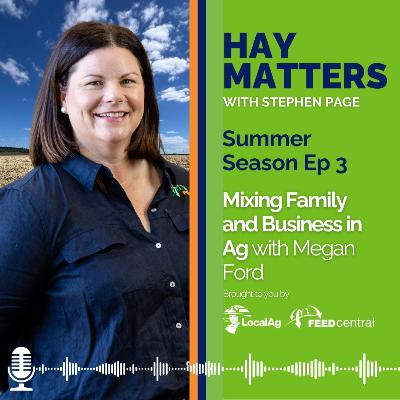
In this Summer Series episode of the Hay Matters Podcast, brought to you by LocalAg and Feed Central, host Jon Paul Driver chats with Megan Ford about her path into agriculture, the growth of Feed Central, and the changing role of women in the industry.Megan reflects on the early days of building a business alongside her husband Tim while raising a young family, sharing the realities of juggling growth, family life, and big ideas. From kitchen-table planning and conversations on the go, to moments that tested resilience, this episode offers an honest look at what it takes to build something lasting.Listeners will hear about the pivotal 2014 hay shed fire and how strong family, team, and community support helped shape Feed Central’s future. Megan also highlights the impact of women’s networks such as the Queensland Rural Women’s Network and Australian Women in Agriculture, and how mentorship and connection have supported leadership and confidence along the way.The conversation also unpacks the thinking behind LocalAg—a platform developed over years of listening to farmers and customers, designed to reflect how producers want to do business today: with flexibility, transparency, and trust at the core.A thoughtful and inspiring episode about resilience, relationships, and evolving agriculture in Australia.
In this episode of Hay Matters, host Jon Paul Driver chats with Marty Conroy, Agronomy Services Lead for Northern Australia at Barenbrug Seeds. From Northern NSW, Marty provides a practical look at tropical pasture systems across Queensland, the NT, and northern NSW. He unpacks the science behind C3 and C4 grasses, explains how feed quality drives profitability, and highlights the untapped potential of pasture management and modern breeding programs.Marty explains how pasture breeding is now focused on fibre quality, seasonal fit, and regional adaptability. C4 grasses like Rhodes and panicum are critical in northern systems, with planting tied to rainfall and temperature windows. Feed quality is key to intake, weight gain, and financial returns.The episode also explores accelerated breeding through genomic tools, underutilised C4 pasture management strategies, strategic input use such as nitrogen, and the importance of benchmarking paddock performance year-on-year to make smarter decisions in unpredictable seasons.
In this Summer Series episode of Hay Matters, Tim Ford and Grower Services Manager, Steve Page, revisit one of the most unique fodder stories we’ve come across — the unearthing and marketing of four- to five-year-old haylage buried in underground pits near Warren, NSW. This episode follows the full journey: from the moment new property owner Pat Hull realised he had up to 1,000 tonnes of haylage hidden beneath mounds on his driveway, to uncovering the pits, testing the feed, and successfully selling it to Victorian dairy farms through LocalAg.Steve first sets the scene, explaining how Pat discovered the buried forage sorghum bales left by the previous owner, who had sealed them underground during the exceptional 2020 season. When tight feed supplies hit southern Australia, Pat decided it was time to dig them up. The results were surprising — despite years underground, the haylage tested extremely well, with strong protein, energy and fibre readings. With quality confirmed, the product was listed on LocalAg, attracting interest from buyers across VIC and SA, all while avoiding the hassle of endless phone calls and unvetted enquiries.Listeners also hear from Ben Wright of Central West Contracting, the contractor who originally cut, conditioned, raked, baled and buried the haylage. Ben explains the conditions in 2019–20, how the crop was made into haylage due to cooler winter weather, the bale specifications used, and why buried feed can remain in top condition even decades later. Together, Pat and Ben offer a full picture of how buried haylage works, its value as a drought-proofing strategy and how modern tools like LocalAg make marketing niche products simpler than ever.
In the final Hay Matters episode of the season, host Steve Page sits down with Tim Ford, Managing Director of Feed Central and LocalAg, to reflect on an eventful year for the fodder industry. They unpack the challenges and opportunities across regions, discuss how the Feed Central and LocalAg partnership has evolved, and share insights on what 2026 might hold for hay growers, traders, and buyers across Australia.1. A Year of Change and GrowthFeed Central and LocalAg have formally separated their Quality Assurance and Marketplace functions, creating independence and clarity for clients.The focus moving forward is helping farmers understand how both arms work together to improve transparency and trust.2. A Tough but Rewarding SeasonSouthern regions faced weather damage and tough conditions, while Central and Northern NSW and Southern Queensland enjoyed exceptional hay quality and yields.Modern cropping techniques are producing strong results despite low rainfall — proof of innovation in the industry.3. Diversity Builds ResilienceSuccessful growers are those who diversify — balancing hay, grain, pulses, storage, and even transport.Flexibility in switching between hay and grain helps spread risk and manage volatile markets.4. Quality and Trust Drive ProfitFeed Central’s Quality Assurance System ensures consistency in testing and grading — giving buyers confidence and helping sellers achieve premium prices.A recent standout sale of vetch hay highlighted how quality, testing, and transparency lead to win–win deals.5. Technology Meets RelationshipsThe new LocalAg platform allows direct communication between buyers and sellers, backed by Feed Central’s support team and Check Vault secure payments.Relationships remain central — technology enhances, not replaces, the trust built in the paddock.6. Market Volatility and the Road Ahead2025 has been one of the most volatile years in 25 years of hay trading.Tim predicts record hay prices again in 2026, driven by inevitable dry spells and unprepared buyers.The aim for the coming year: education, stability, and better-informed trading across the industry.
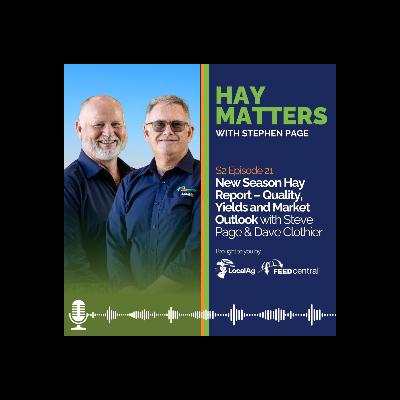
In this episode of Hay Matters, recorded on Thursday 16 October 2025, Cara Stewart steps in as guest host to chat with Feed Central’s Grower Services Manager and Podcast Host, Steve Page and National Sales Manager, David Clothier. Between Steve’s time on the road inspecting new season hay and Dave’s work connecting buyers and sellers across Australia, they bring an on-the-ground look at what’s happening in the hay market right now.From the standout quality in southern Queensland to the first vetch crops ever inspected west of Goondiwindi, this episode unpacks the season’s early results, key market movements, and what both growers and buyers should be planning for in the months ahead.Key Topics Covered:Early results from the 2025 hay season across Queensland and New South WalesRecord-quality cereal and vetch hay and the first inspected lots from Western AustraliaHow strong hay-to-grain gross margins are influencing grower decisionsNational inspection results: 22,000 tonnes tested and graded through Feed CentralMarket trends as buyers restock after starting the year with “empty cupboards”Pricing realities for shedded hay versus paddock stacksThe importance of feed testing, visual grading, and on-farm inspectionsHow proper stacking, sheds, and hay caps protect product and maximise returnsShort-term and long-term market outlook, including livestock demand and export interestPractical advice for both buyers and sellers navigating a busy seasonWhy Listen? This episode offers a grounded look at the new season’s realities - from paddock conditions to price dynamics. Whether you’re producing, storing, or buying hay, you’ll find practical insights to help make informed decisions this season. It’s an honest conversation about quality, supply, and the smarter ways to market and manage your hay in 2025.
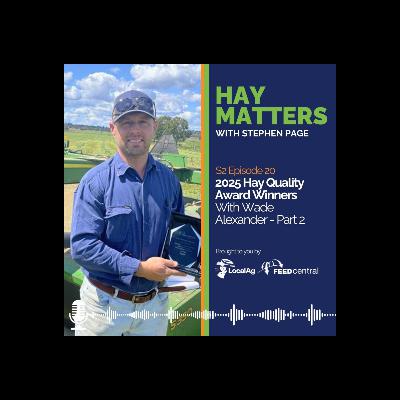
In this follow-up episode, Steve Page continues his conversation with award-winning lucerne hay producer Wade Alexander from Mundubbera, QLD.Wade opens up about the tough lessons learned from the 2013 floods, his approach to risk management, and how he’s future-proofing his family farm through smart planning, water efficiency, and sound financial strategies.🌾 Key Topics Covered:Floods, storms and lessons learned: How the Alexanders rebuilt stronger after disaster struck.Insurance and risk management: The value of insuring for the worst and learning from the past.Efficient irrigation and rising power costs: Why Wade is transitioning from high-pressure pivots to low-pressure laterals.The economics of lucerne: Balancing high machinery costs, input efficiency, and quality production.Lucerne establishment and management: Soil prep, fertiliser programs, and why Wade replants every three years.Marketing through Feed Central and LocalAg: Building trust, ensuring secure payments, and staying connected to repeat buyers.Family, work-life balance, and resilience: Why Wade chooses life on the farm over high-income work away from home.🎙️ Why ListenThis episode delivers a grounded look at what it takes to survive and thrive in Australia’s hay industry. Wade shares the reality behind producing premium lucerne - from irrigation and power costs to marketing and resilience - offering practical insights for farmers of any scale.
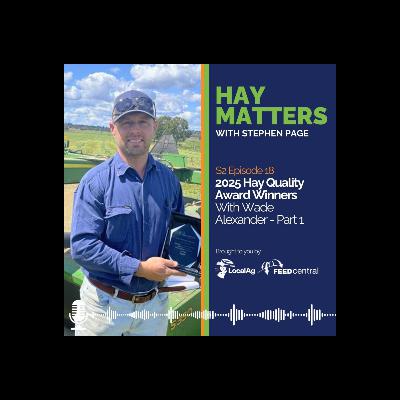
In this first of a two part series of Hay Matters, Steve Page speaks with Wade Alexander from Mundubbera, Queensland - the winner of the Queensland Visual Lucerne Hay Award and the National Dual Visual Award.Wade shares his journey from growing up on a poultry farm to becoming a lucerne hay producer. After floods devastated his family’s property in 2013, Wade rebuilt with a new focus on irrigation and hay production, leaning on his engineering background to master the machinery and systems needed to survive.Key Topics Covered:Wade’s shift from poultry and cattle to lucerne hayThe role of irrigation bores and Mundubbera’s unique conditionsMachinery choices: from round balers to big square balesBuilding a customer base and working with Feed CentralWeather challenges in Queensland and how Wade manages risk in hay productionUsing inoculants and moisture management to maintain hay qualityThe importance of off-farm income and contracting to spread financial riskForward planning, financial management, and why storage doesn’t always equal “money in the bank”Wade’s mindset on risk, resilience, and what keeps him motivated each morningWhy Listen?This episode is full of practical insights for farmers navigating hay production and trade - from managing machinery and weather challenges to making financial decisions that reduce risk. Wade’s story is a testament to resilience, innovation, and the value of producing quality hay that customers can trust.Next Episode (Part 2): Wade will share how he manages disasters, his lucerne planting cycle, and future plans for his farming operation.
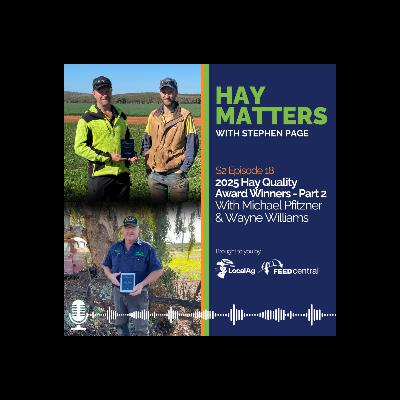
PODCAST HIGHLIGHTSIn this episode of Hay Matters, brought to you by Local Ag and Feed Central, Steve Page continues celebrating this year's National Hay Quality Award winners with another outstanding partnership. In the Riverina, Michael Pfitzner has secured back-to-back vetch hay Visual Awards – the National winner last year and NSW State winner this year, working closely with contractor Wayne Williams to achieve consistently exceptional results. Their collaboration showcases the precision timing and equipment choices that separate award-winning hay from the rest of the field.● Michael and Drew Pfitzner operate 3,400 hectares (8,500 acres) of cropping in the Riverina with vetch comprising 10-12% of their rotation alongside other legumes including lupins, lentils and peas.● Their award-winning vetch hay achieved 3-4 tonne per hectare yields across multiple paddocks, with the state award-winning lot stored under hay caps in the paddock and successfully avoiding rain damage.● Wayne Williams uses a Claas 930 with triple 10-meter mowers cutting 50 acres per hour, followed by a 10-meter merger for windrow management and a New Holland 1290 HD baler with loop knot system producing 650kg bales.● Strategic use of silage inoculant proved crucial when September weather turned challenging, with only 20 out of 1,000 bales showing heat issues after rain events that required re-working the windrows.● Michael has used the Local Ag Marketplace platform and likes that it provided secure payment systems and is creating trusted buyer-seller relationships through built-in messaging and transparent transaction processes.● Machinery ownership challenges drive contractor relationships, with Wayne’s specialised equipment including merger technology capable of combining 2-5 windrows and shifting material up to 30 feet in single passes for optimal bale density.● Wayne had a devastating shed fire last year that destroyed 1,000 tonnes of lucerne-sorghum mix hay after seven weeks in storage, highlighting critical insurance lessons with shed values nearly doubling during the four-year period since construction.
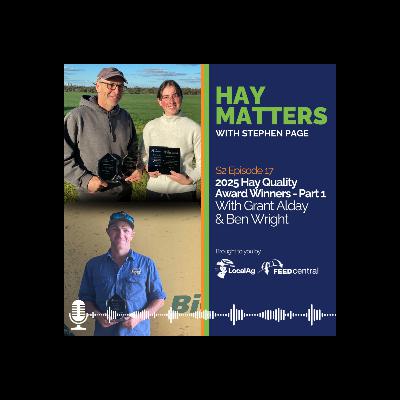
In this episode of Hay Matters, brought to you by LocalAg and Feed Central, Steve Page catches up with two of our 2025 National Hay Quality Award winners - Grant Alday and Ben Wright. At Sea Lake in Northwest Victoria, grain grower Grant turned a challenging frost-damaged season into profitability by pivoting to hay production, earning both National Cereal Hay Feed Test and Visual awards. Meanwhile, contractor Ben Wright from Central West Contracting shares insights into achieving the National Heaviest Cereal Straw Bale award and the equipment strategies behind consistent, high-density bale production.Grant Alday's mixed farming operation at Sea Lake typically dedicates 8-10% of area to oat hay and another 8-10% to vetch, but last season's widespread frost damage prompted an opportunistic shift to cut hay across multiple paddocks.The decision to cut frost-damaged crops for hay transformed what would have been a break-even season into a profitable one, with over 9,000 bales produced compared to their typical 4,000-6,000 bale annual output.Strategic hay cutting eliminated harvest headaches by removing problematic regrowth areas and avoiding the challenge of blending mature grain with frost-damaged sections, particularly in lower-lying paddocks with retained moisture.Chemical withholding periods became a critical timing consideration, with fungicide applications creating mandatory waiting periods before hay cutting could commence on treated paddocks.Ben Wright's national heaviest cereal bale award-winning wheat straw averaged 14.2% moisture and was produced using an eight-string Krone baler, achieving bale rates of up to one every 20 seconds in optimal conditions.Eight-string balers offer some advantages over six-string models through improved durability, fewer string breaks, heavier bale weights for better storage efficiency, and reduced transport costs per tonne.Ben's two eight-string Krone balers each process 15,000-20,000 bales annually, with comprehensive yearly maintenance programs focusing on VFS systems, knotters, and bushes to maintain peak performance.
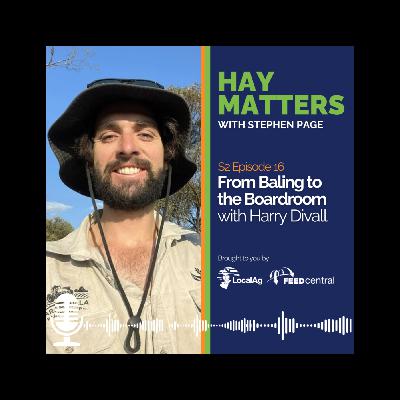
Podcast Highlights In the latest episode of Hay Matters, brought to you by LocalAg and Feed Central, Steve Page catches up with Harry Divall; hay contractor, grower and AFIA board member. Harry shares his path from livestock work in Goulburn to running a growing hay operation across West Wyalong, Stockinbingal, and Crookwell. He shares the ups and downs of learning how to make quality hay, how he manages seasonal risk, and what he hopes to contribute to the fodder industry.Harry left school early and started fencing and working cattle near Goulburn before setting up a mixer on the family farm to boost weight gains in steers and heifersCold conditions limited hay production at home, so his family expanded west and bought their first baler, a Massey 2270XD, in 2016He now operates two Krone balers and produces between 15,000 and 25,000 bales a year, depending on the seasonWith farms spread across Goulburn, Stockinbingal and West Wyalong, he uses geography to manage weather risk and extend the cutting window from September to JanuaryCrop rotations include oats, barley and vetch out west, with canola, oats, barley and lucerne on the Stockinbingal farmHarry adjusts his plan each year, converting crops to silage or grain when conditions aren’t right for hayShed storage now holds over 2,000 bales, but he’s also experimenting with tarping, aiming to protect quality from the bottom upAs a new AFIA board member, Harry wants to make learning resources more visual and hands-on, helping others see what good practice looks like in the paddock
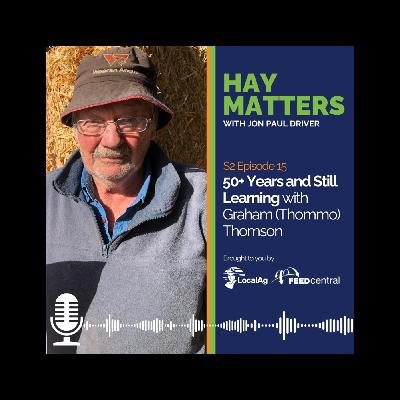
In the latest episode of Hay Matters, brought to you by LocalAg and Feed Central, we welcome back a familiar voice. Graham (Thommo) Thomson joins Steve Page live from the 2025 AFIA Conference to reflect on one of the toughest seasons he’s seen in more than five decades. With his hard-earned perspective, Thommo shares how he kept going through record-low rainfall, what he saw on the road north, and why he’s still not ready to retire.Thommo shares that this past year brought the lowest rainfall he’s recorded in 52 years of daily measurements on his farm, and how a patch of leased river country helped him scrape throughHe talks about the daily challenge of feeding stock when there’s nothing in the paddock — and how sheep were chasing anything that looked like a baleA long drive to the Gold Coast revealed just how bare things are, with empty sheds and only small loads of hay moving southDespite the tough conditions, livestock prices stayed strong, giving some much-needed breathing roomThommo shares why he keeps showing up to the AFIA Conference, and what’s changed (and stayed the same) in the industryHe’s not retiring yet — with a capable apprentice at home, he’s keen to learn more about tech and continue mentoring the next generationAnd before we go… Jon Paul shares a quick update: he’ll be handing over the hosting reins to Steve and Alex, as he focuses on some exciting new projects with Feed Central. He’ll still pop in from time to time — and he’s looking forward to sharing what’s next.
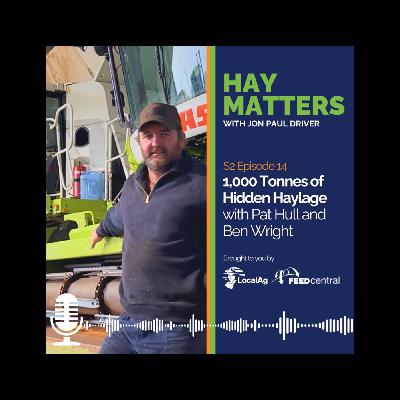
Podcast Highlights In this episode of Hay Matters, brought to you by LocalAg and Feed Central, Grower Services Manager Steve Page hits the road to uncover a unique regional story of buried haylage, long-term storage, and unexpected opportunity.When grain grower Pat Hull purchased a property near Warren in 2022, he wasn’t expecting to find over 1,000 tonnes of buried forage sorghum haylage stored in pits by the previous owner, following the drought-breaking rains of 2020. With no livestock of his own and limited on-farm use, Pat turned to LocalAg to connect with buyers further south, and the response was immediate.The haylage was originally cut, baled and buried in 2020 by contractor Ben Wright from Central West Contracting, after strong summer growthBales were stacked four high in excavated pits, wrapped in plastic and sealed with soil for long-term storage and pest protectionFeed tests returned excellent results for aged haylage: 12.4% CP, 9.25 MJ/kg ME, 51.4% NDF, 35.7% ADF, and 41.7% DMPat listed the product on LocalAg using original baling photos, generating national interest before opening any pitsWith feed shortages in Victoria, the first truckload has already moved to southern dairies, with more to followHay contractor Ben Wright shares practical insights on why buried haylage works, key moisture thresholds, and how proper handling influences long-term results
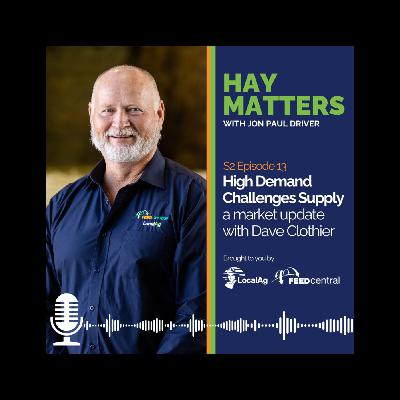
Podcast Highlights In this episode of Hay Matters, brought to you by LocalAg and Feed Central, Jon Paul Driver is joined by National Sales Manager Dave Clothier to unpack current fodder market conditions. With drought in the south driving record demand and pushing prices up fast, Dave explains what’s moving across the country and what’s not — and what buyers and sellers need to know as an early northern season begins to take shape.April and May marked one of the busiest trading periods Feed Central has seen in over 20 years, as drought across southern NSW, Victoria and SA pushed up demandMany southern growers held onto hay, concerned the dry conditions would extend north, which further tightened supply during a period of rapidly increasing demandRain has restored some confidence but feed shortages are expected to continue for six to eight weeks while pasture growth catches upWhile Western Australia and Northern Territory have good supply, biosecurity restrictions and high freight costs are limiting movement eastPrices are sitting above $400 ex farm for cereal hay and $600 for lucerne, with freight adding up to $350 per tonne and some landed prices topping $700In some cases straw is being transported long distances to fill gaps in southern supply and buyers are feeding at any cost to retain core breeding herdsNorthern Australia is set for an early season with cereal hay cuts expected from mid July while southern crops remain four to six weeks behindWith the new financial year underway, more growers are releasing hay to the market but windows are narrow and buyers should act quicklyPrice pressure is expected to remain until southern yield prospects become clearer
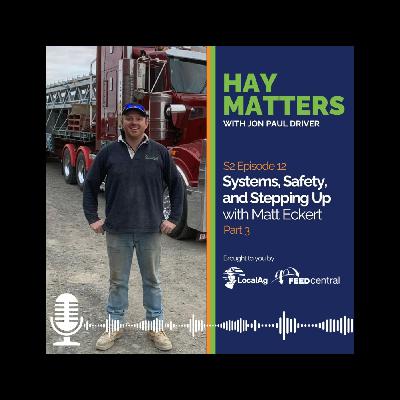
Podcast Highlights In this episode of Hay Matters, brought to you by LocalAg and Feed Central, host Jon Paul Driver concludes his three-part series with South Australian farmer Matt Eckert. This final instalment shifts focus to the financial, mechanical, and personal pressures that often sit behind the paddock - and how Matt and his team are navigating them.From soaring machinery costs and safety scares to family life, team trust, and planning for the future, this conversation reveals the daily challenges that aren't always get discussed, but shape everything on the farm.Why machinery costs are blowing out and how that’s reshaping timelines for soil improvement and capital investmentWhat efficiency really looks like across an operation, and how mismatched upgrades can create new bottlenecksLessons from scaling up hay production, from baler selection to matching loaders, trucks and shed spaceHow past safety incidents have prompted changes in processes and a stronger focus on risk managementWhy trust and teamwork are central to how the farm operates today and how stepping back has helped others step upThe juggling act of parenting, marriage and leadership and how Matt is learning to keep farm pressures from following him homeWhat tough seasons have taught Matt and why backing your people makes all the difference
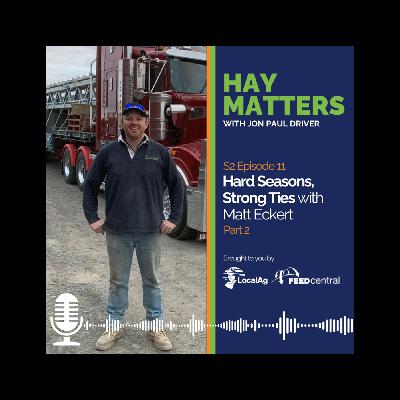
In this episode of Hay Matters, brought to you by LocalAg and Feed Central, host Jon Paul Driver continues the conversation with South Australian farmer Matt Eckert. In Part 2 of this three-part series, Matt opens up about the people, mindset, and decisions that help keep the wheels turning during hard seasons.From financial pressure and breakdowns to succession planning and emotional burnout, this episode digs into the less visible side of managing a large farming operation in a drought — and the personal resilience it takes to carry it through.How a tight-knit team, family loyalty, and off-farm connections have helped carry the business through some of its hardest seasonsWhy your relationship with the bank needs to be built before things go wrong — and how it pays off when flexibility is neededThe story behind three trucks, a 53-metre road train, and how hauling hay turned into a lifelineWhy adaptability beats prediction - and how building practical ability into the business opened unexpected doorsHow a shared focus on quality and ag systems has strengthened a long-standing working relationship with Feed Central and LocalAgWhy succession planning, clear communication, and staying close as brothers matters more than ever in generational farmingHow back-to-back breakdowns, fires, and a sudden dry season pushed mental resilience to the limitMatt’s advice for getting through the hard seasons - and why they sometimes bring the clarity needed to change direction
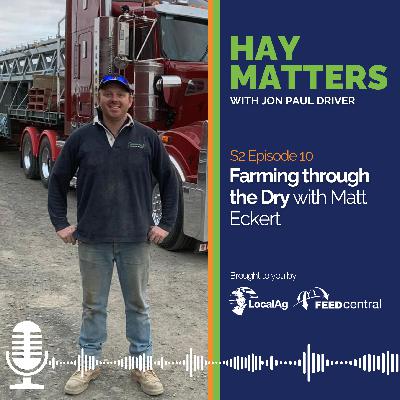
Podcast Highlights In this episode of Hay Matters, brought to you by LocalAg and Feed Central, host Jon Paul Driver speaks with South Australian grower Matt Eckert in the first of a three-part series. Matt shares a candid look at the decisions, trade-offs, and resilience required to keep a mixed farming operation running during a prolonged dry spell.With the region facing one of its hardest seasons in recent years, Matt opens up about the real impact of drought — from feed shortages and pasture losses to the mental load of managing stock and cropping programs when nothing goes to plan.Drought pressure is forcing a rethink of pasture renovation and cropping programs across mixed farmsResowing lucerne has its limits - and knowing when to push on or start again is shaping long-term plansSoil amelioration, including deep ploughing and clay spreading, continues to improve outcomes but isn’t a fix-all in extreme seasonsSeeding strategies are being adjusted in real time, with lessons from previous dry years influencing crop timing, inputs, and variety choiceEarly fodder purchasing and stored inventory have been critical in keeping livestock fed and breeding programs afloatDecisions around feeding, destocking, and confinement lambing are being made fast, with economics and animal welfare front of mindWhile the short-term outlook is tight, a clear long-term view is helping guide every decision on the farm

Comments

Download from Google Play

Download from App Store
 United States