DiscoverInterior DesignHer
Interior DesignHer
Claim Ownership

Interior DesignHer

Author: Interior DesignHer

Subscribed: 1Played: 20
Share

Description

Welcome to the Interior DesignHer Podcast


Are you an interior designer or own an interior design business looking to elevate your success? Look no further! Join us on the Interior DesignHer Podcast, where we bring the absolute best, real-world business education to interior designers.


Hosted by Douglas Robb, a business nerd and interior design fanboy, each episode brings you invaluable insights and strategies to thrive in the competitive landscape of interior design. From mastering operations to dominating marketing, public relations, and social media content, we cover it all.


And none of it is fluff. We push each of our guests to share the stuff that actually works.


We don't talk about design trends and color palettes. We're all about the business side of things. Get ready for candid conversations with top-notch business experts from diverse niches. Whether you're a seasoned designer or just starting out, our goal is simple: to empower you with the knowledge and tools to build a thriving interior design empire.


But…the hard part is up to you. Implementing all that knowledge and putting it to work to take your business / career to the next level.


Tune in every Monday for your weekly dose of inspiration, education, and actionable tips. Don't miss out on your chance to transform your passion for design into a wildly successful interior design business.


Subscribe now to the Interior DesignHer Podcast and let's make your interior design BUSINESS dreams a reality!


41 Episodes
Reverse
Episode #44 - Season 3, Episode 8Format: Solo DTC Runtime: ~26 minutesEpisode Overview:Most interior designers who feel underwhelmed by AI aren't doing it wrong — they're skipping three of the four layers that determine whether AI gives a specific, useful answer or a generic one built for a fictional designer avatar. Doug breaks down all four layers (Specification, Intent, Context, and Prompting) from least to most important and demonstrates the framework through two real AI sessions — one focused on AI image generation for a concept render, one on Instagram strategy for a kitchen and bath specialist who had 7,000 followers and almost zero client inquiries from the platform.Chapter Timestamps:00:00 — The difficult client email problem: what AI was supposed to fix00:41 — What "fine" actually means when AI helps you draft something01:17 — The BlackBerry moment: why designers go quiet about AI02:00 — The gap between what you were promised and what you got is real02:40 — Why AI fails: the interior design client analogy03:30 — "It knows just about everything, but it doesn't know you"04:10 — The four layers, from least to most important04:29 — Why prompt engineering is the icing, not the cake05:08 — Layer 3: Context — what AI needs to know about your specific world05:44 — Layer 2: Intent — the difference between a task and an outcome06:21 — Layer 1: Specification — what "done" actually looks like07:26 — Why going back and forth with AI is slow and starts from scratch each time08:19 — Case study 1: Sarah and the AI image generation problem10:26 — Three gaps Doug identified in Sarah's approach13:35 — What happened when Sarah addressed all four layers14:11 — Case study 2: The Toronto kitchen and bath designer on Instagram15:08 — Introducing AI Sherpa and how it works differently16:35 — What regular Claude gave her vs. what AI Sherpa asked instead19:46 — What AI Sherpa actually surfaced: the intent gap21:09 — The context gap: why beautiful photos aren't enough for luxury clients22:00 — "Her feed was showing the destination. The journey is what clients are buying."22:44 — The caption Claude built once it had everything it needed23:39 — The specification gap: one caption vs. a system that works every time24:47 — Why Doug built AI Sherpa and what it actually does25:36 — Waitlist for AI Sherpahttps://robbandco.myflodesk.com/aisherpa
Season 3, Episode 7 (Episode #43)Solo episode. No guest. Doug introduces a three-layer framework for AI output quality — Intent, Context, and Prompt Engineering — and explains why most designers are over-investing in the least important layer. Uses two fictional designer archetypes to illustrate both ends of the experience spectrum. Introduces his Socratic AI tools as the solution to the context extraction problem that the framework alone doesn't solve.Chapter Timestamps[00:00] Why your AI results are "fine but not good enough"[00:41] Meet Maya — the tech-comfortable designer still getting mediocre results[03:40] The three layers that determine AI output quality[04:05] Layer 1: Prompt engineering — and why it's the least important[05:23] Layer 2: Context engineering — what AI doesn't know about you[06:13] The junior designer analogy[07:29] Layer 3: Intent engineering — outcome vs. task[08:43] How the three layers work together (the hierarchy)[09:02] The outreach email example — generic vs. intentional[11:12] Meet Carol — 22-year veteran who set AI aside[13:16] Why experienced designers can't manually transfer expertise to AI[13:33] Doug's Socratic AI tools — drawing context out through questions[14:46] Carol's breakthrough: 22 years of expertise finally articulated[18:14] What's coming next + how to work with DougMore videos on intent and context engineering: coming soon
Season 3, Episode 6 (Episode #42)Marsha Sefcik brings corporate operations expertise to interior designers who excel at design but struggle with business structure. In this conversation, she diagnoses why talented designers often earn far less than they're worth - not due to lack of design skill, but because business chaos prevents them from seeing where time and money disappear. Marsha explains her personalized coaching approach that rejects cookie-cutter systems, why she refuses to make "6-figure guarantee" promises, and how her "Bring Calm to Chaos" program helps designers audit their businesses to identify what she calls "chaos leaks."Key Topics Covered:[00:22:17] Marsha's Journey from Corporate to Design ConsultingTransition from corporate sales/marketing to interior designDiscovering MyDomaine platform and supporting designersRecognizing pattern of overwhelmed solo designers lacking business operations[00:28:01] Why Designers Earn Less Than Their WorthPeople-pleasing tendencies and underpricing patternsHow low compensation leads to burnout and resentmentThe importance of client qualification processes[00:30:20] The "Bring Calm to Chaos" Program PhilosophyPersonalized mentorship vs. one-size-fits-all systems90-day program focused on business auditNo grandiose financial promises - focus on feeling better about business[00:40:25] Establishing Boundaries and Managing ExpectationsSetting communication boundaries with clientsImportance of detailed welcome packetsProactive communication to prevent client anxiety[00:46:36] Project Qualification and Pricing StrategyCreating qualification processes for ideal clientsWalking away from projects that don't alignUnderstanding your capacity and profitability needs[00:56:55] Client Trust and the Personal Nature of DesignAcknowledging the vulnerability of welcoming designers into homesDesign as luxury, personal service requiring trust[00:58:28] Finishing Strong: The Offboarding ProcessWhy project endings determine referrals and repeat businessCreating story and connection vs. transactional relationshipsMaking memorable final impressions[01:01:22] Learning from Mistakes and Maintaining RelationshipsCustom window seat fabrication error storyProactive SOP audits after mistakesSolution-oriented approach vs. blame[01:08:11] AI and Technology Integration in DesignEmbracing technology for backend efficiencyBeing transparent with clients about AI useAI limitations in physical design execution[01:13:23] Digitizing Operations with Client PortalsEliminating email chaos through centralized systemsClient access to project details, statements, rendersStreamlined onboarding with integrated proposals and invoicing[01:17:05] Time Tracking as Business Audit FoundationTracking time regardless of billing methodIdentifying "chaos leaks" where money disappearsHybrid billing: flat fee for controllable variables, hourly for unpredictable stages[01:19:35] There's More Than One Way to Build a Design BusinessAutonomy and flexibility in business structureSuccess looks different for everyoneCustomized approach based on designer's season of life[01:22:05] Working with MarshaComplimentary discovery call to ensure good fitOne-on-one personalized program structureWeekly newsletter with tips and resourcesResources Mentioned:Marsha Sefcik's website: marshasefcik.comInstagram: @marshasefcik (DMs welcome)Weekly newsletter: 3 tips + 2 resources every Friday"Bring Calm to Chaos" 90-day programGuest Background:Marsha Sefcik transitioned from corporate sales and marketing to interior design and eventually business consulting after recognizing the gap between design talent and business operations. She specializes in working with designers who want to build profitable, sustainable businesses without rigid systems or hustle culture. Her approach emphasizes personalized mentorship, business audits to identify inefficiencies, and creating structure that allows designers to show up how they want while remaining profitable.
Season 3, Episode 5 (Episode #41)Far too many interior designers either avoid art entirely or let clients make expensive mistakes that undermine years of design work. Sarah Hurt built Seattle Art Source specifically to solve this problem for residential interior designers nationwide.What You'll Learn:Why art is the finishing layer that distinguishes luxury design practices from basic decorating servicesHow art sourcing specialists work with designers at any stage of a project (from initial concept to final installation)The truth about designer discounts, markup strategies, and how public pricing eliminates client frictionSarah's "bulletproof" commission process that prevents the expensive mistakes designers encounter when sourcing art independentlyWhy lighting considerations make early art integration critical for new construction projectsHow art creates natural touchpoints for staying connected with past clients and generating repeat revenueThe difference between being art-fluent and being an art expert (and why designers don't need to be both)Key Timestamps:[00:43] Sarah's origin story: Creating Seattle Art Source to lower the barrier to art access[02:13] How art sourcing works for interior designers (the designer's perspective)[07:39] What designers are missing by not including art in their service offering[08:32] Why art is like having a marble specialist in your back pocket[12:04] The repeat business opportunity: Art evolves faster than furniture[17:04] The expertise gap: Why being artistic doesn't make you an art expert[18:41] The client disaster scenario: When homeowners pick art independently[21:23] Financial benefits: Designer discounts and billing flexibility[24:10] Why public pricing eliminates awkward discount conversations[25:06] Expensive mistakes: Why art can't be returned and how to prevent buyer's remorse[27:40] Lighting considerations: Why art specialists need to be involved early[30:40] Different designer working styles: Using art specialists as a store vs. consultant[32:20] Geographic flexibility: Working with designers nationwide[34:26] Lowering the intimidation barrier: Art doesn't have to be rarefied or expensiveResources Mentioned:Seattle Art Source website: seattleartsource.comContact Sarah directly: sarah@seattleartsource.comPrice range: Original art from hundreds to mid-range ($1,800-$2,500 average)40 artists represented, primarily Pacific Northwest regionAvailable nationwide with shippingAbout Sarah Hurt: Sarah Hurt founded Seattle Art Source 10 years ago (celebrating their 10th anniversary this year) after experiencing firsthand how intimidating and disorganized the art buying process felt. She built a business model specifically around servicing interior designers, offering by-appointment consultations, mockups, renderings, and designer discounts. Her approach removes the intimidation factor from art purchasing while preventing the expensive mistakes that happen when clients buy art without guidance.
Season 3, Episode 4 (Episode #40)Human-First AI: Your Experience Should Be BetterThe Problem with Generic AI: Why your current experience with tools like ChatGPT feels like "meaningless busy work".The Productivity Edge: Real-world research showing that organizations ready for AI see a 2.4x higher productivity gain than those who resist.Cognitive Load & Critical Thinking: How removing tedious tasks from your plate allows your brain the freedom to think deeply about your design projects.The Digital Roundtable: A breakdown of Sam’s custom-built tool that researches and creates specific expert avatars to act as your firm's advisory board.Change Management: Understanding the "status quo bias" and "loss aversion" that makes adopting new tech feel naturally uncomfortable for humans.Practical Implementation: Turning site visit audio and site notes into automated employee tasks to reclaim your time.
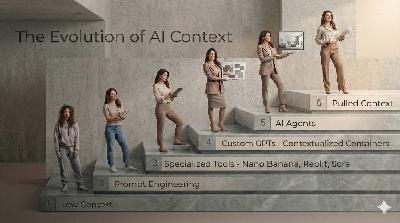
AI Without Context Is Completely Useless: The 6-Phase EvolutionGenius without context is useless. That principle explains everything about AI in 2025.Imagine hiring the world's smartest marketing manager. Unparalleled genius who knows everything about marketing, branding, social media, and client psychology. On day one, you tell them "update our marketing campaign." What happens? They produce generic garbage. Not because they're not smart—because genius without context is useless.AI works exactly the same way.The 6-Phase Context Evolution Framework:I've identified six distinct phases in how AI companies have approached the context problem. Understanding these phases changes how you evaluate every AI tool.Phase 1: Low Context (ChatGPT Launch, 2022-2023) When ChatGPT launched, we treated it like Google. Short questions, immediate answers. For six months, this was mind-blowing. After that? We realized the responses were surface-level and basic. Without context, AI matches generic patterns and delivers generic answers. This is when we all learned that AI without context is useless.Phase 2: Prompt Engineering (2023)AI experts told us the problem was our questions. We needed to become "prompt engineers." Better prompts would get better answers. For a while, prompt engineering was positioned as the career of the future. The underlying issue remained: we were trying to cram context into every single prompt. Unsustainable and inefficient.Phase 3: Specialized Tools (2023-2024) AI companies realized they could pre-load context into specific tools. Image generators like DALL-E and Midjourney. Video generators like Sora. Website builders and app creators. These tools have context built in—you don't need to engineer prompts because the tool already understands its specific purpose. This was the first major breakthrough in solving the context problem.Phase 4: Contextual Containers (2024) Custom GPTs from OpenAI. Claude Projects from Anthropic. Gemini Gems from Google. These tools let you load context once and have the AI reference it forever. You don't have to re-explain your business, your preferences, or your situation in every conversation. The AI remembers. This solved the "forgetting problem" and made AI dramatically more useful for ongoing work.Phase 5: AI Agents (2024-2025) The difference between a custom GPT and an AI agent: agents take action. You ask, they do. They rely on the context you've given them, then go execute tasks. They don't just answer questions—they perform work based on contextual understanding of your needs.Phase 6: Hold Context / Socratic AI (Emerging 2025) The future phase most AI companies aren't implementing yet because it's complicated and resource-intensive. Instead of just storing your context or waiting for you to provide it, the AI actively pulls context from you through intelligent questioning. Socratic AI asks follow-up questions to extract nuanced understanding before answering. This dramatically improves results but requires significant AI processing power.What Every Phase Has In Common:Look at all six phases. What do you see? Incremental improvements on context. AI companies are either:Making it easier to provide context (custom GPTs, Claude Projects)Pre-loading context into specialized tools (DALL-E, Sora)Extracting context intelligently (socratic questioning systems)OpenAI, Anthropic, and Google all realize the same thing: the gap between AI's super intelligence and your specific needs closes through better context delivery. Every evolution of AI so far has involved improving how context gets captured, stored, referenced, and utilized.Why This Framework Matters:Next time you use ChatGPT, Claude, or any AI tool and don't get the answer you wanted, realize the problem isn't the AI's intelligence. It's the context you gave it.You have four options:Get better at prompting (free, requires skill development)Use custom GPTs and Claude Projects (costs money, much better results because context persists)Find socratic AI tools that pull context from you (expensive, best results, limited availability)Wait for AI companies to build better context into existing tools (they're actively working on this because they know context is the problem)The Underlying Principle:AI companies understand that genius without context is useless. That's why every major AI advancement focuses on solving the context problem. Understanding the six-phase evolution puts you ahead of almost everyone using AI because you can evaluate tools based on how they handle context.When AI fails, it's almost always because it doesn't have the context it needs about your specific situation, your business, or the question you're asking. Now that you understand that, you can fix it.Episode #39 - s03e03 Next Episode: AI sycophancy (AI glazing). Anthropic just released content about this that's worth examining critically.
Between interviews, I'm sharing my unfiltered takes on AI and business—starting with why most AI education is setting you up for failure.In This Episode:[00:00] Why tool-centric AI education is completely stupid [00:30] Point 1: AI tools change, AI principles don't [01:41] Point 2: You're getting mediocre results with zero barrier to entry [02:27] Point 3: Your confusion is their business model [03:04] Point 4: Speed without judgment is professional malpractice [04:04] Point 5: Pattern recognition isn't education [05:00] Point 6: Tool education creates technicians, not artisans [05:42] Point 7: AI tools are context agnostic (and that's not good) [06:55] Point 8: You become a brand ambassador for tools that limit you [07:52] What's the alternative to tool-centric AI education? [08:30] Coming next: AI glazing—the topic no one talks aboutThe Core Argument:Every week there's a new AI tool. Every time that happens, another tool goes into the AI landfill. Tool-focused AI education has a shelf life of six months or less. You're memorizing tool-specific tricks instead of learning transferable principles. When the next tool launches, you start from scratch.Eight Problems With Tool-Centric AI Education:Tools change, principles don't - Learning MidJourney never taught you Nano Banana. Learning Nano Banana won't teach you the next generation. You're building on sand.Zero barrier to entry means mediocre results - Everyone has access to the same tools. You're paying for knowledge freely available in documentation. Being great at AutoCAD never made someone the best interior designer. Being great at one AI tool won't make your business better.Confusion is the business model - AI educators profit from your anxiety. Every tool launch creates marketing opportunity: "You're falling behind. Your competitors are learning this now." It's subscription revenue disguised as education.Speed without judgment is malpractice - Tool education emphasizes "do it faster, save time, work like a team of four." This trains you to optimize for output volume rather than quality. Speed doesn't always win.Pattern recognition isn't learning - You memorize recipes without understanding cooking. When the recipe fails in new context, you're lost. When tools change pricing, interface, or capabilities, you're back to square one. You were trained to follow steps, not make decisions.Creates technicians, not artisans - It's easier to record screen tutorials showing button clicks than teach decision-making frameworks. Knowing how to use a tool doesn't make you an expert. I can swing a hammer, but you don't want me as your carpenter.Context agnostic education for infinite context problems - Generic "how to use ChatGPT for interior design" courses can't account for your specific client base, market position, design philosophy, or business model. Success is measured by "did you learn the interface?" not "did this improve your business?"You become a brand ambassador - Once you've invested time and money learning ChatGPT, you resist switching to Claude even if it's objectively better. The education creates switching costs that benefit vendors but limit your flexibility. You're stuck.The Alternative:Learning how to think with AI, not just click buttons. Understanding what your specific business needs, what your clients actually value, and how to get AI to understand your unique context—not generic context, but your approach, your markets, your clients. That's not a tool tutorial. That's a completely different type of AI education.Next Episode: AI glazing—the AI topic almost no one talks about.Resources:Interior DesignHer Podcast - https://www.interiordesignher.com/podcastSubscribe for more unfiltered takes on AI and businessLeave a review to help the algorithm show this to more people
Episode 37Season 3 Episode 1:Interior designers with beautiful websites often wonder why they're not generating inquiries. Digital marketing expert Daniela Furtado, founder of Findable Digital Marketing, reveals the gap between aesthetic excellence and search visibility and how to bridge it without compromising your design. In This Episode You'll Discover: Why interior designers who've built successful businesses on word of mouth for 7-8 years are seeing declining referrals and struggling with inconsistent marketing The specific example of Zoe Feldman's website redesign - how a top US designer balanced beautiful minimalist aesthetics with the strategic content Google needs Why "hidden pages" targeting specific cities (Bethesda, Chevy Chase, Alexandria) were ugly but necessary in Zoe's old site - and how her new design elegantly integrates SEO The portfolio storytelling approach that transforms photo galleries into keyword-rich project narratives that both humans and search algorithms understand How top designers use text hierarchy, punchy headings, and strategic photo placement to add more content without looking "stuffy and robotic" Why the interior design industry resists basic marketing principles that every other business sector considers "the ABCs" - and how this creates opportunities for early adopters The pattern Daniela sees in struggling design firms: 7-10 years in business, beautiful professional photography, sporadic social media, zero consistent business development Why firms that are thriving treat marketing as ongoing strategy rather than "punctual projects" like website redesigns or magazine features The adaptability factor: successful designers aren't just consistent with marketing, they've also adapted their services (design days, virtual consultations, small projects) Daniela's track record of doubling client inquiries through holistic strategies combining SEO, social media, email newsletters, and portfolio optimization Key Insight: The designers building sustainable practices in 2025 aren't necessarily more talented - they're strategic about being findable when clients are searching.Connect with Daniela Furtado: Website: findabledigitalmarketing.com Instagram: @findable_digital_marketing Email: hello@findabledigitalmarketing.com Resources Mentioned: Zoe Feldman Design (website case study example) Studio McGee (portfolio storytelling example) Findable Digital Marketing Services: Bimonthly workshops (starting at $50) One-hour consultation with 12-month marketing blueprint ($800) Full-service agency support ($3,000-$5,000/month)
Season 2 Episode 27:Ronniesha Rivera, founder of Vetted by Design, shares her journey from interior design business owner to platform creator. After a costly bookkeeper mistake led to a government audit, she realized the need for a curated marketplace of business professionals vetted specifically for interior design expertise.Key Discussion Points:The specific tax filing error that triggered a government auditWhy general business experts fail interior design clientsThe vetting process for ensuring professional competencyHow to overcome the fear of delegation and hiringBuilding trust with service providers who understand your industryThe platform economics that keep it free for designersGuest Background:Ronniesha owns Alder and Stone Interiors and founded Vetted by Design in January 2025. The platform features vetted business professionals across categories like bookkeeping, marketing, virtual assistance, and project management - all specifically experienced with interior design businesses.
Season 2 Episode 26:Interior designers are losing projects to competitors with inferior portfolios but superior presentation technology. Jessica Lacerda, founder of Be Live 3D, reveals how 3D visualization has become essential for winning luxury design projects.Key insights include:In Brazil, 3D visualization is considered mandatory for professional credibility - "if you don't have it, you are not a good designer"Clients make design decisions based on what they can see, not what designers can explain through words or mood boardsVisualization changes actual client preferences - Jessica's client switched from light to dark colors after seeing rendersThe process requires only floor plans, measurements, and specifications - visualization partners handle technical executionSuccessful designers treat visualization as a business partnership, not just a service provider relationshipFuture technologies like AR/VR will make current mood board presentations obsolete for luxury clientsThe presentation gap between traditional methods and visualization technology is creating winners and losers based on client experience, not design talent.
Season 2 Episode 25:Tired of managing invoices instead of designing beautiful spaces? Interior design business owner Gina Cotner explains the difference between virtual assistants and executive assistants - and why understanding this distinction can transform your design practice.In This Episode:Why interior designers get trapped in administrative work instead of design workThe real difference between virtual assistants and executive assistantsHow to break the feast-famine cycle that plagues most design businessesDelegation strategies that work for creative professionalsROI calculations that justify executive assistant investmentFinding and vetting high-caliber administrative supportGuest Bio: Gina Cotner is the founder of Athena Executive Services, a firm that provides high-caliber executive assistants to small business owners. After spending her early career at IBM, Gina became an entrepreneur before recognizing the need for corporate-level administrative support in small businesses. For nearly 10 years, she's helped business owners - including interior designers - escape administrative overwhelm and focus on their core expertise.Connect with Gina:Athena Executive ServicesLinkedIn: Gina CotnerKeywords: executive assistant, virtual assistant, interior design business, delegation, administrative support, feast famine cycle, design business operations
Season 2 Episode 24: Interior Designers: How to Protect Your Intellectual Property from AI
Season 2 Episode 23: Interior Designers: AI Tech is Changing Fast - Are You Ready - Industry Research Deep Dive
Season 2 Episode 22: Why Talented Interior Designers Lose Projects To...Nikki Rausch - Sales MavenGet Your Free Training from Nikki : https://yoursalesmaven.com/designher/Seal The Deal: Questions That Close SalesHone Your Skills in Asking the Right Questions to Close More DealsAre you tired of wasting time on consultations that lead nowhere?Asking the right sales questions often determines whether you close the deal and gain a new client.In this valuable training, world-class sales expert Nikki Rausch reveals her proven strategy for asking the right questions that lead buyers to confidently say yes to working with you.
Season 2 Episode 21: AI for Interior Designers: Strategic Commentary on Jenna Gaidusek & Laurie Laizure Discussion
Season 2 Episode 20: Meet Google NotebookLM. It's not just a fancy note-taking app; it’s your personal AI assistant that learns only from the information you give it. This means no random internet noise, just insights tailored to your unique business, your clients, and your dreams. Think of it as centralizing your entire business brain into one smart, searchable hub, designed to help you turn information overload into organized action.
Season 2 Episode 19: Interior Designers: Are You Running a Hobby or a Business? - Porsche Williams - The Prototype
Season 2 Episode 18: Interior Designers: Why Less Talented Competitors Get the Luxury Projects (And How to Fix It) - The fractal math approach that transforms $15K room makeovers into $200K whole-home renovationsPosition your interior design expertise for premium projects today. The most accomplished interior designers often face a frustrating reality: watching less experienced competitors land $200,000 whole-home renovations while they compete for $15,000 room makeovers. In this episode of Interior DesignHer, we explore why design talent alone doesn't guarantee luxury projects.This AI-generated podcast discussion, based on educational content about specialist positioning, reveals how interior designers can transform their practice from high-volume, low-value work to premium, transformational projects. We examine the fractal math approach that shows how serving fewer clients at dramatically higher value creates more revenue and wealth.Industry analysis confirms it - specialists consistently out-earn generalists by 40-60% while working fewer hours. The designers who understand specialization, premium positioning, and systematic client progression dominate luxury markets while generalists fight price wars.You'll discover:Why the "cast a wider net" marketing advice keeps you trapped in small projectsThe fractal math approach: how one designer generated $700,000 from the same client base that previously produced $125,000The SEXY framework (Speed, Execution, eXposure, Intimacy) that justifies premium pricingHow specialization eliminates competition and amplifies opportunitiesThe client progression strategy that naturally guides clients toward larger investmentsIf you find yourself competing on price for room makeovers while less qualified designers book luxury renovations, this conversation will transform your approach. Strategic positioning offers a path from background noise to the obvious choice for premium projects.Do This Now: Listen to this strategic analysis and identify one specialization you could own completely before your competitors understand the opportunity.Key TakeawaysSpecialists consistently out-earn generalists by 40-60% while working fewer hours across professional servicesThe fractal math approach: roughly 10% of clients will invest at 10x higher levels when offered more intimate, valuable, tailored servicesThe SEXY framework (Speed, Execution, eXposure, Intimacy) provides the structure for premium value deliverySpecialization doesn't limit opportunities - it amplifies them by making you the undeniable choice for ideal clientsValue-based pricing focuses on transformation delivered rather than hours worked
Transform your AI anxiety into competitive advantage today. While many interior designers worry about artificial intelligence replacing their expertise, smart designers recognize how AI's limitations validate their premium positioning in the luxury market.This AI-generated podcast discussion, based on research comparing human expertise to artificial intelligence capabilities, reveals why experienced interior designers possess irreplaceable advantages that AI will never replicate. Instead of fearing technology advancement, you'll discover how each AI limitation creates premium positioning opportunities.Industry analysis confirms it – while AI excels at generating inspiration and handling routine tasks, clients still need human experts who navigate renovation realities, manage emotional challenges, and create spaces that work for actual lifestyles. The designers who understand these competitive advantages will command higher fees while building stronger client relationships.In this episode, we explore: ✅ Why embodied spatial intelligence gives designers 3x cognitive productivity advantage over AI ✅ How relationship capital and vendor networks create irreplaceable client value ✅ The ethical judgment requirements that position designers as trusted advisors ✅ Why crisis management and adaptation skills command premium fees ✅ How pattern recognition from decades of experience outperforms AI data processingIf you've been anxious about AI replacing interior designers instead of leveraging your irreplaceable human advantages, this conversation will transform your competitive positioning. Strategic understanding of your AI-proof expertise offers a path to premium market dominance.Do This Now: Listen to this competitive advantage analysis and identify which of your irreplaceable human skills you should emphasize more strongly in your client communications.Key TakeawaysAI validates rather than threatens the premium value of experienced interior designers through its documented limitationsThe 10 human advantages create competitive positioning opportunities for higher fees and deeper client relationshipsEmbodied spatial intelligence gives designers measurable cognitive advantages that AI cannot replicate through data processingRelationship capital and vendor networks provide client value that no technology can substitute or automateCrisis management and adaptive problem-solving skills become more valuable as AI handles routine design tasks
Season 2 Episode 16: The Residential Interior Designer's Brand Problem: Why Luxury Clients Choose Your Less Talented Competitors - Ericka Saurit - Saurit CreativeConnect with Ericka: Website: https://www.sauritcreative.com/ Instagram: https://www.instagram.com/sauritcreative/ LinkedIn: https://www.linkedin.com/in/erickasaurit/Join the Interior DesignHer community: Website: https://www.interiordesignher.com/ Instagram: https://www.instagram.com/interior_designher/ Newsletter: https://robbandco.myflodesk.com/interior-designher-newsletter-full-page
loading
Comments 
loading