


 Claim Ownership
Value Coffee Talk
Subscribed: 3Played: 118
Subscribe

© Copyright 2026 Genius Drive
Description
B2B buyers want to know the business outcomes they can expect from proposed solutions and the realized value of what they've already purchased. Yet far too few solution providers can articulate value. Value Coffee Talk interviews sales, marketing and customer success leaders about their value programs to discuss the challenges, opportunities and share best practices. Hosted by author and serial entrepreneur Tom Pisello, the ROI Guy, and value expert April Morley, the pair grab a coffee with their guests and dive into the tough questions that need answering in order to drive value success. This show is a service of the Enterprise Value Collective (EVC), a community of business value leaders and practitioners, and independent value consultancy Genius Drive.
96 Episodes
Reverse
In this episode of the Value Coffee Talk podcast, host Tom Pisello engages with Chris Mabry, head of community at iris.ai and long time Sales / Solution Engineering advocate and thought leader with the Pre-Sales Collective, discussing the evolving role of Solutions Engineers, the role they will play in Value Selling, and the impact of AI on SEs and sales.The pair explore the shift from reactive support to proactive revenue generation, the importance of building trust and confidence in sales, and the necessity for Solutions Engineers to adapt to new expectations as value engineers.The conversation emphasizes the significance of human touch, curiosity, and transparency in fostering successful customer relationships and driving business outcomes. And discusses just how SEs will be taking over more and more value engineering and consulting deal support and customer engagements.TakeawaysThe title of Solutions Engineer is evolving to reflect a more consultative role.Sales Engineers are transitioning from reactive support to proactive revenue centers.AI is reshaping the SE role by enhancing research and demo capabilities.Building trust and confidence is crucial in the sales process.Solutions Engineers are increasingly being tasked with proving business value, not just technical capabilities.Curiosity and asking the right questions can lead to better customer relationships.Transparency about product capabilities can enhance trust with customers.Demos should focus on value and outcomes rather than just features.Sales is often a moment of crisis for buyers, requiring a consultative approach.Being interesting and engaged makes a significant difference in sales success.
In this episode of the Value Coffee Talk podcast, host Tom Pisello and Gartner Analyst and Fellow David Yockelson discuss the emerging Outcome Economy, and the importance of focusing on customer outcomes rather than just selling solutions. The pair explore the role of AI in shaping this economy, the challenges and benefits of adopting an outcome-focused approach, and the need for effective pricing strategies. The conversation also highlights the significance of quantifying value for buyers and the necessity of aligning marketing and communication efforts with customer needs. Ultimately, they stress the importance of activating change within organizations to successfully navigate this evolving landscape.TakeawaysThe Outcome Economy focuses on customer outcomes rather than solutions.AI plays a significant role in shaping the Outcome Economy.Companies must avoid simply overlaying new technology on outdated processes.Pricing strategies need to evolve to reflect outcomes achieved.Value affirmation is crucial for customer retention and expansion.Effective communication of value is essential for buyer engagement.Organizations must activate change to meet evolving buyer habits.Product-led growth and value-led growth can coexist and complement each other.Understanding customer usage patterns is key to driving value.Don't lose hope; the Outcome Economy presents new opportunities.
In this episode of the Value Coffee Talk podcast, host Thomas Pisello speaks with Sultan Semlali, Value Coach and Global Value Consulting Director at Sitecore, about how AI is reshaping value engineering and sales, and why it’s the human touch and softer skills that are driving value consulting and engineering success. Today, “hospitality,” trust, discovery, and storytelling are becoming the true differentiators in complex B2B decisions.TakeawaysAI is accelerating sales execution, but it cannot replace trust and human connection.Hospitality and authenticity will become key differentiators in high-stakes B2B buying.Great value consultants combine hard value skills with discovery, consensus-building, and storytelling.Buyer enablement matters as much as sales enablement in complex decisions.AI can improve narratives and content, but only if sellers know what to ask and how to validate.Discovery must go deeper, using frameworks like Socratic questioning and “five whys.”Trust without value wastes time, and value without trust feels transactional.Deliberate practice and cross-discipline learning build the soft skills AI can’t replicate.AI agents may handle transactional sales, but complex decisions still require human guidance.Micro-habits and continuous learning are essential to staying relevant in an AI-driven world.
In this episode of the Value Coffee Talk podcast, host Thomas Pisello speaks with David Brock, author of the new book: 'Is Good Enough Good Enough?'The pair discuss the decline of performance standards in sales, the importance of mindsets and behaviors for high performers, and the impact of AI on sales processes.Brock emphasizes the need for a human element in sales, the pursuit of excellence over mediocrity, and the significance of daily habits for personal growth. The conversation also touches on hiring practices and the importance of aligning mindsets with organizational goals.TakeawaysThe decline in performance standards is concerning.Mediocrity is often accepted, but it shouldn't be.High performers have distinct mindsets and behaviors.AI can overwhelm salespeople with too many tools.Caring for oneself and others is essential for success.Mediocrity requires more effort than pursuing excellence.Daily habits contribute to personal growth and excellence.Hiring should focus on mindset and potential.The human element is crucial in an AI-driven world.Continuous improvement is a journey, not a destination.Sound Bites"AI amplifies who we are.""Mediocrity is the harder way out.""It's a journey of continual improvement."
In this episode of Value Coffee Talk, host Thomas Pisello engages with Tim Ryder, VP of Finance and Compliance at Caveonix, to explore the perspectives of CFOs on solution providers and the purchasing process. The duo discuss the importance of reliable data, the crisis of confidence in purchase decisions, the necessity of training and change management, and the critical role of trust in customer relationships. The conversation emphasizes the need for CFO-ready business case presentations that demonstrate ROI and the emotional motivation to change, ultimately highlighting how effective solutions can create value for organizations.TakeawaysCFOs seek reliable data to make informed decisions.Trust is the most significant factor in purchasing decisions.Training is essential for successful product adoption.Crisis of confidence affects buyer decisions.Building trust leads to long-term customer relationships.CFO-ready presentations must be credible and relevant.Emotional motivation drives the need for change.Demonstrating ROI is crucial for sales success.Effective solutions must address specific customer needs.Understanding the buyer's perspective is key to successful sales.Sound bites"Trust is the number one buy button today."
In this episode of Value Coffee Talk, host Thomas Pisello interviews Stephen Morse, a seasoned sales engineer and CEO of the SE Leadership Institute. The pair discussed the evolving role of sales engineers, the importance of value in sales conversations, and the cultural differences in how value is perceived across different regions. Stephen shares insights from his journey in sales engineering, the significance of building trust through value, and the need for sales engineers to adapt to a changing landscape where AI and value creation are paramount. The conversation emphasizes the importance of understanding customer needs and the evolving skill set required for future sales engineers.TakeawaysValue is increasingly becoming a differentiator in sales.Sales engineers must elevate their role to include value conversations.Cultural differences impact how value is perceived in sales.Objections in sales are opportunities to build trust.Sales engineers should co-create value with customers.The convergence of roles in sales engineering is on the rise.Hiring for sales engineers should focus on adaptability and curiosity.Understanding customer outcomes is crucial for sales success.Value consulting has shifted from a factory model to a more collaborative approach.Building relationships based on value is essential for long-term success.Sound bites"Value is the language of trust.""Objections are opportunities to build trust."
In this Value Coffee Talk conversation, CRO and Operating Advisor Tom Canning discusses the challenges of burnout in high-stakes commercial roles with host Tom Pisello. In this session, Mr. Canning emphasizes the lack of control individuals have over customer priorities, the emotional toll it takes when deals fall through, and the best ways to transcend this challenge and still exceed your sales goals.TakeawaysBurnout is often linked to a lack of control.High-stakes roles involve significant emotional investment.Customer priorities can shift unexpectedly, leading to stress.Emotional resilience is key in commercial roles.Burnout can affect both individual contributors and leaders.Recognizing the signs of burnout is important for well-being.Support systems can help mitigate burnout effects.Open communication with customers can alleviate some stress.
In this episode of the Value Coffee Talk podcast, host Tom Pisello speaks with Ray Meiring, CEO of QorusDocs about the marriage of proposals and business value,The pair discuss the significance of proposal automation in business, emphasizing the importance of value articulation and how it enhances the effectiveness of proposals.He draws an analogy between proposals and light bulbs, highlighting that without the 'power' of value, proposals remain ineffective. The discussion transitions into how value modeling can be integrated into proposals to create compelling presentations that resonate with stakeholders.TakeawaysProposals need power to be effective.Value modeling is crucial for impactful proposals.A proposal without value is like a light bulb without electricity.Compelling presentations enhance the effectiveness of proposals.Integrating value modeling can transform business proposals.The marriage of value and presentation is essential.Effective proposals resonate with stakeholders.Business strategy should focus on value delivery.A well-structured proposal can drive acquisitions.Understanding value is key to proposal success.
In this episode of the Value Coffee Talk podcast, host Tom Pisello speaks with value leader Mike Samuels from Pendo.io about the importance of storytelling in value consulting, the challenges of quantifying ROI, and the role of AI in enhancing value measurement. They discuss the significance of proof of value, the need for effective customer success programs, and the evolving nature of value roles within organizations. The conversation emphasizes the importance of collaboration across teams and the necessity of establishing clear benchmarks to drive customer success and retention.Takeaways80% of business cases isn't really about the math.Storytelling is crucial in value consulting.The math comes last in the value conversation.Proof of value must bridge technical and business outcomes.Realized value programs are essential for customer success.AI is reshaping the value consulting role.Attribution challenges can hinder value measurement.Value evolves over time and should be documented.Look at the entire sales process for value opportunities.Don't just focus on the business case; consider the entire customer journey.
In this Value Coffee Talk podcast, Mike Slater, PE Operating Partner for the Carlyle Group, discusses the importance of aligning sales efforts with the ideal customer profile (ICP) to improve pipeline efficiency and win ratios. In the conversation, Slater emphasizes the need for sales teams to focus on opportunities where they have a higher likelihood of success, the importance of value selling, and the importance of improving retention and expansion in driving growth success.Takeaways67 % of all of the pipeline does not match the ICP.Spending time on the wrong opportunities is inefficient.Deals that take longer to close are often lost.Align sales efforts with the ideal customer profile to boost success.Value selling and a focus on business outcomes is essential.Products instrumented to clearly quantify realized value will help drive better retention and growth.
In this Value Coffee Talk podcast episode, host Tom Pisello meets with Angela Hughes, VP of Revenue Acceleration for security firm Ping Identity. The pair discusses the importance of elevating the level of conversation with customers and prospects, in order to uncover transformative opportunities. She emphasizes the need and discusses best practices to keep GTM teams focused on tangible business outcomes, and engage with higher-level stakeholders to understand their challenges and needs better.TakeawaysRaising the level of conversation opens doors to transformative deals.Engaging with top-level stakeholders is crucial.Understanding challenges and needs is key to success.Conversations should be high and wide within accounts.Transformative deals come from understanding client needs.Effective communication leads to better opportunities.Identifying challenges can lead to more innovative solutions.
In this episode of the Value Coffee Talk podcast, host Thomas Pisellowelcomes Jen Thompson, a seasoned sales performance consultant and former Google sales enablement lead. The pair discuss the challenges and strategies of enabling and training large sales teams, from her Google experience, and the nuances of working with smaller growth firms. Jen shares insights on how to best acheive growth success: embracing business value selling, creating effective onboarding experiences, embedding change, and overcoming internal resistance to new methodologies and processes.TakeawaysEnabling large sales teams requires unifying approaches across diverse regions.Psychological safety is crucial for effective team enablement.Smaller firms benefit from quicker decision-making and autonomy.Bad habits can form early without formal onboarding programs.Internal selling is often harder than external selling.Leadership commitment is key to successful program implementation.Active resistance can hinder adoption of new processes.Understanding objections can turn naysayers into champions.Embedding change starts at the beginning of the process.An enablement plan is essential for driving change and scaling sales.
In this episode of the Value Coffee Talk podcast, host Thomas Pisello and sales strategy / value leader Steve Thibodeau discuss the complexities of ROI in AI implementations.The pair explore the paradox of AI investments, the challenges of scalability, and the importance of governance and data readiness. The conversation delves into Gartner's framework for evaluating AI projects, emphasizing the need for change management and effective communication of value propositions. They also highlight the benefits of leveraging external expertise and the significance of measurement in achieving successful outcomes.TakeawaysAI implementation often faces a paradox of ROI.Scalability is a critical challenge for AI projects.Governance and data readiness are essential for success.95% of AI projects fail to deliver expected value.Gartner's framework categorizes AI projects into defend, extend, and upend.Change management is crucial for AI adoption.Consistent messaging across teams enhances value communication.Collaborative business cases foster shared ownership of outcomes.External expertise can significantly improve AI project success.Measurement is key to managing and improving AI initiatives.
In this episode of the Value Coffee Talk Podcast, host Thomas Pisello and Scott Shaul, veteran GTM leader, discuss the concept of the Outcome Economy, which emphasizes aligning vendor and customer incentives around measurable value delivery. The pair explore how this new economy is changing go-to-market strategies, the role of AI in measuring outcomes, and the transformation needed in customer success teams to focus on value realization. The conversation also highlights the importance of creating a shared value plan that evolves beyond the sale, ensuring ongoing collaboration between vendors and customers to achieve desired outcomes.TakeawaysThe outcome economy focuses on charging for value delivered.Aligning vendor and customer incentives is crucial for success.Customers are more educated and demanding proof before purchasing.AI enhances the measurement of outcomes and scalability.Customer success teams must shift to a revenue-focused mindset.A shared value plan should be a living document managed collaboratively.Value realization is essential for customer retention and expansion.Pricing models need to adapt to reflect measurable outcomes.Understanding unique value propositions is the first step to success.Companies should not rush into the outcome economy without preparation.titlesChapters00:00 Introduction to the Outcome Economy03:07 Understanding the Outcome Economy05:52 Shifts in Go-to-Market Strategies08:46 The Role of AI in Value Measurement11:59 Transforming Customer Success14:53 Creating a Shared Value Plan17:49 Final Thoughts and Advice
In this episode of Value Coffee Talk, host Thomas Pisello and Jack Cochran, GM of the PreSales Collective, discuss the evolving landscape of sales engineering, particularly in the context of AI and value consulting. The pair explore the shifting responsibilities of sales engineers, the importance of training and enablement, and the critical role of storytelling in sales conversations. The conversation also highlights the transition from traditional proof of concept to proof of value, emphasizing the need for sales engineers to embrace change and focus on delivering business value outcomes to customers.TakeawaysAI is driving significant changes in sales engineering.Sales engineers are evolving into value consultants.Training should focus on why solutions matter to customers.Soft skills are essential for effective sales conversations.The transition to proof of value is crucial for success.Sales engineers need to ask the right questions to uncover customer needs.Leadership alignment is necessary for implementing changes.Storytelling is a powerful tool in sales.Different types of business value require different approaches.Embracing change can lead to more fulfilling roles for sales engineers.Chapters00:00 Introduction to Value Coffee Talk02:47 The Evolution of Sales Engineering05:47 The Role of Value Consultants08:36 Training and Enablement for Sales Engineers11:15 The Importance of Storytelling in Sales14:08 Transitioning to Proof of Value17:16 Embracing Change in Sales Engineering
In this episode of Value Coffee Talk, Thomas Pisello and Max Elster (CEO / Founder of value automation platform firm Minoa.io) discuss the evolving landscape of value engineering in the age of AI. The pair explore how AI is reshaping the role of value engineers, emphasizing the importance of differentiation, customer accountability, and the orchestration of value across organizations. The conversation highlights the need for value engineers to leverage AI effectively, the significance of value realization, and the human element in maintaining meaningful customer relationships. Max encourages the value community to evangelize their roles and share insights to foster growth and collaboration.TakeawaysAI has fundamentally changed how software is sold and built.Differentiation in products is becoming increasingly challenging.Value engineers are evolving into orchestrators of value across organizations.Customer success roles are becoming more tied to revenue generation.Value realization is crucial for maintaining customer accountability.AI can automate specific tasks, enhancing efficiency in value engineering.The future of AI in business is about connecting systems and extracting insights.Human connections and live interactions remain vital in an AI-driven world.Evangelizing the role of value engineering is essential for community growth.The value engineering community needs to attract new talent and interest.
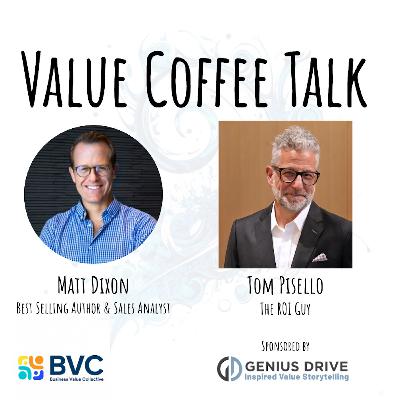
In this episode of the Value Coffee Talk Podcast, Thomas Pisello interviews Matt Dixon, a renowned sales performance author (The Challenger Sale, The Jolt Effect and Activator Advantage), analyst and consultant. The pair discuss the evolution of sales challenges over the past decade, particularly in the context of AI and virtual selling. Matt introduces his latest work, the Activator Advantage, which focuses on adapting sales strategies for professional services. He outlines the characteristics of successful sales profiles, particularly the Activator, who builds strong client relationships through proactive engagement and idea sharing.The conversation also touches on the importance of understanding client needs beyond just business transactions, emphasizing the role of personal value in maintaining client loyalty.TakeawaysSales challenges have worsened with the rise of AI.Buyers are more informed and further along in their journey.The size of buying committees has increased significantly.No decision losses are a major issue for salespeople.AI can enhance productivity but also lead to spam.The Activator Advantage focuses on service organizations.Activators build networks and proactively engage clients.Debaters can exhaust clients with constant challenges.Personal value is crucial for client loyalty.Sales strategies must adapt to changing client expectations.Sound bites"Activators are super connectors.""They are always bringing new ideas to clients.""Personal value creates lasting stickiness."
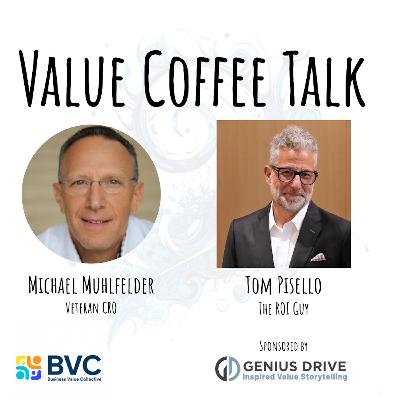
In this episode of the Value Coffee Talk podcast, host Thomas Pisello and guest Mike Muhlfelder, veteran CRO and sales performance coach, discuss the current challenges in B2B sales, particularly in light of economic uncertainty and the rise of AI. The pair unfold two fundamentals - proper value-centric qualification and discovery processes can lead to an incredible increase in success.TakeawaysQuota miss is expected to be higher this year.AI is a game changer for sales and business.Qualification is crucial for closing deals.Understanding the urgency of change is key.Budget discussions should focus on urgency, not just numbers.Discovery processes need to be improved for better outcomes.Sales professionals must balance discovery and demo expectations.Sales should be treated as a lifelong profession.Understanding the economics of your product is essential.Effective sales require continuous learning and adaptation.Sound bites"Quota miss is going to be higher.""You need a trigger for customer change.""It's always about the money."
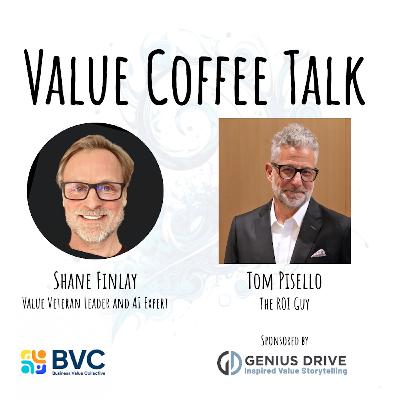
In this episode of the Value Coffee Talk podcast, hosts Thomas Pisello and veteran value leader Shane Finlay dive into the evolving landscape of value engineering and consulting. They discuss the shift from large value teams and the “business case factory” approach to a more streamlined, software-enabled capability, and the role of AI in transforming value consultants into not just orchestrators and enablers, but composers. Tune in to explore how AI is rapidly reshaping value-based growth programs, and the evolving role of AI-powered value consultants, sellers, success reps and sales engineers.TakeawaysValue teams are shifting from the “business case factory” (Player) to software-enabled Composers and lifecycle Orchestrators, with AI multiplying impact across GTM.Smaller teams + smarter tools: Equip sellers, SEs, and CS with guided discovery, ROI, and value storytelling — not just pre-sale business cases.AI as a force multiplier: Private LLMs + value playbooks + past cases = faster, tailored briefs, cleaner CRM hygiene, and real-time discovery prompts.Human-in-the-loop stays essential: AI drafts; value pros validate KPIs, benchmarks, and executive narratives to maintain trust and accuracy.Adoption is a program, not a launch: Drive usage via simple, monthly “one new use case” enablement (lunch-and-learns), track usage, and reinforce wins.Sound Bites“We’re moving from factory to symphony — AI doesn’t replace value pros; it amplifies them.”“Enable the field, not just the deal: value must show up in every touch — discovery, demo, onboarding, renewal.”“AI is the co-pilot; the value consultant is the pilot — keep the human in the loop to make the case credible.”
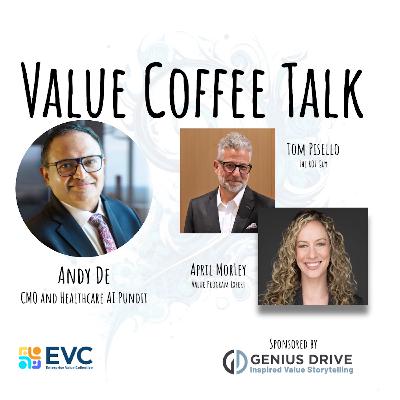
In this episode of Value Coffee Talk, Thomas Pisello and Andy De discuss the current state of AI in healthcare and life sciences, exploring the challenges organizations face in implementing AI solutions, the evolution of AI technologies, and the importance of a strategic portfolio approach to AI investments. They emphasize the need for effective communication of AI's value, the significance of governance, and the necessity of building trust in AI systems to ensure successful adoption and positive patient outcomes.TakeawaysAI investments in healthcare are significant but often yield low ROI.Understanding AI's true potential is crucial for successful implementation.The evolution of AI includes stages from augmentation to automation.Governance and ethics in AI are critical, especially in healthcare.A portfolio approach to AI investments can mitigate risks and enhance outcomes.Trust in AI systems is essential for adoption by healthcare professionals.Effective communication of AI's value is necessary for stakeholder buy-in.AI can alleviate burnout and increase capacity in healthcare settings.The integration of AI should focus on enhancing patient care and outcomes.AI should not be adopted for its own sake but for tangible benefits.Sound Bites"Barely 10 to 11% of CXOs see ROI.""Fear of missing out is prevalent.""AI augmentation is the first stage.""The holy grail is autonomous AI.""AI for the sake of AI is not enough."Chapters00:00 Introduction to AI in Healthcare01:05 Challenges in AI Implementation07:30 The Evolution of AI: From Augmentation to Automation13:07 AI as a Portfolio: Strategies for Success21:38 Communicating AI Value in Healthcare24:53 Pragmatic Approaches to AI Adoption

Comments

Download from Google Play

Download from App Store
 United States