


 Claim Ownership
Connections
Subscribed: 9Played: 35
Subscribe
© 2025 Mouin Rabbani
Description
Connections Podcast offers timely and informative interviews on current events and broader policy questions, as well as themes relevant to knowledge production. It combines journalism, analysis, and scholarship. Connections will focus primarily but not exclusively on the Middle East. Connections is part of the Audio-Visual Magazine Status/الوضع, accessible at www.statushour.com.
This podcast is hosted by Mouin Rabbani. Mouin has published and commented widely on Palestinian affairs, the Israeli-Palestinian conflict, and the contemporary Middle East. He was previously Senior Analyst Middle East and Special Advisor on Israel-Palestine with the International Crisis Group, and head of political affairs with the Office of the United Nations Special Envoy for Syria. He is Co-Editor of the publication Jadaliyya.com.
This podcast is hosted by Mouin Rabbani. Mouin has published and commented widely on Palestinian affairs, the Israeli-Palestinian conflict, and the contemporary Middle East. He was previously Senior Analyst Middle East and Special Advisor on Israel-Palestine with the International Crisis Group, and head of political affairs with the Office of the United Nations Special Envoy for Syria. He is Co-Editor of the publication Jadaliyya.com.
24 Episodes
Reverse
On Tuesday, 23 November Jadaliyya co-editor Mouin Rabbani spoke with Samia Errazzouki about the current crises in the Maghreb. This episode of Connections examines escalating Algerian-Moroccan tensions and the deteriorating situation in Western Sahara. GuestSamia Errazzouki is a doctoral candidate in history at the University of California, Davis. She was previously a journalist with the Associated Press and Reuters in Morocco, where she also worked as a research associate with the University of Cambridge researching the dynamics of surveillance and citizen media in the region. Samia is a Co-Editor of Jadaliyya.HostMouin Rabbani has published and commented widely on Palestinian affairs, the Israeli-Palestinian conflict, and the contemporary Middle East. He was previously Senior Analyst Middle East and Special Advisor on Israel-Palestine with the International Crisis Group, and head of political affairs with the Office of the United Nations Special Envoy for Syria. He is Co-Editor of Jadaliyya Ezine. https://www.jadaliyya.com/Details/43555https://www.facebook.com/watch/live/?ref=watch_permalink&v=310113217421127https://www.youtube.com/watch?v=_vsEO-mQGtk
on Thursday, 18 November Jadaliyya co-editor Mouin Rabbani and Cas Mudde spoke about the global far right. This episode of Connections will examine whether the far right is today ascendant or in decline, and the extent to which it forms a coherent global movement. Connections offers timely and informative interviews on current events and broader policy questions, as well as themes relevant to knowledge production. It combines journalism, analysis, and scholarship. GuestCas Mudde is a political scientist and global authority on populism and political extremism, particularly the European and American far right. He is the Stanley Wade Shelton Professor at the University of Georgia’s School of Public and International Affairs, and also holds the rank of Professor at the University of Oslo’s Center for Research on Extremism. The co-founder and convenor of the Standing Group on Extremism & Democracy of the European Consortium for Political Research, Mudde is a prolific author whose books include The Far Right in America (2018), The Far Right Today (2019), and The Israel Settler Movement Assessing and Explaining Social Movement Success (2021). He is also a columnist for The Guardian.HostMouin Rabbani has published and commented widely on Palestinian affairs, the Israeli-Palestinian conflict, and the contemporary Middle East. He was previously Senior Analyst Middle East and Special Advisor on Israel-Palestine with the International Crisis Group, and head of political affairs with the Office of the United Nations Special Envoy for Syria. He is Co-Editor of Jadaliyya Ezine. https://www.jadaliyya.com/Details/43525/Connections-Episode-23-The-Global-Far-Right-with-Cas-Mudde-18-Novemberhttps://www.facebook.com/watch?ref=sharinghttps://www.youtube.com/watch?v=ak72trjABdc
On Wednesday, 9 November Jadaliyya co-editor Mouin Rabbani spoke with Alison Glick and Nora Lester Murad about the challenges and rewards of narrating personal experience and political realities in Palestine. This episode of Connections examines the personal and political journeys they undertook, and the impact it has had on their writing and activism. GuestsAlison Glick is a writer and activist based in Philadelphia. She previously lived in an Israeli kibbutz and a town near Haifa for nine months, an experience that opened her eyes to the realities for Palestinians living under Israeli control. After studying Middle East History at Temple University, Alison lived in the West Bank, Gaza Strip and Yarmouk Camp in Syria for six years, working as a teacher, human rights researcher, and freelance writer. Her first novel, The Other End of the Sea, was published this month by Interlink Books. Her writing has appeared in the Arab Studies Quarterly, Mondoweiss, and other publications. Nora Lester Murad is a scholar/practitioner/activist who writes about international aid, community philanthropy, and life under military occupation at www.noralestermurad.com. She teaches a critical approach to international humanitarian action at Fordham University. Her work has appeared in The Guardian, Aljazeera.net, Open Democracy, Mondoweiss, and various academic and professional publications. She co-authored Rest in My Shade: A Poem About Roots, and is the editor of I Found Myself in Palestine, both published by Interlink Books. Her tween novel set in Jerusalem is forthcoming in 2022.HostMouin Rabbani has published and commented widely on Palestinian affairs, the Israeli-Palestinian conflict, and the contemporary Middle East. He was previously Senior Analyst Middle East and Special Advisor on Israel-Palestine with the International Crisis Group, and head of political affairs with the Office of the United Nations Special Envoy for Syria. He is Co-Editor of Jadaliyya Ezine. https://www.jadaliyya.com/Details/43524/Connections-Episode-22-Narrations-of-Palestine-with-Alison-Glick-and-Nora-Lester-Muradhttps://www.youtube.com/watch?v=Bf_HNJmFwHwhttps://www.facebook.com/Jadaliyya/videos/626381795033905/
On Friday, 5 November, Jadaliyya co-editor Mouin Rabbani spoke with Raja Shehadeh about Israel’s campaign to criminalize Palestinian human defenders and civic organizations. This episode of Connections examines the context and implications of Israel’s latest initiatives, and assess efforts to counter them.Connections offers timely and informative interviews on current events and broader policy questions, as well as themes relevant to knowledge production. It combines journalism, analysis, and scholarship. GuestRaja Shehadeh is a Palestinian human rights activist and author. He is a founding member of Al-Haq, the West Bank affiliate of the International Commission of Jurists and one of the organizations the Israeli government recently designated as a terrorist organization. His books include Occupier’s Law: Israel and the West Bank (1985); Palestinian Walks: Forays into a Vanishing Landscape (2007), which was awarded the 2008 Orwell Prize; Where the Line is Drawn: A Tale of Crossings, Friendships, and Fifty Years of Occupation in Israel-Palestine (2017), a BBC Radio 4 Book of the Week; and We Could Have Been Friends, My Father and I (forthcoming).HostMouin Rabbani has published and commented widely on Palestinian affairs, the Israeli-Palestinian conflict, and the contemporary Middle East. He was previously Senior Analyst Middle East and Special Advisor on Israel-Palestine with the International Crisis Group, and head of political affairs with the Office of the United Nations Special Envoy for Syria. He is Co-Editor of Jadaliyya Ezine.https://www.jadaliyya.com/Details/43507/Connections-Episode-21-Terrorizing-Human-Rights-with-Raja-Shehadeh-Videohttps://www.youtube.com/watch?v=e7NzdvC1z9chttps://www.facebook.com/watch/live/?ref=watch_permalink&v=1002064493691371
Join us on Wednesday, 2 November for a conversation between Jadaliyya co-editor Mouin Rabbani and Zachary Foster on The Invention of Palestine. This episode of Connections will examine how and why the terms “Palestine” and “Palestinian” came to be contested, and measure various claims in this regard against the historical record.Connections offers timely and informative interviews on current events and broader policy questions, as well as themes relevant to knowledge production. It combines journalism, analysis, and scholarship. GuestZachary Foster earned his Ph.D in Near Eastern Studies at Princeton. His dissertation is entitled, "The Invention of Palestine". He is a Director of Product at academia.edu. HostMouin Rabbani has published and commented widely on Palestinian affairs, the Israeli-Palestinian conflict, and the contemporary Middle East. He was previously Senior Analyst Middle East and Special Advisor on Israel-Palestine with the International Crisis Group, and head of political affairs with the Office of the United Nations Special Envoy for Syria. He is Co-Editor of Jadaliyya Ezine.https://www.jadaliyya.com/Details/43470/Connections-Episode-20-The-Invention-of-Palestine-with-Zachary-Fosterhttps://www.youtube.com/watch?v=_S1Tv582t4Ihttps://fb.watch/94kvtd_hRb/
On Wednesday, 27 October, Jadaliyya co-editor Mouin Rabbani spoke with Khalid Mustafa Medani on the coup in Sudan. This special episode of Connections discusses the latest developments in Sudan and examines the context and consequences of the recent coup in the country.Connections offers timely and informative interviews on current events and broader policy questions, as well as themes relevant to knowledge production. It combines journalism, analysis, and scholarship.GuestDr. Khalid Mustafa Medani is Associate Professor of Political Science and Islamic Studies at McGill University in Montreal, Canada. His research focuses on the political economy of Islamic and Ethnic Politics in Africa and the Middle East. He is the author of Black Markets and Militants: Informal Networks in the Middle East and Africa(Cambridge University Press, 2021) and is presently completing a manuscript on the causes and consequences of Sudan’s 2018 popular uprising. Dr. Medani has published extensively on civil conflict with a special focus on the armed conflicts in Sudan and Somalia. HostMouin Rabbani has published and commented widely on Palestinian affairs, the Israeli-Palestinian conflict, and the contemporary Middle East. He was previously Senior Analyst Middle East and Special Advisor on Israel-Palestine with the International Crisis Group, and head of political affairs with the Office of the United Nations Special Envoy for Syria. He is Co-Editor of Jadaliyya Ezine.https://www.jadaliyya.com/Details/43467/Connections-Episode-19-Special-Episode-The-Coup-in-Sudan-with-Khalid-Medani-Videohttps://fb.watch/8VKC8eBDGo/https://www.youtube.com/watch?v=yFVC2A9Dc98
On Wednesday, 13 October Jadaliyya co-editor Mouin Rabbani and Ali Vaez converse about Iran after the June 2021 elections. This episode of Connections will examine Iran’s domestic politics, its regional and international policies, and the fate of the nuclear agreement. Connections offers timely and informative interviews on current events and broader policy questions, as well as themes relevant to knowledge production. It combines journalism, analysis, and scholarship.GuestAli Vaez is Iran Project Director and Senior Adviser to the President at Crisis Group. He led Crisis Group’s efforts in helping to bridge the gaps between Iran and the P5+1 that led to the landmark 2015 nuclear deal. Previously, he served as a Senior Political Affairs Officer at the United Nations Department of Political and Peacebuilding Affairs and was the Iran Project Director at the Federation of American Scientists. Trained as a scientist, Vaez has written widely on Iranian affairs and is a regular contributor to mainstream media outlets, including The New York Times, The Washington Post, The Guardian, and Foreign Affairs. He is a frequent guest on CNN, BBC, Al Jazeera and NPR.HostMouin Rabbani has published and commented widely on Palestinian affairs, the Israeli-Palestinian conflict, and the contemporary Middle East. He was previously Senior Analyst Middle East and Special Advisor on Israel-Palestine with the International Crisis Group, and head of political affairs with the Office of the United Nations Special Envoy for Syria. He is Co-Editor of Jadaliyya Ezine.https://www.jadaliyya.com/Details/43406/Connections-Episode-18-Iran-Domestic-and-Foreign-Affairs-13-Octoberhttps://fb.watch/8Df322DN6s/https://youtu.be/Kh2Eaaqbths
On Tuesday, 5 October, Jadaliyya co-editor Mouin Rabbani spoke with Nabih Bulos, Middle East Bureau Chief of the Los Angeles Times about a decade of upheaval in the Middle East and the response of its peoples. This episode of Connections examines the various dynamics and impact of revolution, war, and conflict in the Middle East and North Africa. GuestNabih Bulos is the Middle East bureau chief of the Los Angeles Times. Since 2012 he has covered war, revolution, and upheaval throughout the region, including the expansion of the Islamic State movement and the campaign to defeat it. His work has taken him to Syria, Iraq, Libya, Yemen, Afghanistan and elsewhere in the region, as well as on the migrant trail through the Balkans and Europe. A Fulbright scholar, Bulos is also a concert violinist who has performed with Daniel Barenboim, Valery Gergiev, and Bono.HostMouin Rabbani has published and commented widely on Palestinian affairs, the Israeli-Palestinian conflict, and the contemporary Middle East. He was previously Senior Analyst Middle East and Special Advisor on Israel-Palestine with the International Crisis Group, and head of political affairs with the Office of the United Nations Special Envoy for Syria. He is Co-Editor of Jadaliyya Ezine.https://www.jadaliyya.com/Details/43401/Connections-Episode-17-A-Decade-of-Upheaval-with-Nabih-Bulos-Videohttps://www.facebook.com/watch/live/?ref=watch_permalink&v=623748735290195https://www.youtube.com/watch?v=V9i-Iqo-NnU

On Tuesday, 21 September Jadaliyya co-editor Mouin Rabbani spoke with Helen Lackner about the war on Yemen and prospects for peace. This episode of Connections examines the multiple dimensions of the Yemen conflict and the agendas of the main powers involved.GuestHelen Lackner is a leading authority on Yemen who has been conducting research and writing about Yemeni politics and society since the 1970s. A former resident of the People’s Democratic Republic of Yemen, the Yemen Arab Republic, and the Republic of Yemen, her most recent books are Yemen in Crisis: The Road to War (Verso 2019), and Yemen, Poverty and Conflict (forthcoming). A regular contributor to Open Democracy, Arab Digest, Oxford Analytica, Orient XXI, and others, she is currently Research Associate at London’s School of Oriental and African Studies (SOAS), Visiting Fellow at the European Council for Foreign Relations (ECFR), and Associate at the Transnational Institute (TNI).HostMouin Rabbani has published and commented widely on Palestinian affairs, the Israeli-Palestinian conflict, and the contemporary Middle East. He was previously Senior Analyst Middle East and Special Advisor on Israel-Palestine with the International Crisis Group, and head of political affairs with the Office of the United Nations Special Envoy for Syria. He is Co-Editor of Jadaliyya Ezine.https://www.jadaliyya.com/Details/43359/Connections-Episode-16-Whither-Yemen-with-Helen-Lackner-Videohttps://www.facebook.com/watch/live/?v=1293477817748976&ref=watch_permalinkhttps://www.youtube.com/watch?v=2mc9kV6KRas
On Tuesday, 14 September Jadaliyya co-editor Mouin Rabbani spoke with Lisa Hajjar on the post-2001 US torture program and its living legacies. This episode of Connections examines the development and impact of the US torture program in the context of two decades of the “War on Terror”. GuestLisa Hajjar is a professor of sociology at the University of California – Santa Barbara. Her work focuses mainly on issues relating to law and conflict, including military courts and occupations, torture, targeted killing, war crimes, and human rights. Her publications include Courting Conflict: The Israeli Military Court System in the West Bank and Gaza (University of California Press, 2005) and Torture: A Sociology of Violence and Human Rights (Routledge 2013). Her new book, The War in Court: The Inside Story of the Fight against US Torture in the “War on Terror,” will be published by the University of California Press. She is a founding co-editor of Jadaliyya and a member of the editorial committee of Middle East Report.HostMouin Rabbani has published and commented widely on Palestinian affairs, the Israeli-Palestinian conflict, and the contemporary Middle East. He was previously Senior Analyst Middle East and Special Advisor on Israel-Palestine with the International Crisis Group, and head of political affairs with the Office of the United Nations Special Envoy for Syria. He is Co-Editor of Jadaliyya Ezine.https://www.jadaliyya.com/Details/43339/Connections-Episode-15-The-Lasting-Legacies-of-US-Torturehttps://www.facebook.com/watch/live/?v=351982036660042&ref=watch_permalinkhttps://www.youtube.com/watch?v=mk810wt_-sI
On Wednesday, 1 September, Jadaliyya co-editor Mouin Rabbani spoke with digital rights campaigner Marwa Fatafta and about recent revelations concerning the NSO/Pegasus digital espionage program and its broader implications. This episode of Connections examines the human and political and dimensions of digital espionage, and the agendas of those promoting it.Guest Marwa Fatafta leads Access Now’s work on digital rights in the Middle East and North Africa region. She has written extensively on technology, human rights, and internet freedoms in Palestine and the wider MENA region. She is also a Policy Analyst at Al-Shabaka: The Palestinian Policy Network. Previously, Fatafta was the MENA Regional Advisor at the Transparency International Secretariat in Berlin, and served as the Communications Manager at the British Consulate-General in Jerusalem.https://www.jadaliyya.com/Details/43295/Connections-Episode-14-Digital-Espionage-A-Global-Pandemic-Videohttps://www.facebook.com/watch/live/?v=974152580031037&ref=watch_permalinkhttps://www.youtube.com/watch?v=gitpbS_mvB4
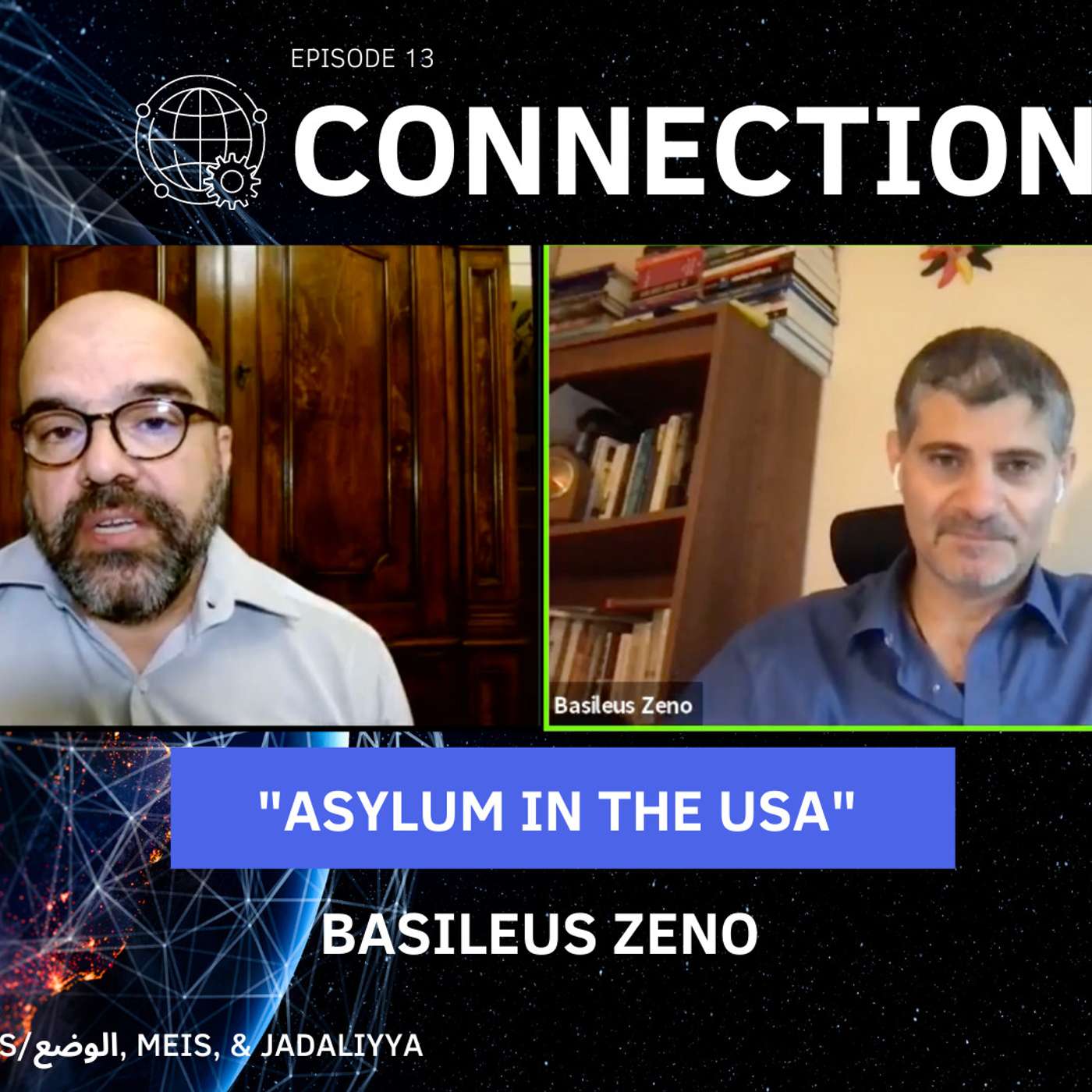
On Monday, 23 August Jadaliyya co-editor Mouin Rabbani speaks with Syrian scholar, political refugee, and Jadaliyya Syria Page co-editor Basileus Zeno about the US asylum system. This episode of Connections examines how this system operates and the extent to which it remains unchanged since the departure of the Trump administration. Guest Basileus Zeno is Karl Loewenstein Fellow and Visiting Lecturer in Political Science at Amherst College in Massachusetts. His areas of specialization are comparative politics and contemporary political theory with a regional focus on the Middle East. An archaeologist by training, he left Syria in 2012 and that same year applied for political asylum in the United States. Zeno recently recounted his experience with the US asylum system in an opinion piece in the Washington Post.HostMouin Rabbani has published and commented widely on Palestinian affairs, the Israeli-Palestinian conflict, and the contemporary Middle East. He was previously Senior Analyst Middle East and Special Advisor on Israel-Palestine with the International Crisis Group, and head of political affairs with the Office of the United Nations Special Envoy for Syria. He is Co-Editor of Jadaliyya Ezine.https://www.jadaliyya.com/Details/43256/Connections-Episode-13-Asylum-in-the-USA-Videohttps://www.facebook.com/watch/live/?v=803090123693410&ref=watch_permalinkhttps://www.youtube.com/watch?v=5ZF58RYd6HA
Join us on Wednesday, 18 August for a conversation with former United Nations Under-Secretary-General Benon Sevan, who served as UN envoy to Afghanistan and Pakistan from 1988-1992, and Jadaliyya co-editor Mouin Rabbani about current developments in Afghanistan. This episode of Connections will examine the US/NATO withdrawal from Afghanistan and collapse of the government in Kabul, and how it compares with the Soviet withdrawal in 1989 and its aftermath.GuestBenon V. Sevan joined the United Nations Secretariat in 1965. Over the next four decades he held numerous positions at UN headquarters and around the world, and carried out a variety of special political missions. In 1985 Sevan was dispatched by the UN Secretary-General to inquire into the situation of prisoners of war in the conflict between Iran and Iraq. In 1988 he was appointed Director and Senior Political Adviser to the Representative of the Secretary-General on the Settlement of the Situation Relating to Afghanistan, and was posted in Afghanistan and Pakistan, for monitoring the withdrawal of Soviet troops from Afghanistan. In 1989 he was appointed as the Secretary-General’s Personal Representative in Afghanistan and Pakistan, and after 1990 concurrently served as the Secretary-General’s Representative on the implementation of the Geneva Accords on Afghanistan. In 1992, he was appointed Special Envoy of the Secretary-General for issues related to missing persons in the Middle East. From 1997-2004 Sevan served as Executive Director, with the rank of Under-Secretary-General, of the UN Iraq Program, with responsibility for overall management, coordination, and supervision of the implementation of all United Nations humanitarian activities in Iraq.HostMouin Rabbani has published and commented widely on Palestinian affairs, the Israeli-Palestinian conflict, and the contemporary Middle East. He was previously Senior Analyst Middle East and Special Advisor on Israel-Palestine with the International Crisis Group, and head of political affairs with the Office of the United Nations Special Envoy for Syria. He is Co-Editor of Jadaliyya Ezine.https://www.jadaliyya.com/Details/43220/Connections-Episode-12-Focus-Afghanistan-with-Benon-Sevanhttps://fb.watch/dfu1fuaoXV/https://www.youtube.com/watch?v=MYwsrM5M5LY
On Monday, 9 August Jadaliyya co-editor Mouin Rabbani spoke with leading economist Jeffrey Sachs about the challenges facing the globe during this pivotal decade. As the world remains mired in the COVID-19 pandemic, the existential dangers of climate change are becoming increasingly clear. This episode of Connections examines the economic dimensions of climate change, the persistence of widespread poverty and inequality, and their inter-relationship.GuestJeffrey D. Sachs is a University Professor and Director of the Center for Sustainable Development at Columbia University, where he directed the Earth Institute from 2002 until 2016. He is also President of the UN Sustainable Development Solutions Network and a commissioner of the UN Broadband Commission for Development. He has been advisor to three United Nations Secretaries-General. He spent over twenty years as a professor at Harvard University, He has authored numerous bestseller books. His most recent book is The Ages of Globalization: Geography, Technology, and Institutions (2020). He is currently hosting the podcast “Book Club with Jeffrey Sachs”. Sachs was twice named as one of Time magazine’s 100 most influential world leaders and was ranked by The Economist among the top three most influential living economists. HostMouin Rabbani has published and commented widely on Palestinian affairs, the Israeli-Palestinian conflict, and the contemporary Middle East. He was previously Senior Analyst Middle East and Special Advisor on Israel-Palestine with the International Crisis Group, and head of political affairs with the Office of the United Nations Special Envoy for Syria. He is Co-Editor of Jadaliyya Ezine.https://www.jadaliyya.com/Details/43198/Connections-Episode-11-A-Planet-in-the-Balance-with-Jeffrey-D-Sachs-Videohttps://www.facebook.com/Jadaliyya/videos/893760918156924https://www.youtube.com/watch?v=JHkdMP7TQj0
On Wednesday, 4 August, Jadaliyya co-editor Mouin Rabbani spoke with Tunisian researcher and journalist Houda Mzioudet about current developments in Tunisia. President Kais Saied’s 25 July dismissal of prime minister Hichem Mechichi and suspension of parliament have plunged the country into crisis. This episode of Connections examines the background, responses, and potential implications of the ongoing power struggle. GuestHouda Mzioudet is a researcher and journalist who between 2011 and 2018 covered the uprisings and their aftermath in Tunisia and Libya for international outlets including Al Jazeera English, CBC, and BBC. She is a co-founder of ADAM, the first black Tunisian association, and of the Voice of Tunisian Black Women collective. She has published widely on both Tunisia and Libya.HostMouin Rabbani has published and commented widely on Palestinian affairs, the Israeli-Palestinian conflict, and the contemporary Middle East. He was previously Senior Analyst Middle East and Special Advisor on Israel-Palestine with the International Crisis Group, and head of political affairs with the Office of the United Nations Special Envoy for Syria. He is Co-Editor of Jadaliyya Ezine.https://www.jadaliyya.com/Details/43197/Connections-Episode-10-Crisis-in-Tunisia-with-Houda-Mzioudet-Videohttps://fb.watch/7aQ6qDvBp0/https://www.youtube.com/watch?v=MUHJkOGx1-4
In this episode of Connections Podcast, Nadya Sbaiti speaks to Connections host and by Jadaliyya co-editor Mouin Rabbani about the crisis in Lebanon. The World Bank recently concluded that Lebanon’s economic and financial meltdown ranks among the worst seen anywhere in the world since 1850. This episode of Connections examines the multiple dimensions, impact, and consequences of Lebanon’s crisis. GuestNadya Sbaiti is Assistant Professor of Middle Eastern Studies at the Center for Arab and Middle Eastern Studies (CAMES) at the American University of Beirut (AUB). She earned both her MA in Arab Studies and her PhD in History from Georgetown University. She specializes in the social and cultural histories of the modern Middle East, with research interests ranging from education, gender, and nationalism to tourism and colonialism. She is a co-founder and a co-editor of Jadaliyya.HostMouin Rabbani has published and commented widely on Palestinian affairs, the Israeli-Palestinian conflict, and the contemporary Middle East. He was previously Senior Analyst Middle East and Special Advisor on Israel-Palestine with the International Crisis Group, and head of political affairs with the Office of the United Nations Special Envoy for Syria. He is Co-Editor of Jadaliyya Ezine.https://www.jadaliyya.com/Details/43119/Connections-Podcast-Episode-9-Lebanon-in-Crisis-with-Nadya-Sbaiti-Videohttps://www.youtube.com/watch?v=_KUFJ_wPkWchttps://fb.watch/6P3mSxbNPi/

Join us on Wednesday, 7 July for a conversation with Anders Persson and Diana Buttu hosted by Jadaliyya co-editor Mouin Rabbani about the role of Europe in the Arab-Israeli conflict. This episode of Connections Podcast will examine the development of European Union policy in this regard, its motives, objectives, and impact. Connections offers timely and informative interviews on current events and broader policy questions, as well as themes relevant to knowledge production. It combines journalism, analysis, and scholarship. GuestsAnders Persson is a specialist on the role of the European Union in the Israeli-Palestinian conflict. He has written three books on this topic, of which the latest is EU Diplomacy and the Israeli-Arab Conflict, 1967–2019 (Edinburgh University Press, 2020). His analysis of EU Middle East policy is regularly featured in Swedish and international media. Diana Buttu is a Haifa-based lawyer and analyst. She was previously a legal advisor to the PLO’s Negotiations Affairs Department. She is a frequent media commentator and has authored numerous articles and opinion pieces on Israeli policy towards the Palestinian people. HostMouin Rabbani has published and commented widely on Palestinian affairs, the Israeli-Palestinian conflict, and the contemporary Middle East. He was previously Senior Analyst Middle East and Special Advisor on Israel-Palestine with the International Crisis Group, and head of political affairs with the Office of the United Nations Special Envoy for Syria. He is Co-Editor of Jadaliyya Ezine.https://www.jadaliyya.com/Details/43081https://fb.watch/6COtsC1UOO/https://youtu.be/5_zO1iqBomk
On Sunday, 27 June Jadaliyya co-editor Mouin Rabbani spoke with Hanan Ashrawi in order to assess the current position and future options for the Palestinians as they confront both challenge and opportunity. This episode of Connections Podcast will also discuss the policies of the new Israeli government and role of the Biden administration in Palestine.Connections offers timely and informative interviews on current events and broader policy questions, as well as themes relevant to knowledge production. It combines journalism, analysis, and scholarship. GuestDr Hanan Ashrawi became a household name as the official spokesperson of the Palestinian delegation to the 1991 Madrid Middle East Peace Conference. In 1996 she was elected to the Palestinian Legislative Council representing Jerusalem, and that same year was appointed the Palestinian Authority’s Minister of Higher Education. Re-elected to parliament in 2006, she in 2009 became the first woman to serve on the PLO Executive Committee, from which she resigned in 2020. Ashrawi was in 1994 a founder of the Palestinian Independent Commission for Human Rights and served as its first Commissioner General. In 1998 she helped establish the National Coalition for Accountability and Integrity, and is currently Executive Director of MIFTAH, the Palestinian Initiative for the Promotion of Global Dialogue and Democracy.HostMouin Rabbani has published and commented widely on Palestinian affairs, the Israeli-Palestinian conflict, and the contemporary Middle East. He was previously Senior Analyst Middle East and Special Advisor on Israel-Palestine with the International Crisis Group, and head of political affairs with the Office of the United Nations Special Envoy for Syria. He is Co-Editor of Jadaliyya Ezine.https://www.jadaliyya.com/Details/43040/Connections-Podcast-Episode-7-Palestine-at-the-Crossroads-with-Hanan-Ashrawi-Videohttps://www.youtube.com/watch?v=gkYexS2e3Qghttps://www.facebook.com/Jadaliyya/videos/239216078012515/
On Thursday, 17 June Jadaliyya co-editor Mouin Rabbani interviewed Lara Friedman about the role of the US Congress in formulating Washington's policy towards Israel and the Palestinians. Existing and proposed legislation and its impact on US policy options is examined. This episode of Connections Podcast also discusses the significance of growing Congressional criticism of US support for Israel and its policies towards the Palestinians.Connections offers timely and informative interviews on current events and broader policy questions, as well as themes relevant to knowledge production. It combines journalism, analysis, and scholarship. GuestLara Friedman is President of the Foundation for Middle East Peace in Washington, DC. She is a leading authority on US foreign policy in the Middle East, with particular expertise on the Arab-Israeli conflict, Israeli settlements, Jerusalem, and the role of the US Congress. She is published widely in the US and international press and is regularly consulted by members of Congress and their staff, diplomats, and journalists. Previously with the US State Department, she was a Foreign Service Officer in Jerusalem, Washington, Tunis, and Beirut.HostMouin Rabbani has published and commented widely on Palestinian affairs, the Israeli-Palestinian conflict, and the contemporary Middle East. He was previously Senior Analyst Middle East and Special Advisor on Israel-Palestine with the International Crisis Group, and head of political affairs with the Office of the United Nations Special Envoy for Syria. He is Co-Editor of Jadaliyya Ezine.https://www.jadaliyya.com/Details/43021/Connections-Podcast-Episode-6-The-US-Congress,-Israel,-and-the-Palestinians-Videohttps://www.youtube.com/watch?v=nHMpSPOsWfohttps://www.facebook.com/Jadaliyya/videos/1430368713993931/
On Monday, 7 June Jadaliyya co-editor Mouin Rabbani spoke with Lori Allen about investigations and commissions of inquiry into the situation in Palestine. This episode of Connections Podcast examines the history of such exercises and asks what might be different about current attempts to hold Israel to account. Connections offers timely and informative interviews on current events and broader policy questions, as well as themes relevant to knowledge production. It combines journalism, analysis, and scholarship. Connections will focus primarily but not exclusively on the Middle East. GuestLori Allen is Reader in Anthropology at the School of Oriental and African Studies (SOAS), University of London. Her work has focused on Palestinian society, politics, and history. She is the author of A History of False Hope: Investigative Commissions in Palestine (2020) and The Rise and Fall of Human Rights: Cynicism and Politics in Occupied Palestine (2013), both published by Stanford University Press. Her articles have been published in academic and news journals, including American Ethnologist, Contemporary Studies in Society and History, MERIP, Al-Jazeera, and Sada. Lori Allen's most recent contributions include “The ICC in Palestine: Reasons to Withhold Hope”, and “This Time May Be Different: on the UN commission of inquiry investigating violations in the occupied Palestinian territory”.HostMouin Rabbani has published and commented widely on Palestinian affairs, the Israeli-Palestinian conflict, and the contemporary Middle East. He was previously Senior Analyst Middle East and Special Advisor on Israel-Palestine with the International Crisis Group, and head of political affairs with the Office of the United Nations Special Envoy for Syria. He is Co-Editor of Jadaliyya Ezine. https://www.jadaliyya.com/Details/43031/Connections-Podcast-Episode-5-Investigating-Israel-with-Lori-Allen-Videohttps://www.youtube.com/watch?v=qSr6UjXWGuE

Comments

Download from Google Play

Download from App Store
 United States