


 Claim Ownership
Continuing Education for Homeschooling Families
Subscribed: 1Played: 5
Subscribe

© Heidi Washington
Description
Dedicated to supporting families in their journey of homeschooling by providing teaching strategies, curriculum guidance, and other actually helpful tips and insights.
Whether you’re a seasoned homeschooling veteran or just starting out on this educational adventure, join us for wisdom and practical advice to help you navigate the homeschooling landscape with confidence and success.
homeschoolce.substack.com
Whether you’re a seasoned homeschooling veteran or just starting out on this educational adventure, join us for wisdom and practical advice to help you navigate the homeschooling landscape with confidence and success.
homeschoolce.substack.com
45 Episodes
Reverse
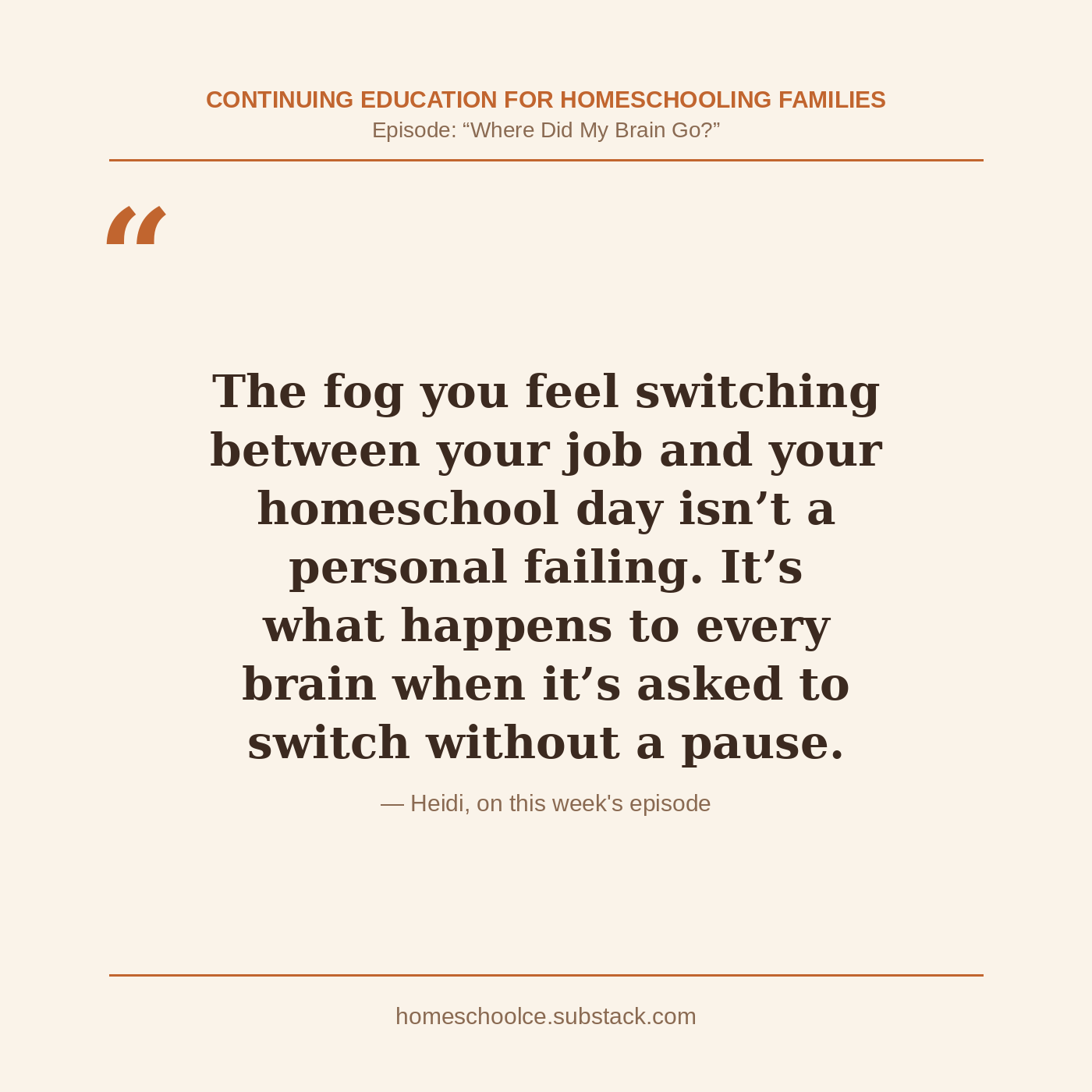
For parents who work and homeschool in the same house — sometimes in the same hour — the hardest part of the day often isn’t the work or the teaching. It’s the switch between them. This episode breaks down the science of “attention residue,” why your brain doesn’t fully leave one task when you move to the next, and a simple, practical method — the Focus Block Method — for protecting your attention on both sides of the handoff.What You’ll Learn* Why you can feel physically present with your kids but mentally still “at work” — and why that’s not a focus problem, it’s a documented cognitive one* The real research behind why a single interruption can cost far more than the interruption itself* How to build “focus blocks” into a homeschool day that also includes a job, a business, or client work* A ninety-second transition ritual to use between switching from work mode to teaching mode (and back)* Why removing the decision to check social media (with a screen time limit, a blocker app, or a physical device) works better than willpower* How a weekly “top three to five” list keeps your protected blocks aimed at what actually matters, not just what feels urgentResearch & Resources Mentioned* Leroy, Sophie. “Why Is It So Hard to Do My Work? The Challenge of Attention Residue When Switching Between Work Tasks.” Organizational Behavior and Human Decision Processes, vol. 109, no. 2, 2009, pp. 168–181.* Mark, Gloria, Victor M. Gonzalez, and Justin Harris. “No Task Left Behind? Examining the Nature of Fragmented Work.” Proceedings of CHI 2005 — foundational work on task interruption frequency. Related follow-up: Mark, Gloria, et al. “The Cost of Interrupted Work: More Speed and Stress.” Proceedings of CHI 2008, ACM, 2008. (Source of the ~23-minute recovery finding.)* Newport, Cal. Deep Work: Rules for Focused Success in a Distracted World. Grand Central Publishing, 2016.Additional Resources* Harvard Business Review, “Stop Letting Yesterday’s Frustrations Ruin Today,” Sophie Leroy’s 2020 HBR piece on attention residue and how to clear it between tasks* Cal Newport’s website (calnewport.com) for ongoing writing on deep work and attention in daily life* A simple “block audit” you can do with a notebook: track one full day, marking every switch between work, teaching, and logistics, to see where your own residue is building upKey Terms* Attention residue — the portion of cognitive focus that stays “stuck” on a previous task even after you’ve physically moved to a new one, first documented by Sophie Leroy in 2009.* Chrono-blocking — organizing your schedule around the type of cognitive task (deep, shallow, logistical) rather than by the clock alone.* Deep work — a term coined by Cal Newport for focused, distraction-free cognitive effort that produces new value and is hard to replicate; contrasted with “shallow work,” which is logistical and low-cognitive-demand. This is a public episode. If you would like to discuss this with other subscribers or get access to bonus episodes, visit homeschoolce.substack.com
Two weeks into homeschooling, a grandma in one of my local groups sent a message that stopped me cold — she didn’t think she could do this, her grandkids (who have ADHD) were whining and crying through every assignment, her husband had doubted the decision from the start, and she felt lost and alone in it. This episode is my answer to her, expanded into something I hope reaches you too, wherever you are in your own hard season.I talk about why “hardheaded” is usually the wrong word for a kid melting down over schoolwork, what’s actually happening in a stressed nervous system, why needing other people isn’t a failure, and the honest timeline of what it took for my own son’s nervous system to settle after we pulled him out of public school — about a year, not a month, and even then the conflict didn’t disappear entirely. It just stopped being the whole-body dread it used to be.Mentioned in this episode:* My earlier episode, Why Deschooling Matters — if today’s episode resonated, that one goes deeper into what deschooling actually looks like day to day.* John Holt on why kids “act unintelligently” at school: John C. Holt Quotes, Goodreads* Russell Barkley on ADHD as a “doing what you know” gap, not a “knowing what to do” gap: Russell A. Barkley Quotes, Goodreads* The research on stress and learning I referenced: “Learning and memory under stress: implications for the classroom,” npj Science of Learning* Ubuntu, the Southern African philosophy behind “I am because we are”: University of Jyväskylä overview* Mary Oliver’s poem “The Journey,” from her collection Dream Work: full text via Poet SeersIf you’re in the thick of a hard start right now — you’re not the only one, and it’s not a verdict on whether this is working. This is a public episode. If you would like to discuss this with other subscribers or get access to bonus episodes, visit homeschoolce.substack.com
Episode Summary This episode is about metacognitive reflection — teaching kids to notice and manage their own thinking, not just produce answers. Heidi breaks down what metacognition actually is, why the research ranks it among the highest-impact teaching strategies available, and six low-lift ways to build it into an ordinary homeschool day.What You’ll Learn* What metacognition actually means and why it’s the “dashboard,” not the “engine,” of learning* Why researchers rank metacognitive instruction as one of the highest-impact, lowest-cost strategies available to any teacher* Six concrete techniques — from think-alouds to confidence checks — you can start using today, at any age* How to tell the difference between a child who doesn’t know the content and one who doesn’t yet have language for their own confusion* Why this habit tends to spill over into emotional regulation, not just academicsResearch & Resources Mentioned* Hattie, John. Visible Learning: A Synthesis of Over 800 Meta-Analyses Relating to Achievement. Routledge, 2009. Metacognitive strategies effect size of 0.69. Hattie Ranking of Influences* Education Endowment Foundation. “Metacognition and Self-Regulated Learning.” Guidance Report. educationendowmentfoundation.org.uk* Flavell, John H. Foundational research on metacognition and children’s developing awareness of their own thinking, 1970s.* Harvard Graduate School of Education, Project Zero — “Thinking Routines” and work on making thinking visible in classrooms. pz.harvard.edu* Zimmerman, Barry J. Research on self-regulated learning and academic resilience.* Child Mind Institute. “Metacognition: How Thinking About Thinking Can Help Kids.” childmind.orgAdditional Resources* “19 Metacognitive Strategies That Put Kids in Control of Their Learning” — We Are Teachers, practical classroom-tested ideas. weareteachers.com* Harvard Project Zero’s Visible Thinking routines library — free thinking routines adaptable for any age or subject.* Peter Brown, Henry Roediger, Mark McDaniel. Make It Stick: The Science of Successful Learning. Belknap Press, 2014 — companion reading on self-testing and reflection as learning tools.Key Terms* Metacognition: Awareness and understanding of one’s own thought process; “thinking about thinking.”* Self-regulated learning: A learner’s ability to monitor, direct, and evaluate their own learning strategies.* Effect size: A statistical measure researchers use to describe how much impact a teaching strategy has on student achievement; Hattie treats 0.40 as roughly “one year of typical growth.”* Think-aloud: A modeling technique where an adult verbalizes their thought process out loud so a child can observe how thinking actually happens, including uncertainty and mistakes. This is a public episode. If you would like to discuss this with other subscribers or get access to bonus episodes, visit homeschoolce.substack.com
This episode is about lesson hooks — sometimes called “anticipatory sets” — the brief moment before a lesson that determines whether your kid leans in or checks out. We look at where the concept comes from, what the research says about curiosity and memory, and six specific, low-effort ways to open any lesson so it actually lands.What You’ll Learn* What an “anticipatory set” is and why Madeline Hunter built it into her lesson-planning model decades ago* The research behind why curiosity — not entertainment — is what makes information stick* Six concrete hook techniques you can use across subjects and ages, starting today* How to avoid the most common mistake homeschool parents make with hooks (over-explaining them)* Why a thirty-second pause before teaching can matter more than the lesson itselfResearch & Resources Mentioned* Loewenstein, George. “The Psychology of Curiosity: A Review and Reinterpretation.” Psychological Bulletin, 1994. * Gruber, Matthias J., Gelman, Bernard D., and Ranganath, Charan. “States of Curiosity Modulate Hippocampus-Dependent Learning via the Dopaminergic Circuit.” Neuron, 2014. * GCU Blog. “Using Anticipatory Sets for Student Engagement.” * Voyager Sopris Learning. “Boost Classroom Engagement with Anticipatory Sets.” Additional Resources* “How Curiosity Enhances Hippocampus-Dependent Memory: The PACE Framework” — a deeper dive into the neuroscience for anyone who wants the full picture. * “9 Lesson Hook Strategies to Engage Students” * Madeline Hunter’s Mastery Teaching — the original book where the anticipatory set model was laid out, useful if you want to see the whole lesson-planning framework it came from.Key Terms* Anticipatory set: The opening portion of a lesson designed to focus attention, activate prior knowledge, and connect it to new content. Coined by Madeline Hunter.* Information gap theory: George Loewenstein’s model explaining curiosity as a felt gap between what we know and what we want to know — and the drive to close that gap.* Hippocampus: The brain region primarily responsible for forming new memories; research shows it’s more active during states of curiosity.* Prior knowledge activation: Connecting new material to something a learner already knows or has experienced, which helps new information “stick” to an existing mental framework. This is a public episode. If you would like to discuss this with other subscribers or get access to bonus episodes, visit homeschoolce.substack.com
Working and homeschooling isn’t one job — it’s three full-time workloads happening at once: work, school, and everything else that makes up a life. In this episode I name the hard truths nobody says out loud, walk through the Three-Legged Stool framework I use every semester to make trade-off decisions before the chaos hits, and get practical about schedules, independent learners, and the tech that actually holds it all together.What You’ll Learn* Why “the math doesn’t math” when you’re working and homeschooling — and why that’s not a you-problem* How to use the Three-Legged Stool framework (Work, School, Life) to set one priority per leg, per season, so decisions get easier under stress* The difference between a schedule and a routine, and why routines are what actually survive a disrupted day* Practical ways to build independent learners — morning boxes, visual timers, teaching mastery instead of busy work* How to pick a tech ecosystem (Apple, Google, Notion, or analog) and a brain-dump-and-organize workflow that keeps things from falling through the cracks* Where to look if you’re still figuring out the work side of this equationResearch & Resources Mentioned* Kellogg School of Management — research on parental identity threat, and how emotional stability and a clear framework protect working parents from the shame spiral* Hobbies and mental health: a systematic review — twelve-year longitudinal findings on hobbies and depression recovery* National Home Education Research Institute — Homeschool Academic Achievement Fact Sheet* Open Oregon — Families 2nd Edition, “How Routines and Predictability” Ch. 5.2* Printable companion handout for this episode (see below) — every spot in the episode marked with the pencil icon has a matching space on the printable, so you can jot down your own priorities, fears, and workflow as you listen. Grab it in the show notes.Note: A printable handout is being created to accompany this episode — it mirrors the pencil-icon prompts throughout so listeners have a place to write down their fears, their three priorities, and their own workflow ideas. This is a public episode. If you would like to discuss this with other subscribers or get access to bonus episodes, visit homeschoolce.substack.com

Comments

Download from Google Play

Download from App Store
 United States