


 Claim Ownership
The Beinart Notebook
Subscribed: 41Played: 1,085
Subscribe

© Peter Beinart
Description
A conversation about American foreign policy, Palestinian freedom and the Jewish people.
peterbeinart.substack.com
peterbeinart.substack.com
228 Episodes
Reverse

This week’s Zoom call will be at our regular time, Friday at 1 PM Eastern. Our guest will be Trita Parsi, executive vice president of the Quincy Institute for Responsible Statecraft and the author of three remarkable books on the relationship between the United States, Israel and Iran. For as long as I’ve followed Trita’s work, he’s been warning that if hawks in Washington got their way, we would end up with the kind of catastrophe we’re currently witnessing in the Middle East. I want to ask him how this war will end— if it ever truly does— and what Iran, the Middle East and the world will look like afterwards. Please join us.Things to Read(Maybe this should be obvious, but I link to articles and videos I find provocative and significant, not necessarily ones I entirely agree with.)In Jewish Currents (subscribe!), Alex Kane writes about the Democratic presidential candidates who are turning against Israel.Mohammad Eslami and Zeynab Malakouti on how Iran will use the Strait of Hormuz to end sanctions and isolate the US.Nate Silver on why Trump’s approval rating will likely never recover from this war.Ziad Abu-Rish on why Lebanon won’t disarm Hezbollah.For the Foundation for Middle East Peace’s Occupied Thoughts podcast, I talked to Mara Kronenfeld, Executive Director of UNRWA USA, about what UNRWA does, and about the lies spread told about it.I talked to the Wisdom of Crowds podcast about whether Israel, or any state, has a right to exist.Last week, Being Jewish After the Destruction of Gaza won the PEN/John Kenneth Galbraith Award for Nonfiction.AppearancesOn April 19, I’ll be speaking in Portsmouth, New Hampshire.On May 6, I’ll be speaking to the Joint Christian Advocacy Summit in Washington, DC.See you on Friday,PeterVIDEO TRANSCRIPT:So, I’ve been noticing that some of the people who still support this war are saying that those of us who oppose it want America to lose. This is a kind of a common rhetorical strategy one hears during war. It kind of diverts the conversation away from the legitimacy and wisdom of a war to suggesting that people in that country who oppose the war are kind of unpatriotic. So, it’s the kind of thing that was said during Vietnam. It’s, I’m sure, the kind of thing that Vladimir Putin and his comrades have been saying in Russia to people who oppose the war in Ukraine.And it is a tricky charge to deal with, right? Because even in an unjust war, one could imagine that feeling like you wanted your country to lose would be a difficult thing. But I think there are cases in which one has to forthrightly say, yes, I want my country to lose. Those circumstances would be one in which there was a war that had overwhelming popular support among the people in your country, but you thought it was wrong, and you wanted your country to lose.In Israel, for instance, this is a war that has overwhelming popular support. Even Netanyahu’s Jewish political opponents support it. It has widespread support among Jewish Israelis. So, if you say, it’s hard to say in this war I want Netanyahu to lose without saying I want Israel to lose because Netanyahu is waging the war with the support of Israel’s Jewish citizens, who are the vast majority of Israel’s citizens.In the United States, though, I think it’s different. Which is to say, I think one can say that I want Donald Trump to lose this war—and I do—without saying that I want America to lose the war, that I think we can distinguish this as Donald Trump’s war without saying it’s America’s war. Why? First of all, because the American public has never supported this war from the very beginning, and because there was never a process of consulting the American people about going to war, as should have been required by the Constitution, in which Congress would have voted to authorize the war. There hasn’t been such a vote, and I think if there were such a vote, the pro-war position would lose. So, this really is a war without popular support, without popular consultation, and in that way, I think one can distinguish it as Trump’s war without saying it’s America’s war.It’s also the case that I think if Donald Trump loses this war, America will be better off. That America and Americans will be better off if Donald Trump loses than if Donald Trump wins. First of all, that’s because the consequences of Donald Trump losing this war will not be catastrophic for Americans. We can imagine circumstances where if you say you want your country to lose the war, that means you want… that means accepting that your country is going to be occupied, invaded.Let’s say you were a German who wanted the Nazis to lose World War II. I would say that that person deserves a lot of—is an admirable person. But you would say so knowing that Germany losing that war would mean Germany ending up in ruins. You can say you want Donald Trump to lose this war against Iran, while recognizing the United States could lose the war, Trump can fail to achieve his aims vis-a-vis this war, and it will not lead to the United States being occupied, ruined, destroyed.In fact, I think one can argue that Americans would be better off if Trump loses this war than if Trump wins, partly because Trump winning would empower him. This is already a man who’s seizing in blatantly unconstitutional ways, massive amounts of power, and extinguishing the rights of Americans, and potentially even extinguishing America as a liberal democracy. And the degree to which he’d be empowered by a victory in this war would actually empower him to go even further. And so, if one cares about America’s survival as a liberal democracy, you actually want Donald Trump to be disempowered, not to be empowered.I also think it’s better for the world if Donald Trump loses this war, because if he wins this war, he will then likely use this as a template for further kinds of aggression. Part of the reason we’re in this place we are in the first place is because Donald Trump believes that he won the war in Venezuela by decapitating the regime. God only knows, imagine, can only imagine what he would do if he were able to do that same thing in Iran, what would be the next country that he—in his kind of mega-maniacal, imperial visions as kind of the world’s king—where else he might attack after that: Greenland or God knows where else.So, I think one can say that the United States, and actually the world in general, will be better off if Donald Trump loses this war than if Donald Trump wins the war. And this kind of war, which is criminal, which is illegal, in which Donald Trump is every day boasting of the new war crimes that he’s going to inflict upon the Iranian people, this kind of war has to end in defeat if it’s going to be less likely that it continues, that it happens in the future, not only for Donald Trump, but for other leaders around the world, right? That leaders learn from one another, so the more successful this is, the more likely we will see more wars, criminal legal wars, with massive war crimes launched, not just for the United States, but by other countries around the world.One might argue that we shouldn’t root for Donald Trump to lose, because then that means the Iranian regime stays in power, is even stronger, and so the Iranian people are losers. That one could make an argument, potentially, that we should want Donald Trump to win, because that would also be a victory for the Iranian people, who therefore would be liberated from their regime.The problem with that argument, seems to me, is that Donald Trump’s real goal has never been, actually, to liberate the Iranian people. He’s been very clear that what he really wanted was a kind of Venezuela-style situation, in which he decapitated some level of the Islamic Republic and got some more compliant people there who, like Delcy Rodriguez in Venezuela, would repress their own people, but would basically make oil deals with Trump and his friends and be compliant with Donald Trump.So, I can understand the desire of people to not want the Islamic Republic to win. It’s a horrible regime. It’s done brutal and terrible things to its people. I very much do hope that that regime falls and is replaced by a more tolerant, more representative, you know, ideally a liberal democratic regime.But I think to say that we should want Donald Trump to win because it would bring about that result for the Iranian people is very, very naive, given everything we know about Donald Trump and his deep preference for autocrats, particularly autocrats who put money in his pocket, as opposed to the messiness of actual democracy, which tends to mean that he has less control.So, I think we can say, in this case, that we want, legitimately, that we want Donald Trump to lose this war. But for Donald Trump to lose this war is not for America to lose. Indeed, it may be part of America winning, in the sense that America survives as a liberal democracy, and that America can move away from the kind of utterly nakedly, appallingly, grotesquely lawless and violent state that it’s become, and I think America is more likely to move away from that if Donald Trump loses this war than if he wins. This is a public episode. If you'd like to discuss this with other subscribers or get access to bonus episodes, visit peterbeinart.substack.com/subscribe
This is a free preview of a paid episode. To hear more, visit peterbeinart.substack.comRabbi Dr. Ismar Schorsch is chancellor emeritus of The Jewish Theological Seminary (JTS) and the Rabbi Herman Abramovitz Distinguished Professor of Jewish history. He’s had a long, illustrious career of service to the Jewish community. Last year, we spoke after he wrote critically about Israel’s treatment of Palestinians. In a time when so many Jews are hungry for moral leadership, Rabbi Schorsch’s courage and decency have been all too rare.I wanted to speak to him before the Passover holiday, as I and so many Jews are struggling to reconcile our Jewishness with opposition to Israel’s actions. I’m honored and grateful he agreed to speak with me again.
This is a public episode. If you'd like to discuss this with other subscribers or get access to bonus episodes, visit peterbeinart.substack.com/subscribe
This is a free preview of a paid episode. To hear more, visit peterbeinart.substack.comIn the shadow of the war with Iran, Israel is doing terrible things in Lebanon: demolishing homes, killing more than one thousand people, displacing close to a million from their homes and perhaps pushing the country toward civil war. To discuss all this, our guest is Rami Khouri, a deeply knowledgeable commentator on Lebanese and international politics. He is Distinguished Public Policy Fellow at the Issam Fares Institute at the American University of Beirut, Director of the Anthony Shadid Archives Research Project, Nonresident Senior Fellow at the Arab Center in Washington and author of the Rami G. Khouri Substack.
This week’s Zoom call will be at our regular time, Friday at 1 PM Eastern. In the shadow of the war with Iran, Israel is doing terrible things in Lebanon: demolishing homes, killing more than one thousand people, displacing close to a million from their homes and perhaps pushing the country toward civil war. To discuss all this, our guest will be Rami Khouri, a deeply knowledgeable commentator on Lebanese and international politics. He is Distinguished Public Policy Fellow at the Issam Fares Institute at the American University of Beirut, Director of the Anthony Shadid Archives Research Project, Nonresident Senior Fellow at the Arab Center in Washington and author of the Rami G. Khouri Substack. Please join us.Cited in Today’s VideoI’m grateful to Dr. Dror Bondi, Corcoran Visiting Chair in Christian-Jewish Relations at Boston College, who brought the Heschel quote about Abravanel to my attention. He cites it in this lecture.Things to Read(Maybe this should be obvious, but I link to articles and videos I find provocative and significant, not necessarily ones I entirely agree with。)In Jewish Currents (subscribe!), Maya Rosen details the way Israel is using the current war to seize more Palestinian land in the West Bank.On the It Could Happen Here podcast, Dana El Kurd explores intra-Palestinian debates about armed resistance.For the Foundation for Middle East Peace’s Occupied Thoughts podcast, I talked with Sari Bashi, executive director of the Public Committee Against Torture in Israel, about the dismissal of charges against five Israeli soldiers who were filmed violently abusing a Palestinian detainee in the Sde Teiman detention facility.AppearancesOn March 30, I’ll be speaking at the State University of New York at Stony Brook.On May 6, I’ll be speaking to the Joint Christian Advocacy Summit in Washington, DC.PartnershipStarting today, all paid subscribers of The Beinart Notebook get a 50 percent discount on a one-year paid subscription to Robert Wright’s Nonzero Newsletter. I’ve known and respected Bob for decades — my earliest appearance on his show will turn 20 this year, and the latest happened earlier this month. He’s a rare voice of reason on questions ranging from foreign policy to psychology of tribalism to AI, and I think you’ll find a lot of value in his writing. The NonZero Newsletter is part of a broader effort Bob has been building called the NonZero Network — a group of independent Substack voices, including mine, as well as Glenn Loury, Kaiser Kuo, and others with whom I may not always agree on substance, but who share a commitment to intellectual honesty and reasoned analysis.Reader CommentA listener (who asked that their name be withheld) commented on last week’s video, in which I argued that synagogues should remove the “We Stand with Israel” signs that dot their lawns.They write:“I think you mischaracterize attacks on Zionist institutions. I have seen these attacks’ defenders on social media, and their line is not support for attacks of synagogues as such. It is, rather, support (or at least apologia) for attacking institutions that align themselves with the Israeli state. I saw some people claiming that Temple Israel [in Michigan] was sending money to the IDF. That sounds dubious—I’m not intimately familiar with the Israeli military’s funding strategies, but it seems unlikely that American congregations play a major role—but it is certainly true that many Jewish American institutions’ support for Israel goes beyond the purely notional. To say, then, that one should not attack Americans who ‘share a religion, an ethnic, national ancestry, a race,’ with some disfavored foreign country—in this case, Jews and Israel—is to box with a strawman. To the attack’s supporters, it’s not about Jewishness as such, under whichever of the four rubrics you name one wishes to conceive of it; it’s about Zionism, and it’s about Israel.”See you on Friday,PeterVIDEO TRANSCRIPT:I recently came across a quote that just kind of stopped me, like, dead in my tracks, kind of almost dumbfounded, because it reflected a view of how Jews should live and think, which is so radically in contrast to the views propounded by the leadership of the organized American Jewish community today.The quote is from a biography that Rabbi Abraham Joshua Heschel wrote of a remarkable Portuguese 15th century figure named Isaac Abravanel. Now, Abravanel was an advisor to the Portuguese king, as well as being a very distinguished commentator on the Bible and philosopher of Jewish thought—really a remarkable synthesis of the kind that you were able to have on the Iberian Peninsula for a period of time.And then in some ways reflects the kind of possibilities that might be imaginable in the United States today, in which Jews have the freedom to both wield political power and also study Torah in a serious way. And this is what Heschel writes about Abravanel and the Jews of his period in the Iberian Peninsula.Heschel writes, ‘the Jews, who had held imposing positions in the state, left their Spanish homeland. Had they remained on the Iberian Peninsula, they most probably would have taken part in the enterprises of the conquistadors.’ And then he says, this is the most astonishing line, then Heschel says, ‘the desperate Jews of 1492 could not know that a favor had been done them. That a favor had been done them.’What Heschel is saying is that the Jews of the Iberian Peninsula were lucky to have been expelled because it meant that people like Abravanel, who had these positions of great power, that they then did not become morally complicit in the terrible crimes that the Spanish and the Portuguese were to commit as conquistadors in the New World.Now, one can very legitimately argue with Heschel’s perspective, I mean, it is quite radical, and I’m not sure even I would necessarily endorse his view that one should say thank you for having been expelled from one’s home because it means that then one is not morally complicit in the terrible crimes that the kind of empire in which you played a prominent role has committed. It’s a very, very audacious thing to say. I don’t think I would go as far as what Heschel is saying.But it is just an astonishing, astonishing contrast to contrast that moral perspective that Heschel is offering to the dominant attitude in the organized American Jewish community today. And if you look at the leaders of America’s most influential Jewish organizations, the Anti-Defamation League, but also the Conference of Presidents of Major American Jewish Organizations, others, they’ve all been, in recent months, basically saying the same thing.Which is that American Jews, because we’re in an era of rising antisemitism—which is true—that Jews have a responsibility only to themselves. Jonathan Greenblatt, in particular, has this new slogan, which he likes to repeat, which is, put your own mask on first. That basically, because we are in a precarious moment for Jews, and because, allegedly, other groups have abandoned Jews, you know, American Jews, in our hour of need, by which people like Greenblatt mean they didn’t wholeheartedly support the destruction and genocide in Gaza, therefore, Jews are relieved of their moral responsibilities to fight for other people in the United States, no matter what they’re going through.Now, this is a radical contrast to the perspective that Heschel is offering in his biography of Abravanel. And one might be tempted to say, well, you know, I mean, this is a completely otherworldly, profoundly naive perspective. How could someone, make this argument, you know? But Heschel wrote his biography of Abravanel in Berlin in 1937 under the rule of the Nazis. In 1937, Heschel wrote those words, right?And so, you just think a man who could write those words about Jewish moral responsibility, about the necessity that Jews not participate in the brutalization and of oppression of others, what right on earth do we have to tell Heschel that he’s naive for writing that? Because we’re worried about antisemitism in the United States in 2026. He’s writing in Berlin in 1937, and yet he still was not saying, let’s put on our own mask first, right? He was actually saying something radically the opposite.Again, not to say that Heschel wasn’t concerned about the preservation of Jewish life. He himself escaped from Nazi Germany. Of course, he was profoundly concerned about that, but not at the expense of the notion that Jews had a responsibility to care about others. And I think what he’s saying by writing about Abravanel, and focusing on a Portuguese Jew who is, for a period of time at least, has great influence in the kingdom in which he lives is to suggest that when you have greater power, you have an even greater moral obligation to try to oppose the crimes that are being committed, to not be complicit, right?I mean, I don’t think Heschel could have imagined a figure like Stephen Miller. I think he would have literally… it would have shaken him to the core to imagine America producing a Jew like Stephen Miller, with his power doing what he’s doing today. But in writing about Abravanel, he was in some ways warning about that possibility and making a kind of remarkable, even extreme statements about the importance of Jews never allowing ourselves to create figures like we, in the American Jewish community, have now created in Stephen Miller.I can’t imagine, I can’t imagine what Abraham Joshua Heschel would say were he alive today about the people who claim to speak for the organized American Jewish community, people who have so radically repudiated his moral fervor in his belief that Jews have a profound, fervent responsibility to take moral responsibility for all of the people in the societies in which they live. This is a public episode. If you'd like to discuss this with other subscribers or get access to bonus episodes, visit peterbeinart.substack.com/subscribe
This is a free preview of a paid episode. To hear more, visit peterbeinart.substack.comOur guest is Diana Buttu, a Palestinian lawyer and political analyst with Israeli citizenship. Since this war began, I’ve struggled to understand why most Israeli Jews support it. I discussed this last week with the Iranian, Jewish, and Israeli writer Orly Noy. But sometimes, the people who best understand a society are those who live within it as outsiders. It’s that experience of marginality, of seeing things from below, that often animates the insights of Black writers in the US and long animated the insights of Jewish writers in Europe. That’s why I’m turning to Diana, a Palestinian in Israel, to help understand Jewish Israeli society in this awful moment. She’s someone I’ve been learning from for a long time. I’m grateful I had the chance to do so again.
This week’s Zoom call will be at our regular time, Friday at 1 PM Eastern. Our guest will be Diana Buttu, a Palestinian lawyer and political analyst based in Israel. Since this war began, I’ve struggled to understand why most Israeli Jews support it. I discussed this last week with the Iranian, Jewish, and Israeli writer and translator Orly Noy. But sometimes, the people who best understand a society are those who live within it as outsiders. It’s that experience of marginality, of seeing things from below, that often animates the insights of Black writers in the US and long animated the insights of Jewish writers in Europe. That’s why I’m turning to Diana, a Palestinian citizen of Israel, to help understand Jewish Israeli society in this awful moment. She’s someone I’ve been learning from for a long time. And I’m grateful to have the chance to do so again this Friday. Please join us.Things to Read(Maybe this should be obvious, but I link to articles and videos I find provocative and significant, not necessarily ones I entirely agree with.)In Jewish Currents (subscribe!), Alex Kane explains AIPAC’s attack on liberal Zionist politicians.Greg Sargent on how the Iran War is hastening the end of the Trump coalition.An insightful discussion with Esfandyar Batmanghelidj on the American Prestige podcast about how this war might change the long term trajectory of the Gulf countries.Last week I spoke to Bob Wright (whose newsletter I strongly recommend) about Israel, antisemitism and this war.On March 26, Jason Stanley will speak with Nikole Hannah-Jones in Brooklyn about his book, Erasing History.AppearancesOn March 17, I’ll be speaking at George Washington University.On March 30, I’ll be speaking at the State University of New York at Stony Brook.See you on Friday,PeterVIDEO TRANSCRIPT:I want to say two things about this terrible attack on a synagogue in Michigan. The first is that no matter what Israel does, no matter how immoral or brutal or horrifying, it doesn’t justify attacking a synagogue or justifying attacking American Jews in any way. There’s a basic principle here. The principle is that Americans are not responsible for the actions of foreign governments or foreign organizations just because they share a religion, an ethnic, national ancestry, a race, with that state or foreign organization.So, by that principle, it is just as wrong to target a synagogue because you’re upset at what Israel did, as it was when people attacked Chinese Americans because they were angry at the Chinese government during COVID, or when people attack Muslim Americans because they’re angry at Al-Qaeda, or ISIS, or Hamas, or Iran, or as when the United States government itself held Japanese Americans responsible and put them in internment camps because of what the Empire of Japan had done in Pearl Harbor. These things are all fundamentally wrong.And—not but, but and—Synagogues in the United States should take down the signs that many have on their lawn that say, ‘We stand with Israel.’ They should take them down, because those signs make the congregants less safe, and because they are immoral. Because they create a climate of… they make the Congress less safe, because they encourage exactly the same conflation between Israel and American Jews that we must resist, and because in this moment, doing so is immoral.Now, if it were morally correct for our synagogues to say in this moment, ‘We stand with Israel,’ then I think you could make an argument that even though those signs may make the congregants less safe, that it would be legitimate to do so. You could say that it’s even courageous for Jews in a synagogue to come together and say: we’re going to take a moral action that’s going to create some risk to our safety because it’s the right thing to do.But how could one possibly argue that this is the right thing to do in this moment? That it is morally right to put yourself at risk by conflating yourself with the Israeli government when the Israeli government is doing the things that it is doing now.Let’s do a thought experiment. Let’s imagine that after Russia’s invasion of Ukraine in 2022, that the Russian Orthodox churches in the United States, that they had signs saying ‘We stand with Russia.’ By putting those signs out there, they would be putting, to some degree, the people inside those churches at risk, because there would be people who were furious about what Russia had done in Ukraine, that might take out their anger against people in those churches. But beyond that, it would be immoral to say, given what Russia has done in Ukraine, for a church to say, ‘We stand with Russia.’And what Israel has done over the past few years, to Palestinians, and now, also, in Lebanon and Iran, is worse than what Russia has done in Ukraine. It’s worse. Let’s just look, for starters, at the numbers. The best numbers we have suggest that since the war that began in 2022 with Russia’s invasion—expanded invasion, because they first invaded in 2014—that perhaps 100,000-150,000 Ukrainians have been killed, which is horrifying.In Gaza, the best numbers we have is that perhaps 100,000 have been killed by Israel, directly and indirectly. So, that’s a slightly smaller number. But remember, Ukraine has 40 million people. There are only about 2.2 million people in Gaza. It’s a much, much smaller area, and yet almost as many people have been killed. The percentage of people in Gaza who have been killed is 4-5% of the population. In Ukraine, it’s perhaps a quarter of a percent.The oppression and the violence that Israel has committed against the people in Gaza also is much older, long predates what Russia has done in Ukraine under Vladimir Putin. The people in Gaza are there because their families were expelled from what’s now Israel in 1948. Gaza has been under Israeli occupation since 1967, and that occupation never ended, contrary to what you often hear in American Jewish spaces. Because even when Israel withdrew its soldiers and settlers in 2005, it maintained virtually all control over people and goods coming in and out of Gaza by air, land, and sea. Yes, with some assistance at the Rafah crossing with Egypt, but even there, Israel had a lot of control of what goes in and out.So, Israel has killed many, many more people in Gaza than Russia has done in Ukraine. And the oppression of Palestinians in Gaza and beyond long predates Russia’s invasion in 2014, and then expanded invasion in 2022. And that doesn’t even include now what Israel has been doing over the last couple of weeks. Estimates suggest that Israel has killed 850 people in Lebanon, including perhaps 100 children. The U.S. and Israel have killed, estimates are, about 1,300 civilians in Iran. These attacks on the oil facilities have created this toxic black rain that will have health and environmental consequences for years, maybe even decades.Now, I am very, very familiar that the Israeli government and its supporters have all kinds of justifications for all of these actions. And frankly, Vladimir Putin has his own justifications, and I think they’re all fundamentally wrong. They’re all fundamentally wrong. Because no justification, nothing justifies the targeting of, the mass killing of civilians, especially when you are targeting them, as Israel has targeted them in Gaza, for instance, when it shut off food, fuel, and water at various intervals after October 7th, or when you attacked oil refineries that you know are going to have these toxic environmental effects.So, if it’s wrong to put out a sign, for a church to put out a sign that says ‘We stand with Russia,’ surely it’s also wrong. For a synagogue to say in this moment, ‘We stand with Israel.’ And it’s surely wrong to put yourself, your congregants, at risk for something that is also immoral. So, what could the synagogues say on these signs, on their lawns instead? They could say, ‘We stand with Israelis and Palestinians.’Or they could do something more radical than that. They could say: ‘This is a house of Torah.’ This is a house of Torah. The reason I say this would be a more radical act is it would be a response, it would be a re-centering of Torah in American Judaism. What has happened in so many of the synagogues, as exemplified by the ‘We Stand with Israel’ side outside, is that Israel has eclipsed Torah as the object of veneration, the object of worship inside these religious holy spaces.I say worship and veneration because when the synagogues put the sign out that says, ‘We stand with Israel,’ it’s not like they then reconsider that sign every year or a couple years based on what Israel’s doing. Oh, we stand with Israel, we don’t stand with Israel because we think Israel is acting in some moral or immoral way. You know, Israel’s human rights organizations have now just said that it’s committing apartheid and genocide. Maybe we should reconsider that sign. No, that’s not the way this operates. Because it’s not actually a statement of political support. It’s more like a statement of worship, that fundamental to our Judaism is our belief in this state, no matter what the state does. That’s what I mean by worship rather than mere support.And replacing that with a sign that says ‘This is a home for Torah’ would be a moving away from this idolatrous centering of the state as an object of unconditional good, right? Unconditional value, irrespective of how it treats the people inside of that state, and a reassertion that what is at the center of this synagogue, what’s at the center of Judaism is Torah, is our religious texts that are far, far older and deeper than the creation of the state of Israel in 1948. And what this synagogue stands for is the study of those texts as a way to try to understand how we as individuals and how the Jewish people should live, right? And that would be a radical act in this moment because, in so many American Jewish spaces, Torah has been eclipsed by the idolatry of the worship of the state.And now, now
This is a free preview of a paid episode. To hear more, visit peterbeinart.substack.comOur guest is Chris Hayes, host of All In with Chris Hayes on MSNOW and the Why Is This Happening? Podcast. He’s also author most recently of The Sirens’ Call: How Attention Became the World’s Most Endangered Resource. Chris sits at a difficult and crucial intersection, between the progressive world (he’s the former Washington editor of The Nation) and mainstream television. I want to talk about how he navigates it, including on Israel-Palestine, what progressives should understand about the American media, and how his work has changed given the perils now facing American democracy.
This is a free preview of a paid episode. To hear more, visit peterbeinart.substack.comI taped a conversation with Orly Noy, an Israeli writer born in Iran who translates Farsi literature into Hebrew. We talked about the excruciating experience of watching her adopted country attack the other nation that she considers home.
Cited in Today’s VideoThe video of Marine veteran Brian McGinnis shouting “No one wants to fight for Israel.” This is a public episode. If you'd like to discuss this with other subscribers or get access to bonus episodes, visit peterbeinart.substack.com/subscribe
Our guest is Aslı Ü. Bâli, the Howard M. Holtzmann Professor of Law at Yale. Given the magnitude of what the US, with Israel, has now done, I wanted to talk about more than just Iran, about the kind of global power the United States has become, and what it means, not just for the safety of people in the Middle East, but for people across the world. Aslı is the most brilliant thinker I know about international law, American foreign policy, and the Middle East. I’m grateful she made time for this conversation. This is a public episode. If you'd like to discuss this with other subscribers or get access to bonus episodes, visit peterbeinart.substack.com/subscribe
This is a free preview of a paid episode. To hear more, visit peterbeinart.substack.comNader Hashemi is Director of the Alwaleed Center for Muslim-Christian Understanding and an Associate Professor of Middle East and Islamic Politics at Georgetown University. We spoke about the roots of America’s antagonism with the Islamic Republic, comparisons between Iran and Cuba, and why Iranians deserve a democratic revolution but Trump and Netanyahu won’t create one.
This is a public episode. If you'd like to discuss this with other subscribers or get access to bonus episodes, visit peterbeinart.substack.com/subscribe
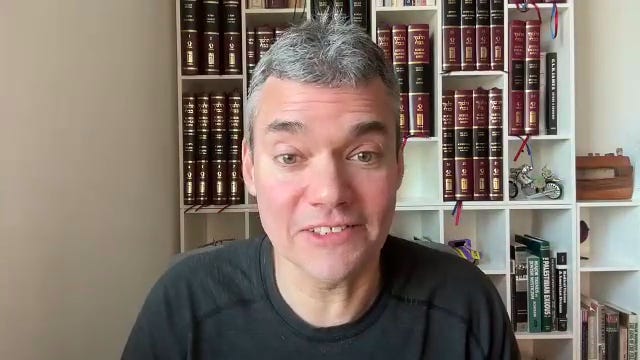
This is a public episode. If you'd like to discuss this with other subscribers or get access to bonus episodes, visit peterbeinart.substack.com/subscribeTopics include:* Mark Carney’s speech* the role of University Hillels* the intelligence of Zionists* Gaza and the West Bank today* Report from Minnesota* how we speak of our opponents* weighing truthfulness against political expediency* speaking to progressives and liberals* polling JewsThe monthly AMA live session and full video is a special perk for Premium paid subscribers. Sample Q&A from last month’s session is for everyone. Thanks so much to all for your support at any level.(A Substack glitch fails to distinguish between subscription tiers in these messages. You can review the various options here.)
A list of ways to help Palestinians in Gaza and the West Bank.This week’s Zoom call will be at our regular time, Friday at 1 PM Eastern. Our guest will be Negar Mortazavi, Senior Fellow at the Center for International Policy and host of the excellent Iran Podcast. We’ll talk about the potential for another US and Israeli attack on Iran, how Iranian dissidents view such a move, the role of the Iranian diaspora, and America and Israel’s efforts to boost Reza Pahlavi, the son of the deposed shah.Ask Me AnythingOur next Ask Me Anything session, for PREMIUM SUBSCRIBERS ONLY, will be this Tuesday, February 24, from 11-12 AM Eastern time.Things to Read(Maybe this should be obvious, but I link to articles and videos I find provocative and significant, not necessarily ones I entirely agree with.)In Jewish Currents (subscribe!), Josh Nathan-Kazis writes about the Jewish community’s reckoning over Les Wexner, patron of Jeffrey Epstein.Muhammad Shehada on how Europe might develop an alternative vision to Trump’s plans for Gaza.My friend, the Swedish writer Goran Rosenberg, has published a beautiful memoir, Israel: A Personal History.Give a Purim gift to Israelis who resist the draft.AppearancesI talked about white Christian nationalism on Ali Velshi’s show on MSNOW.On February 24, I’ll be speaking via Zoom to the Britain Palestine Project.On March 9, I’ll be speaking to Carolina Jews for Justice in Asheville, North Carolina. On March 10, I’ll be attending a fundraiser for Gaza in Asheville.On March 30, I’ll be speaking at the State University of New York at Stony Brook.See you on Friday,PeterVIDEO TRANSCRIPT:So, Donald Trump has moved this massive military arsenal to near Iran, and there’s a lot of reports that any day now, the U.S. could launch a military assault on Iran. And when I watch the debate about this kind of thing in the United States, I find it very frustrating, because I find that even people who are against Donald Trump attacking Iran, it seems to me, don’t necessarily raise the most fundamental questions. They say, well, how do we know this would work in overthrowing the regime, or how do we know it would work in eliminating Iran’s nuclear program, or, you know, why hasn’t Congress had a vote on this, or why hasn’t Donald Trump explained it to the American people, or why isn’t he focusing on domestic issues?I mean, all of these are legitimate points to make, but it seems to me, they miss a far more fundamental point, which is: by what right does the United States have to attack a country that clearly poses no threat to the United States, and that the American exceptionalism is so deep in mainstream American political culture that almost never are Americans asked to flip things, and imagine the idea of Iran or China, for that matter, attacking the United States, right? To reverse the lens, the notion that the United States somehow has the right to do things to other countries that we would never, in a million years think it was okay to do to us is just so baked into American conversation. But I think it’s just worth doing the thought experiment, right?Think about the justifications for America’s attack on Iran, right? And think about how they could be applied if a foreign country wanted to attack the United States. So, one is that Iran has this nuclear program, right? Doesn’t have nuclear weapons, but it supposedly has some kind of nuclear program that could be used to make nuclear weapons one day, right? But Iran has done a much better job of complying with the Nuclear Non-Proliferation Treaty than the United States does. Iran actually signed the Obama nuclear deal, which actually went beyond the obligations of the Nuclear Non-Proliferation Treaty, right?The Nuclear Non-Proliferation Treaty basically says that countries that don’t have nuclear weapons cannot get them, but crucially, it also says that nuclear-armed countries need to move in the direction of disarmament, right? Donald Trump has moved exactly in the opposite direction, right, basically scrapping the remaining nuclear arms control treaties that exist, moving to modernize and build more and more nuclear weapons, right? So, if the claim is that you have the right to attack countries, because they’re not meeting their obligations on the Nuclear Non-Proliferation Treaty, I think that would be a better justification for attacking the United States than for the United States attacking Iran.The second claim is that Iran represents a threat to its neighbors. Now, it’s true Iran has supported groups like the Houthis and Hezbollah and groups in Iraq that have taken violent actions against Israel or against American troops. But the level of aggression that Iran has been involved in vis-a-vis its neighbors absolutely pales to the degree of aggression that the United States has been involved in vis-a-vis its neighbors, right? The United States literally just sent the U.S. military in to kidnap, to abduct a foreign leader in Venezuela. The U.S. is basically, as Donald Trump has threatened to use military force to take over Greenland. He’s threatened to use, kind of, economic coercion to take over Canada, right?Israel’s also used much more aggression in terms of just the number of bombs that they’ve been dropping, the number of troops they’ve deployed outside of their borders, but if the claim is that you have the right to attack Iran because it represents a threat to its neighbors. Well, ask the people in Venezuela, or Colombia, or Mexico, or even Canada how much of a threat the United States represents to its neighbors; a far greater threat than Iran does.And the third argument that, you know, for the U.S. use of military force against Iran is that Iran is oppressing its own people. Now, again, I mean, if you think that Donald Trump is actually, genuinely concerned about the Iranian people, you just have to have been sleeping under a rock for the last 10 years. I mean, the idea is so absurd, right? We even see in Venezuela that Donald Trump shows no interest in actually trying to support actual democracy in Venezuela. He basically just wants, you know, autocrats who will basically allow him and his cronies to take more oil. So, there’s no reason whatsoever to believe that the U.S.’s goal in Iran would actually be to produce a more decent government that treats Iran’s people better, right?But again, if the argument is that you have the right to take military action against Iran, a country that does not, clearly does not threaten the United States, and because it’s doing terrible things to its people, well, the United States under Donald Trump is not as repressive as Iran, you know, towards its… domestically. It’s very repressive. It’s not as repressive as Iran, but if we’re looking at the human rights violations that the United States has committed around the world, right, with eliminating the USAID, which is going to lead to the death of millions and millions of people, right? Or America’s contributions to climate change, which are also going to lead to the deaths of huge numbers of people, as the United States is the largest emitter and basically has refused any efforts to curtail its emissions, right?Again, if the claim is that you have the right to attack countries because they’re committing grave human rights violations, well, again, by that logic as well, people might say that countries have the right to attack the United States. Of course, they don’t have the right to attack the United States, and even raising the conversation in America would make people think that this was an absurd idea. But it is American exceptionalism that prevents us from recognizing that it is just as morally absurd for the United States to bomb Iran as it would be for another country to bomb the United States.We still have so much work to do in the United States in overcoming this legacy of the idea that the United States is somehow on some different kind of moral or legal plane from other countries. If that was ever the case, it sure as heck is not now, right? Nobody—virtually nobody— around the world sees the United States that way, and the Americans have to… we have to stop seeing America that way. Only when we do that, I think, will we be able to address the fundamental problem with this new kind of imperialism that Donald Trump is practicing, which is based on the idea that the United States somehow can hold itself above the laws and moral norms that bind other countries. The United States has no right to do that. And that, it seems to me, is what’s at the most fundamentally wrong with this horrifying impending attack on Iran. This is a public episode. If you'd like to discuss this with other subscribers or get access to bonus episodes, visit peterbeinart.substack.com/subscribe
This is a free preview of a paid episode. To hear more, visit peterbeinart.substack.comOur guest is Sabri Jiryis, who for more than half a century has been among the most important Palestinian intellectuals trying to understand Zionism and promote Palestinian freedom. As a young man, he helped found al-Ard, the first Palestinian political movement in Israel, which called for Palestinian national rights and the establishment of a Palestinian state alongside Israel. In 1966, he wrote The Arabs in Israel, his landmark book on the Palestinians who remained in Israel after the Nakba. In 1970, Jiryis was exiled to Lebanon, where he became a close advisor to Yaser Arafat and director of the Palestine Research Center, the research and publication center of the PLO. In 1977, he published the first volume of his seminal Arabic-language book, A History of Zionism, and followed it up with a second volume in 1986. That book has now been translated into English by his daughter Fida. Following the Oslo Accords, Jiryis was one of the few Palestinians allowed to return to Israel and now lives in his native village, in the Galilee. We discussed his understanding of Zionism, and his extraordinary life.
This week’s Zoom call will be at our regular time, Friday at 1 PM Eastern. Our guest will be Sabri Jiryis, who for more than half a century has been among the most important Palestinian intellectuals trying to understand Zionism and promote Palestinian freedom. As a young man, he helped found al-Ard, the first Palestinian political movement in Israel, which called for Palestinian national rights and the establishment of a Palestinian state alongside Israel. In 1966, he wrote The Arabs in Israel, his landmark book on the Palestinians who remained in Israel after the Nakba. In 1970, Jiryis was exiled to Lebanon, where he became a close advisor to Yaser Arafat and director of the Palestine Research Center, the research and publication center of the PLO. In 1977, he published the first volume of his seminal Arabic-language book, A History of Zionism, and followed it up with a second volume in 1986. That book has now been translated into English by his daughter Fida. Following the Oslo Accords, Jiryis was one of the few Palestinians allowed to return to Israel and now lives in his native village, in the Galilee. We will discuss his understanding of Zionism, and his extraordinary life, on Friday.Reader SurveyWe created a super-short, four question, survey to see how subscribers feel about the Beinart Notebook. If you have 5 minutes, please fill it out. It will help us figure what topics to cover, and what guests to interview, in the coming year. Thanks to everyone who has already filled it out.Cited in Today’s VideoThe open letter claiming that accusing Israel of genocide constitutes a “blood libel.”The letter’s link to one paper published on the International Association of Genocide Scholars’ website accusing Hamas of genocide.The International Association of Genocide Scholars accuses Israel of genocide.Scholars estimate that Israel has killed roughly 100,000 people in Gaza.Things to Read(Maybe this should be obvious, but I link to articles and videos I find provocative and significant, not necessarily ones I entirely agree with.)In Jewish Currents (subscribe!), Daniel May writes about the lessons of Minneapolis’s resistance to ICE.In 972Mag, Sophia Goodfriend explains how ICE is adapting surveillance practices pioneered by Israel.For the Foundation for Middle East Peace’s “Occupied Thoughts” podcast, I interviewed Adalah’s Myssana Morany and B’Tselem’s Sarit Michaeli about the forced displacement of Palestinians in both the West Bank and the Naqab/Negev.AppearancesOn February 17, I’ll be speaking on a panel for the World Policy Forum about Muslim-Christian-Jewish Coexistence in the Holy Land.On February 24, I’ll be speaking via Zoom to the Britain Palestine Project.On March 9, I’ll be speaking to Carolina Jews for Justice in Asheville, North Carolina. On March 10, I’ll be attending a fundraiser for Gaza in Asheville.On March 30, I’ll be speaking at the State University of New York at Stony Brook.See you on Friday,PeterVIDEO TRANSCRIPT:So, there’s this open letter which has been signed by a bunch of people that accusing Israel of genocide constitutes a blood libel. Some of the initial signatories are the Israeli journalist Yossi Klein Halevi, Rabbi Yitz Greenberg, Rabbi Shmuly Yankolovich. I mention them in particular because part of what is so depressing to me, dispiriting to me about this letter, is that these are people who, in other aspects of their lives, I actually think are really, really talented and thoughtful people.I mean, Yossi Klein Halevi—I disagree with his political views—but he’s a very talented narrative journalist. If you read books of his, like, you know, We Were Like Dreamers about the Israeli soldiers in the 1967 war and what happened to them. Yitz Greenberg is one of the most important American rabbis of his generation, really a giant in the kind of field of post-Holocaust theology who shaped, you know, whole generations of Orthodox American Jews. Shmuly Yankielovich, who’s based in the United States, runs an Orthodox organization that, in domestic American politics, on questions of the rights of immigrants, on opposing ICE, has actually done some really, really, you know, wonderful, wonderful work.And so, this letter, to me is a kind of an example of how there’s something about this question, about the question of Israel and the Palestinians that I think takes people’s best qualities—their qualities of intellectual curiosity, and their qualities of empathy—and it kind of drains them. And this letter, I think, is a specimen of kind of what has happened to establishment American Jewish and Israeli discourse.And I just want to explain why I find it so dispiriting. The first point is if you wanted to write an intellectually and morally honest, you know, letter opposing the claim that Israel has committed genocide—you know, and to be fair, genocide is a very particular kind of crime, right? It’s different than crimes against humanity, for instance, right? Genocide has to do with intent. One could make an intellectually honest argument that Israel has not met the standard of genocide. But to be intellectually honest, you would have to start by acknowledging what Israel actually has done, right? That whatever term you claim it meets under international law, just talk about the brute facts of what has happened on the ground, right?The best scholars we have in terms of estimating direct and indirect deaths from war now suggest that Israel has killed 100,000 Palestinians in Gaza. Remember, Gaza’s not a big place, right? It’s only a bit more than 2 million people. 100,000 people, right? That Gaza has the largest population of child amputees per capita of any place in the world. That 80% of the homes have been destroyed. That 70% of farmland has been destroyed. And the reconstruction is not happening, right? In fact, what’s actually happened is Israel has cut the Gaza Strip in half and now confined people in Gaza in this completely destroyed area, where there’s no concrete coming in to actually rebuild homes. Israel has basically confined that population into only now half of the Gaza Strip.So, if you want to argue this is a genocide, okay, but at least ask yourself what the human cost has been, right? There’s nothing in this open letter which does that at all. This is the closest you get. This is the closest you get. I’m gonna read the sentence. It says: ‘There is a vigorous debate within the Jewish community over aspects of how this war was fought, and that is a sign of moral health. So is our pain over every innocent life lost.’So, you noticed the only acknowledgement of any Palestinian death and suffering at all is turned into a kind of self-congratulatory claim about Jews that actually Jews are so moral because we are pained by this, right? And because we’re having a debate about it, right? So, it’s actually, to me, the very opposite of a kind of moral reckoning with what’s happening, which I think, again, to be honest in arguing against genocide, you would have to have some human reckoning with what actually Israel has done, even if you want to say it shouldn’t be called genocide.The second thing that’s so dishonest about this open letter is that intellectually honest arguments acknowledge the arguments and face the arguments of people on the other side and try to respond to them, right? This letter does not acknowledge that among the groups that have said Israel is committing genocide are Amnesty International, Human Rights Watch, B’Tselem—an Israeli human rights organization—Physicians for Human Rights, the International Association of Genocide Scholars, right? It doesn’t acknowledge any of that. It doesn’t actually answer their arguments, which have been documented hundreds and hundreds of pages of reports from on the ground reporting from people, you know, in Gaza.And in fact, what’s even more remarkable, is that the authors of the letter claim that Israel has not committed genocide, but that Hamas was trying to commit a genocide. And to support that claim, they link to an essay written by a scholar that was posted on the website of the International Association of Genocide Scholars, right? Now, just think about this for a minute. The International Association of Genocide Scholars, as an organization, has claimed that Israel is committing genocide. This letter never acknowledges that. But to buttress its claim that Hamas was committing genocide, it cites one essay that was published on the website of this organization, while never acknowledging that the very organization whose website they are linking to has actually argued that Israel is committing genocide, right? That’s what intellectual dishonesty looks like.And the third point about the letter is the use of this term, blood libel, right? You could argue that you don’t think Israel has committed genocide. But why on earth call it a blood libel, right? A blood libel: the term comes from the claim in medieval Europe that Christians made that Jews were using the blood of Christian children to bake matzah. That’s where the term blood libel comes from, right?How can anyone seriously argue, right, that a claim of genocide that has been made by the International Association of Genocide Scholars, Israel’s own human rights organization, B’Tselem, Amnesty International and Human Rights Watch—the most well-known human rights organizations in the world—Israeli-born Holocaust and genocide scholars like Amos Goldberg, Omer Bartov, Roz Siegel, Shmuel Lederman. This is the equivalent, you’re claiming, of Christians in medieval Europe saying that Jews were using the blood of Christian children to bake matzah? It’s just completely absurd. It’s an example of just how far down the rabbit hole this kind of establishment pro-Israel discourse has gone.And the use of the term blood libel is designed specifically to make this conversation, to turn it away from a conversation of what Israel’s actually done, and to force it, straitjacket it back into this idea that
This is a free preview of a paid episode. To hear more, visit peterbeinart.substack.comSari Bashi, is the founder of Gisha, the Legal Center for Freedom of Movement, the leading Israeli human rights group offering legal assistance to Palestinians. She’s also author of the new memoir, Upside-Down Love, about her love affair with a Palestinian professor confined by Israel to the West Bank city of Ramallah.
Ethan Katz is Associate Professor of History at the University of California at Berkeley. He’s the faculty director of the Center for Jewish Studies and co-founder of both the Antisemitism Education Initiative and the Bridging Fellowship Dialogue program.His most recent co-edited book is When Jews Argue: Between the University and the Beit Midrash.He recently wrote an essay for Sources entitled When Is Anti-Zionism Antisemitic? Getting Beyond the Polemics and, while I didn’t agree with all of it, I found it an interesting good faith exploration of these issues, so I invited him to discuss it. This is a public episode. If you'd like to discuss this with other subscribers or get access to bonus episodes, visit peterbeinart.substack.com/subscribe
In this age of unfathomable cruelty and suffering, it’s easy to feel overwhelmed. But I want to highlight one individual, and one campaign, for you to consider supporting. The individual is Abdullah Awwad, a surgeon in the Gaza Strip I interviewed last year. He’s been working for years in horrifying conditions. He’s been accepted to multiple overseas medical programs but needs the money to leave Gaza with his family.The campaign is by Shir Tikvah, the synagogue whose rabbi, Arielle Lekach-Rosenberg, I interviewed last week. It’s to raise money for people harmed by ICE’s assault on the Twin Cities. Please consider supporting both of these efforts.This week’s Zoom call will be at our regular time, Friday at 1 PM Eastern. Our guest will be Sari Bashi, founder of Gisha, the Legal Center for Freedom of Movement, the leading Israeli human rights group offering legal assistance to Palestinians. She’s also author of the new memoir, Upside-Down Love, about her love affair with a Palestinian professor confined by Israel to the West Bank city of Ramallah. We’ll talk about her story of love in the face of institutional oppression, and about Israel’s restrictions on Palestinian movement, particularly in Gaza, where despite a so-called “cease-fire,” Palestinians remain largely unable to enter or leave the Strip.Reader SurveyWe created a super-short, four question, survey to see how subscribers feel about the Beinart Notebook. If you have 5 minutes, please fill it out. It will help us figure what topics to cover, and what guests to interview, in the coming year.Cited in Today’s VideoI wrote about patriotism and nationalism for The Atlantic in 2018.How the UAE bribed Trump to give it America’s most sensitive technology.Things to Read(Maybe this should be obvious, but I link to articles and videos I find provocative and significant, not necessarily ones I entirely agree with.)For Jewish Currents (subscribe!), I wrote about Donald Trump’s “Board of Peace.”For the Foundation for Middle East Peace’s “Occupied Thoughts” podcast, I interviewed Jaser Abu Mousa, a 2025 Yale Peace Fellow and past program officer working for the Swiss Agency for Development and Cooperation (SDC) in Gaza, about life and death in the Gaza Strip.For one day, The Nation magazine devoted its entire website to writing about Gaza, by writers from Gaza.After years of disputing the Gaza Health Ministry’s death toll numbers, Israel now accepts them.Eve Fairbanks writes about the American right’s nostalgia for apartheid South Africa.AppearancesOn February 9, I’ll be virtually speaking to Our Common Beliefs.On February 12, I’ll speaking at the Conference on the Jewish Left at Boston University.On Feb 24, I’ll be speaking via Zoom to the Britain Palestine Project.On March 9, I’ll be speaking to Carolina Jews for Justice in Asheville, North Carolina. On March 10, I’ll be attending a fundraiser for Gaza in Asheville.Reader CommentOccasionally, I publish readers’ responses to my videos. Here’s one from Deborah Seligsohn, Assistant Professor of Political Science at Villanova University, about my criticism of the US Holocaust Memorial Museum for its criticism of Minnesota Governor Tim Walz’s suggestion that a child in Minnesota may one day write a book like Anne Frank’s.“I went to the US Holocaust Museum with my Dad (whose father had died in a concentration camp), an incredibly moving experience. I can’t remember exactly when we went, except that I was carrying my baby in a front pack, and that I think for both of us being able to hold on to precious new life was emotionally what got us through. But what I also remember, which is why I want to mention it to you, is that there was an exhibit about the abuses in Bosnia (and this had to be before Srebrenica - it was probably November 1994 that we went, and Srebrenica was July 1995). The Museum was making a direct analogy to the holocaust. So, if they are now saying that analogies are always impermissible, that is a new point of view or more likely a rather selective one. My recollection of the museum was that you started at the top with the 1930s and worked down through 3 levels that end with the death camps, and then there is another level below that is about other genocides - or at least it was when I went - and that area was about Bosnia. When I look at their website, they have a huge section on other genocides in their genocide prevention section. What is striking there is that genocide is pretty broadly construed, except with the glaring missing discussion of the Palestinians.”See you on Friday,PeterVIDEO TRANSCRIPT:So, this was a somewhat difficult evening, for me on Sunday evening as my hometown New England Patriots lost in the Super Bowl. But, actually, the word patriots got me thinking earlier in the week because I was looking for some merchandise about the New England Patriots and, when I was searching online, what I noticed was that if you search up, kind of, hats or t-shirts with the word ‘patriots,’ you get a lot of MAGA stuff—that this word ‘patriot’ is actually a very MAGA-coded word.On the national Sirius radio network, for instance, the conservative channel with people like Sean Hannity and all these other guys is called the Patriot Radio Network. And I was thinking there’s something very strange about the fact that the term patriot is so coded as a right-wing MAGA word because Donald Trump is so obviously not a patriot. He’s the least patriotic president probably we’ve ever had. And, you know, if patriot means that you put your country above yourself, right, Donald Trump clearly does the opposite in these really blatant ways.So, the Wall Street Journal recently reported that a sheikh connected to the royal family of the United Arab Emirates had put a huge amount of money into Trump’s cryptocurrency business, and then as president Trump turned around and gave the UAE these very advanced microchips that the United States had never been willing to give the UAE before, right?So, basically, a bribe where you put money in Trump’s pocket, and he does something that at least his predecessors didn’t think was in the national interest. Or this insane story where, basically, Trump is saying the federal government won’t pay for the continual building of this rail network between New York and New Jersey unless they rename Penn Station after Donald Trump. So, Donald Trump has claimed very clearly his ego is more important than whether people in New York and New Jersey basically have good rail service. So, this is the antithesis of patriotism.And so, it’s an interesting question why is it that this term, ‘patriot,’ is so coded as a MAGA right-wing word when the embodiment of MAGA is so clearly not a patriot? And I think one reason perhaps is it’s based on a kind of confusion between the idea of patriotism and nationalism. One way of thinking about that difference, although there are others, is that nationalism means putting your country above other countries. And so, Donald Trump is, in a certain sense, a nationalist, right? I mean, he’s very hostile to global cooperation. His general view is that international affairs are zero-sum, and he wants to make weaker countries knuckle under to the United States.But that patriotism is different than nationalism. Patriotism is not about the relationship of your country to other countries. It’s about the relationship of the individual to the country, right? And about the question of whether the individual will sacrifice their own self-interest for the collective good.One way of thinking about this difference, actually, is to compare the slogan that Trump had—‘America First’—to the slogan that John McCain had when he ran in 2008, which was ‘Country First,’ right? So, you know, Trump’s slogan, ‘America First,’ is based on the idea that supposedly these other politicians haven’t put America first because they’ve cared too much about other countries. God forbid they, you know, they were concerned about people dying of treatable diseases in Africa or something like that, right? And Donald Trump will have no moral obligation whatsoever to any country other than the United States.But what McCain was saying by ‘Country First’ was something very different. It wasn’t about America’s relationship with other countries. It was about the relationship of the individual to the country, and he was kind of holding himself up as an exemplar of the idea that people should make sacrifices for the country. And even though I disagreed with a lot of John McCain’s political views, he clearly had made tremendous sacrifices for the country. He’d been tortured in a, you know, North Vietnamese prison when he served in the U.S. military during Vietnam. And Trump mocked him for that, right, because Trump really has no ability to understand, to imagine why anyone would actually put the collective good—the national good in this case—above their own self-interest. For him, that just makes you a sucker and an idiot, right? But John McCain was actually talking about patriotism when Donald Trump is talking about nationalism.And so, my hope is that people will better understand the difference of these terms, and that we may come to a day in the future in which I can celebrate the success of my hometown New England Patriots, and that progressives actually can celebrate the reclaiming of this term, patriot, because I think it’s clear today that progressives, in their willingness to sacrifice for the collective good—we see it, you know, in most extraordinary terms in Minnesota, but all over the place—are showing much, much deeper degree of patriotism than Trump and his cronies, who are basically willing to sell out the interests of the country in order to flatter their own egos and put money in their pockets. This is a public episode. If you'd like to discuss this with other subscribers or get access to bonus episodes, visit peterbeinart.substack.com/subscribe

Comments

Download from Google Play

Download from App Store
 United States