


 Claim Ownership
Tower Tales - ATC Podcast
Subscribed: 5Played: 17
Subscribe

© Mahesh
Description
"Welcome to 'Tower Tales,' the podcast that brings you the untold stories of the heroes who have silently safeguarded our skies. I am Group Captain Mahesh Sharma, a veteran of the Indian Air Force, where I served as an air traffic controller and performed various operational roles and assignments. I also had the honour of serving alongside some of the finest controllers, and through this podcast, I aim to bring their untold stories to light.
In this series, we dive deep into the professional and personal lives of veteran air traffic controllers who have served in the Indian Air Force.
12 Episodes
Reverse
SummaryIn this 11th episode of Tower Tales, host Mahesh Sharma engages with veteran Group Captain Hem Srivastava, who shares his illustrious journey in Air Traffic Control (ATC) and the Indian Air Force. The conversation covers Gp Captain's early motivations for joining the Air Force, his experiences as a young ATCO, the evolution of technology in ATC, and the challenges faced during his career. Gp Capt emphasizes the importance of teamwork, mentorship, and the critical role of ATC in ensuring aviation safety. He also reflects on his post-retirement life, continuing contributions to the ATC community, and the significance of his 50-year career in aviation.Takeaways The importance of mentorship inshaping young ATCOs.Teamwork is crucial in handlingemergencies in ATC.Technological advancements havesignificantly improved ATC operations.Early experiences in ATC can shape acontroller's career.Continuous learning and adaptation areessential in aviation.The role of ATC is critical inensuring aviation safety.Networking and maintaining connectionswith former colleagues is valuable.A strong foundation in training leadsto better performance in ATC.The journey in ATC is a lifelongcommitment and passion. Chapters03:29 Early Influences and Career Path06:12 Memorable First Experiences in ATC11:08 Challenges and Technology Limitations in ATC14:05 Handling Emergencies and Critical Situations17:56 Attributes for Success in Air Traffic Control21:40 The Role of Air Traffic Controllers in Military Operations26:35 Significant Contributions as Director of ATS31:57 Transitioning to Civilian Life and Entrepreneurship37:13 Staying Connected with the ATC Community
In this episode of Tower Tales, Mahesh interviews veteran Group Captain Anuroop Kumar, who shares his extensive journey in air traffic control (ATC) within the Indian Air Force. The conversation covers his early experiences, the importance of mentorship, the challenges faced during modernization efforts, critical incidents that tested his decision-making skills, and reflections on his career achievements. Gp Capt Kumar emphasizes the significance of a strong foundation in ATC training and the lessons learned from both successes and challenges throughout his career. The episode concludes with Gp Capt Kumar's thoughts on life after retirement and the lasting impact of his experiences in ATC.
Key Takeaways
· Mentorship plays a crucial role in shaping young
controllers.
· Building a strong foundation in ATC is essential for
success.
· Critical incidents test the skills and composure of
controllers.
· Reflections on career achievements highlight the
importance of teamwork.
· Understanding the limitations of equipment is vital
for safety.
· Local knowledge and advice are invaluable in
operational settings.
Chapters
02:08 Journey into Air Traffic Control
06:02 Early Experiences and Learning in ATC
12:11 Training and Mentorship in ATC
16:00 Modernization of IAF Airports and
Challenges
22:10 Critical Incidents and Decision-Making in
ATC
30:07 Reflections on Career Achievements
33:52 Life After Retirement
This episode of Tower Tales features Mahesh in conversation with Air Commodore AD Chhibbar, a veteran fighter pilot who shares his experiences and insights on air traffic control (ATC) and the critical role of communication and situational awareness in military aviation. The discussion highlights the relationship between pilots and air traffic controllers,
emphasizing the importance of concise instructions and the evolution of technology in enhancing aviation safety.
Takeaways
The role of air traffic controllers is
crucial for pilot safety.
Modern technology has significantly improved
ATC operations.
Effective communication is key in
high-pressure situations.
Situational awareness can prevent aviation
accidents.
Concise instructions from controllers can
save lives.
Experience plays a vital role in effective ATS
management.
The relationship between military pilots and
controllers is built on trust.
Military aviation requires adaptability and
quick decision-making.
Chapters
00:00 Introduction and Background of Air
Commodore Chibber
05:08 The Journey to Becoming a Fighter Pilot
06:55 The Importance of Air Traffic Control
10:30 Military vs. Civil Air Traffic Control
11:38 Navigational Aids and Situational
Awareness
13:59 The Role of Controllers in Aviation
Safety
19:57 Humor in High-Pressure Situations
20:16 The Role of Air Traffic Controllers in
War
22:26 Adaptability and Flexibility in Air
Force Operations
23:53 Training and Communication for
Controllers
25:03 Situational Awareness in Air Traffic
Control
27:24 Memorable Controllers and Their Impact
In this conversation, Mahesh Sharma reconnects with veteran Group Captain Govind Saxena, exploring his journey in the Air Force, starting from his motivations to join, his experiences during his first posting in Chandigarh, and the mentorship he received. Gp Capt Saxena shares memorable incidents, challenges faced during his tenure, especially in Chandigarh and Tezpur, and the importance of support and guidance in the military environment. The discussion highlights the camaraderie, learning experiences, and the unique challenges of being an ATC officer. Gp Capt Saxena also
discusses the importance of interpersonal relationships within the ATC environment and emphasizes the need for aspiring controllers to maintain a positive mindset, stay ahead of traffic, and continuously seek professional
growth. He reflects on his own career regrets and offers valuable advice for the next generation of air traffic controllers.
Takeaways
Mentorship played a crucial role in his
development as an officer.
He emphasizes the importance of
communication in critical situations.
He learned valuable lessons from mistakes
made during operations.
His experiences reflect the importance of
mentorship in the Air Force.
Building interpersonal relationships
enhances teamwork in ATC.
Maintaining a positive mindset is essential
for controllers.
Being ahead of traffic is key to effective
control.
Good humor and balance are important on
duty.
Continuous professional development is
vital for success.
Interpersonal skills are as important as
technical skills in ATC.
Chapters
00:00 Introduction and Background of Govind
Saxena
02:54 First Posting at Chandigarh:
Memorable Experiences
06:02 Mentorship and Learning in the Air
Force
08:57 Transition to Tezpur: New Challenges
and Experiences
12:14 Handling Difficult Situations as a
Controller
14:59 Navigating Night Flying and Trainee
Pilots
18:02 Challenges Faced : Terrain and
Operations
29:50 Memorable Incidents in Air Traffic
Control
32:24 Building Interpersonal Relationships
in ATC
38:49 Advice for Aspiring Air Traffic
Controllers
46:55 Reflections on Professional Growth
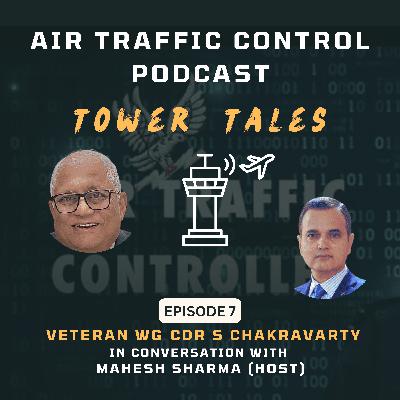
In this episode of Tower Tales, host Mahesh Sharma interviews Wing Commander Sanjoy Chakravorty, a veteran air traffic controller from the Indian Air Force. The conversation covers Chakravorty's early motivations for joining the Air Force, his experiences during his first postings, and the mentorship he received. He shares memorable incidents from his time in Jaisalmer and Bagdogra, highlighting the challenges and innovations he introduced in air traffic management. The episode concludes with valuable advice for aspiring air traffic controllers, emphasizing the importance of practical experience and theoretical knowledge.
Takeaways
The importance of mentorship in shaping a young ATC officer's career.
Experiences in Jaisalmer were both challenging and adventurous.
Innovative solutions can significantly improve operational efficiency.
Understanding the terrain is crucial for effective air traffic management.
Building a strong rapport with pilots enhances safety and communication.
Proactive problem-solving can prevent potential incidents.
Early experiences set the foundation for a successful career in ATC.
Continuous learning and adaptation are key to proficiency in air traffic control.
Collaboration among team members is essential for effective operations.
A good controller must balance practical skills with theoretical knowledge.

Comments

Download from Google Play

Download from App Store
 United States