


Behind The Science Podcast
Subscribed: 19Played: 26
Subscribe


© Paul Flores
Description
Every research paper holds more than just data. It carries years of dedication, sleepless nights, and setbacks. Behind The Science Podcast takes you beyond the published pages and into the real stories of discovery.
In partnership with the UP Resilience Institute, The Philippine Agricultural Scientist, The Philippine Journal of Fisheries, and SciEnggJ.
New episode every Thursday at 7:00 PM.
Hosted by: Paul Caesar M. Flores, DSc
Google Scholar: https://scholar.google.com/citations?user=6QCdWywAAAAJ&hl=en
Support us on Patreon: www.patreon.com/btspodcastph
In partnership with the UP Resilience Institute, The Philippine Agricultural Scientist, The Philippine Journal of Fisheries, and SciEnggJ.
New episode every Thursday at 7:00 PM.
Hosted by: Paul Caesar M. Flores, DSc
Google Scholar: https://scholar.google.com/citations?user=6QCdWywAAAAJ&hl=en
Support us on Patreon: www.patreon.com/btspodcastph
121 Episodes
Reverse
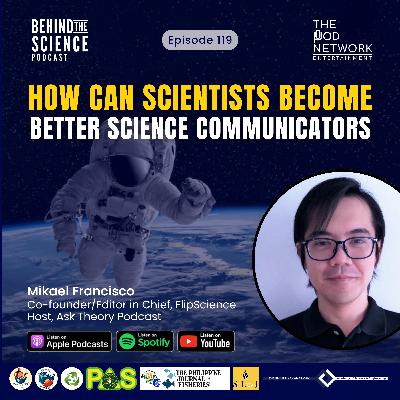
In this episode, we are joined by Mikael Angelo Francisco — an award-winning science journalist, the co-founder and editor-in-chief of FlipScience.ph, host of the Ask Theory Podcast, and a leading voice in Philippine science media — for an in-depth conversation on the evolving landscape of science communication in the Philippines. We discussed the strategic value of podcasting, the common errors scientists make when addressing non-specialist audiences, and the shared responsibility of journalists and researchers in combating misquotation and misinformation.🤝Behind The Science Podcast is presented to you by Marine & Earth Science Learning Hub, UP Resilience Institute, The Philippine Agricultural Scientist, The Philippine Journal of Fisheries, and SciEnggJ.
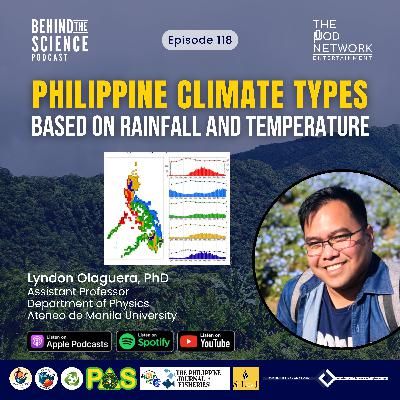
Dr. Lyndon Olaguera discusses their study challenging the existing four-type Philippine climate classification by incorporating temperature alongside rainfall data from 1979 to 2015.📚Reference: Olaguera LMP, Badua EK, Llorin AGA, Cruz FAT, Villarin JRT, Manalo JA, Villafuerte MQ II, Matsumoto J. 2025. Rainfall and temperature-based Philippine climate zones using Self-Organizing Maps. Scientific Online Letters on the Atmosphere. 21C:10–20. 🤝Behind The Science Podcast is presented to you by Marine & Earth Science Learning Hub, UP Resilience Institute, The Philippine Agricultural Scientist, The Philippine Journal of Fisheries, and SciEnggJ.
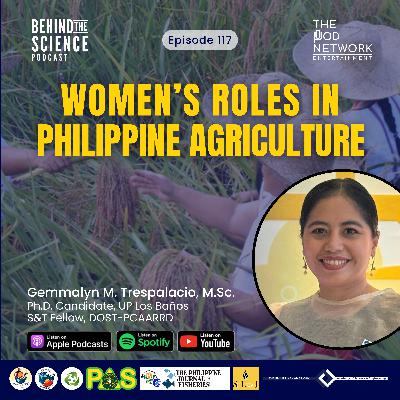
To cap off our March episode and celebrate Women’s Month, Ms. Gemmalyn Trespalacio shares their study examining women’s roles in Philippine agriculture in the context of climate change through a meta-synthesis using a gender analysis framework.🤝Behind The Science Podcast is presented to you by Marine & Earth Science Learning Hub, UP Resilience Institute, The Philippine Agricultural Scientist, The Philippine Journal of Fisheries, and SciEnggJ.
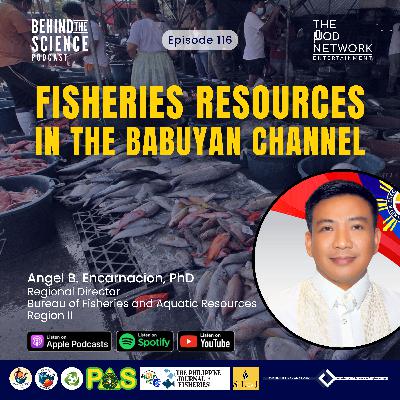
Dr. Angel Encarnacion discusses their study assessing the fisheries resources of the Babuyan Channel in Northern Philippines, uncovering fluctuating fish production trends and high fishing pressure on commercially important species like shortfin scad, mahi-mahi, and largehead hairtail from 2009 to 2013.📚Reference: Calicdan MA, Gumiran E, Encarnacion AB, Ayson JP. 2018. Assessment of fisheries resources in the Babuyan Channel. The Philippine Journal of Fisheries. 25(1):14–24. 🤝Behind The Science Podcast is presented to you by Marine & Earth Science Learning Hub, UP Resilience Institute, The Philippine Agricultural Scientist, The Philippine Journal of Fisheries, and SciEnggJ.
Mr. Gerardo Ilagan investigated the presence and fate of seven veterinary antibiotics, namely, amoxicillin, ampicillin, penicillin G, tetracycline, oxytetracycline, sulfamethazine, and sulfamethoxazole in the surface waters of the Upper Pampanga River and its tributaries in Nueva Ecija. 📚Reference: Ilagan G, Dimzon IK, Guidote Jr. A. 2026. Occurrence and stability of veterinary antibiotics in Upper Pampanga River Basin located in Nueva Ecija, Philippines. SciEnggJ. 19(1):79–88.🤝Behind The Science Podcast is presented to you by Marine & Earth Science Learning Hub, UP Resilience Institute, The Philippine Agricultural Scientist, The Philippine Journal of Fisheries, and SciEnggJ.
Mr. Sean Manalo shares a low-cost method to measure the carbon dioxide efflux in Philippine mangrove forests.📚Reference: Manalo SP, Salmo SI. 2025. Exploring the potential of low-cost portable CO2 meter in the assessment of soil CO2 efflux in Philippine mangroves. SciEnggJ. 18(2):347–355.🤝Behind The Science Podcast is presented to you by Marine & Earth Science Learning Hub, UP Resilience Institute, The Philippine Agricultural Scientist, The Philippine Journal of Fisheries, and SciEnggJ.
Dr. John Manalo discussed their study on how urbanization has driven temperature changes across the Philippines from 1951 to 2018 using 34 meteorological stations.📚Reference: Manalo JA, Matsumoto J, Takahashi HG, Villafuerte MQ, Olaguera LMP, Ren G, Cinco TA. 2022. The effect of urbanization on temperature indices in the Philippines. International Journal of Climatology. 42(2):850–867.🤝Behind The Science Podcast is presented to you by Marine & Earth Science Learning Hub, UP Resilience Institute, The Philippine Agricultural Scientist, The Philippine Journal of Fisheries, and SciEnggJ.
Engr. Angela Bauzon discusses her Master's thesis on ground deformation in Bohol following the devastating 2013 Mw 7.2 earthquake. Her study analyzes post-earthquake land movement along the coastal areas of Loon and Maribojoc using Sentinel-1 satellite imagery and remote sensing techniques like shoreline change analysis and persistent scatterer interferometric synthetic aperture radar📚Reference: Bauzon, M.D.A., Reyes, R.B., Blanco, A.C. et al. Ground deformation analysis caused by post-2013 earthquake in Bohol, Philippines. Spat. Inf. Res. 30, 791–807 (2022).🤝Behind The Science Podcast is presented to you by Marine & Earth Science Learning Hub, UP Resilience Institute, The Philippine Agricultural Scientist, The Philippine Journal of Fisheries, and SciEnggJ.
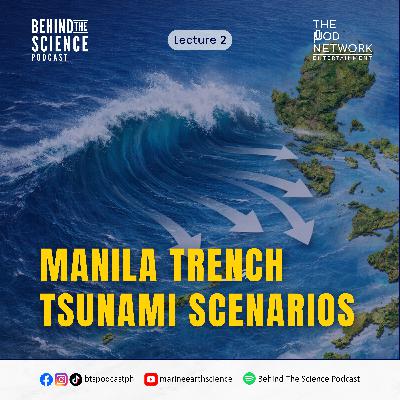
Reuploading this old lecture I made...Numerical modeling of tsunamis from the Manila Trench provides startling insights into the many countries and people who would be affected by such a catastrophic event. This video explains the modeling results and demonstrates just how devastating the effects of a powerful tsunami from the Manila Trench could be.📚References: Megawati K, Shaw F, Sieh K, Huang Z, Wu T-R, Lin Y, Tan SK, Pan T-C. 2009. Tsunami hazard from the subduction megathrust of the South China Sea: Part I. Source characterization and the resulting tsunami. Journal of Asian Earth Sciences. 36(1):13–20. doi:10.1016/j.jseaes.2008.11.012.Qiu Q, Li L, Hsu Y-J, Wang Y, Chan C-H, Switzer AD. 2019. Revised earthquake sources along the Manila trench for tsunami hazard assessment in the South China Sea. Natural Hazards and Earth System Sciences. 19(7):1565–1583. doi:10.5194/nhess-19-1565-2019.
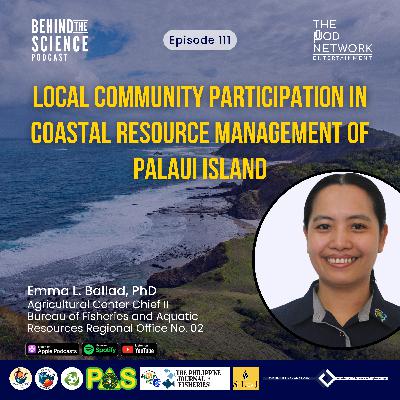
In this episode, Dr. Ballad discussed her study on Palaui Island Protected Landscape and Seascape (PIPLS) where she explores how ecotourism serves as an alternative livelihood for local communities and how it influences their participation in coastal resource management. 📚Reference: Ballad E, Morooka Y, Shinbo T. 2021. Impact of ecotourism on local community's participation in coastal resource management: case of Palaui Island Protected Landscape and Seascape (PIPLS) in Northern Luzon, Philippines. The Philippine Journal of Fisheries. 28(2):168–180. 🤝Behind The Science Podcast is presented to you by Marine & Earth Science Learning Hub, UP Resilience Institute, The Philippine Agricultural Scientist, The Philippine Journal of Fisheries, and SciEnggJ.
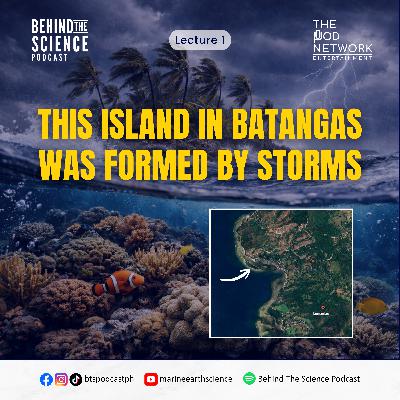
Reuploading this old lecture I made...Tsunami or typhoon? Which one built the mysterious island off the coast of Lumaniag village in Batangas? That's the question researchers from UP Diliman set out to answer.In this episode, we dive into how researchers from UP Diliman solved this coastal detective story. By combining field measurements, uranium-thorium dating of coral boulders, historical typhoon records, and interviews with village elders to piece together how typhoons in the 1960s and 70s built an entire island from scratch. Here's the twist: that storm-built island is now protecting the very community it once threatened.📚Reference: Gallentes AT, Manglicmot MT, Gong SY, Hu HM, Shen CC, Siringan FP. 2021. Coral boulder transport and gravel bar formation by storms in Lumaniag village, Batangas, northwestern Philippines. Geomorphology. 376:107554. doi:10.1016/j.geomorph.2020.107554.🤝Behind The Science Podcast is presented to you by Marine & Earth Science Learning Hub, UP Resilience Institute, The Philippine Agricultural Scientist, The Philippine Journal of Fisheries, and SciEnggJ.
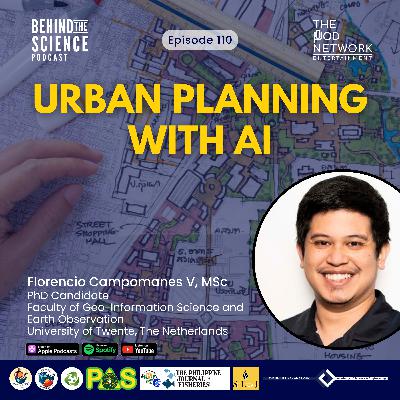
What does a livable city really look like and who gets to decide? In this episode, Enzo Campomanes explains how he developed AI models called "AI-voters" trained on satellite imagery and community input to map urban livability. 📚Reference: Campomanes V, F., Abascal, A., Oliveira, L.T. et al. Whose city is it? Mapping perceived urban livability with citizen-guided AI. npj Urban Sustain 6, 16 (2026).🤝Behind The Science Podcast is presented to you by Marine & Earth Science Learning Hub, UP Resilience Institute, The Philippine Agricultural Scientist, The Philippine Journal of Fisheries, and SciEnggJ.
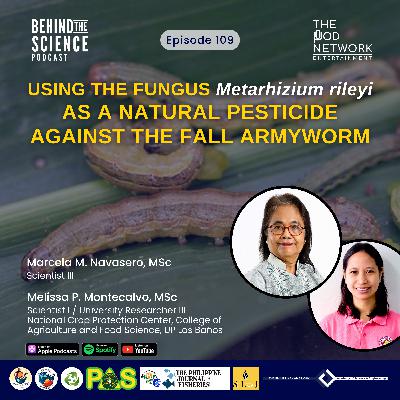
How can a fungus help control one of the Philippines’ most destructive crop pests? In this episode of Behind the Science Podcast, Marcela M. Navasero and Melissa P. Montecalvo of UPLB’s National Crop Protection Center share how Metarhizium rileyi is being studied as a biological control agent against fall armyworm, along with the real-world challenges of turning lab research into sustainable pest management solutions.📚Reference: Valeros JME, Garcia TAP, Sabino NG, Navasero MM, and Montecalvo MP. 2025. Effect of Successive Subculturing on Virulence, Growth, and Germination of Fungus Metarhizium rileyi for Biological Control of Fall Armyworm. The Philippine Agricultural Scientist. 108(4):406–412. 🤝Behind The Science Podcast is presented to you by Marine & Earth Science Learning Hub, UP Resilience Institute, The Philippine Agricultural Scientist, The Philippine Journal of Fisheries, and SciEnggJ.
I talked with Engr. Raymond Lagria about his study on classifying and ranking social media posts to prioritize disaster response.📚Reference: Lagria, R., et. al. “A Text Mining Framework for the Classification and Prioritization of Disaster-Related Tweets for Disaster Response”. Philippine Engineering Journal 2022 Vol. 43, No.: 65-88🤝Behind The Science Podcast is presented to you by Marine & Earth Science Learning Hub, UP Resilience Institute, The Philippine Agricultural Scientist, The Philippine Journal of Fisheries, and SciEnggJ.
I talked with Ms. Cielo Luz C. Mondejar about practical, low-cost ways to improve rice seed quality using organic fertilizers.📚Reference: Mondejar CL. 2025. Comparative Effects of Organic-Based Seed Treatments on Seed Viability and Vigor of Rice (Oryza sativa L.) Varieties. The Philippine Agricultural Scientist. 108(4):305–312.🤝Behind The Science Podcast is presented to you by Marine & Earth Science Learning Hub, UP Resilience Institute, The Philippine Agricultural Scientist, The Philippine Journal of Fisheries, and SciEnggJ.
What happens when you drop 2 quantum particles of different sizes at the same time?📚Reference: Flores PCM, Galapon EA. 2019. Quantum free-fall motion and quantum violation of the weak equivalence principle. Physical Review A. 99(4). 🤝Behind The Science Podcast is presented to you by Marine & Earth Science Learning Hub, UP Resilience Institute, The Philippine Agricultural Scientist, The Philippine Journal of Fisheries, and SciEnggJ.
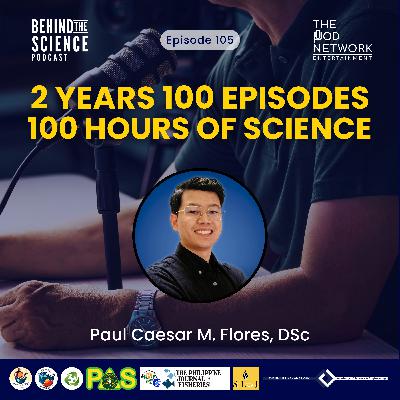
Kwento ko lang paano ito nagsimula hanggang sa kung ano na ito ngayon.
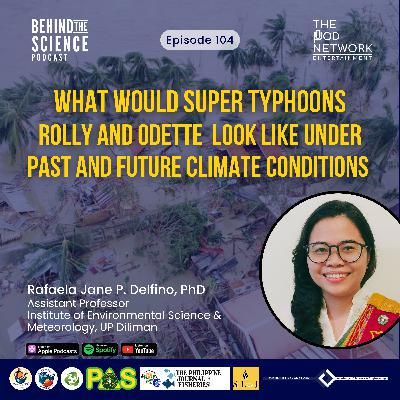
In this episode, I talked with Dr. Rafaela Jane Delfino about her research on how climate change influences super typhoons in the Philippines. Using high-resolution climate models, her study examines how Super Typhoons Goni (2020) and Rai (2021) respond to past and future climate conditions.📚Reference: Delfino RJP, Bagtasa G. 2025. Response of super typhoons Goni (2020) and Rai (2021) to past and future climate conditions in convection-permitting model experiments. Environmental Research Communications. 7(9):091013.🤝Behind The Science Podcast is presented to you by Marine & Earth Science Learning Hub, UP Resilience Institute, The Philippine Agricultural Scientist, The Philippine Journal of Fisheries, and SciEnggJ.

I talked with Dr. Cherrie May Olaya, a postdoctoral researcher at the RIKEN Center for Advanced Photonics in Japan. She explains her work on how light behaves at metal surfaces, focusing on a phenomenon known as the photonic spin Hall effect. Using surface plasmon resonance, her study demonstrates a new way to directly measure tiny light shifts that are usually difficult to detect. We discuss why these effects matter, how they can improve optical sensing and imaging technologies, and what it is like to conduct advanced photonics research as a Filipino scientist working abroad.📚Reference: Olaya CM, Hayazawa N, Balgos MH, Tanaka T. 2025. Enhancing angular photonic spin Hall effect at surface plasmon resonance. Nanophotonics. 14(19):3115–3124. 🤝Behind The Science Podcast is presented to you by Marine & Earth Science Learning Hub, UP Resilience Institute, The Philippine Agricultural Scientist, The Philippine Journal of Fisheries, and SciEnggJ.
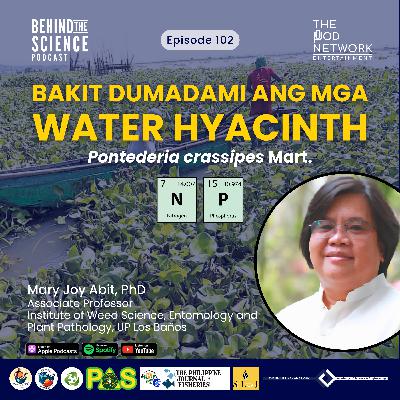
Dr. Mary Joy Abit shares their research that examines how nitrogen and phosphorus concentrations can influence the growth of water hyacinths.📚Reference: Abit MJ, Pilar RF, Ramirez AH. 2025. Influence of Nitrogen and Phosphorus Rates on the Growth of Water Hyacinth (Pontederia crassipes Mart.). The Philippine Agricultural Scientist. 108(1):7–12.🤝Behind The Science Podcast is presented to you by Marine & Earth Science Learning Hub, UP Resilience Institute, The Philippine Agricultural Scientist, The Philippine Journal of Fisheries, and SciEnggJ.

Comments

Download from Google Play

Download from App Store
 United States