


 Claim Ownership
Talking About Organizations Podcast
Subscribed: 239Played: 6,171
Subscribe

© Talking About Organizations
Description
Talking About Organizations is a conversational podcast where we talk about one book, journal article or idea per episode and try to understand it, its purpose and its impact. By joining us as we collectively tackle classic readings on organization theory, management science, organizational behavior, industrial psychology, organizational learning, culture, climate, leadership, public administration, and so many more! Subscribe to our feed and begin Talking About Organizations as we take on great management thinkers of past and present!
352 Episodes
Reverse
We conclude our episode on economic sociology and valuation by looking at the impact work has had on contemporary research. Societies continue to wrestle with how to properly assign value to intangible things such as non-fungible tokens and other cryptocurrencies, “climate change,” and “social media.” There are also questions of the value and utility of expertise in legal proceedings – is it better to have the best expert as a witness or an expert who is a more effective communicator?
Economic sociology bridges economics and sociology, exploring questions such as how social environments explain and influence economic activities. Of interest for this episode is the subfield of economic valuation, in which researchers have been studying how the monetary worth of something is formed or constructed. One influential work is Marion Fourcade’s “Cents and Sensibility: Economic Valuation and the Nature of
‘Nature’,” published in the American Journal of Sociology in 2011. The article explores the economic valuation of peculiar goods, things that are intangible or otherwise cannot be exchanged in a market yet have a social
value, and uses a case study of the legal proceedings following oil spills in the US and France to explain why the monetary awards were calculated so differently from each other.

Coming soon! We enter the field of economic sociology and valuation through a comparative study by Marion Fourcade on the different legal outcomes of oil spills in the US and France. “Cents and Sensibility: Economic Valuation and the Nature of ‘Nature’,” published in the American Journal of Sociology in 2011, presents a case study of the legal proceedings following oil spills in the US (the Exxon Valdez) and France (the Amoco Caldez) where the two lawsuits resulted in surprisingly different monetary awards to the plaintiffs. Why? The answers lie in how the nations constructed the very meaning of nature and its ostensible value.
In this final release of our 5th year celebration, we welcome the perspectives of several past guests, hosts, and observers of past recordings -- with additional commentary from cast members Pedro, Miranda, Catherine, Leonardo, and Tom. Our guests discussed the experiences (and fun) of participating in the podcast, the podcast's current role and potential future directions, and the state of scholarship in organization studies. We thank our guests -- Deborah Brewis, Leon Prieto, Simone Phipps, Maja Korica, Marc Ventresca, Fabricio Neves, Polyana Silva, and Ella Hafermalz.
About a month before the anniversary, we solicited questions from our listeners about things they wanted to know or suggestions for the podcast. Out of the large number of excellent questions received; Dmitrijs, Miranda, Maikel, Jarryd, and Tom broke it down to five that we tackled and discussed in our own Talking About Organizations way. The questions covered academic publication, desires for different topics to be included in the show, on the state of organization studies today, addressing contemporary issues, and attacking wicked problems.
On October 13, 2020, we celebrate our fifth anniversary with a series of releases over next two weeks. In these release, we offer listeners an insider perspective on the making of our episodes. Dmitrijs, Pedro, Ralph, and Tom discuss how we choose an episode topic, schedule it, record it and conduct post-production, and release it through the web and RSS feeds. We also talk about the broader Talking About Organizations Network and what we enjoy most about doing the podcast.
In Part 2 of our episode on Gieryn’s 1983 article “Boundary-Work and the Demarcation of Science from non-Science,” we review the main points in the context of contemporary tensions over society’s growing distrust of scientists and rejection of science. What factors may be contributing to this trend after so many decades where scientists have been considered noble individual or science considered an inherently good thing? What might be necessary to stem or reverse such trends?
We continue our series of discussions on the sociology of science and cover a seminal article that is commonly found as required reading in doctoral programs -- Thomas Gieryn’s 1983 article “Boundary-Work and the Demarcation of Science from non-Science” from the American Sociological Review. This commentary draws from three different historical case studies to explore where the boundary is between what is or should be considered science or the autonomy granted to scientists and what is considered other forms of intellectual pursuit. In Part 1, we explore the cases that involve competition between the world of science and those of religion and engineering, of true science vs. pseudo-science, and of scientific openness and collaboration vs. national security and commensurate need for secrecy.
Coming soon! Our next episode features a 1983 article from Thomas Gieryn that discusses how the “boundary work” of scientists and others science contributes to a broader understanding of where science is separated from non-science or pseudo-science and scientists navigate the gap between their individual autonomy and the constraints placed on them by others such as government leaders. Through historical cases, Gieryn explores the contested spaces surrounding science and why the boundary will likely never be clear.
In Part 2 of our episode on Charles Perrow’s book Normal Accidents, we carry the framework forward into the 21st century to consider newer technological systems (especially in information technology) and the Y2K problem that was looming when the updated edition of the book was published in 1999. Is there any hope for mitigating the potential for new forms of high-risk accidents, or are we just stuck with having to deal with the occasional mass disaster?
This month we are discussing Charles Perrow’s book Normal Accidents that addresses the risks associated with complex, tightly coupled high-risk technological systems. Through analyses of numerous accidents and incidents involving nuclear power plants, petrochemical plants, aerospace and maritime systems, and others, Perrow derived a framework that showed how high-risk systems are prone to accidents if they are highly complex and the components are tightly coupled. He also argued that efforts to improve safety such as more meters and indicators can have the opposite effect of complicating the operator’s ability to control a catastrophic situation.
Coming soon! Our next episode features a 1999 book by Charles Perrow titled Normal Accidents that addresses the risks associated with complex, tightly coupled high-risk technological systems. With the Three Mile Island disaster and a host of other catastrophes, Perrow built a framework that helps forecast which kinds of technologies are most at risk. However, he suggests there are constraints regarding what one can do to preclude accidents.
In Part 2 of our episode on five works of Henry Mintzberg, we move toward the contemporary environment and ask ourselves how much has changed since the Rise and Fall of Strategic Planning was published. After all, some of the very systems that Mintzberg criticized heavily are still very much in use, and still appear to exhibit some of the same failings. So what should be done?
This month we return to the works of Henry Mintzberg, whose book Simply Managing we covered way back in Episode 14. This time, we decided to cover a number of works covering broad themes of strategy development and organizational planning, along with critiques of extant design school works. We divided five works among us to discuss in which he argues about why strategies and plans so often seem to fail, why planners seem so out of touch with the rest of the organization, and why even the processes of strategy development and planning may be inherently flawed.
Coming soon! We will cover a body of work by Henry Mintzberg. His career as a consultant and management researcher spans decades and has resulted in numerous works that provide critical perspectives on dominant schools of thought in organizational design, strategic, and planning. So instead of a single reading, we chose five and the cast members divided the works as they all converged on several common themes.
We now release a recording of a professional development workshop (PDW) called Queer Eye For Academics: Skills For Navigating Academic Life, held at the 2025 Academy of Management annual meeting. Inspired by the popular Queer Eye television series, this PDW offered a fresh approach to skill-sharing within academia, and featured six presenters – most early-career scholars from the LGBTQ+ community -- covering a variety of practical skills such as teaching, crafting research programs, and presenting, and interpersonal development skills such as engaging, fostering caring relations, and recognizing colleagues.
This month, we are presenting recordings of two events from the Academy of Management Annual Meeting 2025. The first event was Multimodal Impact: Translating Academic Knowledge via Contextual, Collaborative, and Collectivist Modes. This symposium brings together five presenters to explore diverse modes of translating academic expertise into practice. As management researchers increasingly strive to achieve societal impact, this event sought to understand how different communication modes can bridge the persistent research-practice divide.
In Part 2 of our episode on Kanter’s Commitment and Community, we examine in depth her conclusions about the distinction between “retreat” and “service” communities and why the former tends to fail while the latter shows greater chances of long-term success. However, we also debate on the meaning of “success” as being more nuanced that merely duration of the commune over time. We then discuss the implications for this study for the present day when Internet-based social movements of all forms and perspectives can be formed readily – but how and why do they last?
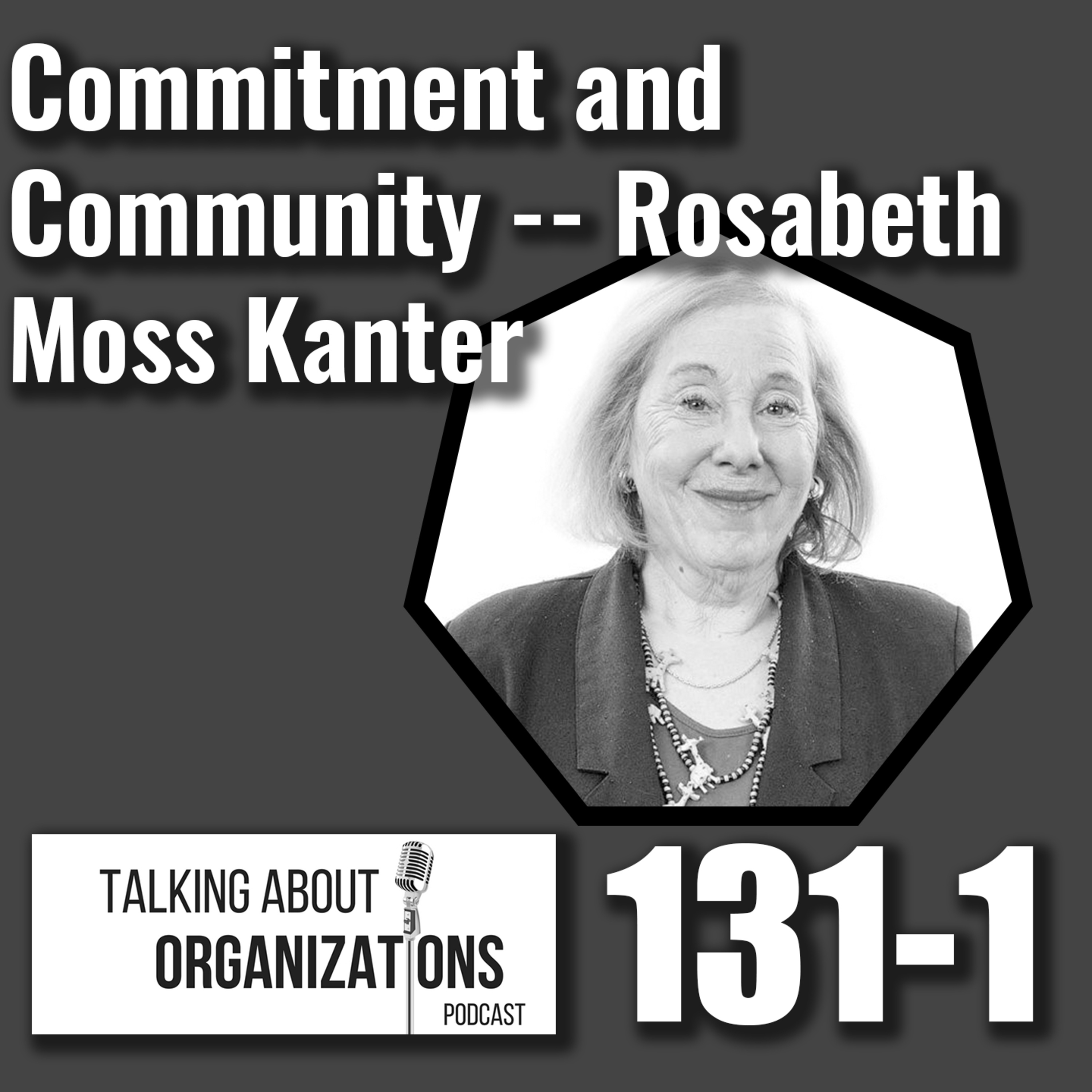
This month we return to the works of Rosabeth Moss Kanter, whose works on tokenism we explored way back in Episode 17. This time, we will discuss one of her better known books Commitment and Community: Commune and Utopias in Sociological Perspective that examines the origins and life cycle of numerous communes that sprang up in the US from the mid-19th century to the 1960s. Written based on her dissertation study at a time when hippie communes were popular, she wondered what drove people to start or join these communes and what factors enabled the communes’ survival. This week’s Part 1 is about her conceptual framework and study, and next week’s Part 2 will focus on the conclusions and implications for social movements today.
Coming soon! In our next episode, we will discuss Rosabeth Moss Kanter’s famous book Commitment and Community that examines the origins and life cycle of numerous communes that sprang up in the US from the mid-19th century to the 1960s. What drove people to start or join these communes? And then, what factors allowed some to survive for decades or longer while others broke up within months? The answers have added greatly to our understandings of individual commitment to an organization and an organization’s commitment to its members.


Download from Google Play

Download from App Store
 United States
Interesting conversation! Too bad about the very bad sound quality though, many things are not possible to hear at all...