


 Claim Ownership
The Chair
Subscribed: 2Played: 2
Subscribe

© Dr. Digby James Wren
Description
Geo-political Risk Analysis, Security Assessments, Economic Development Trends, Diplomacy and Public Diplomacy
theaseanchair.substack.com
theaseanchair.substack.com
17 Episodes
Reverse
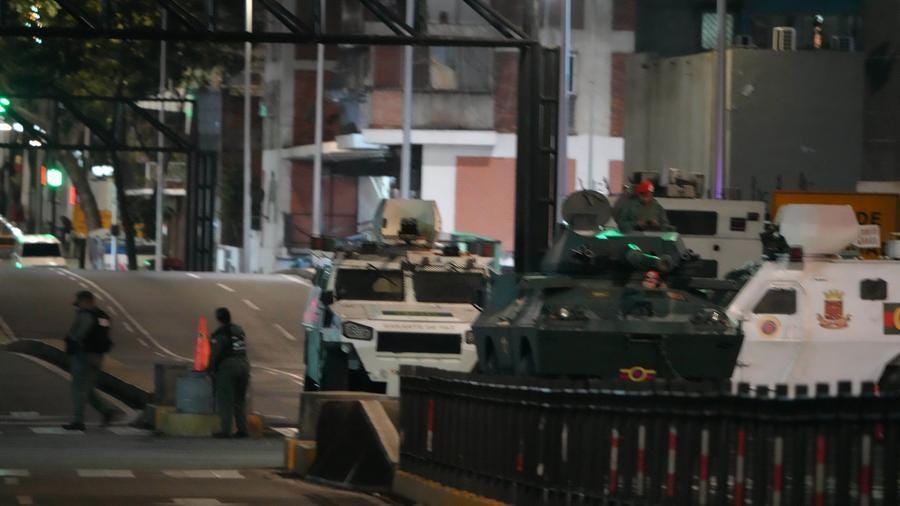
Featured contributor Professor Josef MahoneyThe U.S. forcible seizure of Venezuela’s President Maduro has sent shockwaves across the world. Is this abuse of unilateral power becoming a go-to tool for the United States? Are we witnessing the return of a “might makes right” logic in international affairs? And what kind of world order may emerge from this?Host Ge Anna is joined by Anna Rosario Malindog-Uy, Director and Vice President for External Affairs, Asian Century Philippines Strategic Studies Institute; Cao Ting, Director of the Center for Latin American Studies of Fudan University; and Josef Mahoney, Professor of Politics and International Relations at East China Normal University. Get full access to The Chair at theaseanchair.substack.com/subscribe

Featured contributor Professor Josef Gregory MahoneyRecently, the term “U.S. death line” has been trending across Chinese social media. Originally a term from the gaming world, it’s now being used to describe the financial fragility haunting everyday Americans. Why are so many people in the U.S. just one crisis away from poverty? What does it tell us about the deep-seated institutional gaps in the country’s social safety net? Host Xu Yawen joins Prof. Li Lun, Assistant Professor of Economics at Peking University, and Prof. Josef Gregory Mahoney, Professor of Politics and International Relations at East China Normal University, for a chat. Get full access to The Chair at theaseanchair.substack.com/subscribe
Get full access to The Chair at theaseanchair.substack.com/subscribe

By Dr. Digby James WrenIn the wake of the Pahalgam attack on April 22, 2025, which claimed 26 lives, India launched ‘Operation Sindoor’, a targeted military strike against alleged terrorist infrastructure in Pakistan-administered Kashmir and Pakistan itself. The operation, described by Indian officials as “focused and non-escalatory,” aimed at camps linked to groups such as Jaish-e-Mohammed and Lashkar-e-Taiba, notably in Bahawalpur and Mudrike. Pakistan condemned the strikes as aggression, reporting civilian casualties and retaliating by downing Indian aircraft. The incident underscores the perennial volatility of Kashmir, a region both nuclear-armed nations have contested since 1947. While the immediate conflict highlights Indo-Pakistani hostilities, it also intersects with India’s broader strategic imperatives—particularly its efforts to deepen ties with Central Asia, a region where geographic and political barriers, including Pakistan’s refusal to grant India land access, persistently challenge New Delhi’s ambitions. Get full access to The Chair at theaseanchair.substack.com/subscribe

Partnerships, not pressure: what China offers where the West hesitatesThree countries, one tour, and a clear message from Beijing- President Xi Jinping touched down in Vietnam, Malaysia, and Cambodia this week, marking one of his most strategic Southeast Asian tours in years. What's behind the charm offensive? While the U.S. is fueling global confusion and frustration with its tariff war, China and its Southeast Asian partners are trying to inject cooperation and stability into global growth. What does the whirlwind visit mean for China, Southeast Asia, and the world?Host Tu Yun joins Dr. Zha Daojiong, Professor of International Political Economy, School of International Studies, Peking University, Dr. Digby James Wren, External Relations Advisor, Royal Academy of Cambodia and Chair, Belt and Road Capital Partners, and Dr. Dylan Loh, Assistant Professor, Public Policy and Global Affairs Programme, Nanyang Technological University to decode the tour at the Chat Lounge.Key Quotes“I look at this as a consolidation of ASEAN and to do that, Malaysia, Cambodia and Vietnam are key countries to signal to the other members.” “It's more than just the infrastructure connection. You will have the connectivity in trade and investment.”“This meeting then comes in this context that has injected a new dynamic.”“The idea of the shared future and everywhere in Cambodia people know about this,they do talk about this.”“For Malaysia, what stood out to me was the agreement on using pay to satellites.”“Vietnam, I would think the most significant part is the reaffirmation of cross-border economic trade and investment linkages.”Guest SpeakersDr. Wren holds research degrees in both International Relations and Public Diplomacy and is a leading Sinologist and ASEAN geopolitical expert. He holds the Chair of Belt and Road Capital Partners, a geopolitical risk, investment and trade, and public diplomacy advisory firm. Dr. Wren is also the Publisher of Long Mekong Media, a leading resource for political and economic information across Asia and the Founder of the Young ASEAN Minds Education program.Prof. Zha Daojiong is a professor of international political economy in the School of International Studies, Peking University, where he also directs a Center on Transnational Issues and holds a professorship in the University’s Ocean Research Institute. He specialises in studying non-traditional security issues in China’s foreign relations, with a particular focus on energy, food, and trans-boundary water issues.His recent research interest has expanded to political risk management for Chinese investments overseas, which took him on field trips to Africa, Australia, and Southeast Asia. He serves on advisory boards of the China Chapter of Council for Security Cooperation in the Asia Pacific, Chinese Association for International Understanding, China-USA Friendship Association, and China-Myanmar Friendship Association.He has authored and edited six academic books, including Chinese Investment Overseas: case studies on environmental and social risks (Peking University Press, 2014), in addition to dozens of journal articles. He also served on guest research and teaching positions in Australia, Japan, the United States, Singapore and the Hong Kong Special Administrative region. He holds a Doctoral degree in political science from the University of Hawaii at Manoa and the East West Center.Dylan M.H Loh received his PhD in politics and international studies at Cambridge University. He was a Graduate Research Fellow at the Center of Rising Powers at Cambridge University from 2016 to 2018 and a Pre-Doctoral Fellow at the University of Copenhagen, Department of Political Science, from September 2018 - February 2019. His work has been published in journals such as Pacific Review, Journal of Chinese Political Science, Australian Journal of International Affairs, Cooperation and Conflict, Journal of Current Chinese Affairs, International Relations of Asia-Pacific and International Studies Review. His research interests include Chinese foreign policy, ASEAN regionalism, diplomacy and practice theory.Additionally, his commentaries and interviews have appeared in local and global media outlets such as Bloomberg, Channel 8, AFP, South China Morning Post, The Straits Times, 93.8 Live, Today, 联合早报, Berita Harian, The Nation and Global Times among others.https://radio.cgtn.com/podcast/news/5/Partnerships-not-pressure-what-China-offers-where-the-West-hesitates/2715404 Get full access to The Chair at theaseanchair.substack.com/subscribe

Tariffs or Diplomacy: Will they divide the world?On April 9, 2025, a titanic 145% U.S. tariff on Chinese imports ignited Beijing's swift 125% retaliation. This move has created a cacophony of concerns. Featured contributor Dr. Yasir Masood engaged in a digital dialogue with Mike Billington, a renowned American geopolitical analyst, to unpack this high-stakes clash and its global fallout.Editor's note: CGTN's First Voice provides instant commentary on breaking stories. The column clarifies emerging issues and better defines the news agenda, offering a Chinese perspective on the latest global events.Yasir Masood: On April 9, 2025, a titanic 145 percent U.S. tariff on Chinese imports ignited Beijing's swift 125 percent retaliation. This move has created a cacophony of concerns across global markets, as U.S.-China tensions, once warmed by historic visits, now fray under hardline advisors and economic fears. With Europe eyeing Beijing and talk of cooperation fading, what's next?I engaged in a digital dialogue with Mike Billington, a renowned American geopolitical analyst, to unpack this high-stakes clash and its global fallout.Billington: I think the most important issue in terms of U.S.-China relations and these tariffs that were imposed and then partially withdrawn, except on China, is that we're dealing with a president, President Trump, who is surrounded by people who are rabidly anti-China. You have Peter Navarro as a top economic and trade advisor to Trump. Navarro is literally psychotic about China. Navarro also has been a leader in promoting these extreme tariffs and especially on China.But then you also have the Secretary of Defense, Pete Hegseth. This man is also virtually psychotic about China. Then you have Mike Waltz, who's the National Security Advisor. He was an aide to Dick Cheney, one of the most extreme neocons, so-called warmongers and he was the promoter when he was in the Congress of boycotting the Olympics in China in 2022. So, these are people who have no qualifications whatsoever on diplomacy, but are rabidly anti-China and unfortunately have a certain voice.Masood: Trump's first term kicked off with a rare thaw – visits with Xi, personal overtures and big promises. But Billington says that faded fast, driven by advisors with strong anti-China views – voices that sidelined diplomacy and favored confrontation over talks.Billington: Now, on the other side, you might remember that when President Donald Trump came in his first term, his initial response towards China was that he invited Xi Jinping to visit him in Mar-a-Lago and then he visited Beijing and spent a couple of days with Xi Jinping. Xi Jinping took him to the Forbidden City. He literally gave him a lesson on Chinese history and philosophy and Trump came back praising China and praising Xi Jinping as a great leader.Now, all of this is going on at the same time that the world financial system is on the brink of total collapse. There are now two quadrillion dollars – a quadrillion is a thousand trillion dollars – in gambling debts, what they call derivatives, which are sitting on top of the Western banking system, threatening to completely fall apart.And on top of this, Trump introduced these extremely high tariffs, not only on China, although that's the worst case, and he's removed most of the tariffs except for China. But is he going to continue them? It's not clear.The economic crisis in the West is evident, and these tariffs have properly frightened people around the world.Masood: Billington's perspective illuminates Europe's evolving role in response to Washington's isolationist measures. As U.S. policies marginalize longtime allies, European nations are decisively courting Beijing to forge stronger strategic ties. The overarching question remains: Will the U.S. shift toward cooperation, perhaps by embracing China's development model, as seen with the Belt and Road Initiative, or will its confrontational stance further destabilize the global order?Billington: I think even the Europeans are now trying to improve their relations with China and it's in part because they see that they're being targeted by the United States and they're probably going to lose the support of the United States as the bedrock of NATO and so forth.And I think the fact that most of the countries are willing to talk to the United States and to negotiate on what to do about these tariffs, that's probably, they have no choice. They really have to do that for the betterment of their people.Well, I think we have to be hopeful that Trump will recognize that we need to negotiate. He did say just the other day, I heard him say, just listening to him speaking at a news broadcast, that he recognizes that Xi Jinping is a brilliant person. And if he restores his earlier vision of U.S. and China cooperation and has respect for China's sovereignty, that's a first step to avoid the disaster.We have a model actually in China, which not only lifted 800 million of its population out of poverty and developed the most advanced technological country in the world, but then began to take these ideas of infrastructure and technology to the rest of the world through the Belt and Road. And the Belt and Road Initiative represents a model that the U.S. should join in order to put together a world based on a new architecture that addresses the economic and development needs and security needs of every single nation on earth.https://news.cgtn.com/news/2025-04-17/Tariffs-or-diplomacy-Will-they-divide-the-world--1CEaTKY1k9a/p.htmlWATCH the full version video Get full access to The Chair at theaseanchair.substack.com/subscribe
President Donald Trump’s second term in office has demonstrated his mastery of modern media, but also the weaknesses of being surrounded by ‘Yes’ men and women in his cabinet choices and administration generally.Moreover, his nostalgia for late 19th century American tariff regimes, the Monroe Doctrine and American Imperialism is based on the false assumption that such policies can work in a post-globalisation phase for the world economy. An overview of how the alley and partner hegemony of the US is and was financed and prosecuted also exposes the inherent flaws in late empire and the failure to understand the “cannibalisation effect.”Donald Trump’s aggressive “Art of the Deal” tariffs and sanctions are in effect a rampage against the boomerang effect of past US policies, which caused stagnation in it’s allies economies that were designed to keep allied economies subjugated to the dollar and American markets while weakening and exerting control over China, Russia and any other economy that did not ‘fall into line’. The net effect is that Cannibalisation of allies and partner economies has now generated stagnation in the US and that Trump’s questionable ‘corrective’ measures serve only to accelerate the decline of US economic, political, technological, military and diplomatic power.Meanwhile the incremental shocks to the US economy only further catalyse and, as a result, strengthen the economy of Russia and especially China. The ascent of China’s power, however, is not limited to external forces, but rather the internal dynamism led by deep traditions in political and social unity, unmatched organisation capabilities and the production of innovation at speed and scale matched with massive investments in infrastructure, education, health and technological advances applied to market at speed and scale.Is the US about to suffer catastrophic collapse? Watch the video and leave your comments below. Get full access to The Chair at theaseanchair.substack.com/subscribe
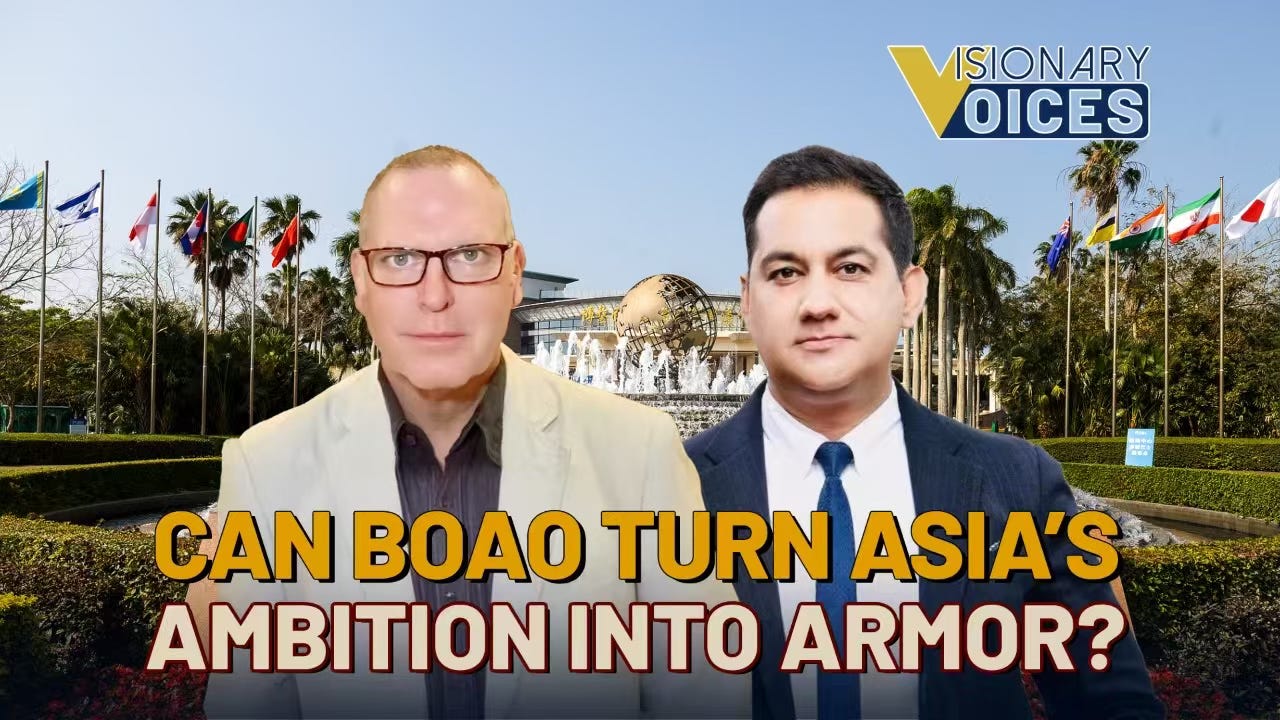
By Yasir Masood (CGTN)Editor's note: CGTN's First Voice provides instant commentary on breaking stories. The column clarifies emerging issues and better defines the news agenda, offering a Chinese perspective on the latest global events.Asia's push to lead in green and digital innovation faces fractured supply chains and geopolitical divides. Can ambition outpace division? The Boao Forum for Asia (BFA) Annual Conference 2025 tackles these challenges head-on, with Australian strategist Dr. Digby James Wren charting a path forward: turn dialogue into infrastructure, scale China's innovation engine and unlock financing for AI and green tech.With RCEP and ASEAN as anchors, Dr Wren advocates unified markets, seamless data flows, and grassroots partnerships. But in a world of tariffs and fragmentation, can multilateralism still prevail? Boao's answer: trust-driven progress, where talk becomes tomorrow. Next, Dr. Wren on bridging promises and progress.Translating policy discussions into economic impactDr. Wren: The Boao Forum is a really great platform for Asia, and (specifically for) Southeast Asia. Translating policy discussions like Boao into actionable initiatives is not necessarily an easy thing to do, but it drives economic impact.The things that are really important at the moment are turning dialogue into action is the key, and institutionalizing the follow-up mechanisms and working groups, converting ideas into blueprints, and developing permanent bodies.Scalability is another thing. I think that's very important, getting things done at speed and scale are really the hallmarks of China's innovation. The Boao Forum enables a platform to do that. So, I'd like to see more innovation models that can be applied to different countries, for example, to Pakistan, Cambodia, Malaysia, Indonesia and Vietnam.And mobilizing finance. I think finance is another area where there's not enough input, and it isn't easy to get the contacts you need at the right time for financing.And then probably the last one is prioritizing digital and green. And I think that's really key. China's leading in that area globally, and I'd like to see that being pushed or supported more strongly right across all of the partner countries in Asia. And then I suppose the last one would be stakeholder engagement.But progress demands more than ambition; it needs armor. From Cambodia's logistics bottlenecks to Indonesia's rail breakthroughs, Asia's supply chains are rewriting resilience. Dr. Wren cuts to the core: Strengthen access, unify systems, prioritise stability. Now, he tackles the trillion-dollar question: How do we futureproof growth in a fragmented world?Reciprocal tariffs and regional resilienceDr. Wren: Intermediate goods, especially Chinese intermediate goods, need clearer access to those new near shoring supply chains. That's important. Resilience of the supply chains is clearly going to have to be strengthened and prioritized. For example, some countries, like Cambodia, it is still very difficult. But there are some bright spots here, the Laos-China railway, Indonesia's railway from Jakarta to Bandung, that's an uplift.Geopolitical fragmentation is very problematic. That fragmentation is really caused by pressure that's being caused by mostly the United States and Europe. China is providing the greatest level of stability for Southeast Asia, for Central Asia, and right across Asia.Resilience is being built rail by rail, policy by policy. But as supply chains stabilize, a tougher test looms: Can Asia's economic alliances outpace geopolitical divides? Dr. Wren shifts focus to the rules of engagement: "Inclusive multilateralism isn't optional. It's survival." From RCEP's unifying power to battling digital Balkanisation, he charts a path where Huawei bridges ASEAN and where Boao becomes the ultimate toolkit. Dr. Wren unveils the strategy: How multilateral frameworks turn fractures into footholds.Navigating geopolitics and economic trajectoryDr. Wren: Inclusive multilateralism is the end way to go here. Boao needs to concentrate on the ones we do have, the networks that are already in place, like ASEAN and RCEP, that's perfect; in Central Asia, with the existing economic blocks; and also the regional ones with the partners in Africa and South America, to reduce fragmentation and create a more unified market. For example, ASEAN especially is a clear winner because it is the biggest trading partner for China.RCEP is also providing a positive magnetic force, which is good for Australians, New Zealanders, Japanese and South Koreans.Companies in China, like Huawei, Xiaomi and others, can all be involved in better governance, I think, communication governance and data-sharing governance. That needs to be looked at fairly closely.We don't want the Balkanization of all these ASEAN countries just because they don't want to connect to their storage systems. We need a toolkit for that, I suppose. Boao would be a very good way to set up a toolkit for doing that.Asia's future hinges on three pillars: speed, scale, and solidarity. From the Laos-China railway to RCEP's game-changing sway, Dr. Wren's playbook is clear: Turn debate into bridges. Turn friction into frameworks. Turn divisions into drive. This isn't about trade spats. It's about rewriting the rules. From Huawei's digital leaps to grassroots grit, Boao is Asia's ultimate toolkit. The race isn't against rivals. It's against the clock. And the finish line? A world where shared futures aren't just debated. They're built.https://news.cgtn.com/news/2025-03-27/Can-Boao-Forum-turn-Asia-s-ambition-into-armor--1C5hnvrF89G/p.html5G-Advanced: The Backbone of the AI RevolutionBy Dr. Digby James WrenThe convergence of artificial intelligence (AI) and 5G-Advanced (5G-A) networks marks a pivotal shift in technological capability, reshaping industries, governance, and daily life. As Yang Chaobin of Huawei emphasised at the recently concluded 2025 World Mobile Congress (WMC) in Barcelona Spain, “5G-A is not merely an upgrade—it is the foundation for unlocking AI’s full capabilities.” With over 60 telecom operators globally deploying 5G-A, its role in powering AI-driven solutions—from smart factories to telemedicine—positions it as the critical infrastructure for a globally interconnected future.The technical foundations of 5G-A, colloquially termed “5.5G,” build on 5G, but with three transformative enhancements: Ultra-High Uplink Speeds (up to 10 Gbps), essential for data-intensive applications like industrial sensors and real-time drone feeds; Near-Zero Latency (<10 milliseconds), enabling instantaneous decision-making for robotics, autonomous vehicles, and remote surgeries; and, Network Slicing, which allocates dedicated bandwidth for specific AI tasks to ensure reliability. These three core advancements address inefficiencies in latency-sensitive environments, allowing AI systems to operate at peak efficacy.For example, AI-driven robotic arms in manufacturing require millisecond-level adjustments based on sensor feedback—a feat unachievable with traditional networks. Huawei’s collaboration with manufacturers reduced production errors by 30% using 5G-A-enabled systems. Similarly, autonomous drones, such as those deployed by JD Logistics in China, leverage 5G-A’s low latency and high uplink speeds to process LiDAR data in real time, slashing delivery times by 50%.Huawei’s AI-Centric Network Solution, presented at WMC 2025, focuses on three pillars of the AI driven economy: All-Domain Connectivity which ensure universal ultra-high speeds for AI applications; Predictive Operations that drive AI managed maintenance initiatives to reduces downtime by 60%; and, Experience Monetization allowing online services like gaming companies and education providers to offer tiered services such as premium latency for students and gamers.In gaming crazy South Korea, 5G-A connected AI systems in homes adjust energy use based on occupancy, saving families an estimated US$600 annually. Adidas is using AI-driven 5G-A systems to add customisation at scale and produce personalised sneakers in 48 hours (vs. 2 weeks), enabling it to capture a US$2 billion niche market. And, in customer engagement, Augmented Reality shopping, such as L’Oréal’s 5G-A-powered AR app, lets users “try on” makeup virtually, boosting online sales by 35%,through virtual makeup trials. Additionally, wearable devices like Huawei’s 5G-A-enabled watches can detect irregular heartbeats with astounding accuracy, alerting users to seek care before emergencies.Economic growth and business innovation rely on improved education outcomes. Education equity and personalised learning are being transformed by AI technologies. In Kenya, AI tutors on 5G-A networks adapt lessons to student needs, boosting literacy rates by 25%. In Mongolia, Huawei’s VR-enabled classrooms connect students to global institutions, bridging geographic divides.The transformation in smart manufacturing and autonomous systems are increasingly powered by the deterministic performance of 5G-A. Siemens’ predictive maintenance tools, integrated with 5G-A, reduced downtime by 60% at its Munich plant, saving €200 million annually. In logistics, Maersk’s AI platform on 5G-A predicts shipping delays with 95% accuracy, saving US$3 billion annually, while Amazon’s smart warehouses utilize 5G-A-connected robots to enable same-day delivery for 90% of US customers. Vietnam’s 5G-A smart ports cut cargo processing times by 40%, which in-turn has helped attract US$12 billion in logistics investments.Another key benefit of the AI transformation is an emerging healthcare revolution built on 5G-A’s unmatched reliability for critical telemedicine, remote surgeries and AI diagnostics. During a recent trial in Shanghai, surgeons performed a kidney transplant using 5G-A-connected robotic arms controlled from 1,500 km away, demonstrating life-saving potential by performing delicate procedures with sub-10ms latency. In rural In
A Journey Through Chinese Fine Arts History, Periods, Materials, and MasterpiecesSource: https://chat.deepseek.com (prompt: write a short article on the history of Chinese fine arts)Chinese fine arts, with a history spanning over 5,000 years, represent one of the world's most enduring and sophisticated artistic traditions. Rooted in philosophy, religion, and imperial patronage, Chinese art reflects the country's cultural evolution, technological advancements, and aesthetic ideals. This article explores the major periods, materials, notable names, and finest examples of Chinese fine arts, highlighting the emperors and dynasties that shaped this rich heritage.### **Historical Periods and Development**1. **Neolithic Period (c. 10,000–2000 BCE):** The earliest Chinese art emerged during the Neolithic era, characterized by pottery and jade carvings. The Yangshao culture (5000–3000 BCE) produced painted pottery with geometric and animal motifs, while the Liangzhu culture (3300–2200 BCE) excelled in jade craftsmanship, creating ritual objects like *bi* discs and *cong* tubes.2. **Shang and Zhou Dynasties (c. 1600–256 BCE):** The Shang Dynasty (1600–1046 BCE) is renowned for its bronze ritual vessels, intricately decorated with taotie (mythical creature) motifs. The Zhou Dynasty (1046–256 BCE) continued this tradition, emphasizing the use of bronze for ceremonial purposes and introducing inscriptions that documented historical events.3. **Qin and Han Dynasties (221 BCE–220 CE):** The Qin Dynasty (221–206 BCE) is famous for the Terracotta Army, a monumental funerary art project commissioned by Emperor Qin Shi Huang. The Han Dynasty (206 BCE–220 CE) saw advancements in silk painting, lacquerware, and tomb art, with murals depicting daily life and mythological themes.4. **Tang Dynasty (618–907 CE):** Often considered the golden age of Chinese art, the Tang Dynasty was marked by cultural flourishing. Buddhist sculpture, landscape painting, and ceramics thrived. The era's cosmopolitan nature is reflected in the vibrant tomb figurines and the famous Dunhuang cave paintings.5. **Song Dynasty (960–1279 CE):** The Song Dynasty is celebrated for its landscape paintings, which emphasized harmony with nature. Artists like Fan Kuan and Guo Xi created monumental works such as *Travelers Among Mountains and Streams*. The period also saw the perfection of porcelain, exemplified by Ru, Guan, and Ding wares.6. **Yuan Dynasty (1271–1368 CE):** Under Mongol rule, Chinese art absorbed foreign influences. Literati painting, led by artists like Zhao Mengfu, gained prominence, focusing on personal expression and calligraphy.7. **Ming and Qing Dynasties (1368–1912 CE):** The Ming Dynasty (1368–1644) revived traditional Chinese aesthetics, producing exquisite blue-and-white porcelain and monumental landscape paintings. The Qing Dynasty (1644–1912) saw the rise of court-sponsored art, including the intricate *Jadeite Cabbage* and the *Forbidden City's* architectural grandeur.### **Materials and Techniques**Chinese artists employed a wide range of materials, including:- **Silk and Paper:** Used for painting and calligraphy.- **Bronze:** For ritual vessels and sculptures.- **Jade:** Revered for its beauty and symbolic significance.- **Porcelain:** Famed for its delicacy and craftsmanship.- **Ink and Pigments:** Essential for painting and calligraphy.### **Notable Artists and Emperors**- **Gu Kaizhi (c. 344–406 CE):** A master of figure painting, known for *The Admonitions of the Instructress to the Court Ladies.*- **Emperor Huizong (1082–1135 CE):** A Song Dynasty emperor and accomplished artist, renowned for his bird-and-flower paintings.- **Qi Baishi (1864–1957):** A modern master of ink painting, celebrated for his expressive brushwork.### **Finest Examples**1. **The Terracotta Army (Qin Dynasty):** A testament to imperial power and craftsmanship.2. **Along the River During the Qingming Festival (Song Dynasty):** A panoramic painting by Zhang Zeduan depicting urban life.3. **The Forbidden City (Ming and Qing Dynasties):** An architectural masterpiece symbolizing imperial authority.4. **Dunhuang Murals (Tang Dynasty):** Buddhist cave paintings showcasing religious and cultural exchange.Chinese fine arts are a testament to the nation's rich cultural legacy, blending technical mastery with profound philosophical and spiritual depth. From ancient jade carvings to imperial porcelain, these works continue to inspire and captivate audiences worldwide.**END*** https://www.patreon.com/c/TheChair844* https://x.com/GalaLive8/* https://www.linkedin.com/in/dgb365/ Get full access to The Chair at theaseanchair.substack.com/subscribe
The rapid turnover of G7 leaders has become a farce. Economic turmoil, a major change in global industrial investment and a river of US sanctions and the Team Trump tariff avalanche expected this year provide the bulk of today’s episode.A quick update on ASEAN and Cambodia FDI and the outlook for Trump tariffs on the world’s largest trade partnership between China and ASEAN.Australia’s sustainability transition is highly dependent on China’s EVs, but so is the UK and many are countries. Like, subscribe and share…https://www.patreon.com/c/TheChair844https://x.com/DGB365/https://www.linkedin.com/in/dgb365/Spotify:Apple Podcasts: Get full access to The Chair at theaseanchair.substack.com/subscribe

Belt and Road updateIn this episode we cover Cambodia's Techo Funan Canal and China's involvement and investment attitude as well as a update on risks to the Belt and Road in West Asia, Red Sea, Mediterranean and Africa.Check out my Multipolar Peace friends on YouTube below.Transcript(00:00:00):welcome to the chair i'm your host dr digby james wren today is friday the 13th of(00:00:06):december 2024 a most auspicious date to end my hiatus for the last two months and(00:00:15):to start broadcasting again streaming(00:00:19):to all of my subscribers and followers.(00:00:22):And I'm pleased to announce that the chair has roughly 4,000 subscribers and we go(00:00:30):out to about 200,000 on our newsletter,(00:00:32):200,000 a day.(00:00:34):We've had a TikTok with one million views.(00:00:36):So that's starting to build.(00:00:38):And so I thought I'd better get back into action and start talking about what is(00:00:43):important in the world for all of those that follow geopolitical risk(00:00:48):global trade and investment,(00:00:49):political economy,(00:00:52):and also public diplomacy,(00:00:54):Full transcript available.Keep enjoying, keep watching and I'll be with you very, very soon.(00:29:07):Thanks very much.(00:29:09):See you again very soon. Get full access to The Chair at theaseanchair.substack.com/subscribe

(00:00:00): Guest Intro:Dr. Digby Wren, geopolitical risk analyst and policy advisor at Belt and Road Capital Partners.Li Qiang saying, [South China Sea situation] it just needs to be more understanding right now. Do you see some sort of off ramp to these tensions that continue to escalate? Or are we actually seeing some sort of imminent armed conflict with China?See Transcript link:Added Comments to those in the original interview: ASEAN is attractive to EU and US investment and trade, but the “jostling” in the South China Sea and Myanmar’s internecine feuds obscure positive economic growth indicators approaching 5% across the bloc, including Myanmar, which had 0.3% economic expansion despite a suppressive external sanctions regime (IMF/WB). (Wren, 2024)NB: “Russia is winning” refers specifically to declining Western material and financial support for Ukraine and Russia’s expanded diplomatic and security reach. The upcoming BRICS+ summit has overshadowed US efforts and the NATO Rammstein Summit has been postponed/cancelled. These indicators are widely published in leading EU and Anglo-American mastheads and streaming news media.” (Wren, 2024) Get full access to The Chair at theaseanchair.substack.com/subscribe

Multipolar Peace Now ! Part 2:1We are forming a global alliance against globalism, and neutrality studies is part of that. Don't get confused, let's just live with the contradiction.Last Friday we held the second panel of independent social media contributors, discussing the new multipolarity we are now in, why we think that the collective west is being collectively stupid about it, and what we—and you—can do to oppose the lunacy.The Basics:* Multipolarity is not only an emerging reality, it is also a preferable foundation for global order.* Neutrality is an important tool within the overall mix of how nations view themselves and position themselves in the context of integrated and indivisible security.* NATO is a dangerous organisation and its expansion globally is undesirable and contrary to achieving a sustainable peace.Work in progress.More here: Multipolarpeace.comContributors:Dr. Warwick PowellDr. Pascal Lottaz: Neutrality StudiesJerry Grey: Jerry's Take on China Youtube, / @jerrystakeonchina799 Arnaud Bertrand: Twitter, https://twitter.com/rnaudbertrand?s=2...Dr. Jeff Rich: Burning Archive Youtube, / @theburningarchive Substack,Dr. Digby Wren Substack, https://substack.com/@digbywrenDr. David Oualaalou: Geopolitical Trends Youtube, / @geopoliticaltrends S.L. Kanthan Substack,Twitter, https://twitter.com/kanthan2030?s=21&...Einar Tangen Linkedin, https://www.linkedin.com/in/ehtangen/...Dr. John Pang Twitter, https://twitter.com/jynpang?s=21&t=Oe...The Chair is a reader-supported publication. To receive new posts and support my work, consider becoming a free or paid subscriber. Get full access to The Chair at theaseanchair.substack.com/subscribe

Multipolar Peace Now ! Part 2:2 We are forming a global alliance against globalism, and neutrality studies is part of that. Don't get confused, let's just live with the contradiction.Last Friday we held the second panel of independent social media contributors, discussing the new multipolarity we are now in, why we think that the collective west is being collectively stupid about it, and what we—and you—can do to oppose the lunacy.The Basics:* Multipolarity is not only an emerging reality, it is also a preferable foundation for global order.* Neutrality is an important tool within the overall mix of how nations view themselves and position themselves in the context of integrated and indivisible security.* NATO is a dangerous organisation and its expansion globally is undesirable and contrary to achieving a sustainable peace.Work in progress.More here: Multipolarpeace.comContributors:Dr. Warwick PowellDr. Pascal Lottaz: Neutrality StudiesJerry Grey: Jerry's Take on China Youtube, / @jerrystakeonchina799 Arnaud Bertrand: Twitter, https://twitter.com/rnaudbertrand?s=2...Dr. Jeff Rich: Burning Archive Youtube, / @theburningarchive Substack,Dr. Digby Wren Substack, https://substack.com/@digbywrenDr. David Oualaalou: Geopolitical Trends Youtube, / @geopoliticaltrends S.L. Kanthan Substack,Twitter, https://twitter.com/kanthan2030?s=21&...Einar Tangen Linkedin, https://www.linkedin.com/in/ehtangen/...Dr. John Pang Twitter, https://twitter.com/jynpang?s=21&t=Oe...The Chair is a reader-supported publication. To receive new posts and support my work, consider becoming a free or paid subscriber. Get full access to The Chair at theaseanchair.substack.com/subscribe

(00:00:00):Well, thank you for having me on the show again.(00:00:01):Well,(00:00:02):the first thing to say,(00:00:03):I think,(00:00:03):is that political assassination is not a new thing in the United States.(00:00:06):There's a long history of this.(00:00:07):I'm not sure how many presidents have been assassinated, but there's been at least(00:00:29):at least seven or eight attempts on presidents.(00:00:33):So it's nothing new.(00:00:34):But of course,(00:00:35):what's interesting about this,(00:00:36):of course,(00:00:37):is that President Biden has been,(00:00:42):well,(00:00:43):has been shown to be a senile old man and hardly capable of fulfilling the presidency.(00:00:49):So I think this is going to,(00:00:53):as the former speaker said,(00:00:55):will most probably propel Trump into the presidency.(00:01:00):There's one photo with his fist clenched in the air where he's saying,(00:01:04):we have to fight,(00:01:05):fight,(00:01:05):fight,(00:01:07):with blood streaming down his face.(00:01:09):And I think that will be enough to get him across the line.(00:01:13):But,(00:01:13):you know,(00:01:13):one always has to ask the question,(00:01:16):who's going to benefit from such an assassination attempt?(00:01:19):You know, why was it attempted in the first place?(00:01:22):And,(00:01:23):you know,(00:01:23):the fact that this fellow was fairly obvious in some videos that I've seen,(00:01:28):he was easily spied.(00:01:30):So how he got there and how he was able to do this is quite strange, I think.(00:01:37):But yes, this is definitely going to change the balance of the election in November.(00:01:42):And I think Trump is now going to get a fairly smooth ride to the victory in November.(00:01:49):Trump is now, in effect, a kind of a hero.(00:01:53):He survived an assassination attempt.(00:01:55):And I think that's going to swing a lot of voters,(00:01:59):not urban voters,(00:02:00):but definitely sort of suburban voters and(00:02:03):and areas,(00:02:04):poorer areas,(00:02:05):especially areas that have suffered from de-industrialisation and former soldiers(00:02:12):are definitely going to rally behind him now.(00:02:14):And I think that's going to be enough to get him across the line.(00:02:17):And I think people will forget very quickly that he has incited the public to(00:02:23):violence previously,(00:02:25):the insurrection after the previous election.(00:02:29):So all of this(00:02:32):I think he's really going to help him.(00:02:35):And Biden is looking so bad.(00:02:38):So the timing, you know, he couldn't have asked for better timing to survive an assassination attempt.(00:02:43):And I think he's going to ride the wave of sympathy and a sort of hero worship into(00:02:50):the presidency in November.(00:02:51):All right.(00:02:53):Thank you very much for that.(00:02:54):Digby Wren, international relations expert from Pen on Pen.(00:02:57):Thank you.Original video stream here. The Chair is a reader-supported publication. To receive new posts and support my work, consider becoming a free or paid subscriber. Get full access to The Chair at theaseanchair.substack.com/subscribe

NATO is boosting its visibility in the Asia Pacific region. For three years in a row, leaders or representatives of four Asia Pacific countries – Japan, South Korea, Australia and New Zealand – have attended the annual summit of the military alliance. The outgoing NATO Secretary-General Jens Stoltenberg has been an ardent advocator of Asia Pacific outreach, and his argument has been echoed by US officials as Washington, DC hosted this year’s NATO summit.What is behind NATO’s growing interest in Asia Pacific? Will NATO be a force for good if it establishes a sizeable footprint in the region? Host Ding Heng is joined by Digby James Wren, External Relations Advisor to the Royal Academy of Cambodia; Lee Pei May, Assistant Professor of Political Science at the International Islamic University Malaysia; Professor Shen Dingli from the Institute of International Studies, Fudan University.Listen to original here.Transcript below.The Chair is a reader-supported publication. To receive new posts and support my work, consider becoming a free or paid subscriber. Get full access to The Chair at theaseanchair.substack.com/subscribe
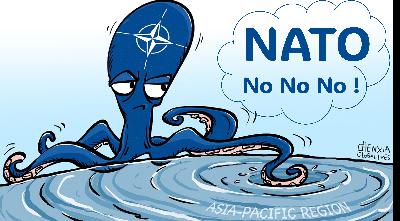
The United States wants NATO to be dragged in to Asia.Today is Wednesday the 10th of July 2024 and today we're going to explore the NATO Summit that's being held in Washington today and tomorrow. And, I think we're going to start with an article written by the the former Singapore ambassador to the United Nations, Kishore Mahbubani, who was actually appointed twice as Singapore’s UN ambassador. Now, he's a very, very well-respected figure, and he wrote in 2021 that...“that the Pacific has no need of the destructive militaristic culture of the Atlantic Alliance.”Now, what was he talking about?What he was talking about was the fact that NATO, which has existed since post-World War II and the Cold War era, basically has been involved in invasions and wars in Europe, in the Middle East, Central Asia, North Africa and other places.Now the United States wants NATO to be dragged in to Asia. Get full access to The Chair at theaseanchair.substack.com/subscribe
Comments

Download from Google Play

Download from App Store
 United States