


 Claim Ownership
Two by Two
Subscribed: 6,161Played: 29,372
Subscribe

© (c) 2024 The Ken
Description
The Two by Two podcast is a premium business podcast from The Ken that investigates, discusses and breaks down the most important business stories around you.
Hosted from The Ken's newsroom by business journalists Rohin Dharmakumar and Praveen Gopal Krishnan, Two by Two will feature guests and experts from across the industry and academia to talk about issues no one else is talking about.
Hosted from The Ken's newsroom by business journalists Rohin Dharmakumar and Praveen Gopal Krishnan, Two by Two will feature guests and experts from across the industry and academia to talk about issues no one else is talking about.
36 Episodes
Reverse
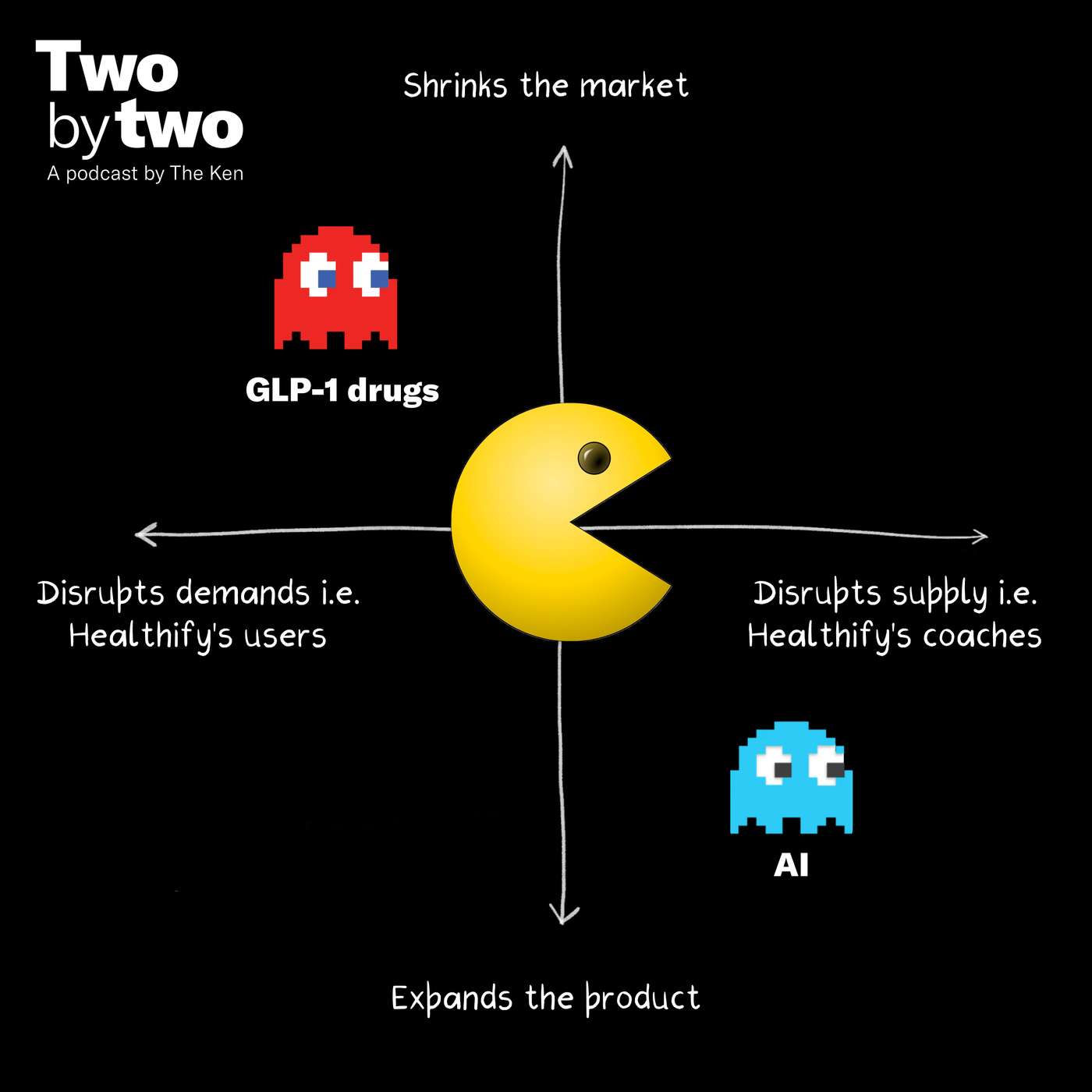
Most businesses die quietly. They miss a wave, lose relevance and fade out.Healthify nearly got hit by two in quick succession. First, AI that could do what took the company years to build. Then, a drug which meant you didn't need the discipline anymore.So Rahel Philipose and Praveen Gopal Krishnan asked Tushar Vashisht, Healthify's co-founder and CEO, the uncomfortable question directly: if anyone can build an AI coach and a drug can kill your appetite, what exactly are you selling?This episode is really about three things most people don't know. One, why people who take Ozempic without a lifestyle program gain almost all the weight back within a year. Two, what actually happens to a platform business when AI replaces one entire side of it. And three, why Tushar believes his most dangerous competitor hasn't been founded yet.We were also joined by Professor R Srinivasan from IIM Bangalore, who had a very different read on whether Healthify's bet is genius or cope.______This episode was produced by Uddantika Kashyap and mixed and mastered by Rajiv CN, our resident sound engineer.If you liked this episode, share it with your friends, family and colleagues. And if you have thoughts on the discussion, write to us at twobytwo@the-ken.com.
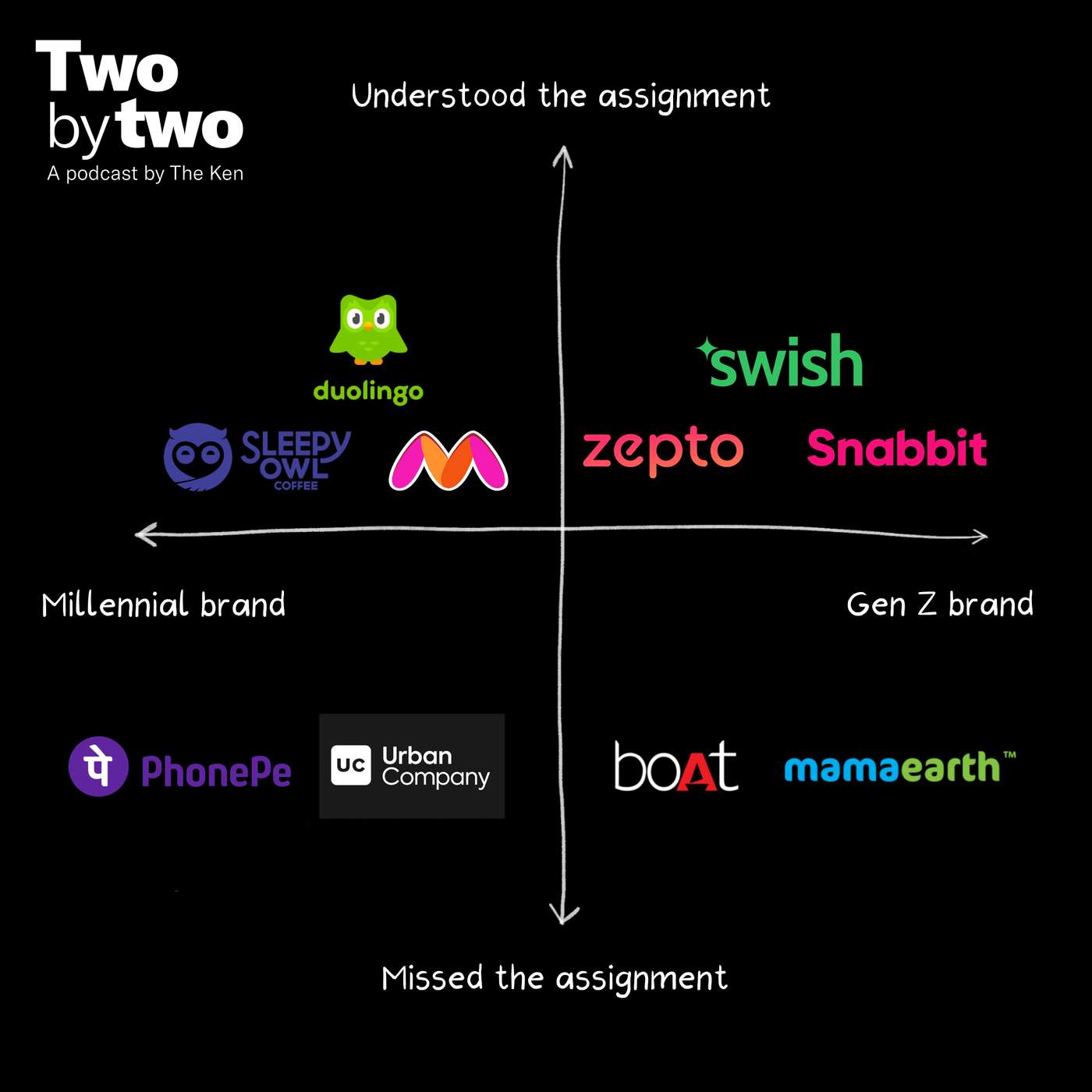
"They are not disloyal. They are unforgiving."Sector by sector, a new generation of brands is doing the same thing by ignoring millennials entirely and going straight for Gen Z. Zepto did it to Blinkit. Snabbit is doing it to Urban Company. The thesis is simple: Gen Z has no loyalty to the old guard, so steal them first and use them as a wedge to crack the rest of the market open.But is that actually true? And if you do win them, can you hold them?Our guest Adarsh Menon has put Fireside Ventures' money behind this question. His portfolio includes brands that have read this generation inside out. On the other hand Ajay Thandi built Sleepy Owl without a single marketer on the founding team and ended up with a brand Gen Z and millennials claim as their own.The most interesting thing they land on isn't about Gen Z at all. It's about aspiration and how it stopped pointing upward. This generation doesn't want to be the person above them. They want to be the person next to them. That one shift changes everything about how you build a brand.Turns out the most fickle generation might be the most loyal one you've ever had. If you deserve it. Further reading- Fireside Ventures — The Indian Consumer at 2030_______This episode was produced by Uddantika Kashyap and mix and mastered by Rajiv CN, our resident sound engineer.If you liked this episode, share it with your friends, family and colleagues. And if you have thoughts on the discussion, write to us at twobytwo@the-ken.com.
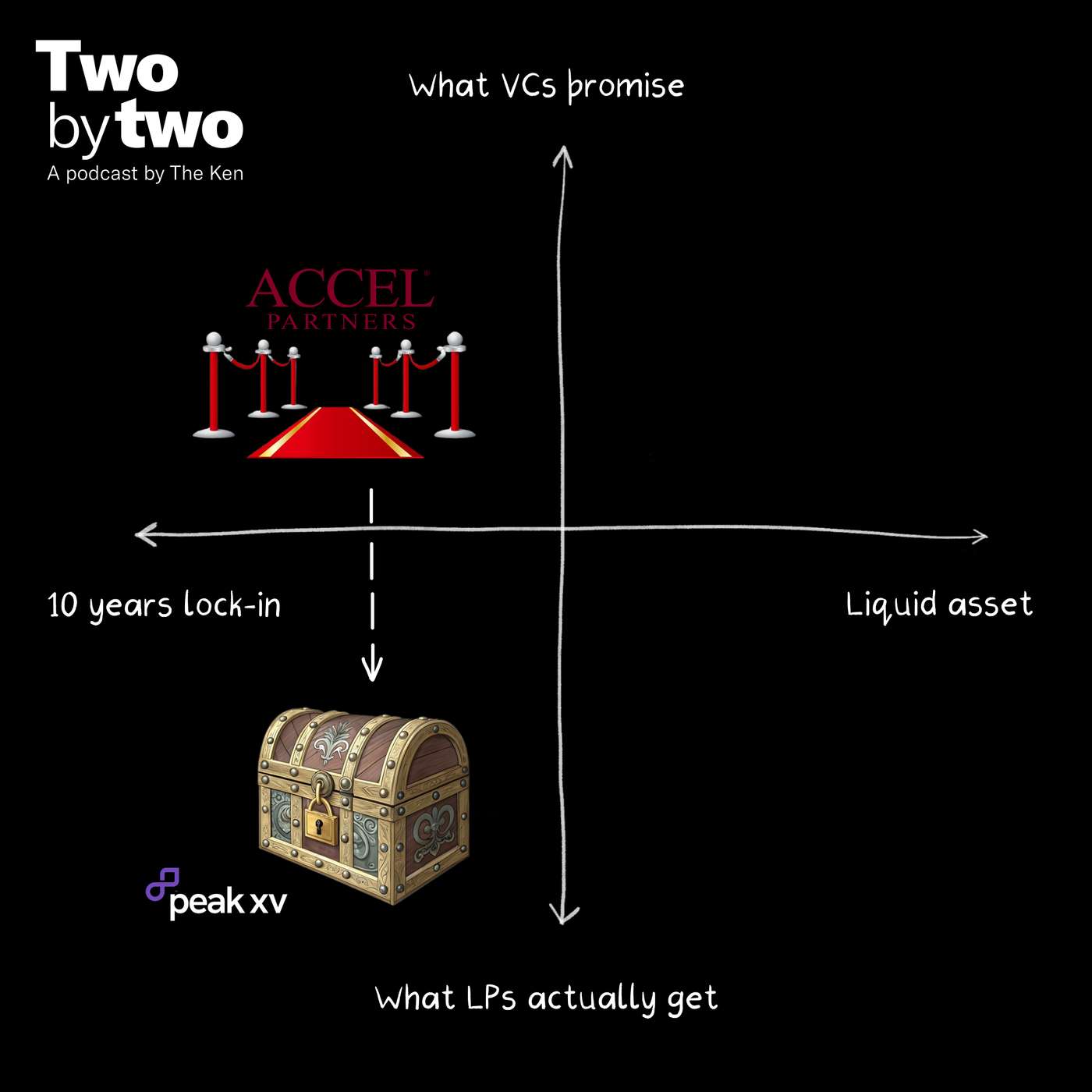
Quick question: Would you give someone your money for ten years if they promised you'd get back roughly what an FD would give you? And they'd also take 2% of your money every single year, no matter what happens, plus 20% of any profits at the end.You'd laugh them out of the room, right? Well, that's venture capital.Peak XV lost three of its partners. Ashish Agarwal who backed Groww, Ishan Mittal who invested in Razorpay and Tejasvi Sharma who bet on Cred. These guys crushed it and they still walked out over "disagreements on economics and payouts."That's when we realized: this isn't a Peak XV problem but a VC industry problem that nobody wants to admit. So we brought in Mayank Bansal, a hedge fund manager who pulled the actual numbers: Crisil data, Peak XV's fund performance, small cap index returns, FDs. All of it. Joining us is also Arundhati Ramanathan, deputy editor at The Ken, who's been tracking these partner exits closely.Mayank's take? "What is happening in the VC industry currently is they are charging the profit shares of that Medallion fund while returning less than index funds, which is blasphemous."Most Indian VC funds are charging 36% profit share to deliver 12% returns while a small cap index fund gave 13.35% over the same period which you can withdraw anytime. So why do the smartest investors in the world keep putting money into this? Why does two and twenty still exist?Fair warning, this episode is number-heavy. We've linked the reports in the show notes so you can follow along. But the punchline is simple: venture capital in India might just be an overpriced underperforming asset class nobody's willing to admit is broken.Listen to find out why the exits are just beginning.____Additional resources:1. Accel India's fund returns (Newcomer, paywalled)2. Crisil's AIF Benchmarks Report3. Indian VCs’ boss wants them to take a pay cut by Arundhati Ramanathan4. India's VCs are getting disrupted… by India's tax-payers by Praveen Gopal Krishnan5. The invisible whale that capsized India’s leaky options boats- Two by Two episode 51____This episode was produced by Uddantika Kashyap.If you liked this episode, share it with your friends, family and colleagues. And if you have thoughts on the discussion, write to us at twobytwo@the-ken.com.
If you are in your 20s or 30s in India right now, things probably feel a little weird. The headlines say the country is a rocket ship, but your reality might be hiring freezes and stagnant salaries.To understand why, we sat down with someone who actually moves the money. Since the 1990s, Rohit Chopra, portfolio manager/analyst at Lazard Asset Management, has managed billions of dollars across emerging markets: from Brazil to Korea to China and India. He doesn't look at the Indian market with pride or pessimism but with one question: is this the best place on Earth for his clients' money right now?In this episode of Two by Two, Rahel Philipose and Rohin Dharmakumar dig into Rohit’s playbook. They discuss how he identifies "the Holy Grail" of businesses, why capital has been leaving India recently, and which sectors will actually define the next decade. If you have ever wanted to sit across from a global fund manager and get the uncomfortable truth about where India really stands, this is the conversation you’ve been waiting for.______This episode was produced by Uddantika Kashyap and mixed and mastered by Rajiv CN, our resident sound engineer.If you liked this episode, share it with your friends, family and colleagues. And if you have thoughts on the discussion, write to us at twobytwo@the-ken.com.
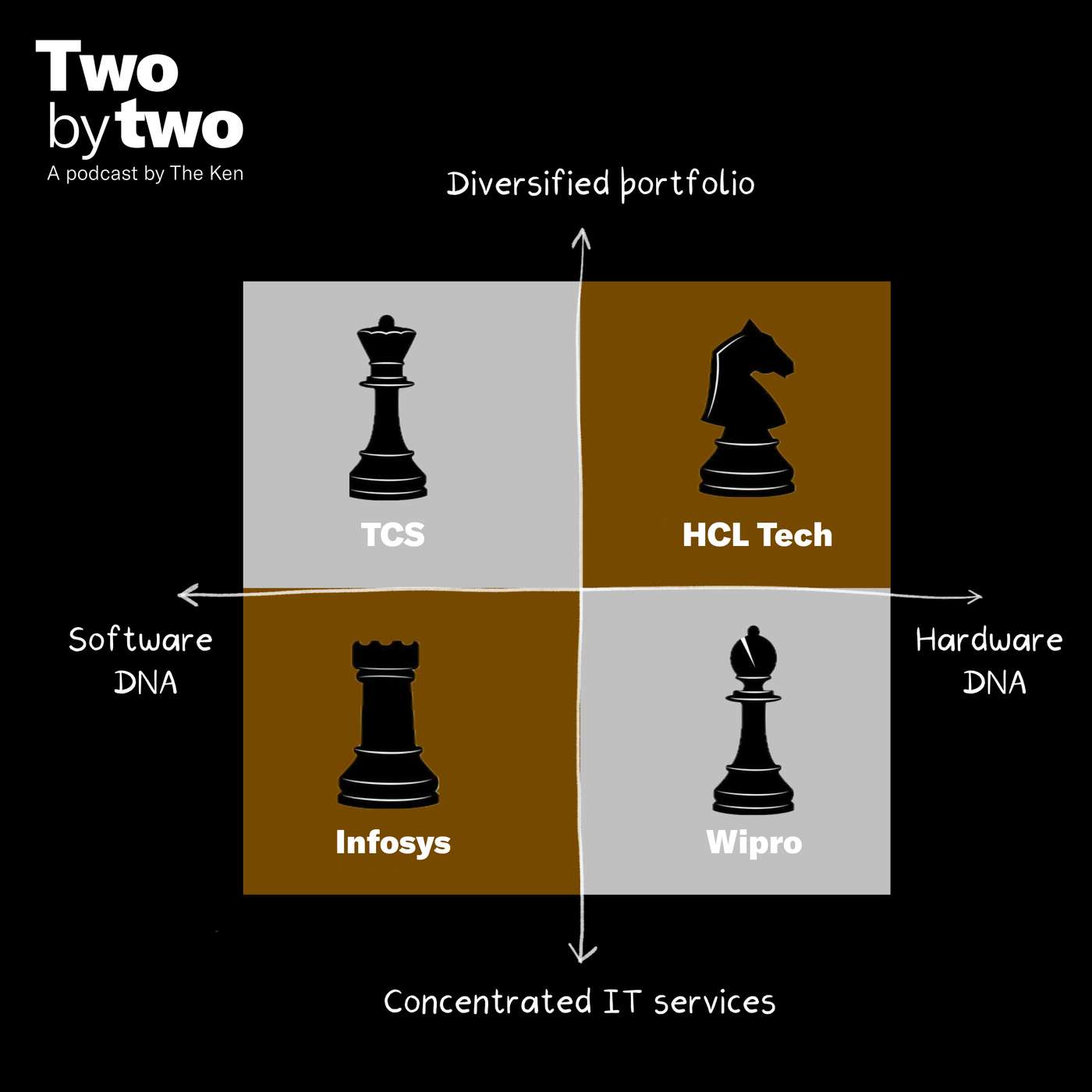
Last week, nearly ₹2 lakh crore vanished from Indian IT stocks in just four days. A big reason was Anthropic's new product, Claude Cowork. Suddenly investors were confronted with an unsettling reality: what if the work Indian IT has long depended on is now the easiest to automate?For almost 20 years, India's IT giants have been unstoppable compounding machines. They built empires worth hundreds of billions of dollars by doing one thing very well: renting out smart people by the hour to write code and run technology for Western clients. But when code starts to write itself, what happens to these companies?Conversations about IT services usually lump all these firms together, as if they are the same business with different logos. In this episode, we break them apart. We ask a simple but uncomfortable question: in an AI-first world, who thrives and who gets left behind? We take five of the biggest IT services firms in India's orbit—TCS, Infosys, Wipro, HCL Tech and Cognizant—and rank them on who is best placed right now for what's coming next. Spoiler: the answer is not what the last 20 years of market-cap tables would suggest.To do this, we brought in two people who have lived this industry from the inside.Krishnakumar Natarajan co-founded Mindtree in 1999 and built it into a multi-billion dollar global IT services firm. He later chaired NASSCOM and now runs Mela Ventures, where he backs early-stage deep tech and enterprise startups.Vivek Kant spent over two decades in IT services across Tech Mahindra and Cognizant, then moved to the other side of the table as CTO at Bajaj Markets and as an advisor at Boston Consulting Group. He still codes 3-4 hours a day using AI. You can check out his blogs here.The board is set. The King, the Rook, the Knight, and the Bishop. The question is: who makes the first move?_________This episode of Two by Two was produced by Uddantika Kashyap and mixed and mastered by Rajiv CN, our resident sound engineer. If you liked this episode, share it with your friends and colleagues. And if you have thoughts on the discussion, write to us at twobytwo@the-ken.com.
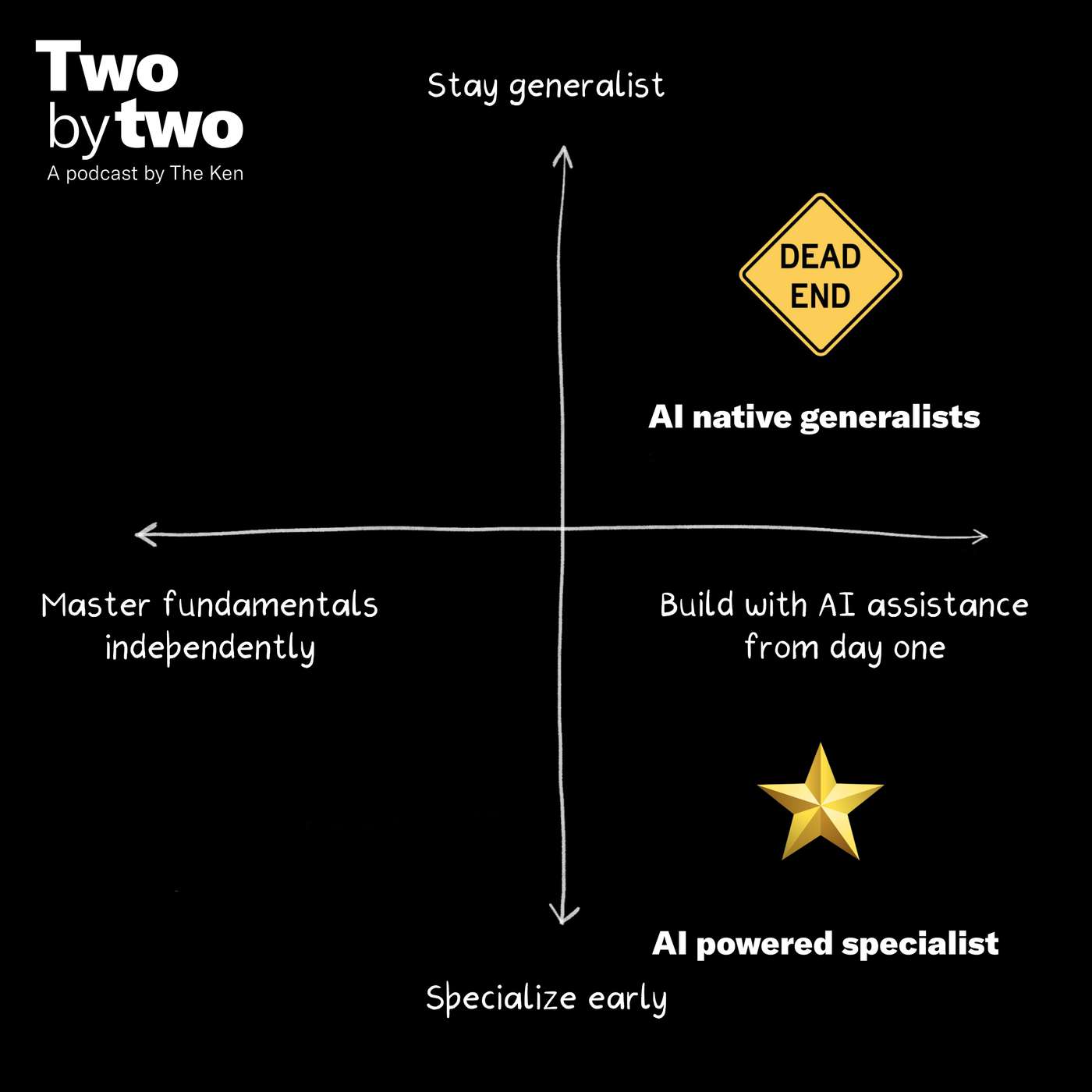
Software engineering as we knew it is over and the entry-level job has vanished. So what do you tell someone graduating today?This question splits even the experts. Arnav Gupta, Engineering Manager at Meta and co-founder of Coding Blocks, argues the knowledge must compress. He says that the future belongs to those who adapt fast and embrace the AI tools.Meanwhile Abhay Saraf, Director at Bushel Technologies and ex-Microsoft, pushes back hard. He believes you cannot build a calculator and stop teaching multiplication. The fundamentals matter more than ever, even if it takes longer to learn them.Together with co-hosts Praveen Gopal Krishnan and Rahel Philipose, they break down what skills actually matter now, why typing still beats voice coding, and whether engineering college should be two years or ten. The answers might surprise you._____Similar episode:Episode 6 Is the golden era of the (software) engineer over?This episode of Two by Two was produced by Uddantika Kashyap and mixed and mastered by Rajiv CN, our resident sound engineer.If you liked this episode, share it with your friends and colleagues. And if you have thoughts on the discussion, write to us at twobytwo@the-ken.com.
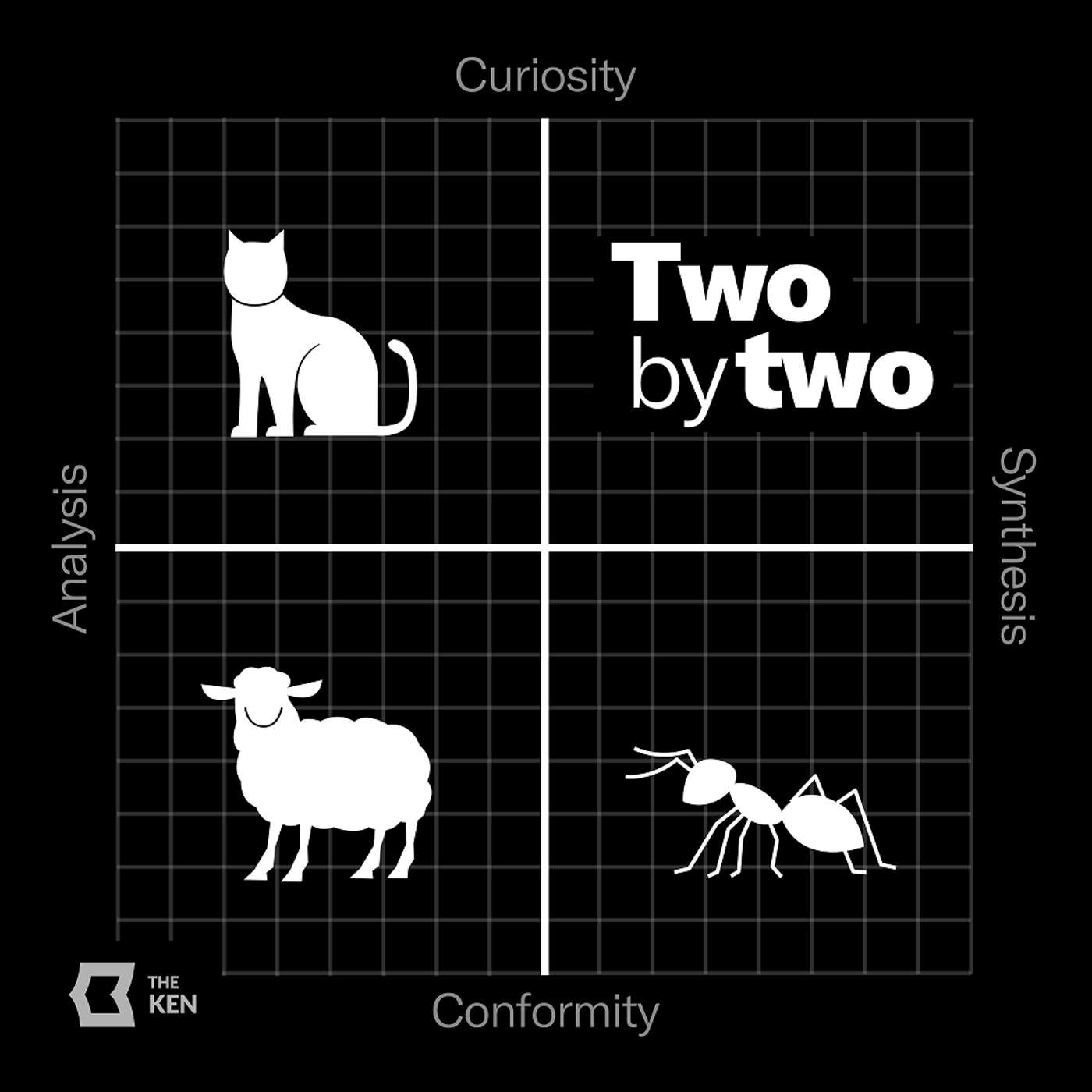
Join Rohin and Praveen as they celebrate the one-year anniversary of the 2x2 podcast, reflecting on 52 episodes of business and strategy discussions. This special ‘vibes’ episode looks back at their journey creating Two by Two, the evolution of the show, and future plans, deviating from their usual topic-focused format.Praveen shares key meta-narratives he picked from the past year, including a "desperation-driven convergence" where companies like Flipkart and Phonepe try to become each other. He also highlights themes such as the government shaping markets as a "competitor" or through "artificial constraints", and a "great career existential crisis" impacting roles from engineers to marketers. Other themes include the "destruction and retreat of big tech in India", the podcast's contrarian framing of topics, and a focus on India's "livability crisis", addressing issues like urban infrastructure and air pollution.We’d love to hear what you think about Two by Two as well. You can write to us at twobytwo@the-ken.com.
Welcome to the year-end special edition of Two by Two.We’ve released 22 episodes of Two by Two since our inaugural edition in July. We’ve covered an incredible breadth of counterintuitive topics framed as, well, two by twos. Would Flipkart become Phonepe before Phonepe became Flipkart? Did Delhi prick Bengaluru’s bubble? Is the golden era of the software engineer over? Why is health insurance broken? How will Ola and Uber avoid ‘death by a thousand cuts’? Why is Zepto behaving like a gold medallist? Can venture capitalists do no wrong? Dmart versus the challengers at the gates. AI and the impending disruption of Indian SaaS. We’ve had incredible fun exploring these ideas with a bunch of really sharp, experienced and opinionated guests. Finding guests who don’t hesitate to speak their minds and state unpopular truths has been one of the hardest things. Far, far tougher than finding interesting topics. We owe all our guests a huge thanks for trusting us. Far too many professionals and leaders prefer to stick to rehearsed and predictable talking points in public these days.We’d started Two by Two with the ambition to operate at the intersection of curiosity and synthesis. Each week, we said we’d spot the hidden connections and unasked questions. We’d identify the cast of players and their motivations. We’d bring in incredible people to discuss these with. We’d try to answer simple yet fundamental questions like, what is going on, why is it happening, who gains and who loses, and where is all of this leading to?By always asking questions. Always connecting the dots. Always being unfiltered and uninhibited.We wanted Two by Two to be ‘your personal investigative brain’. In 2025 we hope to make Two by Two even more interesting and unpredictable. Yes, at its core it will still be a weekly podcast. But I’m excited at the possibility of doing so much more by involving our subscribers, listeners and readers in these endeavours. We want to make Two by Two ‘our collective investigative brain’. And hosts Rohin Dharmakumar and Praveen Gopal Krishnan will continue to do so with a new episode every Thursday.To listen to all episodes of Two by Two, consider subscribing to The Ken’s Premium plan, which in addition to the podcast, will also get you access to our long-form stories, Premium newsletters and visual stories.If you just want access to Two by Two, you can do that as well on Apple Podcasts with a paid subscription.Two by Two is also a free weekly newsletter published every Friday. You can sign up for it here. Listen to all Two by Two episodes here:1. Will Flipkart become Phonepe before Phonepe becomes Flipkart? - https://the-ken.com/podcasts/two-by-two/will-flipkart-become-phonepe-before-phonepe-becomes-flipkart/2. Why has all the excitement and disruption gone out of startups? - https://the-ken.com/podcasts/two-by-two/why-has-all-the-excitement-and-disruption-gone-out-of-startups/3. Is Zepto a gold medallist or a bronze medallist? - https://the-ken.com/podcasts/two-by-two/is-zepto-a-gold-medalist-or-a-bronze-medalist/4. Delhi pricked the Bengaluru bubble - https://the-ken.com/podcasts/two-by-two/delhi-pricked-the-bangalore-bubble/5. Swiggy needs to reclaim its past glory - https://the-ken.com/podcasts/two-by-two/swiggy-needs-to-reclaim-its-past-glory/6. Is the golden era of the (software) engineer over? - https://the-ken.com/podcasts/two-by-two/is-the-golden-era-of-the-software-engineer-over/7. Google Pay: Big. Successful. Vulnerable - https://the-ken.com/podcasts/two-by-two/google-pay-big-successful-vulnerable/8. Private coaching is eating away at schooling - https://the-ken.com/podcasts/two-by-two/private-coaching-is-eating-away-at-schooling/9. Why Stripe could not become the Stripe of India? - https://the-ken.com/podcasts/two-by-two/why-couldnt-stripe-become-the-stripe-of-india/10. Health insurance in India is ripe for disruption - https://the-ken.com/podcasts/two-by-two/health-insurance-is-ripe-for-disruption/11. Netflix and its last growth market - https://the-ken.com/podcasts/two-by-two/netflixs-last-growth-market/12. Ather Energy was a pioneer. Can it also be a leader? - https://the-ken.com/podcasts/two-by-two/ather-energy-was-a-pioneer-can-it-also-be-a-leader/13. Do we even need Product Managers? - https://the-ken.com/podcasts/two-by-two/do-we-even-need-product-managers/14. How will Ola and Uber avoid ‘death by a thousand cuts’? - https://the-ken.com/podcasts/two-by-two/how-will-ola-and-uber-avoid-death-by-a-thousand-cuts/15. The relentless rise of the government as a competitor - https://the-ken.com/podcasts/two-by-two/the-relentless-rise-of-the-government-as-a-competitor/16. What does the future hold for Ola Electric? - https://the-ken.com/podcasts/two-by-two/what-does-ola-electrics-future-hold/17. Can venture capitalists do no wrong? - https://the-ken.com/podcasts/two-by-two/can-venture-capitalists-do-no-wrong/18. Dmart versus the challengers at the gate - https://the-ken.com/podcasts/two-by-two/dmart-versus-the-challengers-at-the-gate/19. Marketing is eating itself from the inside - https://the-ken.com/podcasts/two-by-two/marketing-is-eating-i...
Happy Deepavali, dear listeners!On account of Deepavali, the Two by Two team is also taking a small break. But don't worry; we'll be back with our regular programming next week.Until then, you can always listen to past episodes of Two by Two that you haven't gotten around to yet. If you're a Premium subscriber listening to this on The Ken’s mobile app or on Apple podcasts, you can just scroll down and listen to any of our episodes in their full, unedited form. On the other hand, if you aren’t a premium subscriber yet, you can listen to one of our older episodes which we’ve unlocked for you. In fact, in the latest unlocked episode, we argue, debate, and discuss what Netflix needs to do to win in its last growth market — India.Netflix's last growth market. (Full republished episode for free users available on Spotify | Apple Podcasts | Amazon Music | Youtube)By the way, if you’re in the mood for something other than two-by-twos and business models, why don’t you head over to Daybreak, The Ken’s daily podcast?Just last week, our colleagues Snigdha and Rahel did an amazing episode where they spoke to multiple people to understand why women freeze their eggs.Successful women are freezing their eggs. And that's on men. (Spotify | Apple Podcasts | Amazon Music | YouTube Music)If you have suggestions for potential future episodes, we’re all ears. We’re also all ears if you have recommendations for interesting guests we can invite to the show—guests who know their stuff and aren’t afraid to speak their minds, even if it goes against conventional wisdom. Write to us at twobytwo@the-ken.com.
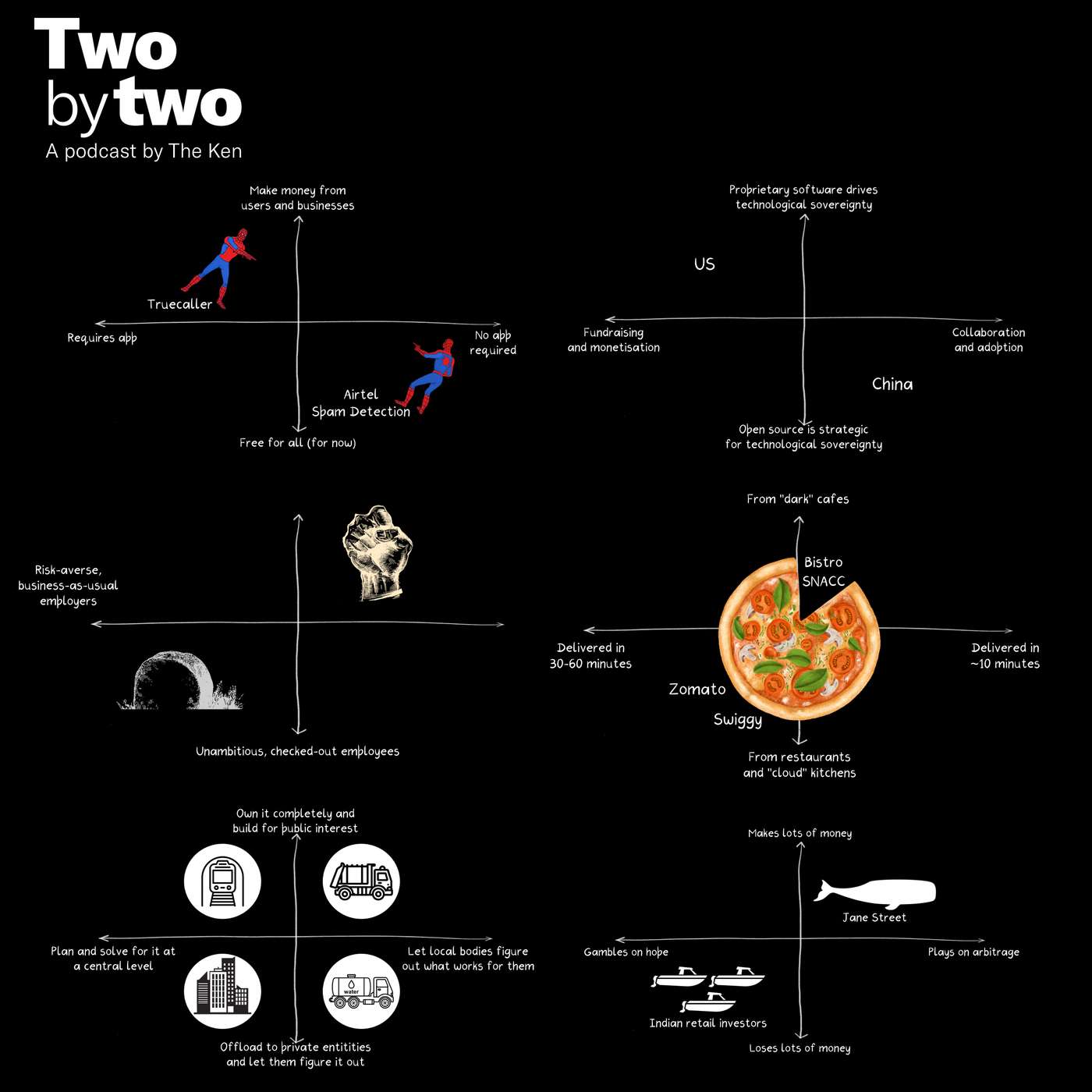
2025 is done. Forty-eight episodes. Hundreds of guests. Endless banter between Rohin and Praveen.This year, Two by Two covered stories from Bengaluru to the world including business, tech, and everything in between. We didn't just stick to the usual. We asked about people, trends, and the things others weren't paying attention to. We brought on guests who didn't rehearse their answers and tried to make sense of things as they happened.Some episodes turned out to be prescient. Some were messy. Some sparked arguments in our inbox. All of them tried to do what we set out to do: spot hidden connections, ask unasked questions, and figure out what's really going on.This final episode is Rohin looking back at six moments from the year with clips from conversations that stood out. Between each one, he adds context and some behind-the-scenes perspective on why it mattered.Here are the episodes featured:Episode 26: Zomato, Swiggy, and the rise of the 10-minute "dark" caféEpisode 31: Airtel fights spammers. And Truecaller's business modelEpisode 47: Who broke Bengaluru, and how do we fix our cities?Episode 50: In an AI age, India does not have an open source strategyEpisode 51: The invisible whale that capsized India's leaky options boatsEpisode 66: What will bring ambition back from the dead?To everyone who listened, argued with us, sent guest suggestions, or just stuck around, thank you. Next year, we're coming back with everything that makes Two by Two what it is, but bigger and better. Maybe even a few surprises. Stay tuned.There won't be an episode next Thursday. We will return on January 8th, 2026.See you in the new year.________This episode was produced by Uddantika Kashyap and mixed and mastered by Rajiv CN, our resident sound engineer.If you liked this episode of Two by Two, please share it with your friends, family and colleagues who would be interested in listening. If you have suggestions for guests, episodes or even changes we could make. Please write to us at twobytwo@the-ken.com or comment below.
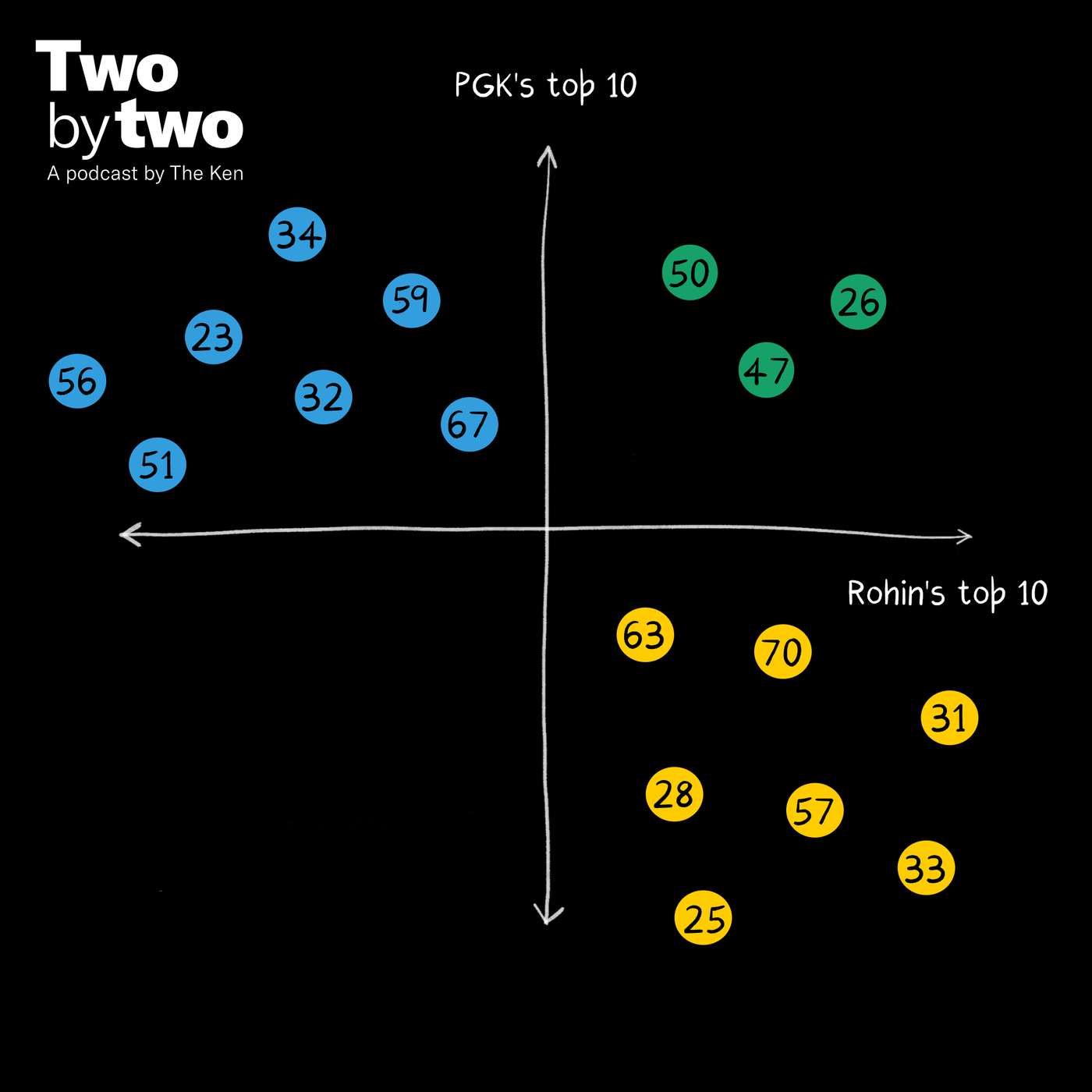
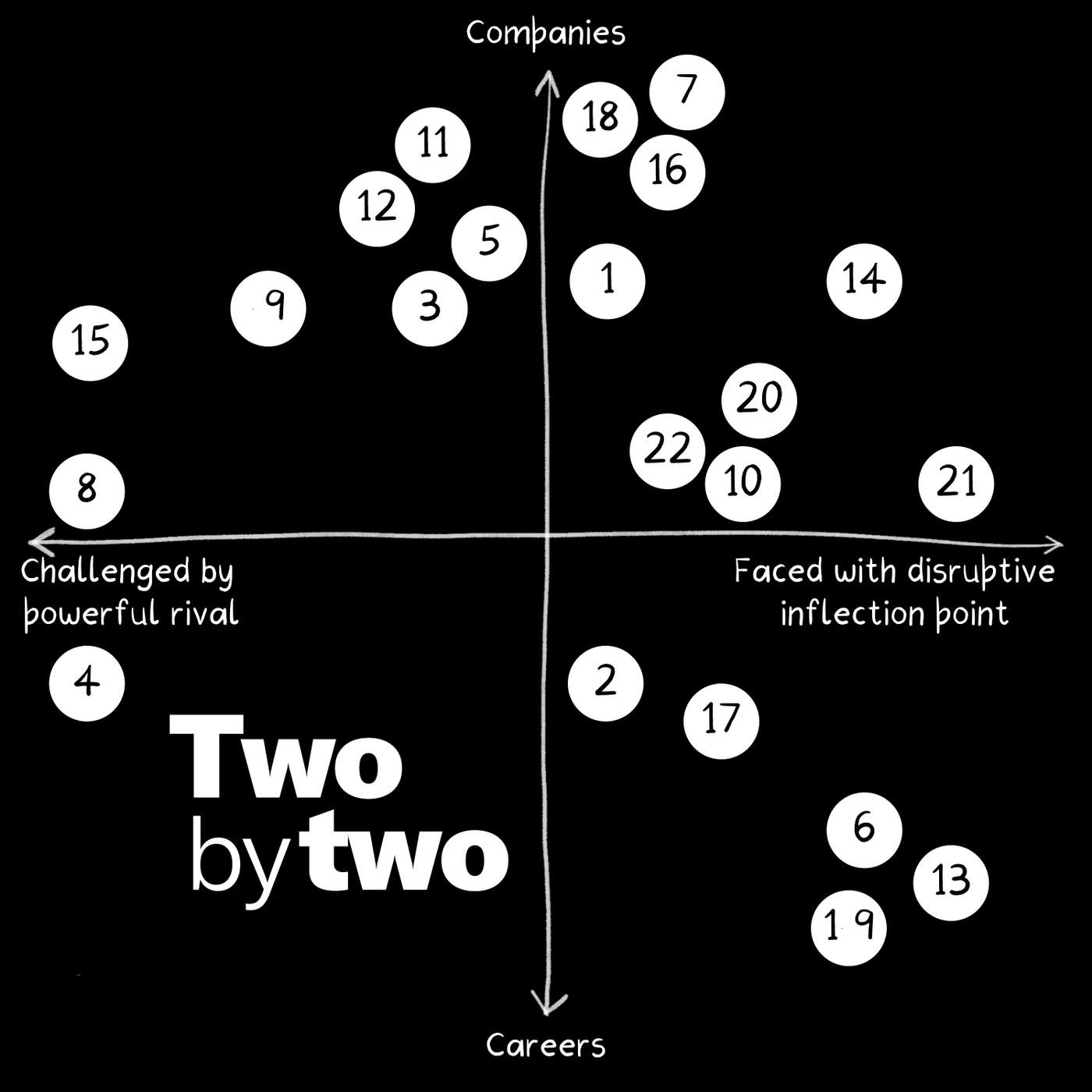
As we try to wind down this year, Rohin and Praveen do something they’ve never done before: go through every single episode they recorded this year. All 48 of them. In 60 minutes.The rules were simple. Each host had 10 points to build their personal top 10 list for the year. No take-backs, and no pre-discussion. It was a completely live, vibe-based recording where they figured it out as they went.What follows is a rapid-fire sprint through the year. From Amazon India’s struggles to the electric car slowdown, from B-school placements to the rise of quick commerce dark stores, and from Razorpay versus Juspay to the chaos of concert infrastructure in India. They cover it all—the hits, the misses, the prescient calls, and the episodes they wish had gone differently.Along the way, they debate whether episodes were too speculative, too early, or just not memorable enough. By the end, they’re locked in a tight race with only five episodes left and one point each remaining.Because it wouldn't be Two by Two without a matrix, we plotted the results of their debate. Take a look at the graphic to see which episodes they both loved (the green zone) versus their personal favourites.It is chaotic, nostalgic, and a perfect preview of what 2025 looked like through the lens of Two by Two.______This episode was produced by Uddantika Kashyap and mixed and mastered by Rajiv CN, our resident sound engineer.With 48 episodes in the books, this is the perfect starting point for anyone looking to catch up on the defining business stories of 2025. If you liked this sprint through the year, please share it with someone who loves a good deep dive.Have your own "vibe-based" arguments about our list? We’re all ears. Reach out at twobytwo@the-ken.com or leave a comment.
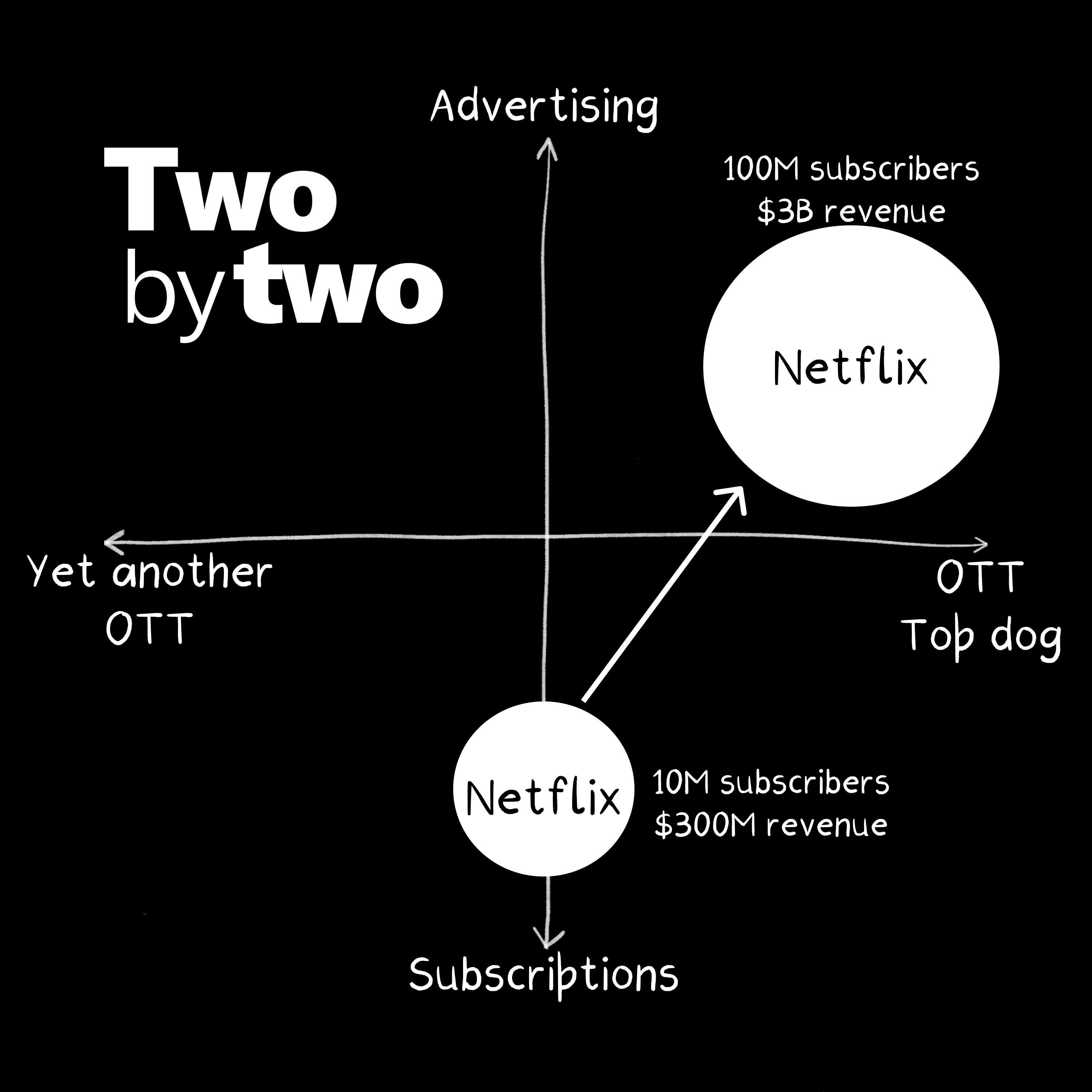
We have unlocked the full and unedited subscriber version of episode six which we released on September 26 for Premium subscribers of The Ken on The Ken’s app and on Apple Podcasts. Now you can stream the full episode on Spotify, Amazon Music , Apple Podcasts or wherever you get your podcasts for free for a few weeks.Netflix is trying hard to crack the Indian market. Ever since the US streaming giant entered the country it has been hard at work to make an impact. And over the years they’ve learnt a thing or two about how the Indian streaming space functions.Netflix is also not shy about expressing how it sees India as its last growth market. Most of the other geographies it has saturated its reach to a large extent, but India has always been a pain point for it to get a leg up on. So much so, that the then CEO, Reed Hastings expressed his frustration about why they weren’t able to crack India during an earnings call in 2022.But from then to now, Netflix has managed an interesting turnaround by climbing down the pricing ladder on its subscriptions in India, even as it raises its prices in North America, and throwing in a somewhat limited regional and diversified slate of shows into the mix.But Netflix is clear on one thing, it sees India as its last growth market and expects to add 100 million paying subscribers in the country. But for that to happen it has to put in a lot more work and now it faces the added pressure of competing with the merged entity of Jio Cinema and Disney+ Hotstar which would create a mammoth of a content library stacked with regional content, endless range of movies and prestige television, and the massive distributional heft Jio brings to the table.All of this begs the question, given the situation, how seriously is Netflix looking at India as its last growth market?To discuss this, hosts Praveen Gopal Krishnan and Rohin Dharmakumar are joined by Kunj Sanghvi who is the Content and Creative Head at Kuku FM, and Nishad Kenkre, who presently is an Operating Partner at Verlinvest. Nishad has previously worked at Swiggy and was also Director and Head of Strategy at Disney.Welcome to episode 11 of Two by Two.Two by Two is also a newsletter, where every Friday a short storified version of the latest episode is sent out to subscribers for free. You can sign up for the Two by Two Newsletter here.(Listen to the free highlights only episode on Spotify, Amazon Music, YouTube or wherever you get your podcasts)Further reading:Netflix house will let you experience your favorite shows, movies in real lifeNetflix climbs down India’s ladderFurther listening:Why couldn’t Stripe become the Stripe of India?This episode of Two by Two was researched and produced by Hari Krishna. Rajiv CN, our resident sound engineer, mixed and mastered this episode.New episodes are released every Thursday. So follow the show wherever you get your podcasts, and tell us what you think of the show.
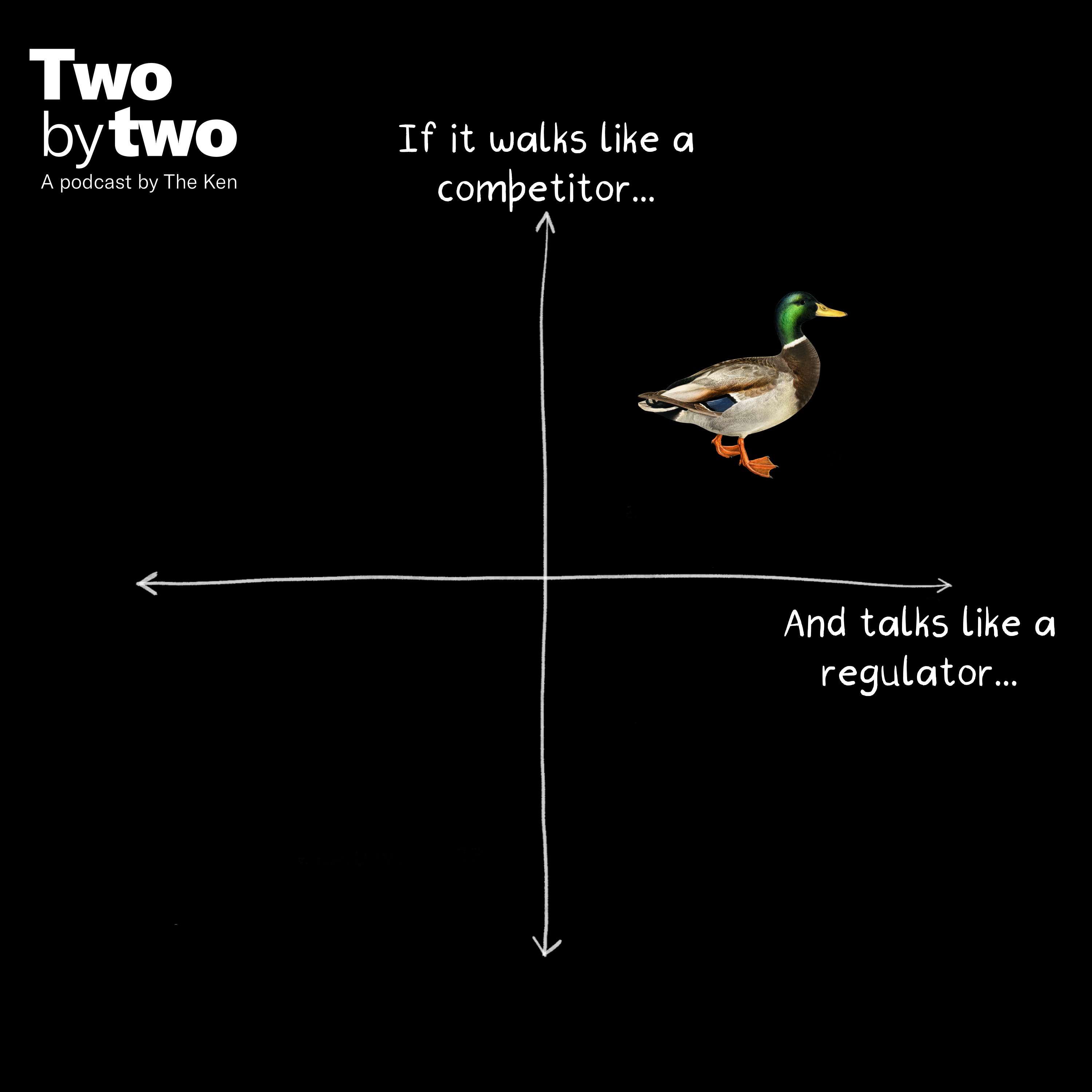
What happens when the government plays the role of regulator, policymaker, and operator?The government has played a pivotal role in establishing and promoting Digital Public Goods (DPG) and Digital Public Infrastructure (DPI) in the past decade and a half, and there have been a few which have been integral in our daily lives in more ways than one.The reason why these solutions exist is plain and simple: There emerged companies which disrupted the landscape of finance, commerce, mobility and a whole lot of other aspects of our lives, but as they gained prominence, they also started to play by their own rules.The regulator was not able to act fast enough in most cases to keep things in check. So the government intervened and helped establish and promote solutions which would keep things in check and protect the interests of all the parties involved.Some solutions literally changed the way our day-to-day lives are, and created businesses which are built on top of these solutions. Think UPI, ONDC or Bharat Connect (formerly known as Bharat Bill Payment System).In addition to creating and shaping these systems, frameworks, or protocols, these government-backed players, or GBPs, as we referred to them in this episode, also became competitors in what they had helped build, which begs the question: What kind of system does this shape up to be?In episode 15 of Two by Two, hosts Rohin Dharmakumar and Praveen Gopal Krishnan sit down with Anupam Manur, Professor of Economics at The Takshashila Institution, to break down the interventionist solutions championed by the government. From UPI and ONDC to the Unified Lending Interface.Two by Two is also a newsletter, where every Friday, a short, storified version of the latest episode is sent out to subscribers for free. You can sign up for the Two by Two Newsletter here.Additional listening:Google Pay: Big. Successful. VulnerableAdditional reading:You need to download Digiyatra again. But it’s less about a tech upgrade and more about a scamRBI is competing with its regulated entities — and killing competition-This episode of Two by Two was researched and produced by Hari Krishna. Rajiv CN, our resident sound engineer, mixed and mastered this episode.New episodes are released every Thursday. So follow the show wherever you get your podcasts and tell us what you think of the show.Write to us at twobytwo@the-ken.com, and tell us what you thought of the episode.
Want to attend The Ken’s next event—How AI is Breaking and Remaking the Way Products are Built?🎟️ Join us in person or on the livestream—tickets here
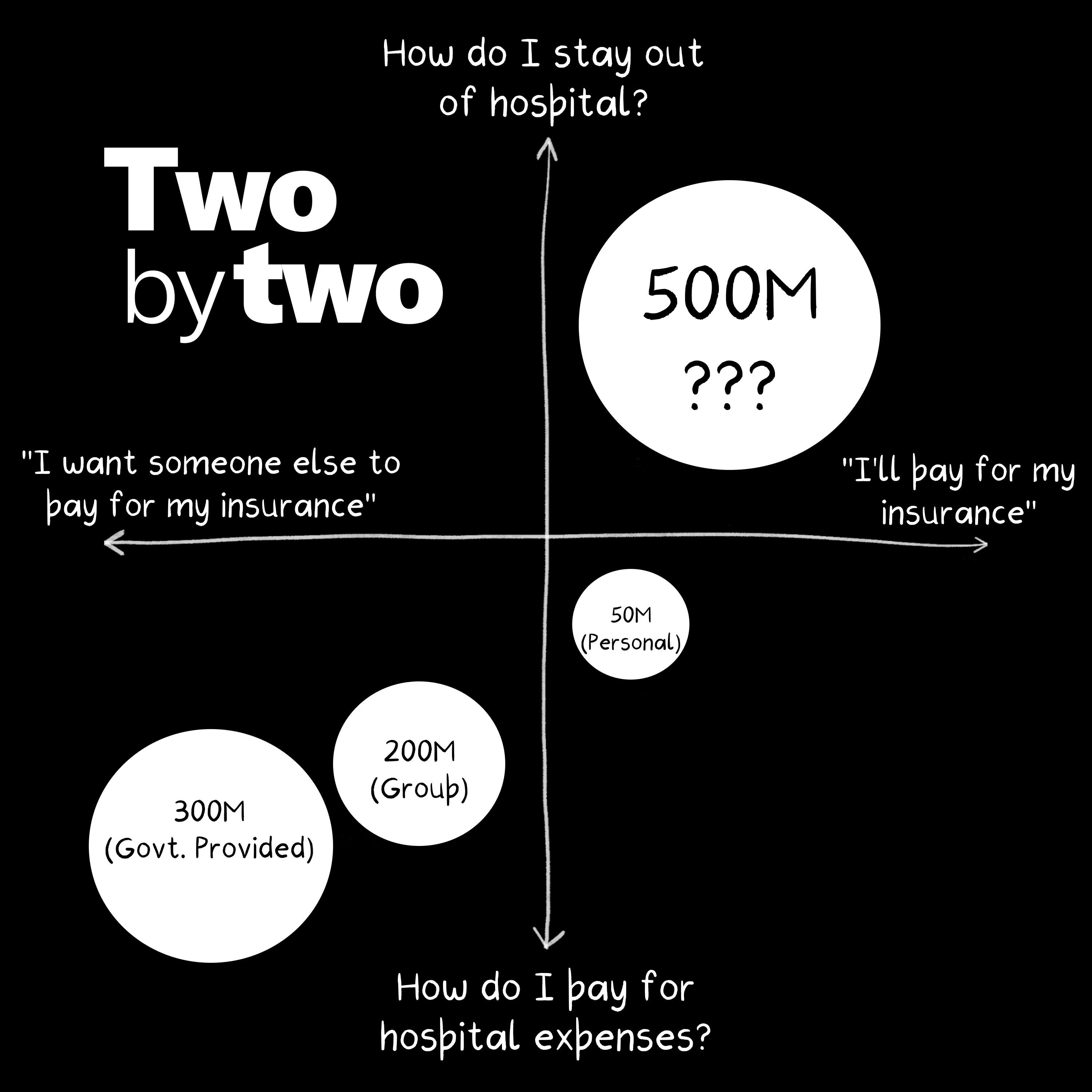
We have unlocked the full and unedited subscriber version of episode six, which we released on September 19th for Premium subscribers of The Ken on The Ken’s app and on Apple Podcasts. Now, you can stream the full episode on Spotify, Amazon Music, Apple Podcasts, or wherever you listen to your podcasts for free for a few weeks.The fastest growing segment of insurance in India is individual health insurance. It’s growing steadily at a, well, healthy pace of 20% annually. But scratch just a little beneath the surface and things don’t appear so rosy. Of the 20% annual growth in revenue, nearly 15% comes from medical inflation. Meaning, existing customers paying higher premiums each year because the costs of treatments are going up.The growth in the number of customers each year is just around 5-6%. Health insurance in India is broken from top to bottom. 70-75% of Indians have no health insurance. Of those who do, the largest chunk have free or low cost insurance provided by the government, followed by usually employer provided group insurance. Less than 10% Indians have their own health insurance. Scratch that. It’s more accurate to call it hospitalization insurance, not health insurance. Because the industry has developed in a way that incentivizes catastrophic illnesses and hospitalization and treatment, not health. Why, you wonder? Because much of the industry wrongly incentivizes, for legacy reasons, all the wrong things. Like, large groups that make lots of claims. High commissions to distributors. Expensive procedures. Expensive premiums. Instead of incentivising the right things. Like, getting the young and healthy covered early on. Insuring blue collar workers. Building products customers actually want. And most importantly, staying healthy.So when hosts Praveen Gopal Krishna and Rohin Dharmakumar sat down to discuss this complex topic, they decided to invite two guests who had the experience and candour to tell them what needs to change. Our first guest is Viren Shetty, the Executive Vice Chairman of one of India’s largest hospital groups, the listed Narayana Health. was our first guest. Viren has also been spearheading Narayana Health’s foray into providing its own health insurance, built to address many of the gaps I spoke about earlier.Our second guest is Shivaprasad Krishnan. Shivaprasad currently runs an investment banking firm, Kricon Capital, but was a part of the founding team at ICICI Lombard, one of India’s first private health insurers. He also has over 3 decades of experience in finance and management.This episode of Two by Two was researched and produced by Hari Krishna. Sound engineering and mixing is by Rajiv C N.You can listen to full episodes either with a Premium subscription to The Ken or by subscribing to Two by Two Premium on Apple Podcasts.If you enjoyed listening to this episode of Two by Two or have some thoughts that you’d like to share with us you can always write to us twobytwo@the-ken.com. We’ll be back next week with a new episode for you.
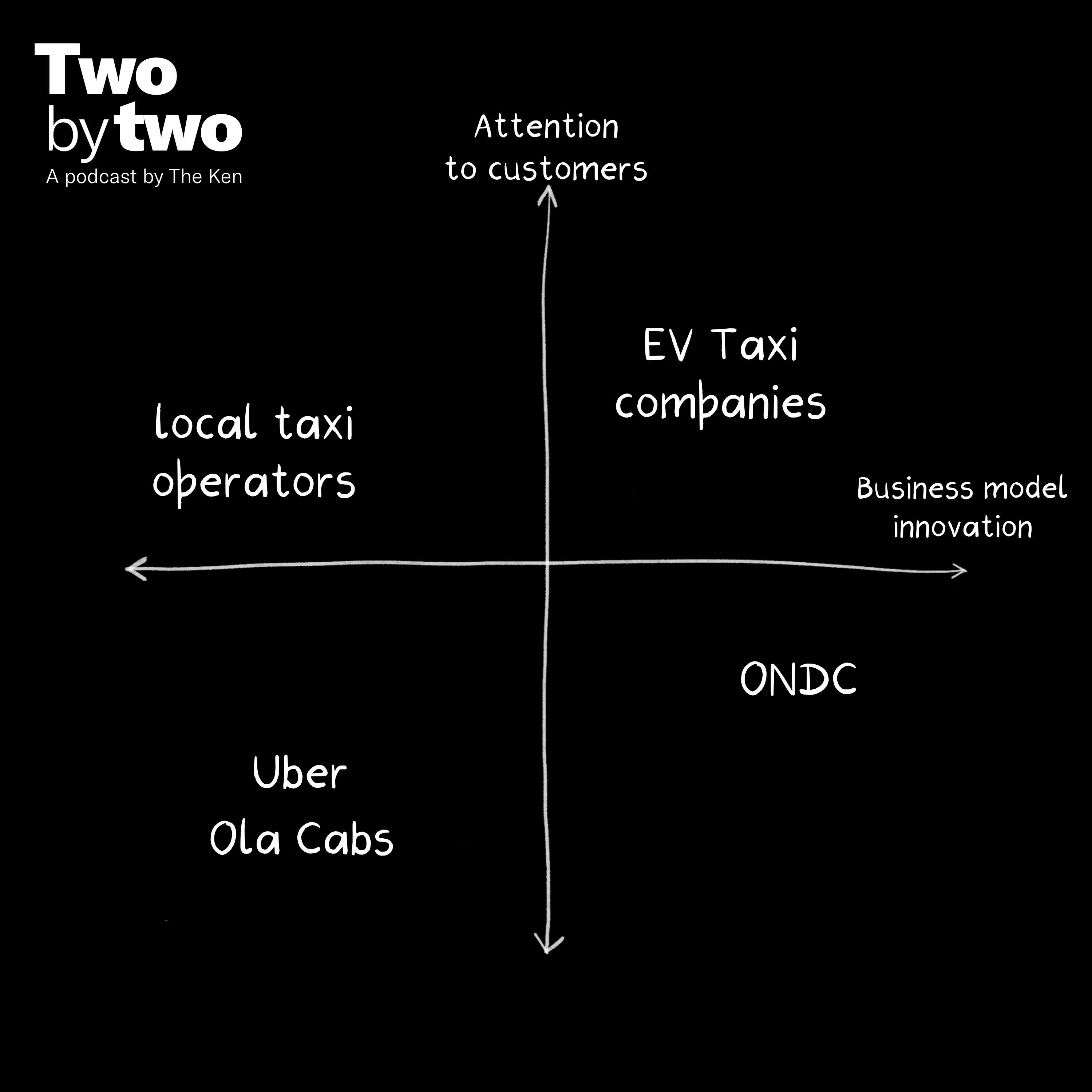
Ola and Uber are in a “late stage duopoly”.After spending billions and billions of dollars, they have finally secured pole positions in ride sharing in India.Both of these companies together control 70% of the market and they have created network effects that make it much harder for anyone to enter and compete with them.However, this particular situation is facing some new challenges and just like how Uber and Ola conquered city after city using a disruptive model and technology, the same thing threatens to happen to them.Ola and Uber are facing structural disruptions from multiple fronts in India.And in today’s episode hosts, Praveen Gopal Krishnan and Rohin Dharmakumar try to answer how the disruptors are getting disrupted by upstarts who are coming in with both business model innovation and newer fleets which offer a significantly better experience, which was the original promise of Ola and Uber as well.So what is the next stage of disruption in ride-hailing look like in India? Is it EV fleets? Is it democratized tech-enabler platforms like ONDC which enables platforms like Nammayatri? Are we looking at the return of local taxi operators? And most importantly, what should Ola and Uber do to defend their position as new incentive models are introduced for both drivers and passengers?Welcome to episode 14 of Two by Two.Joining the hosts for the discussion are Nilesh Sangoi, CIO of Fincare Small Finance Bank, previously CEO of Meru Cabs; Pradeep Puranam, Head of Revenue and Operations at Yulu, ex-Udaan and -Uber; and returning guest Professor Srinivasan R, who teaches Strategy at IIM Bangalore.Two by Two is also a newsletter, where every Friday a short storified version of the latest episode is sent out to subscribers for free. You can sign up for the Two by Two Newsletter here.Additional listening:Will Flipkart become Phonepe before Phonepe becomes Flipkart?Additional reading:Rapido rips up the Uber-Ola playbook for cabsThis episode of Two by Two was researched and produced by Hari Krishna. Rajiv CN, our resident sound engineer, mixed and mastered this episode.New episodes are released every Thursday. Follow the show wherever you get your podcasts and tell us what you think of the show.Write to us at twobytwo@the-ken.com, and tell us what you thought of the episode.
Want to attend The Ken’s next event—How AI is Breaking and Remaking the Way Products are Built?🎟️ Join us in person or on the livestream—tickets here
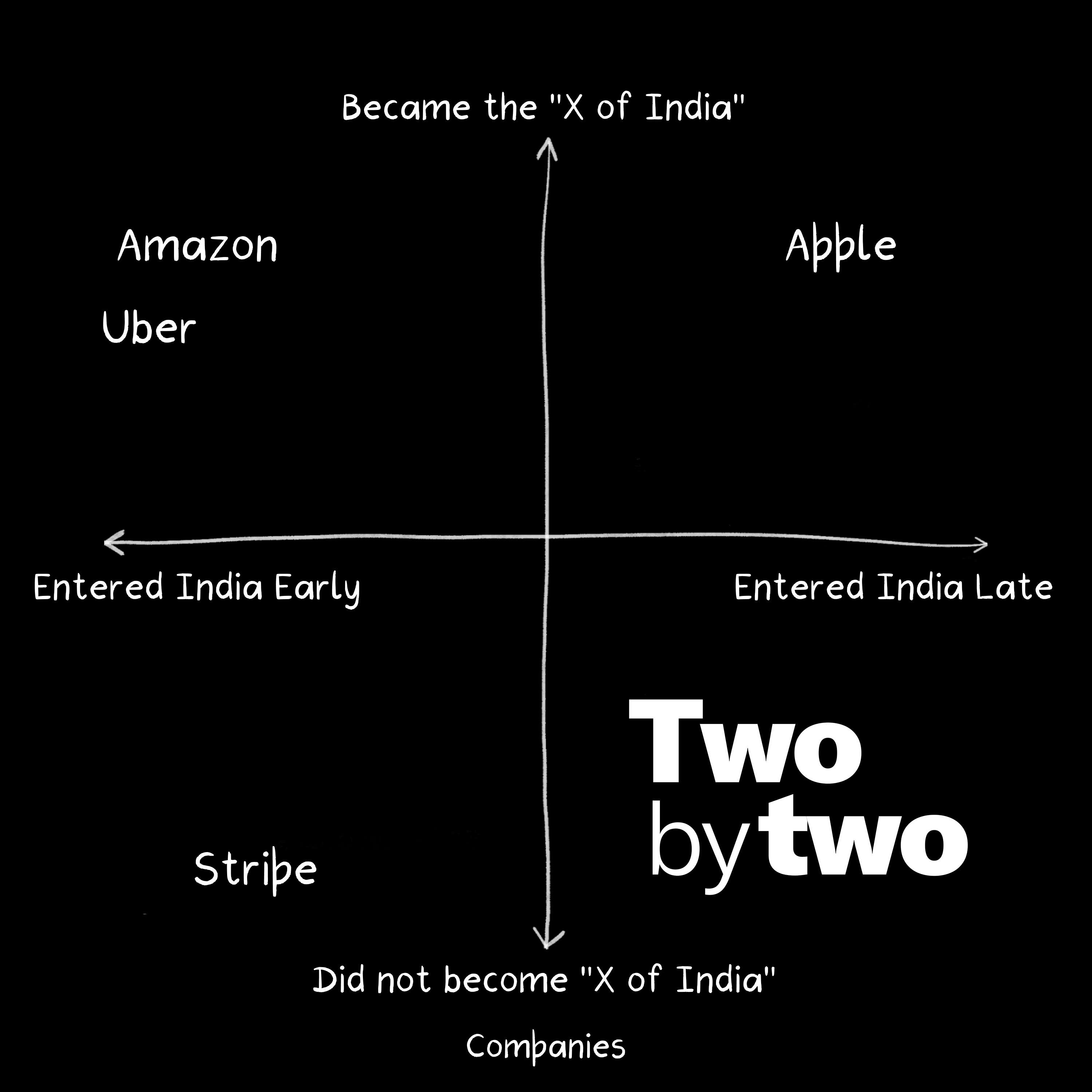
[This episode which we released on September 12 for Premium subscribers of The Ken on The Ken’s app and on Apple Podcasts is now available to listen for free for a limited time. Stream the full episode on Spotify, Amazon Music , Apple Podcasts or wherever you listen to your podcasts.]It seems like ‘invite only’ is a rite of passage for Stripe. If Stripe entered India with an invite-only step, then it seems reasonable to assume that it’s leaving India on the basis that it’s doing invite-only again. Over seven years, Stripe, the world’s mightiest fintech, currently valued at $70 billion (and at $95 billion at its peak), could not make a dent in India. It had a great product, a massive untapped opportunity in India, and didn’t have much competition. And yet, it failed. Why? There’s an internet quip that was quite popular until recently. The Amazon of China is Alibaba, the Uber of China is Didi, and the Google of China is Baidu, the Apple of China is Xiaomi. In India, the thinking was : Amazon of India is Amazon, the Uber of India is Uber, the Google of India is Google, and the Apple of India is Apple. In today’s episode of Two by Two, we discussed why Stripe couldn’t become the Stripe of India.And to discuss this, hosts Praveen Gopal Krishnan Rohin Dharmakumar were joined by two guests.Arundhati Ramanathan, Deputy Editor at The Ken. Arundhati is India’s preeminent Fintech reporter, and she’s demonstrated it over a career of 8 years at The Ken.Our second guest is Vikram Bhat. Vikram is one of India’s most accomplished Product leaders, he was in product leadership roles at Myntra, Abof, Ekstep Foundation, LendingKart, Capillary Technologies, Goodworker, and most recently CPO at Setu, which is a fintech company that enables API-based infrastructure for financial services.Welcome to episode nine of Two by Two, The Ken’s weekly podcast that asks the most interesting and often uncomfortable questions on topics we all want to know more about. And we do that through the lens of a 2×2 matrix!You can also sign up for the Two by Two newsletter for free. Each week you’ll get to read a “storified” version of that week’s episode.This episode of Two by Two was produced by Anushka Mukherjee. Hari Krishna is the lead writer and researcher for this episode. Rajiv C N, our resident sound engineer is the audio producer.Write to us twobytwo@the-ken.com and tell us what you think of the show.Please rate, share and follow us on your favorite streaming platform. It helps more like-minded people like you to find out by Two by Two.
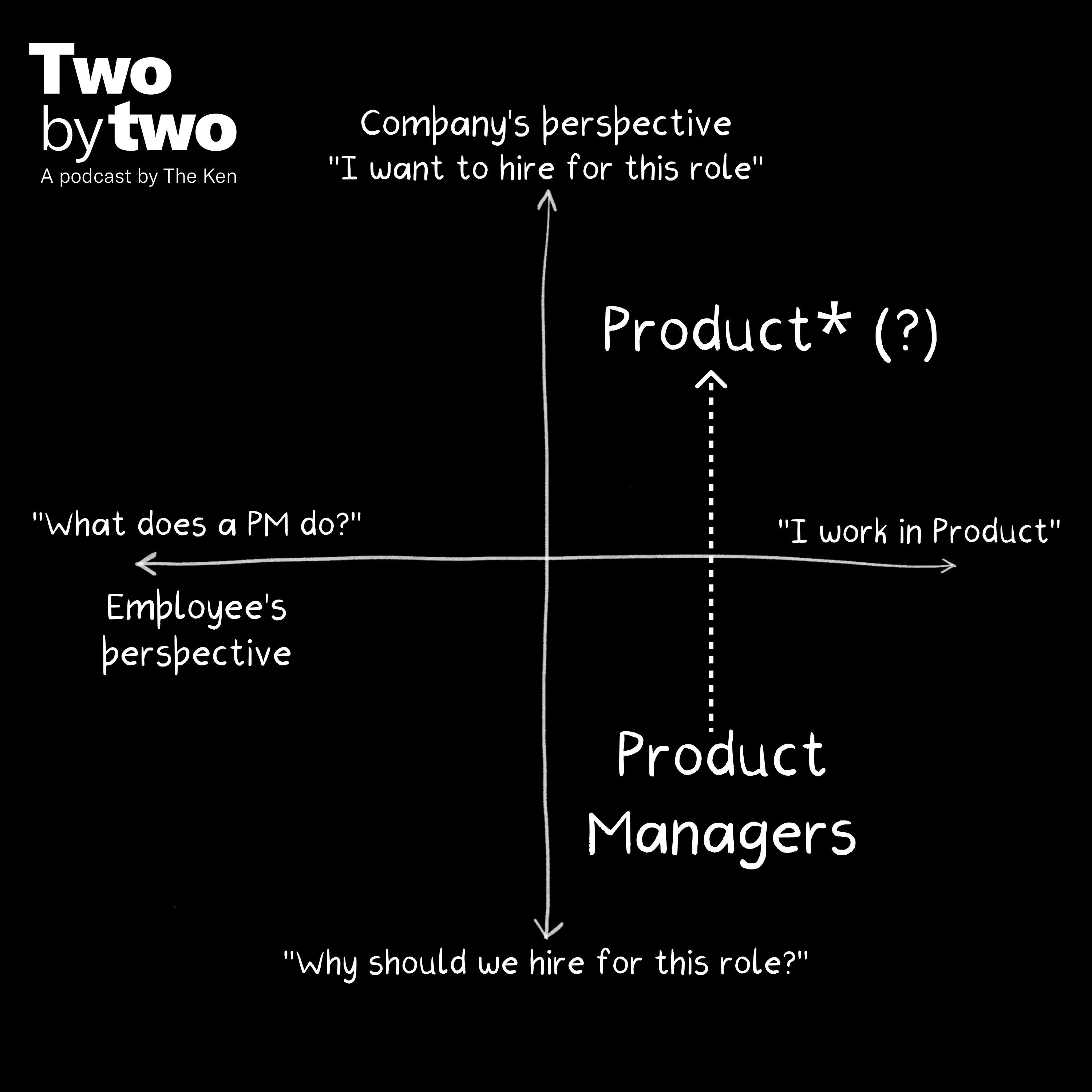
If you are a Product Manager, especially in India, you’re probably going through a crisis of faith and existence.As a career, Product Management in India has gone through multiple eras — in the early days, PMs struggled to explain to people what they actually did. Think about all the people you’d imagine who work at a software company. Marketing. Engineering. Sales. Analytics. Design.You can explain what they do to your grandmother. However, the one exception to the rule is Product Management. It’s the only function where the people who do it struggle to explain to their parents what they do.Then, suddenly, there was a gold rush when everyone wanted to become a Product Manager. And now, there’s an existential crisis — partly driven by the reduced funding and attrition, the rise of AI, and the changing nature of products themselves, more and more leaders are asking the question: Do we even need Product Managers?In today’s episode of Two by Two, hosts Rohin Dharmakumar and Praveen Gopal Krishnan interview two accomplished product leaders in India. First, there’s Chandrashekhar Vattikuti (CPO and SVP at InMobi, ex-Yahoo, Microsoft) and Shreyas Srinivasan, Chief Product Officer at Paytm*, and also founder of Paytm Insider. During the discussion, they trace the origin, the evolution and the crisis that Product Management as a career faces in India. They try to figure out why and how Product Management became a science and stopped being an art.They try to answer what makes a great product manager and how to find one.And they also ask the question that CEOs and Founders are asking themselves — do we even need Product Managers at all?Welcome to Episode 13 of Two by Two.Two by Two is also a newsletter, where every Friday, a short, storified version of the latest episode is sent out to subscribers for free. You can sign up for the Two by Two Newsletter here.(Listen to the free highlights only episode on Spotify, Amazon Music, YouTube or wherever you get your podcasts)Further reading:Product Managers used to be creators. Now they are mostly bureaucratsWho killed the art of Product Management in India?Who made the Frauduct Manager?Episode referenced:Google Pay: Big. Successful. VulnerableNew episodes are released every Thursday. Follow the show wherever you get your podcasts and tell us what you think of the show. You can write to us at twobytwo@the-ken.com.*Paytm founder Vijay Shekhar Sharma is an investor in The Ken.
Want to attend The Ken’s next event—How AI is Breaking and Remaking the Way Products are Built?🎟️ Join us in person or on the livestream—tickets here
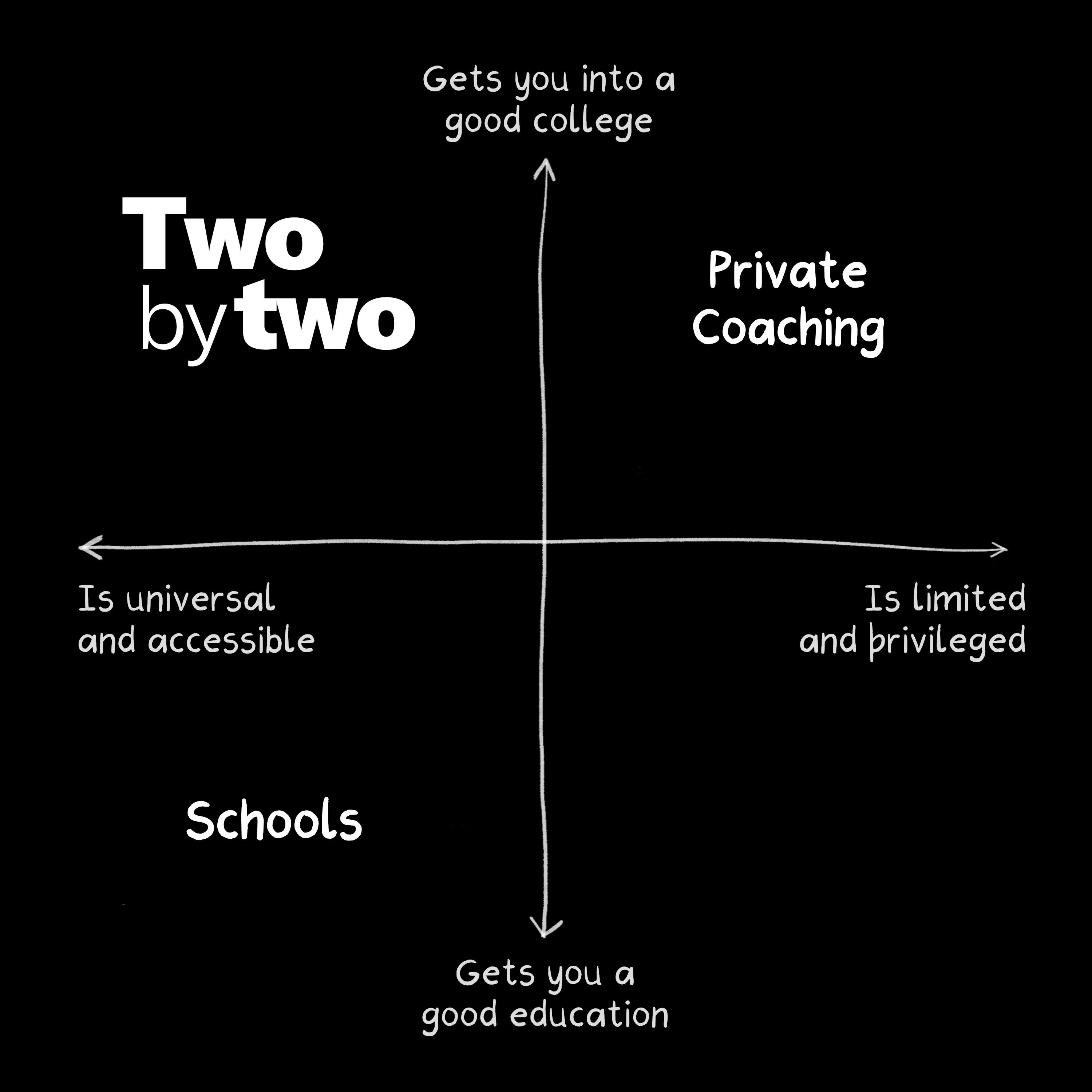
We have unlocked the full and unedited subscriber version of episode eight which we released on September 05 for Premium subscribers of The Ken on The Ken’s app and on Apple Podcasts.School education is a fundamental right in India. An average Indian child spends 10-12 years in schools. And for most parents and families, the money they spend on educating their child is one of the largest over time.And yet, school education is slowly becoming (or perhaps being made) irrelevant in the next step that comes after that: college.The schools-exams-college “chain” is broken. Perhaps because it is now the schools-private-coaching-exams-college chain. And your school education is not going to cut it for you to make the cutoff as millions line up to clear the exam every year.Private coaching is how you manage to get into the school and your actual schooling is just a condition you have to fulfil to sit in for the exam. It plays no part in preparing you for the entrance exam.Private coaching, estimated to be a $25 billion industry by 2025, is becoming the determinant of a good quality education. Not schooling. Thus, as entrance exams get centralized, and private coaching becomes the most reliable way to clear them, the results are only accentuating numerous privileges and biases, including central boards like ICSE/CBSE, bigger cities, boys, and families with higher incomes.12 years of schooling – one of the biggest spends for families – is becoming disconnected from college education and jobs.And to discuss this, hosts Rohin Dharmakumar and Praveen Gopal Krishnan were joined by three guests.Maheshwer Peri, the founder and CEO of Careers 360, a company that helps hundreds of millions of students each explore career plans. Mahesh has been an investment banker with SBI Capital Markets, then was with the Outlook group for 17 years, including heading it for more than 10 years.Sumeet Mehta, Co-founder and CEO, LEAD Group. LEAD Group offers school edtech solutions across 8000 schools in India, which in turn touch 3.5 million+ students.Nitin Pai, our third guest and the co-founder and director of the Takshashila Institution, an independent think tank and school of public policy based in Bengaluru.Additional references:How fair are entrance exams?Welcome to episode eight of Two by Two, The Ken’s weekly podcast that asks the most interesting and often uncomfortable questions on topics we all want to know more about. And we do that through the lens of a 2×2 matrix!This episode of Two by Two was produced by Anushka Mukherjee. Hari Krishna is the lead writer and researcher for this episode. Rajiv C N, our resident sound engineer is the audio producer.You can also sign up for the Two by Two newsletter for free. Each week you’ll get to read a “storified” version of that week’s episode.Write to us twobytwo@the-ken.com and tell us what you think of the show.
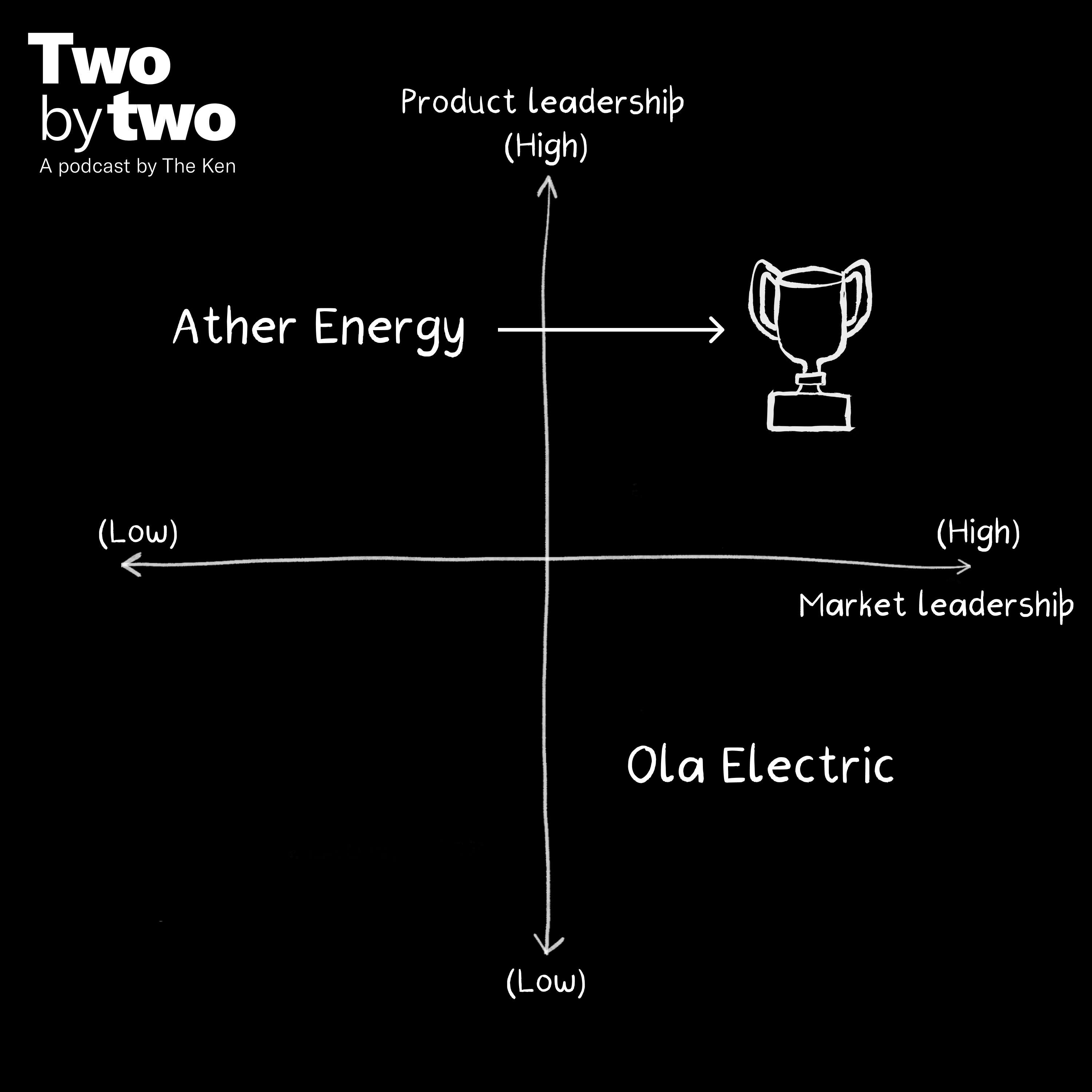
Ather Energy is the third largest seller of electric two-wheelers in India. Founded in 2013, Ather Energy is known to have kicked off the electric two-wheeler wave in India. They came in with a great product which offered the best of software and hardware on a two-wheeler. And over a decade of its existence Ather has delivered on its promise of a great product which will create a “magical experience” for its customers.Ather spent years building their own electric two-wheelers from the ground up. They built their own batteries, their own chassis, their own electronics and powertrain, and even their own software. But in the process, they lost the opportunity to become the market leader, a spot that was filled by Ola Electric, a much later entrant.On September 9th this year Ather filed its draft red herring prospectus as it plans to go ahead and list on the Indian bourses. And as hosts Rohin Dharmakumar and Praveen Gopal Krishnan sat down to discuss and understand what the market looks like for electric two-wheelers and how Ather will fare in a market it kickstarted and popularized. They also got two great guests to discuss this.First is the co-founder and CEO of IPO-bound Ather Energy Tarun Mehta himself and the second guest we had was Professor Rishikesha Krishnan, Director of IIM Bangalore, and a professor of Strategy.It’s not often that we have the co-founder and CEO of a company heading for its IPO discussing its strategy with the director of one of India’s most prestigious management institutes who both studies and teaches strategy.And over the course of 90 minutes, they discussed the strategy and vision Ather Energy is going ahead with into the future and how they intend to keep innovating on their product leadership while also stepping up and getting on the front foot to improve their market leadership.Welcome to Episode 12 of Two by Two.This is shorter version of the episode which highlights some of the most interesting parts of the discussion. The full episodes are available to Premium subscribers of The Ken on The Ken app and Apple Podcasts.Two by Two is also a newsletter, where every Friday short storified version of the latest episode is sent out to subscribers for free. You can sign up for the Two by Two Newsletter here.This episode of Two by Two was researched and produced by Hari Krishna. Rajiv CN, our resident sound engineer, mixed and mastered this episode.New episodes are released every Thursday. So follow the show wherever you get your podcasts and tell us what you think of the show.Write to us at twobytwo@the-ken.com and let us know what you thought of the episode.
Want to attend The Ken’s next event—How AI is Breaking and Remaking the Way Products are Built?🎟️ Join us in person or on the livestream—tickets here


Download from Google Play

Download from App Store
 United States
frequent interruptions without any meaning addition but disrupting the flow of talk.. Couldn't follow after 20 min