


 Claim Ownership
Illuminated
Subscribed: 166Played: 6,405
Subscribe

© (C) BBC 2026
Description
Illuminated is BBC Radio 4's home for creative and surprising one-off documentaries that shed light on hidden worlds.
Welcome to a place of audio beauty and joy, with emotion and human experience at its heart. The programmes you will find in this feed explore the reality of contemporary Britain and the world, venturing into its weirdest and most wonderful aspects.
This is a chance to meet voices that are not normally heard, open secret doors into concealed chambers and, above all, be transported by the art and inventiveness of the very best programme makers. Just press the switch.
New episodes are available weekly on Sunday evenings. Subscribe on BBC Sounds to make sure you don't miss an episode.
87 Episodes
Reverse
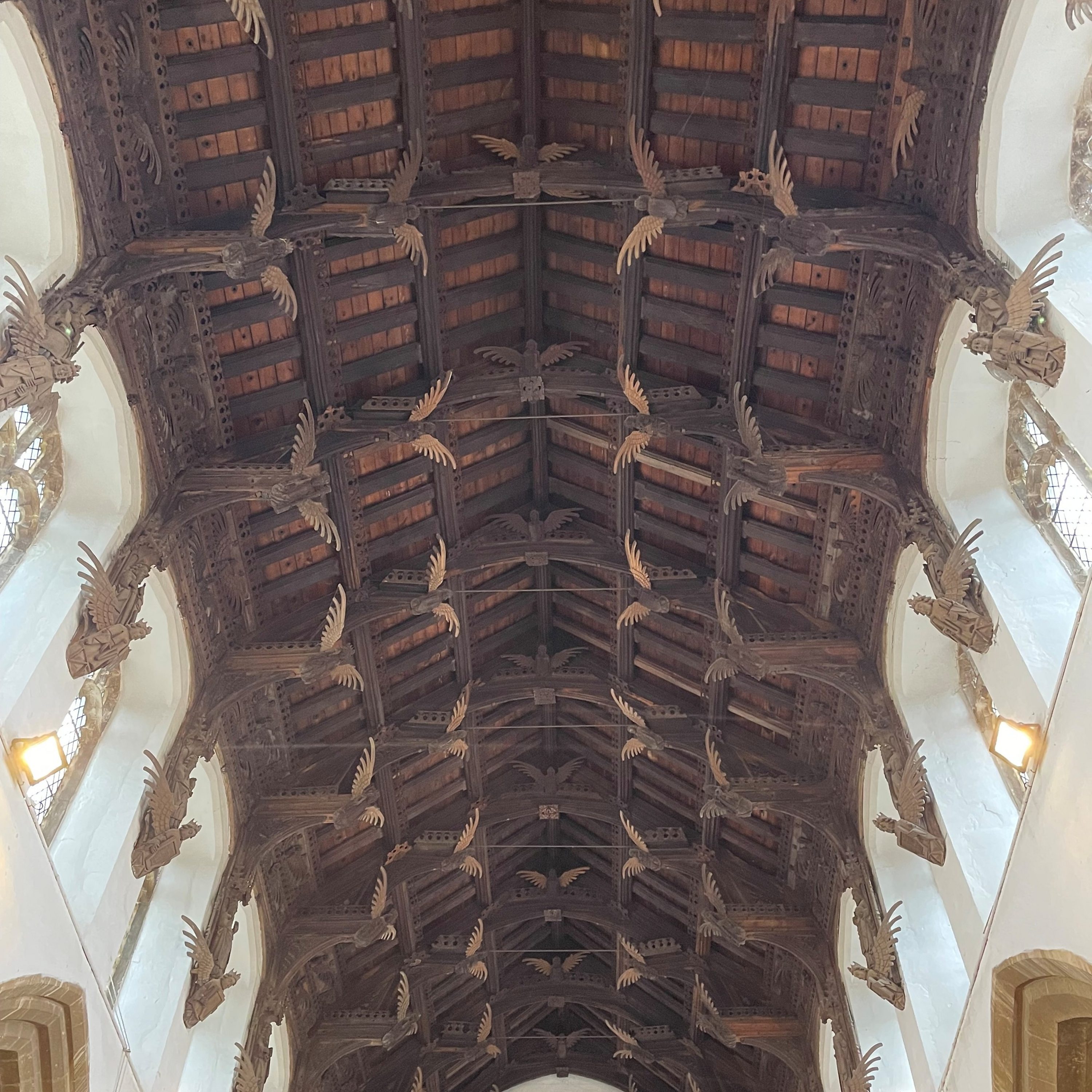
John Betjeman wrote that it was 'worth cycling forty miles in a head wind to visit St Wendreda's church in March, Cambridgeshire, because of the 118 angels in the roof.
The wings of the C16th oak carvings are inspired by hen and marsh harriers. Once common locally - they are returning now. Nature writer Robert Macfarlane looks at the carvings, drawing connections between angels and harriers, what they say about of our feelings for the birds and angels.Robert climbs to the ringing chamber to get close to the harrier angels with Ruth Clay, vicar of St Wendreda's, Edward Wilson-Lee, author of The Grammar of Angels, and Ajay Tegala, ranger at Wicken Fen. They discuss their meaning, in the C16th when they were carved, and today. The persecution and survival of the angel carvings corresponds to that of the birds. At Easter this is a resonant story.During the Reformation iconoclasts destroyed 'idolatrous' church decorations, including carvings. Michael Rimmer, author of The Angel Roofs of East Anglia, tells of their destruction. At the same time the Tudor Vermin Acts led to a frenzy of killing of birds of prey such as harriers.When Henry VIII's agents came to March to destroy the carvings, the people of March plied them with drink and food. They left with the church silver, but the harrier angels stayed intact. In William Barsley’s workshop the wood carver speaks about the art of the carvers who were known as 'imaginators'.
Robert visits Wickham Fen with Ajay Tegala, where hen and marsh harriers are in recovery, to observe them in angelic flight.And musician Martin Simpson has made a special recording of his song Skydancers, about harriers, their predicament, recovery, and our role in this.Presenter: Robert Macfarlane
Producer: Julian May
In 2018, the writer and actor Harriet Madeley found out that she was going to die.
At least, that’s what she heard when a doctor diagnosed her with Primary Sclerosing Cholangitis, a progressive disease for which there is no medical treatment, no cure, poor understanding and a long list of frightening Google stats..
None of her loved-ones knew how to respond to this bombshell. Her best friend kept crying. Her parents preferred not to talk about it. And her fiancée? She took it upon herself to cure the thing.In the midst of a confrontation with looming death, Harriet’s closest relationship began disintegrating.
Harriet's response? To write a comedy about it.This is the story of how Harriet used her creativity to come to terms with a life-changing diagnosis, and how it helped her to rebuild her relationships and decide how to face the future.The play featured (slightly) fictionalised versions of the people closest to her. The script was a monologue, in which her own flaws and those of her loved-ones are magnified for the paying audience.But how will those loved-ones respond? Will they be horrified? Or will the play force a meaningful conversation at last?
Harriet is still alive and kicking, facing a finite future. But then again, aren’t we all?Writer: Harriet Madeley
Producer: Andrew Wilkie
Sound Design: Micky Curling and Bella Kear
Voices of theatre team: Madelaine Moore, Mark Knightley, Jessica Clark
With heartfelt thanks to Abi Mowbray
Photo: Karla GowlettA PRA production for BBC Radio 4
‘Do nothing’. So exhorts Jimmy as he overhauls the strokes, kicks and breathing of his adult swim learners at Cardiff International Pool. They plunge, roll, extend. As they learn to let go and glide, they’re overcome with a sense of joy, freedom and bodily ease.For journalist Selma Chalabi, Jimmy’s classes have been a lifeline. She joined the class to improve her swimming technique, but what she found was something so much more profound. Jimmy’s unique and philosophical style of teaching taught her not only how to move at one with the water, but also how to live her life - when to move and when to rest and how to breathe.It’s in the pool that Selma meets a community of learners - all ages, shapes and cultures - who are doing so much more than learning to swim. There’s Maggs, who is determined to face her worst fear and overcome a deep childhood trauma, and working mum Doris, whose moment of peace is when she submerges into the water. As for Darius, he has transformed from absolute beginner to potential competitor. This is a world you might find in any leisure centre around the country. A place so familiar to us, and yet in its depths and shallows, in its pools of chlorine and azure light, are stories of courage, determination, bliss and finding new meaning in the water. Producer and presenter: Selma Chalabi
Executive Producer: Leonie Thomas
Sound Designer: Mike Woolley
Sound engineers: Meic Parry and Katie HillWith deepest gratitude to Jimmy, his students, and the staff at Cardiff International Pool.An Overcoat Media production for BBC Radio 4
Historian Maurice Casey reveals the story of an anti-Nazi resistance network and the family at its heart, told through a newspaper crafted by two young girls. In the dusty corners of a Galician villa on Spain’s northern coast, Casey uncovered a forgotten archive of revolution, resistance and love. Among the documents was something extraordinary. The Alpenpost - a newspaper lovingly hand-crafted by Elisa and Alida Leonhard, two girls raised on Europe’s 1930s refugee routes. Created every fortnight from late 1935 until 1940, The Alpenpost charted the activities of the two Leonhard girls and their mother Emmy, a veteran of the repressed world of Weimar German communism. With a mixture of cartoons, light stories and precocious political analyses, the girls charted their unusual upbringing as the children of an anti-fascist father and an exiled revolutionary mother.Each issue was posted to the girls’ ‘papa’ Edo Fimmen, separated from his family, constantly travelling to maintain a network of activists and informants. Fimmen led the powerful International Transport-Workers’ Federation in continual resistance to fascism. Reading The Alpenpost, Edo could chart his daughters’ flight through 1930s Europe. Both a love letter to a father seperated from his family by dangerous work and a remarkable document of a childhood lived in flight from totalitarianism.This is a tale of survival against the odds - not only the survival of a family that lived under grave political threats, but an archive that survived a journey across countries and generations.Contributions from Pedro Ewald, Dieter Nelles, Rene Dumont, Bob Reinalda
Voices of The Alpenpost: Hannah Nehb, Juno Nehb, Neva Nehb with Arjan SchipperProducer: Mark Burman
A Storyscape production for BBC Radio 4
Alan Hall and his siblings have a shared story from their childhoods - their mum, Jackie, describes walking through a Liverpool park with her mum, their grandma, Hettie. It must be the 1940s. Hettie is a single mum. She'd fallen pregnant, according to family mythology, while working as a domestic servant in Scotland. Jackie has had spells in foster care. "Don't stare," Hettie says. "Those men over there, they're your uncles." Years later, after Jackie's death, Alan finds an envelope labelled, 'Mum's Pics'. Inside, there are photographs of two men in military uniforms, one with 'Fred' written on the back, the other, of a soldier in a kilt, 'Brother Bill'. These are Hettie's brothers - or rather, two of them. She was the youngest of nine and the only daughter. Of the other boys, Jackie had told her children, three had been killed in the Great War. A third photograph, of the Foster family gravestone, provides their names - Harry, Sidney and Thomas, "their duty nobly done".Cannon Fodder traces memory, myth and meaning within one family touched by the catastrophe of World War One. With contributions from historian Jeremy Banning, Lynelle Howson of the Commonwealth War Graves Commission, retired Salvation Army officers Lt-Cols. David and Doriel Phillips, Ruth Anders of St Anne's Church, Aigburth in Liverpool and Hettie's grandchildren - Cathy, Laureen, Alan and Robin.With music by Robin's daughter, Leila Hall (voice), and Alan Hall (cornet).
Produced by Alan Hall
A Falling Tree production for BBC Radio 4

Hilik Magnus is Israel’s foremost search and rescue specialist. He has performed missions, public and private, for over 30 years across six continents. He has worked under the radar during disasters such as 2004’s tsunami and 2008’s Mumbai attacks. He has worked with everyone, from grieving families to cartels and the Taliban, all for the simple purpose of returning people to where they belong.
Now, he opens up about this secretive world, and talks frankly about his origins and values.The start, in the 1990s, was simple. His operating base was an abandoned train carriage in the southern desert of Israel with three telephones and a dial-up connection. Hilik did not know what awaited him. All he knew was that he felt a ‘shlichut’ – ‘higher purpose’ in Hebrew – to help save lives, to return the unburied to their grieving families. Yet the business grew and now employs 80 people in a hi-tech hub in Tel Aviv. There is GPS, GSM, fibre-optic, and over 2,500 calls for help every year. In the midst of this change, Hilik is finding it hard to connect the now and then. For him, the purity of the work was in shepherding lost souls, alive or dead, to their rightful place. Strange, mystical encounters at 6,000m above sea-level, exposing national corruption in Bolivia - not board meetings and touchscreens. He hates the city and all it implies. Yet the world moves on, and the work means everything to him. When he lets himself stop, his 76 years catch up with him, leading to days laid up in bed. Producer: Jeremy Neumark Jones
Assistant Producer, Additional Research: Robert Neumark Jones
Original Music by Theo Whitworth
Executive Producer: David Prest
A Whistledown production for BBC Radio 4
 1
1The Indri lemur, also known as the singing lemur, can be found only in Madagascar’s rainforests. Famous for their eerie, melodic calls, they are one of the few primates that sing and, as it turns out, they have a surprising relationship to rhythm - one that’s very similar to our own. After hearing news of these unlikely rhythmic capabilities, Georgie Styles ventures into one of the most biodiverse yet threatened ecosystems on Earth to capture the haunting songs of this critically endangered species, as they echo through the treetops. But as she goes deeper into this tale of survival and song, she discovers a hidden female history. So what can the Indri lemur tell us about the origins of music?Providing us with the first-ever evidence of complex vocal abilities that exceed those of any other mammal, besides humans, the Indri reveals clues to our own evolutionary journey and offers us a rarely told perspective.With contributions from primatologist and conservationist, Dr Sylviane Volampeno, primatologist Dr Chiara De Gregorio, researcher Irene Marchesi and a team of Madagascan research guides, A Lemur’s Song connects nature’s melodies to the evolution of music. Through the captivating sounds of Madagascar’s rainforests, the Indris songs and the creative responses of an original score by music artist and saxophonist Laura Misch, Georgie reflects on what sounds can tell us about our world and what we are at risk of losing.A 2 Degrees West production for BBC Radio 4
If you ask many women in recovery from alcoholism what the term ‘functioning alcoholic’ means to them, they will laugh. In truth, a large percentage of women who end up in treatment had been, to the outside world, ‘functioning’. Holding down jobs, raising children, paying their rent or mortgage. However, internally, ‘functioning’ is about the last word they would use to describe their mental and emotional landscape as alcohol increasingly tightened its grip on their lives.Here, two women share in raw and brutally honest detail their descent into alcohol dependency, which took place incrementally, behind closed doors, and, for the most part, under the radar as they continued to appear to live regular, ‘functional’ lives.Functioning offers a rare insight into the experience of leading a completely dual existence - the secrecy, the agility and the alchemy required in maintaining a ‘functioning’ exterior, while your interior is coming apart; and a lesson in how much can go undetected when you are not what the world assumes of an alcoholic.Sound design by Action Pyramid
Produced by Jodie Taylor
A Falling Tree production for BBC Radio 4
In the 1930s a group of researchers descended on the northern mill town of Bolton to observe the natives. They christened their chosen case-study 'Worktown'. It was a ground breaking study of working class culture - and one thing they wanted to know was what makes people happy.The people of Bolton were asked a simple questions "What is happiness to you and yours?" The letters written in response reveal a snapshot of the innermost thoughts and feelings of ordinary people, living ordinary lives almost a century ago. Katharine Longworth returns to Bolton to discover whether this town still holds the secret to happiness. Exploring the town centre, markets, pasty shops and pubs; she asks the same question, bringing the original letters to life as modern day Boltonians reflect on the insights of their predecessors. We knock on the doors of those who live in the same spot as the original correspondents, linking them to the past through the words of the letters, and hearing their own reflections on happiness. Have things changed? Is it more difficult to be happier today? And is Bolton the happiest town on earth?Original letter written by:
J.E. Nelson
G. Taylor
J. Warburton
Joseph Roberts
A. Thornley
F. Fielding
L. Bollington
E. HorrocksProducer: Katharine Longworth
Sound Design: Michael Smith
Actors: Paul Brennan, Jasmine Hyde and Mike RogersWith thanks to Professor Jerome Carson and Dr Sandie McHugh at The University of Greater Manchester.
Time is a journey - the future ahead of us, the past behind. Our burdens are a weight that we carry, our problems are a puzzle that we solve.Metaphor is at the heart of how we understand our existence. In a period of huge change and global uncertainty, are we outgrowing the metaphors we have lived by?The poet Jack Underwood is offering his services as a metaphor consultant, for a very reasonable fee.Featuring conversations with poet and psychoanalyst Nuar Alsadir; Dr Stephen Flusberg, the Director of the Framing, Reasoning And Metaphor (FRAME) Lab at Vassar College; computer scientist Melanie Mitchell; the philosopher Dr Julia Ng; and the linguist and author of Metaphors We Live By, George Lakoff.Location recording by Mitra Kaboli, Kristina Loring, Gustavo Martinez and Donelle WedderburnProduced by Eleanor McDowall
A Falling Tree production for BBC Radio 4
For decades, Nigerian hall parties have been the hub for communities in the UK, it was the place where they could bring a little bit of home and be transported through music, food and fashion. Full of extravagance, warmth and culture, the word Owambe, both noun and adjective, directly translates to ‘everything is there’. Now, first generation British Nigerians continue this tradition, their way. Presenter Bisi Akins takes us on a journey through an Owambe, exploring what that “everything” really means. We dive into the key elements of a successful Nigerian hall party, immersed in the sounds, smells, music, and traditions that bring an Owambe to life. We’ll hear from those who lived it, loved it, and how the next generation are keeping the tradition alive. Bring your big beats, bold outfits, and dancing shoes – Into the Owambe for BBC Radio 4. A Hill 5.14 production for BBC Radio 4
Bass guitarist and record producer Jah Wobble has had a lifetime’s immersion at the low end of the musical spectrum. Over four decades, his hypnotic bass riffs have powered music from punk to reggae, fusion to world music.He relates his first experiences as a teenager attending blues dances where Jamaican sound systems played cuts of reggae dub where the bass felt like a force like gravity, and seeing Bob Marley and the Wailers where he was captivated by the playing of bassist Aston ‘Family Man’ Barrett, and on to his own involvement with Public Image Limited, where he brought a dub sensibility into their post-punk music. He discusses his long years as a solo artist, and collaborations with musical legends from Can’s Holger Czukay to Sinead O’Connor, and Primal Scream to Pharoah Sanders. During these years, Jah Wobble has also been interested in the Science of Bass. So, he meets up with Dr Duncan Edwards of Salford University, to ask him about the special, physical properties of Bass Notes. How do they reach our brains and, once there, what psychological, emotional effects can they have on us? To understand this, he submits to an experiment where his head is wired up, and the Wobble brain waves measured. After years lost in drink and drugs Jah Wobble turned to Buddhism and became fascinated by alternative explanations of his bass playing that this could give him. He interviews eminent teacher of Tibetan Buddhism, Lama Jampa Thaye, to find further enlightenment. And in a south London Prayer room, he listens to the extraordinary low-pitched chanting of exiled Tibetan monks, where one mantra has the awesome power of a bass note.Presenter: Jah Wobble
Producer: Alastair Laurence
Sound Design: Jake Wittlin
A Whistledown production for BBC Radio 4
What does Christmas Day mean to you? This raw, kaleidoscopic audio portrait, made up entirely from voice notes recordings, tracks the emotional contours of the day as it unfolds.
Through midnight churchgoing and moments of quiet reflection to frenetic gift-giving, culinary chaos and karaoke, the programme evokes and questions our own multifarious experiences of what Christmas Day ‘means’. Variously boozy, silly, sad, excited, warm, lonely, deeply spiritual and endearingly humanistic – the contributions chart a cross section of modern Britain, encompassing heartfelt-stories, accidental field recordings, impromptu songs and audio diary entries. With special thanks to all those who recorded their Christmas Day for us in 2024. Original music and sound design by James Bonney. Producer: James Bonney
Mix: Mike Woolley
Executive Producer: Olivia Humphreys
An Overcoat Media production for BBC Radio 4
In 1939, Emma Freud's mother Jill was evacuated from London to the suburbs of Oxford. After staying with Lewis Carroll's friends the Butler sisters for a few years, she arrived at her next designated accommodation clutching a small suitcase and a copy of her favourite book, The Screwtape Letters by CS Lewis. It was just a few weeks later, after she spotted several copies of that book on a shelf, that she realised she was actually living with CS Lewis himself.In this telling of Jill's fascinating story, Emma hears all about her mother's love for CS Lewis, known to her as Jack. How she cared for him, how he paid for her to go to drama school and how a big, old, wooden wardrobe became part of her story...Illustrated with readings from The Lion, the Witch and the Wardrobe, Emma captures these precious memories as she sits down with her mum to hear her magical story.Readings of The Lion, the Witch and the Wardrobe by Olivia Williams.
Other readings by Richard Gibson.Presenter: Emma Freud
Producer: Elizabeth FosterThe Lion, the Witch and the Wardrobe by CS Lewis © copyright 1950 CS Lewis Pte Ltd.Lady Jill Freud, April 1927-November 2025.
Like so many people at a similar time of life, the poet Paul Farley is facing up to the fact that he might need hearing aids. His wife has been asking him to turn down the volume on the telly for years, and has given up shouting downstairs for him because he never hears. Out in cafes and pubs, Paul can no longer really follow what people are saying to him, and so he often turns down invitations knowing he can’t turn up the volume. Even worse, for Paul at least, is the fact he can no longer hear the high frequencies of his beloved birdsong. Now, though, all that could change as he heads for a test at his local opticians to get his own NHS hearing aids fitted. He also speaks with Gabrielle Saunders, Professor of Audiology at the University of Manchester, about the past and future of hearing aids, and also the truth about the supposed connection between dementia and hearing loss. Paul also visits the near total silence of Salford University’s anechoic chamber so that he can hear himself think properly - and looks forward to a time when he might once again be able to listen to the birds.Presented by Paul Farley
Produced by Geoff Bird
Executive Producers: Eloise Whitmore and Jo MeekA Naked production for BBC Radio 4
From Rock-a-bye Baby to Brahms to AI…Has the lullaby become a lost art?Matt Edmonds is trying to sing his child to sleep. It’s not working. As his baritone produces My Bonnie Lies Over The Ocean for the 19th time and his toddler says 'Dada, stop!’, he drifts into a parallel reality. Could AI do bedtime for him? Surely it would be simpler? And he would be spared lying on the floor of his child’s bedroom.What is a lullaby? What gives it its magic? The tune? The words? The rhythm? The very act of delivery? In this programme, we join Matt Edmonds - writer, musician and father - as he falls down a rabbit hole, chasing the lost art of the lullaby. In this dreamy, musical 'sleeper hit', Matt encounters people with stories that explore the power of the lullaby.During Lullaby Hour at a neonatal unit, Matt hears first-hand the impact live lullabies have on premature babies. He talks to Roxana Vilk, whose lullabies project gathers songs from all over the world, to see if she can help. And he meets his friends, musicians Johnny and Lillie Flynn, to hear what musical tricks they use to compose and sing lullabies. Full of fresh wisdom, Matt returns to his child’s bedside, his baritone hoarse and sleep-deprived, to test if the ancient art of the lullaby still has legs. This programme is richly designed with a soundscape woven from recordings of Matt’s own attempts at lullabies, the sounds of the locations he visits, and music from Matt, Mica Bernard, Bex Ashford and from Johnny and Lillie Flynn.Presenter: Matt Edmonds
Producer: Jenny Dare
Executive Producers: Shannon Delwiche, Chris Jones and Guy NatanelWith special thanks to Dr Aniko Deierl and Irena Meza for their contributionsA Sound & Bones production for BBC Radio 4.
Emily Berry leads us on an exploration of agoraphobia: a poetic journey through the lives of people who don't like going on journeys.Agoraphobia is elusive and elastic – and it's very probably not what you think it is.Poet Emily Berry was diagnosed with agoraphobia over ten years ago, a condition which limits her ability to travel. And so she's setting off in a different way: on a journey into the life of the mind, guided by a chorus of fellow agoraphobics. What does it mean to come up against the boundaries of the self and how might those limits be breached through the power of the imagination – in the words of poet Vasko Popa, "the little box which contains the world."Featuring Graham Caveney, Charlotte Levin and Peter Ruppert.Includes extracts from a BBC interview with Dr Claire Weekes.
Graham Caveney's memoir is called On Agoraphobia (Picador)
Charlotte Levin's most recent novel is If I Let You Go (Mantle)
Peter Ruppert's on-line community is anxietyfitness.com
The Piano Boat, the floating concert hall where world-renowned concert pianist Masayuki Tayama played, sits empty. His wife, Rhiana, is left with a boat with no captain and a Steinway she was never allowed to play. We join her as she processes her grief and considers the future of The Piano Boat without Masa.Rhiana and Masa commissioned the boat in 2019 and planned to run concert cruises, on board the boat, along the inland waterways. It was a dream project for both of them – a life designed for two.But, in 2021 Masa was diagnosed with pancreatic cancer and although the chemotherapy turned his fingers numb, he relearned his technique and kept playing. In August 2023, a week after what would be their final round of cruises, Masa was hospitalized for the last time. He died two weeks later.Will Greenwood, who has seen the boat from creation to present day, journeys with Rhiana on the waterways and as she rebuilds her dreams while coping with her grief. She shares her honest audio diaries, the highs and lows. She is surprised by sorrow and joy as she starts to fill the boat with music once more. Beginning with playing Masa’s piano – something she had never done before.Craig Terry, Director of Steinway & Sons UK, tells us about the piano and meeting Rhiana and Masa for the first time. Concert Pianist and one of Masa’s former colleagues, Graham Caskey, and music academic, Kris Worsley, talk on the intimacy of The Piano Boat, and show us how the pieces we hear don’t need words to tell a story.Presented by Will Greenwood
Produced by Will Greenwood and Anna Scott-Brown
An Overtone production for BBC Radio 4
There are so many problems in the world. For the past three years, Estonian clown Julia Masli - armed with a microphone taped to a mannequin leg - has been trying to solve them.So far, during the performances of her live show ha ha ha ha ha ha ha, where Julia asks audience members their problem, she has recorded 1574 problems. A few people feel homesick, some worry about the collapse of society, and many lament their retreating hairlines. But we are not alone with our problems: Janet is not the only one with a broken fridge. Simon shares his back pain. Alexandra might feel lonely, but Aisha does too. This clown might not be able to solve all of our problems, but she’s going to try. Photo: Cameron Whitman
Original music composed by Alessio Festuccia
Produced by Talia Augustidis and Julia Masli
Dramaturgy by Kim Noble (director of ha ha ha ha ha ha ha)
Executive producers Alan Hall and Eleanor McDowall
A Falling Tree production for BBC Radio 4
This is a story about a community on the north east coast of Scotland that talked to plants with miraculous results.Established in 1962, the Findhorn community gained international recognition for 40lb cabbages, 8-foot delphiniums, and roses that bloomed in snow.With seemingly no gardening experience, community founders Peter and Eileen Caddy and their friend Dorothy Maclean transformed the barren sand dunes surrounding the 30-foot caravan they were living in, into a modern-day garden of Eden.The public wanted to know how this was possible. What was the source of this horticultural miracle? People flocked to Findhorn from around the world to witness this incredible transformation first-hand.An extraordinary story began to emerge. Peter, Eileen and Dorothy - along with Scottish writer and supernatural enthusiast Robert Ogilvie Crombie (ROC) - attributed their success to one thing: collaboration with the ‘intelligence of nature’.They claimed they had pierced the veil of the nature spirit realm, and were regularly receiving guidance from fairies, floral spirits and angelic forms Dorothy called 'Devas' - the ‘architects’ of the natural world. Moreover, they had been called upon by these entities to transform the Findhorn Garden into a centre of spiritual light. What started with a single family in a caravan quickly grew into a thriving international village of hundreds of people united by shared social, spiritual and ecological values.Inspired by the media's enduring fascination with Findhorn's supernatural origins, sound designer Jonathan Webb travels to Findhorn in search of transmissions from the nature spirit realm.Trawling through the archives, in conversation with community elders, and in pursuit of sonic traces of higher elemental worlds, Jonathan brings into focus the echoes and reverberations of Findhorn’s strange and magical past.Produced, Edited & Sound Designed by Jonathan Webb
Executive Producer: Carys WallA Bespoken Media Scotland production for BBC Radio 4Additional field recordings by Brenda Hutchinson.With grateful thanks to Jonathan Caddy, Judy McAllister and Karl Jay-Lewin, whose kindness and generosity made this programme possible.Thank you to the Findhorn Foundation for providing access and permission to use recordings from the Findhorn Foundation archive.The Findhorn Garden includes excerpts from ‘The River’ by Lark Batteau and ‘Love One Another’ by David Spangler and Milenko Matanovic, performing as The New Troubadours (Findhorn community band, 1970-1973)Jonathan Webb makes no claim to authorship or ownership over any of the quotations or repurposed recordings used in the production of this work, and for practical and artistic reasons it has not been possible to reference and cite them individually. Jonathan Webb’s authorship is in the overall conception, arrangement, treatment and presentation of this audio artwork in its context.

Comments

Download from Google Play

Download from App Store
 United States