


 Claim Ownership
Research Translation Podcast
Subscribed: 2Played: 11
Subscribe

© David Newman
Description
72 Episodes
Reverse
Get full access to Research Translation at researchtranslation.substack.com/subscribe
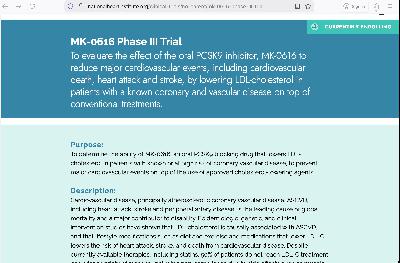
When Arthur Conan Doyle wanted Sherlock Holmes to show off, he didn’t give him a bloody fingerprint or a dropped monocle. He gave him a dog that didn’t bark.In Silver Blaze, the silence was the clue. The horse didn’t vanish because of a stranger—the stable dog knew the intruder. The absence of noise told Holmes everything.That’s where we are with the newest trial of PCSK9s, a class of drug that dramatically lowers cholesterol levels.At first glance, the study looks like a triumph of modern pharmacology. It’s a massive, multinational, double-blinded trial done at hundreds of sites in a dozen countries, enrolling nearly three thousand people. The paper trumpets spectacular reductions in LDL (half or more!) and a power analysis north of 99%. Reviewers nodded. Editors smiled. Headlines followed.And yet: The dog never barked.This drug class exists for one reason: to reduce cardiovascular events—heart attacks, strokes, and deaths. Cholesterol is not the goal, it is the surrogate. Human outcomes are the prize.So where are they?Nowhere in the paper. Nowhere in the abstract. Nowhere in the results. Nowhere, even, in the discussion of limitations. Not a single Kaplan–Meier curve. No exploratory table. Not even the typical cowardly offering—“CV outcomes will be reported separately.” Just, silence.That is not an accident.Holmes would first note the power analysis (a window to the soul of a study): The authors insist the trial was designed to have more than 99% power to prove the drug can lower LDL. But that is absurd on its face. Sniff test: failed. No regulator requires 99% power to prove a biomarker outcome. Eighty percent is standard. Ninety if you’re nervous. But as I’ve pointed out before, increasing power, by upping the number of participants, can be a cover story for ulterior motives.And it’s pricey, to the tune of $50,000 or more per enrollment. Fiscally responsible companies don’t add study participants without a good reason. Which makes it notable that a standard power analysis for this trial suggests the researchers didn’t need to enroll three thousand people—they needed about twenty. Yup. Twenty. For the whole study. Both arms. The PCSK9 drugs drop cholesterol so powerfully that it takes very few participants to demonstrate it mathematically. Which means the company paid more than $140 million for seemingly extra, unnecessary enrollments. So, what’s really happening here?There is a clue that may at first seem small (Dr. Watson once said, "I am glad of all details, whether they seem to you relevant or not"): According to an online recruitment posting for this exact trial, the goal was not to lower cholesterol, but rather “to reduce major cardiovascular events, including cardiovascular death, heart attack and stroke, by lowering LDL-cholesterol.”Ahaa.There it is, in black and white. It takes thousands of subjects to find the tiny reductions in cardiac events that cholesterol lowering drugs can (under the best of conditions for the highest risk people) theoretically achieve. This explains the study’s size. Moreover, in a trial this expensive, CV events were not just possibly collected, they were inevitable. Logged. Coded. Reviewed. Sitting somewhere in a database.Which brings us back to the dog.Why not include the cardiovascular outcomes in the paper? Because they weren’t reduced. If CV outcomes had favored the drug, even weakly, they would have been mentioned or, more likely, headlined . But nary a mention. Not even, “Numerically fewer events, ” or “a favorable trend.” Journals allow that sort of nonsense. Regulators tolerate it. Marketing departments adore it.Instead, nothing. That is not sloppiness, it’s subterfuge.The brilliance of the design is that it allowed them to pivot. By claiming a primary endpoint of LDL reduction (a cakewalk for PCSK9s), and then massively inflating sample size, they could quietly chase their true goal, cardiovascular benefit—while still guaranteeing ‘success’.Heads they win. Tails they don’t lose.The drug succeeded at what was always easy: moving a lab value. But it failed at its secret raison d’être: helping humans.Sherlock Holmes would have closed the file already. The most telling result of this enormous, costly, meticulously planned trial is not what it reported—but what it very carefully did not. Get full access to Research Translation at researchtranslation.substack.com/subscribe
When readers sent me media articles touting baloxavir (‘Xofluza’), I started looking. In the interim, Sensible Medicine, a wonderful Substack by evidence-based doctors, published a podcast, and today a written piece, recommending the drug. I believe they have it deeply wrong. Fun! Check it out, tell me what you think.When I was seven years old I tried hard to see through a frosted glass window. My pediatrician, a silly and smiley man with a nasal voice, stood behind me. “You see that, across the street?” he quacked. Then, leaning forward, as if to sync his line of sight with mine, “See?” His hand was on my shoulder, squeezing gently.I squinted, and tried hard. “Wait… is that it?”“Ah, forget it” he said, smiling at my mother. “You missed it.”Which was true—I’d completely missed the shot in my shoulder. Research Translation is fully reader-supported. Like it? Consider becoming a paid subscriber to help me keep doing it.In addition to being a beloved and brilliant pediatrician, Dr. Gribbetz was a master of distraction. Unfortunately, that’s a skill drug company scientists have also mastered—for different ends—and they played it to perfection with a flu drug called baloxavir.In recent weeks The Atlantic and the Wall Street Journal, noting the rough flu season and weak effects of this year’s vaccine, ran articles extolling the virtues of baloxavir, a single-dose drug hoping to replace 5-day Tamiflu. Both media articles rely heavily on experts who have fallen hard for a 2018 trial published in the New England Journal of Medicine.To be fair, the study also convinced FDA reviewers who approved the drug. Though clearly, that ain’t tough, and the study is a crowded swamp of data. Reading it feels like trying to see through frosted glass. I’ll try to be efficient here, but for the geeks I’ll get into more detail on the podcast.The ‘study’ is actually two separate trials. One compared three doses of baloxavir to a placebo. The other compared baloxavir vs. Tamiflu vs. placebo. Which is remarkable because Tamiflu is a debunked drug, years ago revealed by many independent investigations as not just unhelpful but, to some critics, a premeditated fraud. As I’ve written and podcasted before, Tamiflu trades side effects for flu symptoms, adding as much misery as it subtracts, while failing to prevent serious illness. Meanwhile, symptoms—the only measure either drug even claims to affect—were identical with baloxavir. So the first and most obvious headline should be: BALOXAVIR WAS NO BETTER THAN TAMIFLU, A PROVEN FAILURE. That should end all discussion. But it won’t. The most interesting quirk about the baloxavir paper is that the first trial is an “FDA, Phase 2, dose-finding study”—a fancy way of saying it was done to find a dose, not prove efficacy. The trial had three drug groups of differing doses, plus a placebo group. And no group, when compared to placebo, had enough participants to say whether the drug works. That isn’t a flaw, it’s the point of Phase 2 studies. But it means efficacy claims drawn from them are, by definition, a mistake.Why? Because with three drug groups and one placebo, the drug is getting multiple shots on goal. Efficacy trials get one shot on goal—no more. Ever. And that’s why Phase 2 studies are, well, phase 2. Only Phase 3 studies can say whether a drug works. And in fact, it's weird to publish two studies of different design, from two separate FDA phases, together. It’s weird because the studies have different goals and are interpreted differently. Which is deeply distracting.So what were readers being distracted from? The paper’s much more pivotal Phase 3 study compared baloxavir to Tamiflu and placebo. And here’s where a red flag pops up, bright and tall: Why wasn’t the study a non-inferiority trial comparing the two drugs?‘Non-inferiority’ is a special design statistically and methodologically focused on finding equivalence between drugs. That’s different from a classical superiority trial, designed to find a difference between drugs. For years non-inferiority has been the FDA’s favored design for testing when a new drug claims to be as effective as an older drug. Typically, in such cases the new drug offers some convenience upgrade, like being a pill instead of an injection. Or, perhaps, 1-day versus 5-day dosing. Like baloxavir.Baloxavir is a picture-perfect candidate for a non-inferiority study, but that’s not what the company did. Which means they probably expected more than equivalence with Tamiflu. They expected superiority. When that failed, they settled for (and pretended to celebrate) sameness.How can we know the trial aimed to show baloxavir was better, when the authors claim superiority based on dose-finding, placebos, and virologic results? The Methods section is the paper’s guilty conscience, confessing. The researchers used classical (non-parametric) superiority testing techniques to compare the drugs. Besides this, there is circumstantial evidence. For starters, early lab studies found baloxavir had better effects on viral load and biologic markers than Tamiflu. But that only matters when it translates into people feeling better or being safer, which didn’t happen. This probably surprised and dismayed company researchers, who—like the literati of medical evidence—surely know that Tamiflu is a failed drug. So when baloxavir failed, they changed the narrative: “It’s as good as Tamiflu—yay!” And sadly, most flu ‘experts’ are experts in virology, but not evidence. So when the red flag appeared—a failed superiority trial dressed up as success—they did what seven-year-olds do when asked to see through frosted glass.They squinted, nodded, and missed the shot.Tamiflu is a failed drug. Now we know baloxavir is too. Moreover, both represent a profound risk to public health, because both must be started within two days of first symptoms. If everyone with a sniffle runs immediately to their doctor, or ER, or clinic—resources already dangerously over-burdened—people in dire need of these resources will be harmed. So as I’ve written and podcasted about before, if you want one day’s relief from the flu, try silicon nasal sprays. They’re better, safer, and cheaper, and they’re over-the-counter. Get full access to Research Translation at researchtranslation.substack.com/subscribe
Below marks my first critique of politics, and you’ll see why. For background: I have no political affiliation and do not care for party politics. Years ago I became deeply disenchanted with parties of all stripes. I do not seek a packaged bundle of beliefs or positions—I have my own. I care what works, one issue at a time, and I’m open. What I cannot stand, the attribute that repels me most, is the abuse and distortion of truth. On Tuesday the New England Journal of (oddly partisan) Medicine published two opinion pieces on autism—a favored topic of RT! The first addressed Trump and RFKjr’s September press conference on prenatal Tylenol, while the second discussed vague claims by FDA officials implying a chemotherapy drug can now treat autism.To jump into this cesspool of exaggerators and distortionists, we must first acknowledge an uncomfortable but obvious truth: When, on the campaign trail, you promise frenzied crowds that, once in office, you will quickly discover a cause and treatment for autism—a poorly defined neuro-developmental condition that has eluded researchers for decades—you have two options. Fail and concede, or fail and pretend.Guesses, anyone?After months of fishing through a swamp of poorly supported but rhetorically convenient pseudo-theories, RFKjr landed on the one entertained by stoner neuroscience grads munching funyuns at 3am. (Duuude. It’s totally the Tylenol.)I walked through the Tylenol-autism data in October, and last week a review published in a prominent journal confirmed: Put simply, Tylenol has—provably—zero connection to autism. This was self-evident to anyone who actually read the relevant studies.And yet, September 22nd, 2025 the Health Secretary, FDA head, NIH director, and President, acted out an SNL-ready skit, a tragicomedy of performance art. Speaking in the imperious tones of concern for their people, the four most powerful authorities in public health made a claim that wasn’t just weak—it was palpably b******t.The irony is thick. After years of furiously and publicly condemning Anthony Fauci and others for a crisis of public trust, they offered something far more corrosive than technocratic arrogance: A display of knowing dishonesty. This wasn’t confusion or misplaced confidence. It was the deliberate use of scientific authority to launder a claim that everyone involved knew was indefensible.That isn’t a mistake. It’s contempt—for evidence, for the public, and for the idea that science is anything more than a prop.Which is why recent FDA maneuvers around leucovorin, folate autoantibodies, and ‘folate deficiency associated with autism’ cannot be viewed in isolation. They sit in the same epistemic ecosystem. Once again a small, messy batch of weak studies became a nonsense narrative.To be fair, the folate-autism story is not proven nonsense—yet. It is, um, unfinished. Hypotheses deserve testing, not regulatory implication or political theater. The recent Lancet review, like mine months ago, showed what happens when you slow down and let the data breathe (scary headlines evaporate). And I have little doubt the brain-vitamin narrative will dissolve. But there’s work to be done.Bottom line? Autism doesn’t yield to deadlines. It yields to patience, rigor, and a tolerance for ambiguity—three necessary tools for science, ones in desperately short supply right now. When science is forced to perform certainty on command, what it produces isn’t truth—it’s theater.And this is the kind of theater that doesn’t merely fail to rebuild trust, it finishes it off. This administration didn’t set out to heal the public wound of scientific overreach. They inherited that wound and began poking at it deliberately. Trust wasn’t restored, because restoration was never the point. Control was. And a government that treats science as a stage prop shouldn’t be surprised when the audience stops believing anything it says. Get full access to Research Translation at researchtranslation.substack.com/subscribe
This week is an audio hodgepodge—lagniappe, if you will—a chance to discuss and explore recent headlines. Enjoy!Here are some of the relevant RT and news links.WSJ on vitamins-Vitamins piece on RTNYT on recent vaccine changes-Vaccines piece on RT (Covid for children, and related discussion)NY Times on Alcohol and Cancer, Alcohol and cardiovascular disease -Alcohol, alcohol, alcohol, and alcohol pieces on RT (relation to cancer)YLE on antivirals-Tamiflu, antivirals, and other flu treatments on RT (plus Tamiflu’s placebo effect!)RT is 100% reader supported. I’d love to keep doing it. If you agree, consider becoming a paid subscriber Get full access to Research Translation at researchtranslation.substack.com/subscribe
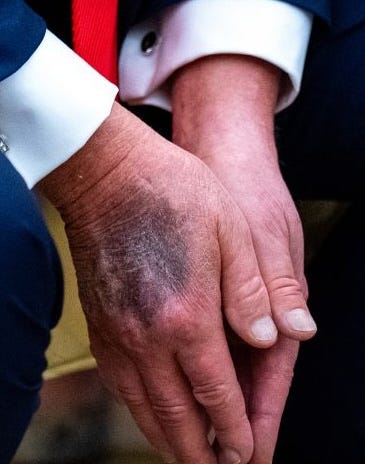
“Meet Virginia” is, I believe, one of the great rock singles of recent decades. It opens with a blue-sy, core-bending bassline and a thirsty guitar riff, as Pat Monahan etches a fantasy vamp. You will not forget Virginia.“Train” is the band’s eponymous first album, and with other tracks like “Free”, “I Am”, “Egglpant”, and “Rat”, it does not falter. Incredibly, it’s nearly matched by “Drops of Jupiter”, their second album. “She’s on Fire” and “It’s About You” are lyrically brilliant curtains of sound, and the title track is a magical tribute to Monahan’s deceased mother. And yet it’s the deep cut, “Mississippi”, that closes the circle: Train makes albums. Old school, full-package, musical journeys. Not singles. Albums. Which brings me to Donald Trump’s colorful hand, photographed and transmitted around the world this week: RT is 100% reader-supported. To keep it going, consider becoming a paid subscriber.While media outlets fluttered joyously over the president’s mysterious (possibly fatal!) affliction, my first thought was of “Bruises”, a song by Train. In it, Monahan and country singer Ashley Monroe re-connect after years, to find loss and pain have changed them. The chorus digs into a lesson learned by anyone who's been to their high school reunion: “We all got bruises.” Take heart, DJT, you’re not alone.Known in medical lingo as ‘ecchymosis’, bruises are bleeding under the skin. They happen with minor (or major) trauma, but sometimes they pop up spontaneously. As people age, the skin’s superficial vessels become increasingly fragile and bruising more common. Rarely, bruising is the flag for a disease—but rarely. When a man approaching 80 shows up with a hand bruise, it’s usually meaningless.But then we learned that Trump takes daily aspirin—DUN-DUN. And, at a higher dose than normal—DUN-DUN-DUN.There’s lots of data on the pros and cons of daily aspirin, which inhibits platelets and therefore makes blood clotting a bit less efficient. For a quick review (with help from Bill Murray in Meatballs) check out last year’s “It Just Doesn’t Matter.” In it I write (and talk) about how recent trials re-confirmed what I found in 2015 after reviewing the data: For people without known heart disease, daily aspirin is, on balance, more harmful than helpful.But as the NY Times highlights in their finger-wagging explainer about Trump’s aspirin addiction, until 2022 the USPSTF (United States Preventive Services Task Force) was recommending daily aspirin. Why? The USPSTF and I saw the same data, but they’re bad at translating it. Which is sad, since their reviews set standards for insurance (insurance is legally forced to pay for many tests and treatments that are provably worthless because of the USPSTF). But I’ve discussed the task force’s failures, and while I believe there are good, well-intended people there, it was 100% predictable that aspirin would fail in the recent primary prevention trials—because it already had. But I digress.The bigger point here is that aspirin is a wonderful example of a preference-sensitive medicine. That is, people should know the pros and cons—and choose their poison. So here’s the (summarized) deal on daily aspirin for primary prevention:* It does NOT reduce mortality (i.e. it doesn’t prevent death).* It DOES prevent nonfatal heart attacks and strokes, for about 1 in every 250.* It CAUSES bleeding in the brain for 1 in 1,000.* It CAUSES other life-threatening bleeding (mostly gastrointestinal) for 1 in 200.We can turn this into an easy comparison: For every 1,000 who take daily aspirin for primary prevention, 4 avoid a heart attack or stroke, 1 bleeds in their brain, and 5 have a different life-threatening bleeding problem.A few factoids: First, any heart attack or stroke aspirin prevented was likely to be followed by full recovery. Meanwhile, bleeding in the brain is real real bad and typically leads to serious long term disability. Finally, the other bleeding problems mean hospitalization and treatment, but they too are rarely fatal and lead to full recovery.So what does it all mean for our fearless leader, the new President of Venezuela? There’s a better chance Trump will be harmed than helped, and he won’t live longer. BUT HE GETS TO CHOOSE. Perhaps he’s most afraid of a nonfatal heart attack or stroke, and doesn’t mind hand bruises and a 1 in 200 chance of serious bleeding. Though he IS taking a bigger dose of aspirin than in most trials, so his chance of bleeding is even a bit higher.But the worst part for him, it seems to me, is that the press will be waiting for him to bleed, then lapping it up like a parched vampire. They will hover like vultures to bathe in the world’s most public case of bloody schadenfreude. But in reality, as the tiny numbers for aspirin make clear, whether he bleeds or doesn’t, has a stroke or doesn’t, and dies or doesn’t, is far more likely to be determined by his genes, lifestyle, and luck. Which calls to mind another Train song, “Calling All Angels.” Trump should check it out. Get full access to Research Translation at researchtranslation.substack.com/subscribe

I wrote and posted this last year, but with the respiratory season now gripping local and national stats—and me spending time with my family, including two boys with the flu—I thought I’d repost this for anyone interested. Turns out no new flu research has changed anything below. And for a list of prior dives into flu-related studies (including a treatment that works!) see the links at the bottom of the page. Happy Holidays, everyone!My boys found our dog, Jazz, earlier this year. She was eating out of a trash can behind an office building. Collarless and homeless, she was also mangy and thin—but somehow pathologically optimistic. On the car ride home her attitude felt contagious, which led me to record her first ever entry into our house. We went inside, Jazz locked eyes with me and, sporting a winsome grin, shat on the couch. The video plays like a teaser for the horror movie Smile.Jazz’s assimilation into local canine culture has also been rocky. There is, I learned, an unspoken code of behaviors in the dog park. Thankfully she’s not a humper or a poop-eater, traits that can lead to doggy censure. And she’s not a fighter. But she plays rough and, worst of all, looks like a pit bull. Which may be partly because she’s a pit bull.Mostly this hasn’t been a problem. Dogs don’t mind her style of play, but many owners do and recently we had a hiccup. A bougie Pomeranian pranced into the park wearing a harness. I’m not sure why an owner chooses the asylum-style, thoracic harness with a rubber handle on top, but Jazz knew what to do with it.Unfortunately, as Jazz shook her new toy the owner screamed. Like, blood-curdling. I practiced emergency medicine for 25 years in the streets, the ER, and combat support hospitals in Iraq, and I swear to you the following: I’ve never heard anyone make that sound.People ran, men flexed, the dogs were separated. The woman took her pom-pom and left, and there seemed to be broad consensus we should too. Perhaps it was my soft jog as the crisis unfolded. Or the eye roll. In any case, we shame-walked to the gates as breathless owners held their loved ones close.Jazz never wavered, doing her best Marilyn Monroe.Naturally, I’ve been hesitant to go back, despite the fact that Jazz mostly loved her time there, and was loved. It’s probably irrational, but even rare bad moments can have that effect.Which brings me to the seasonal influenza vaccine. Does it work? Should everyone have it? What are the downsides?The flu vax is, to me, a fascinating case study with lots of defensible arguments on all sides. Here are some facts:* The Northern hemisphere vaccine changes each year, built on guesses using flu strains found in the Southern hemisphere where flu season starts earlier* The guesses are pretty good but every five years or so the vaccine uses the wrong strains, like in 2021* Flu vaccine was intended to reduce deaths and serious illness in the elderly, but randomized trials and lots of good observational data suggest it didn’t work; some argue there aren’t enough trials to know for sure* In the late 20th century vaccine uptake rose precipitously—along with flu deaths* In trials, the vaccine consistently reduces getting the flu or a flu-like illness—for kids, healthy adults, elderly people, and even immuno-suppressed adults* The flu vaccine may have reduced serious illness for heart patients at the highest risk (i.e. people with heart failure or known heart disease)Okay so let’s accept some easy and some hard realities. First, the good news: getting vaccinated makes a flu-type illness less likely. That’s a good thing.True, the numbers are small: only about 1 in 30 vaccinated people avoids a flu episode because of the vaccine. But why would anyone not want to reduce their chances of getting the flu?The answer, of course, is because of the downsides. These include effort, and cost, and inconvenience. Most vaccines also involve a needle (for healthy adults there’s now a nasal spray). Also, about 1 in every 125 people experiences a fever because of the vaccine.Finally, there are rare serious reactions. Unfortunately, adverse effects aren’t closely tracked partly because the formula changes yearly, and there aren’t new randomized trials every year. So it’s tough to know how much harm the vaccine might be causing. Studies in past years found the vaccine increased non-flu sicknesses, or (rarely—like 1 in 50,000) may have caused narcolepsy. It was also linked to miscarriages in one study, though the CDC says newer data refute that finding.So… what’s it all mean?For me, there are a few bottom lines. First, the flu vaccine probably isn’t saving anyone’s life. That’s a claim the CDC makes based on zero rigorous data. Therefore the vaccine probably isn’t accomplishing it’s original goal, and that has led some trustworthy experts to suggest marketing and money are behind the yearly push.On the other hand I love the idea it might keep me from getting sick—but only if it’s not going to do anything bad. Is the rare fever, or a super-rare chance of narcolepsy or some other bizarre problem, going to keep me from taking advantage?Not sure yet. But Jazz sure does love playing in the dog park.The RT influenza library:-The new mRNA flu vaccine study—and the one STILL unpublished (both)-A fancy new flu drug, that’s actually not new at all (and doesn’t work) (both)-A not-at-all fancy, or new, flu drug that works (written)-A not-at-all fancy, or new, flu drug (podcast/audio)-Tamiflu (written); Tamiflu (audio)-Sore throats, and mindless medicine (both)-Tamiflu and the double-dog placebo (audio only)- Get full access to Research Translation at researchtranslation.substack.com/subscribe
More than a decade ago, large data reviews found that using drugs to tightly control blood sugar in people with type 2 diabetes does more harm than good. In careful studies, it didn’t save lives, reduce heart problems, or prevent kidney failure. And while on rare occasions it helped to avoid or delay limb amputations (1 in 250 people), forty times more often it caused life-threatening episodes of low blood sugar (1 in 6 people).These findings, and the fact that newer drugs prevent heart problems and deaths independent of glucose lowering, have led to a merciful shift away from obsessing over sugar levels. As a former ER doc, I saw countless hypoglycemic episodes—some of them tragic—during the era of “tight glycemic control.”[To read about one strange case, check out this post from last year.] So when I saw the New York Times headline, “Controlling Blood Sugar Cut Heart Disease Risk in Half, Study Says,” I was concerned. Predictably, however, the Times has virtually everything about the study wrong. Less predictably, so do the study’s authors.The Times writer claims the new study, published this week in a Lancet journal, highlights the effects of treatment to lower glucose. It doesn’t. In actuality, the study compared long-term (20-year) outcomes among people with borderline diabetes in two trials that started in the ’90s. Both compared lifestyle changes and pills with no treatment, but found mostly small differences in progression to diabetes. The new paper, however, did a post hoc secondary analysis comparing participants whose sugars normalized in the first year with those whose didn’t, and tracked heart problems.In other words, the researchers compared people whose abnormal sugars quickly resolved—regardless of treatment, including in the placebo group—with people whose sugars stayed too high. And what did they find?Extra! Extra! Read all about it!! We got a doozy, folks: People who were healthier twenty years ago were sometimes healthier today, too.Science!!!Which brings us to the Times headline: “Controlling Blood Sugar Cut Heart Disease Risk in Half.” For starters, the new study didn’t look at ‘controlling’ sugar. That would be treatment, and the study didn’t compare outcomes based on treatment; it compared outcomes based on changes in sugar irrespective of treatment. Then the writer uses a relative number—“cut in half”—rather than an absolute number, to glaze the result. BTW, for a one-minute primer on absolute vs. relative risk, see our new video, posted last week.So what was the absolute number that was cut in half? It was 7%. Which is pretty amazing. Only 7% of people with persistent prediabetes or diabetes went on to have a heart problem over twenty years. For those whose sugar resolved immediately, it was about 3%. That is a 4% difference. That is the difference the researchers tout, the journalist trumpets, and readers are supposed to be impressed by: 4%.Yay?I mean, dude. The New York Times has GOT TO LEARN HOW TO READ A STUDY. So do the (Stanford and Johns Hopkins) doctors who offered breathless quotes like “an incredible finding!” I realize it’s exciting to be asked to comment for the Times, but you need to read the study—and think, please—before you talk to a reporter.To be fair to the journalist, the worst part is that the researchers who did the new study spun their results, and the editors and peer reviewers at Lancet allowed it. All parties ignored the paper’s methods (a secondary analysis of sugar levels, not treatment) and seem not to know the proven history of harms from treating numbers, rather than people. This illiteracy across the scientific and lay-press ecosystem is what allowed and amplified the study’s wrongheaded conclusion. The researchers’ conclusion statement was: “Targeting remission might represent a new approach to cardiovascular prevention.”New?!? Targeting low glucose levels is not new. It’s a failed and harmful approach. And it’s not what their study tested. The study tested what happens to people whose prediabetes quickly disappeared—spontaneously, treatment-related, or otherwise. The answer was 4% fewer heart problems, twenty years later.So thank you, NYT, for always offering deranged, uneducated, misleading research translation. And thank you, Lancet, for the same. Couldn’t do it without you.For a little more depth, check out the podcast.Research Translation is fully reader-supported. To support my work and keep it going, please consider becoming a paid subscriber. Get full access to Research Translation at researchtranslation.substack.com/subscribe
Get full access to Research Translation at researchtranslation.substack.com/subscribe
Every generation of medicine has its totems—high-tech gizmos that measure, promising mastery over the human form if we can just capture the numbers precisely, continuously, and in triplicate. For my teachers the Swan–Ganz, a fancy catheter snaked into the hearts of ICU patients, held this role.It offered heart and capillary pressures, saturations, and cardiac outputs to two decimal places. More numbers than any mortal clinician could use. And yet, even with the full force of physiology, the Swan–Ganz somehow never helped people. When careful trials finally showed the catheters were risky, harmful, and didn’t improve outcomes, the lesson was uncomfortable but undeniable: Even in medicine, there is such a thing as too much information.Last month a large, high quality randomized trial brought this lesson back to the bedside, by testing the humble arterial line catheter. In people suffering from shock the A-line has for decades been a default—a badge of ICU care, offering second-by-second blood pressures, instant sampling for endless labs, and a reassuring sense that even the deep interior is under the watchful eye of modern tech.The ‘EVERDAC’ trial randomized over a thousand people with shock to either routine A-line insertion or no A-line, and found what decades of habit had hidden: People didn’t survive more, recover faster, or fare better in any way with an A-line. But harms—bleeding, infections, pain—were clearly, and statistically, higher. More precision delivered only more injury.In other words, arterial lines represent a catastrophic failure of medicine’s first principle: Primum non nocere. First, do no harm.This is more than just the story of another failed catheter. It’s the story of our failed relationship with information. The modern medical mind is taught to believe that more data moves us closer to truth, as though the human form were a transparent machine, and shock a solvable equation. But our physiology knowledge isn’t a sprawling continent; it’s a tiny lit island in a vast dark sea. We see a few trees and decide we understand the forest. That false confidence is how numbers become idols.The Enlightenment gave us the scientific method, which gave us modern medicine, which saves lives every day. That, in turn, gave us a misplaced faith in measurement—the belief that if we can quantify something, we can control it. It is delusion to believe we understand the causal web of shock physiology well enough to convert better numbers into better outcomes.The EVERDAC trial reveals the gap. What clinicians did with the A-line was order more labs, poke and flush more often, bleed more patients, infect more arteries, and cause more pain. The A-line didn’t improve outcomes; it merely gave clinicians more numbers to chase. All with no measurable benefit.It isn’t moral failure; it’s human nature. Give clinicians a number and they’ll try to change it. Give them a stream of numbers and they’ll invent trends. When we think we understand the system, we feel compelled to manipulate it. With no proper studies to clarify its effects, the arterial line has been, til now, like bloodletting or frontal lobotomy or the Swan-Ganz catheter—a long-standing, harm-inducing practice distorted by the prism of cognitive bias. When people recovered, we believed it was because of the arterial line, when in fact it was in spite of it. That is textbook experiential delusion, described by Hippocrates more than two thousand years ago. EVERDAC is therefore not just a trial, but a philosophical reminder: Medicine’s job is not acquiring good data, it is delivering good care. Which means admitting our limits.So will we?There was never a randomized trial showing the benefit of arterial lines. Much like Swan-Ganz catheters and countless other gizmos, arterial lines were introduced based on misplaced faith, that more information is always better. Now, the only randomized trial of arterial lines is complete, and the results published for all the world to see: No benefit, serious harms.For doctors who claim evidence-based practice (read: all doctors) the path is obvious: Abandon arterial monitoring unless future trials reverse this finding.We will always practice on that small island. To claim the banner of our first principle, do no harm, the trick will be to do what all good islanders must—respect the sea. Get full access to Research Translation at researchtranslation.substack.com/subscribe
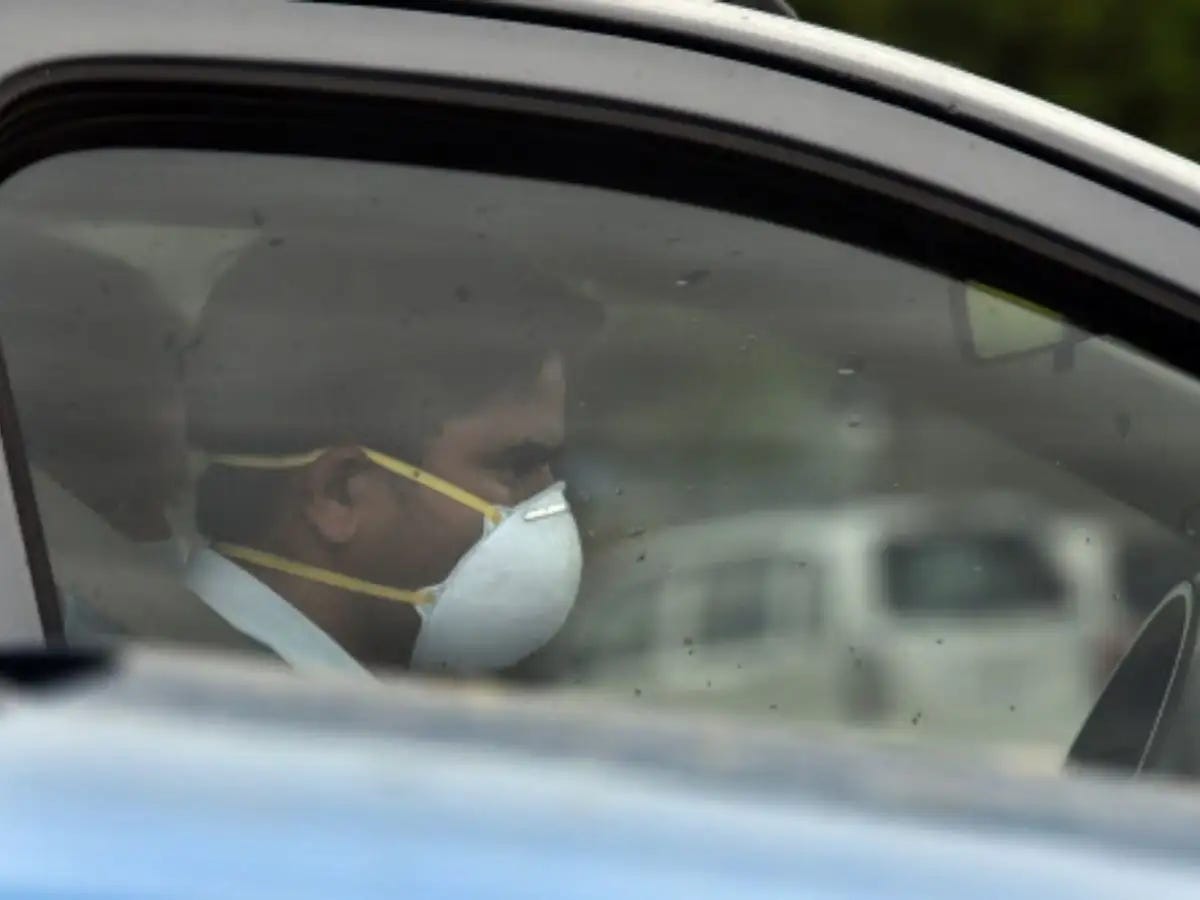
During the pandemic we were treated to a common, but curious site in traffic: A driver gliding by, alone in the car, windows up—wearing a mask. Like Covid was hiding in the glove compartment. It’s tough to count the things that went wrong to make such a moment possible. For starters, masking during Covid wasn’t to protect the wearer. It was to protect people from the wearer. Masking alone, in a car, protects exactly no one. Also, research suggests that at best, masks probably do very little. To avoid Covid the best thing was (and is) an open air environment. So maybe crack the windows, pal? RT is 100% reader-supported. Please consider becoming a paid subscriber.And yet in some places driving a car alone, without a mask on, was illegal. During Covid even health authorities were selling crazy. But that doesn’t mean masks are always worthless. Any indoor setting with people in close proximity is a reasonable place to try masking. If it’s going to work, it’ll be there. But not alone in a car. Context is everything.The same is true for lowering cholesterol. For most people without heart disease lowering cholesterol is demonstrably silly, and more harmful than helpful. For people with heart disease and at ultra-high risk, however, it may be a perfectly reasonable addition, once everything else has been handled (BP control, aspirin, exercise, Mediterranean Diet, quitting smoking). But I’ve podcasted and written lots about the fruitlessness and harms of lowering cholesterol in anyone else, because recent studies have nailed the cholesterol coffin shut.But last week a paper presented at the AHA’s annual meeting and published in the vaunted New England Journal of Medicine, “Evolocumab in Patients without a Previous Myocardial Infarction [heart attack] or Stroke,” found a ‘25% reduction’ in heart attacks, strokes, or cardiovascular deaths with cholesterol lowering. So is it true? Did people without a prior heart attack or stroke benefit? Sort of! Here’s how it worked. The study was run by the makers of evolocumab, a drug that massively lowers cholesterol, on average from 200 mg/dL to about 50 (way more powerful than statins). The trial compared the drug to a placebo in over 12,000 people. The catch? To get in the study participants had to have “coronary artery disease, atherosclerotic cerebrovascular disease, peripheral artery disease, or high-risk diabetes [i.e. with vascular disease].” In other words, people with known heart and vascular disease. That’s a very high risk group. But even that risk wasn’t high enough to get in. The participants were also “required to have at least one additional criterion that placed them at higher risk.” Plus, they had to have high (or “very elevated”) cholesterol levels. This is strange: The title is clearly intended to sound like ‘primary prevention’, treatment to prevent a first heart problem. ‘Secondary prevention’ is for second (or third or fourth) heart problems. That’s an easier target (it’s harder to reduce heart problems in people who rarely have them). But secondary prevention in ultra-high risk people is the only thing evolocumab (and its class) has ever worked for. Even then the benefit is tiny and the drug doesn't save lives.Thus it’s technically correct that the study participants were ‘without a previous MI or stroke’. But it’s a lot like saying crocodile-wranglers are people without a previous crocodile bite. Technically true. But I too have, so far, avoided being bitten by a crocodile. And yet I’m not quite ready to purchase crocodile bite insurance. The wranglers, on the other hand, might want to look in to it. Predictably, the study participants receiving the drug (painful, twice-monthly shots) didn’t live any longer than those who didn’t. But 1 in every 56 of them, or less than 2%, avoided a (nonfatal) heart attack. Pretty much exactly what earlier studies—all of which openly admitted to being secondary prevention—showed. So, nothing new here: The drugs had a tiny effect and didn’t save lives for secondary prevention. Why did the NEJM allow the company to title the study in such a misleading way? Two reasons. First: marketing. The AHA press releases, cardiology news splashes, and Medpage headlines. Good press, and lots of clicks for the Journal. Better yet, the drug company will now buy millions of dollars worth of reprints from the New England Journal of Medicine. Reprints are glossy paper versions of the title-page or full study, handed out by attractive drug company representatives who bring lunch (and pens and chotchkes) to doctors’ offices. The reps brim with confidence that few if any doctors will read past the title or summary.Reason two: FDA approval. Impossibly, the FDA apparently didn’t read past the title. The drug is now approved for use in primary prevention, based on this trial of clear secondary prevention. The FDA, in a move as dumb as buying croc-bite insurance, or wearing a mask alone in a car, fell hook and sinker for the company’s and the journal’s title. The drug costs about $7,000 per year and the company will see a windfall. So, too, will the New England Journal of Medicine. The co-dependent ecosystem of journal and drug company wins again.And we can add Repatha (the drug’s brand name) to our list: Masking in the car, croc-bite insurance, and Repatha for primary prevention. Get full access to Research Translation at researchtranslation.substack.com/subscribe
As you can probably tell I’m frustrated with modern medicine’s apparent immunity to evidence, so I hope you’ll suffer my rant-y, short essay this week.Research Translation is a reader-supported publication. To receive new posts and support my work, consider becoming a free or paid subscriber.“Modern medicine tells its own story, one that always begins with control and ends with rescue.”— Arthur W. Frank, The Wounded StorytellerSometimes modern medicine is less a science than a theater of control. The costumes are white coats, the set is fluorescent, and the script always ends the same way: We found it early! [Thunderous applause].Screening has become the profession’s most enduring ritual—not because it works, but because it reassures us someone is doing something.The United States Preventive Services Task Force (USPSTF), sadly, was meant to be the sober counterweight to this reflex. A kind of moral accountant for the excesses of enthusiasm, decoding evidence and keeping the leger. But even the accountants have stage fright. Every time they try to close the curtain on a screening program they know doesn’t save lives—mammography (2009), PSA (2011), the next thing—they’re met with an outcry: You’re abandoning prevention, you’re letting people die! So the Task Force doesn’t stop screening. It just revises the choreography. “Shared decision-making” becomes the new applause line.The evidence, meanwhile, is unforgivingly consistent. Decades of cancer screening trials have failed to show reductions in overall mortality, even when disease-specific deaths appear to drop. I’ve written about it before, and the pattern repeats: The test finds more disease, leads to many (many) more procedures, and creates a screening economy, while shuffling death certificates and never extending life. But medicine, like politics, survives on narratives, not negatives. “Lives saved” is a better story than “statistically similar survival curves.”Mammography and PSA are the twin fables of this stage production. Both began as simple ideas with irresistible moral appeal—catch it early, save a life—and both ran aground on the same reef: overdiagnosis. But their cultural fates diverged. Breast cancer screening is politically untouchable; prostate screening, quietly disavowed. The difference isn’t in the data, which is virtually identical. It’s in the audience. Breast cancer advocacy built an empire of pink (B+ for mammograms, yay!!!). Prostate cancer never got a ribbon that caught the light (C-, booooo).What fascinates me isn’t the hypocrisy but the sociology. The public doesn’t want a Bayesian conversation; it wants a moral one. And the Task Force knows this. So it compromises, inching toward truth and never arriving. The language shifts: ‘may be beneficial’, ‘individualize’, ‘consider patient preference’. That phrasing isn’t policy—it’s stage direction. It tells clinicians how to pretend. Meanwhile, mastectomies and lumpectomies skyrocket, impotence and incontinence metastasize, lives are devastated, and the threat of cancer is dangled. Less than 2% of men die of prostate cancer but nearly ten times that experience a scare with annual screening. For women, 2% die of breast cancer yet almost thirty times as many—over half, i.e. most—will have a mammogram showing ‘possible’ cancer.Is there another medical endeavor like it? Screening has failed in countless trials with literally millions of participants, never finding a true mortality benefit. Yet researchers, authorities, and doctors contort and distract to convince us otherwise. The deeper pathology is that prevention is performance art for a culture that can’t tolerate uncertainty. Screening is the illusion of agency, offering a transaction: Submit to the machine, and in return you’ll know—you’ll have certainty. Even if (especially if) it changes nothing. The test itself becomes a kind of civic duty, a badge of virtue. Like recycling, but with shocking co-pays.What we cannot admit is that our obsession with ‘early detection’ is therefore about emotional containment, not biological rescue. That’s why we don’t ask if screening saves lives in any meaningful sense; instead, we ask if it makes us feel more certain. The answer of course is no. But like all good art, it makes the uncertainty more bearable. The USPSTF is now the director of a Greek tragedy, “The Oracle of the False Positive,” and they will continue to split recommendations into smaller and smaller moral fractions. And the curtain will never fall, because the audience keeps clapping. But evidence left the building years ago. Get full access to Research Translation at researchtranslation.substack.com/subscribe
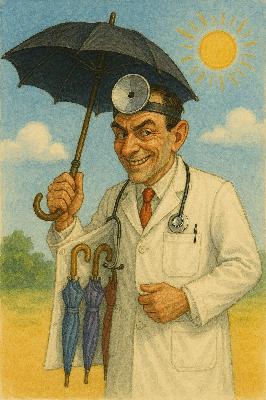
Imagine a weatherman who’s wrong 97% of the time he predicts rain. Picnics and ballgames canceled, flights rerouted, bikes garaged. Yet somehow, he has fans—devout ones—who revel in warning their neighbors about coming storms.“Stock up!” they cry, taping their windows.“Oh my! Thank you!” the neighbors reply.Worse, this weatherman also misses a third of real storms, sending his fans to the beach just as the cats and dogs start flying.Research Translation is 100% reader-supported. If you dig it please, consider becoming a paid subscriber. ThanksYou’d think such a record would end a career, not build a following. But imagine a town so terrified of rain that its citizens watch every forecast like scripture. When the skies stay clear, they’re not angry—they’re grateful. The weatherman’s vigilance, they believe, is a gift. Surely, one day, he’ll save their life.That town is the Western world. And cancer screening doctors are the weathermen.For decades, we’ve treated ‘early detection’ as gospel. Professional societies and public-health agencies extol it as lifesaving—despite the data. No cancer screening test has ever been proven to save lives, and virtually all are about as accurate as our hapless weatherman.The damage is not theoretical. Neuroblastoma screening in Japan, Germany, and Canada was abandoned after trials showed it harmed—sometimes killed—more children than it could ever save. Thyroid screening in Korea was halted when it led to a flood of false cancers and needless surgeries, with no drop in mortality. Even mammography, the most studied test in history, generates millions of extra lumpectomies and mastectomies, without extending women’s lives.People can still choose screening, of course, if they understand the trade-offs. The problem is, they rarely do. And it’s about to get worse.Headlines are now celebrating a new ‘multi-cancer early detection’ blood test. Funded and run by the manufacturer, the PATHFINDER-2 study is being trumpeted in press releases and medical conferences. Early detection, but earlier! Detect-ier!Incredibly, the researchers don’t even pretend their new test can save lives or help people. Instead they parade the test’s ability to detect more, and earlier. With any knowledge of the history of early detection, this is a breathtaking deceit. And it’s worse than it sounds, because the test missed 60% of the cancers it tested for. The reason most people submit to screening (with or without knowing the dangers) is their belief the test can catch cancers—this is the raison d’être for cancer screening. But the new test is WORSE than most standard screening tests. These numbers raise an obvious question: Did screening ever make sense? Does anyone truly believe, for instance, that detecting a lump on a mammogram instead of under a fingertip is the difference between life and death? For those who do, consider the findings from more than 600,000 women in randomized trials: It wasn’t.And yet, there is good news: Evolution beat us to it. The immune system runs a nonstop, exquisitely precise screening program, detecting and destroying mutated cells before they ever become disease. Immuno-surveillance, as it is known, is everything human technology isn’t: sensitive, specific, safe—and free. That includes both harms and costs.So be skeptical of the next miracle in ‘early detection’. The best screening technology ever invented is already inside you. And unlike its commercial counterparts, it doesn’t sell false alarms. Get full access to Research Translation at researchtranslation.substack.com/subscribe
On September 22nd the most important figures in US government and health performed a bit of research translation at a podium in the White House. That, of course, compelled a new issue of Research Translation. It’s all audio this time, folks, sorry to my dedicated readers but this one was too big to write. Enjoy!Research Translation is totally reader-supported . Maybe consider becoming a free or paid subscriber, so I can keep doing it. Get full access to Research Translation at researchtranslation.substack.com/subscribe
This week we saw something new: A president of the United States behind a podium, and flanked by the heads of the FDA, the Department of Health, and the NIH, and they were all doing research translation. Well that’s my job, dammit. So today we’ll do a prelude and prep session for our next episode, which will be a review and discussion of the six studies that underpinned that press conference. We’ll translate those studies so readers and listeners can decide for themselves. This week, however, we need to lay a little groundwork. So we’ll talk about an observational study just published in a major journal, a study that examined radiation doses in children due to medical imaging (primarily CAT scans) and their association with cancers like leukemia in the decade that follows.This is a blockbuster article, bound to become a standard bearer, the paper that governments and medical societies and other organizations will cite when they craft recommendations for how to approach medical imaging in children. But like all observational studies, this excellent study has critical attributes that should make us wonder whether CAT scans and cancers have virtually anything to do with each other. Which is why it’s a perfect foundation for next week’s episode. Tune in to the podcast, and get your weekly dose of Research Translation. Get full access to Research Translation at researchtranslation.substack.com/subscribe
Son, I’ve been avoiding this conversation. But it’s important. It will be difficult and I realize you don’t want to hear it, least of all from me. But there are things you have to know. Please try not to think of this as personal. It’s not about your thoughts or feelings. It’s about the future, how to make decisions, and how to understand our bodies and how they interact with the world. So, here goes.In March of 2020 the Covid pandemic hit hard. The virus was new, leading governments and companies around the world to work furiously on developing Covid vaccines. The most promising and effective were mRNA vaccines from Pfizer and Moderna, which completed clinical trials of 70,000 people by November of the same year. This was a jaw-dropping achievement, and both vaccines reduced infection rates by over 90%. The vaccines were quickly made available to everyone, and by June of 2021 more than half of the US was vaccinated. But there were many holdouts. People worried about the safety of a new technology pushed by government, and rushed to market by companies with long histories of unethical, profiteering behaviors. Then, in July, the Delta variant of Covid tore through the US, infecting vaccinated and unvaccinated people alike. So. . . did the vaccines work?Research Translation is 100% reader-supported. I’d like to keep doing it. If you dig, consider becoming a paid subscriber.The Delta variant extinguished any dreams of herd immunity, showing the vaccines didn’t protect well against Covid infection. Even so, they could still work. After all, humans deal with seasonal influenza and countless other viruses. What made Covid awful was its fatality rate. If the vaccine prevents the severest cases, most importantly deaths, Covid could become just another seasonal virus. So. . . did the vaccine at least do that? The two big mRNA randomized trials ran just 6 months each, which is frustratingly short. (Placebo participants were then given vaccine shots, so we don’t have trial data to know long term effects, good or bad). At 6 months, however, deaths were equal between groups: 31 vaccine, 30 placebo. And most of the deaths (29 vs 25) weren’t related to Covid.For the Pfizer trial, which reported 15 vs 14 deaths, FDA documents actually show 21 vs 17. But this includes the ‘crossover phase’ which came after 6 months. Some people therefore like to say deaths were “23% higher” in the vaccine group. While that’s numerically correct, it’s misleading since a) there was no statistical difference, and b) after 6 months most people in both groups were vaccinated. For the Moderna trial, deaths were 16 vs 16. These numbers don’t tell us much. Okay, yes, the vaccine trials didn’t find a life-saving benefit. But that could be because there weren’t enough deaths due to Covid (just 2 vaccine vs 5 placebo) among participants. Or maybe the vaccine doesn’t save lives overall. Maybe it prevents some Covid deaths but causes others, for instance due to sudden cardiac arrest or heart problems (the National Academy of Science looked, and couldn’t say yes or no). We may never know, both because the studies were cut off at 6 months and because Pfizer and Moderna, even today, refuse to make their data public. In any case, we should admit the obvious: It feels weird that, in trials done during the peak of Covid fatalities, people who got vaccinated died as often as people who got a placebo. That’s either an unfortunate and misleading anomaly (i.e. the trials were too small), or it’s an important signal of failure lost in the noise of politics and opinion.Meanwhile, many other studies have concluded the mRNA vaccines save lives. Sadly, they’re all hopelessly shitty. Excuse my French, but let us be honest and blunt: So-called ‘real-world’ data is neither real nor data. It is, at best, the plural of anecdote. The ragtag collection of studies making this claim all suffer from healthy user bias (in which people who choose to be vaccinated are predictably much healthier at baseline than people who choose not to get vaccinated, and therefore die less) and are easily challenged. This includes a devastating, if barely noticed, takedown in the pages of the New England Journal of Medicine. But, alas, even a naked moment of research verité doesn’t prove that ‘real-world’ study findings were wrong. It just means their data can’t answer the question. And in fact, on an ecological scale it’s likely the vaccines did save millions of lives. The timing of the pandemic’s last gasps—as vaccines phased in—and the statistically powerful finding that people who died of Covid were overwhelmingly unvaccinated, are both strong circumstantial arguments.But that is what they are, and we should be honest about it. We should be bashful when saying the vaccine ‘works’, and clear about the uncertainty. Particularly when data from the trials show roughly 1 in every 1,000 people experiences a serious harm from the vaccine, like appendicitis, myocarditis, gall bladder problems, and more. Therefore we must accept that it isn’t crazy, wrong, or conspiratorial to worry the vaccines may not save lives, or could be more harmful than helpful for some. Particularly now, when most people have natural immunity, which is as good as vaccine immunity. Therefore the decision to be vaccinated can be personal, not communal. For most people under the age of 30 the flu is more of a life-threat than Covid, and the Covid vaccines are way more likely to be harmful than helpful. For those 30 to 60 it’s close, but Covid may be worse than flu as their age rises. And over 60, Covid definitely is the bigger threat. Which explains why, for instance, most European countries only recommend Covid vaccination for the elderly—a reasonable, not insane, approach.Does the vaccine work? It depends. It probably won’t keep you from getting Covid, and if you’ve had the infection it’s likely redundant. But if you haven’t, or you’re getting along in years, it’s possible—though not definite—that it could reduce your chance of dying from Covid.So. . . son: Be honest and be true, and respect people. It’s their body, it’s their choice. Get full access to Research Translation at researchtranslation.substack.com/subscribe
Media, Substackers, and authorities are screaming bloody murder about the difference between new Covid vaccine guidelines posted by the American Academy of Pediatrics and guidelines from the CDC. For kids under two the AAP recommends the shot. The CDC says not so fast: discuss it with a doctor. Who’s right? Guidelines are written by panels that review the data, then make judgment calls. The only way to know if you agree is to understand the data. And to do that, we must first revisit a fated moment in Covid history. For the July 4th weekend in 2021, I was on Cape Cod with my kids. We were supposed to be safe from the virus. In the preceding months more than half the US population had been urgently vaccinated, and in a town full of LGBTQ+ people, artists, and self-styled intellectuals, it seemed almost certain the vaccination rate was way more than half. But the Delta variant hit Provincetown like a tornado, and vaccinated people everywhere got sick, including me. I briefly lost my sense of smell for the first time. But the world lost something else, permanently: the dream of herd immunity. Here’s why. The MMR vaccine prevents about 97% of measles infections, which is high enough that if 90% or more in a community get the shot, the measles virus has no inroad. While rare ‘breakthrough’ infections may occur, outbreaks are impossible. For the virus, every road is a dead end. That’s herd immunity.With a prevention rate of 95% in Covid vaccine trials, herd immunity seemed tantalizingly close. Then Provincetown happened. The Cape Cod outbreak signaled to the world that the virus would constantly mutate, and even vaccinated people would routinely be infected. In a single jubilant holiday weekend, the dream of herd immunity came and went like so many fireworks.But there was some good news: vaccinated people rarely died. Covid vaccination, it seemed, made death or serious illness extremely unlikely. Which is critical for decoding the vaccine’s benefits, and thus the guidelines. Now, to the data.The best data in kids comes from a vaccine trial of 4,526 children, a little less than half of whom were between 6 months and two years old. The actual focus of the trial was whether the kids developed Covid antibodies, which they mostly did, but importantly the researchers also reported the vaccine prevented 76% of Covid cases. Unfortunately, this estimate was based on just 4 illnesses in the vaccine group and 8 in the placebo group, or 1% vs 5%, respectively. That is weak data, and a useful reminder: even in a 2021 trial from the heart of the pandemic, kids get sick with Covid less than adults and experience less severe illness. But remember what we said. The benefit of the vaccine is not in preventing illness—vaccinated kids will still get sick—it’s prevention of serious illness. Which raises an obvious question: how often do young kids become seriously ill with Covid? In other words, how common is the problem the vaccine aims to prevent?It's rare. The CDC estimates 1 in every 2000 young children in the U.S. was hospitalized with Covid in 2025. While that is a surprisingly large number (suggesting about 3,500 children hospitalized), it’s also seven times lower than the corresponding number for adults. Moreover, less than half of the hospital stays were for "severe Covid", in which a child received ICU care, oxygen, or other Covid treatments. Indeed, more than half the kids were home in less than two days, suggesting the admission was, at worst, precautionary. But, in theory, vaccination could prevent 76% of those hospitalizations by preventing the initial infection, which would mean 1 in every 2,632 vaccinated kids in the U.S. avoids hospitalization because of the vaccine. Next we have to quantify the vaccine’s harms, but the data is even sparser. The Pfizer trial of young children reports “severe reactions” in 0.3% (1 in 333), but these were fevers, irritability, and loss of appetite, usually for a few days or less. It takes larger datasets, like the 67,000-person original Pfizer and Moderna trials, to find major harms. The best report on harms from those two trials found roughly 1 in 800 people experienced serious illness due to the vaccines. Unfortunately, current data can’t tell us whether children are more or less harmed than adults, so we’re left to apply adult harm data to kids.In aggregate, then, a best-case estimate for the vaccine suggests about 0.038% (1/2,632) could benefit by avoiding hospitalization, while 0.125% (1 in 800) would be harmed by a life-threatening or serious illness. Based on these numbers harms are three times more common than benefits.There you have it! Sort of.Now take a moment to consider how many judgment calls it took to generate these calculations. To estimate benefits I selected the most flattering possible study, extrapolated tiny numbers to the rest of the world (4 vs 8 kids!), and then accepted a dubious, almost certainly inflated, CDC estimate of hospitalization rates. For harms I ignored all transient ‘reactions’, and was forced to apply adult data to children.Clearly, there’s room for judgment. It becomes easier to see how two expert panels might differ. If you believe vaccines are under-appreciated and very safe for kids (read: if you’re the AAP), you might conclude the serious harms from the vaccine are likely much less common in kids than in adults. Which could shift the recommendation because even a tiny benefit, or potential benefit, would be bigger and more common than a serious harm.If you’re a Covid vaccine skeptic, or a pharmaceutical company skeptic, (read: if you’re RFKjr) and you believe Pfizer’s reported benefits and the CDC’s rates of hospitalization are likely exaggerated, you might conclude harms are probably way more common and more serious than any benefits.But if you explained all that you’d be admitting that opinion has affected your recommendations. Neither the AAP nor the CDC seems prepared to do that.But they should. Then, the ‘science’ would be evident, and accessible to all, and the judgment would be transparent. And people could use their own values to make decisions about the vaccine. Imagine that. Get full access to Research Translation at researchtranslation.substack.com/subscribe
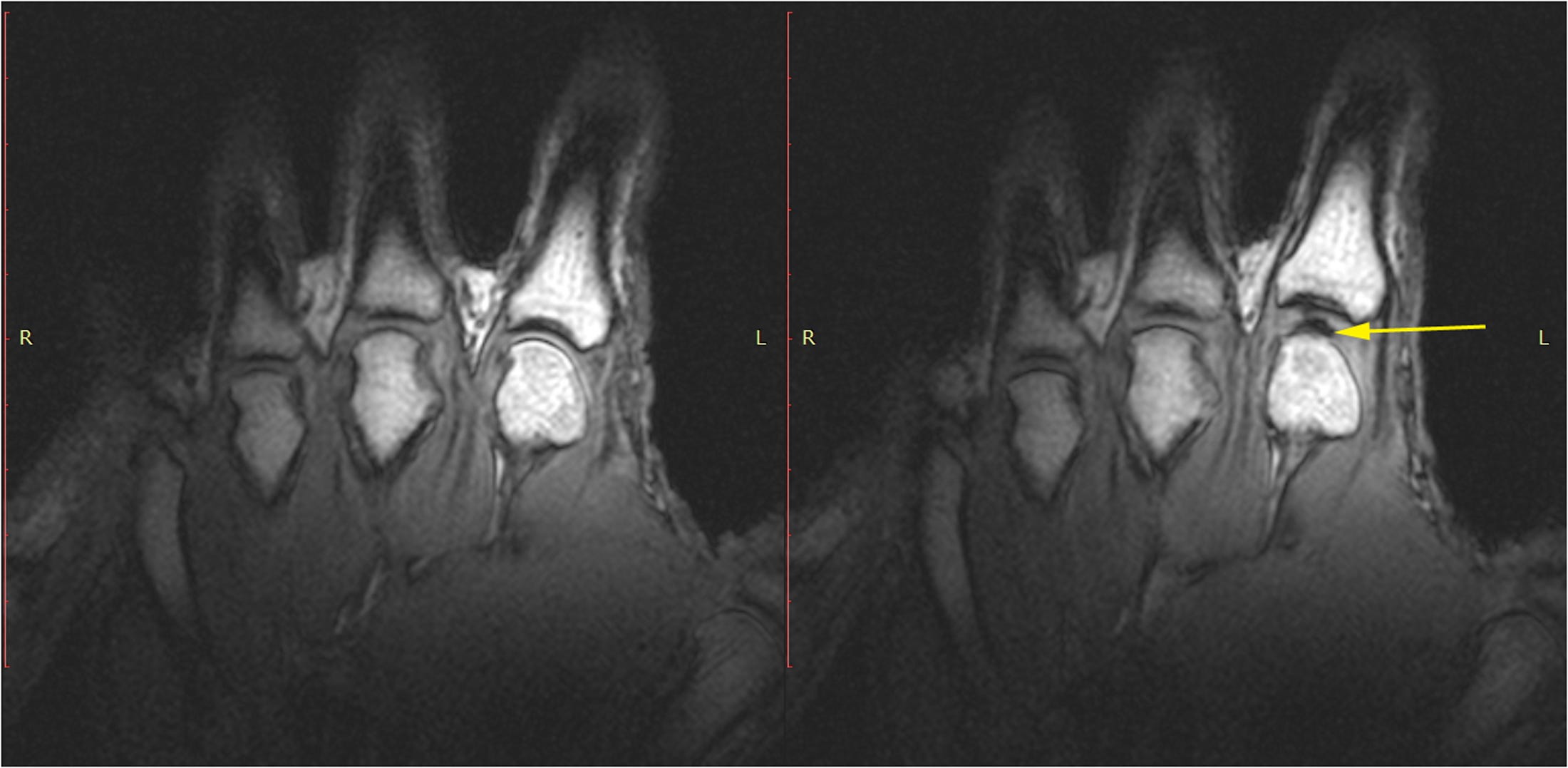
In case you were wondering: After you crack a knuckle it’s about 20 minutes before you can crack it again. This was established by a series of experiments in 1947 at a research hospital in London. According to the researchers, “the minimum time was 17 minutes… but never more than 22.”Eureka!This may seem like menial work, but efforts to understand knuckle cracking pepper more than a hundred years of scientific literature, and continued into the 2000s. Then, in 2015, Canadian researchers watched knuckles cracking on MRI and were able to document ‘cavitation’, bubbles that pop open to fill space where a knuckle joint is stretched. Soon after, mathematical work confirmed those tiny bubbles can fully account for the impressive sound of a knuckle crack. Research Translation is, like, totally, reader supported. Like, totally. Please, like, consider becoming a paid subscriber.The modern quest to explain knuckle cracking is a useful reminder that, even today, physicians stand on a tiny island of knowledge, surrounded by a nearly endless sea of unknowns. Until just recently, that sea included knuckle cracking. But the single greatest unknown remains. That, ironically, is the great repository of knowledge itself, the human brain. How it works and what’s happening in it is the holy grail of unknowns. One reflection of our ignorance about the brain is the DSM-V, a book that defines and classifies mental illness. It is an important and broadly helpful book that codifies a universal language for psychiatry. But name any condition in it, and you’ve spoken a word with absolutely no anatomic or physiologic explanation. Depression? Don’t know where it is, don’t know what it is, don’t know how it happens. Schizophrenia? OCD? Bipolar? Addiction? Same. This means there is not one pill, procedure, or treatment for mental illness that targets the underlying problem, a fact that makes psychiatry special in modern medicine. The biomedical model—identifying pathology at the anatomic or cellular level, then curing or improving it—simply does not apply.Which may be one reason why a Nobel Prize was awarded in 1949 for the advent of the frontal lobotomy, a procedure for psychiatric patients in which an ice pick-like instrument was inserted through the forehead or eye socket, into the brain. The tip then pierced, and irreversibly damaged, the frontal lobe. This often led to a permanent loss of personality, lifelong apathy and listlessness. Even some of the procedure’s proponents referred to it as 'soul surgery’.Today, frontal lobotomy is broadly recognized as unethical, and largely banned. But it arose from the hubris of scientists who believed so firmly in the power of their small island that they ignored the sea around them. Despite knowing nothing of the underlying disease or the inner workings of the brain, they developed a ‘treatment’ designed to permanently alter brain anatomy and physiology. It is a very different approach to medical treatment than the biomedical model, and it is one to avoid.Incredibly, to this day, the Nobel Prize website defends the 1949 award, saying “at that time there were no other alternatives!” This is flagrantly untrue, and betrays a profound misunderstanding of psychiatric treatment. While antipsychotic drugs were not yet available, there were many alternatives to lobotomy. Options like talk and group therapy, institutionalization, safety measures in periods of danger, assisted living, social support and guidance, and more, are crucial measures that still help psychiatric patients every day, and through periods of crisis.Yet the Nobel language implies that like lobotomy, drugs are somehow uniquely directed at the underlying problem in psychiatric illness. In reality, they are no more targeted than a rubber room.To be clear, for many people psychiatric drugs are a godsend, making life livable, safe, and productive. But while they may change thinking and behavior, they don’t even attempt to correct the underlying condition. Like lobotomy, they simply go into the brain and muck around.Confusion on this point is intentional. For decades pharmaceutical campaigns used the misleading phrase ‘chemical imbalance’ to describe mental illnesses, as if this is a part of any known pathology. It is not. But that did not stop the makers of dopamine blocking drugs from advancing the theory that ‘overactive’ dopamine causes schizophrenia. Nor did it stop advocates of the ‘monoamine theory’, who suggested neurotransmitter imbalances caused mood disorders and monoamine drugs could fix them. And then came the greatest bamboozle of all, the idea that serotonin deficiency causes depression, which made serotonin drugs among the most prescribed in the world. But the joke’s on us. Today, the serotonin theory is thoroughly debunked, but serotonin drug sales continue to soar. The illustration below, from the current website of a high profile research lab, is typical. It is based entirely on an advertising campaign, and has no basis in scientific fact.Obviously, serotonin drugs don’t target any known disease. And yet they are commonly used not just for depression, but for anxiety, OCD, phobias, bulimia, premature ejaculation, PMS, fibromyalgia, irritable bowel syndrome, sleep, pain, and more. Why else would they be prescribed for such a mind-boggling array of conditions? As one of my instructors in med school used to say: a drug that works for everything, doesn’t work for anything.Again, some psychiatric drugs can be life saving (not the serotonin ones—mostly lithium and the antipsychotics), and there are many who need them to function. But if we’re being careful with our terminology ‘psychiatric drugs’ are not psychiatric. Like lobotomy, they simply have effects in the brain. Some may be desirable, others may not.To be fair, using a pill to treat a symptom, rather than cure a disease, is common. Ibuprofen for a headache is one example. But when people and their families agree to long term medicines for mental health, they and their families often believe the pills are specific to their illness, or at least based on knowledge of the underlying problem. That belief is buttressed by white coats, framed degrees on the wall, and misleading illustrations like the one above. For safety, island dwellers must respect the sea. To avoid disasters like bloodletting and frontal lobotomy we must recognize and acknowledge what we do not know. Get full access to Research Translation at researchtranslation.substack.com/subscribe
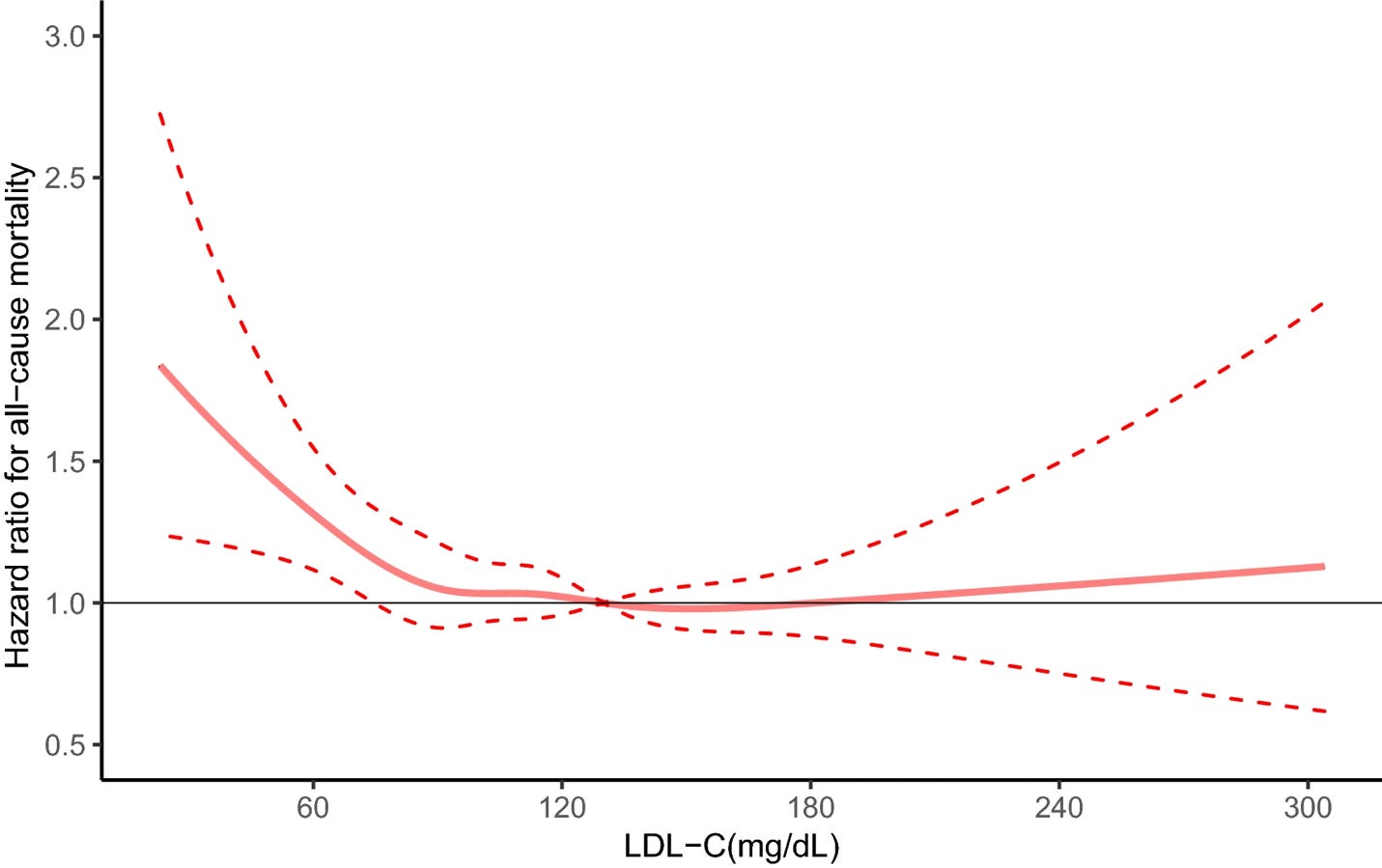
This week I've opted for a slightly longer format, which I sometimes like to do—we'll be back to normal next time. Enjoy. On Friday December 13th, 1799, President George Washington was in a chipper mood. He sat by the fire talking politics with Martha and Tobias Lear, his secretary. At age 67, two years after his presidency, Washington was still America’s most popular public figure. Robustly healthy, he had spent the afternoon on his Mount Vernon estate marking trees through a snowfall. Now, however, he mentioned a sore throat that had been dogging him for days. Lear noted the President was hoarse, and suggested medicine. Forever the stoic soldier, Washington declined. “Let it go as it came," he said.Among medical historians the infection that ended Washington’s life the next day is a subject of debate. All agree, however, on the nature of his care. The physicians who worked furiously at his side were highly trained, deeply concerned—and fully culpable.In the early morning hours Martha woke to find the President in pain and short of breath. Washington insisted she wait til light to summon help, lest she be exposed to the night air. At sunrise Martha notified Lear, and messengers were dispatched for James Craik, a local physician and dear friend. While awaiting Craik’s arrival Washington summoned the overseer of the estate, Albin Rawlins, to perform a bleeding. Bloodletting, to remove toxins and restore balance, was routine in such illnesses. Rawlins incised a vein in the President’s inner forearm, and 14 ounces of blood flowed. Martha, suspicious of bloodletting, voiced her discomfort. But Washington encouraged it. "Don't be afraid. The orifice is not large enough. More, more."Dr. James Craik, who fought at Washington’s side in the Revolutionary War, arrived late in the morning. Craik was a former Physician General, similar to today’s Surgeon General, and attended the University of Edinburgh in Scotland, widely considered the world’s most respected training ground. The President had recently convinced Craik to move his practice nearby, and he arrived to find Washington with severe throat swelling and a fever. Craik began treatment with a blister of Cantharides on the President’s neck. The powdered beetle preparation was intended to purge toxins by raising a blister on the skin, which it did.Washington’s condition, however, worsened. Craik performed the morning’s second bleeding. This time he drained 20 ounces, again from the General’s arm.As noonday passed the President’s breathing became labored. Attempts to swallow, including a concoction of molasses, vinegar, and butter, resulted in violent coughing spasms. The President’s throat appeared to be closing. Craik administered doses of calomel and tartar rectally. Calomel, a mercury-based pesticide, functioned as a purgative to stimulate bowel evacuation. Tartar, another common pesticide, produced vomiting. Both were believed to remove toxins. The president moved his bowels and retched. But he did not improve.Concerned, Craik bled him again, for 20 more ounces.In the late afternoon Dr.'s Elisha Cullen Dick and Gustavus Brown arrived to find Washington gravely ill and barely able to speak. Dick was a prominent young doctor who had earned his degree from the University of Pennsylvania. Dr. Brown, a lifelong friend of the President and Surgeon General of the Continental Army in the Revolution, had also trained at Edinburgh. After conferring, the physicians reached a consensus and acted.They spilled 40 more ounces of the president's blood, for a total of 94. So far.The first president of the United States, a young country’s most beloved figure, was slipping away. The three physicians conferred again and quickened their pace. Blisters on the arms, inhaled vapors, cataplasms (a form of compress) for the skin, more purgatives. Nothing was helping, and Washington’s throat was now almost fully occluded.The doctors were frantic, but the President was not. According to Tobias Lear, the great general asked them to cease their efforts. “I thank you for your attentions, but I pray you take no more troubles about me” he whispered. “Let me go off quietly.”Dr. Dick, the youngest and brashest of the three, suggested they perforate Washington’s trachea. It was a last resort and Dick understood the implications, offering to take responsibility for any untoward outcome. Surgically opening an airway—tracheostomy—was new. Twenty-five years later the French surgeon Armand Trousseau would use the technique to save children suffocating from diphtheria, allowing them to survive an infection whose only fatal mechanism was airway closure. Dr. Dick felt asphyxiation was the President’s greatest threat. Still, tracheostomy was experimental and new. The older physicians would not assent.Instead, they offered a final effort: 32 more ounces of presidential blood.Just after 10pm the President spoke his final words, “‘Tis well”, and checked his own pulse. As one witness recalled “With surprising self-possession he prepared to die. Composing his form at length and folding his arms on his bosom, without a sigh, without a groan, the Father of his Country died. “**********To the modern mind, the events of Washington’s death are unfathomable. Basic principles of medicine and common sense seem grievously violated. But all three of Washington’s physicians trained at leading universities, and had the purest of intentions. Two were close friends and all were aware of the President’s god-like status. Yet incredibly, they took a gallon of his blood. Even for a man of the President’s stature (over 6 feet, more than 200 lbs.) this was nearly two thirds his total blood volume.Could it be the importance of human blood was unknown in 1799? More than a century earlier William Harvey elucidated the mechanics of a beating heart, and the blood it propels. And despite a confused understanding, blood was known to be necessary for survival. Two of Washington’s doctors were battlefield surgeons who had witnessed, and attempted to stanch, mortal blood loss. What, then, explains the quasi-assassination?Experiential delusion and ideologic gumption.For Hippocrates the delusion of experience plagued the practice of medicine, which he called 'the Art'. In his best-known aphorism Hippocrates wrote, “Life is short, the Art is long, opportunity fleeting, experience delusive, judgment difficult.” With bloodletting, the delusion was powerful. Even in the 18th century, while bloodletting harmed the chance of survival (as controlled experiments later showed) most people still recovered soon after, creating the illusion of effectiveness.And Dr.’s Craik, Brown, and Dick were accomplished bleeders. With years of practice and thousands of anecdotes, all three were fully deluded. Of course, none subjected their knowledge to rigorous testing. None compared notes with physicians who did not use bleeding. And none conducted—or had likely ever heard of—a randomized trial.Experiential delusion can be all-consuming. But a second, equally powerful trap was in play at Mount Vernon. In 1799 the Humoral Theory of illness was the prevailing ideology at top medical schools and universities. A vestige of the ancient Greeks' four humors (blood, phlegm, yellow bile, black bile) the theory centered on toxins and a belief in 'balance'. To heal, doctors were taught to restore balance by removing toxins. Dr. Craik began with a blister of Cantharides which created a skin eruption, a visual sign that evil toxins were erupting forth. The tartar and calomel, designed to wreak intestinal havoc by inducing diarrhea and vomiting, provided two more routes of egress for toxins. Indeed, all the methods used on the president—cataplasms, vapors, purgatives, suppositories, blisters, salves, and bleedings—were for purging toxins.Washington’s doctors stuck to the ideological script they were given. Neither their experiences in war, nor recent papers challenging bloodletting, not even their friend’s death spiral, could make them deviate from their faith. When bloodletting made Washington worse, they doubled down. Even for honest, rational men, ideologic gumption overwhelmed both the sciences and the senses.Experiential delusion eschews scientific method and handicaps reasoning, teaching the opposite of truth. Ideologic gumption consecrates the delusion, closing the mind's eye, and setting a fixed, inalterable path. Together, the traps are a prison of wrongheadedness.Which leads to an inevitable question: If the most experienced, best trained, brightest physicians of the day, using the most advanced theories and therapies, hastened the death of their friend, what of today? In the science-soaked 21st century are we fooled by experiential delusion? Do we suffer from ideologic gumption?You bet.A hundred years from now scientists will shake their heads at us. Our theories will seem primitive and our methods feeble. And for many of our errors the evidence is here, now, staring us in the face.Today's cardiologic version of the Humoral Theory, for instance, is the Lipid Hypothesis, suggesting cholesterol is the primary cause of heart disease. First debunked by findings from the Framingham study in 1987, the Lipid Hypothesis was birthed, ironically, by earlier results in the same study. In 1961, preliminary papers from the project explored cholesterol as a potential risk factor for early death. But over time the already tenuous connection waned further, even as risk factors like high blood pressure, smoking, and diabetes grew more robust. By 30 years of follow-up low cholesterol was associated with early death, not high. Other than men under 50 with exceedingly high levels (e.g. those caused by rare conditions like familial hypercholesterolemia) 'high' cholesterol was meaningless.Many modern, arguably more rigorous studies have confirmed the final Framingham findings, and they often include figures like the one below, plotting mortality against cholesterol levels.The solid pink l
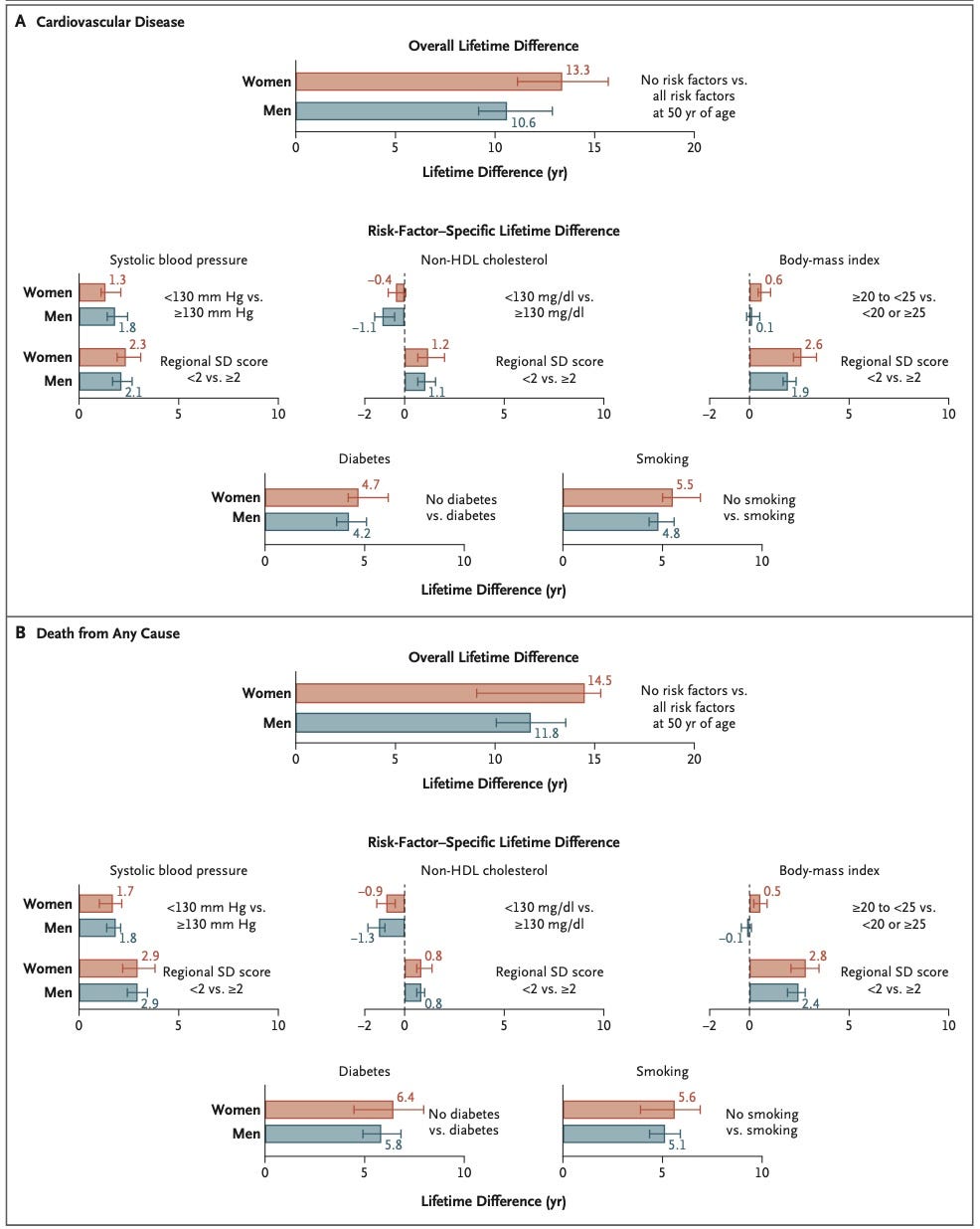
I learned years ago that people’s beliefs about medical care are often religious. That is, they’re built on faith, not evidence. That’s not always a bad thing. Faith in the patient-doctor relationship can, quite literally, lead to physical and biological healing. Extensive data proves it.But using faith in the absence of good data is more often harmful than helpful. One historical example is bloodletting, a treatment used for hundreds of years without data. A more modern example is Paxlovid, a Covid drug that never worked but was hailed and touted based largely on faith and hope. The fact that it’s still used, even after it failed in every relevant trial, is testament to the stickiness of faith.Last week the New England Journal of Medicine, however, published a faith-busting article, a study I alluded to in May just after it was pre-released online. The faith under siege in the new paper is Cholesterolism. The Cholesterolites are a proud missionary people, with strong traditions of vehemence and certitude. But do they seek the truth? We’ll find out, as the findings from this new study sink in. It is the largest ever examination of the classic risk factors for heart disease and death, combining 133 study cohorts from 39 countries around the world, and representing just over 2 million participants. Established in the mid-20th century, the five classic modifiable risk factors are high blood pressure, smoking, high cholesterol, diabetes, and obesity. Each study interviewed and examined participants at the outset and periodically, drawing blood for testing, and following them for years. In many cases the follow-up lasted decades, with one study extending for nearly 50 years.All of which means there is unlikely to ever be a paper more reliable or more valid for estimating the general importance and impact of the individual classic risk factors for heart disease and death. Which is why it will be difficult for truth-seeking Cholesterolites to stay in the fold. Below are the two figures from the study that estimate the impact of each individual risk factor, and all of them combined. At the top of each panel is the impact of all five, i.e. of being an obese, diabetic, smoker, with high blood pressure and high cholesterol. Below are the individual risk factors. Impact is measured in years of heart disease added (top panel) and years of life lost (bottom panel). What is obvious, and jarring, is that only one of the five factors consistently has either zero impact, or even a negative impact. While diabetes and smoking are by far the most powerful, taking 5-6 years of life each, high blood pressure takes roughly two years. Obesity is more equivocal, but at extremes can represent up to three years of life lost. Meanwhile, high cholesterol stands alone as the only classic ‘risk factor’ on the wrong side of the ledger, appearing to ADD YEARS OF LIFE. This is, to be frank, no surprise for those versed in cholesterol study data. This is not new. What’s new is its publication in one of the worlds best known journals and its pedigree, arising from the largest and most rigorous dataset in history. These findings cannot be denied or swept under the rug. Why is it so important? Because for years the medical community has been playing a Cholesterol Charade, pretending not to notice findings that are fundamentally inconsistent with the notion of cholesterol as a risk factor. To find therapies for preventing or treating heart disease, data must first establish an association with heart disease and death. When found, studies can then attempt to treat or modify that risk factor. If it can be modified, studies must then show it saves lives to do so. That is how high blood pressure became a proven, effective target: Elevated BP was consistently associated with heart disease and death. Studies then showed it could be lowered with medicine, and later studies showed doing so saved lives. First comes the association, then the treatment, then the proof of effect. In the case of cholesterol the first link in the chain has been absent all along. Which explains why and how lowering cholesterol could never be an effective path to preventing heart disease or prolonging life. And why the statins, and other cholesterol-lowering drugs, have failed so miserably.The sect of Cholesterolites is doomed to extinction. It may take years or even decades, but history will shake its head at the strange blind spot we developed for cholesterol and its role in heart disease. ****For a more in depth look at the study, and its context in the history of cholesterol data, listen to today's audio and definitely check out the written or audio version of my prior post, The Cholesterol Charade: How Statins Debunked the Lipid Hypothesis. Get full access to Research Translation at researchtranslation.substack.com/subscribe

Comments

Download from Google Play

Download from App Store
 United States