


 Claim Ownership
 GUTTER STUDIES
GUTTER STUDIESSubscribed: 2Played: 9
Subscribe

© Tom
Description
This is the audio feed for Gutter Studies: a video-essay project exploring the pleasure, history, and meaning of low cinema.
gutterstudies.substack.com
gutterstudies.substack.com
29 Episodes
Reverse

This one took a while.This is part Three of my continuing series on Carol Clover’s Men, Women, and Chainsaws. And while it follows naturally from the first two installments, it stands completely on its own — you don’t need to have watched the first two videos to watch and understand this one.The subject is rape-revenge cinema. It’s a controversial and challenging genre, to say the least—dismissed as garbage, celebrated as radical feminism, and analyzed as some of the most ideologically complex filmmaking in American cinema history. As we’ll see, it’s all three at once.To get here, I watched and revisited around twenty films. The full canon, more or less, plus the films that shaped and surrounded it.What looks like vile garbage on the surface turns out to be a revenge myth in the most political sense — a story that American culture tells itself to process guilt, justify winners, and make peace with losers. And its roots run from frontier westerns all the way through to #MeToo. Get full access to GUTTER STUDIES at gutterstudies.substack.com/subscribe

This is one of the last videos I’ve had in the vault from my Youtube days. It started as a silly idea for a kind of audacious clickbait project. I didn’t realize how wildly time-consuming it’d end up being. And it was kind of a maddening project too. Many times along the way, I felt uncomfortably deranged for even attempting such an obscene exercise. But it ended up being good practice for me as a video editor, since it involved wrangling and sequencing a huge number of clips in specific order. I can’t say I’m necessarily proud of making this. But I did make it, so here it is for your sick enjoyment. Get full access to GUTTER STUDIES at gutterstudies.substack.com/subscribe
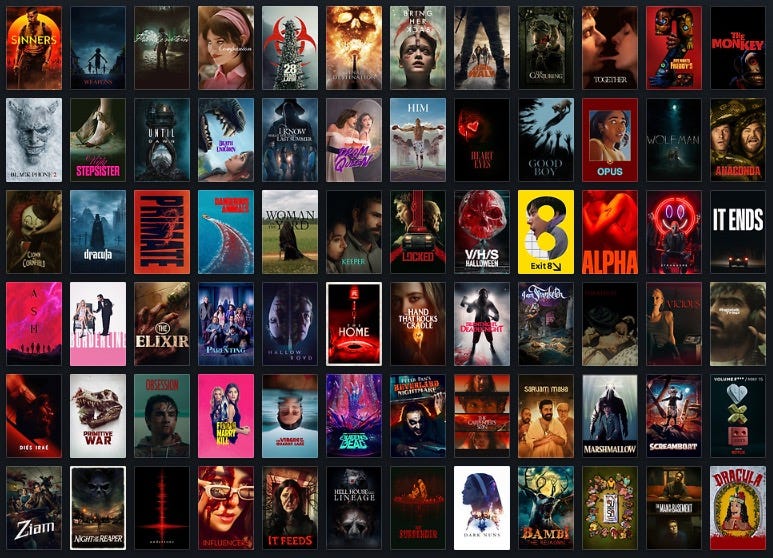
In this audio-only episode, I’m joined again by Cynthia to count down the best horror movies of 2025. The conversation is 100% spoiler free—and I think also free of pretentious jargon! WDYT - was 2024 or 2025 a better year for horror? Many are asking. Get full access to GUTTER STUDIES at gutterstudies.substack.com/subscribe

This is part two of my investigation into Japanese nunsploitation. Building on the foundation built in part one—which featured a brief history of pink film and a close reading of School of the Holy Beast, the foundational Japanese nunsploitation film—this video explores six additional pink nunsploitation films. The video also provides additional discussion on the role of censorship in generating pink film aesthetics, and in the end sums the project up with a comprehensive conclusion.In many ways, I see it as a certain culmination of all my work on nunsploitation over the past few years. Six months ago I somewhat reluctantly undertook this project because I knew my study would always be incomplete without addressing the Japanese school. To my own surprise, in the end I landed on an interpretation applicable not only to Japanese nunsploitation, but the wider nunsploitation genre too, and one that aligns precisely with my big-picture theory of exploitation film.Timestamps 0:00 - introduction0: 48 - the role of censorship in pink film history and aesthetics; Day-Dream (1964); Black Snow (1965)5:37 - Cloistered Nun: Runa’s Confession (1976)9:21 - “ama” versus “shudojo”; Nuns that Bite (1977); Virgin Witness (1966) 14:10 - Sins of Sister Lucia (1978) 15:25 - Nun’s Diary: Confession (1979)19:00 - Nun’s Story: Frustration in Black (1980)21:11 - Nun in Rope Hell (1984)23:45 - conclusion: understanding the specifically Japanese meaning of nunsploitation In all likelihood this will be my final video on nunsploitation. Across five videos and a total runtime of almost two hours, I feel I’ve said what I have to say. I hope this one is a fitting conclusion! If you’ve enjoyed my work on nunsploitation, please consider signing up with your email, making a donation, and telling others about the project.GUTTER STUDIES is a reader-supported publication. To receive new posts and support my work, consider becoming a free or paid subscriber. Get full access to GUTTER STUDIES at gutterstudies.substack.com/subscribe

This is part two of a video series analyzing Carol J. Clover’s Men, Women, and Chainsaws: Gender in the Modern Horror Film. You can catch up on part one here, or you can jump right into this one.Part one focused on Clover’s classic reading of the slasher film and her coining of the term Final Girl. Part two explores so-called “occult horror,” which includes ghosts, demonic possession, black magic, and the like. Clover’s take on occult horror is a useful complement to her analysis of slasher films, exploring the way male-driven arcs reflect the same underlying tendency we see in the female-driven spectacle of slasher films. These two currents defined horror movies in the 1970s and 80s, and Clover argues that both draw on the same underlying anxiety: an unconscious fear the two sexes are one. 0:00 - introduction1:45 - Don’t Look Now (dir. Nicolas Roeg 1973)2:32 - white science and black magic3:27 - the too-open female vs. the too-closed male4:40 - sex in slasher films vs. reproduction in occult horror films5:54 - The Exorcist (dir. William Friedkin 1973)7:20 - Witchboard (dir. Kevin Tenney 1986)9:44 - Possession (dir. Andrzej Żuławski 1981)10:40 - summary and critique of Carol Clover’s analysis14:08 - conclusion - slashers comparedI started this project a while back now, and do plan on finishing it out with two more installments. For a change of pace, the next installment will focus on Clover’s chapter on rape revenge films. You can expect a content warning! Get full access to GUTTER STUDIES at gutterstudies.substack.com/subscribe

I’m proud to give you the first in a two-part video series covering Japanese nunsploitation film. This first video provides a thorough introduction to the wild and perverse world of pinku eiga, providing key context we’ll need to even begin to understand strange, surprising phenomenon of Japanese nunsploitation. The second half of the video then proceeds to a close reading of the foundational classic School of the Holy Beast (1974).This video has been a long time coming. When I first took up my research and writing on nunsploitation film, I knew I’d need to tackle the Japanese school eventually. What’s unbelievable about Japan’s nunsploitation cinema is that it’s second only to Italy in terms of the number of features produced in the 1970s and 80s, but also how closely Japanese nunsploitation movies resemble their western counterpart. It’s always been fairly obvious why nunsploitation flourished in Roman Catholic markets like Italy and Latin America, but why in Japan?This is a difficult question to answer, and most of the sources I consulted did not give me a satisfying answer. Most commentators acknowledge that it’s a bit puzzling, but usually these remarks end in a shrug. My goal with these videos was to consider the question of Japanese nunsploitation closely, and to provide an account that pulls together the historical, cultural, and aesthetic dimensions at play.But here is where I’ll issue my obligatory disclaimer. I’m far from an expert on pink film, and I can only begin to understand Japanese culture and history as an outsider. My investigation into this world has led me far outside of my comfort zone, and has required even deeper research than usual. Prior to undertaking work on this video, I was almost completely unfamiliar with pink film and only casually acquainted with Japanese pop culture here and there.I’ve tried my best to rely on reputable and intelligent sources in forming my understanding. On a practical level, these sources are from western (English-speaking) academics and writers who have spent significant time studying or living in Japan. I attempted to find Japanese commentators, but I was unable to find much. (There’s little serious writing on these films to begin with, let alone in English!) These are the main books and articles I consulted: Behind the Pink Curtain: The Complete History of Japanese Sex Cinema by Jasper SharpPink samurai : love, marriage & sex in contemporary Japan by Nicholas BornoffJapanese Cinema Encyclopedia: The Sex Films by Thomas Weisser and Yuko Mihara WeisserEros in Hell: Sex, Blood, and Madness in Japanese Cinema by Jack Hunter“The prerogative of confusion: pink film and the eroticization of pain, flux and disorientation” in Screen (vol. 60 issue 1) by Alexander ZahltenBut it’s inevitable that I’ll be less than perfect in my analysis. Some of this is my take, informed I hope, and reasonable genre observers may disagree on some of the finer points. It’s also perfectly possible that I’ll get things wrong about Japanese culture, religion, or history. If I do, I hope you’ll be generous in offering corrections. Where appropriate, I’d be happy to add errata notes on this post. Timestamps: 0:00 - nunsploitation cinema in the context of post-war religious life in Japan 2:25 - where did Japanese nunsploitation film come from?3:53 - pink film history: 1960s origins, Nikkatsu “roman porno”, and Toei “pinky violence”9:46 - emergence of pink nunsploitation10:16 - School of the Holy Beast aka The Transgressor (1974 dir. Norifumi Suzuki) 19:22 - pink theaters and the modernization of Japanese religious identityPart two will provide an even deeper dive, exploring five more Japanese nunsploitation films and concluding with an analysis of how nunsploitation relates to the wider picture of pink film and Japanese cultural aesthetics. Thanks for reading GUTTER STUDIES! This post is public so feel free to share it. Get full access to GUTTER STUDIES at gutterstudies.substack.com/subscribe

This is video takes a close look at the nunsploitation work of Italian trash-cinema legend Bruno Mattei. Filmed at the same time, with the same cast, and the same set, these two movies provide a useful contrast when it comes to the variations on nunsploitation. Both are atmospheric and provocative in their own way; one offers psychologically complex and cerebral sexploitation; the other is a full-on unhinged Italian horror. Viewing them together also provides an amusing window into the sausage-making of Italian exploitation film.My previous video on nunsploitation provided an overview of four films that I thought represented the best of the genre. I still think that the geographic and chronological structure of that video provides a thorough picture. But since making that video, I realized that Mattei’s True Story absolutely needs to be part of that category. Other than The Devils, this one has become for me the epitome of the genre.I don’t think that’s necessarily a common take. If you have a chance to watch this one, I’d like to know what you think. Get full access to GUTTER STUDIES at gutterstudies.substack.com/subscribe

Russ Meyer once claimed that his films dealt in female archetypes that went “beyond women.” This video attempts to understand what he meant by that.I’m reposting this one from the Gutter Studies vault in honor of Tura Satana’s birthday last week. Tura is best remembered today as the star of Faster Pussycat, and she remains an icon in exploitation film history.This was actually the very first video essay I did as part of the Gutter Studies project. I’ve taken the opportunity to clean it up a bit, but it’s overall the same video. I’d love to do more videos on Russ Meyer. He was definitely my gateway to exploitation film, and I’ve seen just about every one of his movies. Let me know in comments, email, messages if you’d like to see more Russ Meyer on here. In particular, I’d love to do a deep dive on his roughie masterpiece Lorna (1964) and to revisit his big-budget Beyond the Valley of the Dolls (1970). Looking back, he didn’t always have the most consistent career, but when he was interesting he was interesting.In the meantime, check out my Letterboxd list: Lust and Profit: Russ Meyer ranked.SourcesDean DeFino - Faster, Pussycat! Kill! Kill! (Cultographies) Jimmy McDonough - Big Bosoms and Square Jaws: The Biography of Russ Meyer, King of the Sex Film Get full access to GUTTER STUDIES at gutterstudies.substack.com/subscribe

I’m happy to post the final chapter of my continuing series on Jean Rollin. This segment is about what became of Rollin’s career following the fallout of The Living Dead Girl, and how is final stretch of movies were organized around themes of nostalgia and self-referential pastiche. I argue that in Rollin’s career, we can see a clear passage between two cultural epochs: from the modernism of his experimental early work, to the funereal postmodernism of his late films.0:00 - Freud’s distinction between mourning and melancholia2:51 - Streets of Bangkok4:22 - Lost in New York7:06 - Fredric Jameson’s theory of postmodernism and the significance of nostalgia9:53 - self-reference in Killing Car, Two Orphan Vampires, and Dracula’s Fiance 11:02 - Night of the Clocks13:22 - conclusionIf you’ve made it this far, I want to say thank you. This has been my most challenging project so far, but it’s also turned out to be some of my proudest work. I hope that the series contributes to the broader conversation on Jean Rollin, both by helping new viewers approach Rollin’s work for the first time, and perhaps to enable new meanings for seasoned fans.If you enjoyed the series, please consider making a donation and sharing the series with others. A project like this depends entirely on word of mouth, so please help put it in the fans of Jean Rollin fans everywhere.As for what’s next: I have a few straggler videos that I’ve been wanting to finish, including more nunsploitation, as well as a return to Carol Clover’s Men, Women, and Chainsaws.Longer-term, I want to do videos on Hellraiser, Jess Franco, Joseph Sarno, Nazisploitation, Paul Naschy, Lucio Fulci…and much more. If there’s anything in particular you’d like to see, don’t hesitate to reach out and let me know via email or Instagram. Get full access to GUTTER STUDIES at gutterstudies.substack.com/subscribe

Jean Rollin’s early work featured repeated imagery of renegade female pairings and doppelgängers. In those films, like Shiver of the Vampires and Requiem for a Vampire, the motif was employed as a surrealist technique for communicating fairytale wistfulness, imperiled innocence, and a sense of the uncanny.But in his more mature work, Rollin explored a series of female relationships—including sexual, circumstantial, and sisterly variations—to represent some of his deepest themes. As we can see in these three films, Rollin saw female intimacy as the privileged vehicle for the way we achieve death-like transcendence in other people, a transgressive form of connection that burns so hot that it erases the boundary between self and other, thus verging on the experience of death. Timestamps0:00 - introduction 0:52 - Fascination (1979)6:58 - Zombie Lake (1981)9:27 - The Escapees (1981)16:43 - The Living Dead Girl (1982)This is the penultimate chapter of our study on Jean Rollin. You can catch up on the entire series here. In the final chapter, we’ll examine the mournful final phase of Rollin’s career. His descent into self-referential pastiche and meta-nostalgia has something to say about the two cultural epochs his career straddled—modernism and postmodernism—and helps us tie a bow on an understanding of his work as a whole. Get full access to GUTTER STUDIES at gutterstudies.substack.com/subscribe

To honor the passing of Pope Francis, I’m reposting a nunsploitation video I did back in my Youtube days. Every if you followed my work back then, it’s possible you haven’t seen this one. I have a strong suspicion that this is the video that got my channel banned. It was starting to blow up for a day or two before the ban.The discussion here is a sequel to the video I did providing an overview of the history and elements of nunsploitation generally, which was also paired with a thorough analysis of Ken Russell’s The Devils (1971). Russell’s film remains the foundational masterpiece, but these four films provide a panoramic view of what nunsploitation became throughout the 1970s: a complex exploitation subgenre with fascination variations thematically, geographically, and stylistically.Timestamps0:00 - introduction 0:34 - Story of a Cloistered Nun (1973)5:19 -Satanic Pandemonium (1975)10:08 - Alucarda (1977)15:08 - Killer Nun (1979)Here I refer to these four as the “best” nunsploitation films alongside The Devils, but in retrospect I feel like I’m leaving an important one out: Bruno Mattei’s The True Story of the Nun of Monza (1980). That’s another very important one that I’ve come to appreciate greatly. You can be sure that Monza will be featured in my next video on nunsploitation, which will also analyze the nunsploitation-horror movie Mattei filmed concurrently using the same sets and cast: The Other Hell (1981). Stay tuned! But before that, we’ll return to the career of Jean Rollin to finish out the last two chapters of our five-part Voluptuous Melancholy series. Catch up on our Rollin series here. Get full access to GUTTER STUDIES at gutterstudies.substack.com/subscribe

In this third segment of Voluptuous Melancholia: A Critical Examination of the Films of Jean Rollin, we not only encounter some of Rollin’s very best work, but also reach the fullest exploration of his most important artistic theme.Following his early vampire cycle, Rollin’s work took a new direction. His work became more intensely personal, as he struggled to express something profound about the human condition. Across three key films—The Iron Rose (1973), Lips of Blood (1975), and Night of the Hunted (1980)—we see characters experience an inarticulable sense of incompleteness and loss, a gap in their soul that leads them in search of a lost object to fill it.But such completeness is elusive, and instead we see a turn toward oblivion, death, and the dissolution of fixed identity. In my view, these visions of darkly romantic fatalism embody the very essence of Jean Rollin’s work.This segment also explores the more unseemly side of Rollin’s career, namely his detour through sexploitation film and eventual banishment to hardcore pornography in the late 1970s. As we’ll see, his most artistically pure films were always his biggest financial failures. The closer he came to saying what he wanted to say through film, the more he needed to debase himself as a filmmaker. This inextricable link between his proudest work and most humiliating failures is another of the most important things to understand about Rollin’s life and career.Timestamps0:00 - introduction0:33 - The Iron Rose (1973)8:23 - sexploitation features Schoolgirl Hitchhikers (1973) and Fly Me the French Way (1974)9:37 - The Demoniacs (1974)11:45 - Phantasmes (1975) and Rollin’s hardcore work13:38 - Lips of Blood (1975)20:13 - The Grapes of Death (1978)21:47 - Night of the Hunted (1980) Get full access to GUTTER STUDIES at gutterstudies.substack.com/subscribe

This is part two of our ongoing series VOLUPTUOUS MELANCHOLIA: A CRITICAL EXAMINATION OF THE FILMS OF JEAN ROLLIN.In this segment, we dive into the first phase of Rollin’s career, which was comprised of four vampire films in a row. We’ll see his style emerge almost fully formed from the very beginning, beginning with the chaotic Dadaism of his first feature Rape of the Vampire (1968), through to the more patient and elegant style achieved in his fourth film, Requiem for a Vampire (1971).After these first four films, Rollin was forever associated with vampires. But after these four, Rollin largely left vampires behind, as his career unfolded in a number of new directions.Timestamps: 0:00 - Rape of the Vampire (1968)4:02 - The Nude Vampire (1970)8:21 - Shiver of the Vampires (1971)11:38 - Requiem for a Vampire (1971)In the third segment, we’ll explore the middle portion of Rollin’s career, which features some of his finest work and most important artistic themes. Get full access to GUTTER STUDIES at gutterstudies.substack.com/subscribe

Welcome to VOLUPTUOUS MELANCHOLIA: A CRITICAL EXAMINATION OF THE FILMS OF JEAN ROLLIN! Our first installment provides a thorough introduction to Jean Rollin, and is appropriate for both beginners and those already familiar with Rollin’s work. The video introduces some biographical background on Rollin, as well as a discussion of the French film culture that he emerged from in the 1960s. As we’ll see, a confluence of influences resulted in his distinctive style, which we can identify with the term poetic surrealism. Lastly, the video provides some tips and caveats on Rollin’s work. Nobody made films like Rollin, before or since, and it’s best to understand that going in.Timesamps: 0:00 - introduction and personal note 2:09 - biographical background 3:15 - French New Wave, poetic realism, and surrealism 6:35 - is it horror?7:45 - contextualizing the erotic dimension9:10 - narrative style, or lack thereof9:54 - emotional viewing and interpretation This was a challenging series to research and assemble, not least because of the inherently enigmatic and remote nature of Rollin’s work. His movies are sometimes challenging, and it can be even harder to write about them, let alone understand. The series is a humble attempt at doing all of the above, and I hope you’ll join me and offer your own perspectives on this remarkable, odd, fraught, and painfully unique filmmaker. Get full access to GUTTER STUDIES at gutterstudies.substack.com/subscribe

Robert Eggers’s Nosferatu (2024) inspired a strongly negative reaction in me. But it was a reaction that arose from a tangle of mixed feelings. I’ve continued to circle and reconsider my take on the movie—not only because my network of friends and amateur critics largely seem to have enjoyed it—but also because of the particular subject matter and style on display. In many ways, Nosferatu is not only the kind of movie I could see myself making; it’s the movie I’d be worried that I’d make: something that others with shared sensibilities would clock as phony, pseudo-intellectual, and out of its depth.I understand what people are responding to in Nosferatu, and it brings me no pleasure to criticize it so harshly. For a while, I questioned whether I should even do the video, as I’d much rather spent time studying work that I find interesting and enjoyable. It’s actually not much fun explaining what you don’t like about something.I hope the criticisms I’ve offered will come across as minimally thoughtful and respectful, even where I refrain from pulling punches.Thanks for reading GUTTER STUDIES! This post is public so feel free to share it. Get full access to GUTTER STUDIES at gutterstudies.substack.com/subscribe

This is the first video in a planned series on nunsploitation cinema. One of the most notorious and mischaracterized subgenres of exploitation film, nunsploitation movies offer complex and provocative treatments of themes like desire, taboo, and transgression.For many years I was not a fan of these movies. The reason for this, I discovered a few years ago, was that I just wasn’t digging deep enough. Once I expanded my research, I discovered that these are some of the most fascinating exploitation films ever made.This first video introduces nunsploitation film generally, identifying its key themes and characteristics, and also discussing the genre’s literary tradition and emergence in the late 1960s.The remainder of this video provides an analysis of Ken Russell’s The Devils (1971).Timestamps:0:00 - Definitions, key themes, and essential features2:24 - Cultural history of the naughty nun as medieval trope4:39 - connections to the Marquis de Sade6:16 - proto-nunsploitation in film history: Angels of Sin (1943); Black Narcissus (1947); The Nun (1966)8:22 - conditions for the emergence of nunsploitation proper: Vatican II, Italian film industry, and The Lady of Monza aka The Awful Story of the Nun of Monza (1969)11:03 - Ken Russell’s The Devils (1971) as the foundation and epitome of nunsploitation21:22 - Conclusion Future entries in this series will explore individual films in more depth. For those that would like to “read ahead,” the next part of the series will cover the following, which are four movies that I think represent some of the very best of the genre:Story of a Cloistered Nun (1973)Satanic Pandemonium (1975)Alucarda (1977)Killer Nun (1979) Get full access to GUTTER STUDIES at gutterstudies.substack.com/subscribe

This video offers a detailed interpretation of Andrzej Żuławski’s Possession (1981), viewed through the lens of Lacanian psychoanalysis. My hope is that it works both as a close reading of Żuławski’s film, which can be baffling as much as it is beloved, as well as a primer on the work of Jacques Lacan.No prior understanding of psychoanalysis or Lacan is necessarily. It’s strongly recommended, however, that you watch Possession first. This is not only because the video contains substantial spoilers, but also because the interpretation will make the most sense after you’ve had a chance to experience the movie on a visceral, emotional level. That is the “real” way to experience Possession, with intellectualization and interpretation coming later.In fact, watch it twice! 😉Timestamps0:00 - Introduction: a competition of fantasies2:44 - Spy games as queer intrusion5:19 - Primer on Lacanian psychoanalysis8:07 - Mark’s fantasy of phallic possession14:48 - Anna’s fantasy of feminine masquerade20: 58 - Conclusion: the other’s desirePlease help raise awareness of GUTTER STUDIES! This post is public so please share it with a friend. Get full access to GUTTER STUDIES at gutterstudies.substack.com/subscribe

This essay interprets two films—The Witch (2015) by Robert Eggers, and Antichrist (2009) by Lars von Trier—through the lens of the existentialist feminism of Simone de Beavoir. Note that the discussion involves heavy spoilers for both films.GUTTER STUDIES is 100% free. Subscribe for updates and to show your support!Timestamps:0:00 - Introduction3:04 - The Witch (2009)5:45 - The existentialist feminism of Simone de Beavoir9:12 - The Witch (2009) continued11:20 - Antichrist (2009)19:10 - Conclusion Get full access to GUTTER STUDIES at gutterstudies.substack.com/subscribe

For the holiday season, I’m reposting my Christmas horror video from last year. I’m glad to do so, because when I first tried posting to Youtube, the platform’s capricious AI copyright monitoring wouldn’t let me include the segment on Christmas Evil. That’s perhaps the strongest part of the video, and the most popular film analyzed here, so it was a shame.I’m delighted now to present my full analysis of three overlooked Christmas horror movies!0:00 - Introduction0:25 - Silent Night, Bloody Night aka Night of the Dark Full Moon (1972)4:08 - Elves (1989)7:22 - Christmas Evil (1980)I’m already thinking about what to cover next year. Maybe a full analysis of the entire Silent Night Deadly Night franchise? A comparison of three generations of Black Christmas iterations? More obscure Santa slashers? Supernatural Christmas horror?Let me know in comments email etc what you’d like to see!Thank you as always for your support, and happy holidays to you and your inner circle. Get full access to GUTTER STUDIES at gutterstudies.substack.com/subscribe

From the Gutter Studies Vault, this is a video summarizing and discussing the first part of Carol Clover’s book Men, Women and Chainsaws: Gender in the Modern Horror Film. Clover is best known for coining the term “final girl”, a rare example of a phrase that has come into popular usage from film theory.The video covers both this concept and Clover’s wider theory about the horror genre as a return to the unconscious fantasies of so-called “one-sex” sexuality. What does that mean? Watch to find out.This is the first part of a planned four-part series covering Clover’s entire book. So far I’ve done the second video, covering Clover’s theory of supernatural horror, but I stopped halfway to focus on other stuff. The second half covers rape-revenge films, as well as Clover’s take on “gaze” in modern horror. It’s an interesting book covering lots of territory, so I’d love to finish the series one day. If you’re keen on seeing more, let me know via comments, email, etc. Get full access to GUTTER STUDIES at gutterstudies.substack.com/subscribe

Comments

Download from Google Play

Download from App Store
 United States