


 Claim Ownership
Business Talk
Subscribed: 34Played: 91
Subscribe

© All rights reserved
Description
Welcome to Business Talk, your go-to podcast for the latest trends, insights, and thought-provoking discussions in the business world. Whether you're a business professional, entrepreneur, researcher, or academic, our episodes will challenge you to rethink conventional wisdom and inspire actionable ideas.
Brought to you by Global Management Consultancy, we are committed to driving innovation and excellence in the business community. All content Copyrighted 2024 by Global Management Consultancy.
For more information about our past and upcoming podcasts, please click here:https://www.deepakbbhatt.com/businesstalk
Brought to you by Global Management Consultancy, we are committed to driving innovation and excellence in the business community. All content Copyrighted 2024 by Global Management Consultancy.
For more information about our past and upcoming podcasts, please click here:https://www.deepakbbhatt.com/businesstalk
337 Episodes
Reverse
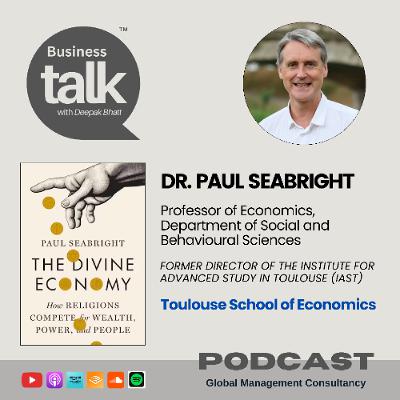
Dr. Paul Seabright, Professor of Economics at the Toulouse School of Economics, joined the Business Talk podcast to discuss his book The Divine Economy: How Religions Compete for Wealth, Power, and People and his research on religious movements as economic platforms that compete for members and resources while providing vital services such as education, marriage facilitation, financial support, and insurance against life shocks. He reflected on how religions operate on both the extensive margin (which faith people join) and the intensive margin (how much time and commitment they devote), drawing on fieldwork from India, China, Ghana, Haiti, and beyond to show the remarkable diversity of religious practice and the ways communities offer material, emotional, and preventive support to their members.
At the same time, he highlighted troubling patterns of abuse enabled by cultures of secrecy and silence, and argued for treating religions as legitimate but accountable organisations that, like businesses, should be subject to basic transparency and reporting standards to protect trust while respecting religious freedom.
This podcast is brought to you by Global Management Consultancy. For more information, please visit www.globalmanagementconsultancy.com.
Disclaimer:
A. The background music used in this video is the property of its respective developer and is protected by Copyright. Although it is a free version, Business Talk, Global Management Consultancy and Deepak Bhatt do not hold the rights to this music.
B. Dr. Paul Seabright shared insightful perspectives from his acclaimed book “The Divine Economy: How Religions Compete for Wealth, Power”, and People during his conversation on the Business Talk podcast channel. The uploaded video contains copyrighted material; therefore, any modifications to graphics, music, or the presence of the author or host are strictly prohibited.
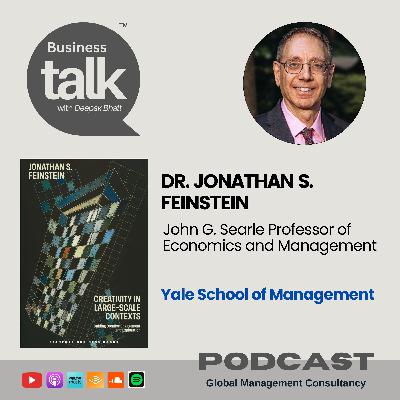
Dr. Jonathan S. Feinstein, John G. Searle Professor of Economics and Management at the Yale School of Management, joined host Deepak on the Business Talk podcast to explore ideas from his book Creativity in Large-Scale Contexts: Guiding Creative Engagement and Exploration, published by Stanford University Press. Drawing on his interdisciplinary background in economics, knowledge representation, and mathematical modeling, Dr. Feinstein explained how creativity unfolds within vast networks of context and shared practical tools, such as guiding conceptions and guiding principles, for individuals and organizations navigating complex creative journeys.
This podcast is brought to you by Global Management Consultancy. For more information, please visit www.globalmanagementconsultancy.com.
Disclaimer:
A. The background music used in this video is the property of its respective developer and is protected by Copyright. Although it is a free version, Business Talk, Global Management Consultancy and Deepak Bhatt do not hold the rights to this music.
B. Dr. Jonathan Feinstein shared thoughtful insights from his acclaimed book Creativity in Large-Scale Contexts: Guiding Creative Engagement and Exploration during his conversation on the Business Talk podcast channel. The uploaded video contains copyrighted material; therefore, any modifications to graphics, music, or the presence of the author or host are strictly prohibited.
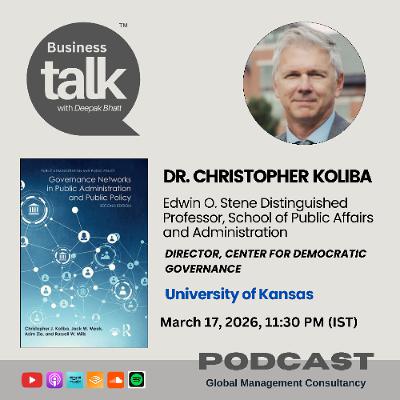
Dr. Christopher Koliba, the Edwin O. Stene Distinguished Professor of Public Administration, Policy, and Governance at the University of Kansas, explains how contemporary public administration increasingly operates through governance networks rather than isolated agencies, with multiple public, private, and nonprofit actors exchanging resources, information, and political power across interconnected systems. Drawing on his book “Governance Networks in Public Administration and Public Policy,” he outlines core building blocks of these networks, actors, ties, functions, and structures, and shows how policy tools such as regulations, contracts, grants, and subsidies both shape and are shaped by these configurations.
Through examples including private prisons, the Deepwater Horizon oil spill, and crop insurance programs, he illustrates how networks can generate both public value and unintended consequences, depending on accountability flows, information sharing, and the health of civil society organizations that act as watchdogs, conveners, and implementers.
This podcast is brought to you by Global Management Consultancy. For more information, please visit www.globalmanagementconsultancy.com.
Disclaimer:
A. The background music used in this video is the property of its respective developer and is protected by Copyright. Although it is a free version, Business Talk, Global Management Consultancy and Deepak Bhatt do not hold the rights to this music.
B. Dr. Christopher Koliba shared thoughtful perspectives from his acclaimed book “Governance Networks in Public Administration and Public Policy” during his conversation on the Business Talk podcast channel. The uploaded video contains copyrighted material; therefore, any modifications to graphics, music, or the presence of the author or host are strictly prohibited.

In this episode of the Business Talk podcast, host Deepak Bhatt speaks with Professor Joseph Zeira of the Hebrew University of Jerusalem about his book The Israeli Economy: A Story of Success and Costs. Drawing on Israel’s unique history, Professor Zeira explains how rapid growth from 1922 to 1972 was driven by external financing through immigrant capital, German reparations, and large-scale public investment in education and technology. He highlights the 1980 peace agreement with Egypt as a pivotal “natural experiment” that enabled economic stabilization, sharply reduced public spending, and showed that long-run growth can remain robust even as the state shrinks.
The conversation also explores his “missing capital” research, the economic costs of wide and narrow conflicts, and why Israel’s neoliberal turn failed to boost growth but significantly increased inequality.
This podcast is brought to you by Global Management Consultancy. For more information, please visit www.globalmanagementconsultancy.com.
Disclaimer:
A. The background music used in this video is the property of its respective developer and is protected by Copyright. Although it is a free version, Business Talk, Global Management Consultancy and Deepak Bhatt do not hold the rights to this music.
B. In a compelling conversation on the Business Talk podcast channel, Prof. Joseph Zeira shared thoughtful perspectives drawn from his acclaimed book, “The Israeli Economy: A Story of Success and Costs”. The uploaded video contains copyrighted material; therefore, any modifications to graphics, music, or the presence of the author or host are strictly prohibited.
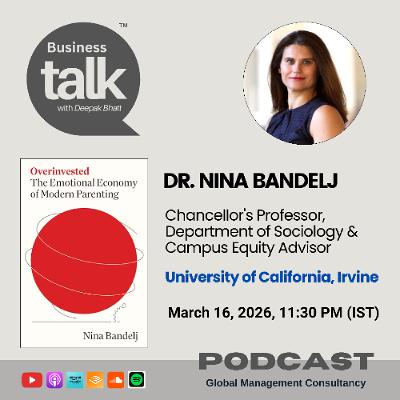
Dr. Nina Bandelj, Chancellor's Professor of Sociology and Campus Equity Advisor at the University of California, Irvine, shares key insights from her latest book Overinvested: The Emotional Economy of Modern Parenting, exploring what happens when children become investment projects and parenting transforms into exhausting labor.
In her latest book “Overinvested: The Emotional Economy of Modern Parenting”, Dr. Nina Bandelj examines how modern parenting has evolved into an exhausting blend of emotional devotion and economic investment, where children are simultaneously treated as priceless emotional treasures and human capital projects to be optimized. Drawing on interviews with 120 parents across diverse backgrounds, she traces how two powerful cultural forces, the economic style, rooted in human capital thinking and productivity mindsets, and the emotional style, driven by therapeutic culture and identity - have together transformed child-rearing into what she calls the "emotional economy."
From soaring childcare costs and tutoring expenses to the mental load of constant scheduling and monitoring, Dr. Bandelj reveals that this culture of over-investment not only exhausts parents but may also undermine children's resilience and independence - and, crucially, does not just reproduce inequality but actively grows it. Her work is not a judgment on parents, but a call for systemic change: to reimagine children not as private investment projects, but as a shared societal responsibility deserving collective support.
This podcast is brought to you by Global Management Consultancy. For more information, please visit www.globalmanagementconsultancy.com.
Disclaimer:
A. The background music incorporated in this video is the intellectual property of its respective developer and is protected under applicable copyright laws. Notwithstanding that it is a free-to-use version, Business Talk, Global Management Consultancy, and Deepak Bhatt do not own, and expressly do not claim, any rights, title, or interest in or to this music.
B. Dr. Nina Bandelj brought compelling insights from her acclaimed book “Overinvested: The Emotional Economy of Modern Parenting”, to an engaging conversation on the Business Talk podcast. The uploaded video contains copyrighted content, so changing any graphics, music, or on-screen appearance of the author or host is not allowed.
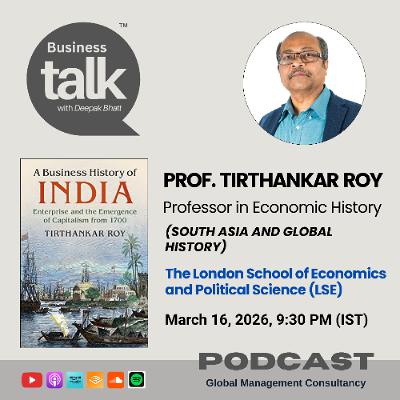
Dr. Tirthankar Roy, Professor of Economic History at the London School of Economics and Political Science, joins us to share key insights from his acclaimed book, A Business History of India: Enterprise and the Emergence of Capitalism from 1700.
In this illuminating episode of Business Talk, Prof. Tirthankar Roy, takes us on a sweeping 300-year journey through India's entrepreneurial past. Drawing from his acclaimed book, A Business History of India: Enterprise and the Emergence of Capitalism from 1700, Prof. Roy explores how Indian capitalism flourished despite scarce capital, powered by social networks, community trust, and geographic advantage. From the cotton trade boom in Bombay and the unique managing agency system pioneered by houses like Tata and Birla, to the transformative role of weak ties in enabling Jamshedji Tata's steel revolution, the conversation uncovers the deep historical roots of India's modern enterprise.
Prof. Roy also offers a nuanced reading of the colonial era, challenges the popular "extraction" narrative, and explains how the 1990s liberalization was less a revolution and more a return to India's natural economic instincts, one built on the power of people, mobility, and global integration.
This podcast is brought to you by Global Management Consultancy. For more information, please visit www.globalmanagementconsultancy.com.
Disclaimer:
A. The background music used in this video is the property of its respective developer and is protected by Copyright. Although it is a free version, Business Talk, Global Management Consultancy and Deepak Bhatt do not hold the rights to this music.
B. Dr. Tirthankar Roy offered thoughtful perspectives from his acclaimed book, “A Business History of India: Enterprise and the Emergence of Capitalism from 1700”, in his conversation on the Business Talk podcast channel. The uploaded video contains copyrighted material; therefore, any modifications to graphics, music, or the presence of the author or host are strictly prohibited.
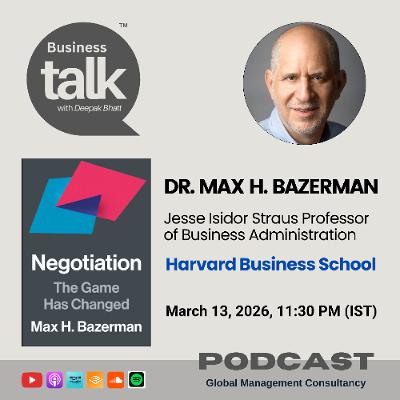
In this insightful episode of the Business Talk Podcast, Dr. Max H. Bazerman, Jesse Isidor Straus Professor of Business Administration at Harvard Business School shares transformative lessons from his book, Negotiation: The Game Has Changed. Dr. Bazerman explores how sweeping shifts in the negotiation landscape from the rise of AI and Donald Trump's global trade policies to the dominance of virtual communication, are fundamentally redefining how we negotiate. He introduces the concept of "richness" in communication, highlighting how moving from in-person to digital interactions demands greater preparation, strategic pauses, and advance documentation.
Yet, amid all this change, Dr. Bazerman affirms that timeless principles BATNA, reservation price, zone of possible agreement, and value creation, remain the bedrock of effective negotiation. He also challenges two of the most common negotiation mistakes: neglecting perspective-taking and falling into the trap of fixed-pie, zero-sum thinking.
This podcast is brought to you by Global Management Consultancy. For more information, please visit www.globalmanagementconsultancy.com.
Disclaimer:
A. The background music used in this video is the property of its respective developer and is protected by Copyright. Although it is a free version, Business Talk, Global Management Consultancy and Deepak Bhatt do not hold the rights to this music.
B. Dr. Max Bazerman offered thoughtful perspectives from his acclaimed book, “Negotiation: The Game Has Changed”, in his conversation on the Business Talk podcast channel. The uploaded video contains copyrighted material; therefore, any modifications to graphics, music, or the presence of the author or host are strictly prohibited.

In this episode, Dr. Caroline Levander, Vice President for Global Strategy, Carlson Professor in the Humanities, and Professor of English at Rice University, shares transformative insights from her book Invent Ed: How an American Tradition of Innovation Can Transform College Today. Drawing on rich historical examples, including the story of Samuel Morse, a painter who built the first telegraph in his art studio, Dr. Levander makes a compelling case for cross-disciplinary thinking as the cornerstone of true innovation.
She challenges universities to move beyond the proliferation of "innovation centers" and instead embed creative mindset-building into every aspect of undergraduate education, arguing that innovation is radically democratic and requires no major investment, only intention and commitment. With the World Economic Forum ranking creativity as the most in-demand skill across industries, Dr. Levander urges institutions to reverse-engineer their curricula around real-world industry challenges, ensuring students graduate not just with degrees, but with the problem-solving agility and intellectual courage demanded by an AI-driven world.
This podcast is brought to you by Global Management Consultancy. For more information, please visit www.globalmanagementconsultancy.com.
Disclaimer:
A. The background music incorporated in this video is the intellectual property of its respective developer and is protected under applicable copyright laws. Notwithstanding that it is a free-to-use version, Business Talk, Global Management Consultancy, and Deepak Bhatt do not own, and expressly do not claim, any rights, title, or interest in or to this music.
B. Dr. Caroline Levander shared insightful perspectives from her acclaimed book “Invent Ed: How an American Tradition of Innovation Can Transform College Today”, during her engaging conversation on the Business Talk podcast. The uploaded video contains copyrighted content, so changing any graphics, music, or on-screen appearance of the author or host is not allowed.

In this episode of Business Talk, we are joined by Paul Johnson, Provost of The Queen's College, University of Oxford, for a thought-provoking conversation drawn from his acclaimed book, Challenging Inequalities: How We Got Stuck and Where We Go Next.
With decades of expertise in economics and public policy, Paul unpacks why inequality - despite decades of awareness and policy intervention, continues to persist and deepen across societies. He examines the structural, political, and behavioral forces that keep inequality entrenched, and offers a candid assessment of where conventional approaches have fallen short.
The discussion explores how income gaps, wealth concentration, and unequal access to education and opportunity are not inevitable outcomes, but the result of deliberate choices and how different choices can lead to different results. Paul also reflects on what meaningful, evidence-based reform could look like, and why building political and social will is as important as designing the right policies.
This is a compelling conversation for anyone interested in economics, social justice, public policy, and the future of equitable societies.
This podcast is brought to you by Global Management Consultancy. For more information, please visit www.globalmanagementconsultancy.com.
Disclaimer:
A. The background music used in this video is the property of its respective developer and is protected by Copyright. Although it is a free version, Business Talk, Global Management Consultancy and Deepak Bhatt do not hold the rights to this music.
B. Paul Johnson offered thoughtful perspectives from his acclaimed book, “Challenging Inequalities: How We Got Stuck and Where We Go Next”, in his conversation on the Business Talk podcast channel. The uploaded video contains copyrighted material; therefore, any modifications to graphics, music, or the presence of the author or host are strictly prohibited.

In this episode, we sit down with Dr. Barry Eichengreen, the George C. Pardee and Helen N. Pardee Professor of Economics and Political Science at the University of California, Berkeley, one of the world's foremost authorities on international monetary systems and economic history.
Dr. Eichengreen takes us on a sweeping journey through his forthcoming book, Money Beyond Borders: Global Currencies from Croesus to Crypto, tracing the evolution of money from the ancient Lydian coins of King Croesus to the rise of digital currencies and crypto assets in the modern era. Along the way, he unpacks how global currencies have shaped and been shaped by, the political, economic, and technological forces of their time.
Whether you're an economist, a policymaker, or simply curious about the future of money, this conversation offers rare insight from a scholar who has spent decades studying the institutions and ideas that underpin the global financial system.
This podcast is brought to you by Global Management Consultancy. For more information, please visit www.globalmanagementconsultancy.com.
Disclaimer:
A. The background music used in this video is the property of its respective developer and is protected by Copyright. Although it is a free version, Business Talk, Global Management Consultancy and Deepak Bhatt do not hold the rights to this music.
B. In a compelling conversation on the Business Talk podcast channel, Dr. Barry Eichengreen shared thoughtful perspectives drawn from his forthcoming book, “Money Beyond Borders: Global Currencies from Croesus to Crypto”. The uploaded video contains copyrighted material; therefore, any modifications to graphics, music, or the presence of the author or host are strictly prohibited.
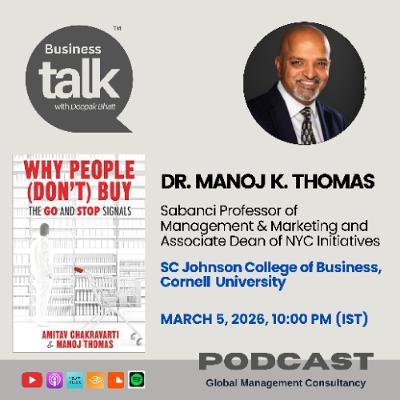
Dr. Manoj Thomas, Sabanci Professor of Management & Marketing and Associate Dean of NYC Initiatives at Cornell SC Johnson College of Business, explores how behavioral science shapes business strategy, and why overlooking it can lead to critical strategic missteps that put a company off course.
In this engaging episode of Business Talk, host Deepak Bhatt sits down with Dr. Manoj Thomas, Sabanci Professor of Management & Marketing and Associate Dean of NYC Initiatives at Cornell SC Johnson College of Business, for a rich exploration of how behavioral science quietly governs our economic decisions. Dr. Thomas unpacks the psychology behind everyday phenomena, from why $2.99 feels dramatically cheaper than $3.00 (the left-digit anchoring effect), to how precise pricing like $500,250 reduces negotiation compared to a round $500,000, to the fascinating "pain of paying," where cash purchases trigger more deliberate spending while mobile payments fuel impulse buying. He also reveals how political ideology shapes negotiation behavior conservatives feeling a personal duty to negotiate, while liberals often view fair pricing as the seller's responsibility. Broadening the lens to AI, Dr. Thomas highlights a striking paradox: while nearly all AI innovation originates in the West, Eastern countries with collectivist cultures show far higher adoption of AI-branded products.
He closes with a timeless reminder from Peter Drucker, "The main purpose of a business is to create a customer" - urging executives to anchor every strategic decision in genuine customer value creation.
This podcast is brought to you by Global Management Consultancy. For more information, please visit www.globalmanagementconsultancy.com.
Disclaimer:
A. The background music used in this video is the property of its respective developer and is protected by Copyright. Although it is a free version, Business Talk, Global Management Consultancy and Deepak Bhatt do not hold the rights to this music.
B. Dr. Manoj Thomas offered thoughtful perspectives from his acclaimed book, “Why People (Don’t) Buy: The GO and STOP Signals”, in his conversation on the Business Talk podcast channel. The uploaded video contains copyrighted material; therefore, any modifications to graphics, music, or the presence of the author or host are strictly prohibited.
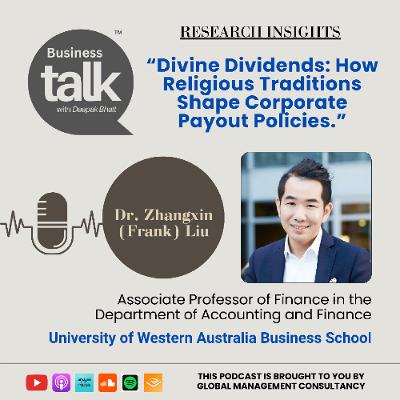
Dr. Frank Liu, Associate Professor of Finance at the University of Western Australia Business School's Department of Accounting and Finance and Research Affiliate at the Centre for Economic History (CEH), joins us to discuss his study "Divine Dividends: How Religious Traditions Shape Corporate Payout Policies" - exploring how Buddhist and Taoist influences shape dividend behaviors among Chinese A-share firms. His research finds that stronger religious traditions foster higher dividend payouts, greater corporate responsibility, and deeper investor trust, highlighting the powerful role of informal institutions in financial decision-making.
What inspired this research was a moment of striking contrast in Shanghai - walking out of a modern glass-and-steel office tower, Dr. Frank Liu found himself face-to-face with the Jingang Temple directly across the street, incense in the air and temple bells ringing. That juxtaposition sparked a profound question: could the cultural environment surrounding companies actually shape boardroom decisions? Drawing on over 33,000 firm-year observations of Chinese listed companies from 2009 to 2023, Dr. Liu and his co-author Xu Xian mapped the density of Buddhist and Taoist temples within a 200-kilometer radius of company headquarters to measure religious influence. Their findings are compelling; firms located in areas with stronger religious traditions were not only more likely to pay dividends but also paid larger amounts and maintained more consistent payout policies over time. Buddhism, with its core emphasis on dhana (generosity and giving), exerted a stronger influence than Taoism, though both traditions discouraged the kind of corporate stinginess that Chinese investors colorfully describe as "iron roosters", companies so tight-fisted that not even a single feather can be plucked from them. Beyond dividends, religiously influenced firms demonstrated superior CSR performance, reduced opportunistic behavior by controlling shareholders, and greater transparency underscoring how informal institutions like culture and religion can serve as powerful governance mechanisms, particularly in contexts where formal enforcement remains imperfect.
This podcast is brought to you by Global Management Consultancy. For more information, please visit www.globalmanagementconsultancy.com.
Disclaimer:
A. The background music incorporated in this video is the intellectual property of its respective developer and is protected under applicable copyright laws. Notwithstanding that it is a free-to-use version, Business Talk, Global Management Consultancy, and Deepak Bhatt do not own, and expressly do not claim, any rights, title, or interest in or to this music.
B. Dr. Frank Liu offered compelling insights from his research, "Divine Dividends: How Religious Traditions Shape Corporate Payout Policies," in a thought-provoking conversation on the Business Talk podcast channel. The uploaded video contains copyrighted content, so changing any graphics, music, or on-screen appearance of the author or host is not allowed.

In her research, "Blind Spot: Integrating Biodiversity into Corporate Risk Management," Dr. Monomita Nandy, Professor in Accounting and Finance at Brunel Business School, Brunel University of London, UK, reveals a critical oversight at the heart of modern corporate strategy, most businesses treat nature as an externality rather than recognizing how deeply their operations, supply chains, and long-term resilience depend on living ecosystems.
This podcast is brought to you by Global Management Consultancy. For more information, please visit www.globalmanagementconsultancy.com.
Disclaimer:
A. The background music incorporated in this video is the intellectual property of its respective developer and is protected under applicable copyright laws. Notwithstanding that it is a free-to-use version, Business Talk, Global Management Consultancy, and Deepak Bhatt do not own, and expressly do not claim, any rights, title, or interest in or to this music.
B. Dr. Monomita Nandy shared key insights from her research, “Blind Spot: Integrating Biodiversity into Corporate Risk Management”, in an engaging conversation on the Business Talk podcast. The uploaded video contains copyrighted content, so changing any graphics, music, or on-screen appearance of the author or host is not allowed.

Dr. Sarah Whitley, Assistant Professor of Marketing at the University of Georgia's Terry College of Business, joins us to discuss her research, "Positive Emotions During Search Engine Use: How You Feel Impacts What You Search for and Click On."
In her research, "Positive Emotions During Search Engine Use: How You Feel Impacts What You Search for and Click On," Dr. Sarah Whitley, along with co-researchers Dr. Anindita Chakravarty and Dr. Pengyuan Wang, explores how incidental positive emotions, feelings unrelated to the search task itself. shape the way people interact with search engines. The study, drawing on approximately 50 million archival search queries, reveals that users in a positive mood are more likely to describe products using emotionally positive keywords such as "exciting," "joyful," or "inspiring," and are subsequently more inclined to click on advertisements. Notably, positive emotion queries demonstrated a 2% higher click-through rate compared to neutral queries, a seemingly modest figure that translates into thousands of additional clicks at scale. The research also uncovers a key psychological mechanism: positive emotions reduce users' skepticism toward advertising, not by making them unaware of ads, but by lowering their perception of manipulative intent what Dr. Whitley describes as a "rose-colored glasses" effect.
For marketers, these findings present a valuable and largely untapped opportunity, particularly during high-mood periods such as weekends and holidays, and across hedonic product categories like entertainment, clothing, and dining.
This podcast is brought to you by Global Management Consultancy. For more information, please visit www.globalmanagementconsultancy.com.
Disclaimer:
A. The background music incorporated in this video is the intellectual property of its respective developer and is protected under applicable copyright laws. Notwithstanding that it is a free-to-use version, Business Talk, Global Management Consultancy, and Deepak Bhatt do not own, and expressly do not claim, any rights, title, or interest in or to this music.
B. Dr. Sarah Whitley joined the Business Talk podcast for an engaging conversation, sharing key insights from her research, "Positive Emotions During Search Engine Use: How You Feel Impacts What You Search for and Click On." The uploaded video contains copyrighted content, so changing any graphics, music, or on-screen appearance of the author or host is not allowed.
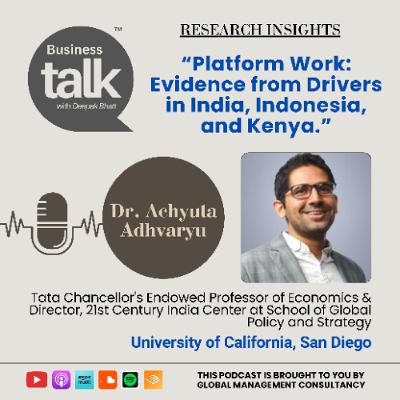
Dr. Achyuta Adhvaryu, Tata Chancellor's Professor of Economics at the School of Global Policy and Strategy and inaugural Director of the 21st Century India Center at the University of California, San Diego, presented his research on "Platform Work: Evidence from Drivers in India, Indonesia, and Kenya," drawing on surveys and platform data to examine drivers' earnings, costs, and career trajectories.
In his research on "Platform Work: Evidence from Drivers in India, Indonesia, and Kenya," Dr. Achyuta Adhvaryu unpacks the complex realities of gig work in the Global South by combining platform administrative data with on-ground worker surveys. The study finds that while monthly net earnings for platform drivers can exceed comparable informal work by 25-30% in India, this comes at a steep cost, fuel expenses alone consume one-third of gross earnings in India and Indonesia, and over half in Kenya, where high operating costs render platform work increasingly unsustainable.
A critical distinction also emerges between hourly and monthly earnings: drivers in Indonesia log upwards of 70 hours a week, raising serious concerns about work-life balance and whether flexibility is a genuine advantage or a quiet compulsion. The research further reveals that platform work serves a dual role - as a primary income source for roughly one-third of drivers, and as a financial safety net for another third who turn to platforms during economic emergencies - though algorithmic pressures for constant engagement increasingly threaten that safety-net function. Dr. Adhvaryu argues that the most promising path forward lies not in capping work hours, but in transitioning drivers to electric two-wheelers, expanding charging infrastructure, and enabling platforms to deliver financial benefits such as insurance and micro-credit directly through their apps.
This podcast is brought to you by Global Management Consultancy. For more information, please visit www.globalmanagementconsultancy.com.
Disclaimer:
A. The background music incorporated in this video is the intellectual property of its respective developer and is protected under applicable copyright laws. Notwithstanding that it is a free-to-use version, Business Talk, Global Management Consultancy, and Deepak Bhatt do not own, and expressly do not claim, any rights, title, or interest in or to this music.
B. Dr. Achyuta Adhvaryu shared insightful perspectives drawn from his research, "Platform Work: Evidence from Drivers in India, Indonesia, and Kenya," during an engaging conversation on the Business Talk podcast channel. The uploaded video contains copyrighted content, so changing any graphics, music, or on-screen appearance of the author or host is not allowed.
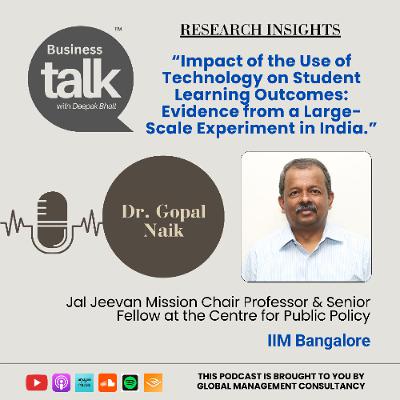
In this episode of the Business Talk podcast, Dr. Gopal Naik, Former Professor in the Economics Area and Jal Jeevan Mission Chair in Utility Development & Water Economics at IIM Bangalore, shares compelling insights from his research study, "Impact of the Use of Technology on Student Learning Outcomes: Evidence from a Large-Scale Experiment in India." His groundbreaking tele-education initiative reached nearly 200,000 students across 1,000 rural government schools in Karnataka, earning the prestigious WSIS 2015 Award at ITU Geneva.
Conducted as a large-scale Randomized Control Trial (RCT) spanning 1,823 schools across 18 districts, the study examined the impact of live, interactive multimedia-based instruction on student performance in Science, English Grammar, and Mathematics. The intervention, designed to be resource-light and self-sufficient, used just one computer and projector per school, delivering expert-led, high-quality content via EduSat, India's educational satellite replacing approximately one-third of regular classroom time. Results demonstrated significant improvements in learning outcomes across all three subjects, with Science recording the largest gains, as animations and videos made complex concepts more accessible to rural learners.
Dr. Naik emphasizes that technology must complement, not replace, traditional educational investments such as teacher hiring and training, and underscores the transformative role technology can play in bridging educational inequality for students in underserved communities.
This podcast is brought to you by Global Management Consultancy. For more information, please visit www.globalmanagementconsultancy.com.
Disclaimer:
A. The background music incorporated in this video is the intellectual property of its respective developer and is protected under applicable copyright laws. Notwithstanding that it is a free-to-use version, Business Talk, Global Management Consultancy, and Deepak Bhatt do not own, and expressly do not claim, any rights, title, or interest in or to this music.
B. Prof. Gopal Naik offered insightful perspectives drawn from his research, "Impact of the Use of Technology on Student Learning Outcomes: Evidence from a Large-Scale Experiment in India," in an engaging conversation on the Business Talk podcast channel. The uploaded video contains copyrighted content, so changing any graphics, music, or on-screen appearance of the author or host is not allowed.
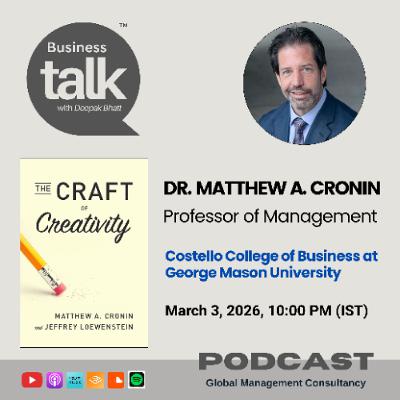
In a thought-provoking conversation on the Business Talk podcast, Dr. Matthew Cronin, Professor of Management at the Costello College of Business, George Mason University, unpacks the transformative ideas behind his acclaimed book The Craft of Creativity, co-authored with Prof. Jeffrey Loewenstein and winner of the 2018 Choice Award for Outstanding Academic Title by the American Library Association. Dr. Cronin challenges the popular notion that creativity is an innate talent or a sudden "aha moment," arguing instead that it is a skill built on four core practices - faith, persistence, tolerance for ambiguity, and provisional commitments, each of which can be cultivated with time and experience. Central to his framework is the Story Model of Creativity, which holds that everyone operates with mental narratives about how things work, and that true innovation lies in finding the "plot twist" that productively disrupts those stories.
He further introduces the PAGES model - Parts, Actions, Goals, Events, and Self-concept, as a practical tool for unlocking fresh solutions by shifting just one dimension of how we perceive a problem. Ultimately, Dr. Cronin reminds us that creativity is not about powering through; it is about holding ideas lightly, exploring them immediately, and balancing the courage to persist with the wisdom to know when to change course.
This podcast is brought to you by Global Management Consultancy. For more information, please visit www.globalmanagementconsultancy.com.
Disclaimer:
A. The background music used in this video is the property of its respective developer and is protected by Copyright. Although it is a free version, Business Talk, Global Management Consultancy and Deepak Bhatt do not hold the rights to this music.
B. Dr. Matthew Cronin offered thoughtful perspectives from his acclaimed book, “The Craft of Creativity”, in his conversation on the Business Talk podcast channel. The uploaded video contains copyrighted material; therefore, any modifications to graphics, music, or the presence of the author or host are strictly prohibited.

In this episode of Business Talk, Emeritus Professor Lawrence H. White, an American economist formerly of George Mason University, joins us to discuss the central ideas from his book Better Money: Gold, Fiat, or Bitcoin?
He explains what a “monetary standard” means in practice and compares three alternatives, gold, fiat money, and Bitcoin, through a clear lens: how well each system responds to changes in money demand and how stable its purchasing power is over time. Professor White challenges the notion that a gold standard has a rigid money supply, arguing that recycling and expanded mining can make gold supply more responsive than many assume, while also emphasizing gold’s longer-run predictability. He contrasts this with fiat systems, where central banks must forecast money demand (often imperfectly), and with Bitcoin’s fixed supply rule, which he argues can produce extreme volatility and limits its usefulness as everyday money and for long-term contracts.
Drawing on history, including his interpretation of the Great Depression, and present-day policy dilemmas, he makes the case that real-world monetary performance depends less on slogans and more on incentives, institutions, and how monetary systems handle shocks.
This podcast is brought to you by Global Management Consultancy. For more information, please visit www.globalmanagementconsultancy.com.
Disclaimer:
A. The background music used in this video is the property of its respective developer and is protected by Copyright. Although it is a free version, Business Talk, Global Management Consultancy and Deepak Bhatt do not hold the rights to this music.
B. Dr. Lawrence White offered thoughtful perspectives from his acclaimed book, “Better Money: Gold, Fiat, or Bitcoin?”, in his conversation on the Business Talk podcast channel. The uploaded video contains copyrighted material; therefore, any modifications to graphics, music, or the presence of the author or host are strictly prohibited.
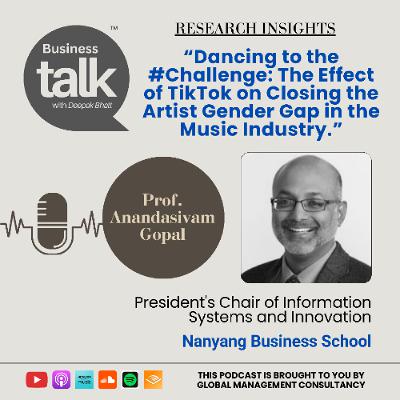
Dr. Anandasivam Gopal, President’s Chair of Information Systems and Innovation at Nanyang Business School, discusses his research, “Dancing to the #Challenge: The Effect of TikTok on Closing the Artist Gender Gap in the Music Industry.”
Professor Anandasivam Gopal explained how TikTok hashtag dance challenges, 30-45 second, easily replicable dance videos tied to a shared hashtag, can create measurable, sustained momentum for emerging music artists rather than just a short-lived “spike.”
Drawing on a dataset linking TikTok challenge activity with Spotify followership, the study uses daily follower growth (a compounding metric that signals durable audience-building) and carefully constructed comparison groups to isolate impact across similar songs while reducing confounds such as “superstar bias” and overlapping TikTok releases. The key finding is that when women creators make dance challenges for women artists (especially in Western pop with high danceability and light, fun themes), artists see roughly 3% higher daily Spotify follower growth, an effect that can compound to around 40–50% over two weeks, while self-created challenges by artists show little to no net benefit due to the “self-promotion penalty,” explained through role congruity theory. Practical implications follow for platforms and artist teams: encourage and seed more third-party challenge creation (ideally by women creators), treat challenges as selective strategy rather than a guaranteed formula, and keep the creative tone authentic and “peppy” to maximize the likelihood of sustained cross-platform spillover.
This podcast is brought to you by Global Management Consultancy. For more information, please visit www.globalmanagementconsultancy.com.
Disclaimer:
A. The background music incorporated in this video is the intellectual property of its respective developer and is protected under applicable copyright laws. Notwithstanding that it is a free-to-use version, Business Talk, Global Management Consultancy, and Deepak Bhatt do not own, and expressly do not claim, any rights, title, or interest in or to this music.
B. Dr. Anandasivam Gopal shared insightful perspectives from his research, “Dancing to the #Challenge: The Effect of TikTok on Closing the Artist Gender Gap in the Music Industry”, during his conversation on the Business Talk podcast channel. The uploaded video contains copyrighted content, so changing any graphics, music, or on-screen appearance of the author or host is not allowed.
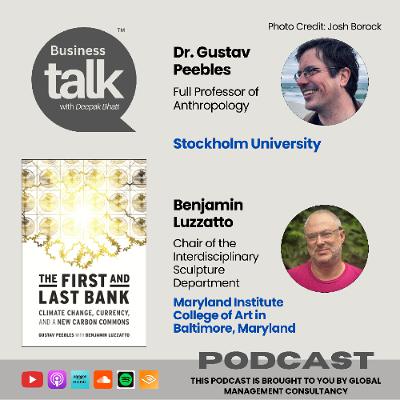
Dr. Gustav Peebles and Prof. Benjamin Luzzatto discuss their book, “The First and Last Bank: Climate Change, Currency, and a New Carbon Commons,” which presents a bold new approach to currency and community, one designed to help remove carbon from the atmosphere and add a powerful new tool to the fight against climate change.
The guests, propose a carbon-based monetary system inspired by the historical gold standard except designed to be regenerative rather than extractive, with carbon drawn down and securely stored while a community currency circulates in the local economy. They argue carbon can function as a viable reserve asset because it already has real market value and practical uses (for example, in soil improvement and water purification), and they outline a model of community-owned “carbon banks” that convert carbon waste into stable biochar, verify its carbon content, and issue currency chits backed by that sequestration.
By keeping storage local and governance commons-based, the model aims to rebuild trust through transparency and enable ordinary citizens to take direct climate action, complementing, not replacing, existing tools like regulation, carbon taxes, and decarbonization efforts.
This podcast is brought to you by Global Management Consultancy. For more information, please visit www.globalmanagementconsultancy.com.
Disclaimer:
A. The background music used in this video is the property of its respective developer and is protected by Copyright. Although it is a free version, Business Talk, Global Management Consultancy and Deepak Bhatt do not hold the rights to this music.
B. Dr. Gustav Peebles and Prof. Benjamin Luzzatto shared thoughtful insights from their acclaimed book, “The First and Last Bank: Climate Change, Currency, and a New Carbon Commons,” in a conversation on the Business Talk podcast channel. The uploaded video contains copyrighted material; therefore, any modifications to graphics, music, or the presence of the author or host are strictly prohibited.

Comments

Download from Google Play

Download from App Store
 United States