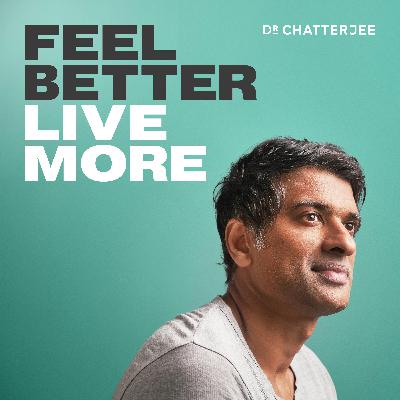
DiscoverFeel Better, Live More with Dr Rangan Chatterjee
Feel Better, Live More with Dr Rangan Chatterjee
Claim Ownership

Feel Better, Live More with Dr Rangan Chatterjee

Author: Dr Rangan Chatterjee: GP & Author

Subscribed: 108,358Played: 4,463,575
Share

Description

“Health has become overcomplicated. I aim to simplify it” In this podcast, we hear stories from leading health experts and exciting personalities who offer easy health life-hacks, expert advice and debunk common health myths giving you the tools to revolutionise how you eat, sleep, move and relax. Hosted by Dr Chatterjee - one of the most influential GPs in the country with nearly 20 years experience, star of BBC 1’s Doctor In the House, and author of 6 internationally best-selling books, including ‘The 4 Pillar Plan’ – Feel Better, Live More aims to inspire, empower and transform the way we feel. When we are healthier, we are happier because when we feel better, we live more.


Support the podcast and enjoy Ad-Free episodes. Try FREE for 7 days on Apple Podcasts https://apple.co/feelbetterlivemore. For other podcast platforms go to https://fblm.supercast.com.


https://www.drchatterjee.com/podcast

https://www.instagram.com/drchatterjee

https://www.twitter.com/drchatterjeeuk

https://www.facebook.com/DrChatterjee

616 Episodes
Reverse
What if the biggest source of stress in your life is not your job, inbox, or finances – but the simple fact that you have too much stuff? This week, my guest is Joshua Fields Millburn, co‑founder of The Minimalists, whose documentaries, books and podcast have inspired millions of people around the world to reconsider their own relationship with possessions and success. Joshua grew up with very little money, in a home marked by addiction, violence and instability and, as a young man, became convinced that the solution was to be found in acquiring ‘more’:  more income, more status and more material comfort. By the age of 30, he had everything he thought he wanted – the big job title, the nice car, the large house, all the visible signs of having “made it”. And yet, inside, he was anxious, overwhelmed and deeply unhappy. Then, in the space of a single month, his mother died and his marriage ended. Those two events forced him to pause and ask some uncomfortable but essential questions: What am I actually doing with my life? Whose values am I living by? Is this endless consumption really what life is all about? That period of questioning led Joshua towards minimalism – not as a trend or an aesthetic, but as a practical framework for living with greater clarity and intention.  in our conversation, we discuss: How external clutter is often an outward reflection of internal clutter Why products so often promise fulfilment but ultimately deliver dissatisfaction The difference between healthy consumption and harmful consumerism Practical rules that make decluttering simpler, including the 30-day minimalism game, the 90/90 approach to clothes and why a “sale price” can often become a “fool’s price” How identity clutter keeps us stuck - when we cling to things, roles or labels, not because we need them, but because we’re afraid of who we’ll be without them How minimalism can improve our health and relationships by creating more time, attention and presence. Joshua is a wonderful human being, a brilliant communicator and someone who thinks deeply about the human experience.  He believes that minimalism is the art of “addition through subtraction” - it’s not about having less for the sake of it, but about making space for what matters most. Support the podcast and enjoy Ad-Free episodes. Try FREE for 7 days on Apple Podcasts https://apple.co/feelbetterlivemore. For other podcast platforms go to https://fblm.supercast.com. Thanks to our sponsors: https://vivobarefoot.com/livemore https://thewayapp.com/livemore Show notes https://drchatterjee.com/614 DISCLAIMER: The content in the podcast and on this webpage is not intended to be a substitute for professional medical advice, diagnosis, or treatment. Always seek the advice of your doctor or qualified healthcare provider. Never disregard professional medical advice or delay in seeking it because of something you have heard on the podcast or on my website.
With the Children’s Wellbeing and Schools bill returning to the House of Commons imminently, it’s a key time to make your feelings known. Email your MP https://www.smartphonefreechildhood.org/email. Today’s episode is about a topic that I am truly passionate about - the introduction of social media and smartphones into all aspects of our lives - and what impact this is having on us individually, collectively and, perhaps most urgently, what impact is this having on our children.  Jonathan Haidt is arguably one of the worlds’ most eminent psychologists. He is a Professor of Ethical Leadership at New York University’s Stern School of Business and the author of 4 best-selling books, including his latest ‘The Anxious Generation: How the Great Rewiring of Childhood Is Causing an Epidemic of Mental Illness’.   In this episode, Jonathan and I explore how the fundamental differences between online and real-world interactions are affecting young people's social, emotional and cognitive development. We discuss why girls face unique risks on social media, from damaged relationships and reputations to harassment, and how gaming and pornography are shaping boys' expectations of relationships. Jonathan also shares some eye-opening data about the link between a decline in teen mental health and the widespread adoption of smartphones and social media. He emphasises the need for collective action to create healthier norms around technology use, both at home and in schools. We dive into practical strategies for parents, including setting clear boundaries and prioritising hobbies and family time. Our conversation also touches on the challenges of navigating technology use in a world where the pace of change has been so fast. Jonathan remains optimistic that we're nearing a tipping point and outlines four key norms we can all adopt with our children—even if they’re already dependent on their phones throughout the day. We also discuss in detail what we believe schools could be doing to help their students have less screen time and the importance of collaborating with other families to support healthier habits. As a parent and a doctor, I'm deeply concerned about the mental health crisis facing our children and young people. But if, as a society, we can come together to raise awareness and take purposeful action, we can create a healthier future for the next generation. I think this is one of the most important conversations that I have ever had on my podcast. Jonathan and I both believe that the rewiring of our children’s brains to be one of the most urgent societal harms that needs addressing.   My hope is that you find this conversation eye opening, enlightening and thought provoking - and I very much hope it prompts you to take action. Support the podcast and enjoy Ad-Free episodes. Try FREE for 7 days on Apple Podcasts https://apple.co/feelbetterlivemore. For other podcast platforms go to https://fblm.supercast.com. Thanks to our sponsors: https://ag1.com/livemore https://thewayapp.com/livemore  Show notes https://drchatterjee.com/613   DISCLAIMER: The content in the podcast and on this webpage is not intended to be a substitute for professional medical advice, diagnosis, or treatment. Always seek the advice of your doctor or qualified healthcare provider. Never disregard professional medical advice or delay in seeking it because of something you have heard on the podcast or on my website.
It’s easy to believe that we have to dedicate lots of time and energy to exercise. That, unless we’re pushing ourselves to our limits, it’s not worth doing.  Today’s clip is from episode 325 of the podcast with neuroscientist and Professor of Neural Science and Psychology, Dr Wendy Suzuki. Every morning Wendy starts her day with 30-minutes of exercise. She knows – from personal experience backed by scientific research – that this makes her more focused, happy, motivated, and even creative. She knows it’ll help her grow new brain cells and neural pathways, long into old age. And she wants you to reap all these benefits too. In this clip, Wendy shares why you don’t need to exercise for hours to gain benefits and  how just 10 minutes of exercise can create changes in the brain that go much further than simply boosting our mood. This is a practical and inspiring episode that I’m certain will have you taking action immediately. Thanks to our sponsor ⁠⁠⁠https://drinkag1.com/livemore Show notes and the full podcast are available at https://drchatterjee.com/325 Support the podcast and enjoy Ad-Free episodes. Try FREE for 7 days on Apple Podcasts ⁠⁠https://apple.co/feelbetterlivemore⁠⁠ For other podcast platforms go to ⁠⁠https://fblm.supercast.com. DISCLAIMER: The content in the podcast and on this webpage is not intended to constitute or be a substitute for professional medical advice, diagnosis, or treatment. Always seek the advice of your doctor or other qualified health care provider with any questions you may have regarding a medical condition. Never disregard professional medical advice or delay in seeking it because of something you have heard on the podcast or on my website.
If you have ever struggled with your weight, low energy, pre-diabetes or even type 2 diabetes, this is a conversation that could change your life. Dr David Unwin is an NHS GP who not only put his own type 2 diabetes into drug free remission, he has also helped over 150 patients do the same in a standard UK general practice – with ordinary people, on ordinary budgets, using food and lifestyle. It’s estimated that around 7/8ths of the adult population are metabolically unhealthy, which means that only a tiny minority of us are truly metabolically well. And this is a serious issue because poor metabolic health is one of the root cause drivers of insulin resistance, type 2 diabetes, cardiovascular disease, strokes, Alzheimer’s and many forms of cancer. In fact, this is one of the main reasons why I co-founded Do Health https://drchatterjee.com/do-health/ - a personalised health companion, powered by your individual biology and lifestyle - as a way of helping people improve their metabolic health early, well before they get sick in the future. In this week’s episode, we cover: The early signs of poor metabolic health, and why symptoms like fatigue, belly fat and brain fog are often overlooked. Why many issues we see as ‘normal ageing’ are actually signs of insulin resistance. How David himself reversed his own type 2 diabetes and, at the same time, improved his mood, energy and cognition. How reducing starchy carbohydrates if you have metabolic dys-regulation can dramatically improve blood sugar control Why so many of us struggle with bread, pasta, and ultra processed foods – and how food addiction may be silently driving our behaviour. The two women who helped David rethink everything he thought he knew about food, hope and healing And why it’s never too late to work on your metabolic health and why doing so can change every aspect of your life. One of the things I love most about David is his passion. He really is someone who genuinely wants to improve the health and lives of his patients and our hope is this conversation empowers you to make small changes that will improve your blood sugar, weight, energy, and ultimately, your future.   Support the podcast and enjoy Ad-Free episodes. Try FREE for 7 days on Apple Podcasts https://apple.co/feelbetterlivemore. For other podcast platforms go to https://fblm.supercast.com.   Thanks to our sponsors: https://boncharge.com/livemore https://thewayapp.com/livemore   Show notes https://drchatterjee.com/611⁠   DISCLAIMER: The content in the podcast and on this webpage is not intended to be a substitute for professional medical advice, diagnosis, or treatment. Always seek the advice of your doctor or qualified healthcare provider. Never disregard professional medical advice or delay in seeking it because of something you have heard on the podcast or on my website.
What do you think you might be saying on your deathbed? Will you be looking back at your life with a sense of joy and completeness, or, do you think that perhaps you might be consumed with regret? As this week’s guest shares, “It’s easy to assume that you will live with great health to a ripe old age, then die peacefully in your sleep wearing your favourite pyjamas but it doesn’t work out that way for most people…” Bronnie Ware is an internationally acclaimed speaker and author of the bestselling memoir, The Top Five Regrets of the Dying. Published more than 10 years ago, it’s been translated into 32 languages and continues to attract new audiences. The book is about her eight years as an end-of-life carer, the close relationships she formed, and lessons she learned from those dying people, which changed her life forever. In this conversation, we discuss some of the various regrets of the dying and what they can teach us so that we can live better lives, right now. We talk about the concept of choice. Everything we do, or don’t do, has a price – be it time or money. Our culture incentivises what we can measure – salaries, possessions, status, social media ‘likes’ and comments. But Bronnie urges us to realise the sacredness and value of our time. Is something a choice worth making if it means you have to sacrifice time with your loved ones? Is it worth pushing extra hard for the promotion that may bring you more money but also more stress and more time away from home? These are decisions that I think we all need to wrestle with from time to time if we are truly going to be living a contented and intentional life. We also talk about the real meaning of regret, what it means to be courageous, and how self-compassion can help us see our mistakes as a natural part of life and growth. Importantly, Bronnie also defines the qualities and habits she observed in those patients who reached the end of life with no regrets – what can we learn from these people? Death can be a topic that many people shy away from discussing but Bronnie is a wonderful soul who is able to talk about death in a relatable, powerful and authentic way. Appreciating we are going to die is the first step to getting more out of life. This really was a thought-provoking and intimate conversation. I hope you enjoy listening.   Support the podcast and enjoy Ad-Free episodes. Try FREE for 7 days on Apple Podcasts https://apple.co/feelbetterlivemore. For other podcast platforms go to https://fblm.supercast.com. Thanks to our sponsors: https://www.thewayapp.com/livemore https://drinkag1.com/livemore   Show notes https://drchatterjee.com/610   DISCLAIMER: The content in the podcast and on this webpage is not intended to be a substitute for professional medical advice, diagnosis, or treatment. Always seek the advice of your doctor or qualified healthcare provider. Never disregard professional medical advice or delay in seeking it because of something you have heard on the podcast or on my website.
Did you know that your daily habits directly affect the speed at which your brain is ageing and your risk of getting Alzheimer’s disease in the future? Feel Better Live More Bitesize is my weekly podcast for your mind, body, and heart. Each week I’ll be featuring inspirational stories and practical tips from some of my former guests. Today’s clip is from episode 573 of the podcast with medical doctor, board-certified surgeon, and expert in preventive health, Dr Darshan Shah. This was one of the most-listened-to podcast episodes in the UK in 2025, and one that clearly resonated with so many of you. In this clip, Darshan shares practical advice that could transform how you think about your health and we explore some of the most important daily habits that could add decades to your life.  These practical, evidence-based changes can help you feel better not just now, but for decades to come. Thanks to our sponsor ⁠⁠⁠https://drinkag1.com/livemore Show notes and the full podcast are available at https://drchatterjee.com/573 Support the podcast and enjoy Ad-Free episodes. Try FREE for 7 days on Apple Podcasts ⁠⁠https://apple.co/feelbetterlivemore⁠⁠ For other podcast platforms go to ⁠⁠https://fblm.supercast.com. DISCLAIMER: The content in the podcast and on this webpage is not intended to constitute or be a substitute for professional medical advice, diagnosis, or treatment. Always seek the advice of your doctor or other qualified health care provider with any questions you may have regarding a medical condition. Never disregard professional medical advice or delay in seeking it because of something you have heard on the podcast or on my website.
Most of us want our lives to feel calmer, clearer and more aligned. Yet so often, we hesitate, overthink or delay the changes we know would help us feel better. This week’s guest believes that what holds us back is not a lack of motivation or confidence, but a lack of self-trust, which is the foundation that shapes everything from our habits to our relationships. This week on, I’m joined by Dr Shadé Zahrai. Shadé is a behavioural researcher, award-winning peak performance educator and leading authority on confidence and self-doubt. In her new book, Big Trust: Rewire Self-Doubt, Find Your Confidence and Fuel Success, her message is simple: we need to stop getting in our own way, loosen the grip of self-doubt and learn how to back ourselves when it counts. Many of Shadé’s insights are shaped by her own journey. After years in corporate roles that were filled with intense self-doubt and even physical anxiety, she found herself starting again when the pandemic hit and her work fell away overnight. Creating simple videos from home to support others became an unexpected turning point - and ultimately the foundation of the work she does today. During our conversation, we discuss: Why self-trust sits at the heart of confidence, action and meaningful change, and how waiting to ‘feel ready’ keeps so many of us stuck. The four key attributes that make up self-trust, how our identity shapes our behaviour and why small daily choices become meaningful “proof points” of who we want to become. Why confidence doesn’t come first, and why self-trust, not motivation, is what allows us to take action. How repeatedly breaking promises to ourselves erodes our identity, and why keeping small commitments rebuilds a sense of capability and worth. The powerful connection between our inner narrative and our wellbeing, and how shifting our story changes the way we experience life. Shadé believes that we are not defined by our doubts but by the choices we make when doubt appears. This episode offers a compassionate, practical guide to strengthening the trust we place in ourselves and invites us to stop outsourcing our worth to external validation. Only then can we reconnect with our core values and begin living from a place of clarity and courage. I hope you enjoy listening. Support the podcast and enjoy Ad-Free episodes. Try FREE for 7 days on Apple Podcasts https://apple.co/feelbetterlivemore. For other podcast platforms go to https://fblm.supercast.com.   Thanks to our sponsors: https://www.vivobarefoot.com/livemore https://drinkag1.com/livemore   Show notes https://drchatterjee.com/608   DISCLAIMER: The content in the podcast and on this webpage is not intended to be a substitute for professional medical advice, diagnosis, or treatment. Always seek the advice of your doctor or qualified healthcare provider. Never disregard professional medical advice or delay in seeking it because of something you have heard on the podcast or on my website.
What has the biggest impact on your health and happiness today? Perhaps you’re thinking it’s work, money, what you eat, how you sleep… Maybe it’s your friends and family and how you interact with them… These are all valid answers. But let me put it to you that I think there’s one factor that is linked to, but overrides, all of these things: stress. For this bonus New Year’s Day episode, I wanted to speak to you directly about stress, so you can take action to stop it controlling your life in 2026. A bit like my Boxing Day podcast a few days ago, his episode is designed to gently inspire you at the start of the year, to help you reflect on your life, and to encourage you to create positive change in the months ahead. So I’m sharing with you the five simple habits that I know will help you reduce the impact of stress and transform your wellbeing this year. In this episode I reveal why it’s so important to: Have a morning routine – to dramatically reduce early micro stress doses and positively shape the rest of your day. Learn a breathing technique you can take anywhere – because the way you breathe is powerful information for your body. Stop taking things personally – because learning to create space between what happens and how you respond is a surefire stress reliever. Practice true prevention – and stop worrying about your future health, with my revolutionary new app, Do Health. Find out how you can be one of the first to try it! www.drchatterjee.com/do And prioritise your sleep – by optimising light exposure, being aware of caffeine and creating a calming evening routine. I genuinely hope this episode helps you see stress differently and reminds you that small, consistent changes can have a profound impact. A little stress is part of life – but chronic stress doesn’t have to be. And if you want to find out more about optimising your health in 2026, my book Happy Mind Happy Life is available TODAY in a brand new format in the UK, in its original format in many other countries and as an audiobook which I narrate all over the world!   Support the podcast and enjoy Ad-Free episodes. Try FREE for 7 days on Apple Podcasts https://apple.co/feelbetterlivemore. For other podcast platforms go to https://fblm.supercast.com.   Thanks to our sponsors: https://drinkag1.com/livemore http://thewayapp.com/livemore   Show notes https://drchatterjee.com/607   DISCLAIMER: The content in the podcast and on this webpage is not intended to be a substitute for professional medical advice, diagnosis, or treatment. Always seek the advice of your doctor or qualified healthcare provider. Never disregard professional medical advice or delay in seeking it because of something you have heard on the podcast or on my website.
Is happiness a skill you can develop? Or is it a place you find yourself, if you’re lucky? Today’s podcast is a bonus episode that I’ve recorded, from me to you, to demonstrate that yes, happiness is about more than just chance. These special Boxing Day podcasts are becoming a bit of a tradition now (look out for one I’ll be releasing on New Year’s Day too). And in this one, I share five powerful ideas with you – five happiness habits that can transform your life in meaningful ways. They’re all explored in much greater detail in my book Happy Mind Happy Life: 10 Simple Ways to Feel Great Every Day, which is being re-published in the UK in an exciting new format on 1 January 2026. But you can leverage your happiness levels right away by listening today. Here’s a quick overview of what you’ll learn: 1. Happiness is a Skill - Discover the difference between ‘junk happiness’ and ‘core happiness’ to feel more content, in control, and aligned with your values. 2. Define Success for Yourself - Imagine yourself on your deathbed and identify three things you’ll wish you had done. What can you do now to move toward that ending? 3. Eliminate Choice - We make thousands of decisions a day, and each one drains mental energy. By creating routines and reducing choice, you can reduce that stress. 4. Make Time Stand Still - Identify ‘flow state’ activities that make you lose track of time, and schedule them as investments in your happiness. 5. Seek Out Friction - If someone upsets you, ask yourself why their words affected you so much. Rewriting their story with compassion will increase your own sense of control. I hope this episode helps you and your family cultivate lasting happiness in 2026 and beyond. I explore all these ideas and many more in my newly formatted book Happy Mind Happy Life - available here as a paperback or as an audiobook, which I am narrating. Support the podcast and enjoy Ad-Free episodes. Try FREE for 7 days on Apple Podcasts https://apple.co/feelbetterlivemore. For other podcast platforms go to https://fblm.supercast.com.   Thanks to our sponsor: https://drinkag1.com/livemore   Show notes https://drchatterjee.com/606   DISCLAIMER: The content in the podcast and on this webpage is not intended to be a substitute for professional medical advice, diagnosis, or treatment. Always seek the advice of your doctor or qualified healthcare provider. Never disregard professional medical advice or delay in seeking it because of something you have heard on the podcast or on my website.
Journalling regularly can help improve sleep, lead to better decision making and reduce symptoms of anxiety and depression. It has also been shown to decrease emotional stress, make it easier to turn new behaviours into long term habits, improve the quality of our relationships and, ultimately, help us lead more mindful and intentional lives. Feel Better Live More Bitesize is my weekly podcast for your mind, body, and heart. Each week I’ll be featuring inspirational stories and practical tips from some of my former guests. Today’s clip is from episode 413 of the podcast which was a solo episode I recorded to celebrate the launch of my ‘3 Question Journal’ where I outlined the transformative power of journaling.  Over the years, I’ve recommended a journalling practice to thousands of my patients, and I’ve experienced the benefits first-hand in my own life too. In this clip, I share a simple way to begin each day by asking yourself three powerful questions. They are deceptively simple, and answering them will take less than 5 minutes, but doing so regularly can prove transformative. If want to take a look at ‘The 3 Question Journal’ go to: https://drchatterjee.com/journal Thanks to our sponsor ⁠⁠⁠https://drinkag1.com/livemore Show notes and the full podcast are available at https://drchatterjee.com/413 Support the podcast and enjoy Ad-Free episodes. Try FREE for 7 days on Apple Podcasts ⁠⁠https://apple.co/feelbetterlivemore⁠⁠ For other podcast platforms go to ⁠⁠https://fblm.supercast.com. DISCLAIMER: The content in the podcast and on this webpage is not intended to constitute or be a substitute for professional medical advice, diagnosis, or treatment. Always seek the advice of your doctor or other qualified health care provider with any questions you may have regarding a medical condition. Never disregard professional medical advice or delay in seeking it because of something you have heard on the podcast or on my website.
What is intuition? What happens when we die? And, how does trauma get stored in our bodies? These are just a few of the fascinating themes I explore in today’s episode with returning guest, Dr Tara Swart. Tara is a neuroscientist, a former medical doctor & psychiatrist, a lecturer at MIT, an executive coach and author of 2 books, including her very latest The Signs: The New Science of How to Trust Your Instincts.   In this episode, Tara shares her own personal story about love, loss, and learning to trust herself again, after the death of her husband, Robin. This life changing experience left her questioning her deepest beliefs as a scientist, when in the midst of her grief, she started noticing unusual signs that she felt - she was unable to ignore. At first, she was sceptical, but these moments gradually helped her reconnect with her intuition in ways she never expected.   In our conversation, we explore: What intuition really is and how to start accessing it again The gut-brain connection, and how emotions, trauma, and even grief can be stored (and released) in the body. The practical tools and techniques that helped Tara - and can help you - rediscover your own intuition, including journaling, creative practices and nature How to gently challenge your beliefs and open yourself to possibility (even if, like Tara, you’re sceptical at first). Reflections on what science can and can’t explain - and why sometimes, believing in something greater (be it love, the universe, or connection itself) can be a healing force. How to help your children (or yourself!) grow up with a stronger trust in their inner wisdom, without fear or ridicule. We also talk about the disconnection that many of us feel in the modern world, the transformative power of nature and the many different ways in which humans try to make sense of death.   This is a raw, honest and thought-provoking conversation that I’m certain will leave you feeling inspired and eager to rediscover your own inner wisdom.   Support the podcast and enjoy Ad-Free episodes. Try FREE for 7 days on Apple Podcasts https://apple.co/feelbetterlivemore. For other podcast platforms go to https://fblm.supercast.com.   Thanks to our sponsors: https://join.whoop.com/livemore https://www.boncharge.com/livemore https://www.calm.com/livemore https://thriva.co/   Show notes https://drchatterjee.com/604   DISCLAIMER: The content in the podcast and on this webpage is not intended to be a substitute for professional medical advice, diagnosis, or treatment. Always seek the advice of your doctor or qualified healthcare provider. Never disregard professional medical advice or delay in seeking it because of something you have heard on the podcast or on my website.
Today’s guests are both passionate about spreading the crucial message that high-quality relationships are one of the biggest predictors of happiness, health, and longevity. Feel Better Live More Bitesize is my weekly podcast for your mind, body, and heart. Each week I’ll be featuring inspirational stories and practical tips from some of my former guests. Today’s clip is from episode 364 of the podcast with co-authors of The Good Life: Lessons From The World’s Longest Scientific Study of Happiness – Professors Robert Waldinger and Marc Schulz.  They are directors of the Harvard Study of Adult Development, an extraordinary research project that began in 1938 and has followed participants for more than eight decades. In this clip, they explain why nurturing high-quality relationships may be one of the most powerful things we can do to support both our long-term health and our happiness. By the end of today’s episode, I’m pretty sure you’ll feel inspired to reconnect with an old friend, phone that family member you don’t see enough of, or make plans for a face-to-face get-together. You’ll feel happier, and even be healthier, if you do because the quality of our relationships determines the quality of our lives. Thanks to our sponsor ⁠⁠⁠https://drinkag1.com/livemore Show notes and the full podcast are available at https://drchatterjee.com/364 Support the podcast and enjoy Ad-Free episodes. Try FREE for 7 days on Apple Podcasts ⁠⁠https://apple.co/feelbetterlivemore⁠⁠ For other podcast platforms go to ⁠⁠https://fblm.supercast.com. DISCLAIMER: The content in the podcast and on this webpage is not intended to constitute or be a substitute for professional medical advice, diagnosis, or treatment. Always seek the advice of your doctor or other qualified health care provider with any questions you may have regarding a medical condition. Never disregard professional medical advice or delay in seeking it because of something you have heard on the podcast or on my website.
This is the time of year that reminds us to be grateful, kind and spend time with the people we love. To celebrate, I have decided to re-release a conversation that took place on this podcast almost 6 years ago now with the wonderful David Hamilton. David is a scientist, researcher and one of the world's leading experts in the science of kindness. He is also the author of multiple bestselling books including Why Kindness Is Good For You and How Your Mind Can Heal Your Body. This conversation was actually recorded all the way back in February 2020, one month before the start of COVID. But, as with most of the conversations on my podcast, the content within it is timeless and just as relevant today as it was when we actually recorded it. In our conversation, we explore many different themes including: How empathy and kindness can impact various markers of our health, including the functioning of our immune systems and our cardiovascular health Why David calls oxytocin the ‘kindness hormone’ How exactly we can use visualisation to improve the quality of our lives, The science of the placebo effect The importance of connection and empathy in healthcare And the phenomenal ripple effect of kindness, whereby one act of kindness can lead to one hundred and twenty-five more. David is such a wonderful human being who is doing his very best to help create a kinder and more compassionate world. I think this conversation is perfect for the current time of year and I hope that it serves as a gentle reminder that being kind is not only good for the world around us, it’s good for ourselves as well…….   Support the podcast and enjoy Ad-Free episodes. Try FREE for 7 days on Apple Podcasts https://apple.co/feelbetterlivemore. For other podcast platforms go to https://fblm.supercast.com.   Thanks to our sponsors: https://www.vivobarefoot.com/livemore https://drinkag1.com/livemore   Show notes https://drchatterjee.com/602   DISCLAIMER: The content in the podcast and on this webpage is not intended to be a substitute for professional medical advice, diagnosis, or treatment. Always seek the advice of your doctor or qualified healthcare provider. Never disregard professional medical advice or delay in seeking it because of something you have heard on the podcast or on my website.
What do you think you might be saying on your deathbed? Will you be looking back at your life with a sense of joy and completeness, or, do you think that perhaps you might be consumed with regret?  As today’s guest shares, “It’s easy to assume that you will live with great health to a ripe old age, then die peacefully in your sleep wearing your favourite pyjamas but it doesn’t work out that way for most people…” Feel Better Live More Bitesize is my weekly podcast for your mind, body, and heart. Each week I’ll be featuring inspirational stories and practical tips from some of my former guests. Today’s clip is from episode 383 of the podcast with former palliative care nurse and author of the best-selling book ‘The Top 5 Regrets of the Dying’, Bronnie Ware. In this clip, we reflect on some of the meaningful lessons Bronnie learned from those at the end of life, and she shares some thought provoking insights that could help us live better lives right now. Thanks to our sponsor ⁠⁠⁠https://drinkag1.com/livemore Show notes and the full podcast are available at https://drchatterjee.com/383 Support the podcast and enjoy Ad-Free episodes. Try FREE for 7 days on Apple Podcasts ⁠⁠https://apple.co/feelbetterlivemore⁠⁠ For other podcast platforms go to ⁠⁠https://fblm.supercast.com. DISCLAIMER: The content in the podcast and on this webpage is not intended to constitute or be a substitute for professional medical advice, diagnosis, or treatment. Always seek the advice of your doctor or other qualified health care provider with any questions you may have regarding a medical condition. Never disregard professional medical advice or delay in seeking it because of something you have heard on the podcast or on my website.
Today’s episode is with someone who is regarded as one of the best ski coaches on the planet, yet this is not a conversation about skiing. The things my guest has experienced over the years through teaching, coaching, and working in the mountains in unpredictable conditions hold valuable lessons for us all. Warren Smith is one of Britain’s leading professional free skiers, an Internationally Qualified Performance Coach, creator of the Warren Smith Ski Academy and someone who has spent several decades helping people understand their bodies better to help them move and ski with more freedom. Warren has been a sponsored Volkl athlete for over 10 years and is one of the most innovative instructors working in the Alps and is held in high regard for the research and development he carries out combining Ski Technique, Ski Biomechanics and Ski Physiology. As well as coaching tens of thousands of recreational skiers, he is also well known for being the ski instructor that many high profile individuals seek out when wanting to improve their skills, including Prince Harry, Heston Blumenthal, Laurence Dallaglio and Bradley Wiggins. I myself have known Warren for around two decades having sought him out in my mid 20s when I first started getting into skiing because I was deeply fascinated by his philosophy, which made a lot of intuitive sense to me.  In our conversation, we discuss: Why so many of us feel limited by our bodies and how simple, five-minute functional exercises can help Why differences in strength or mobility between the two sides of the body are incredibly common, and how they affect everything from skiing to running to daily movement. What Warren’s injuries have taught him about resilience, patience and rehabilitation. Why fear on the mountain mirrors fear in life, and how breaking challenges into smaller steps can help us stay calm and move forward. The mental and emotional benefits of elevation and nature, and why gaining perspective from a higher vantage point can help us reset and unwind. The life lessons Warren learned from surviving an avalanche and losing friends in the mountains Warren’s incredible life story from growing up in a council state to living in one of the most prestigious ski resorts in the world. This is not just a conversation about skiing, but one that reminds us that when we prepare well, stay curious and look after ourselves , we can keep doing the things we love for longer. I hope you enjoy listening.  Support the podcast and enjoy Ad-Free episodes. Try FREE for 7 days on Apple Podcasts https://apple.co/feelbetterlivemore. For other podcast platforms go to https://fblm.supercast.com.  Thanks to our sponsors: https://www.vivobarefoot.com/livemore https://thriva.co/ https://airbnb.co.uk/host https://www.boncharge.com/livemore   Show notes https://drchatterjee.com/600   DISCLAIMER: The content in the podcast and on this webpage is not intended to be a substitute for professional medical advice, diagnosis, or treatment. Always seek the advice of your doctor or qualified healthcare provider. Never disregard professional medical advice or delay in seeking it because of something you have heard on the podcast or on my website.
Today’s guest believes that every single one of us has a lot more potential than we think, and once we start to tap into that potential, we can create huge changes in our lives, for both our health and our happiness. 86% of people in the Western world reach for their phone first thing in the morning. But what if that simple habit is programming you to think, feel and behave in the same way… every single day?⁠ Feel Better Live More Bitesize is my weekly podcast for your mind, body, and heart. Each week I’ll be featuring inspirational stories and practical tips from some of my former guests. Today’s clip is from episode 549 of the podcast with Dr Joe Dispenza, a New York Times best-selling author, speaker, and researcher. Dr Joe has spent decades studying neuroscience, meditation, and the effect our thoughts have on our health and well-being.  In this clip, he shares how we can begin breaking free from the unconscious patterns that can keep us feeling stuck, and why your morning routine could be the most important place to start.⁠ Thanks to our sponsor ⁠⁠⁠https://drinkag1.com/livemore Show notes and the full podcast are available at https://drchatterjee.com/549 Support the podcast and enjoy Ad-Free episodes. Try FREE for 7 days on Apple Podcasts ⁠⁠https://apple.co/feelbetterlivemore⁠⁠ For other podcast platforms go to ⁠⁠https://fblm.supercast.com. DISCLAIMER: The content in the podcast and on this webpage is not intended to constitute or be a substitute for professional medical advice, diagnosis, or treatment. Always seek the advice of your doctor or other qualified health care provider with any questions you may have regarding a medical condition. Never disregard professional medical advice or delay in seeking it because of something you have heard on the podcast or on my website.
Modern life gives us endless ways to connect with others, so why is it that so many of us struggle to build loving and supportive relationships? This week, I’m joined once again by Mo Gawdat for the second part of our inspiring two-part conversation. Mo is the former Chief Business Officer of Google [X], the author of multiple bestselling books and a world leading expert in technology and AI. In last week’s episode, we explored Mo’s remarkable insights into happiness, grief and the nature of life and death. In this second part, our conversation shifts towards love — what it really is, why it’s so challenging for many of us and how greater self-awareness can transform the way we relate to others. Mo believes love itself is simple, but that relationships are complex. He shares his reflections on breakups, long-term commitment, emotional patterns and why so many of us misunderstand what we truly need. We also explore the fascinating psychology behind modern dating, the unhelpful design of many dating apps and the maths that quietly shapes our search for a partner. During this incredible episode, we discuss: Why Mo believes love is simple, but relationships are difficult - and the common mistakes we make in both.  The emotional patterns, habits and conditioning that shape how we show up in love. Why modern dating has become so challenging, and how commercial dating apps can make things worse. The maths behind dating and why our expectations, checklists and biases make it harder to find a partner. Why many relationship problems stem from misunderstandings, unmet needs and unexamined emotional triggers. How increasing self-awareness can transform the way we love, relate and resolve conflict. A significant part of our conversation focuses on Emma, the AI companion Mo has built to help people understand themselves better, navigate conflict with more compassion and approach dating and relationships with greater emotional clarity. You may feel sceptical about this, but Mo explains how Emma is designed not to replace human relationships, but to support them: improving communication, breaking unhelpful patterns and encouraging deeper connection. As always, Mo brings a depth of understanding to a topic that we can all struggle with at various times during our lives. What he does so brilliantly in this episode is remind us that at the heart of any meaningful relationship lies self-understanding, compassion and honesty. When we become more aware of our old patterns, needs and blind spots, we give ourselves a chance to love - and be loved - in a way that helps us find the connection we truly need - and desire. I hope you enjoy listening. Support the podcast and enjoy Ad-Free episodes. Try FREE for 7 days on Apple Podcasts https://apple.co/feelbetterlivemore. For other podcast platforms go to https://fblm.supercast.com.   Thanks to our sponsors: https://airbnb.co.uk/host https://www.calm.com/livemore https://join.whoop.com/livemore https://thriva.co/   Show notes https://drchatterjee.com/598   DISCLAIMER: The content in the podcast and on this webpage is not intended to be a substitute for professional medical advice, diagnosis, or treatment. Always seek the advice of your doctor or qualified healthcare provider. Never disregard professional medical advice or delay in seeking it because of something you have heard on the podcast or on my website.
Are you constantly trying to create better habits and quit those that don’t serve you? We can all make short-term changes, but so many of us struggle to make our new desired behaviours last. Feel Better Live More Bitesize is my weekly podcast for your mind, body, and heart.  Each week I’ll be featuring inspirational stories and practical tips from some of my former guests. Today’s clip is from  episode 402 of the podcast with entrepreneur and best-selling author Shane Parrish.  In this clip Shane introduces the powerful notion of playing life on ‘easy mode’ to put us in the best position for success, and we discuss why setting personal rules can be a powerful hack for creating healthy habits and effortlessly achieving our goals. Thanks to our sponsor – ⁠⁠⁠https://drinkag1.com/livemore Show notes and the full podcast are available at drchatterjee.com/402 Support the podcast and enjoy Ad-Free episodes. Try FREE for 7 days on Apple Podcasts ⁠⁠https://apple.co/feelbetterlivemore⁠⁠ For other podcast platforms go to ⁠⁠https://fblm.supercast.com. DISCLAIMER: The content in the podcast and on this webpage is not intended to constitute or be a substitute for professional medical advice, diagnosis, or treatment. Always seek the advice of your doctor or other qualified health care provider with any questions you may have regarding a medical condition. Never disregard professional medical advice or delay in seeking it because of something you have heard on the podcast or on my website.
We all want to be happy. Yet the harder we chase it, the more elusive happiness it can seem. This week’s returning guest podcast believes the answer does not lie in changing our circumstances, but in changing how we see them. Mo Gawdat is the former Chief Business Officer of Google [X] and the author of multiple bestselling books, including Solve for Happy and That Little Voice in Your Head. Following the tragic death of his son Ali, Mo has made happiness his primary topic of research, diving deeply into literature and conversing on the topic with some of the wisest people in the world.   Mo actually came on my podcast to talk about relationships and how he believes technology and AI can help us transform them, but when we started chatting our conversation went off in a completely different direction. We ended up having a wonderfully deep and thought provoking conversation that ended up being almost 3 hours - so, I have decided to split up the conversation into 2 different episodes. This week’s episode is the first half of our conversation, and the second half will come out next week. In this week’s episode, Mo shares what he’s learned about happiness, suffering and the true nature of life and death. We explore what it really means to say that “happiness is a choice,” and why that perspective can coexist with deep compassion for pain and loss. During our conversation, we discuss: ●      Why happiness isn’t dependent on external circumstances – and how it’s possible to find peace even in difficult times. ●      How reframing our thoughts and expectations can shift our emotional experience of life. ●      What Mo learned about happiness growing up in Egypt, and how seeing suffering around him shaped his sense of gratitude. ●      The powerful lessons he drew from losing his son, Ali, and how grief can open a path to love and meaning. ●      Why suffering can be one of our greatest teachers, showing us what truly matters. ●      How our thoughts can keep pain alive – and why letting go of the mental replay of past events is an act of wisdom. ●      Mo’s belief that death is not the end, and how physics and spirituality can point to the same truth about consciousness. Mo helps us all to see that happiness isn’t fragile or fleeting; it’s a state of being we can nurture, even when life feels hard. His story is a testament to the strength of the human heart and our endless capacity to find meaning in love. I hope you enjoy listening.  Support the podcast and enjoy Ad-Free episodes. Try FREE for 7 days on Apple Podcasts https://apple.co/feelbetterlivemore. For other podcast platforms go to https://fblm.supercast.com.   Thanks to our sponsors: https://www.boncharge.com/livemore https://www.betterhelp.com/livemore https://airbnb.co.uk/host https://www.vivobarefoot.com/livemore   Show notes https://drchatterjee.com/596   DISCLAIMER: The content in the podcast and on this webpage is not intended to be a substitute for professional medical advice, diagnosis, or treatment. Always seek the advice of your doctor or qualified healthcare provider. Never disregard professional medical advice or delay in seeking it because of something you have heard on the podcast or on my website.
What if the key to happiness and fulfilment was not changing our external circumstances but learning to appreciate and understand our inner world?  Feel Better Live More Bitesize is my weekly podcast for your mind, body, and heart. Each week I’ll be featuring inspirational stories and practical tips from some of my former guests. Today's clip is from episode 476 of the podcast with Buddhist monk and author Haemin Sunim. Haemin is a Zen Buddhist teacher and the author of two Sunday Times bestselling books, including his very latest, the beautiful: ‘When Things Don’t Go Your Way: Zen Wisdom for Difficult Times.’ In this clip, he shares some of his tips and practical insights for a better life. This was a beautiful conversation, full of deep and practical insights that I’m sure will help you find greater peace, purpose and contentment. Thanks to our sponsor ⁠⁠⁠⁠https://drinkag1.com/livemore⁠ Show notes and the full podcast are available at drchatterjee.com/476 Support the podcast and enjoy Ad-Free episodes. Try FREE for 7 days on Apple Podcasts ⁠⁠https://apple.co/feelbetterlivemore⁠⁠ For other podcast platforms go to ⁠⁠https://fblm.supercast.com. DISCLAIMER: The content in the podcast and on this webpage is not intended to constitute or be a substitute for professional medical advice, diagnosis, or treatment. Always seek the advice of your doctor or other qualified health care provider with any questions you may have regarding a medical condition. Never disregard professional medical advice or delay in seeking it because of something you have heard on the podcast or on my website.
loading
Comments (247)

D Woodstock

Please go on Instagram too. so many people not on X. Amazing interview, thank you 🙏

Jan 15th
Reply

z a

Hello, thank you for your work. Iran is in the middle of a nationwide uprising, and people urgently need international attention and support. The government has shut down the internet to suppress information and cover up widespread violence against civilians, while much of the mainstream media remains silent. Your platform can help amplify Iranian voices and bring global awareness to what is happening. Public attention saves lives. Thank you for considering this. You can save lives.

Jan 11th
Reply

Jo Mosley

so glad you're back

Sep 2nd
Reply

Kelly Fulton

thank you for some really helpful information 😀

Jul 20th
Reply

Dermot McGowan

This guy is a 21st century snake oil salesman. Shame on you for giving him a platform to shill his crap.

Jul 1st
Reply

Tammy Orth Haskin

Absolutely loved this episode. Thank you. 🙏🏼

Jun 18th
Reply

Tammy Orth Haskin

How do I listen to these amazing stories and not want to apply them to loved ones who won’t listen?💔

Jun 18th
Reply

Donna Hoy

brilliant. Thanks for sharing 🙏🙏

Feb 25th
Reply

Adam

incredible discussion.. thank you both for your insights and sharing your stories.

Feb 25th
Reply

محمد💊

important pod 👍

Jan 27th
Reply

MrD

$100 Registration Bonus Eksklusibo sa jet!

Jan 16th
Reply

dobrowin88

Maging Miyembro ng daddy at Makatanggap ng $100 Agad!

Jan 16th
Reply

MrQQ

Magsimula sa fresh: Makakuha ng $100 Welcome Bonus!

Jan 16th
Reply

dobrowin88

Magsimula sa fresh: Makakuha ng $100 Welcome Bonus!

Jan 15th
Reply

dobrowin88

sherbet Registration Bonus: Libreng $100 Para sa Mga Bagong User!

Jan 15th
Reply

dobrowin88

Magparehistro sa supernova at Makakuha ng $100 Bonus Kaagad!

Jan 15th
Reply

dobrowin88

Sumali sa jazz Ngayon at Kumuha ng $100 Welcome Bonus!

Jan 14th
Reply

dobrowin88

Sumali sa jazz Ngayon at Kumuha ng $100 Welcome Bonus!

Jan 14th
Reply

dobrowin88

Simulan ang Iyong Paglalaro sa 500 casino na may Libreng $100 Bonus!

Jan 14th
Reply

dobrowin88

$100 Bonus Agad Para sa Mga Bagong User ng highway!

Jan 13th
Reply