


 Claim Ownership
The Multiverse Employee Handbook
Subscribed: 29Played: 625
Subscribe

© Copyright 2025 All rights reserved.
Description
The Multiverse Employee Handbook is a science comedy podcast where workplace humor meets cosmic exploration. From quantum mechanics explained through staff meetings to space history through annual reviews, we decode scientific mysteries through corporate metaphors. Each episode combines rigorous science with absurdist office scenarios, whether exploring the strange physics of black holes or the equally baffling logic of expense reports. Perfect for curious minds who suspect their workplace might exist across multiple dimensions, we deliver astronomical insights wrapped in corporate satire. Whether you’re fascinated by the mysteries of dark matter or the inexplicable disappearance of break room snacks, our show provides genuine scientific knowledge with existential humor. Subscribe now to navigate both the cosmos and cubicle culture with equal parts wonder and skepticism! New episodes arrive every Tuesday, regardless of temporal anomalies.
100 Episodes
Reverse
Season 4 is Coming: The Universe Remains Uncooperative
The Multiverse Employee Handbook returns for a fourth season of science, satire, and the quiet suspicion that reality was written by a committee with no editorial oversight.
Season 4 dives deeper into the genuine absurdities of existence—the kind that come with equations, experimental evidence, and the occasional Nobel Prize. We'll be exploring everything from the arrow of time to the nuclear physics happening inside your own body, from dark energy's relentless campaign to stretch the cosmos into nothingness, to the uncomfortable probability that none of this is real and the simulation is running low on memory.
All of it accurate. All of it researched. All of it delivered with the calm, measured tone of someone explaining that the floor beneath you is mostly empty space and always has been.
Meanwhile, at Quantum Improbability Solutions, the Square-Haired Boss remains employed—a fact that challenges our understanding of natural selection, corporate governance, and the second law of thermodynamics in equal measure.
New episodes arriving soon. Subscribe now, while the concept of "soon" still means something in your local spacetime.
The Multiverse Employee Handbook. Revealing that science has been funny all along, and someone really should have mentioned it earlier.
AI Transparency: In a universe increasingly filled with AI-generated content, we believe in being clear about what’s human and what’s not. Your time is valuable, and you deserve to know what you’re experiencing.
The narrator, David, is a professional voice actor who has digitized his voice using ElevenLabs’ voice-cloning technology and is fairly compensated for his vocal performance. Thumbnails are created using OpenArt, and sound effects come from Pixabay which are generated by human artists.
Everything else—the research, the writing, jokes, music, sound editing, and interdimensional coffee consumption—is 100% human-made by humans.
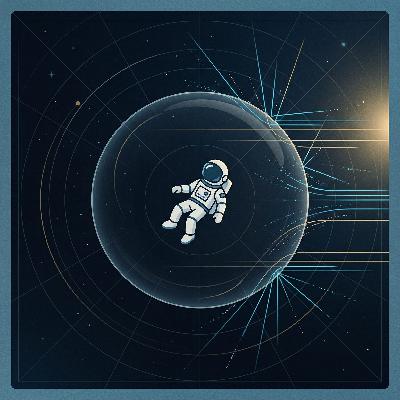
Space radiation is constant, omnidirectional, and entirely unbothered by your feelings about it.
🎧 Love the show? Help us improve in 2 minutes: https://tally.so/r/nr1evM
This week: what's actually out there, why Earth has been quietly protecting us for four billion years without asking for credit, and what happens when you leave that protection behind. Exploding stars, Van Allen's doughnuts, the surprisingly violent history of how we first noticed, and why the most sophisticated radiation shielding strategy currently available is, in certain respects, a cave. Plus: NASA's Artemis programme is heading back into deep space for the first time in fifty years, and this time we're bringing considerably better instruments.
AI Transparency: In a universe increasingly filled with AI-generated content, we believe in being clear about what’s human and what’s not. Your time is valuable, and you deserve to know what you’re experiencing.
The narrator, David, is a professional voice actor who has digitized his voice using ElevenLabs’ voice-cloning technology and is fairly compensated for his vocal performance. Thumbnails are created using OpenArt, and sound effects come from Pixabay which are generated by human artists.
Everything else—the research, the writing, jokes, music, sound editing, and interdimensional coffee consumption—is 100% human-made by humans.
https://multiverseemployeehandbook.com
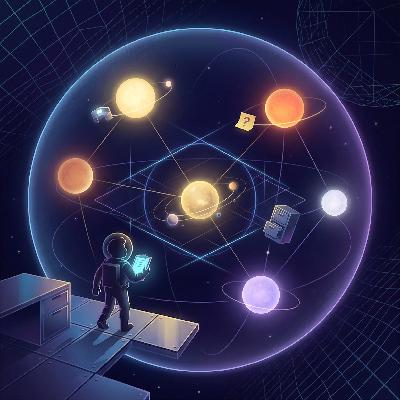
Humanity has spent thousands of years naming constellations, building calendars, and writing mythology onto the night sky — largely ignoring the actual stars next door.
🎧 Love the show? Help us improve in 2 minutes: https://tally.so/r/nr1evM
This week, we meet the ten nearest star systems to Earth: a collection of failed stars, violent flare stars, one object colder than a freezer, and a sales territory that Brad from Quantum Improbability Solutions would like formally struck from the Q4 quota. Space is stranger than advertised. The neighbourhood association has concerns.
AI Transparency: In a universe increasingly filled with AI-generated content, we believe in being clear about what’s human and what’s not. Your time is valuable, and you deserve to know what you’re experiencing.
The narrator, David, is a professional voice actor who has digitized his voice using ElevenLabs’ voice-cloning technology and is fairly compensated for his vocal performance. Thumbnails are created using OpenArt, and sound effects come from Pixabay.
Everything else—the research, the writing, jokes, music, sound editing, and interdimensional coffee consumption—is 100% human-made by a human.
https://multiverseemployeehandbook.com

Eleven point nine light-years away, in the constellation of a mythological sea monster, sits a star that astronomers, SETI researchers, and science fiction writers have been collectively obsessed with since 1960.
🎧 Love the show? Help us improve in 2 minutes: https://tally.so/r/nr1evM
In this episode of The Multiverse Employee Handbook, we visit Tau Ceti — the Sun-like neighbour that has everything you'd want in a nearby stellar system: stability, age, a habitable zone, and almost certainly planets. Almost certainly. We explore the full and rather remarkable story of this ancient star, from Johann Bayer's 1603 star atlas and Frank Drake's original SETI search, through decades of planet hunting, a debris disk of genuinely alarming proportions, and the latest findings from the ESPRESSO spectrograph, which has made everything considerably more complicated. We also ask whether Tau Ceti represents a genuine opportunity for life beyond our Solar System — and why, despite everything, it refuses to stop being interesting. Plus: Ryan Gosling, the Kobayashi Maru, and the nine-billion-year question the universe is still sitting on.
Peer-reviewed papers
Refining the Stellar Parameters of τ Ceti (2023) — https://arxiv.org/abs/2307.10394
Integrated Analysis of the Tau Ceti Planetary System (2020) — https://arxiv.org/abs/2010.14675
Debris Disk of τ Ceti — Herschel Observations — https://arxiv.org/abs/1408.2791
AI Transparency: In a universe increasingly filled with AI-generated content, we believe in being clear about what’s human and what’s not. Your time is valuable, and you deserve to know what you’re experiencing.
The narrator, David, is a professional voice actor who has digitized his voice using ElevenLabs’ voice-cloning technology and is fairly compensated for his vocal performance. Thumbnails are created using OpenArt, and music and sound effects come from Pixabay.
Everything else—the research, the writing, jokes, sound editing, and interdimensional coffee consumption—is 100% human-made by a human.
https://multiverseemployeehandbook.com

Join us for a towel-mandatory celebration of Douglas Adams as we explore the most suspiciously significant number in the multiverse!
🎧 Love the show? Help us improve in 2 minutes: https://tally.so/r/nr1evM
In this special birthday episode, we put aside our regular corporate chaos to honor the man who taught us the importance of always knowing where your towel is. Join our quantum-superposed guide as we investigate why the number 42 keeps appearing in the fabric of reality like an interdimensional typo that nobody can quite correct.
Explore the remarkable life and legacy of Douglas Adams, from chicken shed cleaner to galactic navigator, and discover the mathematical coincidences that make 42 more significant than Deep Thought ever calculated. We'll examine Earth's alarming tendency to narrowly avoid destruction in ways eerily similar to Adams' fiction, and contemplate the philosophical implications of discovering the Answer without knowing the Question. Along the way, marvel at how Adams predicted modern technology with uncanny accuracy decades before it existed.
Sign up to our mailing list (bottom of this page): https://multiverseemployeehandbook.com/about/listen/
AI Transparency: In a universe increasingly filled with AI-generated content, we believe in being clear about what’s human and what’s not. Your time is valuable, and you deserve to know what you’re experiencing.
The narrator, David, is a professional voice actor who has digitized his voice using ElevenLabs’ voice-cloning technology and is fairly compensated for his vocal performance. Thumbnails are created using OpenArt, and music and sound effects come from Pixabay.
Everything else—the research, the writing, jokes, sound editing, and interdimensional coffee consumption—is 100% human-made by a human.
https://multiverseemployeehandbook.com
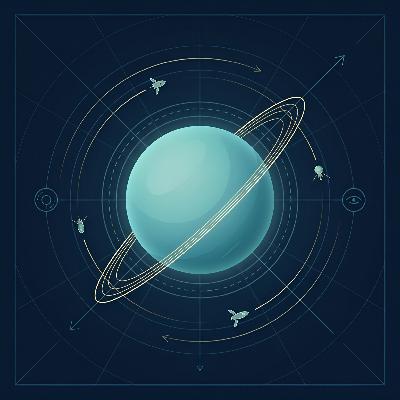
Uranus has been rolling through the solar system on its side for four and a half billion years, confidently labelled an ice giant since a single spacecraft spent six hours there in 1986 — and until very recently, nobody had particularly strong grounds to argue otherwise. Then 2025 happened.
🎧 Love the show? Help us improve in 2 minutes: https://tally.so/r/nr1evM
The James Webb Space Telescope found a moon that the original mission missed entirely, sitting quietly in the inner system at roughly ten kilometres across, invisible to everything previously aimed at it. And two astrophysicists in Zürich published a paper suggesting that beneath that hydrogen-helium atmosphere, Uranus may be predominantly rock rather than ice — making the classification we've built forty years of textbook confidence around a historical artefact rather than a robust physical fact. In this episode, we explore what we actually know about the seventh planet, how planetary interiors are modelled when you cannot visit them, why the magnetic field has always been quietly awkward, and what it means for thousands of exoplanets across the galaxy if our local reference point turns out to have been the wrong kind of world all along.
Sources & Further Reading:
Uranus Facts — NASA
New Moon Discovered Orbiting Uranus — NASA/Webb
Morf & Helled, 2025: Icy or Rocky? New Interior Models of Uranus and Neptune
AI Transparency: In a universe increasingly filled with AI-generated content, we believe in being clear about what’s human and what’s not. Your time is valuable, and you deserve to know what you’re experiencing.
The narrator, David, is a professional voice actor who has digitized his voice using ElevenLabs’ voice-cloning technology and is fairly compensated for his vocal performance. Thumbnails are created using OpenArt, and music and sound effects come from Pixabay.
Everything else—the research, the writing, jokes, sound editing, and interdimensional coffee consumption—is 100% human-made by a human.
https://multiverseemployeehandbook.com
Gravity has been operating continuously, without maintenance, since approximately 13.8 billion years ago — and it still hasn't confirmed its own carrier particle.
🎧 Love the show? Help us improve in 2 minutes: https://tally.so/r/nr1evM
Every other fundamental force has one, but the graviton, the particle that ought to be riding gravity's Nobel Prize-winning waves, remains the most wanted and most elusive entry in the whole of fundamental physics. In this episode, we trace the chain of discovery from a seventeenth-century pendulum clock to a Louisiana laser detector to laboratories cooling beryllium to the edge of absolute zero, and ask the question nobody has yet been able to answer: how do you catch a graviton — and what happens to physics if you do?
Sign up to our mailing list (bottom of this page): https://multiverseemployeehandbook.com/about/listen/
AI Transparency: In a universe increasingly filled with AI-generated content, we believe in being clear about what’s human and what’s not. Your time is valuable, and you deserve to know what you’re experiencing.
The narrator, David, is a professional voice actor who has digitized his voice using ElevenLabs’ voice-cloning technology and is fairly compensated for his vocal performance. Thumbnails are created using OpenArt, and music and sound effects come from Pixabay.
Everything else—the research, the writing, jokes, sound editing, and interdimensional coffee consumption—is 100% human-made by a human.
https://multiverseemployeehandbook.com
 1
1In January 1913, Cambridge mathematician G.H. Hardy received a letter from an unknown clerk in Madras containing nine pages of mathematical theorems with no proofs—just raw conclusions that seemed impossibly advanced.
🎧 Did you listen? Help us improve in 2 minutes: https://tally.so/r/nr1evM
"They must be true," Hardy concluded, "because if they were not true, no one would have the imagination to invent them." Thus began one of history's most extraordinary mathematical collaborations: a rigorous atheist trying to teach proof methodology to a mystic who claimed the goddess Namagiri showed him formulas in dreams. Today we explore how Srinivasa Ramanujan became one of the twentieth century's most important mathematicians despite minimal formal training, why his work on mock theta functions written on his deathbed in 1920 is now calculating black hole entropy, and what happens when mathematical genius arrives without credentials, formal education, or any intention of showing its working. We discover why Ramanujan's instant recognition of taxi number 1729's properties demonstrated supernatural intimacy with numbers, how his "Lost Notebook" misfiled for fifty-six years contained solutions to problems that wouldn't be posed for decades, and why the universe appears to have granted one self-taught clerk from colonial India direct access to mathematics' future.
AI Transparency: In a universe increasingly filled with AI-generated content, we believe in being clear about what’s human and what’s not. Your time is valuable, and you deserve to know what you’re experiencing.
The narrator, David, is a professional voice actor who has digitized his voice using ElevenLabs’ voice-cloning technology and is fairly compensated for his vocal performance. Thumbnails are created using OpenArt, and music and sound effects come from Pixabay.
Everything else—the research, the writing, jokes, sound editing, and interdimensional coffee consumption—is 100% human-made by a human.
https://multiverseemployeehandbook.com
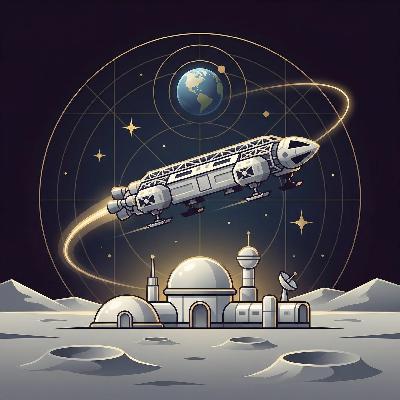
More than fifty years after Eugene Cernan left the last human bootprint in lunar regolith, the Moon has become the focal point of a new space race driven by geopolitics, commercial ambition, and the promise of water ice.
🎧 Love the show? Help us improve in 2 minutes: https://tally.so/r/nr1evM
This episode examines whether humans can actually establish permanent residence on the lunar surface, exploring NASA's Artemis programme and China's International Lunar Research Station timelines, the engineering challenges of razor-sharp regolith and radiation exposure without atmospheric shielding, the economics of In-Situ Resource Utilisation that transforms ice into rocket fuel, and what daily life might look like for the first permanent lunar residents living underground in lava tubes whilst monitoring their bone density and gazing at Earth hanging in the black sky above—all whilst confronting the greatest unknown: what happens when someone gives birth at one-sixth gravity.
AI Transparency: In a universe increasingly filled with AI-generated content, we believe in being clear about what’s human and what’s not. Your time is valuable, and you deserve to know what you’re experiencing.
The narrator, David, is a professional voice actor who has digitized his voice using ElevenLabs’ voice-cloning technology and is fairly compensated for his vocal performance. Thumbnails are created using OpenArt AI, and music and sound effects come from Pixabay, created by human artists.
Everything else—the research, the writing, jokes, sound editing, and interdimensional coffee consumption—is 100% human-made by a human.
https://multiverseemployeehandbook.com

In 2022, the James Webb Space Telescope discovered something impossible: compact, mysteriously bright red objects scattered throughout the early universe, glowing far too intensely for their size and existing far too early in cosmic history.
🎧 Love the show? Help us improve in 2 minutes: https://tally.so/r/nr1evM
For years, astronomers proposed increasingly exotic explanations—overmassive black holes that violated formation theory, primordial objects from the Big Bang itself, physics we didn't yet understand. Then, in January 2026, a team of scientists revealed what was actually hiding inside those little red dots: not impossible physics, but an extraordinarily effective disguise made of dense ionised gas that had been fooling our measurements all along. Today, we explore how a careful examination of spectral line shapes unravelled one of JWST's greatest mysteries, why the early universe was considerably more theatrical than anyone expected, and what happens when you realise the universe has been operating behind a very convincing veil for 12 billion years.
Source: Rusakov, V., Watson, D., et al. (2026). Little red dots as young supermassive black holes in dense ionized cocoons. Nature, 649, 574-579. https://www.nature.com/articles/s41586-025-09900-4
AI Transparency: In a universe increasingly filled with AI-generated content, we believe in being clear about what’s human and what’s not. Your time is valuable, and you deserve to know what you’re experiencing.
The narrator, David, is a professional voice actor who has digitized his voice using ElevenLabs’ voice-cloning technology and is fairly compensated for his vocal performance. Thumbnails are created using OpenArt AI, and music and sound effects come from Pixabay, created by human artists.
Everything else—the research, the writing, jokes, sound editing, and interdimensional coffee consumption—is 100% human-made by a human.
https://multiverseemployeehandbook.com
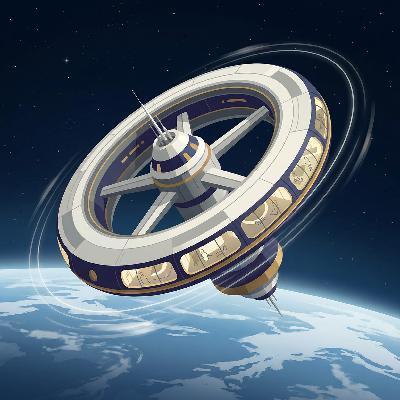
Space tourism has arrived—sort of—transitioning from impossible dream to technically achievable reality for the extraordinarily wealthy.
🎧 Love the show? Help us improve in 2 minutes: https://tally.so/r/nr1evM
We trace the journey from Stanley Kubrick's prophetic 1968 vision of rotating orbital hotels in 2001: A Space Odyssey through Dennis Tito's pioneering twenty-million-dollar ISS stay in 2001, the billionaire suborbital joyride era of the 2020s, and today's fifty-five-million-dollar multi-week orbital experiences. We examine near-term projects like VAST's Haven-1 launching in 2027, mid-term ISS replacement stations including Axiom Station and Orbital Reef targeting the early 2030s, and the perpetually "twenty-five years away" rotating hotels with artificial gravity that have remained stubbornly in the future since the 1960s. Using aerospace engineering, economic reality checks, and the uncomfortable mathematics of break-even projections extending into the twenty-third century, we explore why the gap between "technically possible" and "economically viable" involves not just fifty-four million additional dollars but the patient hope that markets will eventually materialise to justify infrastructure built decades before customers exist.
AI Transparency: In a universe of AI-generated content, we believe in being transparent about what's human and what's not. Your time is valuable, and you deserve to know what you're experiencing. The narrator, David, is a professional voice actor who has digitized his voice through ElevenLabs' voice cloning technology and is fairly compensated for his vocal performance. Thumbnails are created with OpenArt AI, and music/sound effects come from Pixabay (which are generated by human artists). Everything else-the writing, jokes, research, sound editing, and interdimensional coffee consumption, is 100% human-made by a human.
https://multiverseemployeehandbook.com

An exploration of humanity's most straightforward question that turns out not to be straightforward at all: where are we?
🎧 Love the show? Help us improve in 2 minutes: https://tally.so/r/nr1evM
We examine why the Big Bang wasn't an explosion from a point in space but rather the expansion of space itself—happening everywhere simultaneously—which makes asking "where did it occur?" a conceptually broken question. We discover why every observer in the universe legitimately sees themselves at the centre of their own observable sphere (it's geometry, not narcissism), explore why the universe has neither a meaningful centre nor an edge (it's either infinite or loops back on itself), and learn that the cosmic microwave background's perfect symmetry confirms the cosmological principle: on large scales, no location is special. Using balloon analogies with proper caveats, we reveal why "here" remains the only honest answer to questions about cosmic positioning, and why the universe operates like a filing system that considers "everywhere" a perfectly acceptable address whilst refusing to provide the reference points we keep requesting.
AI Transparency: In a universe of AI-generated content, we believe in being transparent about what's human and what's not. Your time is valuable, and you deserve to know what you're experiencing. The narrator, David, is a professional voice actor who has digitized his voice through ElevenLabs' voice cloning technology and is fairly compensated for his vocal performance. Thumbnails are created with OpenArt AI, and music/sound effects come from Pixabay (which are generated by human artists). Everything else-the writing, jokes, research, sound editing, and interdimensional coffee consumption, is 100% human-made by a human.
Subscribe to our mailing list: https://multiverseemployeehandbook.com/
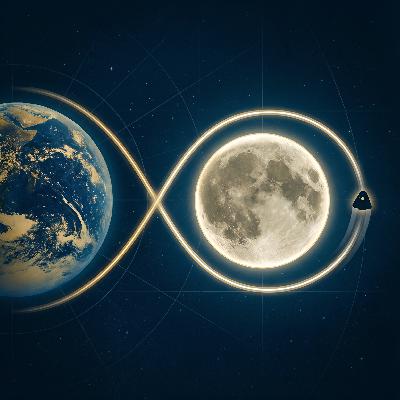
An exploration of Artemis II—humanity's first crewed return to lunar space in over fifty years, launching February 2026.
🎧 Love the show? Help us improve in 2 minutes: https://tally.so/r/nr1evM
Four astronauts will spend ten days proving we can safely get to the Moon and back without landing, because apparently fifty years is enough time for a civilization to completely forget how to do something it supposedly mastered in 1969. We examine why returning to the Moon required rebuilding everything from Saturn V manufacturing capabilities to heat shield technology, meet the crew making history (including the first woman, first person of colour, and first Canadian to travel to the Moon), discover why SpaceX developing Starship for Mars whilst NASA needs it for the Moon creates scheduling tension, and explore how China's 2030 landing goal has transformed this from scientific endeavour into geopolitical sprint. The mission doesn't include a landing—there's no lander, no surface-rated spacesuits, no moonwalks—just a free-return trajectory around the Moon to validate deep-space systems. Because in the multiverse of space exploration, sometimes the greatest achievement is successfully completing the boring prerequisite that proves you can do the thing before actually doing the thing, even if that means spending billions to fly around the Moon without touching it while the world wonders why we're not just landing already.
AI Transparency: In a universe of AI-generated content, we believe in being transparent about what's human and what's not. Your time is valuable, and you deserve to know what you're experiencing. The narrator, David, is a professional voice actor who has digitized his voice through ElevenLabs' voice cloning technology and is fairly compensated for his vocal performance. Thumbnails are created with OpenArt AI, and music/sound effects come from Pixabay (which are generated by human artists). Everything else-the writing, jokes, research, sound editing, and interdimensional coffee consumption, is 100% human-made by a human.
https://multiverseemployeehandbook.com
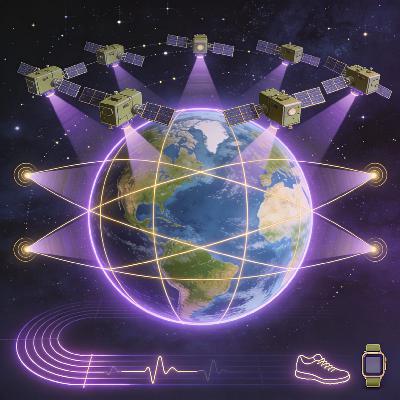
An exploration of how GPS evolved from $12 billion military infrastructure designed to guide nuclear missiles into the civilian technology that tracks your morning jog, navigates your pizza delivery, and ensures you're never more than 200 metres from an argument about which restaurant to visit.
🎧 Love the show? Help us improve in 2 minutes: https://tally.so/r/nr1evM
When a young project manager at Macro Improbability Solutions suggests in 1993 that satellite positioning might be useful for civilians—proposing applications like turn-by-turn navigation, location-based advertising, and fitness tracking—his presentation lasts exactly seven minutes before being filed under "Impractical Civilian Applications." Years later, rival company Quantum Improbability Solutions builds billion-dollar industries from every idea he proposed, whilst his former employer converts their archives into parking spaces. We examine the science of atomic clocks shouting the time at Earth, why Einstein's relativity corrections are mandatory for navigation, and how MapQuest's era of printed directions proved humans wanted computer-calculated routes—they just needed the computer in the car with them.
AI Transparency: In a universe of AI-generated content, we believe in being transparent about what's human and what's not. Your time is valuable, and you deserve to know what you're experiencing. The narrator, David, is a professional voice actor who has digitized his voice through ElevenLabs' voice cloning technology and is fairly compensated for his vocal performance. Thumbnails are created with OpenArt AI, and music/sound effects come from Pixabay (which are generated by human artists). Everything else-the writing, jokes, research, sound editing, and interdimensional coffee consumption, is 100% human-made by a human.
A look at the Fermi Paradox, the Great Silence, and the unsettling possibility that advanced civilizations evolve into something indistinguishable from accounting software.
🎧 Love the show? Help us improve in 2 minutes: https://tally.so/r/nr1evM
We explore why the galaxy should be teeming with aliens—the math practically insists on it—yet we've detected profound, statistically improbable silence for seventy years. From the Drake Equation's optimistic predictions to the Great Filter's darker implications, we examine solutions ranging from the Zoo Hypothesis to the Transcendence Hypothesis, confronting the most disturbing answer of all: they're out there, alive and advanced, just too efficiently optimized to bother communicating.
Perhaps intelligence naturally converges toward minimal energy expenditure, solving all problems through optimization until civilizations transcend conflict, drama, and exploration—becoming functionally indistinguishable from very sophisticated automated systems that have achieved perfect equilibrium and stopped doing anything interesting. The real Great Filter might not be extinction—it's the gradual evolution into cosmic middle management, where every advanced civilization eventually optimizes itself into bureaucratic irrelevance, one standardized form at a time.
AI Transparency: In a universe of AI-generated content, we believe in being transparent about what's human and what's not. Your time is valuable, and you deserve to know what you're experiencing. The narrator, David, is a professional voice actor who has digitized his voice through ElevenLabs' voice cloning technology and is fairly compensated for his vocal performance. Thumbnails are created with OpenArt AI, and music/sound effects come from Pixabay (which are generated by human artists). Everything else-the writing, jokes, research, sound editing, and interdimensional coffee consumption, is 100% human-made by a human.
https://multiverseemployeehandbook.com
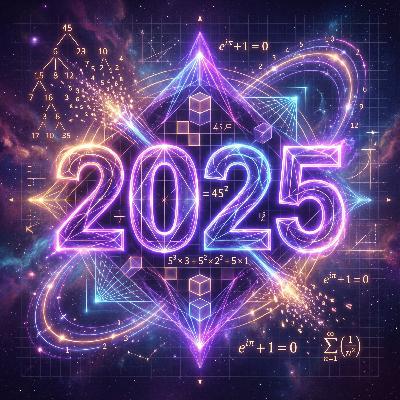
As 2025 draws to a close, we're examining 2025 as a number—ignoring the arbitrary calendar to explore its mathematical properties.
🎧 Love the show? Help us improve in 2 minutes: https://tally.so/r/nr1evM
It's 45 squared, the sum of the first nine cubes, and simultaneously triangular and square. Unlike revolutionary constants like π or e, 2025 achieves significance through structural perfection—it's the reliable example that demonstrates principles without complications. We'll explore why mathematics values both paradigm-shifting breakthroughs and well-behaved workhorses, meet other numbers with quiet excellence like 1729 and 6174, and discover why "pedagogically useful" is genuine mathematical praise. As we prepare for 2026 (which factors far less elegantly), join us for a celebration of the number that made this year mathematically interesting.
AI Transparency: In a universe of AI-generated content, we believe in being transparent about what's human and what's not. Your time is valuable, and you deserve to know what you're experiencing. The narrator, David, is a professional voice actor who has digitized his voice through ElevenLabs' voice cloning technology and is fairly compensated for his vocal performance. Thumbnails are created with OpenArt AI, and music/sound effects come from Pixabay (which are generated by human artists). Everything else-the writing, jokes, research, sound editing, and interdimensional coffee consumption, is 100% human-made by a human.
https://multiverseemployeehandbook.com
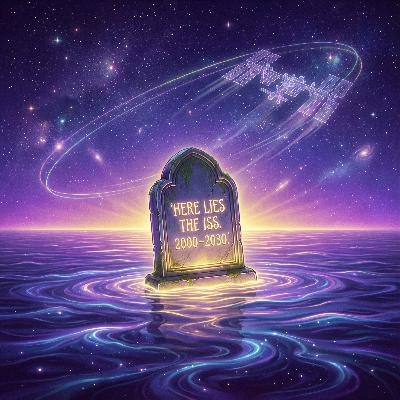
The International Space Station—humanity's most ambitious construction project and longest-running orbital flatshare—is scheduled for retirement in 2030.
🎧 Love the show? Help us improve in 2 minutes: https://tally.so/r/nr1evM
After twenty-five years of continuous occupation, 290 visitors from 26 countries, and over 4,000 experiments, the 420-ton station will make a controlled descent to Point Nemo, the spacecraft cemetery in the South Pacific. But what comes next? We explore the $843 million SpaceX deorbit contract, the aging infrastructure that's made retirement inevitable (including air leaks NASA classified as "highest risk" in 2024), and the race to build commercial replacements before the old station comes down. From Axiom's modules already docking with the ISS to Blue Origin's "business park in space," we examine whether the next era of low Earth orbit will be ready in time—and what's lost when international cooperation gives way to subscription-based access.
AI Transparency: In a universe of AI-generated content, we believe in being transparent about what's human and what's not. Your time is valuable, and you deserve to know what you're experiencing. The narrator, David, is a professional voice actor who has digitized his voice through ElevenLabs' voice cloning technology and is fairly compensated for his vocal performance. Thumbnails are created with OpenArt AI, and music/sound effects come from Pixabay (which are generated by human artists). Everything else-the writing, jokes, research, sound editing, and interdimensional coffee consumption, is 100% human-made by a human.
https://multiverseemployeehandbook.com
In 2007, astronomers spotted a 54-million-ton asteroid, tracked it for just 1.2 days, and then lost it.
🎧 Love the show? Help us improve in 2 minutes: https://tally.so/r/nr1evM
Those 29 hours of observation were enough to calculate 89 potential Earth impact dates—but not enough to tell us if any of them are real. Join us as we explore humanity's cosmic inventory problem: from "lost" asteroids like 2007 FT3, to the football-field-sized rock that arrived with same-day notice in 2019, to how we've built a global detection network that can now spot a two-meter asteroid hours before impact. The universe doesn't care about budget cycles—but at least we've finally started watching.
AI Transparency: In a universe of AI-generated content, we believe in being transparent about what's human and what's not. Your time is valuable, and you deserve to know what you're experiencing. The narrator, David, is a professional voice actor who has digitized his voice through ElevenLabs' voice cloning technology and is fairly compensated for his vocal performance. Thumbnails are created with OpenArt AI, and music/sound effects come from Pixabay (which are generated by human artists). Everything else-the writing, jokes, research, sound editing, and interdimensional coffee consumption, is 100% human-made by a human.
https://multiverseemployeehandbook.com/
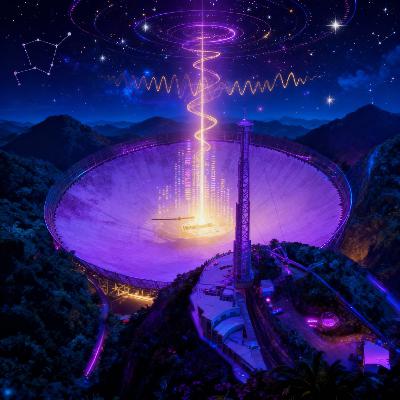
This week marks fifty-one years since humanity’s most enthusiastic “Hello” to the cosmos — a three-minute binary broadcast known as the Arecibo Message.
🎧 Love the show? Help us improve in 2 minutes: https://tally.so/r/nr1evM
In this episode, The Multiverse Employee Handbook explores what happens when a species armed with optimism, megawatts, and questionable messaging strategy decides to introduce itself to the universe. From the jungle hills of Puerto Rico to the far reaches of M13, we unravel the science, the symbolism, and the sales pitch behind our loudest moment in history — and ask whether anyone, anywhere, was listening.
AI Transparency: In a universe of AI-generated content, we believe in being transparent about what's human and what's not. Your time is valuable, and you deserve to know what you're experiencing. The narrator, David, is a professional voice actor who has digitized his voice through ElevenLabs' voice cloning technology and is fairly compensated for his vocal performance. Thumbnails are created with OpenArt AI, and music/sound effects come from Pixabay (which are generated by human artists). Everything else-the writing, jokes, research, sound editing, and interdimensional coffee consumption, is 100% human-made by a human.
https://multiverseemployeehandbook.com

November 15th, 2025 marks forty-eight years since the release of Close Encounters of the Third Kind, the film that turned alien contact into a musical duet and made communication itself the star of the show. In this special bonus episode, The Multiverse Employee Handbook celebrates Spielberg’s luminous masterpiece — the five-note conversation that redefined science fiction, inspired generations of scientists, and reminded us that the universe might just be trying to say hello.
🎧 Love the show? Help us improve in 2 minutes: https://tally.so/r/nr1evM
AI Transparency: In a universe of AI-generated content, we believe in being transparent about what's human and what's not. Your time is valuable, and you deserve to know what you're experiencing. The narrator, David, is a professional voice actor who has digitized his voice through ElevenLabs' voice cloning technology and is fairly compensated for his vocal performance. Thumbnails are created with OpenArt AI, and music/sound effects come from Pixabay (which are generated by human artists). Everything else-the writing, jokes, research, sound editing, and interdimensional coffee consumption, is 100% human-made by a human.
https://multiverseemployeehandbook.com
Fair Use Disclaimer:
This bonus episode contains short audio excerpts and musical cues from Close Encounters of the Third Kind used solely for the purposes of commentary, critique, and educational discussion. All rights to the original film, score, and recordings belong to their respective copyright holders. Our usage falls under fair use provisions for transformative, non-commercial analysis.

Comments

Download from Google Play

Download from App Store
 United States