


 Claim Ownership
IT SPARC Cast
Subscribed: 1Played: 13
Subscribe

© John Barger
Description
IT SPARC Cast is a digest of the Enterprise IT news over the last week, with insights, opinions, and a little sarcasm from 2 experts each with over 20 years of experience working in IT or for IT vendors.
Hosted on Acast. See acast.com/privacy for more information.
120 Episodes
Reverse
This week on IT SPARC Cast, John Barger and Lou Schmidt break down three stories shaping the future of enterprise IT—from continued AI spending despite questionable ROI, to radically new approaches to long-term data storage, and a major consolidation in the online learning market.⸻📰 News Bytes00:46 – CEOs Keep Spending on AI Despite Spotty ReturnsDespite mixed financial outcomes, a growing number of CEOs plan to increase AI investment through 2026, viewing AI as strategically unavoidable rather than immediately profitable.Key discussion points:•Fewer than half of current AI projects are delivering clear ROI•Strong gains in sales, marketing, customer service, and developer productivity•Weak performance in regulated, high-risk areas like legal, HR, compliance, and cybersecurity•Layoffs blamed on AI may result in long-term operational backlashThe hosts argue that AI should augment human expertise, not prematurely replace it—and warn against betting the company on incomplete automation strategies.https://www.msn.com/en-us/technology/artificial-intelligence/ceos-to-keep-spending-on-ai-despite-spotty-returns/ar-AA1SkMcE07:34 – 5D Glass Storage: Crystals for the EnterpriseA UK company, SPhotonix, is advancing 5D glass storage, capable of preserving data for billions of years by etching nanoscale structures into glass using femtosecond lasers.Highlights include:•360 TB per 5-inch glass disk•Designed for permanent archival, not hot or warm storage•Potential replacement for long-term tape archives•Early write speeds are slow, but roadmap improvements are promisingThis technology positions itself as a future-proof solution for enterprises, governments, universities, and cultural institutions facing long-term data retention challenges.https://www.tomshardware.com/pc-components/storage/sphotonix-pushes-5d-glass-storage-toward-data-center-pilots15:00 – Coursera Acquires Udemy for $930 MillionOnline education giant Coursera is acquiring Udemy in a deal valued at approximately $930 million, creating a dominant force in enterprise and consumer e-learning.Discussion points:•Udemy’s strong practitioner-led course model•Coursera’s academic and credentialing reach•Expanded use of AI for assessments, personalization, and skills validation•Potential shift toward a “market-driven university” modelThe hosts see this consolidation as a net positive for enterprise IT teams responsible for compliance training, upskilling, and leadership development.https://techcrunch.com/2025/12/17/coursera-and-udemy-enter-a-merger-agreement-valued-at-around-2-5b/🔁 Wrap Up20:00 – Listener Feedback⭐ Community Call-Out: Abdullah’s React Audit ToolA special shout-out to Abdullah ( https://x.com/ozkayabd ) who responded on X after a previous React CVE episode and shared an open-source tool to help teams audit their environments:👉 React Audit Scannerhttp://rsc-auditor.vercel.appThis tool allows teams to quickly check whether they may be impacted by recent React vulnerabilities. As always, review and validate any third-party tool before using it in production.A special shout-out to Megan, who reached out after the episode with thoughtful feedback—and who’s doing important work to tackle a problem far too many people experience: ghosting of job applicants by recruiters and HR teams.Megan is actively pushing for better communication, transparency, and basic professionalism in the hiring process. It’s a reminder that while we talk a lot about AI, automation, and efficiency, the human side of tech and hiring still matters. Follow her on LinkedIn:https://www.linkedin.com/in/megan-julianoConnect with the hosts and the show:IT SPARC Cast@ITSPARCCast on Xhttps://www.linkedin.com/company/sparc-sales/John Barger@john_Video on Xhttps://www.linkedin.com/in/johnbarger/Lou Schmidt@loudoggeek on Xhttps://www.linkedin.com/in/louis-schmidt-b102446/ Hosted on Acast. See acast.com/privacy for more information.

In this episode of IT SPARC Cast – CVE of the Week, John Barger and Lou Schmidt break down a long-overdue security move from Microsoft: disabling the RC4 cipher by default across Windows authentication infrastructure. After more than two decades of known cryptographic weaknesses, RC4 is finally being deprecated in favor of modern encryption standards like AES.The discussion covers why RC4 persisted for so long, how legacy Active Directory and Kerberos environments kept it alive, and why attackers have continued to exploit it through techniques like Kerberoasting. The hosts also highlight the new logging, auditing, and PowerShell tools Microsoft released to help enterprises identify and eliminate lingering RC4 dependencies—without breaking production systems.⸻📋 Show Notes🔐 Main Topic: Microsoft Disables RC4 by Default•Microsoft is removing RC4 (Rivest Cipher 4) as a default cipher in Windows authentication after more than 25 years.•RC4 has been known to be cryptographically broken for decades and has been actively exploited in real-world attacks.•The change impacts Kerberos authentication across Windows Server 2008 and later.•RC4 will still function only if explicitly re-enabled—which is strongly discouraged.⚠️ Why RC4 Is Dangerous•RC4 has been abused in Kerberoasting attacks against Active Directory environments.•Weak encryption allows attackers to extract service account credentials offline.•Keeping RC4 enabled significantly increases the blast radius of a compromised domain.🛠️ What Microsoft Did Right This Time•Added enhanced Kerberos logging (Event IDs 4768 and 4769) to identify RC4 usage.•Released PowerShell scripts to audit domain controllers for RC4 dependencies.•Published clear migration guidance to move environments to AES-SHA1 and stronger encryption.•Provided visibility before enforcing the change, helping admins avoid outages.🎧 Listener Feedback Highlight•A YouTube listener praised the CVE of the Week format as being highly valuable from an ops and security standpoint.•Strong validation that actionable vulnerability analysis resonates with enterprise IT teams.⭐ Community Call-Out: Abdullah’s React Audit ToolA special shout-out to Abdullah ( https://x.com/ozkayabd ) who responded on X after a previous React CVE episode and shared an open-source tool to help teams audit their environments:👉 React Audit Scannerhttp://rsc-auditor.vercel.appThis tool allows teams to quickly check whether they may be impacted by recent React vulnerabilities. As always, review and validate any third-party tool before using it in production.⸻🔚 Wrap Up & Social LinksIT SPARC Cast@ITSPARCCast on Xhttps://www.linkedin.com/company/sparc-sales/ on LinkedInJohn Barger@john_Video on Xhttps://www.linkedin.com/in/johnbarger/ on LinkedInLou Schmidt@loudoggeek on Xhttps://www.linkedin.com/in/louis-schmidt-b102446/ on LinkedIn Hosted on Acast. See acast.com/privacy for more information.
In this episode of IT SPARC Cast – News Bytes, John and Lou tackle one of the most emotionally charged weeks in enterprise IT. Google CEO Sundar Pichai openly acknowledges that AI-driven layoffs will cause real pain before progress—a statement that sparks a candid Hot Take on disruption, job loss, and opportunity.From there, the show dives deep into the mounting backlash against U.S. data centers, with over 200 environmental groups demanding a halt to new builds—ironically accelerating plans for orbital data centers. The conversation then turns optimistic as the inventor of the Super Soaker unveils a breakthrough technology that converts waste heat directly into electricity, potentially reshaping geothermal and data center power economics.Finally, the guys explore Boom Supersonic’s unexpected pivot—using jet engines as grid-scale power generators for data centers—and Google’s launch of managed MCP servers that allow AI agents to plug directly into core Google services with minimal integration effort.⸻⏱️ Show Notes00:00 – IntroThis week: Google admits AI pain is coming, environmentalists push data centers toward orbit, waste heat becomes power, and AI agents get a universal plug.⸻HOT TAKE00:55 – Google CEO on AI Layoffs: “We’re All Going to Have to Suffer Through It”•Sundar Pichai acknowledges widespread layoffs and economic strain tied to AI adoption.•John and Lou discuss why AI-driven efficiency gains are being used as justification for premature workforce cuts.•Key argument: AI doesn’t replace people—it amplifies small teams and enables entrepreneurship.https://www.msn.com/en-us/money/companies/google-ceo-says-we-re-all-going-to-have-to-suffer-through-it-as-ai-puts-society-through-the-woodchipper/ar-AA1S5Pzx ⸻NEWS BYTES06:11 – More Than 200 Environmental Groups Demand Halt to New U.S. Data Centers•Greenpeace and others cite water usage, power demand, and CO₂ emissions.•~$64 billion in data center projects already delayed or halted.•Lou explains why this pressure is accelerating interest in orbital data centers—one FCC license vs. hundreds of local permits.https://www.theguardian.com/us-news/2025/dec/08/us-data-centers ⸻10:26 – Super Soaker Inventor Wants to Turn Waste Heat into Electricity•Lonnie Johnson (inventor of the Super Soaker) unveils the Johnson Thermal Electrochemical Converter (JTEC).•Works with small temperature differentials—no turbines, no moving parts.•Could dramatically change how data centers source supplemental power.https://www.ajc.com/business/2025/11/earth-needs-more-energy-atlantas-super-soaker-creator-may-have-a-solution/ ⸻13:08 – Boom Supersonic Uses Jet Engines to Power Data Centers•Boom Supersonic repurposes its jet engine designs into natural gas turbines for data centers.•Each turbine outputs ~42 MW; initial orders exceed 1.2 GW and are rapidly increasing.•First deliveries expected in 2027; turbine factory opening next year.•John and Lou connect this to job creation across manufacturing, operations, and IT management.https://techcrunch.com/2025/12/10/google-is-going-all-in-on-mcp-servers-agent-ready-by-design/ ⸻16:44 – Google Launches Managed MCP Servers for AI Agents•Google introduces managed Model Context Protocol (MCP) servers on GCP.•MCP creates a universal “language” for AI agents to interact with tools and services.•Reduces API complexity—ask questions, get results, take action.•Free during public preview for enterprise customers.•Lou calls this a major step toward AI-native enterprise workflows.https://techcrunch.com/2025/12/10/google-is-going-all-in-on-mcp-servers-agent-ready-by-design/ ⸻Wrap Up20:38 – Mail Bag & Wrap Up•Listener feedback highlights interest in portable and containerized data centers.IT SPARC Cast@ITSPARCCast on Xhttps://www.linkedin.com/company/sparc-sales/ on LinkedInJohn Barger@john_Video on Xhttps://www.linkedin.com/in/johnbarger/ on LinkedInLou Schmidt@loudoggeek on Xhttps://www.linkedin.com/in/louis-schmidt-b102446/ on LinkedIn Hosted on Acast. See acast.com/privacy for more information.
This week on IT SPARC Cast – CVE of the Week, John Barger and Lou Schmidt break down a code-red security situation affecting a massive portion of the modern web. CVE-2025-55182 is a critical, actively exploited vulnerability in React Server Components (RSC) that enables unauthenticated remote code execution, even in applications that don’t explicitly use server functions.With an estimated 33–35% of cloud-based services running React, attackers are already leveraging automated tooling to deploy cryptominers, Linux backdoors, and persistent malware across vulnerable systems. If you run React, Next.js, or containerized web workloads, this episode outlines exactly why this exploit is so dangerous, how attackers are weaponizing it, and what you must do right now to mitigate risk—from emergency patching to Zero Trust and micro-segmentation strategies.⸻Show Notes🔴 CVE of the Week: CVE-2025-55182 (React Server Components RCE)In this episode, John and Lou sound the alarm on a critical vulnerability in React Server Components that has escalated from disclosure to active, automated exploitation in the wild.Key points covered:•CVE-2025-55182 allows unauthenticated remote code execution via unsafe serialization and deserialization in React Server Component endpoints•Vulnerable components include:•react-server-dom-webpack•react-server-dom-parcel•react-server-dom-turbopack•A related issue impacts Next.js App Router deployments, tracked separately as CVE-2025-66478•Even applications that do not explicitly use server functions may still be exploitable if RSC support exists🚨 Active Exploitation ConfirmedLou shares real-time intelligence showing attackers using automated tooling dubbed “React-to-Shell”, delivering:•Cryptocurrency miners•Linux backdoors (PeerBlight)•Reverse proxy tooling (CowTunnel)•Go-based post-exploitation implants (ZinFoq)This is no longer theoretical—production systems are being compromised right now.🛡️ Immediate Mitigation GuidanceIf you run React or Next.js workloads:•Patch immediately to fixed versions•Disable or strictly isolate RSC server function endpoints if not required•Place RSC behind WAFs and strict network controls•Harden container and OS permissions•Implement payload anomaly detection•Move toward micro-segmentation and Zero Trust architectures to limit blast radiusJohn and Lou emphasize that patching alone is no longer enough in an era of AI-accelerated exploitation.⸻Wrap Up & Community FeedbackThe episode closes with listener feedback from LinkedIn discussing CXL memory pooling and how it is changing enterprise infrastructure economics—plus a recommendation to check out deep-dive demos from Serve The Home.As always, the team invites listener input on whether future episodes should focus on individual CVEs or broader security themes.⸻Follow & ConnectIT SPARC Cast@ITSPARCCast on Xhttps://www.linkedin.com/company/sparc-sales/John Barger@john_Video on Xhttps://www.linkedin.com/in/johnbarger/Lou Schmidt@loudoggeek on Xhttps://www.linkedin.com/in/louis-schmidt-b102446/ Hosted on Acast. See acast.com/privacy for more information.
In this episode of IT SPARC Cast – News Bytes, John and Lou cover a packed week in tech policy, AI disruption, and cloud infrastructure. Apple loses its AI chief as the company struggles to keep pace with rivals. India orders smartphone makers to preload a government surveillance app—then backpedals after Apple pushes back. Sam Altman declares a “Code Red” inside OpenAI as pressure mounts from Google, Anthropic, and the entire LLM ecosystem. And finally, Amazon and Google partner on a new high-speed multi-cloud interconnect—an unexpected alliance triggered in part by AWS’ recent outages.This episode blends politics, enterprise IT strategy, security concerns, and cloud architecture trends—delivered with classic SPARC Cast sarcasm.⏱️ Show Notes00:00 – IntroThis week: Apple says goodbye to its AI chief, India tests mandatory surveillance apps, OpenAI hits the panic button, and Amazon+Google become “friends with benefits.”NEWS BYTES00:46 – Apple AI Chief ExitsApple confirms that John Giannandrea, SVP of Machine Learning & AI Strategy, will step down in Spring 2026.•He was Apple’s “big hire from Google” and led AI initiatives for eight years.•His replacement: Amar Subramanya, reporting to Craig Federighi.•John & Lou discuss Apple’s AI struggles:– Apple Intelligence is “not what was promised”—delayed, underwhelming, and widely criticized.https://www.apple.com/newsroom/2025/12/john-giannandrea-to-retire-from-apple/ 06:43 – India Orders Smartphone Makers to Preload State-Owned Cyber Safety AppIndia announces a mandate requiring all new smartphones to include a government-built, undeletable cybersecurity app.•Goal: combat rising cybercrime, IMEI cloning, stolen-device fraud.•Users cannot remove or disable the app.•Lou and John highlight the risk.https://www.reuters.com/sustainability/boards-policy-regulation/india-orders-mobile-phones-preloaded-with-government-app-ensure-cyber-safety-2025-12-01/ 11:51 – Sam Altman Declares ‘Code Red’ for ChatGPTOpenAI CEO Sam Altman declares an internal “Code Red” tied to ChatGPT 5.2.•All nonessential projects—including the Pulse personalized assistant—paused.•Focus is entirely on improving 5.2 performance, reliability, and user experience.•Why now?– Gemini just jumped ahead in accuracy.– Claude leads in coding tasks.– Competition is moving at blistering speed.https://www.macrumors.com/2025/12/02/openai-delays-ad-plans/ 16:55 – Amazon and Google Launch Multicloud Service for Faster ConnectivityAmazon Web Services & Google Cloud jointly launch a multi-cloud private interconnect for rapid cross-cloud connectivity.•High-speed AWS ↔ Google Cloud links provisioned in minutes, not weeks.•Early adopter: Salesforce.•Why this matters:– After the major AWS East-1 outage, enterprises need cloud failover options fast.– This partnership essentially creates a safety net: if one cloud fails, the other can pick up load.https://www.reuters.com/business/retail-consumer/amazon-google-launch-multicloud-service-faster-connectivity-2025-12-01/ 20:32 – Mail Bag & Wrap UpSocial Links:IT SPARC Cast@ITSPARCCast on Xhttps://www.linkedin.com/company/sparc-sales/John Barger@john_Video on Xhttps://www.linkedin.com/in/johnbarger/Lou Schmidt@loudoggeek on Xhttps://www.linkedin.com/in/louis-schmidt-b102446/ Hosted on Acast. See acast.com/privacy for more information.
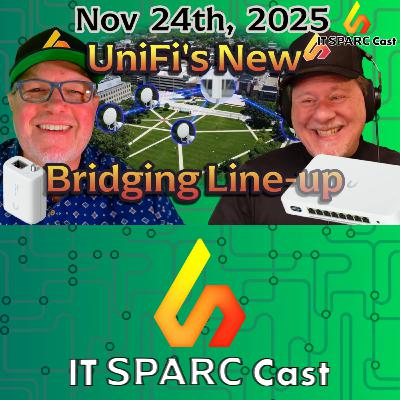
In this episode of IT SPARC Cast – News Bytes, John and Lou break down Ubiquiti’s brand-new UniFi wireless bridging lineup, test drive the surprisingly powerful ChatGPT Group Chat feature, and review the newly released IT Specialist Simulator game—yes, it’s a real thing.Lou also shares his SuperComputing 25 highlights, covering quantum computing, CXL memory extension, and why this year’s show was one of the most energetic he’s ever seen. A packed week for enterprise IT, networking, AI tooling, and HPC.⏱️ Show Notes00:00 – IntroA preview of the week’s topics: ChatGPT enters the chat, Pixel Team Red makes IT into a game, and UniFi pushes wireless bridging further.NEWS BYTES01:21 – All-New UniFi BridgingUbiquiti announces an expanded lineup of UniFi bridging hardware, offering new flexibility for building-to-building links and hard-to-cable environments. Key highlights:•Building Bridge Single Unit – no more buying pairs; units can now be paired or re-paired on demand.•Device Bridge IoT – tiny 2.4 GHz client bridge for connecting wired devices where Ethernet isn’t available.•Device Bridge Switch – 2.5GbE PoE switch + Wi-Fi 7 / 6 GHz bridging for high-throughput deployment without new cabling.•Ideal for renters, campuses, remote buildings, and temporary connectivity.https://blog.ui.com/article/all-new-unifi-bridging 05:00 – ChatGPT Group ChatsChatGPT now offers multi-user group chats, allowing collaborative research, shared notes, and real-time AI-assisted discussions.•Works like “ChatGPT inside Slack or Teams.”•No cross-bleed from personal ChatGPT memory—group chats stay isolated.•Great for brainstorming, problem-solving, and real-time content creation.•John tests memory segmentation and explains why this feature actually matters for privacy.https://openai.com/index/group-chats-in-chatgpt/ 07:38 – IT Specialist Simulator (Game)A new Steam game, IT Specialist Simulator, lets players start as junior IT techs and work their way up the ladder.•Tasks include configuring IP addresses, handling tickets, and climbing into management roles.•John plans to test it using Crossover on his Mac during Thanksgiving vacation.•Lou questions whether this is secretly a recruitment or training tool.•Possible educational value for beginners learning networking basics.https://store.steampowered.com/app/3266090/IT_Specialist_Simulator/10:16 – Lou’s SuperComputing 25 OverviewLou shares additional SC25 observations not covered in the shorts:•Deep dive conversations with quantum computing firms including Alice & Bob.•IBM’s quantum roadmap and why commercial systems are likely 2030+.•How quantum computing targets molecular simulation, advanced materials, next-gen drugs, and computational fluid dynamics.•The rise of CXL, PCIe expansion, and technologies enabling enterprises to extend hardware rather than replace it.•SC25 was one of the most active HPC events Lou has seen in decades.Wrap Up14:42 – Listener Feedback & Wrap UpListeners react to recent shorts, including extreme cooling solutions (0.01 Kelvin) and moon-mined Helium-3 for future fusion and quantum workloads.Full contact and feedback channels below:Social LinksIT SPARC Cast@ITSPARCCast on Xhttps://www.linkedin.com/company/sparc-sales/ on LinkedInJohn Barger@john_Video on Xhttps://www.linkedin.com/in/johnbarger/ on LinkedInLou Schmidt@loudoggeek on Xhttps://www.linkedin.com/in/louis-schmidt-b102446/ on LinkedIn Hosted on Acast. See acast.com/privacy for more information.
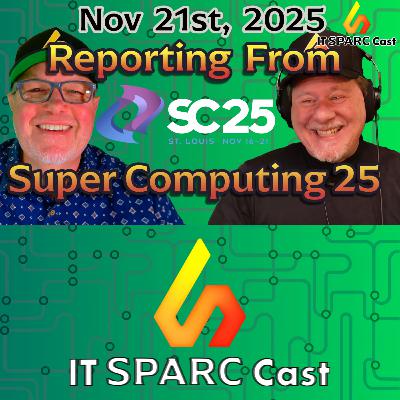
In this episode of IT SPARC Cast, Lou brings you a packed 8-minute walkthrough of the biggest themes and technologies from SuperComputing 25—the largest and busiest HPC show he’s ever attended.In this video, Lou covers:🔥 Cooling Wars: immersion cooling, PG25 liquid loops, cavitation risks, phase-change fluids, and long-term hardware reliability.🧠 CXL & Memory Expansion: shared GPU pools, multi-host memory fabrics, and how CXL can extend server life.☁️ Hybrid Cloud AI Platforms: two research-born vendors (including one FedRAMP-compliant) redefining HPC + cloud orchestration.⚡ Infrastructure Giants: the mind-blowing cooling and power equipment that will shape future enterprise data centers.And John reads out Listener Feedback regarding AlmaLinux as the successor to CentOS.If you want a concise, expert-level briefing from the SC25 show floor—this is the one to watch.What it on Youtube Here - https://youtu.be/Ve57fs7efFY00:00 – Intro01:08 – Greeting from Super Computing 25Lou sets the stage after returning from SuperComputing 25, describing the massive scale of the show, packed floors, and how SC25 has effectively replaced events like Interop and SuperComm.NEWS & TECH BREAKDOWN02:22 – The Major Theme: Cooling, Cooling, CoolingLou explains that cooling dominated the show, with two primary approaches emerging:1. Immersion Cooling•Full-system submersion in mineral oil or engineered fluids2. Active Liquid Cooling (PG25 Mix)•Issues explored: erosion, cavitation, biological growth, thermal cycling, solder fatigue3. Phase-Change Approaches•Solutions that vaporize at fixed temperatures (e.g., 55°C boiling point phase-change fluids)Why It Matters: Enterprise hardware longevity, reduced thermal stress, and predictable cooling efficiency.05:41 – CXL & Memory Expansion: The Future of Server Life ExtensionLou discusses a major standout category: CXL (Compute Express Link) technologies allowing:•Shared memory pools & GPUs across multiple hosts•Extending server life by adding external memory instead of replacing hardware•Switching architectures enabling dynamic assignment of terabytes of memory to GPUsEnterprise takeaway: “Do more with less” becomes practical—critical during recessionary or budget-tight periods.⸻07:55 – Hybrid Cloud AI PlatformsLou meets with two research-born companies offering advanced hybrid cloud and orchestration stacks:•One FedRAMP-compliant, built for U.S. federal and defense workloads•One European research derivative, designed for container-heavy hybrid environments without VMware relianceThese solutions focus on orchestration, HPC-to-cloud overflow, container scheduling, and distributed compute for AI.09:19 – Wrap UpJohn closes by encouraging viewers to watch the upcoming shorts and emphasizing how SC25 showcased the next generation of enterprise-class tech. He also covers Listener Feedback on our first short from SC25 regarding AlmaLinuxSocial LinksIT SPARC Cast@ITSPARCCast on Xhttps://www.linkedin.com/company/sparc-sales/ on LinkedInJohn Barger@john_Video on Xhttps://www.linkedin.com/in/johnbarger/ on LinkedInLou Schmidt@loudoggeek on Xhttps://www.linkedin.com/in/louis-schmidt-b102446/ on LinkedIn Hosted on Acast. See acast.com/privacy for more information.
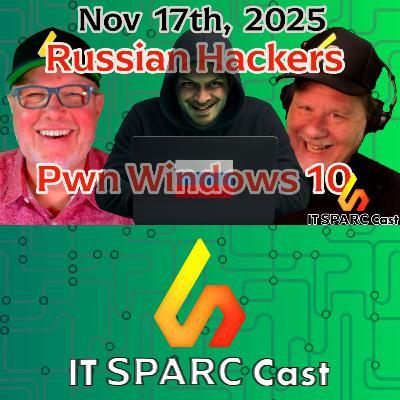
In this episode of IT SPARC Cast – News Bytes, John and Lou tackle a wild week in enterprise IT—from grounded aircraft disrupting hardware logistics, to open-source maintainers calling out Google, to sophisticated VM-based malware hiding inside Windows systems, to Santa Clara’s power grid collapsing under the weight of the AI boom.First, a tragic UPS MD-11 crash in Louisville forces both UPS and FedEx to ground all MD-11 aircraft—creating ripple effects for enterprise sparing strategies and next-day hardware replacement SLAs. John and Lou explain how events outside the IT bubble can quietly break your uptime guarantees.Then, the maintainers of FFmpeg publicly call out Google: either fund the project or stop flooding it with fuzz-generated bugs. The hosts explore the broader lesson: organizations relying on open source must contribute—code, money, or both.Next, the team walks through a jaw-dropping Hyper-V evasion technique, where Russian hackers spin up hidden Alpine Linux VMs to run malware undetected by EDR tools. Lou calls it “one of the most clever attack chains we’ve seen in years,” and John argues that Windows security must evolve to detect surprise VM creation.Finally, Santa Clara—Nvidia’s hometown—has data centers sitting empty because the city literally has no power left to give. With AI megaprojects like Project Stargate on the horizon, John and Lou warn that the grid crisis is about to become every CIO’s problem.Show Notes00:00 – IntroNEWS BYTES01:05 – UPS and FedEx Ground Planes After Louisville Crash•A UPS MD-11 crashes, triggering a fleetwide grounding of MD-11 cargo aircraft.•Immediate supply-chain impact for next-day server replacements and enterprise sparing.•John and Lou highlight why IT leaders must monitor “non-IT” news that affects logistics.•A reminder: SLA = logistics, and logistics depends on the real world.https://www.nbcnews.com/news/us-news/ups-grounds-md-11-fleet-type-plane-louisville-crash-sources-say-rcna242711 04:19 – FFmpeg to Google: Fund Us or Stop Sending Bugs•Google’s fuzzing system floods FFmpeg with nonstop bug reports.•Maintainers say the project is overwhelmed and demand Google contribute.•Discussion: the ethical and practical responsibility companies have to support open source.https://thenewstack.io/ffmpeg-to-google-fund-us-or-stop-sending-bugs 07:25 – Hackers Weaponize Windows Hyper-V to Hide Linux VM and Evade EDR Detection•Threat actor Curly Comrades uses Hyper-V to run hidden Alpine Linux VMs.•Malware (CurlyShell & CurlyCat) routes through host NAT, appearing as normal traffic.•Hard to detect: tiny VM footprint, few forensic artifacts, zero EDR visibility.•John: Windows Defender should alert when a new VM spins up—“Did you mean to do this?”https://thehackernews.com/2025/11/hackers-weaponize-windows-hyper-v-to.html 13:08 – Data Centers in Nvidia’s Hometown Stand Empty Awaiting Power•Two new Santa Clara data centers cannot turn on due to a power shortage.•Signals a coming crisis as AI mega-facilities exceed grid capacity.•Power costs and grid constraints may soon drive enterprise IT budgeting changes.https://finance.yahoo.com/news/data-centers-nvidia-hometown-stand-100009877.html 15:56 – Mail Bag & Wrap UpIT SPARC Cast@ITSPARCCast on Xhttps://www.linkedin.com/company/sparc-sales/ on LinkedInJohn Barger@john_Video on Xhttps://www.linkedin.com/in/johnbarger/ on LinkedInLou Schmidt@loudoggeek on Xhttps://www.linkedin.com/in/louis-schmidt-b102446/ on LinkedIn Hosted on Acast. See acast.com/privacy for more information.
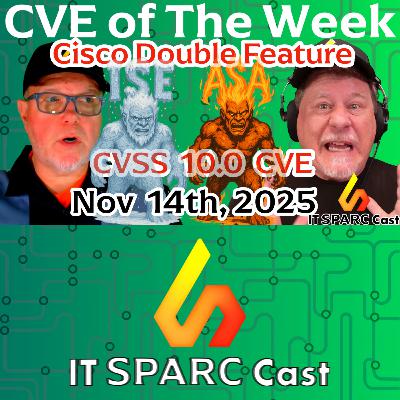
In this week’s IT SPARC Cast, John and Lou break down a Cisco security double feature—three critical vulnerabilities impacting Cisco ASA, Cisco Secure Firewall (FTD), and Cisco Identity Services Engine (ISE). These flaws include authentication bypass, chained remote code execution, and a CVSS 10.0 root-level compromise via an undocumented ISE API.We explain how CVE-2025-20333, CVE-2025-20362, and the newly revealed CVE-2025-20337 work, why federal agencies issued emergency patch directives, and what immediate mitigation steps enterprise defenders must take. If you manage Cisco firewalls or identity systems, this episode is mandatory listening.00:00 - Intro01:05 - CVEs of the Week – Cisco ASA & FTD (CVE-2025-20333 & CVE-2025-20362)• Two actively exploited Cisco firewall vulnerabilities enable authentication bypass and chained remote code execution.• Attackers linked to ArcaneDoor/Storm-1849 are using CVE-2025-20362 to bypass authentication, paired with CVE-2025-20333 for full RCE device takeover.• Compromised devices show unexpected reloads, disabled logs, and firmware persistence via ROMMON modification.• Over 50,000 ASA/FTD systems remain exposed, many still unpatched.• Emergency guidance from CISA and NCSC stresses immediate patching, disabling WebVPN/SSL, IP whitelisting, and checking for persistence or odd CLI behavior.• Lou and John emphasize the need for a multi-vendor firewall strategy to avoid single-vendor blast-radius failures.⸻05:00 - Cisco ISE – CVE-2025-20337 (Root-Level RCE via Undocumented API)• Amazon’s threat intelligence team discovered in-the-wild exploitation of an undocumented ISE API endpoint.• This CVSS 10.0 vulnerability allows deserialization attacks leading to unauthenticated root-level access.• Attackers deploy an advanced, stealthy web-shell (“IdentityAuditAction”) featuring:– In-memory execution– Java reflection thread injection– Custom DES-encrypted C2– No disk artifacts• Exploitation activity dates back to at least May and may be earlier.• Mitigation requires updating to patched ISE versions, segmenting management networks, monitoring unexpected listeners, and tightening inbound firewall policies.• John and Lou reiterate that identity remains the “universal attack surface,” and poor segmentation continues to amplify enterprise risk.⸻09:26 - Listener FeedbackA viewer asked whether the F5 BIG-IP source code leak affects only the management plane or the data plane.Answer: Both. Because the entire codebase was leaked, any subsystem could harbor latent zero-day attack surfaces—further stressing the importance of aggressive patching and hardened segmentation.⸻10:28 - Wrap UpWe appreciate every question, comment, and suggestion. Keep them coming.IT SPARC Cast@ITSPARCCast on Xhttps://www.linkedin.com/company/sparc-sales/ on LinkedInJohn Barger@john_Video on Xhttps://www.linkedin.com/in/johnbarger/ on LinkedInLou Schmidt@loudoggeek on Xhttps://www.linkedin.com/in/louis-schmidt-b102446/ on LinkedIn Hosted on Acast. See acast.com/privacy for more information.
In this week’s IT SPARC Cast – News Bytes, John and Lou go galactic—covering AI data centers in orbit, Microsoft’s blunders, and a nasty new Windows backdoor exploiting OpenAI’s API.First, it’s “IT in SPAAAAAACE!” as Google unveils Project Suncatcher, an effort to launch radiation-hardened Tensor Processing Units (TPUs) into orbit for solar-powered, space-based AI compute. Then, SpaceX announces plans to build low-Earth-orbit data centers using its Starlink satellite infrastructure and Tesla’s upcoming AI chips—pushing the data center arms race off-planet.Next up in “Really, Microsoft?” — the latest Windows 11 bug means “Update and Shut Down” doesn’t actually shut down. It just reboots. But the real danger comes from the newly discovered SesameOp backdoor, which uses the OpenAI Assistants API as its command-and-control channel—making it nearly invisible to traditional security tools.Finally, Microsoft ends volume pricing discounts for enterprise customers, sparking frustration across IT departments already battling licensing complexity.Show Notes00:00 - IntroJohn and Lou open with a new segment: “IT in Space!” as data centers literally leave Earth’s surface.01:02 - Google’s Next Moonshot: Project Suncatcher•Google to launch Project Suncatcher—solar-powered AI compute nodes using Tensor Processing Units (TPUs) in orbit.•Partners with Planet Labs for radiation-hardened TPU testing.•Orbiting clusters could provide 8x more energy efficiency than Earth-based systems.•Challenges include cooling, radiation shielding, and debris avoidance.https://9to5google.com/2025/11/04/google-project-suncatcher/03:41 - SpaceX Plans Data Centers in Low-Earth Orbit•SpaceX confirms Starlink v3 satellites will support data center modules.•Tied to Tesla’s AI5 and upcoming AI6 chip platforms.•Starship will be used to deploy orbital compute clusters.•Laser interlinks and orbital energy capture could redefine distributed computing.https://x.com/dimazeniuk/status/1984613494629503484?s=61&t=vt5DZTzMzVaVQd0cNd8iuA06:55 - “Update and Shut Down” No Longer Restarts PC•Microsoft’s November 2025 preview patch fixes a long-standing issue: “Update and Shut Down” reboots instead of powering off.•Optional fix available under Windows 11 build 26200.7019.•Another headache in Windows’ long list of quality-of-life bugs.https://www.windowslatest.com/2025/11/02/update-and-shut-down-no-longer-restarts-pc-as-windows-11-25h2-patch-addresses-a-decades-old-bug/08:10 - SesameOp Backdoor Using OpenAI Assistants API•SesameOp discovered by Microsoft’s DART Team.•Uses OpenAI’s Assistants API as a stealthy command-and-control (C2) channel.•No patch yet—only firewall whitelisting and Defender rules recommended.https://thehackernews.com/2025/11/microsoft-detects-sesameop-backdoor.html13:53 - Microsoft Ends Volume Pricing•As of Nov 1, Microsoft has eliminated tiered volume discounts for Enterprise Agreements.•Large customers will now pay the same flat rate as smaller ones.•Could increase software spend by double digits at renewal.https://www.cio.com/article/4079004/microsoft-ends-volume-pricing-potentially-costing-companies-millions.html15:29 - Mail Bag & Wrap Uphttps://daily.jstor.org/when-the-push-button-was-new-people-were-freaked/IT SPARC Cast@ITSPARCCast on Xhttps://www.linkedin.com/company/sparc-sales/ on LinkedInJohn Barger@john_Video on Xhttps://www.linkedin.com/in/johnbarger/ on LinkedInLou Schmidt@loudoggeek on Xhttps://www.linkedin.com/in/louis-schmidt-b102446/ on LinkedIn Hosted on Acast. See acast.com/privacy for more information.
In this episode of IT SPARC Cast – CVE of the Week, John Barger and Lou Schmidt dive deep into CVE-2025-52665, a critical 10.0 CVSS vulnerability impacting Ubiquiti’s UniFi Access Management API. This flaw blends physical security and cybersecurity risks — allowing unauthenticated attackers to execute remote code, manipulate door access, or even lock users inside buildings.John and Lou break down how this misconfigured API opens the door (literally) to full network takeover and discuss the real-world implications of smart building vulnerabilities. They cover the affected UniFi Access versions (3.3.22 to 3.4.31) and emphasize updating immediately to version 4.0.21 or later.Beyond the technical details, they debate the broader question: Are smart buildings worth the risk? From API hygiene to network segmentation, the hosts offer actionable strategies to secure IoT infrastructure and ensure that “smart” doesn’t become “unsafe.”⸻Social Links:IT SPARC Cast@ITSPARCCast on Xhttps://www.linkedin.com/company/sparc-sales/ on LinkedInJohn Barger@john_Video on Xhttps://www.linkedin.com/in/johnbarger/ on LinkedInLou Schmidt@loudoggeek on Xhttps://www.linkedin.com/in/louis-schmidt-b102446/ on LinkedIn Hosted on Acast. See acast.com/privacy for more information.
In this week’s IT SPARC Cast – News Bytes, John and Lou explore the intersection of AI, hardware, and IT freedom — from creative tension at EA to chipmaking disruption.First, Electronic Arts (EA) launches ReefGPT, an internal AI design tool meant to boost productivity across studios. Developers say it’s unreliable and fear job losses, while leadership insists AI is the future. John and Lou unpack the deeper message: AI won’t take your job, but someone using AI will.Then, Qualcomm jumps into the AI data center market with its new AI200 and AI250 chips — scaled-up versions of its mobile neural processors, ready to challenge Nvidia and AMD for inference workloads. The hosts discuss how this could finally relieve the GPU bottleneck driving AI infrastructure costs through the roof.Next, Ubiquiti declares “SFP Liberation Day.” The new $49 SFP Wizard not only tests but reprograms fiber modules to work with any switch — bypassing vendor lock-ins from Cisco, HPE, and others. John and Lou call it “the jailbreak every network engineer has been waiting for.”Finally, Substrate, a U.S. startup, unveils an X-ray lithography chipmaking tool that could rival ASML’s $400M EUV machines. Backed by $100M in funding, the company aims to bring advanced chip manufacturing back to the U.S. — potentially reshaping the semiconductor landscape.00:00 - Intro00:52 - Electronic Arts (EA) AI Divide•EA launches ReefGPT to accelerate game design.•Creatives call it unreliable and fear losing creative control.https://www.businessinsider.com/inside-ai-divide-roiling-video-game-giant-electronic-arts-2025-10?op=1 04:15 - Qualcomm Joins the AI Arms Race•Qualcomm announces AI200 (2026) and AI250 (2027) chips for data centers.•Targets Nvidia’s GPU monopoly with rack-mounted, liquid-cooled solutions.•Could ease supply pressure and diversify AI compute resources.https://www.cnbc.com/2025/10/27/qualcomm-ai200-ai250-ai-chips-nvidia-amd.html 11:35 - Ubiquiti Liberates the SFPs•“SFP Liberation Day” brings a $49 SFP Wizard tool for testing and reprogramming optics.•Supports SFP, SFP+, and QSFP modules across brands.•A win for network engineers tired of overpriced vendor modules.https://blog.ui.com/article/welcome-to-sfp-liberation-day 15:58 - Substrate Announces Chipmaking Tool to Rival ASML•Substrate reveals an X-ray lithography system•Rivaling ASML’s EUV tools at lower cost.•Could reshape semiconductor competition and domestic manufacturing.https://www.reuters.com/world/asia-pacific/us-startup-substrate-announces-chipmaking-tool-that-it-says-will-rival-asml-2025-10-28/https://www.ft.com/content/2496edef-4f1b-47aa-877d-9c01271faaa1https://www.wsj.com/tech/peter-thiel-backed-startup-secures-100-million-to-make-chips-in-u-s-baff93ac21:02 - Mail Bag & Wrap Up Hosted on Acast. See acast.com/privacy for more information.
In this special Halloween edition of CVE of the Week, John and Lou dive into a truly chilling scenario — a high-severity DNS poisoning flaw that could be the perfect setup for a wave of phishing attacks and credential theft across enterprise networks.The star of the episode: CVE-2025-40778, a newly discovered vulnerability in BIND 9’s resolver logic. This flaw allows unauthenticated attackers to inject forged DNS records, redirecting legitimate queries to malicious servers — all without user interaction. With a CVSS score of 8.6, exploits are already active in the wild, and over 5,900 exposed instances have been identified.But that’s just the start. The hosts explain how major outages at AWS (US-East-1) and Microsoft Azure opened the door for clever phishers to strike when users were most vulnerable — during downtime. Together, these issues illustrate a perfect storm of technical failure and human manipulation.Lou and John share practical defenses: patch immediately, enable DNSSEC, restrict recursion, and — most importantly — establish a trusted, redundant communication plan for your users before the next outage hits.⸻Key Takeaways•CVE-2025-40778 impacts BIND 9 versions from 9.11 to 9.21.12, including S1 previews.•Exploits are already circulating — attackers can poison DNS caches remotely.•Misconfigured DNS and phishing attacks can combine for devastating impact.•Immediate action: patch, enable DNSSEC, monitor cache entries, and reduce TTLs.•Prepare for outages — build redundant user communication channels to prevent panic and credential leaks.Linkshttps://kb.isc.org/docs/cve-2025-40778 https://nvd.nist.gov/vuln/detail/CVE-2025-40778https://thehackernews.com/2025/10/threatsday-bulletin-dns-poisoning-flaw.html https://www.helpnetsecurity.com/2025/10/28/bind-9-vulnerability-cve-2025-40778-poc/ ⸻Wrap-Up – Stay ConnectedIT SPARC Cast@ITSPARCCast on Xhttps://www.linkedin.com/company/sparc-sales/ on LinkedInJohn Barger@john_Video on Xhttps://www.linkedin.com/in/johnbarger/ on LinkedInLou Schmidt@loudoggeek on Xhttps://www.linkedin.com/in/louis-schmidt-b102446/ on LinkedIn Hosted on Acast. See acast.com/privacy for more information.
In this week’s IT SPARC Cast – News Bytes, John and Lou explore the fast-moving world of AI, quantum computing, and cloud reliability.First up, OpenAI launches Atlas, an AI-powered browser with ChatGPT built in—complete with persistent memory, agent mode, and deep personalization. But as John warns, “If ChatGPT can see everything you do, that includes your company’s data.” Lou connects it to last week’s 7-Zip discussion, emphasizing the need for strict data access policies in enterprises managing shadow AI use.Then, Google makes a quantum leap with its new Willow chip and Quantum Echoes algorithm, achieving verifiable quantum advantage—13,000x faster than classical supercomputers. The duo discusses its implications for material science, encryption, and the coming “cryptopocalypse.”Next, Signal gets proactive, introducing Triple Ratchet Encryption—a post-quantum secure update using ML-KEM (Kyber) to protect against future quantum decryption. It’s the first major messaging platform to harden itself against Harvest Now–Decrypt Later attacks.Finally, in this week’s Hot Take, the hosts analyze the recent AWS DNS outage that took down half the internet. Their verdict? “It’s not just AWS—it’s the apps.” They discuss multi-region design, cloud dependency, and why “Five Nines” uptime might be a thing of the past.⸻⏱️ Show Notes00:00 - Intro01:24 - OpenAI Debuts AI-Powered Browser (Atlas)https://tech.slashdot.org/story/25/10/21/1725235/openai-debuts-ai-powered-browser-with-memory-and-agent-features 07:27 - Google Launches New Quantum Chip and Algorithmhttps://blog.google/technology/research/quantum-echoes-willow-verifiable-quantum-advantage/ 09:31 - Signal Stays Ahead of the Game — Triple Ratchet Encryptionhttps://signal.org/blog/spqr ⸻12:03 - Hot Take: Amazon Web Services (AWS) DNS OutageJohn recounts debugging his Ring cameras—before realizing the culprit was AWS.•Cascading DNS failure caused a self-inflicted denial of service•Exposed lack of redundancy and poor multi-region design•50% of the internet went down, despite AWS only running 30% of itLou’s takeaway: “Cloud isn’t inherently resilient—it’s only as resilient as you design it to be.”https://youtu.be/ygcYoFBXdjQ IT SPARC Cast@ITSPARCCast on Xhttps://www.linkedin.com/company/sparc-sales/ on LinkedInJohn Barger@john_Video on Xhttps://www.linkedin.com/in/johnbarger/ on LinkedInLou Schmidt@loudoggeek on Xhttps://www.linkedin.com/in/louis-schmidt-b102446/ on LinkedIn Hosted on Acast. See acast.com/privacy for more information.
In this episode of CVE of the Week, John and Lou unpack a fresh pair of vulnerabilities affecting one of the most common tools on Windows desktops — 7-Zip.Tracked as CVE-2025-11001 and CVE-2025-11002, these directory traversal flaws allow attackers to craft malicious archives that can escape the extraction folder, overwrite arbitrary files, and potentially lead to remote code execution (RCE). The hosts discuss how the vulnerabilities impact not just individual users but also automated systems such as CI/CD pipelines, backup servers, and antivirus scanners that automatically unpack archives.They also cover how this seemingly moderate (CVSS 7.0) issue highlights a deeper problem — shadow IT and uncontrolled software installation inside enterprise environments. From patching strategies to user privilege escalation controls, this episode offers real-world guidance for keeping your organization secure.⸻Key Takeaways•Two new 7-Zip vulnerabilities (CVE-2025-11001 & CVE-2025-11002) enable directory traversal and code execution.•Impacts Windows desktops and automated extraction workflows in enterprise systems.•Proof-of-concept exploits are already public on GitHub.•The fix: Update 7-Zip immediately, disable automatic extraction of untrusted files, and audit your endpoint permissions.•Also, define a clear policy for software installation to minimize risk from unmanaged tools.⸻Stay ConnectedIT SPARC Cast@ITSPARCCast on Xhttps://www.linkedin.com/company/sparc-sales/ on LinkedInJohn Barger@john_Video on Xhttps://www.linkedin.com/in/johnbarger/ on LinkedInLou Schmidt@loudoggeek on Xhttps://www.linkedin.com/in/louis-schmidt-b102446/ on LinkedIn Hosted on Acast. See acast.com/privacy for more information.
In this episode of IT SPARC Cast – News Bytes, John and Lou cover the latest updates from Ubiquiti, Google, and the global supply chain.First, UniFi Network 9.5 rolls out with Channel AI, a next-gen visualization tool that uses AI to map RF interference, optimize channels, and improve roaming performance. Add in wired port anomaly detection, Bonjour and multicast enhancements, and it’s clear—Ubiquiti’s aiming straight at the enterprise.Then, a new report from UC San Diego and the University of Maryland reveals that half of all geostationary satellites are transmitting unencrypted data—including in-flight Wi-Fi, phone calls, and even critical infrastructure telemetry. Lou calls it “the coffee shop Wi-Fi of enterprise networking.”Finally, Microsoft, AWS, and Google are all cutting China out of their supply chains, relocating server, switch, and AI chip production to India, Thailand, and Vietnam to reduce risk and geopolitical exposure. The move may reshape where tomorrow’s cloud is built.⸻⏱️ Show Notes00:00 - IntroJohn & Lou tee up the week’s biggest IT stories with a mix of insight, humor, and caffeine.⸻00:48 - Introducing UniFi Network 9.5•Major update to UniFi’s platform with Channel AI for real-time RF visualization.•Enhanced roaming for Apple devices.•New wired port anomaly detection and better multicast handling.•Lou calls it “the most enterprise-ready version of UniFi yet.”https://blog.ui.com/article/releasing-unifi-network-9-5 ⸻06:18 - Satellites Found Exposing Unencrypted Data•Researchers intercepted sensitive traffic from half of all GEO satellites.•Data included calls, in-flight Wi-Fi, and industrial telemetry.•Some providers, like AT&T and T-Mobile Mexico, are still unpatched.•John warns: “Satellites are the coffee shop Wi-Fi of enterprise networks.”•Encrypt your traffic at the endpoint—don’t rely on the carrier.https://techcrunch.com/2025/10/14/satellites-found-exposing-unencrypted-data-including-phone-calls-and-some-military-comms/ ⸻12:24 - Microsoft, AWS, and Google Are Reducing China’s Role in Their Supply Chains•Microsoft aims for 80% of Surface, Xbox, and server production outside China by 2026.•AWS and Google shifting to India, Thailand, and Vietnam.•Lou notes: “The white boxes in your rack probably started in a hyperscaler design lab.”•Reduced tariffs, diversified supply, and fewer geopolitical risks ahead.https://techcrunch.com/2025/10/16/microsoft-aws-and-google-are-trying-to-drastically-reduce-chinas-role-in-their-supply-chains/ ⸻18:05 - Mail Bag & Wrap UpListener Tom writes in, celebrating Synology’s decision to restore third-party drive compatibility:“They’re back at the top of my list.”IT SPARC Cast@ITSPARCCast on Xhttps://www.linkedin.com/company/sparc-sales/ on LinkedInJohn Barger@john_Video on Xhttps://www.linkedin.com/in/johnbarger/ on LinkedInLou Schmidt@loudoggeek on Xhttps://www.linkedin.com/in/louis-schmidt-b102446/ on LinkedIn Hosted on Acast. See acast.com/privacy for more information.
A suspected state-sponsored attack has breached F5 Networks, compromising source code, customer data, and production systems. With F5 handling 85% of global load balancing, this could expose countless organizations to new zero-day vulnerabilities.John and Lou break down how it happened, what’s at risk, and what you should do right now if your infrastructure depends on F5 BIG-IP or related systems.✅ Learn how to prepare for cascading exploits✅ Why this breach could redefine patch management and Zero Trust✅ What AI means for future vulnerability discoveryLike, subscribe, and share to stay ahead of the next major exploit.Follow us:IT SPARC Cast — @ITSPARCCast on X | https://www.linkedin.com/company/sparc-sales/John Barger — @john_Video on X | https://www.linkedin.com/in/johnbarger/Lou Schmidt — @loudoggeek on X | https://www.linkedin.com/in/louis-schmidt-b102446/ Hosted on Acast. See acast.com/privacy for more information.
In this episode of IT SPARC Cast – News Bytes, John and Lou break down three big stories that touch nearly every corner of enterprise IT—from power to code to storage.First, Ubiquiti expands into the UPS market with the new UniFi Uninterruptible Power Supply, combining network management integration, graceful shutdown control, and plug-and-play simplicity for small offices and home labs.Then, they explore Google DeepMind’s latest breakthrough—CodeMender, an AI tool that not only finds software vulnerabilities but also rewrites and tests patches automatically before submitting them upstream.Finally, Synology caves to user backlash, walking back its controversial policy that restricted third-party drives in 2025 NAS models. The nerd uprising worked, restoring support for Seagate, WD, and other drives under DSM 7.3.⏱️ Show Notes00:00 - Intro00:51 - Ubiquiti Is Launching a New UniFi Uninterruptible Power StrategyUbiquiti enters the UPS market with the UniFi UPS Tower ($159) and UniFi UPS 2U Rackmount ($279).•Fully integrates with UniFi OS for device-wide graceful shutdown.•Simplifies UPS monitoring—no scripting or manual config needed.https://blog.ui.com/article/introducing-uninterruptible-power06:00 - Google’s New AI Doesn’t Just Find Vulnerabilities — It Rewrites Code to Patch ThemGoogle DeepMind’s CodeMender is the next step in automated software security.•Detects, rewrites, and self-tests patches before submitting them.•Refactors vulnerable code to prevent flaw reoccurrence.•Uses multi-AI feedback loops to ensure accuracy before final submission.https://thehackernews.com/2025/10/googles-new-ai-doesnt-just-find.html 11:03 - Synology Walks Back Controversial Compatibility Policy for 2025 NAS UnitsUser backlash works—Synology reverses its decision to block third-party drives in the Plus Series 2025 NAS lineup.•DSM 7.3 restores compatibility with non-Synology drives.•Synology pledges a new third-party drive validation program.https://www.tomshardware.com/pc-components/nas/synology-walks-back-controversial-compatibility-policy-for-2025-nas-units-third-party-hdd-and-ssd-support-returns-with-diskstation-manager-7-3-update IT SPARC Cast@ITSPARCCast on Xhttps://www.linkedin.com/company/sparc-sales/ on LinkedInJohn Barger@john_Video on Xhttps://www.linkedin.com/in/johnbarger/ on LinkedInLou Schmidt@loudoggeek on Xhttps://www.linkedin.com/in/louis-schmidt-b102446/ on LinkedIn Hosted on Acast. See acast.com/privacy for more information.
In this week’s episode of IT SPARC Cast - CVE of the Week, John Barger and Lou Schmidt dive deep into CVE-2025-49844, a newly discovered and critical remote code execution vulnerability in Redis—the in-memory database that powers over 75% of cloud services. This flaw, dubbed “RediShell”, scores a perfect 10.0 CVSS and affects Redis instances using Lua scripting, allowing attackers to execute arbitrary code and gain full system control.This 13-year-old bug stems from a use-after-free memory corruption issue that lets attackers escape the Lua sandbox, run malicious code, exfiltrate data, deploy crypto miners, or move laterally inside cloud environments. Even worse—more than 60,000 internet-exposed Redis servers have no authentication, leaving them completely open to exploitation.John and Lou discuss how this happened, what you can do to secure your infrastructure, and why “cloud-hosted” doesn’t always mean “secure.”✅ Key Takeaways:•Update to patched versions immediately (8.2.2, 8.0.4, 7.4.6, 7.2.11, 6.2.20)•Restrict network access with ACLs•Rotate all credentials and API keys•Don’t run Redis as root•Isolate any compromised hosts before investigationLou calls it “a 10 on the oh-crap-ometer”—and he’s not wrong.https://thehackernews.com/2025/10/13-year-redis-flaw-exposed-cvss-100.htmlhttps://www.darkreading.com/cloud-security/patch-now-redishell-redis-rce Hosted on Acast. See acast.com/privacy for more information.
In this episode of IT SPARC Cast – News Bytes, John and Lou dive into three stories that blur the line between security, AI, and sci-fi becoming reality.First, a jaw-dropping report reveals landlords using tenant-screening services to demand employee workplace logins—scraping paystubs directly from systems like ADP. It’s not only unethical—it’s potentially illegal. John and Lou unpack the security, HR, and legal nightmare this poses for corporate IT teams.Next, OpenAI and Samsung team up under the Stargate project, with Samsung dedicating nearly 40% of its DRAM output to fuel OpenAI’s next wave of AI data centers—potentially even floating ones. The AI arms race is expanding into new dimensions.Finally, a newly disclosed exploit gives attackers full control over Unitree robots—including humanoids and quadrupeds—via Bluetooth. The flaw, dubbed UniPwn, allows worms to spread across fleets of robots. Lou calls it “Runaway with Tom Selleck meets Star Trek: The Borg.”⸻⏱️ Show Notes00:00 - IntroJohn and Lou set up this week’s stories on privacy violations, AI chip deals, and robot exploits.⸻00:48 - Landlords Demand Tenants’ Workplace Logins to Scrape Their PaystubsLandlords and tenant-screening services are asking renters to log into employer systems so they can scrape payroll data.•Platforms like Argyle and Approve Shield are at the center of the controversy.•This violates employee data access policies and may breach federal hacking laws.•IT leaders should issue internal advisories and enforce MFA to prevent credential leaks.https://www.404media.co/landlords-demand-tenants-workplace-logins-to-scrape-their-paystubs/ ⸻07:05 - OpenAI, Samsung & the Stargate Chip PactOpenAI partners with Samsung and SK Hynix under the Stargate project.•Samsung to provide 900,000 DRAM wafers monthly—40% of its capacity.•Floating, green data centers are in the works.•May overlap with Nvidia’s 10GW expansion announced last week.https://www.theverge.com/news/789687/openai-samsung-stargate-chips ⸻10:51 - Exploit Allows Takeover of Fleets of Unitree RobotsResearchers uncovered CVE-2025-60251, a wormable flaw in Unitree’s robot lineup.•Bluetooth handshake vulnerability allows remote takeover.•Affects quadrupedal GO2/B2 and humanoid G1/H1 robots.•Attackers can form botnets, move robots, or exfiltrate data.•Security professionals must begin planning IoT and robotics policies now.https://spectrum.ieee.org/unitree-robot-exploit ⸻17:01 - Mail Bag & Wrap UpIT SPARC Cast@ITSPARCCast on Xhttps://www.linkedin.com/company/sparc-sales/ on LinkedInJohn Barger@john_Video on Xhttps://www.linkedin.com/in/johnbarger/ on LinkedInLou Schmidt@loudoggeek on Xhttps://www.linkedin.com/in/louis-schmidt-b102446/ on LinkedIn Hosted on Acast. See acast.com/privacy for more information.

Comments

Download from Google Play

Download from App Store
 United States