


 Claim Ownership
From A Dog's Eye View
Subscribed: 4Played: 35
Subscribe

© Susan Coleman
Description
A space to embrace your dog and understand their behavior. Bi-weekly episodes exploring all things positive reinforcement training + effectively communicating with your dog. Because dogs are simple, when their owners have the right information.
canineconcierge.substack.com
canineconcierge.substack.com
26 Episodes
Reverse
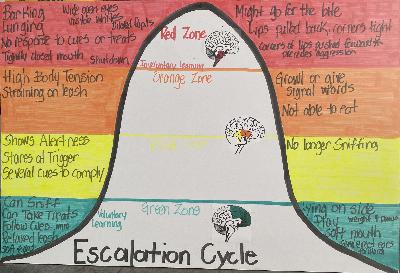
Dr. Jennifer Smith has returned to the Canine Concierge podcast, “From A Dog’s Eye View” to discuss two misunderstood aspects of dog behavior - reactivity and aggression. Dr. Smith is a trauma-informed behavior specialist in Cleveland with extensive experience working with and training dogs. She brings her unique expertise of both humans and dogs to explain the neurological escalation cycle that drives these behaviors. She will also provide practical insights for pet parents struggling with reactive dogs. Together, we hope to help you understand what is happening in your dog’s brain and what you can do to manage and reduce the reactivity and/or aggression.According to Dr. Smith, reactivity is the dog’s expression of how they are interpreting their environment. They assess everything they smell, see, and hear, in that order. This determines what type of reaction they will have. Reactions are the dog’s way to communicate about what they are experiencing. If they are left to express their own reaction to a particular stimulus, they can get in a rut and repeat that same reaction over and over again. It is up to us as handlers to teach them to have a different reaction.“All reactions are communicative in nature.” Dr. Jennifer SmithReactivity is not always an outwardly visible and audible response, like lunging and barking. It is also a passive reaction, such as Dr. Smith’s poodle named Blue, laying in the studio with us. He was told to lie down and stay. He is communicating that he feels safe and will successfully hold that stay until he is released. If he didn’t feel safe, he would be pacing, whining, panting and possibly drooling - all signs of stress. Aggression is the dog’s outward expression that is more severe than their initial instinct to investigate a stimulus they are unsure of. In my opinion, the most dangerous type of aggression is the quiet dog that is not showing the typical signs of an imminent attack. When dogs are improperly trained not to react to stimuli, they can suppress the typical initial signs of possible aggression such as barking and lunging. The dog will react in an explosive manner and go from the green zone to the red zone in a second. Reactivity is not always aggression. There are many factors that play a part in a dog’s reaction to stimuli. To name a few, a dog that is in pain can have an aggressive reaction when touched, but does not mean he is aggressive. A dog that is restrained and can’t reach the desired target can have an aggressive reaction, but should not be labeled aggressive. When dogs are playing, one dog can bark and bite the other dog when there is a disagreement. This may look like an aggressive act, but it is really a form of dog communication. As Dr. Smith mentions how mama dogs scold their puppies when they start getting obnoxious, is not a form of aggression, but a way to communicate to them to settle down. Certain breeds have traits that are more prevalent in some than in others. Some breeds are protective of their territory or owner, causing certain reactions. It is important to know these traits so you can manage them better. Just because your dog lunges and barks at other dogs, doesn’t mean that your dog is now labeled an aggressive dog. Could that dog’s reaction turn into aggression? Absolutely! Depending on the circumstances, your dog may have to defend himself from being attacked and bite the attacker. If your dog feels threatened and pressured enough by the stimulus, he can strike out. All of these factors come into play when assessing reactivity and aggression. Terriers are known to have stronger prey drives than other breeds. Their motivation and persistence when chasing their prey escalates as they pursue their prey more intensely than a dog that is known to retrieve prey. Dogs can be trained to chase but not kill. They can also be trained to maim or kill their prey. They can be trained to pursue and alert their owner where the prey is. It is how the dog is trained to move through these escalation cycles that determines the control you have over your dog. The average dog owner does not pursue this type of advanced training. Therefore, dogs that have not been taught the skillset to move through these drives can become so dangerous to people and animals that they become a liability to their community. This will be discussed in detail with Gary Flynn from The Dog Advocate when we talk about training hunting dogs.It is important to point out that our reactions can be totally different than our dog’s reaction even though we are experiencing the same stimuli in our environment. Their reaction can be starkly different when the dog is experiencing something they smell, see or hear, especially for the very first time. If it becomes a pattern, make a note of your dog’s reactions as they may be triggers for certain behaviors. As “my dog trainer friend”, Gary Flynn, always comments about this subject:One instance does not a behavior make”This means that just because your dog had a particular reaction to something or someone once, it doesn’t mean he will always have a reaction to the same thing again. It is when the dog has this reaction several times to the same trigger that it becomes predictable, is it now an issue that needs to be addressed. For example, just because your dog backed up and was not interested in meeting a random man with a hat on, doesn’t mean that your dog is afraid of all men with hats. However, if your dog only has this type of reaction to several men with hats in different places, then you will want to take precautions when introducing him to men with hats. For example, we humans may know that the garbage bin on the side of the road poses no threat to us. However, our dog may start growling, barking, and resisting by backing up. These are all signs of feeling uncomfortable and unsafe with the garbage bin. The worst thing we can do is force the dog towards the garbage bin while vocalizing in a frustrated tone and energy that there is nothing to be afraid of. The reaction in the dog is real and should not be discounted by the pet parent. We don’t want to make the dog feel that they cannot trust their own skillset because you are telling them they should be reacting in a different way. Instead, validate how the dog feels and then take action to fix it.A way to help the dog is to implement what I call the distance formula - find that distance from the garbage bin where your dog can sit by your side without growling or barking. Then, step by step with substantial time in-between each step to recover, slowly approach the bin until you are right next to it. Keep your leash loose with each progression. Then, leave it up to the dog to investigate the garbage can by sniffing it. This may take several days. You can never be in a hurry when conditioning your dog to have a different reaction than their original reaction. Why Reactivity is Common TodayReactivity has become a buzzword in the dog community. So many more people have dogs today than when I grew up. There are many stores that are dog friendly. You can travel with your dog and stay in designated dog friendly hotels. There are patios where you can eat and have drinks with our dogs at our side. However, not every dog is as comfortable as we are with these different places. Not every business owner is a dog person. We must respect that. Every place and every activity is not for every dog. Be aware of your dog’s limits as a social being. Don’t force them into those situations just because you want a dog that can accompany you everywhere you go. It is a balance you must strike. You don’t want to limit and restrict your dog from certain experiences. but you also don’t want to expose them to situations you know they are uncomfortable with. Aggression is best explained by Dr. Smith’s chart below. The schematic below shows which part of the brain is activated during each cycle of escalation and what visible signs are noticeable during each phase. The Green ZoneThe part of the brain that is colored green in the schematic is the executive functioning part. It is the CEO of the brain. The dog is in a relatively calm state. They use their sense of smell to explore, their body is relaxed, their eyes are soft (the whites of their eyes are not showing), and they accept treats. This is the only zone when they can take in new information. This is the zone that is necessary for learning in my obedience classes. When I notice dogs starting to move into the yellow zone, I tell the pet parent to move their dog to a different place where the distractions aren’t as high. In the green zone, the dog may be lying on his side. This reflects a different state of mind than when they lie in the sphinx position where they can erupt and get up very quickly. The dog will feel safe enough to engage in play. It must be noted that play can encourage a dog to move to the next levels of escalation. If you have a dog that moves through the escalation cycle rather quickly, you must know when to end the play session so that your dog does not get to the red zone. The Yellow ZoneThe yellow and orange zones are the emotional parts of the brain right above the brainstem. The dog is processing a stimulus in their environment that we refer to as a trigger. This can be another dog, person, squirrel, or anything that moves. Their head raises up, their ears are alert and they may sniff the air. When they start to focus in and stare at the trigger, the first sense that is affected is their sense of smell. They are not able to sniff and hone in on a target. You may have to repeat a command a couple of times because now they are distracted enough to not execute the command you give them on the first try. You may have to use the scent of treats right up to their nose to get their attention first and then tell them the command. They can still execute
My guest, Brendan McCarthy, is the operations manager and one of four founders of Doggy Style. Brendan’s company sells their own line of pet care products. What separates retail dog grooming products from Doggy Style products is the quality and uniqueness of the natural ingredients. Most of the ingredients are plant based.Work experienceBefore Brendan formed his own company, he worked for Park Ohio Industries in Cleveland. He ran their operations for 12 years by revitalizing local companies that were run down and needed improvements. This experience led to his next job working in operations, quality control and sales for Blue Buffalo, the #1 - selling pet food brand. They were one of the first national companies with an all-natural ingredients dog food. Blue Buffalo is a family run business that started in 2003. When the family’s Airedale, named Blue, was diagnosed with cancer, they started looking into giving him the best quality food possible. What a motivator to create their own all natural food with quality ingredients!The founding members of Doggy Style are Brendan, his brother, his cousin, and a good friend from the Blue Buffalo family. They were talking one day about creating shampoo for dogs. They noticed that it was hard to find a good dog shampoo, especially one with natural ingredients. Brendan was intrigued by this concept since one of his dogs was plagued with itchy, irritated skin. The shampoo he was using could have contributed to that. One of the team members was in the ingredients business. He had knowledge and exposure to plant-based products for humans. The four compadres all loved dogs and thought it would be innovative to invent a recipe for a shampoo. They wanted their product to be good not just for the dog, but for the pet parents and their home/environment. They didn’t know it at the time, but they were to become a team and create a whole line of pet products. Doggy Style Shampoo Brendan remembers the day they all got serious in creating an all natural dog shampoo. It was August 23, 2023. Some ingredients they wanted to include were coconut oil, olive oil, and natural soaps. It was important to them that the remaining ingredients were all natural and plant-based. Doggy Style shampoo is both a hypoallergenic shampoo and conditioner. It only takes a little shampoo to produce a lot of suds. The best way to apply it is putting a little bit on one of their massaging brushes and gently rubbing it into the dog’s fur. In order to make a shampoo, an elastomer is required. Most elastomers are man-made and silicone based. Doggy Style shampoo uses an all-natural elastomer called Gransense, which has only been on the market for approximately 5 years. It binds the other ingredients in the shampoo with different oils to produce a moisturizer type feel to the shampoo. This benefits the dog by making their fur stay soft for days and weeks. The other plant based ingredient is Sage Balance. It has antioxidant and antimicrobial properties. It is also anti-odor and anti-dander. The antimicrobial agents destroy microorganisms such as bacteria, viruses and fungi that can cause itchy skin. Doggy Style shampoo is the only shampoo on the market with both Gransense and Sage Balance.Doggy Style shampoo doesn’t claim to be a whitening shampoo. However, it does whiten dog’s fur because it removes the unnecessary oils and returns them back to their natural pure color. I refer you to my previous podcast dated 10/14/25 about grooming with Sharyn Ugan, a dog should not be fully bathed every day or every week. Once a month is adequate. Bathing too often can strip the natural oils in a dog’s coat. If it is necessary to bathe your dog more often, using Doggy Style shampoo is much safer than other shampoos on the market due to the natural ingredients. It is based off a baby formula, so you could bathe your dog twice a week and it wouldn’t hurt. It would actually help in the case of hot spots or itchy skin. Brendan recommends a couple of baths within the first week of the onset of skin irritation. The itching will most likely disappear unless an internal problem exists, such as allergies or other conditions. Please seek the advice of a veterinarian to identify the root problem. Deodorizer SprayIf there is a need to freshen up your dog’s fur or just make it smell better, Doggy Style makes a deodorizer spray that also acts as a conditioner. This is a top seller for Doggy Style. Brendan suggests carrying a bottle in the car and having one on hand in the house. Sometimes I feel the need to freshen up my dog in between baths. This spritz smells very fresh and pleasant. Brendan suggests to spritz a little on your wrist to smell it first to see if you like it. After all, it is you who will be smelling it the most!Doggy Style chose Grant Industries as one of their main suppliers. Grant Industries is a leading global provider to the personal care and beauty industry. They pride themselves in providing materials that are safe for consumers. One of their products is essential oils which are derived from plants and contain aromatic compounds. Brendan’s team tried many different ones until everyone agreed on The Ocean. This is what makes their shampoo and spritzer so pleasant. The scent is for the humans, of course. Dogs can roll in dirty diapers and be happy, but their pet parents won’t be! Paw ProtectorAnother great product that Doggy Style sells is a paw protector. This product can protect paws from cracking, bleeding and getting chapped from very cold, dry temperatures. Exposure to snow, salt, ice, and chemical de-icers can irritate the pads and become problematic. The best time to apply the paw protector is right before heading out for your daily walk. It is also advisable to wash and wipe off the pads when returning home from the walk. If there are any injuries or small fissures, apply some more protector to the pads. The same product that protects, also heals. Many pet parents may not use paw protector because they are concerned it is not safe for their dogs if they lick their paws. However, Doggy Style’s paw protector is lick safe and will not cause any stomach upset if ingested. There is actually some charcoal in the product to deter the dogs from licking it. After all, you don’t want to make it so appealing that the dog enjoys licking it and negates the whole reason you are applying it in the first place!The variety of oils: coconut, olive, sunflower seed and sweet almond, combined with the sage balance is what produces the healing properties of the paw protector. It can also be used to heal hot spots, dry spots, and even can be used on their nose and crusty elbows. It is soft enough to scoop easily and apply just the right amount. Scrub Brushes and Regular BrushesAs mentioned above, the best way to apply Doggy Style shampoo is with a scrub brush pictured below. A little bit can go a long way. The scrub brush also helps spread the shampoo more evenly. The shampoo is thicker than most dog shampoos, so squeezing it out directly on the dog makes it more difficult to spread around. Personally, I love the scrub brush better than scrubbing my dog’s fur with my fingers, especially around the back end! It acts as a massager too. Just as a massage feels good for us, the scrub brush can act as a massager as well. Brendan’s dog Maggie isn’t a fan of baths but she perks right up when she sees the scrub brush. The scrub brushes come in two different sizes. The smaller one is for short fur and smaller dogs. The bigger one has longer bristles and can cover more territory for larger dogs. Both the scrub brushes and the regular brushes are made out of bamboo and are tightly sealed with high quality silicone. This prevents mold from forming. Bamboo is durable and water resistant but is not waterproof. It is advisable not to expose it to prolonged moisture. Towel Doggy Style also makes a 20”X40” towel for drying the dog off. It is 87% cotton and 13% charcoal fused rayon. When you dry your dog, the charcoal pulls any odors and oxidants out of the skin and fur. The charcoal is activated by the heat from the friction of drying the dog off. The charcoal is good for the life of the towel. Putting it through a wash cycle and then in the dryer will not degrade the effectiveness of the charcoal. Doggy Style is currently working on a larger version of the towel. It will be the size of a bath towel - great for larger dogs. They are also working on developing all natural disposable paw wipes - great for spot cleaning dirty paws.How Doggy Style Got Its Name Doggy Style strives to keep as much of their products manufactured first in Ohio (as close as New Albany) and then within the United States. However, they had to source out the cap of the shampoo overseas in order to get the green color they wanted. So much more goes into not just developing the product but also finding a company to manufacture the container it is sold in. Now that the team had a specialty product available to market, they needed to come up with a name. Brendan’s brother Dan interviewed over 500 people in Washington, D.C. where he lives. He asked people walking with dogs 6 questions about grooming their dogs. He asked questions about where and how often they bathe their dogs. He also asked what shampoo they use or what their groomers use and if they would prefer an all natural dog shampoo. Some people knew the name of the shampoo they used but many did not. That’s when he decided that the name of their shampoo had to be catchy and memorable. Doggy Style achieves that! Every dog has their own style!Doggy Style LogoDoggy Style found an exceptional Cleveland based brand company called New Baum. Brendan and his team wanted their own dogs to be part of the logo. Instead, they compromised and chose an Irish Wolfhound because of their heritage. Irish Wolfhounds are huge dogs with huge
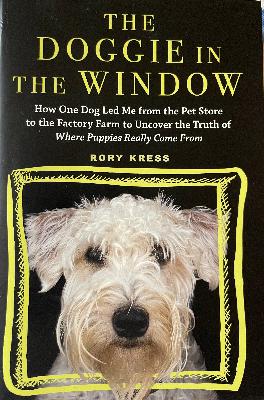
Before I had the honor of meeting my two guests, Zaron Van Meter and Stefanie Mowrey, the information I had about puppy mills was based on second hand knowledge. I also learned a lot from a book that a client/friend gave to me entitled, “The Doggie in the Window” by Rory Kress, pictured below. My very first exposure to the existence of puppy mills happened about 25 years ago. I remember exactly where I was. I had just finished playing tennis with a weekly women’s league. We were all talking in the lobby of the North Olmsted Rec Center. One of the ladies was asking for signatures on a petition that had to do with puppy mills and the welfare of the puppies born and raised in them. Someone had to explain to me what puppy mills were. I was horrified to say the least.My Exposure to Puppy MillsI am originally from upstate New York. I thought at the time that the existence of puppy mills was an Ohio issue. I was in disbelief anyone could treat dogs with anything but love. Jump ahead 25 years, I never dreamed I would have a venue such as this podcast to spread awareness of this sensitive subject. Additionally, to be able to host two dedicated dog advocates who are fighting for more effective and efficient enforcement of legislation protecting the welfare of dogs in high volume dog breeder facilities, known as puppy mills. Zaron and Stefanie have taught me so much about the regulations puppy mills are supposed to adhere to and the current oversight that exists. In both episodes of our podcast, they talk about this and the effects puppies and dogs have after growing up in a puppy mill. It is not just the physical, but also the mental toll it takes on them. Before I became a dog trainer in 2012, I volunteered at the Cuyahoga County Animal Shelter for almost a year. I knew that I wanted to work with dogs and thought this would be a good way to get hands-on experience with all types of dogs. I don’t ever remember anyone telling me that certain dogs were from a puppy mill. When I look back on that experience knowing what I know now, I think about particular dogs behaving in a way that could have indicated they were distrustful of humans for one reason or another, or they were from a puppy mill. We were told to just put the bowl of food in their crate and not to take them out for a walk. They were terrified and shaking. Their pupils were dilated and they were practically glued to the back of the crate. As I mentioned to Zaron and Stefanie, there was a computer station at Petco when I started working there in 2012 that allowed customers access to websites selling dogs. The general consensus was that this was a great idea - better than buying a dog from the newspaper, like my family and I did with our Corgi, Hank. By the time I left, the computer was gone. We weren’t told why. We all assumed that it was because it didn’t work anymore. However, Zaron and Stefanie revealed to me that puppy mill breeders can also be licensed brokers. They could be the ones selling these cute puppies online or part of a network of high volume dog breeders. When I think about certain dogs I trained in obedience classes, they too could have come from puppy mills. No one ever told me they knew they adopted a dog from a puppy mill. I recall soon after I was hired at Petco, I asked the dog trainer I replaced if he thought dogs could have “a screw loose”. I don’t really remember his answer. At that time, I was experiencing a young dog that was so out of control and unpredictable that nothing worked. One minute he was happy go lucky and the next minute he was attacking whoever had the leash, even his owner. The owner purchased the dog to be a therapy dog. Well, the dog ended up getting rehomed and the owner’s dream dashed of making him a therapy dog. At the time, I chalked that one up to my inexperience as a dog trainer. Current notoriety of puppy mills When I think about the dog I tried to train at Petco with the knowledge I have now, there was something wrong with the dog. Perhaps the dog’s behavior was due to poor breeding and was possibly from a puppy mill. Today, it is more and more common to hear that people knowingly adopt a puppy or dog from a puppy mill. Individuals at shelter and rescue agencies, including Stefanie, are familiar with the urgency that arises when breeders surrender unwanted dogs or puppies to a shelter. This situation occurs after breeders receive a two day notice of an inspection. Please refer to her story in Part 1 about the Rottweiler puppy she adopted within the past two years. It has reached a point where rescue agencies are tapped out. Volunteers and fosters are in short supply. There are just too many dogs being born that are suffering due to the lack of care inside these puppy mills. Additionally, the people who rescue or purchase them can be riddled with vet bills due to diseases, physical, or behavioral issues. There are just not enough people to care properly for them. This issue is not improving. It is only getting worse, to the point that puppy mills are no longer a hush-hush word. Puppies and dogs need to be rescued when puppy mills are violating regulations after being inspected, and they need to get rid of dogs. Too many dogs are disposed of either by dumping them on the side of the road, or ethically or unethically euthanized. It is difficult to state accurately what they do and how widespread it is since reporters and the public have difficulty gaining access to this information. How Ohio rates in regulating puppy mills Ohio is second in the nation for having the most egregious violations found by the United States Department of Agriculture (USDA)inspectors. This is backed up annually by “The Horrible Hundred” published by The Humane World for Animals. Some issues that are commonly found by inspectors in “The Horrible Hundred” list itemized by state are:* too many dogs per crate* unsanitary conditions* sick or injured dogs * inadequate and substandard veterinary care for surgical procedures* problematic veterinary check ups of female dogs suitable for breedingAccording to inspection reports that are available to the public, docking of tails have been performed using carpet knives. I remember a client of mine with a Corgi whose tail was cut off right at the base of the tail. It made an impression on me because my Corgi’s butt did not look like that. I also have seen Corgi tails cut off about 4 inches from the base of the tail, like a boxer’s tail. I have seen a Boxer’s stub infected when the puppy was picked up. At the time, I knew what I saw wasn’t quite right, but I didn’t know what I was really looking at. Cropping ears used to be legal only if done by a licensed vet. However, in 2022, the Joint Committee on Agency Rule Review (JCARR) ruled in favor of the breeders. Now, ears can be cropped by the breeder. We can only hope that both the docking of tails and cropping of ears are done under anesthesia by a licensed vet in the puppy mills. PPOV is trying to reverse this procedure back to where only a licensed vet can perform the cropping of ears. Stefanie tells us the Humane Society she volunteers for accepted 1,000 puppies and dogs in 2023. Almost half of them came from puppy mills. According to the intake person at the rescue agency, the biggest problem she sees is how many emergency medical issues exist with the puppy mill dogs such as C-section complications on female breeder dogs, dental issues, and the effects of the amount of stress endured at the facility. Whether the breeding process is done naturally or by artificial insemination, it has to be very stressful on both the male and female dogs. When ethical breeders get the male and female together to mate naturally, that process is stressful for both. I can only imagine how puppy mill breeders conduct the mating process. Oversight for high volume dog breedersHigh volume dog breeders in Ohio are regulated by the Ohio Department of Agriculture. These breeders must obtain proper insurance or surety bonds, breeders licenses, and adhere to existing laws ensuring the welfare of the puppies and dogs housed on their premises. Ohio regulations classify high volume dog breeders as an establishment that keeps, houses, and maintains 6 or more breeding dogs and does at least one of the following:* sells 5 or more adult dogs or puppies to brokers or pet stores in one year for a fee or consideration* sells 40 or more puppies or dogs to the public in a year for a fee or other consideration* houses and maintains more than 40 puppies under 4 months old, bred on premises and have been primarily kept, housed, and maintained from birth on the premises of the establishment.Currently, there are over 900 licensed breeders in Ohio. According to Ohio Department of Agriculture, there are 468 licensed high volume dog breeders. There are 453 licensed brokers. It is possible for a breeder to also be a broker. This means that a breeder can sell their dogs on the side of the road to paying customers like us. However, due to their high volume of dogs, they will also use brokers to pick up puppies and dogs to be sold to pet stores and online sites. Brokers pay the breeders for the cost of the dogs. They in turn will charge the pet store or online brokers a fee to recover their costs. Legislation intended to protect the welfare of puppy mill The last time legislation was passed concerning high volume dog breeders was in 2012. Senate Bill 130 (or SB130), section 956.04 took 7 years to pass. This bill established criteria for high volume dog breeders to follow. These are outlined in Part 1 of this podcast. Two of the stipulations have to be reintroduced due to lack of adherence by the breeders and lack of enforcing. One provision is the “no-knock” inspection. Inspections are to be unannounced so that inspectors see the real conditions of the facility. The other provision that needs to be reintroduc
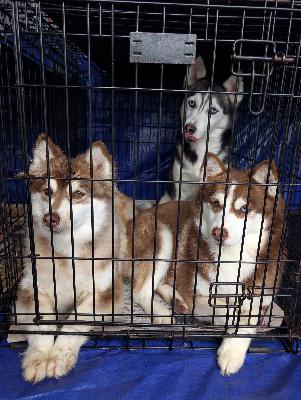
Nearly half of all households in the United States have at least one dog. Many have multiple dogs. All of those dogs were bred somehow and somewhere. This episode is to increase awareness of where your puppies and dogs may have come from. In particular, I will be focusing on commercial dog breeders known as puppy mills. Specifically, those located in the state of Ohio, even though they exist worldwide.Puppy mills are not the reputable breeders your friends or family may have recommended you get your puppy from. Commonly, they are unsanitary and have inadequate veterinary care. Their dogs are overbred and ill-bred, live in crowded undersized crates, and are provided insufficient socialization time, if any at all. There is no limit to how many dogs can be in one building. It can be hundreds. It is doubtful that there are enough people to properly care for the dogs housed in one location. Puppy mill owners typically use brokers who act as “middlemen” between the puppy mills and pet stores, breeders and online sales. However, they can also sell directly from their kennels to prospective customers like us. Many customers may not realize that they are dealing with a large-scale commercial breeder. The facilities, which can house hundreds of puppies, are often located at a distance from the point of sale and may not be visible to buyers. These breeders frequently transport animals across state lines. Puppies raised in such conditions may experience significant stress, potentially leading to behavioral challenges such as fearfulness or aggression. There are puppy mills who relinquish breeder dogs, and sometimes puppies, to rescue groups and shelters. They also call rescue groups to let them know that they have a certain amount of puppies or dogs they need to move out of their facility within hours. Some of the reasons could be:* an upcoming inspection* not adhering to size requirements of crates per dog* dogs can no longer produce puppies for health reasons* shoddy veterinary procedures* cost of euthanasia For this episode, I introduce two women from Columbus who are passionate in their advocacy for dogs and decided to do something about it. Stefanie Mowrey, seated next to me in the studio, and Zaron Van Meter, have tirelessly volunteered their spare time for many years by fostering, rescuing, and adopting dogs. Stefanie is a registered nurse whose passion for animals has endured since childhood. She was heavily influenced by a “60 Minutes” episode decades ago which depicted the unsavory conditions of puppy mills. It captivated her attention to take action when she became an adult. She started fostering, adopting and then volunteering at the local Humane Society, and for the Ohio state chapter of Bailing Out Benji., where she met Zaron. Bailing Out Benji is a national non-profit organization which advocates for dogs in puppy mills and also provides research and education about them.While volunteering, Stefanie became more aware of the increasing number of dogs and puppies from mills and backyard breeders ending up in shelters and rescues. All too often, the shelters were already at capacity. Therefore, they have to rely heavily on fosters to take in dogs, especially puppies. Stefanie uses the example in our podcast of the shelter she volunteers for. This shelter will only adopt “puppy mill breeder dogs” out to a home that already has a resident dog in order to help the mill dog become less anxious and learn how to actually be a dog. Some puppy mill dogs do not know how to play. They don’t know how to socialize with people or other dogs. As a dog trainer, I know that the best teacher for dogs like this are other patient, gentle dogs. Dogs learn quickest and most effectively from other dogs, but it has to be the right type of dog. Dogs also want to know where they fit in their pack. A dominant and/or guard dog in this situation with a fearful newcomer can cause havoc. It is also up to the humans in the pack to ensure the safety of those involved. Zaron Van Meter is a business owner and has been an advocate for dogs for over 25 years. Through her involvement as the founder of SK9 Scottish Terrier Rescue, she organized presentations by well-known devoted companion animal advocates, such as Cesar Millan, Dr. Jean Dodds, Temple Grandin, and Dave Hunt(an expert on dog fighting). In 2012, Zaron was instrumental as an activist in getting an anti-puppy mill law passed included in Senate Bill 130 (Ohio Revised Code 956.20)1️⃣ which mandates better living spaces, regular vet exams, and health certificates for every dog that is sold to a vendor, like a retail pet store. Violations to this code is a misdemeanor. Zaron and Stefanie wanted to do even more to help out by reducing the amount of dogs coming from puppy mills, with the ultimate goal of eliminating them. They became involved in educating the public and informing Ohio legislators of the need to close loopholes in the current laws to protect dogs who come from all commercial breeders. In my opinion, there is not enough attention and priority given to puppy mills by the public and the government agencies that oversee them. More regulations need to be passed and current regulations need to be enforced more effectively. A light needs to be shined on these factories of sadness for the benefit of the dogs and the customers who unknowingly purchase them.There are laws and agencies to oversee and enforce existing regulations against the breeders. On a state level, there is the Ohio Department of Agriculture. On a federal level, it is the U.S. Department of Agriculture (USDA). Existing laws preventing abuse are rarely enforced. If they are, often the penalty is simply a fine. Breeders who have received many violations have been known to change their name and operate under a different licensed name.Even the mission statement of the Ohio Department of Agriculture, which oversees the high volume commercial dog breeder kennels, gives no mention to dogs. It reads:“To protect Ohio citizens by ensuring food supply safety, maintaining the health of plants and animals, and creating economic opportunities for the state’s farmers, food processors, and agribusinesses, all while preserving resources and supporting the state’s largest industry.”2️⃣In Ohio, dogs are similarly classified as livestock. We all know and love our dogs as loving companions that share our homes and are members of our families. To think that dogs are also viewed as property and can be discarded at the whim of these commercial breeders is beyond sad. Their well-being is not at the forefront of their business plan. It all comes down to money. If a breeder dog can no longer have puppies for health reasons or overbreeding, they cease to be a moneymaker. They are discarded or euthanized. Their best chance for survival is to be transported to rescue groups or shelters and eventually adopted by a loving family. Laws in Ohio need to be passed to change the classification of our beloved dogs to be recognized as companion animals, not livestock. Examples of states that consider dogs’ welfare and best interest are New York, California, and New Hampshire. More states are updating their regulations and classification concerning dogs. Within the past two years, Pennsylvania joined suit. Ohio can too with your support!The Ohio Department of Agriculture(ODA) inspects high volume commercial dog breeders. However, there are only 5 inspectors in the entire state to cover the approximately 475 that exist.3️⃣ In 2025, Ohio was designated once again, the second worst state in the nation, with 16 commercial breeders committing major egregious violations. 4️⃣ This is according to the Humane Society of the United States’ (now known as The Humane World for Animals) list called “The Horrible Hundred”. These mills are sometimes documented repeat offenders that should be shut down. Currently, ODA inspections are announced. This is why puppy mills will dump numerous puppies/dogs at a time at a shelter or elsewhere before the inspection date. Mill breeders know they will be fined because of the health conditions of certain puppies or because they lack required paperwork. Legislation in Ohio needs to return to the original code stating inspections be unannounced. This way the proprietors would not be able to hide the true conditions of the living quarters for the puppies and dogs. More inspectors need to be hired, trained and protected from zoonotic diseases that can pass from puppies to humans. One disease that is becoming more prevalent in puppy mills is brucellosis. According to Dr. Felicia Nonnenmacher at Animal Clinic Northview, there is a simple blood test to screen for brucellosis. Most reputable breeders have their breeder dogs tested annually to make sure they do not expose positively tested dogs to people and other dogs. If a dog tests positive, antibiotics can be attempted, but unfortunately do not always lead to a cure. Euthanasia is recommended. Fortunately, Dr. Nonnenmacher has not seen a case of brucellosis in her practice. Zaron describes in our recording an experience a woman had in Canada with a dog she added to her existing pack that had brucellosis. It did not end well for her and her own dogs. Under the current Ohio law (code 956.20), when puppy mills sell to pet stores, the pet stores must provide paperwork to prospective buyers which include:* puppy’s date of birth * puppy’s breed including color, gender, and identifying marks* name and address of the breeder or kennel* health info, including vaccinations signed by a licensed vet* when the pet store took possession of the puppy* breeder’s USDA license number and inspection report (if applicable)Shady breeders hope that people won’t do their homework and research. Their website may look professional and inviting. They may say all the right things on the phone, but they are sourcing their puppies f
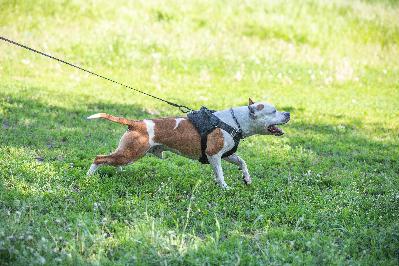
Over the past 13 years, I have helped thousands of dogs and their pet parents learn how to communicate effectively so they can live in harmony together. Most clients just need to establish more structure, consistent boundaries and an exercise regimen for their dogs in order to lead a happy and fulfilled life. Others are presented with challenges by their canine companions, especially when fear or aggression are present. Dog training is not only about teaching obedience skills. It is also about making pet parents realize that what they are currently doing is not working. I help them solve the problem behaviors they are experiencing. Most clients are very receptive to this and some are not. I have only been told once to leave a client’s home. A young man’s girlfriend called me to help her golden doodle get along with her boyfriend’s Staffordshire Terrier. She said their first encounter did not go well. The man greeted me outside with his dog. At least he had the dog on a leash, but the dog was lunging and barking to get at me. The girlfriend stayed about 25’ away with her quiet and probably terrified doodle. The man was offended that I didn’t want to greet his dog. I told him repeatedly over the barking that I never say hello to dogs that are vocalizing, especially in an aggressive tone. I tried to coach him to put the dog in a sit by his side, but he refused for his own reasons. He was struggling to control his dog. I suggested we move to the back yard to see if a change of scenery would help. We did, but the dog never calmed down. The man even told me that his dog is very friendly and this was the worst he had acted out with a stranger. That’s when he said I could go home. I quietly slipped away and was glad when I got inside my car! You can only learn if you are open to it.It can be very difficult for people to admit they are part of their dog’s behavior problem. A lot of times, they don’t even know they are reinforcing bad behavior by giving the dog affection at the wrong time. Most clients end up telling me that they have to change even before I come right out and tell them. That’s when I know that I have gotten through to them. I had to learn how to communicate this to my clients so as not to come across too offensively. My training emphasized to keep everything positive with the dog and the client, but did not outline what to say to the clients when they disagreed with my philosophy and solutions. Customer service is crucial in dog training. You are being hired to fix issues and you better tend to their wishes in a professional manner. If you are the type of person who prefers dealing with dogs and not people, then this job is not for you. Dogs are the easy part, humans can be the difficult part.That being said, I have met some incredible people over the years whose friendships I treasure. They started out as clients, and turned into wonderful friendships. I am still a part of these friends’ lives, even after the dog we trained together has passed on. As a dog trainer, you bond with people in a unique way. When a pet parent brings a puppy home, they treasure this puppy because it IS a part of the family. I don’t think I have ever come across anyone who feels any differently. I am requested to help transition this precious puppy from where it came to their new home. That’s a pretty tall order!During this transition and multiple visits or classes, life happens. I have had several clients whose partner was the primary caretaker of the dog. Then, they either passed away or divorce split up the pack. One client’s son had adopted a dog from a shelter during the COVID shutdown. We conducted our trainings outdoors to stay safe. Then, he was struck with COVID and passed away due to complications with diabetes. His mother wanted desperately to keep the dog, but she knew she could not be there for it due to her demanding work schedule. Happily, she found a great home for the dog and the new pet parent has been very happy with the adoption. Sometimes, I become like a family therapist. The new addition can wreak havoc on relationships, especially when not everyone agreed to get the puppy in the first place. Let’s face it. Puppies are a lot of work. Rescue dogs can present challenges that could not be foreseen in the shelter. There can be disagreements between family members as to how to solve problem behaviors. This is when it is crucial for me to find the right words to explain why certain solutions work and others do not.I absolutely love what I do. I got into dog training all because of my former dog, Hank, the Corgi. Even with my experience and the standards I have today, Hank was a difficult dog. I had to figure him out and I wasn’t going to be satisfied until I had answers to why he acted the way he did. Little did I know that in learning how to figure him out, I would become a dog trainer. I thought at the time I was just really interested in dog behavior. I never intended to make a career out of it. After I made the decision to pursue a job as a dog trainer, I applied to Pet Smart and Petco. Pet Smart wasn’t looking for a trainer, but Petco was. It took me almost 7 months to get hired at Petco. I pursued management on a weekly basis to see if they had made a decision. Sometimes I would drive to the store to talk to the managers. Every time I would drive there, I would get emotional. I couldn’t explain it. The tears were happy tears even in spite of the obstacles I came up against. I felt so driven this was the job I should be doing and the tears confirmed that feeling. I still feel today that the universe was shouting to me not to give up on Petco because I needed to be a dog trainer. After 7 months of persevering, I was finally in the right place at the right time.I started studying the Petco curriculum on dog behavior and how to train dogs. The curriculum was written by a well known dog behaviorist named Patricia McConnell. I read all the books I could get my hands on. However, in my opinion, there was something monumental that was missing from what I was learning from a book. It’s what Cesar Millan, the star of “The Dog Whisperer” is all about - energy. While I was learning the Petco way of training, I was also watching Cesar Millan’s, “The Dog Whisperer” episodes on tv in my spare time. Studying dog behavior became a passion of mine.In every “Dog Whisperer” episode, Cesar repeated the fact that the dog is a mirror of their human’s energy, philosophy, and actions. He proved this concept with every client while handling their dog versus when the client handled the dog. It was not magic or trick photography. It really was all about the handler’s energy that influenced the dog’s behavior. The magic is mastering that type of energy. This resonated with me in some way. I understood the concept, but could not see how it applied to me. I was on a mission to figure this all out. This ‘magical’ type of energy involves mastering remaining calm but at the same time, being assertive. I typically am a calm person, but I wasn’t when I was communicating with Hank. It seemed like I was always frustrated and mad at him because he wouldn’t obey me. I thought that was somehow being assertive. I thought refraining from exploding and yelling at him was somehow remaining calm. Honestly, I didn’t know how to be any different. Hank was unpredictable and sometimes aggressive. Anyone who knows me would probably say that I am the exact opposite of that. However, when I dealt with Hank, I was usually agitated and frustrated because he would often ignore me. Cesar was right. I was the one who had to change and then Hank would follow suit. Dogs do not want to follow unstable energy. It’s so true! As soon as I started to change, Hank changed too. Cesar believes, and so do I, that every human in the household should be a calm and assertive leader. This is the kind of energy most dogs want to follow. I knew I had the calm part down but was fuzzy about what assertive energy looked like. Reading and watching Cesar on tv dealing with dogs using calm and assertive energy was not easy to imitate. It had to come from within and it had to be genuine. Dogs know when you are faking it and they will not respect you. I knew the exact moment that I had achieved calm and assertive energy. When I worked at Petco, I used to have a puppy play time. I had to teach puppies how to play nicely and to respect cautious puppies who needed some extra space. One puppy was picking on another and a third puppy was trying to intervene. The third puppy that was intervening was a sign to me that the energy in the pack of puppies was elevating. Dogs have an inherent desire to keep the pack in a calm state. So, as soon as I noticed this, I stood in front of the puppy that was bullying the other and said with my body language and energy only, no words, “Hey, leave that puppy alone!” The guilty puppy slowly laid down and surrendered to me. I felt like jumping for joy because I knew at that moment what calm and assertive energy felt like. I remembered exactly how I felt in that moment. I tell people that you say in your head “I must get this accomplished and I’m not giving up”. I use and teach this technique and energy on every appointment.See the end result in your head and get it done.I can relate to my clients when they are honest with me in describing how they are with their dogs. I was just like them. I explain to them that the calm part means barely talking to your dog. Instead, communicate using your body language and your energy. If you keep repeating “No!”, you are usually saying this in a frustrated and agitated manner. This typically makes the dog excited because your energy is excited in a negative way. On the contrary, if you keep telling your dog, “Sit!, Sit! Sit!”, your dog will start wagging his tail and jumping. You are coming
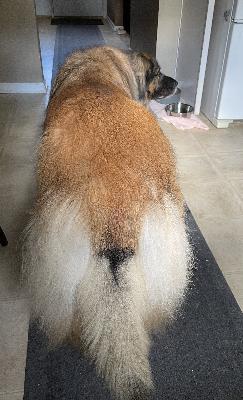
Dog groomers are an integral part in maintaining optimal health for your dog. They are not just limited to bathing and trimming a dog’s coat. They are also checking for ear infections, trimming nails, and noticing lumps and any other superficial health issues. It is important to find a groomer who will point out possible concerns they may have about the appearance and behavior of your dog. They may suggest a follow up visit with your veterinarian.Finding a groomer you can trust and keeping the recommended frequency of grooming appointments are two key ways to help your dog get acclimated to the salon and the entire experience, which can be somewhat stressful. The more often your dog goes to the groomer, the more they will become familiar with them and the surroundings. Communication between the groomer and pet parent must be open and honest. All pet parents want to know how their dog behaved at the salon and if there are any concerns they need to know about. Sharyn Ugan is a retired dog and cat groomer from Petco. She still grooms dogs for friends and family on her own. In this episode,Sharyn shares with me all of the tools she uses. When she worked at the Petco grooming salon, the company provided a lot of the equipment. However, if she needed or preferred certain tools, she would purchase them herself. Typically, a lot of the equipment is purchased by the groomer. Sharyn likes to have backups for every tool. In the pictures below, you will discover which scissors, clippers, and products she prefers. Over the years, she has built up an extensive array of grooming tools for her “toolbox”. BrushesSharyn predominantly uses three different types of brushes. Depending on the job, there are metal slicker brushes, a rake, a fine toothed flea comb, and a FURminator. Brushes are integral in maintaining a healthy coat by preventing and detangling mats. They also help distribute natural oils throughout the body to prevent hair follicles from clogging. Daily brushing keeps matting in check. It also removes loose fur and dirt which helps reduce shedding.* Slicker brushesSharyn likes to use metal slicker brushes with a blue plastic handle. The teeth are made of metal and come in different lengths and textures. The wider brush with shorter teeth are used on shih tzus and smaller dogs. The brush with longer bristles are used more on longer coats like poodles, doodles and German Shepherds. The slicker brush pictured below has an ‘S’ on the back which means that the bristles are soft. They come in soft, medium and hard. Sharyn uses this type of brush on 95% of the dogs she grooms because they are very durable and get the job done. * The RakeThe Rake is a type of brush to manage matting. They are recommended particularly on dogs with an undercoat. I use a rake on my dog, Ebi, every day. She has feathers, long, wispy fur, by her rear end and behind her legs. I use a slicker brush for her body. One month, I tried using a slicker brush on her whole body and thought I was doing a good job. However, when it was time for Ebi’s grooming appointment with Sharyn, she found the most mats ever. The slicker brush didn’t cut through the feathers. Sharyn calls feathers, pantaloons. Rakes can be found in the detangling brush section on the internet. Many companies make them. Just make sure you get a sturdy handle and appropriate size for your dog. * Flea combSharyn uses a flea comb that also has a small comb on the other side. She likes to use this on small dog’s faces, ears, and paws. Sometimes little knots form on the fur on and around the ears. Breeds like Westies and terriers have beards that need to be brushed out. The small comb is perfect for that purpose. I have seen her use it on my dog’s fur that grows in between her toes. She may even find fleas since these are the areas where fleas tend to reside. FURminatorFURminators were invented in the early 2000s as a deshedding tool. The purpose was to develop a safe and efficient way to remove loose undercoat fur without damaging the top coat. However, Sharyn says that you have to be careful because of this. They can take a bulk of the fur out, but you can possibly strip away too much of the topcoat. She liked to use them when they first came out, but now she doesn’t care for them. Shampoo Shampooing a dog is the first step in the grooming process. There are many different shampoos to choose from. Sharyn likes Johnson&Johnson Baby Shampoo. It is tearless and mild. There are other shampoos available for different skin issues. For example, there is a shampoo with oatmeal in it that soothes irritated skin. No matter what shampoo she uses, she always dilutes it. She finds that rinsing the shampoo out is a lot easier. A little bit of shampoo produces a lot of suds to really scrub into the fur. An added benefit is if the dog should have allergies to the shampoo, it will be less concentrated, producing a milder reaction to it. I personally prefer all natural products for my dog. I showcase a shampoo made by a company called Doggy Style. It is a shampoo and conditioner in one and only requires a little bit. I love the way it smells and how my dog’s fur feels when it’s all dried. For more information, check out: Doggy Style Dog Care. This is a local Cleveland company that sells varied products for grooming your dog. I love the bath scrubber for short haired dogs too!Nail trimsEven if you don’t take your dog to a groomer, you still need to trim the nails or get someone to do it for you. The anatomy of a dog’s foot is similar from breed to breed, but the shape and length of the nails can be different. For example, I used to walk my Corgi so much that the concrete would naturally file down his nails. In fact, sometimes the nails would be worn down so low to the quick, they would start bleeding (Please see below the definition of the quick) I walk my Leonberger just as much, but her nails stick straight out and don’t touch the sidewalk unless they start getting too long. When I can hear clicking on the pavement, that’s when I know it’s time for a nail trim. If dog’s nails get too long, the dog will compensate by walking differently. This will put undue strain on the joints. The nails can also get caught on rugs and become injured, causing even more pain and a visit to the vet. Overgrown nails can be painful if walking on pavement. It alters their natural gait and will cause the dog to shift their weight to avoid the pain. When nails are left long on a consistent basis, the quick will grow out with the nail, which makes it difficult to trim them without bleeding. If neglected for a long period of time, the nails can curl under and grow into the paw pad. Ouch!The quickThe quick is located on the inner part of a dog’s nail. It will appear as a small pink dot on the inside of a dog’s nail or as a small dark circle on the nail’s tip on the inside of a black nail. It contains blood vessels, so if it is nicked with clippers, it will start to bleed. Before beginning to trim your own dog’s nails, make sure you have some styptic powder to dunk the nail in. The bleeding should stop immediately. * Small Nail ClippersThese clippers are shown on the far right of the picture below. Small nail clippers are great for cat nails and small animals like ferrets and guinea pigs. They are used for very small dogs like Bugsy, who is laying on his bed in the video of this podcast. Although, Bugsy likes his nails done with a Dremel. 5. The Dremel Some animals prefer the Dremel over clipping, as mentioned above. Some dogs are afraid of the sound of it as it grinds away the nail. There are some models that are quieter than others. In general, the Dremel is safer since it reduces the chance of nicking the quick. It leaves a smoother finish and is great for thick nails. I have seen Sharyn cut Ebi’s nails with a clipper and then Dremel them to smooth out rough edges. Big Nail Clippers* Large Nail ClippersFor larger dogs like Ebi, Sharyn uses a larger, sturdier clipper. Ebi’s nails are thick and more suitable for a Dremel. However, Ebi never has liked the sound of it. The sound and the feel of the Dremel can be off-putting for a dog. On breeds whose nails are long and curved under, clipping away bit by bit is the only way to get the job done. If using a Dremel on these types of nails, the Dremel will come too close to the toe pad, causing possible injuries. The guillotine Sharyn knows how to use the guillotine for nails but does not like them. She finds that they crush and splinter the nail too much. The nail can get stuck upon releasing the grip. Dew clawsSome dog breeds have dew claws which need to be trimmed by a clipper. These are long curved nails located on the side of each front paw, by the ankle. Since they are located so close to the leg, it is awkward to Dremel on the side of the nail closest to the leg. Therefore, it is easier to clip them. Sometimes dew claws are removed at birth so that they don’t present problems down the road. They can get caught on things and ripped off. Some breeds have front and back dew claws. Leonbergers, Great Pyrenees and some Sheepdogs have both. Typically, the dogs that were bred to climb mountains to protect their livestock, will have both front and back dew claws. They help grip the rough terrain as they climb. I have seen Ebi’s back dew claws do this. Scissors Sharyn uses three types of scissors for trimming fur. It is difficult to distinguish the size of the scissors and if the blades are straight or curved in the picture below. Just as a hair stylist has their favorite sheers, so do groomers. * Thinning shears Sharyn uses thinning shears to thin out bulky sections of a dog’s coat. These shears are pictured below on the far left. She will also use them on poofy ears first and then finish the cut with the curved shears. * Blunt end scissorsWhen trimming around the eyes,
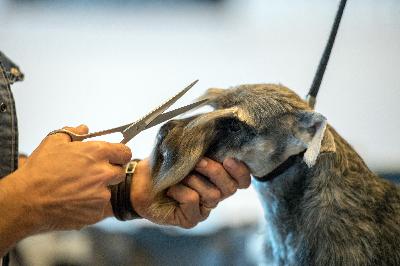
Depending on your dog’s breed, you may be well acquainted with your favorite grooming salon. You might even have a preferred groomer who knows your dog and have established a trusting, reliable relationship with them. My guest, Sharyn Ugan, retired from Petco after 14 years of grooming cats and dogs. I met Sharyn over 10 years ago while working at Petco and also got to know some of the other groomers in the store. My dog training arena was right next to the salon. I would watch in awe how they would work tirelessly on various breeds. I was frequently amazed at the transformation from how the dog looked upon entering the salon and then leaving as a work of art with their pet parents.Dog grooming isn’t only about brushing and cutting a dog’s coat. Most professional groomers check the ears, eyes, the mouth, and even the rear end! Grooming is also about the dog’s health and well being. Sometimes groomers find lumps and bumps that go unnoticed by their owners. They may be located in areas that the owner doesn’t pet on a daily basis. If the fur is overgrown, skin infections cannot be seen. The owner may think their dog is just itching a lot, and doesn’t realize there is a skin infection developing. Regular appointments with professional groomers and veterinarians keep the dog’s health in check.Over the years, Sharyn has found numerous health issues while grooming. Before Sharyn became a full time groomer, she was a vet tech. She saw and treated a variety of health conditions that came into the vet office. This helped her recognize the signs of common ailments when she became a groomer, like ear infections, broken nails, and growths in hidden places. She even identified a swollen scrotum on a non-neutered male dog who ended up having testicular cancer! The owners had the dog neutered right away which extended his senior life by another 3 years. Sharyn became interested in grooming when her best friend bought a kennel that came with a grooming salon. Sharyn learned from the woman who was the groomer in that salon and came to really enjoy it. Sharyn learned a lot from her but she really taught herself. Back then, groomers didn’t need to be certified. She used a workbook for groomers as a guide which showed pictures and described details of the standard cuts for all the different breeds. “It’s just a matter of the more you do it, the easier it gets. You learn by trial and error”. Sharyn UganFor 24 years. Sharyn worked two jobs: a groomer and a vet tech, until she decided to just stick to grooming. She loved it and actually made more money than being a vet tech. Grooming is a lucrative business for the salon and the individual groomers. The popularity of all the doodles out there will keep them in business for a long time! As Sharyn experienced, an unexpected benefit of the job was that she developed relationships with a lot of her repeat clients. It was these relationships that added a little something special to just being a groomer. I remember Sharyn showing me the gifts she would get at Christmas time. Her human clients loved her and her dog clients loved her even more!When Sharyn worked at Petco, there were strict protocols in place. For example, it was required that puppies and dogs be up to date on all vaccines. Typically, puppies don’t get their rabies shot until at least 6 months old. It is essential to get them used to the salon as soon as they are fully vaccinated, so they don’t develop fear issues later. Sharyn’s advice to pet parents who rescue adult dogs is to take them to the salon about 3 to 4 weeks after they become accustomed to their new home. It is possible the rescue dog already had a bad experience with a groomer/grooming salon. Therefore, you don’t want to stress the dog out too much right after bringing them home.Petco also changed their policy on using muzzles on dogs that showed signs of aggression. Groomers used to be able to muzzle these types of dogs who were getting something as basic as a nail trim. However, the company changed their policy on muzzles. They were no longer allowed. Instead, groomers were directed to start referring aggressive cases to their local veterinarian to avoid their employees getting bit. Vet offices will muzzle dogs and even sedate them if necessary.When seeking out a grooming salon or individual groomer, it is worthwhile to find out what their policies are with dogs who have a hard time being manipulated. Get a tour of the salon so you can see where dogs are placed while they are being bathed, dried, and waiting to be picked up. Go at a busy time so you can hear the noise that your dog will hear. If your dog has fear issues, you may not want to expose your dog to such a hectic environment. Always have your dog’s best interest in mind. At Petco and other corporate pet stores, there is usually a training program that involves being mentored by another groomer. When groomers first begin their apprenticeship, they get to know the dog by handling them on leash and leading them to the bathing area, shampooing and drying them, and learning how to get the dog up on the table to be worked on. Many dogs are fearful of the entire experience, so it is important to learn how to handle and manage a dog in this state of mind. It requires a lot of patience with calm and assertive energy. Sharyn mentored plenty of apprentices who weren’t cut out for the job. They discovered they were more fearful of dogs than they thought they were. It can be a very stressful environment when dogs are barking while grooming a fearful dog, and being afraid of getting bit. Groomers should know they will get nipped and sometimes bit. It comes with the job! Part of being a groomer is building a relationship not just with the dog but also with the client. When the client drops their dog off, Petco had a list of questions to ask them which included if there were any changes in the dog’s health. Groomers were instructed to have the dog walk into the salon instead of being carried. This way they could confirm that the dog didn’t have mobility issues. Sharyn would always do a quick check up before the client left for fleas, sore spots, and anything that might affect her grooming.Sharyn found the best approach with clients was to be honest and upfront. If she found fleas or ticks, she would put them in a baggie to show the client, in case they were in disbelief. If she found any health issues, she would bring it to the client’s attention. If the dog was having an “off” day, or the dog was so stressed out from the noises in the salon, she would call the client to have the dog picked up as soon as possible. One time, Sharyn was only able to groom half of the dog because it was so stressed out. She had the client bring the dog back after a week to finish the rest. Sometimes, the dog wouldn’t exhibit any aggression or fear until they were put up on the grooming table. If the dog was wiggling and thrashing about so much that it impeded working on the dog, the client would be contacted to pick up their dog. It was a matter of the dog and the groomer possibly getting hurt. Whatever needed to be done that was best for the well being of the dog, Sharyn would act accordingly. She was always her client’s best advocate.Sharyn not only groomed dogs, but also cats. It had to be a special cat to tolerate a noisy salon and be surrounded by dogs. Some cat clients would shave their long haired cats because it was easier to maintain a short coat and it would also keep hairballs in check. One thing to keep in mind when shaving a cat or a dog is that it can damage the follicles, making it difficult for the coat to grow back in. The fur will grow back in different places and not in others. Sometimes, it doesn’t grow back at all. Sharyn had a longhaired Scottish Fold named Marshall who she would use as a teaching tool for apprentices to learn how to shave and work with cats. Marshall lived a nice long life and died at the age of 22! Almost unheard of for a cat!!One common issue that groomers deal with is when the fur gets tangled and forms knots, called matting. This is a painful condition especially when the mats are close to the skin. It actually starts pulling on the skin. Sometimes mats can be brushed out, but more often than not, they have to be cut or shaved out with clippers. Breeds like Poodles, Doodles with tight curls, and Shih Tzus, are more apt to get mats. Daily brushing can keep long coats in check to avoid matting.In reality, any breed of dog can get mats. They can be formed by:* lack of regular brushing* not using the correct type of brush* loose fur that hasn’t been blown out periodically (like Samoyeds and Huskies)* moisture and dirt* friction due to harnesses, sweaters and even petting behind the ears * areas that are frequently overlooked when brushing (under carriage, private parts)* excessive itching due to skin infections or parasitesSharyn says a misconception about matting with most people is that if they give the dog a bath first, then it will be easier to brush out the mats. The moisture actually makes it worse. What should happen instead is that the dog gets blown out with a high powered dryer and then brushed. Then, mats that can be cut or teased out with scissors are worked on first. The mats that are located in hard to reach spots or close to the skin get shaved off with clippers. If the dog is covered with mats, the whole body will be shaved. In rare cases, mats are so severe that amputation is the only option, I have seen this happen when people have rescued a dog that has been neglected for a long time. Clippers are a gentler way of tackling mats than trying to tease them out with a comb. Dogs may have an aversion to the noise of the clippers but they do not hurt the dog. There is such a thing as razor burn that comes from not changing out the metal detachable clipper often enough. Shary
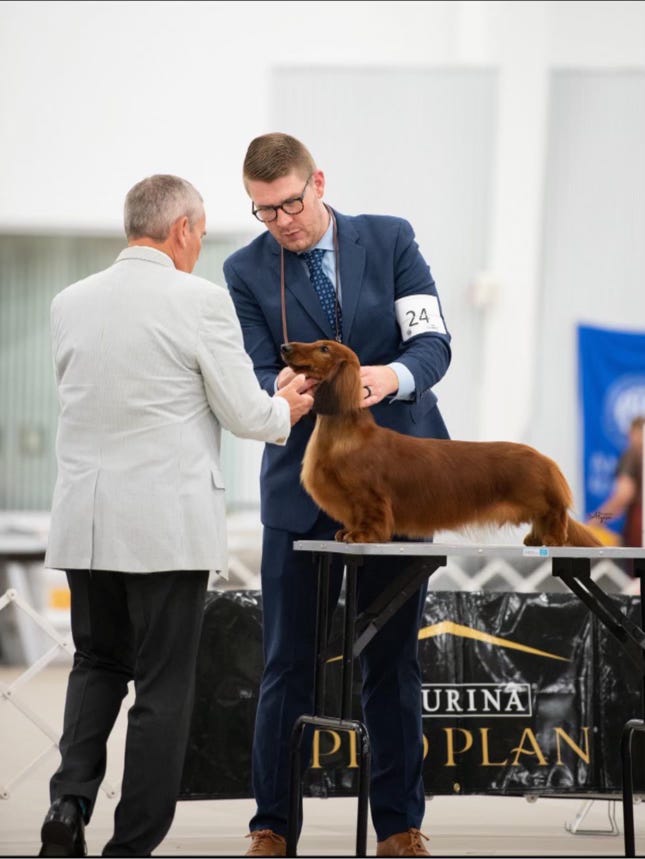
There are so many fun activities to do with your dog that speak to the instincts of specific breeds, such as agility for Jack Russell Terriers, hunting for Beagles, and herding for Border Collies. However, there is a whole other venue that is all about the preservation of over 200 purebreds recognized by the American Kennel Club (AKC). That is the world of the show dogs. Breeders dedicate their lives to ensure their dogs are born healthy and structurally sound according to the standards set by the AKC. Judges at dog shows are an integral part of preserving the legacy of purebreds by choosing which dogs (males) and b*****s(females) meet these standards.My guest, Dr. Jennifer Smith, has been involved with competitive dog performance sports for decades. That was her comfort zone. However, she was always interested in the show arena, but never gave it a try until about 5 years ago. Watching the handlers and dogs on the Westminster Dog Show every year looked easy. Little did Jennifer know that there was a lot more than just prancing around the ring with your best buddy. As with everything that Jennifer decides to take on, she went all in! At this point in her life, poodles are her favorite breed. Please refer to our previous episode entitled “Oodles and Oodles of Poodles” where Jennifer elaborates on the temperament, intelligence, and instincts of this magnificent breed.Jennifer studied for years how to groom poodles to standard. Her goal was to learn how to groom her own poodle, Scarlet, so she would become show quality. She would go to shows and just observe what the pros did. Poodles have a continuous coat which keeps on growing. Jennifer used this to her advantage while learning because the coat happens to be very forgiving. If you make a mistake, you can cut it out, and it will grow back fairly quickly.If hunters never trimmed poodles’ fur, it would weigh them down in the water so much that they could drown! Styling the poodle has changed a bit over the years, but the shape of the cuts around the body serve the same function. The “rosettes” (the two round mounds of fur on their back) were trimmed to keep the poodle’s hips warm. The poof balls on the ankles are intended to keep them from getting too cold. The “jacket” around the body keeps their internal organs warm. The function of the poof ball on the tip of the tail is to make the dog visible while swimming to retrieve fowl from the water.Jennifer also had to go through a series of conformation classes. Conformation classes teach handlers how to present their dogs in the show ring. They teach handlers how to position their dogs in a standing position called stacking. They also teach them how to move around the ring to highlight the dog’s gait. Lastly, they learn proper etiquette when communicating with the judges and how to prepare for the judge’s exam. Jennifer also spent countless hours watching and practicing handling dogs. Part of Jennifer’s dream was to not only have a show worthy poodle, but also to handle her poodles in the ring. Jennifer succeeded because Scarlet now has her Championship and is a finished dog. She performed beautifully, but she really wasn’t thrilled about being in the show ring. Therefore, Jennifer didn’t pursue getting Scarlet her “specials”, which is the highest level of competition in a dog show. The anatomical structure of the poodle is unique. Poodles are squarely built, which means their length is equal to their height. They also have a specific angulation to their structure which allows for a very elegant and effortless prancing gait. It looks like they are floating. There really is no other breed that compares to it. Every feature about them evolved that way to facilitate retrieving fowl in the water swiftly and powerfully. This becomes integral to assessing the poodle in the show ring. **“Not all family dogs are show dog quality, but all show dogs are family dogs”. - Jennifer SmithWhen interested in getting involved in the dog show arena, one of the first places to start is searching for reputable breeders who have experience showing that breed. Jennifer recommends for people to go to dog shows and actually talk to any of the breeders of the type of dog you are interested in. They have a lot of pride in what they do. They will give you unique insight into the breed that online research cannot. The most responsible breeders will divulge information about how they breed out certain health issues. Good breeders are all about sharing information about the breed they love and live with. They want others to love their dogs as much as they do. These are the owners who will make sure their dogs will live on for generations to come. Just as with any profession, there is plenty of fraud, so make sure you do your homework.After selecting a favorite breed, do extensive research on the breed. Make sure this is a breed that is suitable for your lifestyle. Border Collies are a lot of fun and they are highly intelligent, but that comes at a cost. You better be prepared to provide an active lifestyle for them and challenge them intellectually or else behavioral issues can arise. Jennifer talks about the pages and pages of standards set by the AKC for every recognized breed in the United States. When you show your dog, the judges are looking for the one that best conforms to those standards. “Dogs aren’t competing with each other. They are competing against the standards.” - Jennifer SmithJennifer reads and then rereads the pages of standards for the poodle breed. Each time she reads them, something jumps out at her that she didn’t notice the last time she read them. The more experience you have, the more you understand on a deeper level what the standard means. Jennifer has 4 poodles as pets. She has studied their behavior, learned how to properly groom them, and how to handle them in the arena for several years now. Showing a poodle is different than showing a dachshund, like her husband Tom does. They are a different breed with a different temperament and require a skillset unique to each one. It is imperative to know the breed you are handling in the show arena inside and out.One important aspect of owning and showing dogs is they have to remain intact. This means that dogs cannot be neutered and b*****s cannot be spayed. This presents a challenge for Jennifer and her husband Tom twice a year when the b*****s go in to heat. She says that the intact males will claw through anything to get to the female! The instinct to reproduce is that strong. They get triggered by the smell of the urine. The entire heat cycle can last for a couple of months. However, when the b*****s are ready to mate, the males can no longer just be separated by fences in the backyard. They have to go live with other show dog friends until the b***h’s hormones subside. Jennifer’s latest addition to her poodle pack is Chapel, shown below. Chapel finished her championship on September 13 and won again to earn points towards her grand championship. Jennifer decided to have Chapel live with and be handled by a professional handler. She likes to play with her dogs and let them be dogs in her vast backyard, which isn’t conducive to maintaining the type of coat required for the show ring. When dogs play, they like to take bites at each other’s tails. It’s cute and fun to watch but it is too challenging to keep them from doing this. It prolongs the growing out process needed to properly groom them for show quality. Therefore, Chapel’s handler makes sure her coat pristine. As Jennifer explains in our podcast together, showing your dog starts as early as 6 months old. There are many categories to pass through, all while earning points. The more shows you compete in, the more chances you have of earning enough points and winning to progress to the next category. This is why you will find show dog people who have motor homes. They can transport their dogs and set up camp at nearby camp grounds for the weekend events. Days in the show arena are long days, sometimes 12 hours. It can be grueling, but very rewarding when all of your efforts pay off with a win. For those of you who are interested in finding out more about the show dog life, please contact the AKC at akc.org. There is also the UKC (United Kennel Club) which has different standards and events that may be more appealing. They can be reached at ukcdogs.com. Thanks for reading From A Dog’s Eye View! Subscribe for free to receive new posts and support my work. This is a public episode. If you would like to discuss this with other subscribers or get access to bonus episodes, visit canineconcierge.substack.com

**This episode is dedicated to Gary Flynn, all of the Task Forces deployed with their search and rescue canines, including Ohio Task Force 1, and those who perished on September 11, 2001. This is also dedicated to the dog handlers and emergency crews who continue to suffer from the trauma experienced during that time, and to their family members supporting the mental and health issues of their loved ones who continue to suffer.September 11 was the worst terrorist attack on U.S. soil. People were stunned and frightened as they watched the events unfold on their television screens. After the plot to destroy human lives and weaken American leadership had concluded on that horrific day, the largest call-up of emergency services occurred and FEMA task forces were deployed. One of the 26 FEMA task forces summoned was Gary Flynn and Ohio Task Force 1.I highly recommend listening to this podcast where Gary describes, in detail at times, how the events impacted him and his 5 year old Belgian Malinois, Tascha. To say that this was an emotional podcast is an understatement. In fact, words cannot describe adequately the plethora of information that Gary was willing to share. Therefore, I am only going to write about details in the best way possible to help break down the magnitude of that day, and the months and years to follow. This is also the platform where I can share photos that Gary took during his time there. Never did I think that I would meet and get to know someone who I could call my mentor and my friend, and someone who tirelessly worked at finding survivors with his personally trained professional dog. This was a war zone, no doubt about that. The way that Gary describes how he got the call while working his day job at BIOPLASTICS CO. in North Ridgeville, Ohio, is already uniquely different than the majority of us who watched the news that day in our homes. He was called up and ready to go like any soldier summoned to war. We all remember exactly where we were when we found out about the first plane slamming into the World Trade Center. None of us dreamt this was part of a much bigger plot to wreak devastation on a such a grand scale. We were able to watch the events on tv in the security of our homes. However, the first responders and those called up to search for survivors had to risk their lives and the lives of their beloved and highly trained canines.Out of the 72 people in Ohio deployed by FEMA, only 4 dog handlers and their canines were chosen to go. Three of the four handlers were from OSDA (Gary’s search and rescue dog agency). The fourth handler, Terry Trepanier was a veteran firefighter and paramedic from Washington Township, shown in the picture below with his dog Woody. There were many more qualified people ready and willing to go serve, but were not chosen by the federal government to assist. FEMA plans for disasters similar to this and whatever they decide is not to be debated or contested. Gary talks about how much the love and support from those not selected to go was an immeasurable support system while being there.FEMA requested that the canines to be deployed be live human finds only. Gary had a cadaver dog, Felix, fully trained and ready to go, but that was not what was needed from Ohio Task Force 1. There were Task Forces from other states who received the order for trained cadaver dogs. However, Gary’s dog Tascha, exhibited an aversive behavior whenever she would come across cadaver parts. She would shrug her body in such a way that it was almost an actual alert signal. Gary had specifically trained her to go past any cadavers and only focus on the live human scent. Gary and Tascha worked 12 hour shifts, but it never ended at the 12th hour. If they were commanded to search a specific area of “the pile” (which was approximately 40 stories high) and they kept finding more openings within that pile to investigate, they did not quit just because their shift was up. They continued until there was no more area left to search . If it required to rappel blindly into a dark hole, then that’s what they did. Sending his dog in first with no leash and no collar to find survivors caused fear and anxiety that cannot be verbally described. “I can tell you what it was like, but I have no way to tell you how it feels” Gary FlynnGary and Tasha weren’t always working the pile. Sometimes they were commanded to search the surrounding buildings. A badly damaged structure assigned to Gary and Tascha was the Merrill Lynch Financial Center, pictured below. They had to climb 51 flights of stairs with no lights to guide them and search every inch for survivors. What they found was mostly plane pieces, cadavers, luggage and clothes. Gary says that the job always starts from the top on down, instead of the other way around. That way, when you are all done with the search, you can just exit the building.One of my questions to Gary was about using protective gear for himself and his dog. Gary had all the protective gear needed for a toxic environment like the one at Ground Zero. He knew what he could be exposed to because he was a certified environmental hazard specialist. However, the protective gear got in the way when navigating through narrow passages with sharp objects all around. He wished he could have worn the gear all the time, but it wasn’t feasible. Tasha did not wear any boots for her paws. She managed okay without them. She did endure a large burned area on her chest, not from direct fire, but from abrasions caused by squeezing in between and crawling through so much rubble. The wound healed up, but the fur never grew back. She lived until the ripe old age of 17. She was a cancer survivor on top of all that. It was too difficult to say that the cancer was due to her exposure to chemicals at Ground Zero, but living 13 years after the event is pretty astonishing! Gary is beyond grateful to the Veterinary Medical Assistance Teams dispatched by FEMA to Ground Zero to provide medical care to the hundreds of search and rescue dogs on site. Tascha became dehydrated to the point where she needed to have intravenous fluids pumped into her. The VMAT teams provided the prompt assistance required to get Tascha back on her paws again.Another question I asked Gary was if dogs experience PTSD. He believes they do but it is because those dogs were not properly trained or they were not the type of dog that could handle the stress from search and rescue work. Just like not all dogs make good service dogs, not all dogs are cut out to make effective search and rescue dogs. The stamina and prolonged self motivation required for this kind of work is not present in all dogs. The dogs who have been correctly trained succeed and love what they do. Their handlers reward them with play time whenever they can sneak in a few minutes of downtime. Sometimes, due to the tasks at hand, the only reward was their handler’s voice praising them. Other times, down time meant rest time. Catching a few Z’s had to be squeezed in there too!Another amazing feature of the search and rescue dog is their ability to provide loving and caring support to their handlers and emergency staff members. Gary said there were plenty of them crying into their beloved dog’s fur. Dogs provide comfort that humans cannot. It’s just different. Gary is eternally grateful to so many people, but most importantly, his wife and young daughter. Returning from any search and rescue mission is difficult to resume a normal routine, but coming back home from Ground Zero was especially challenging. The trauma of seeing so much death and destruction can make it hard to carry on. Gary encourages anyone experiencing trauma to seek help. PTSD manifests itself in so many disguising ways. Seeking professional help is crucial to learning how to resume mundane chores and a “normal” lifestyle. You want things to be the way they were, but it’s impossible when you have changed because of this traumatic event in your life. I want to extend my humble and sincere gratitude to Gary for giving me the opportunity to talk about such an emotional subject. I feel deeply that our paths crossed at Petco because as fate would have it, one day I would have the platform for him to share his experience with all of you. So many people suffered, and sadly still suffer, from that sunny fall day 24 years ago that suddenly turned dark. Please be kind to all people. You don’t know what their story is.Thanks for reading From A Dog’s Eye View! Subscribe for free to receive new posts and support my work. This is a public episode. If you would like to discuss this with other subscribers or get access to bonus episodes, visit canineconcierge.substack.com
Search and Rescue dogs are highly trained canines used to locate missing people and their personal items at disaster sites either natural or man-made, crime scenes, and terrorist attacks. Dogs possess the ability to pick up different scents that humans and technology cannot. They travel faster than humans when navigating through rough terrain, which speeds up the process of finding missing individuals. Time is of the essence when working a search and rescue mission. Every minute counts when dealing with life and death. Human emotions can be highly charged during these missions. Therefore, professional search and rescue organizations must maintain a sense of calm and control while adhering to local, state and federal standards. Gary Flynn, owner and head handler for The Dog Advocate in Vermilion, Ohio, has been passionate about working with dogs since his time in the military. His training as an infantryman taught him how to navigate in the wilderness. This highly refined skill became very useful when he started working with Georgia Canine Search and Rescue while stationed at Fort Benning. Land navigation skills are extremely useful while working on a mission that may last days, even weeks. Sometimes these search and rescue missions will take crews into the woods or disaster sites where there are no well defined exits. The crews have to figure out how to navigate through it without getting lost. Before cell phone and GPS technology, search and rescue missions were even more challenging. Gary used his land navigation skills and applied them to become an extremely qualified and well sought after search and rescue handler. Upon Gary’s discharge from the military, he moved back to familiar territory in Vermilion, Ohio. He knew he wanted to become a professional search and rescue canine handler. He contacted Benji McPeak who owned and operated Firelands Kennels. Benji was a police dog trainer who also trained wannabe professional handlers like Gary. Benji had contracts to train dogs for the Ohio State Police, numerous sheriff departments, and even police departments that had their own canine programs. Gary started training dogs in junkyards searching for various items and conducting car searches for drugs. However, what really sparked his interest was training cadaver dogs - placing cadaver parts in different areas for training purposes for the dog to find.One of the most important lessons that Gary learned was how to shape dogs into performing desired behaviors. It takes a skillful eye to piece together the deliberate behavior conditioning by the handler with what the dog does naturally. Reading the dog accurately was key to developing the most effective and reliable professional dog. Taking this skillset and applying it to searching for humans, dead or alive, became one of Gary’s specialties. He trained his dog to be a cadaver dog. He used this skill many times when doing area searches of collapsed buildings, floods, tornadoes and other natural disasters.Gary discovered that how he trained dogs to alert him to dead or live finds was different than a fellow canine handler for the Ohio State Patrol. Gary trained his imported German Shepherd, Iren, to alert him to a deceased body by running back to him, bark 4-5 times, and then run back and forth between him and the deceased. If the body was alive, she was trained to run to Gary, run back to the person, and stay there and bark. This was vital later on when Gary had his own search and rescue agency and he got a call from a homicide detective for the State Bureau of Investigation (SBI) who was trying to solve a missing persons case. Sometimes Gary was called to help solve cold cases. There was a possibility that by using one of his dog’s keen sense of smell and method of alerting, some of the SBI’s cold cases would result in closure.One of those cases was a deathbed confession. The murderer told his wife where the body was. Then, the wife was dying and told their daughter. So many years had passed, so the credibility of this confession was suspect. However, the daughter did the right thing and contacted the police. The police made contact with the new owners of her parent’s house. Then, Gary and his cadaver dog, two forensic anthropologists and a coroner showed up. Bingo! The remains were there and the identity of the deceased was verified.Another pertinent lesson that Gary learned while working for Benji was how to keep a dog engaged with their handler and remain focused with the task at hand for a prolonged period of time. This is the foundation for building the motivation and drive which is required in professional dogs. A tremendous amount of time is spent teaching the dog not to give up. Providing the appropriate rewards and the timing of it is also extremely important to achieve this. As a professional handler, Gary believes everything he does is intentional. The dogs must be worked in every type of situation imaginable so they ignore the bunny that runs in front of them and continue to search for people or articles of clothing. They have to ignore the juicy cheeseburger on the ground and be motivated enough to stay on course. Many times the dogs are out of the handler’s sight, so it is crucial to work with them in all scenarios in order to ensure they stay on task.I believe this lesson can be applied on a much smaller scale to every dog owner who wants to train their dogs to do a certain behavior. You have to make it exciting and fun for the dog with plenty of rewards to keep your dog engaged. Otherwise, the dog will wander off mentally and physically because you are not providing enough excitement to keep them interested. I had the privilege to work with one of Gary’s professional dogs named Abby. First, Gary demonstrated how he worked Abby through the different stages of escalating her drives. Once he got her to where she needed to be, he had me copy him. I put the bite sleeve on my arm and shouted out the German commands for her to run towards me, no leash, no collar, and bite my sleeve. I was not scared because I trusted Gary and knew previously how well controlled Abby was. Since it was my first time wearing a bite sleeve, I was hesitant and not confident enough. I couldn’t get Abby to respond in the same way that Gary could. Gary told me that I wasn’t all in. I needed to be 100% committed in order for Abby not to be confused with what I was trying to achieve and then stop working for me. I tried again and did better, but I definitely needed practice! This is exactly what Benji taught Gary and Gary taught other handlers. The easy part is shaping the dog’s behavior. The hard part is teaching the handler to trust their dog and maintain prolonged engagement with them.Benji introduced Gary to North American Police Work Dog Association (NAPWADA) and North American Search Dog Network (NASDN). These organizations established a working standard for all police work dog handlers and trainers through an accreditation program. There are standards for tracking article search, area search and human remains detection. Any evidence that could be presented in court had to adhere to strict standards so as not to corrupt a crime scene. Gary even brought his dog into court to prove the reliability of their results. As far as search and rescue missions were concerned, Gary started noticing the lack of standards in place that was prohibiting the expediency and efficiency of conducting and completing a mission. The issue of liability was emerging and the last thing Gary wanted was for him or his co-workers to be sued by individuals because the integrity of the mission was compromised. This was the motivation for Gary to form his own search and rescue agency, Ohio Search Dog Agency, which still exists today.The impetus to follow through with Gary’s desire to form his own search and rescue agency was when he received 3 calls to find missing searchers in the same county. Gary realized that not all search and rescue handlers had the same land navigation skillset he did. There was no requirement to be trained in that and no guidelines to be certified in wilderness first aid. Being a paramedic is a great foundation for what may be expected of a handler while being deployed on a mission, but it is not the same as wilderness first aid. Injuries from a tornado are different than injuries from a flood or a terrorist attack such as Ground Zero on 9/11. Search and rescue is not just about the dog sniffing out and finding missing humans. It’s also about getting the proper education required, knowing the standards and most importantly, knowing your dog. Lack of resources, lack of egress, and the undefined time spent searching, are all factors that weed out the professionally trained handlers from the volunteer handlers. Gary understands that people want to volunteer their dog during times of disasters. Their hearts are in the right place, but due to their lack of professional training, they get in the way and can become a liability. Gary suggests to people who want to become handlers of search and rescue dogs to contact their local Emergency Management Agency and inquire about trainers with credentials and experience in search and rescue in their area. Start your way down the chain of command instead of the other way around. There are too many organizations who claim they are search and rescue experts but they are not. Make sure you weed them out from the real professionals.Some of the individuals Gary was introduced to when he worked for Benji would become invaluable assets to him when he formed his own search and rescue agency in the 90s called Ohio Search Dog Association, He decided to contact three people he thought would work well together in this new venture. One of them was John Macioce, who had a lot of experience working with professional dogs with Benji like Gary did. Another person was Mike Pal
Canine Companions is one of the premier service dog organizations in the United States. They provide dogs to people with disabilities free of charge. One of the clients who applied for a Canine Companions service dog is Jim Turner. Jim has a hearing dog named Koogle, who helps him navigate his daily life with confidence and independence. I had the privilege of talking to Jim with Koogle by his side, and saw first hand how Koogle assists Jim as his link to the world of sound.Jim was diagnosed with bilateral neurosensory hearing loss during a company physical exam when he was in his forties. His wife, Kathleen, thought he had selective hearing and was sometimes ignoring her. It is a hereditary condition which worsens over time. Since then, he has been wearing hearing aids. Jim’s hearing challenges are defined by the limitations of not being able to hear the upper half of the frequency range that humans normally hear. Smoke detectors, doorbells, microwave alarms are all very challenging for Jim because even his hearing aids do not pick up that frequency. Also, when Jim is in a crowd of people, it is difficult to hear, especially when his name is being called amongst all that background noise. Jim and Kathleen were familiar with Canine Companions because they were already puppy raisers for the organization. Volunteers like Jim and his wife, agree to raise the puppies provided to them by selected breeders from 8 weeks to 16-18 months old until they go on to professional training. (Please refer to my previous post with Staicey Sholtz dated 8/5/25 for more details about puppy raisers).Jim was being encouraged by his close friends in the Canine Companions community to get a service dog. He didn’t feel that his hearing loss was that bad to warrant one. He wanted the service dogs to be reserved for people who were deaf. An event in his life changed his mind. One day, his wife was working in the kitchen and hurt herself. She was bleeding and calling Jim for help. Jim was only 10 feet away in another room and had no clue he was being called. He didn’t hear her pleas for help. That day he applied for a service dog. Jim filled out an application online at Canine Companions’ website: canine.org. Applicants are prompted to describe their disability and how they could benefit from a service dog. The organization then reaches out to them for an initial interview. There is a space to write about your lifestyle - what your interests are, if you are an active or sedentary person. In Jim’s case, he had to provide a medical recommendation from his audiologist about hearing limitations. Canine Companions wants to ensure that the request is not only warranted, but also to match up the right dog with each applicant. This entire process can take up to two years. Jim is a retired geologist. He had an illustrious career in the oil and gas industry and was part of a team who located oil and gas under ground. The first day of Jim’s retirement, at age 63, was the day he started his team training with Koogle. It was meant to be!Part of the process of getting a service dog from Canine Companions is to go to one of their training facilities to be matched up with your personal service dog. At the time, Jim and Kathleen were living in Houston, Texas. The closest training facility was located in Oceanside, California. This is where he completed his two week team training, referred to as “rotations”. There were 7 applicants and 8 dogs. All of the applicants practiced handling each one of the dogs. The professional trainers who spend 6 months with these dogs make their observations and match up the best dog for each applicant. The “extra” dog remains at the training facility and is the first one in the next rotation to be matched up with the next group of applicants. After several days, Jim was matched with Koogle. Jim said it was like magic how accurately the teams were put together so perfectly. Koogle is a six year old Labrador Retriever Cross. His mother is 50% Lab/50% Golden Retriever and his father is 100% Lab. Canine Companions select breeders who must meet certain standards. Koogle’s breeder was the caretaker of Koogle’s mother and had the privilege of naming one of the puppies in the litter. Canine Companions have restrictions for naming the puppies so that the names are appropriate and not repetitive. Koogle’s breeder/caretaker’s maiden name was Koogle. What a great way to honor her late father.During Jim’s two week stay at the training facility, he learned many cues that were taught to Koogle. The trainers tailored certain cues according to Jim’s hearing loss needs. He learned protocols for socializing Koogle such as making sure Koogle wears his Canine Companions vest and what he should do when approached by people who want to greet Koogle. The first six months, Jim was to be the only person to give Koogle food. He was instructed to notify close friends and relatives about how important the first six months were and to abide by Jim’s rules so as to not disrupt any training Koogle had received up to this point. Canine Companions wants to assure that the bonding between their client and the dog remains intact.The Americans With Disabilities Act does not require any labeling or vests for service dogs. Canine Companions require their dogs to wear a vest which you will see in some of the pictures below. Wearing a vest helps Jim notify the public that Koogle is a service dog. He found it useful to have “Please Ask To Pet” sewn on to it. Like most dogs, Koogle loves people and would love to greet everybody he meets. However, every time he says hello to people, he is no longer working for Jim during that interaction. It is out of respect for the handler of any dog, let alone a service dog, that they be asked first to greet their dog.Koogle was trained to perform many different tasks to assist Jim in his everyday life. When he hears an alarm, a doorbell, or Jim’s name being called, he is to find Jim, nudge him with his nose, Jim tells him, “Good, Koogle what?”and Koogle takes him to where the sound is. However, if it is a smoke alarm, Koogle will still nudge Jim, but instead of taking him to the noise, he lays down. So, whenever Jim sees Koogle lay down after being nudged, he knows to get out of the building they are in. Koogle was also trained to do standard service dog tasks such as turning on and off lights and opening and closing drawers. He can even jump up and push the accessibility button to open doors in public places.One intangible benefit that Jim did not expect to experience with a hearing dog was the acceptance of having a hearing disability. For example, Koogle gives Jim the confidence he needs when trying to have a conversation with someone in a crowded environment. Background noise impedes the ability to hear well. He is more apt to tell a stranger to repeat themselves because he has a hearing disability when Koogle is by his side.Jim’s wife was very excited to have a hearing dog in the house so she didn’t feel she always had to be Jim’s ears. Koogle relieves her of knowing that when she is not with Jim, the dog can alert him, if needed. Even something as simple as dropping his keys and not hearing that sound, Koogle can stop Jim by nudging him and taking him to where he heard the keys drop. This gives his wife a lot of reassurance that he will manage well when going out of the house. Jim believes there are two aspects to being a service dog. One is the ability to perform the tasks they were trained to do as demonstrated in the video above. That’s the easy part! The other part is that the dogs need to be calm and manageable in public. This is attributed to the puppy raisers who properly socialize them while they are in their care. The other part of being calm is the temperament of the dog. This speaks to the breeding of these dogs. For example, if a dog is too hyper or has a high prey drive, Canine Companions breeders will not breed that dog. In both podcast videos of Staicey Sholtz and Jim Turner, their dogs remained laying down until they were called to do a task. Although the dogs look like they are sleeping, they always have an ear out for noises that change in their environment or that could possibly harm them. This auditory instinct allows them to differentiate between familiar voices and changes in the intensity of those voices which will wake them up in case they need to act on them. Their dogs are trained to be ready for action as soon as they hear their name being called.Jim meets people out in public who either have service dogs they paid a lot of money for, or who tried to train their own dog only to find out that it didn’t work out for numerous reasons. Sadly, there is plenty of fraud in the service dog field. Organizations will claim they can train your dog to become a service dog, but are not qualified to do so. They also do not have the standards required to be an effective service dog. Canine Companions is a well known and trusted service dog organization yielding qualified dogs and plenty of satisfied clients. There is so much that goes into training service dogs above and beyond just training the standard tasks. If a dog is fearful or even mildly aggressive with certain triggers, this can present problems. Professional trainers can work on these issues with the dogs, but it can slow down the timeline required to place these dogs with applicants. My dog, Ebi, could make a great service dog, but she is too big and too hairy! Also, I have come across some people who are afraid to meet her because of her size, or they are cautious because they don’t know what breed she is. Labs are a great size and can fit under tables at restaurants or places of business. They don’t drool, and have a very inviting look. They are famous for being friendly dogs. They do shed but their fur is not long and fluffy like a Golden Retriever’s

Canine Companions, formerly Canine Companions for Independence, is the oldest and largest service dog organization in the United States. It was formed in 1975 and is credited with starting the concept of the modern service dog that we are familiar with today. They attend to over 65 different types of physical and cognitive disabilities including autism, hearing loss, PTSD, Parkinson’s disease, POTS, Multiple Sclerosis, Muscular Dystrophy, and debilitating arthritis. They do not train dogs for the blind or for people who need to be alerted for medical conditions such as seizures and low blood sugar levels. Canine Companions provides their own breeders, puppy raisers and professional trainers with the end goal of placing the right dog with the right person in need. Since Canine Companions’ inception, 8,000 dogs have been placed nationwide. Currently, approximately 400 dogs are placed annually, of which 50 are in Ohio. The need for these highly trained dogs far exceeds the supply. Canine Companions’ longterm goal is to decrease the current two year waiting list by increasing the amount of puppies born as well as volunteer puppy raisers.There are many ways that distinguish Canine Companions from other service dog organizations, but the main feature is that these highly trained dogs are provided at no cost to the person in need. Canine Companions exists solely on donations. Please access their website: canine.org to read the stories of the celebrities who have generously donated their time and money to the organization. You can also read many heartwarming personal stories about how these dogs have helped people live their daily lives more independently. One very generous donor was Charles Schultz, the late cartoonist and the creator of the comic strip Peanuts, featuring Charlie Brown and Snoopy. Shultz was instrumental in getting Canine Companions off the ground. He donated money to help fund the national campus and current headquarters in Santa Rosa, CA, where he resided the last 30 years of his life. Since he passed away in 2000, his wife and family continue to support the organization. Canine Companions was founded by Bonnie Bergen. She is credited with inventing the concept of the service dog. Up until then, there were only guide dogs for the visually impaired. While Bonnie was traveling overseas, she saw donkeys assisting people with mobility issues. Her special education background motivated her to help her own students by experimenting with training dogs to assist them. She started with shelter dogs and began training them to pick up things. It was highly successful and rewarding to discover that this could actually be a way to help people with disabilities. Because of her innovative idea and determination, Canine Companions has grown into the thriving service dog organization it is today.Service dogs are different from therapy dogs in that service dogs are trained to perform specific tasks for physically and cognitively challenged individuals. They are paired with an individual in need and live with them in order to assist them to manage their day to day lives with more independence. Service dogs have access rights under the Americans with Disabilities Act (ADA). This permits public access anywhere that humans are allowed to go, except where they may compromise a sterile environment. Most importantly, they serve one person only.Therapy dogs are not trained to perform specific tasks. They are considered a family pet just as service dogs are, but they do not have public access rights. They are able to go to venues that are dog friendly. They are trained and tested to have good manners and are there to provide emotional comfort wherever they go with their handler. Please refer to my June 17 podcast regarding therapy dog training for further details.My guest on this podcast is Staicey Scholtz. Staicey is a Northern Ohio Leadership Team member and a 15-time volunteer puppy raiser. After the female dogs (referred to as dams) give birth at a Canine Companions approved breeder’s home, the puppies are transferred to volunteer puppy raiser’s homes for 16 to 18 months. Currently, Staicey has a 16 month old Lab/Golden mix, named Rocco the 5th, who hopefully will be ready to go to his professional trainer on August 8, 2025. If he qualifies, he will be trained on specific tasks and hopefully placed with a person in need. Staicey also has a 5 month Lab/Golden named Hammond the 3rd.Staicey’s motivation for volunteering as a puppy raiser grew out of the desire to help raise future service dogs. She wanted to help those in need live more independently. According to Staicey, service dogs are life changing. Raising the puppies has had a tremendous impact on her. The experience has made her look at her own life and feel blessed that she does not have a disability that would require a service dog. She views what she does as a puppy raiser as a gift to someone in need.When Staicey is out in public, she sometimes gets comments from people who don’t understand how she can give a dog up after living and caring for them for a year and a half. They think of it as comparable to a death of a pet. Staicey doesn’t view what she does in the same way. The clients who get these dogs love them just as much as she and the professional trainers do. The dogs want to work and are happy doing the jobs they were trained to do. However, she does admit that getting another puppy to fill the gap definitely helps in getting over missing the dog who has finished their stay with her. Hammond will be filling that gap very soon!The journey of a Canine Companions dog begins and ends as follows:* Breeder - from birth to 8 weeks old* Puppy raiser - from 8 weeks old to up to 18 months old* Professional trainer - from 18 to 24 months* Forever handler - from 24 months to end of lifeBreeding ProgramCanine Companions has a state of the art Research and Science Team who discovered that the ideal breed for service dogs involves a combination of Labrador and Golden Retriever. All of the males in the breeding program are 100% Lab. The females can be Lab/Golden crosses and have varied percentages of each in them. They decide which dogs will be best suited for breeding by the time they are old enough to move onto their professional trainers. If a dog is not marked for breeding, it is either spayed or neutered. They are very careful to breed out any physical and medical defects, so that the failure rate of service dogs due to medical reasons is very low. For example, if a dog’s bite doesn’t align quite right, that dog may not be suitable to carry things in their mouth to their handler. A dog like this will most likely be deemed to be a therapy dog, which will be discussed later. Volunteer breeders sign up to take care of either the sire (male) or the dam (female). Litters are born in the homes of these volunteers located in California. If a volunteer has a sire, they will get called to meet up with the dam in heat and travel to that location. They drop them off and give them several days to do their magic and then get picked back up again once the dam is no longer in the receptive period of her heat. Caretakers of dams have the option to whelp (assist in the birthing process) the litter in their own home, but are not obliged to do so. If they choose to experience this, there is a Canine Health and Wellness Center near by to assist them with the birthing process or to just support the breeder during this stressful yet exciting event.When puppies are born in the caretaker’s home, they will be named by a letter of the alphabet which is assigned by headquarters. The breeders will submit 50 names which will be reviewed to make sure there are no other working dogs with the same name. There is a possibility for a donor of $15-$20K to submit a name for a future service dog. In fact, Staicey’s dog Rocco the 5th was named after the owner of Fahrenheit Restaurant in Cleveland - Rocco Whelan. Puppy RaisersOnce the puppies are named, they will be designated to volunteer puppy raisers in one of the six regions of the United States. Ohio is in the North Central region and includes states from western Pennsylvania to North Dakota. The puppy raiser will go to the nearest training center to pick up their puppy. The closest one in Ohio is located in the Columbus suburb of New Albany. This is also the same location where the puppy will return for professional training once they have reached 15 to 18 months.Puppy raisers sign a contract stating that they will be responsible to care for the puppy for the next 15 to 18 months, including veterinary care, food, and spaying or neutering if they aren’t marked for breeding. They are obligated to attend at least two obedience training classes each month which follow the LIMA training philosophy, or as most people are familiar with, the positive reinforcement technique. The LIMA training philosophy stands for Least Intrusive Minimally Aversive, and prioritizes the dog’s well being. They are to avoid any methods causing fear, pain or distress. As soon as the puppy comes home, they are introduced to the preferred walking tool by Canine Companions known as the Gentle Leader. In the picture above, Hammond is wearing a Gentle Leader. In order to establish positive association with the Gentle Leader, the puppy will wear it while they eat as soon as they arrive at the puppy raiser’s home. Since puppies eat three times a day, this is a frequent opportunity for them to get used to it. The Gentle Leader is a tool that requires some conditioning since it encompasses their nose and mouth. Typically dogs do not like it at first and need to gradually get used to it. However, it can be a great tool to guide the dog in different directions and teach a nice heel position. The designated client is under no obligation to use the Gentle Leader, but it is highly recommended. The Gentle L
In order to have a well-balanced dog, 60% of a dog's day should be filled with exercise, 20% discipline, and the other 20% affection, and in that order. This is according to Cesar Millan, a well known dog behaviorist. I agree with that, but I break that down a little bit more by saying that within that 60% exercise, 40% of it should be structured exercise. This refers to walking your dog in a structured way - more specifically, in a heel position. The dog should not be in front of you, behind you, or allowed to go wherever they want. Another form of structured exercise is playing fetch or tug of war with your dog, but there has to be rules. When playing fetch, the dog must sit before you throw the ball. When the dog brings back the toy, you tell them to drop it, and then step in front of the toy to show that it belongs to you. This demonstrates you are the leader, making the rules of the game you are both engaged in. This also avoids the dog lunging at the toy at the same time as you, possibly avoiding an unintentional bite. After the dog retrieves the toy, you either engage in playing more fetch or you end the game. If playing tug of war, the dog should be trained to release the toy on command. It is important to note that when you are playing tug of war with your dog, you are both competing for the same toy. They will see you as an equal until you set some rules from a position of leadership. Some dogs get over-the-top excited when playing this game, especially the terrier breeds, who are known to hold on at all costs! In order to teach the dog to drop the toy, start with a light game of tug and trade the toy with a treat. At the same time the dog releases the toy from their mouth, say either “Release” or “Drop It”. They need to know what “Release” or “Drop It” means before escalating further with stronger tugging. This takes hundreds of repetitions. If you feel that your dog starts to get into a more aggressive state of mind, please contact me or a certified dog trainer for guidance. The other 20% of a dog’s daily exercise can be unstructured exercise. This includes having free time in a fenced-in yard to wander around or to play with other dogs. Playing with another dog can totally exhaust a dog because there is the physical part of playing, but also the mental part of navigating how to communicate with the other dog. As dogs play with each other, they are communicating through their body language and movements. I always recommend that playtime be supervised in case any disagreements arise between the dogs.Throughout the day, 20% of it should include discipline. This does not mean we are telling the dog “No!” every time they misbehave. It means that we are telling the dog where they can and cannot go. We are enforcing the rules of the house: what to do when guests arrive, if they are allowed on the furniture, or where they are allowed to sleep at night. This is where your basic obedience skills come in to play. For example, you may want the dog to sit and stay while you prepare his breakfast or dinner, or the dog must be in a down stay while your child or grandchild eats at the table. The last 20% of a balanced dog’s day should be affection. The problem most of us have is that we give too much affection to our dogs at the wrong time. We unknowingly pet our dogs lovingly when the dog is in an excited or fearful state of mind. Remember, petting our dogs is a reward in the dog’s mind. You are rewarding the state of mind the dog is in at that moment. The best time to pet our dogs is when they are calm and submissive. We can be fooled by our dogs too. We may think they are calm because they are laying down. However, their brain may be in a tizzy still because they just finished playing and they haven’t calmed down yet. So, if you go to pet your dog and they get up and start getting excited all over again, then they aren’t totally calm and submissive. Just wait a few minutes for the brain to adjust to a calmer state and try again.I believe that our dogs want us to be the leader and make decisions for them. Even in our human family, the parents should be enforcing the rules of the house. Otherwise, the children will feel they have to make their own decisions and they simply do not have the skillset to do so until they have matured into adolescence. Dogs are no different. Remember, they have the intelligence and insight of a 2 to 3 year old toddler. Dogs thrive when they know where to go and what to do in every situation, especially new scenarios. They need their leader to tell them.I have found over the years working with clients, this 60% exercise, 20% discipline and 20% affection is lopsided. People are giving too much affection to their dogs, not enough discipline, and not enough exercise. Some people actually do exercise their dogs quite a bit, but it is mostly unstructured exercise. All of this can lead to unbalanced dogs who end up with various issues that get in the way of living harmoniously with their human family. It is very challenging to keep up with our dogs. They have way more energy than we do. However, by keeping this 60-20-20 lifestyle with our dogs in the forefront of our minds, we are on our way to having a more balanced dog.There are two different types of walks. One is a structured walk in the heel position and the other is a nature walk on a long leash, sometimes referred to as a “Sniffari”-a sniffing safari. The structured walk is what I recommend and teach all of my clients. This involves teaching the dog not to pull on the leash. It involves a mentality that the human is the leader and the dog is the follower. I am not opposed to a sniffari type of walk. Just make sure you are giving the dog permission to be at the end of the long leash instead of the dog making that decision. In fact, a sniffari type of walk can exhaust a dog due to the brain power expended from processing all of the scents on the walk. However, your everyday walks should include a structured walk to maintain a healthy leader-follower relationship.Structured walks in the heel position require a lot of training and patience to accomplish. It doesn’t happen overnight. I haven’t met one person yet who enjoys being pulled on the leash by their dog. However, since it takes months and hundreds of repetitions to achieve a walk with no pulling, people tend to rush the process. So many people abandon walking their dog because of the danger of being pulled. Even those clients who do contact me for this reason, still won’t take the time necessary to teach the dog how to heel, and therefore still deal with being pulled on the leash. The way I have had success in teaching a dog to heel is first finding the best walking tool for that dog. I go in to this in detail in my episode “Harnesses, Leashes and Collars, Oh My!”. After deciding on the right tool for the dog, choose which side you will predominantly walk your dog. It really doesn’t matter if the dog walks on the right or left hand side, unless you have plans to make your dog a show dog, a therapy dog, an AKC Canine Good Citizen, or enter competitive handling competitions. In these cases, it is highly recommended and even mandatory that the dog be walked on the left hand side. As a trainer working with a pack of dogs, it is easier when everybody walks their dog on the left hand side. Some people may have physical limitations which may require the dog to be walked on the right hand side. However, as long as the dog is in the heel position, I can still manage the pack for certain obedience exercises.After determining the right walking tool and the side the dog will walk on, next is teaching the dog to stay next to you by using treats. As far as where the heel position is, I tell clients to think of the dog’s ears lining up with your thigh. When dealing with medium to large dogs, this position is even more important. It helps arrange the dog’s shoulders and chest to be a little behind you. Should the dog lunge, you will have much more control from this posture as opposed to the dog already being in front of you and possibly making you fall down as you try to hold on. Fun fact: The “heel” position originated in the military. Guns were drawn from the right and dogs were handled on the left.When training your dog to walk in the heel position on the left hand side, it is best to hold the leash in your right hand and treat the dog with your left hand. If your left arm hangs straight down with your hand open and palm facing the dog’s mouth, that is the heel position. Treat the dog only when the leash is loose. Later, add the “Heel” command and always use your voice to confirm this by saying, “Good Heel”. I taught my dog Ebi this way. She doesn’t know how to walk way in front of me. A Leonberger in front of their handler would be sending a message to the dog to protect the handler. That is not a scenario I want to intentionally create. I wish more people asked me how often they should walk their dog. Before I knew how beneficial it was to the dog, I would walk my Corgi, Hank, whenever it fit into my schedule. When I had to get a professional dog trainer to manage Hank’s aggression, it was brought to my attention how beneficial exercise was to his well being. I was advised to walk Hank twice a day for at least one to two miles. This is what I advise my clients. Hopefully, one time in the morning and another time in the afternoon to early evening. If you can get another walk in, that is great. We all have busy days, but we have to remember the exercise requirement of our dogs. One walk is better than no walks. No exceptions for holidays. Obviously, as the dogs age, adjust the schedule according to what they can manage. If you can’t physically walk your dog, think of hiring a dog walker. I can recommend a few!When you are walking your dog, it is very important that you don’t stop every 10-1

Aggression in dogs is a serious issue which always needs to be addressed. Some dogs are reactive, but not aggressive, towards other dogs. Some are aggressive towards dogs and some are aggressive towards people. I hope to clarify the difference between these behaviors and explain some of the reasons why dogs act out in an aggressive manner. Getting to the root of the behavior and why it is occuring is key to a rehabilitation plan for the dog. Some dogs show aggression when protecting their human, their territory, or things of value. Other dogs show aggression when in a state of uncertainty and fear. Very few dogs that I have encountered are aggressive due to their dominant temperament. Dogs are not born aggressive. The environment, which includes the humans around them, can contribute to developing aggressive behavior. Reactivity is when a dog barks, lunges, shows their teeth, or the hackles are raised on their back. They are reacting to things in their environment. Sometimes reactivity can be mistaken for aggression because the dog’s reaction can appear to be intense. Aggression is taking it to the next level of intensity and the dog bites either another dog or a human. However, just because your German Shepherd may have bit a stranger while he was protecting you, it doesn’t mean that your dog will bite all humans after that incident. It is important to know the traits of your dog and seek the guidance of a professional dog trainer to help manage these types of breed traits and identify potential triggers that cause the reactivity and/or aggression in your dog.The training I received at Petco was based on the positive reinforcement philosophy. The company policy prohibited dog trainers to work with any kind of reactivity or aggression. I probably dealt with more reactive cases than what Petco wanted me to. However, I knew my limits and I was not qualified to handle a certain level of intense reactivity that could turn into aggression. I had no formal training on how to deal with it. Therefore, I referred these cases out to Chuck Stella, owner of Elite K911.I met Chuck almost 15 years ago. It was very rare when I had to refer aggressive cases to him, but it was a necessity nonetheless. The dogs I referred to Chuck would take part in the board and train service that was and still is offered at Elite K911. The dogs stay on premise and trainers work with the dog to discover the root of the aggression and devise a rehab plan to help the dog and the humans live harmoniously together. Whenever I come across a dog that is beyond my expertise, I still refer them to Chuck, as well as Gary Flynn, an excellent dog trainer who has been a guest on my podcast. Presently, I still base my assessment of a potentially aggressive dog as I did many years ago while working at Petco. I observe the dog’s body language, how it interacts with me first, then with their pet parent, and finally with other people. If a dog has bit their pet parent, I will find out what happened which caused the dog to act that way. If a dog has bit strangers, I will find out what environment and position the dog was in, in relation to their pet parent. For example, if a dog was out in front of their handler, the dog may be in protection mode. In this case, a dog should be walked in the heel position to confirm that they are being led by their handler. Their handler does not need to be constantly protected. Conversely, if a dog is a cautious dog and is also allowed in front of their handler, they feel more insecure and may lash out because of that. This type of dog prefers to be led than to lead. They don’t want to make the decisions on how to react to stimuli in their environment. They prefer their handler to make those decisions.I also assess the dog’s temperament and body language. Finally, I feel I have a sixth sense which picks up the dog’s energy. I always tell people I am way better at sensing a dog’s energy than people’s energy. Dogs can’t fake how they act or feel. People can be experts at it!I will work with the dog that is having aggressive tendencies, as long as the dog lets me handle them. The best way for me to really get to know a dog is by walking them on leash. I may try different tactics, and specific walking tools to come up with how to manage this dog in different scenarios. A lot of times, I am successful. However, when I have exhausted my options and I am not seeing any improvement, I will refer this dog to either Chuck or Gary. Thankfully, this doesn’t happen a lot. The good news is the majority of dogs that come my way can be rehabbed and very few have unfortunate outcomes.Cesar Millan, a famous dog trainer/behaviorist whom I admire, says the true nature of a dog is to be calm and confident, to exude love, and to be joyful. Everyone wants to be around this type of energy. We all know it when we experience it. My previous dog, Hank the Corgi, did not have it. My current dog, Ebi the Leonberger, does. Part of that is due to the amount of training and knowledge, or lack of knowledge, the pet parent has about dog behavior. The other part is their temperament and true nature that Cesar Millan speaks of. Dogs do not want to be in an aggressive state. They prefer to be in a calm and submissive state of mind. They strive for balance in any pack they are in. It is when they cannot achieve a balanced state that they act out, sometimes in an aggressive manner. Chuck recounts on our podcast how it pains him to see dogs who want to be dogs, but their pet parents get in the way. Some people have their own version of how dogs should be trained, which goes against what professional dog trainers believe. It is necessary to make the pet parents understand dogs are animals with certain instincts which are different than ours. We have to call out the pet parents when they try to anthropomorphize their dogs. This is when humans project human emotions and logic on to their dog. They explain their dog’s behavior using human logic and reactions, and not basing it on dog psychology. This is one way that pet parents get in the way of fixing their dog’s behavior.Chuck believes dogs are survivalists. Their brain is always in survival mode. They assess their world by determining if they need to fight or flee any given situation. It is up to us humans to assure them through our confident and consistent leadership that “we got this.” It is through repeated events that are handled in this way, when the dog begins to trust us. The majority of dogs do not want to handle unknown situations. They much prefer to surrender that job to their leader. It is when this leadership and trust are not present that the dogs become unstable. We cannot love our dogs into changing their behavior. There is a time and place when it is appropriate to show affection towards our dogs. However, what typically happens is the pet parents will pet the dog who is barking or is scared. This reinforces the exact behavior in the dog they are exhibiting in the moment. From a dog’s point of view, petting is a reward. Ultimately, you are rewarding the dog for barking or you are rewarding the dog for its current fearful state of mind. That coupled with saying “It’s okay, it’s okay” in a soft voice, is not only rewarding the dog, but also demonstrating that their leader is no longer calm and confident. In the dog’s eyes, their leader has weak energy and therefore there must be something to be fearful about. This is another way pet parents get in the way of rehabbing their dog.Always remember the behavior you are reinforcing in the dog when you pet them or give them a treat.It is very rare to come across truly aggressive dogs. According to Chuck, people tend to quickly label a dog as aggressive, even if the dog is not biting, but is growling and showing their teeth. These are all warning signs a bite may be imminent, but doesn’t mean the dog is aggressive. There are many reasons why dogs may act out in an aggressive way, but it doesn’t mean that this dog should be labeled aggressive. So many of these aggressive tendencies can be managed by teaching the pet parent how to handle the dog when triggered. In order to highlight the issue of reactivity, I will cite examples starting with my own dog. When Ebi was about 15 months old, she went into heat. During those months prior to the heat cycle and post heat cycle, she didn’t want any stranger dogs near her. She started barking at any dog passing by, sometimes rather intensely. I was able to manage her 110 lb. body, but it was challenging. I did not know at the time this could happen during a heat cycle. I had to work through this reactivity in order to rehab it. This took a long time. As of today, she may bark and jump a little at certain dogs who stare her down, but she has never gone after a dog aggressively. It was around this time that she started barking a particular bark when she was outside in the backyard. A key instinct of a Leonberger is to protect their territory from predators. She started barking at pedestrians walking by on a nearby busy street. I had to go outside each time to put her in a sit by my side, which communicated to her I was now in charge, and her job to alert me of the stranger was done. She still does this occasionally today. It’s difficult to fight Mother Nature and that actually is a useful trait to have. I want my dog to alert me, but then I also want her to stop once I get involved to manage the situation. If I never addressed this issue, some other negative behaviors could have formed and she could have become aggressive.Both of these examples are reactivity examples. The second example is one of two reasons that Chuck says can trigger a dog to be aggressive. If Ebi thought the stranger on the street was encroaching on her territory and a potential threat, she could bite that person. She would be in the territorial min
One of the premier dog training companies in the greater Cleveland area is Elite K911. The owner is Chuck Stella. I became acquainted with Chuck while I was working at Petco beginning in 2012. When I wasn’t conducting classes, I was trying to sell my obedience classes to customers. So many of them would tell me they were all set with their training needs because Chuck at Elite K911 took good care of them and he was an excellent trainer. He helped rehab their dogs and they were forever grateful to him. I had to meet this man! As I have mentioned before, Petco’s policy was to not manage any aggressive dogs. Before meeting Chuck, I had to tell clients whose dogs had aggression issues that I could not continue to help them. I didn’t want to just leave them hanging with not knowing where to turn. This didn’t happen very often, but I wanted to be able to help more by referring them to someone reputable. Chuck was that guy. After meeting Chuck, I knew if he couldn’t help the client and dog, no one else could. Over the years, I have referred about a dozen cases to Chuck and his trainers. They all had serious issues outside of my realm of experience. When I went out on my own, I decided that I did not want to handle “red zone” cases. In order to help these dogs, I consulted with Chuck, and either he or his trainers would work with the dog as a board and train situation. This is when the dog stays at Elite K911 for a period of time while the issues are being evaluated and worked out. Some cases did not have a good outcome, but others surely did. I cover this in more detail in my next episode with Chuck about reactivity and aggression. Before Chuck built Elite K911 into a business of 15 employees, including trainers and groomers, he started rescuing dogs while working on construction sites. He would bring them home with him, but then he didn’t know how to train them. He met a young woman who showed him ways to work with the dogs to help correct their behavior. When Chuck implemented these strategies, they worked. That was the beginning of his interest in training dogs. Over time, Chuck brought more dogs home and integrated them into his existing pack. Dog catchers weren’t as plentiful and efficient as they are today. So, Chuck felt that every time he would go to a new construction site, he would end up bringing a dog home! Along the way, Chuck was meeting more people who knew about dog behavior. The more he learned, the more he was interested in really helping these dogs. Ultimately, he contacted Mel McGrath from Paramount Dog Training Company, who took Chuck under his wing and even helped him form his own company. After almost 35 years working construction and then forming his own construction business, Chuck was ready to focus all of his attention into starting a dog training business. He bought a dilapidated house where the owner bred chinchillas. Chuck had to completely strip down the interior due to the damage done by the chinchillas, and start from scratch. As he rebuilt the inside while living there, Chuck started doing in-home visits to help people with their problem dogs. Then, he built a training room where he could conduct group obedience classes. Elite K911 was under way!One of my first interactions with Chuck was when I called him for advice to give to the son of a friend of mine whose dog spent all day and night in a crate that was too small for him. It was located in a rough section of Cleveland. Chuck went there, rescued the dog, and brought him back home to re-home him. Fast forward to today, Chuck is still helping dogs in need. Chuck and his staff have been working with a dog belonging to another rescue organization that is mostly blind and very reactive. It is imperative to treat this case not only with caution, but also with respect for the dog. Chuck has found from his experience that when a dog is completely blind, it is easier to rehab the dog. They no longer try to use that sense of eyesight and therefore rely on their other senses. This is a work in progress and everyone on staff is trying all they can to save this dog. Board and trains When dogs come from different rescues to be rehabbed, they are considered part of Elite K911’s board and train service. A plan is devised that will best suit each individual dog, whether it is a rescue or a client’s dog who needs help. Chuck prefers to screen the pet parent who brings their dog to him because he wants to make sure that they will commit to continuing the work and progress made during the board and train once the dog is back at home. There is always a transition period after the dog has completed his stay at Elite K911 and ready to go home. Two transitional training home visits are included in the board and train contract, with unlimited follow-up visits if necessary. Board and trains are not meant to be a shortcut to having someone else train your dog and relieve you of the hard work of training your dog and fostering a healthy relationship. Dogs don’t get fully trained in a 3 to 4 week board and train or in a 6 week group class. It can lay a nice foundation for the pet parent to expand upon. If there are serious issues like aggression or overcoming crippling fear, it can take your laser focused attention to these types of issues for the lifetime of the dog. Dog training is not just training dogs. It is about making the humans aware of their dog’s behavior and knowing what signs to look for that could trigger those behaviors when interacting with other dogs and people.A trained and well-balanced dog takes effort from the pet parent. Dog training is for the lifetime of your dog. It is about the relationship you have with your dog. Progress can be accelerated by getting professional help, but the bulk of the work has to come from you. BoardingAs every smart and successful business owner knows, you have to keep developing a solid business plan to satisfy the demand for your services. Chuck has definitely been following a plan to grow his business by including other services besides dog training. A service that has been recently resurrected since COVID is boarding dogs when pet parents are out of town. The indoor kennels can handle 20 dogs. There is an additional 15 outdoor kennels so dogs can spend some time outside. Standard boarding includes taking the dog out multiple times each day and feeding them according to the pet parent’s instructions. Everything closes down at 8:00 p.m., but if a dog requires attention after hours, Chuck is there on site to tend to that dog. There are package deals that include socialization, swimming in the outdoor pool and supervised running through the agility course. Dogs have the option to get some exercise while being boarded there which can help limit the stress of being away from the familiar surroundings of their home.GroomingWithin the last year, Elite K911 expanded their services to include grooming. There are 3 groomers and 3 bathers, with room to grow. On Saturdays from 8am-1pm, open grooming is available. No appointment is necessary for a nail trim or an ear cleaning. Otherwise, the salon is open Monday through Saturday for full grooming services by appointment only. Anna, the head groomer, is a behavioral groomer. She will take on difficult cases. Not all dogs love the sounds of a grooming salon. It is very common for dogs to avoid being touched on their paws and near their eyes. Some don’t even like to be on the grooming table. Dogs have to be conditioned to withstand all of the stimuli of the grooming salon. So, early exposure is key for your puppy. However, if you are rescuing an adolescent or adult dog, doing some exposure work at home to scissors. clippers, and being elevated on a table, can expedite this conditioning process. Obedience classesElite K911 offers a variety of obedience classes starting with the 5-week Puppy Start class. This class addresses basic puppy behaviors like jumping, nipping, barking, and potty training issues. There is time for socializing off leash with the other puppies in the class. It also includes a time for the pet parents to get tips from their trainers about dog behavior. The goal is to provide information about optimal ways to deal with puppy issues and provide them with hands-on experience so they will have a well-balanced dog.After completing the puppy start class, a 6 week basic obedience class teaches the Sit, Down, and Come commands. This is then followed by Advanced Obedience, which takes the basic skills and starts adding further distances, more distractions, and longer durations of holding the commanded behavior. It also sets the foundation for off leash reliability. If pet parents wish to continue their training even further, Canine Good Citizen is offered. The protocol for this class is dictated by the American Kennel Club(AKC) and is concluded with a 10 step test. For more information about this 10 step test, please access the AKC website: www.akc.org.Scent and Mantrailing classesThe scent class at Elite K911 is taught by head trainer, Elise, who has trained both of her Belgian Malinois’ for live human and cadaver recovery. She is very skilled and knowledgeable in search and rescue work. This class introduces dogs to certain smells to track. The different scents for this type of work is derived from essential oils. Birch, Anise and Clove are the most commonly recognized scents that are found in scent kits and also used by the AKC in their classes.Scent work is both physically and mentally draining for a dog. Their noses are exponentially more sensitive than a human’s nose to the point where we don’t even really know exactly what they can discern and process from a particular scent. I know when I hide treats for my dog either indoors or outdoors, she gets exhausted much quicker than a 2 mile walk. That’s because of all of the processing that goes on in their brain
So many people who have dogs have told me that their dog can tell when they aren’t feeling well or when they are sad. It is evident when dogs respond to our happy and excited state of mind. They get excited too; sometimes too excited. However, we are sometimes taken back when our dogs come over and just want to be with us when we are sad and not feeling well. Not every dog has that ability. Some get very anxious when their pet parent isn’t feeling well. As Dr. Jennifer Smith pointed out in the previous episode about the 5 pillars of intelligence in dogs, empathy is one of the pillars. The dogs who do sense that they can make people feel better are the ones who make great therapy dogs. Even if your dog isn’t certified to be a therapy dog, they can still provide much needed comfort during times of stress.I am a believer in our own personal energy and how it affects other people and animals. I believe that we all project a certain type of energy without even being aware of it. How many times have you walked into a room full of people and you pick up on a certain energy? The energy I am speaking of can reflect the type of person that we are. If we are an anxious person who worries a lot, the energy this person projects is unsettling. On the contrary, if we are relaxed and easy going, our energy can be calm and confident. Dogs are the same way. Dogs who aren’t anxious or overly excited will project that calming energy that makes us feel good. These are the dogs who can make great therapy dogs.Therapy dog training was not a class that was offered when I worked at Petco. I was not trained in training dogs to be therapy or service dogs. I really didn’t know much about it, except that it existed. However, when I met one of my guests in 2012, Coleen Monroe, early on in my Petco career, while conducting obedience classes, I had a feeling that her young dog, Teddy, had the energy it takes to be a great therapy dog. I loved his energy and he wanted to be with me. He would let me pet him until I had to tend to my other responsibilities in the store. He wasn’t demanding of my attention. He was becoming a well trained dog and Coleen was developing such a strong bond with him. I also met Coleen’s family and Teddy was happy and well behaved with all of them.I knew things could change because Teddy was a young dog when I started working with them. When dogs mature and when the pet parents are not providing the rules, boundaries, and leadership a dog needs, it can change a dog. As Coleen says in our discussion, she was very determined to have a well trained dog. She had two daughters who brought a lot of friends over to the house, and she wanted her dog to behave appropriately. I put the bug in her ear that I thought Teddy would make a good therapy dog. This motivated Coleen to have more than just a well trained dog. She started doing some research to find a pet therapy program which was right for her and Teddy. What sealed the deal for her was when she was visiting her Mom in the same hospital where she ended up volunteering, someone brought in a therapy dog. When Coleen saw the whole room light up when the dog came in, she decided that’s what she wanted to do. My other guest, Lisa Bolognia and her Golden Retriever, Josie, also found me at Petco and signed up for classes in 2015. I got the same feeling again with Josie as I did with Teddy. At that point, I had trained hundreds of dogs, and felt that I knew what it took for a dog to become a good therapy dog. Josie had it! She just exuded love and wanted to share it. And who doesn’t love a well trained Golden Retriever? Lisa was very motivated, just as Coleen was, to have a well trained dog . Lisa’s Mom was wheelchair bound due to a surgery gone wrong. She did not want her puppy to become a dog that was obnoxiously jumping around her Mom. Josie needed to understand the boundaries and space required by a person in a wheelchair, as well as being trained in all her basic obedience skills. When I suggested to Lisa that Josie would make a great therapy dog, Lisa wasn’t even sure what that was. I arranged for Lisa to meet Coleen. By that time, Coleen and Teddy had passed the therapy test with Pet Partners and were already sharing their love at the hospital. She put Lisa in touch with the coordinator at the time to see what was involved. That was the beginning of Lisa and Josie’s 10 year stint as a therapy dog team at Fairview Hospital. As far as I was involved in this process, I wanted to train more dogs to become therapy dogs. Dogs thrive on having jobs to do. Therapy dogs help people in countless ways, and likewise, the therapy work is wonderful for the dog. I was able to tell clients more about the process and help them prepare for the test. I went to the testing site to observe the test as it was taking place. I felt that I could prepare my clients better by knowing all of the steps required to pass. In the picture below is another client, Peg Mondozzi and her Belgian Tervuren, Dralion, who passed the therapy test with flying colors. Peg stayed in the program for two years until she got involved in the show arena with Dralion. If you are thinking about your dog becoming a therapy dog, you need to be aware that it’s a lot of work besides attending obedience classes. The three teams above all completed basic obedience, advanced obedience, AKC Canine Good Citizen, and therapy dog training classes. I recommend these classes to my clients who wish to pursue this path. Sometimes the puppies start so young that they breeze through the 6 week classes. I recommend repeating a class or two, just for the sake of keeping those skills fresh. Practice makes perfect!It is also imperative to socialize your dog a lot. This involves bringing your dog with you to as many dog friendly places as possible. The best time to start socializing is after the puppy has been immunized and approved by your vet to be exposed to people, places, and dogs. Socializing involves conditioning your dog to get used to all different types of people, sounds, smells, and other dogs. Imagine the hustle and bustle of a hospital environment with all the noises, people shouting, and gurneys passing by. For the dogs who pass the test, there will always be a first time for the dog to experience these stimuli. There really is no way of knowing how your dog will respond to this because only therapy dogs are allowed to go in to hospitals. However, if you socialize your dog in stores where there is a lot of activity and noises on the intercom, they shouldn’t have a major issue. If your dog passes the therapy test and does react negatively to the stimuli in the hospital, there are other places connected with Fairview Hospital to frequent as a therapy dog. One of my clients and her dog who recently passed the test found out that her dog did not react well with the stretchers passing by, especially with an entourage of people surrounding it. She was also nervous around the large food and laundry carts. The solution for this team was to frequent the Moll Cancer Center of Fairview Hospital. They provide much needed emotional support to all of the people in the waiting room. Socializing also involves establishing rules while out in public. No one likes to greet a dog who jumps, nips or licks them. This is covered in my obedience classes. It is very important. All of these manners require training by qualified professional dog trainers in order to ensure that the dog behaves well while they are out and about in public. It is not imperative to pass the AKC Canine Good Citizen test in order to qualify for the Pet Partners test, but it is highly recommended. The Canine Good Citizen test is a 10 step test. Nine of these steps are also on the Pet Partners test. The one step that is on the Canine Good Citizen test but not on the therapy test is the dog being separated and out of site from his handler for 3 minutes. If your dog whines, paces, or barks while being tested for this step, the dog and handler will fail. This can be a deal breaker. This indicates that the dog has separation anxiety. Don’t worry if you don’t pass the first time. It is possible to retest at any time with a qualified evaluator. The other two steps that occasionally cause the dog and handler to fail are greeting other people without jumping, and doing a pass with a neutral dog without reacting. These are also typically the two steps that teams fail on the Pet Partners test. To find out more about the Canine Good Citizen test, please contact either me at the number below or access the American Kennel Club at www.akc.org.In my opinion, one of the most important things that isn’t on either test is the relationship between the dog and the handler. As a dog trainer, I am always teaching my clients to solicit a look up to them from the dog. You want the dog to “check in” with their handler. You have to know when your dog is getting stressed or has reached their limit while being out in public. Lisa describes in our discussion how Josie looks up to her for guidance as if to ask what’s next. Dogs live in the moment but they also want to know what’s next. It is up to the handler to communicate that effectively. The handler should be able to interrupt the dog at anytime by this signal or command to look at them. As Coleen mentions in our discussion, the testing isn’t just an evaluation of the dog. It’s a team test and a team evaluation. Both Lisa and Coleen notice that their dogs are excited about being at the hospital. They know they have a job to do. Dogs love to have a job and making people happy. However, jobs can be exhausting. Lisa says that after making the rounds, which is typically after a half hour, Josie may lay down, start panting, or Lisa just sees that Josie’s eyes look tired. Coleen noticed the same signs in Teddy and was always aware to not push him to the poi
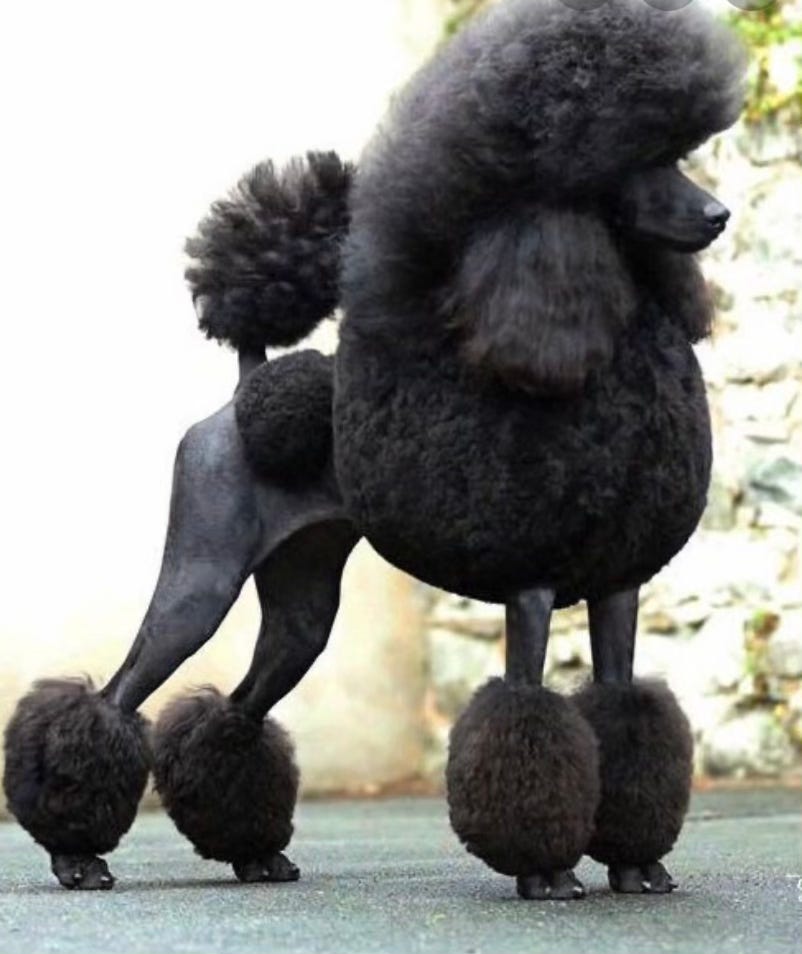
My guest, Dr. Jennifer Smith, has been in the education field for 46 years and is a business owner specializing in trauma-informed behavior. Her love of animals (dogs in particular) has been constant in her life. So much so, that she was on her way to pursue a degree in veterinary medicine at The Ohio State, until she changed her mind. When Jennifer discovered how dogs can change human behavior and humans can change dog behavior, the desire to study human behavior prevailed over the desire to study dog behavior. She noticed that interactions between dogs and humans could be silent but very powerful. She wanted to get to the root of this soulful connection between the two.Jennifer has a masters in psychology and special education teaching. She pursued her doctorate in psychology, specializing in self-injurious behaviors and functional assessments. Delving into this field at the Institute for Applied Behavior Analysis in California opened Jennifer’s world to figuring out the reasons why certain individuals with a limited skillset in certain environments exhibit particular behaviors. This newly acquired knowledge helped Jennifer bridge the two passions in her life - human and dog behavior.Jennifer managed a way to use her degrees in education while following her passion for dogs. Working with dogs with challenging behaviors and working with people with disabilities is very much aligned, according to Jennifer. The procedures and interventions are the same. The functional assessment process is the same. This helps with understanding the reasons behind the behaviors manifesting in both humans and dogs so that the interventions can be therapeutic. I find in working with my clients that trying to identify the root of the behavior helps assist in developing a rehabilitation plan. If you only try to treat the symptoms, you will only end up putting a bandaid on the problem. It will only rear its ugly head again and again down the road.Whenever I help a client and their dog in the Cleveland area, and the client’s profession is in the special education field, they invariably know Dr. Jennifer Smith. She was the head of the behavior and curriculum department at the Cuyahoga County Board of Developmental Disabilities until she retired almost 12 years ago. These clients were either trained by her or participated in a seminar where Jennifer lectured. All of these clients understand my approach and how I assess their dogs. They get it. There is a certain way to communicate across the species which is similar to communicating with individuals with limited language skills. I will often compare dog behavior to human behavior for the sole purpose of trying to make my assessment of a client’s dog more relatable. I do not have a degree in Animal Behavior. However, there are patterns and common reactions to stimuli in dogs that are very similar to those in humans. I was a little unsure about making these comparisons so as not to imply that humans are like dogs or vice versa, because I didn’t want to offend people. Also, I had no scientific research to back up my comparisons. I find myself often telling my clients “Think about what the dog is feeling and interpreting right now”. Hence, my choice for the title of this podcast, “From A Dog’s Eye View.” After talking to Jennifer, I feel validated in the explanation of my approach to assessing any given dog. Jennifer combined her expertise in functional assessments of individuals for Cuyahoga County with training and rehabilitating dogs through her connection with It’s A Dog’s Life. Since I have known Jennifer, she was always rehabbing dogs and blending them into her own pack of dogs. As she was performing in-home assessments with families of children with disabilities, she was also doing in-home family visits with dogs that had various issues. Wherever the behavior presented itself was where Jennifer would be. If it meant going to a grocery store, that’s where she would set up her meeting. Not only is it necessary to observe the person or dog closely, but you also have to know what you are looking at. Observing something as simple as prolonged eye contact that causes a reaction, or as complex as the frantic or intentional movement of an individual or dog, can help identify the root of a particular behavior. ‘“We don't know what it's like to hear, see or especially smell at the levels that dogs can.” - Dr. Jennifer SmithTo elaborate on this subject of observing and working with dogs who are triggered by something in a particular environment, I will work with a dog wherever the behavior is happening. Dogs do not generalize. What that means is that if your dog barks at strangers at their own front door, it doesn’t mean that they will bark at strangers at your friend’s front door. I need to see the dog in their own environment and how he reacts to certain triggers. It is equally important to observe how the pet parent reacts and what their body language is like while the dog is in the middle of the reactivity. It takes teamwork to rehab a dog, and guiding the pet parent to handle the dog appropriately is crucial to the entire rehab process. The difficulty with the rehabilitation process is always when you return a dog to his pet parents. It is up to the pet parents to understand and change their own behavior because we, as the adults, are the agent of change. It's the same in schools. If you want your kindergartner's behavior of throwing books at other kids to change, they aren’t going to magically wake up one morning and make today the day that they won’t throw books anymore. Adults have to guide the child to an alternate behavior that is more appropriate in order for the child to change. I always love to hear from my clients, “You’re training us humans, not the dogs.” That’s exactly right!You must change things up because whatever you were doing wasn’t working. This is a lot easier said than done. According to Jennifer, on any given day, our frustration level is higher than on other days. Our reactivity to issues can be more intense. We’re rarely on the same emotional level. This inconsistency can be very confusing and create an unstable environment for the dog. The dog can’t figure out all of these changes. We become unpredictable, and in their eyes, unsafe. I advise clients that life happens, and you just have to try your best to push your life issues aside while you are in communication with your dog. “A lot of individuals who have reactive dogs that are fear-based, have trouble because they themselves aren't being perceived as safe.” - Dr. Jennifer SmithJennifer has had a wide variety of breeds as family dogs. From German Shepherds and French Briards to Shih Tzus and Chihuahuas. However, Jennifer’s dream as a little girl was to have a poodle. She came to know that poodles were a complex breed that would require more time and effort to do the breed justice. She knew the common traits of the various breeds she rehabbed in her home, but she needed to learn more about the poodle. She felt that she needed a higher skillset and needed to mature in her approaches to working with this sensitive and very intelligent breed. The wait was worth it and it happened at the right time in her life. That time came several years ago when she had the opportunity to meet her longtime idol, and now mentor, Joseph Vergnetti of Dassin Farms, who is a highly respected breeder in the poodle world. Joseph had heard that Jennifer did temperament training and testing. He said he had a poodle for her. This particular poodle was not ready yet for the show ring because she had some quirks to be ironed out. When Joseph showed Jennifer this beautiful, quirky black poodle, Jennifer was weak in the knees. She named this poodle Scarlet. At last, her dreams came true! Jennifer exposed Scarlet to many different places and people to build Scarlet’s self confidence. Jennifer believes that upon conception, the temperament of the dog is set. Then, you add personality on top of that. This is where the pet parent plays a big part. It’s how we, humans react to what dogs are reacting to that can shape a dog into becoming a fearful, cautious dog or a confident, polite dog. Scarlet has a very reactive bark and Jennifer just has to be very aware of the environment they are in at the moment and be Scarlet’s best advocate. When Scarlet’s frustration is high, her skillset is low. Always being aware of this helps maintain a balanced approach to any given situation so as not to overwhelm her. Instead of continuing to show Scarlet, Jennifer decided to breed her with a sire from Joseph’s line of poodles. In fact, Scarlet was pregnant when Jennifer showed her for the last time. Joseph picked the perfect sire for a dog with Scarlet’s temperament. She had a litter of nine puppies, but two of them died. Scarlet was amazing and knew what to do, but Jennifer and her husband were a nervous wreck. They had experts on stand-by to help out if anything went wrong. In the long run, Jennifer and Tom just watched this beautiful miracle take place as Scarlet did what came naturally. There is a definite sense of pride when whelping a litter and contributing positively to their impressionable first couple of months. On top of that, what an honor and privilege knowing that you had a part in this process, especially when one of the puppies becomes a winner in dog shows. There is such a sense of pride after studying the poodle line, taking care of them, and socializing them properly.It is a lot of work raising puppies and socializing them and then ultimately finding good homes for them. Jennifer and Tom couldn’t just let them all go, They had to keep one and named her Chapel. She is now two years old and is currently living and working with a professional handler. The hard work is so worth it when they hear back from the families who adopt
E-collars (electronic collars) or shock collars are used in dog training for different reasons. Some dog trainers use them almost exclusively, and others use them for specific purposes. My knowledge and experience is limited with e-collars due to my background. As I have mentioned before, I was trained at Petco. E-collar training was not part of their program. However, I met a lot of clients during my time as a trainer there and even more clients when I started my own business who would tell me that they tried an e-collar and it didn’t work. I could not offer any assistance or feedback, even though e-collars were sold in the store. My lack of knowledge and inability to help, motivated me to learn about them. Luckily, I know Gary Flynn, from The Dog Advocate, from our days at Petco. The more I got to know Gary, the more I knew that he was the one I wanted to learn from. I knew that he had used e-collars before in his professional career before working at Petco. I had a lot to learn when I started my own dog training business, so learning about e-collars was not a priority. There were so many other issues to focus on first. It wasn’t until about 3 years ago that I felt it was time to learn about e-collars so that I could help my clients more. I had a sneaky suspicion that the whole reason people weren’t having success with them was because they weren’t being used correctly. My suspicion was right. As I was in the process of being trained by Gary, I realized right away that an e-collar was a serious training tool. I could understand how it could be used incorrectly. As with so many things that I learn about, I need to know everything I can about a certain subject until I feel comfortable advising people about it.In order to learn about e-collars, I knew that I needed hands-on experience. So, I brought my dog, Ebi, to Gary for many sessions until I felt I had a good foundation to start practicing using the collar on my own. I also was at a point with Ebi where learning something new would be a challenge for her. After I realized that using an e-collar was not harmful to the dog if used correctly, I enjoyed learning about it and working with my dog in a new way. I was getting a little bored with challenging her with the basic obedience skills at long distances in different locations. The timing of this new tool was perfect for me. Ebi was 4 years old. I remember telling Gary that I felt that Ebi was getting bored with the same old skills that I tried challenging her with. Ebi would do what I asked her and was very reliable in her skills, but she just looked bored. Gary actually told me that I was the boring one! I didn’t give her enough incentive to keep her engaged with me. At that point, I had pretty much abandoned rewarding her with treats. Gary reminded me that everyone, including dogs, needs a “paycheck” every now and then when they are working. So, I brought the treats back in to my routine, giving them to her every now and then, while working with her.I brought an e-collar that was recommended by a different dog trainer to my first session with Gary. We quickly discovered that the lowest stimulus and even the vibration setting on that collar was too much for Ebi. She looked around anxiously wondering where it came from. That is not the type of reaction you want to start off with from your dog. Instead, you should be looking for a flick of the ear or a turn of the head. When I returned for my next lesson, I brought the e-collar with me that Gary recommended - The mini Educator. (www.educatorcollars.com) As Gary describes in our interview, the reaction that he is looking for when testing out a dog’s sensitivity to stimulus, the dog should be a little annoyed that maybe a little bug flew by. Then, they should quickly recover back to being calm. When Gary tried out the new e-collar on Ebi, he adjusted it to a very low setting. She was just laying down in his backyard. She responded in a more acceptable way this time. She actually flicked her ear. I saw this but didn’t realize that this is a classic sign that the dog felt the stimulus. When Gary experiences a dog’s sensitive reaction to the stimulus, he carefully notes what the dog was doing when he interrupted him with it. Maybe the dog was in the process of passively eating a treat or chewing on a branch. The stimulus could make the dog a little hyper sensitive at that moment if interrupting an active behavior. It is very important when you are testing out the sensitivity (or lack of it) to be mindful of what you are interrupting the dog from doing.I really had no intentions of using the e-collar as a permanent training tool on Ebi. However, in order for me to advise clients on my opinion about this type of training,I had to master: * manipulating the various functions of the remote control* the timing of the stimulus * choosing the right degree of stimulus depending on the situation* recognizing the subtle body language from Ebi with the varying degrees of stimulusIt took me almost a year of working with Ebi every day until I felt comfortable using the e-collar. I worked on getting her excited about putting the e-collar on. Fun things were going to happen when she got the collar on. The collar had to fit tight enough, and the prongs had to be long enough to get through all of her fur. If the collar is too loose, then the stimulus won’t be as effective. I found myself turning up the power higher and higher so that she would feel something. I solved that issue by making a mark by the correct hole in the collar to guarantee the right fit. Proper fitting is imperative to the e-collar functioning correctly.I worked with Ebi in my backyard to learn her body language when I had the setting too low or too high for a particular application. I started out with turning the power on low, but just high enough to where I would get that flick of the ear while commanding her to do a basic “Sit”. I had to get used to the timing of turning it on and off. Pressing the power on means the dog is in the process of executing the command. Releasing the power means the command has just been executed. Then, we progressed to doing “Sit” out on our walk. I had to turn up the power a little bit more now because there were more distractions on the walk. Figuring out how much to increase the stimulus given the situation was the most difficult part for me, but I figured it out. I have found that the most common reason people purchase e-collars is to try to stop an issue they are having with their dog. For example, dogs may jump on people when guests come to the house. The pet parent purchases an e-collar, puts it on the dog, and zaps the dog when he jumps on a guest at the front door. One reaction the dog may have to this shock is he may stop jumping and the pet parent thinks the e-collar worked. The pet parent never showed the dog an alternate behavior in that scenario - only that he feels a shock when he jumps on people at that particular door. If this is done enough times, the dog may begin to be afraid of people entering their house through that door again. If the pet parent does the same thing while out and about in the community, the dog will begin associating that people approaching them is a negative thing. All the pet parent was trying to accomplish was to stop the dog from jumping. What ended up happening is now the dog is afraid of people at the front door and out in public. A new problem was created by trying to solve the original problem.Another reaction a dog can have to being shocked while jumping on guests is the dog may run away. The dog hasn’t been conditioned to know what to do when he feels the shock. The dog stopped jumping, but again, now the dog won’t go near that door. He didn’t like the feeling of being shocked, he had no idea what he was supposed to do when he felt it, he didn’t know where it came from and consequently ran away to get away from that feeling. Once again, in the pet parent’s mind, the e-collar worked. From the dog’s mind, this feeling left him very unsure and confused. The feeling was negative, his reaction was negative, but his pet parent was happy. If the pet parent is also using the e-collar like this for a different issue, even more uncertainty will develop and fear will set in. The dog won’t know at any given time if he is going to feel that shock again. This can make the dog neurotic where he becomes afraid of everything. I have met dogs like this who don’t trust anything or anyone. I can’t say conclusively that it is because of the misuse of the e-collar, but I feel that it can be a contributing factor.In all of these reactions from the dog, the stimulus setting could have been too high and no alternate behavior was offered. Also, there was no interaction between the pet parent and the dog. They were expecting the shock to solve the problem and they didn’t have to do anything else. This is the exact scenario that Gary and I refer to as using the e-collar as a “Magic NO button”. You never want to leave the dog hanging in blind punishment. You always want to correct and then redirect with a more appropriate and already known behavior for that situation. To top that all off, most people start yelling at the dog to stop jumping. Any kind of verbal reaction from the pet parent can only add to the excited state the dog is already in, which exacerbates the problem. Sometimes, pet parents will threaten the dog by showing them the remote and that they are going to receive a shock if they don’t behave. Now the dog is really uncertain about their pet parent’s energy with that threat and whether or not they may feel a shock. This can develop into neurosis. Deconditioning this behavior out of the dog takes so much longer than creating the neurotic behavior. So, be very mindful of how the dog sees this scenario being played out - hence, the name
When you bring your puppy home for the first time, it is one of the most exciting events in your lifetime. You have made a decision to add to your existing pack, and I congratulate you for doing so. One of the first items you will need to purchase is a leash and a collar or harness. How to decide on which one can be overwhelming. Just as overwhelming as what cereal to choose in the cereal aisle at the grocery store. There are so many choices! Sometimes, you just go by what friends and family have recommended. Other times, you may be influenced by an ad on social media. This episode is to clarify how certain walking tools work, and to help you choose the right one for you and your dog.When we pick up our puppy from a breeder, most likely, the breeder has put some kind of colored ribbon around the puppy’s neck to differentiate which puppy is which. The puppy is somewhat used to wearing something around its neck, but that doesn’t mean that the puppy will be totally willing to have you put a snap or buckle collar on them. How you introduce this collar is very important to the puppy positively associating this “thing” with something good. There will be some of you reading this post saying to yourselves that your puppy was absolutely fine with you putting the collar on. As a dog trainer, anything you introduce to your puppy should be well thought out in advance how you will be presenting it before you just go barreling in and forcing a new item on them. You ALWAYS want to create positive association with introducing anything new to your dog.Introducing a collar or harnessThe process of introducing a collar or harness to a rescue dog is the same as introducing them to a puppy. Rescue dogs may already be used to wearing a collar, but most likely you will be choosing an additional collar or harness for walking purposes. Whichever tool you decide, the introduction will be the same as if it was a puppy. First, take your time with the whole process of showing the dog their new collar. If you are relaxed and mildly excited, your dog will be too. You want to create some excitement over the collar or harness, but not too much. Get them interested in what is about to happen by feeding them small treats. Then, let them sniff it to their heart’s content. Pet the dog with the collar or harness while giving them treats, being mindful of not letting straps from a harness dangle in front of them. This can trigger a fear response. If the dog is still engaged and not shying away, use some treats while showing them how it snaps together. Sometimes the sound of the snap can trigger some fear in them. If all is progressing positively, ideally you want them to come to you to put the collar or harness on. Again, lure them with treats. You may need to ask a family member to feed the treats while you put the collar or harness on and snap it. When it is on, you will have to adjust it so that it is “two fingers snug”. If introducing a harness, every strap should be two fingers snug. What this means is that you can fit two fingers between their neck or body and the collar or strap of the harness. This is to ensure that the dog cannot back up and escape out of it. Also, fit the collar high up on the neck, right behind the ears. This prevents the collar from damaging the trachea when they do pull (how to prevent dogs from pulling on a walk will be a separate episode). I want the dog to be excited about their new collar or harness, but not so excited that I am chasing the dog around the house just to get it on. Remember, you are setting an example of how this walking tool is going to be associated with something. That something is going to be your way of eventually controlling the dog on a leash. Now that the collar or harness is on, take the dog outside to play or play with the dog inside the house. Pretend that this is a huge accomplishment and make sure the dog knows that you are happy that they are wearing their first walking tool. Depending on the reaction of the dog, just leave the collar or harness on them for a very short period of time. Dogs usually don’t react adversely to collars, but they can with harnesses. There are only two harnesses that I recommend, which I explain below. Harnesses are made to have dogs haul things. The majority of harnesses clip on the back of the dog. It is impossible to walk a medium to large sized dog in the heel position with this type of harness. It is set up to have the handler behind the dog and to be pulled. If there is tension on the leash, the dog will resist that tension by pulling forward. Now, who is taking whom for a walk?? Harnesses can be big and bulky and it’s a very foreign feeling for the dog to have something on their back. Some dogs will freeze and not want to move forward. I have seen way too many harnesses that are improperly fit - usually too loose. This is a perfect setup for the dog to wiggle out of it and run away. I have heard of too many stories like this. One dog actually got hit by a car when he ran away. The handler was pulling back on the leash, creating the resistance for the dog to move forward. He wiggled out of it, panicked, and ran in the street and got hit by a car. He was okay, but it involved an expensive vet bill and some recovery time for the dog. Luckily, nothing was broken. Collars are great for hanging identification tags. They are also a way to quickly grab the dog if needed. I don’t recommend leaving a collar with tags on in the crate, especially if you are leaving the house for a period of time. Always check the integrity of the collar. A cloth buckle collar can begin to fray at the eyelets or the buckle can start to break down. If you have any doubts, buy a new one. There are other collars with the 3 prong plastic snap that are very sturdy too. This is just a preference issue. The most important thing to remember about the collar is that it is fit correctly - two fingers snug!It is worth noting that collars are great to leave on the dog during the day while you are potty training. You can attach the leash to a collar a lot quicker than trying to put a harness on a very wiggly puppy. LeashesI always tell my clients to purchase a cheap leash while training a puppy. As much as you want to discourage your puppy from biting the leash, they inevitably will. I will explain more in detail how to stop your puppy from biting the leash in a future episode where I will talk about “The Walk”. When the puppy has been trained how to walk, that’s when you can invest in a leash that will last a long time. Leather leashes are my favorite. They are comfortable and don’t slip in my hand, and they last many years. Gary Flynn, who has been on my podcast before, likes the BioThane leash. It is generally more durable than leather, and is waterproof. However, it is vulnerable to bite marks. Make sure you have worked with your dog to stop biting the leash before investing in a BioThane leash. In my next episode, we will show you this type of leash. It is very durable and comfortable in your hands. These leashes are not sold in most pet stores, but are sold online. The important thing to keep in mind when deciding on a leash is how comfortable it is when your hand is wrapped around it. Remember, I do not promote walking dogs in front of you where you are just holding on to the handle. Walks in the woods and “sniffaris”are different than walking in a heel position. I will discuss this further in my episode about “The Walk”. In the video below, you will see how I recommend holding on to a leash. Note that my left hand is grabbing the leash over the leash as if I am holding on to handlebars on a bike. My hand is right by the clip so that the dog does not have much leeway to go where they want to go. It is up to the handler to take the dog over to an area to sniff or eliminate, not the dog leading you over there.YOU are taking the dog for a walk, not the dog taking you for a walk.In the picture below, from top to bottom, the first leash is a small 6’ leather leash with a small clip. This is suitable for small dogs. The clip is small and can attach to the ring on a very small collar. You want to make sure that you don’t weigh down your small dog with a heavy, bulky clip. The leash underneath is the leash I use for my 100+ pound Leonberger. The clip is bigger and sturdy enough if she were to lunge. I have rather small hands so the width of this leash is perfect for me. Below this leash is a two handled leash that is very comfortable to grab with your bare hands. Some people really like double handled leashes. You have the option of walking the dog on a shorter lead with the second handle. Both handles are very comfortable to hold on to. The very bottom multi-colored leash is a slip lead. I like this leash for some dogs because I can position it high on the neck, right behind the ears, and keep it in place with the grey tab. It is important that it is adjusted on the dog like a slip collar or chain collar. There is a right and wrong way to put this on depending on which side you walk your dog. I explain this more below under the slip and chain collar categories.I would be remiss if I didn’t mention retractable leashes. The only application I can even possibly approve of this type of leash is if you have to take your dog out to eliminate on a leash and you don’t want to go outside, and you have a small dog. Otherwise, there are several reasons why I don’t like them. First of all, I have seen and heard of too many accidents where the dog ran around their handler so quickly and tightly that they caused lacerations around their handler’s legs. Other times, the dog gets hurt by chasing after something and goes to the very end of the leash and abruptly gets choked. Our friend was biking with his dog running beside him. He was holding onto the casing of the retractable leash. The dog saw something,
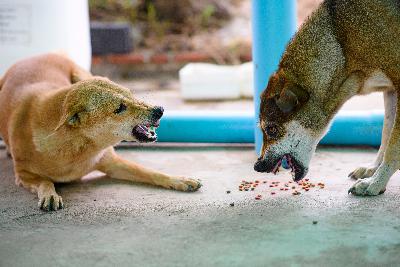
At some point in your dog’s lifetime, most likely you have had to take them to your vet for an emergency type situation. Whether it be due to swallowing a foreign object or requiring surgery for an acute injury, Dr. Randy Hutchison and his professional staff at Animal Clinic Northview in North Ridgeville, Ohio, will be able to get your dog back on the road to recovery. In this episode, Dr. Randy and I discuss common injuries and treatments that are available for various conditions. As much as we try to prevent injuries from happening, they are almost inevitable. I don’t think I have ever met anyone who hasn’t had to take their dog to the vet only for well check ups. One of the great things about Animal Clinic Northview is that they have round the clock service. So, no matter what time of day or night your dog suffers an injury or illness, there will be a vet on duty to help you.Dog BitesAs a dog trainer, unfortunately, I have seen plenty of people get bit by dogs or their dogs have gotten into dog fights. The wounds can be serious, sometimes fatal. Especially if they have gone untreated for a period of time. Bite wounds for people should never, ever be taken lightly because of the bacterial content of dogs’ mouths. When we witness or experience dog bites, we think of the dog lunging toward their target and biting quickly and powerfully. Some dogs will bite and hold on. Others will bite once and let go. Either way, the damage can be extensive. To a trained eye, dogs ALWAYS give you a warning before biting. Please consult a professional dog trainer if you feel that your dog has aggressive tendencies. They will not go away on their own. My contact info is below. If I feel that I cannot help you because the aggression is too serious, I can refer you to other dog trainers. Dr. Randy sees an influx of bite wounds in the winter time. Dogs don’t always get the exercise they are used to during the warmer months. This can create a lot of frustration for dogs due to pent up energy. Sometimes, fights happen between dogs living in the same household. Common causes of fights are over claiming possession of valuable resources such as toys and food. In the dog training arena, we call this resource guarding. One dog will pose in a way that their body is over the food or toy and their body is stiff. You may even see “whale eyes” or the whites of their eyes, accompanied by growling and baring their teeth. Assessing the damage done by a dog bite to another dog has to be done very carefully. If the decision is made to stitch up the wound, the possibility of locking in the bacteria can lead to locking in an infection. Antibiotics may be prescribed to address the infection. Sometimes, depending on where the wound is located, there is not enough skin to stitch together. However, there is a new treatment on the market called Phovia. Phovia delivers fluorescent light to the affected wound, which stimulates the body’s natural healing process. It is non-invasive and painless. Any kind of wound care treatment involves multiple visits until everything has healed up nicely. Your vet will guide you through the healing process and may even recommend physical therapy depending on the injury.The bacteria in dogs’ mouths can cause serious infections in humans too. It may require antibiotics to get rid of the infection. The bacteria doesn’t necessarily have to be transmitted through a bite. My neighbor almost died after she came home from an operation and her dog licked the wound, like dogs do. There can be certain bacteria in the dog’s mouth that can cause sepsis through an open wound. Please consult your veterinarian or medical doctor if you or your dog experience a bite or licking an open wound from another dog. Another totally innocent way a dog can get a serious infection from a bite wound is through play. My dog, Ebi, was playing with her best friend across the street. I was watching the dogs play. It is very common for dogs to use their mouths while playing and bite gently. I heard one of the dogs shriek. Ebi was laying down, but then got back up to play again. I figured one of the dogs came down too hard on the other and they let the other dog know about it. Well, 2 to 3 days later, my husband discovered a big growth on her side that we had never noticed before. My friend, who is a former vet tech, came over, and shaved the area where the growth was. It revealed a puncture wound from a tooth. That’s when I realized what that shriek was all about. Our neighbor dog came down too hard on Ebi. The bacteria from that bite caused an abscess to form. I took Ebi to the vet for further treatment and she healed up beautifully. Cranial Cruciate Ligament TearsAnother common yet painful injury to dogs is tearing the cranial cruciate ligament (CCL), which is the equivalent of tearing the anterior cruciate ligament(ACL) in humans. The CCL is located inside the knee joint, connecting the thigh bone to the shin bone. I have never personally experienced this with my dogs, but plenty of my client’s dogs have, unfortunately. The surgery and rehab is quite pricey and stressful because the dogs have to be contained for an extended period of time. A lot of times, dogs will tear their CCL because they sprinted towards something or jumped off a high place. You will know right away if your dog injured themselves because they will start limping immediately. Every time your dog steps on that leg with a torn CCL, it buckles because the ligament is not there to provide stabilization. When the injury occurs, there is acute pain. However, that pain subsides as time goes on, but the limp persists. If this does happen to your dog, contact your vet immediately so that they can assess the injury.One of the biggest misconceptions about CCL injuries is that the vet is surgically repairing the ligament. If that was actually attempted by a vet, it would almost certainly end in failure. The ligament is so minute and damaged that it is impossible to stitch it back together. Almost all CCL repair techniques are done to provide stabilization to the joint. There are a couple of ways to repair these injuries. One option is called a lateral suture. This procedure uses sutures to reinforce the outside of the knee joint which creates a type of artificial ligament. A more up-to-date method is referred to as TPLO (Tibial Plateau Leveling Osteotomy). This procedure is done more commonly now. The joint forms scar tissue around itself to let the body heal it in a way that creates stability. Rehab Facility On Premise Animal Clinic Northview offers many different types of therapies for patients coming off of surgeries and injuries. They now have a swimming pool to help rehab a joint that needs to move but not involve hard impact. Also on the premises are underwater and dry treadmills, acupuncture, and laser therapy to help with the healing process. This is such an improvement to what used to be offered when the dog would undergo surgery and be sent home to heal. All of the therapies mentioned above can expedite and improve the quality of the dog’s life a lot quicker so that they can get back to running around again.The rehab facility at Animal Clinic Northview is in the same building as the main veterinary clinic and is staffed by therapists dedicated to rehabbing dogs. There is a separate extra wide entrance to accommodate patients coming in on gurneys and for those who may be more stressed entering through the main lobby. There is even a special rubber coated floor for those patients recovering from leg surgeries to prevent any slipping. ObstructionsTwo of the commands I teach during my basic obedience class are the “Leave It/Drop It'“ commands. Dogs love to explore their world through their nose and their mouth. I don’t think I have ever met a puppy that hasn’t wanted to put everything in their mouth. It’s their way of exploring their world. It’s up to us humans to keep them safe and teach them to stop pursuing an object with the “Leave It” command. If it’s too late to prevent them from putting it in their mouth, we use the “Drop It” command to make them release the object and surrender it. It is also common for puppies and dogs to play “keep away” from their humans and make a game out of running around the yard or house with a prized possession in their mouth. We don’t realize that we are playing the exact game the dog wanted to play when we chase the dog around and yell at them to drop it. The more the humans yell, the more excited and energized the dog gets to continue this fun game! It’s when the dog decides to swallow the object and a blockage occurs that Dr. Randy comes in. He has dealt with plenty of clients whose dogs ingested something they shouldn’t have. Whole ears of corn, fish hooks, socks and underwear to name a few. He says that a lot of the time, family members just want to know who is to blame - who left the underwear on the floor in the first place???There are instances where we actually witness our dog swallowing an object that was too big or knowingly indigestible. It is extremely advisable to immediately go to the vet to get it expelled. Socks and underwear are two very common foreign bodies that are ingested. If addressed soon enough, there are medications to induce vomiting, and the object comes back up the esophagus, out the mouth, and everyone breathes a sigh of relief and goes home. Another way to prevent having to surgically remove a foreign body is through an instrument called an endoscope. There are different kinds and sizes of grabbers and loops that are attached to the endoscope which are fed down the esophagus and into the stomach. The grabber will pick up the foreign body and be pulled back out of the mouth. Foreign bodies get tricky when no one in the family notices that the dog ingested anything. All they notice is that the dog does not

Comments

Download from Google Play

Download from App Store
 United States