


 Claim Ownership
The Metro
Subscribed: 9Played: 285
Subscribe

© 2024
Description
"The Metro" covers local and regional news and current affairs, arts and cultural events and topics, with a commitment to airing perspectives and uncovering stories underreported by mainstream media in Detroit.
930 Episodes
Reverse
Super Bowl 60 is this weekend. Yet, the teams playing in the game have gotten less attention than who’s performing at the 2026 Apple Music Super Bowl 60 Halftime Show.
Bad Bunny is the first solo Latin and Spanish speaking musician to lead the show. The selection of the Puerto Rican born artist sparked conversations across music, sports, and culture—making this more than just a halftime performance.
In his announcement, he said this is for his people, culture and their history.
So, what does this moment mean for Latino representation? And furthermore, what does this performance say about the American public’s idea of what it means to be American?
Alejandra Márquez is an Assistant Professor of Spanish Department of Romance and Classical Studies at Michigan State University. She joined The Metro’s Tia Graham to discuss Bad Bunny’s performance and its significance to Latino culture.
Most everyone wants students to have good teachers. But how do we adequately prepare educators, and keep them in the profession? Ten years ago, only a handful of Michigan school districts reported permanent teaching vacancies. Today, that number has exploded: More than 150 districts now have jobs they can’t fill.
Some in the state are trying to fix this. Jack Elsey leads the Michigan Educator Workforce Initiative. His nonprofit is launching a collaboration with some public universities in the state to change the way teachers are trained, and to keep them in the field. He spoke with Robyn Vincent.
Detroit has a lot of needs, including things like bus transit, policing and security, and trash pickup. Those things cost money — money that can be difficult to come up with in a city of relative poverty. But with more people spending time in Detroit, and even moving to the city, it also has more opportunity to raise revenue.
The Citizens Research Council investigated whether a sales tax could benefit residents by generating $72 million a year. Madhu Anderson is the council's senior research associate for local government affairs. She believes a sales tax isn't a great idea, but offered other possible ways Detroit could raise revenue. Anderson spoke with The Metro's Sam Corey.
As conversations about climate change continue to evolve, the College for Creative Studies (CCS) is being proactive about the role its students will eventually play. The art and design college is holding a series of conversations that interrogates how artists and designers build a future that is more sustainable.
CCS president, Donald Tuski, joined the show to explain why they are encouraging more sustainable and innovative designs.
Ismael Ahmed: A life devoted to service
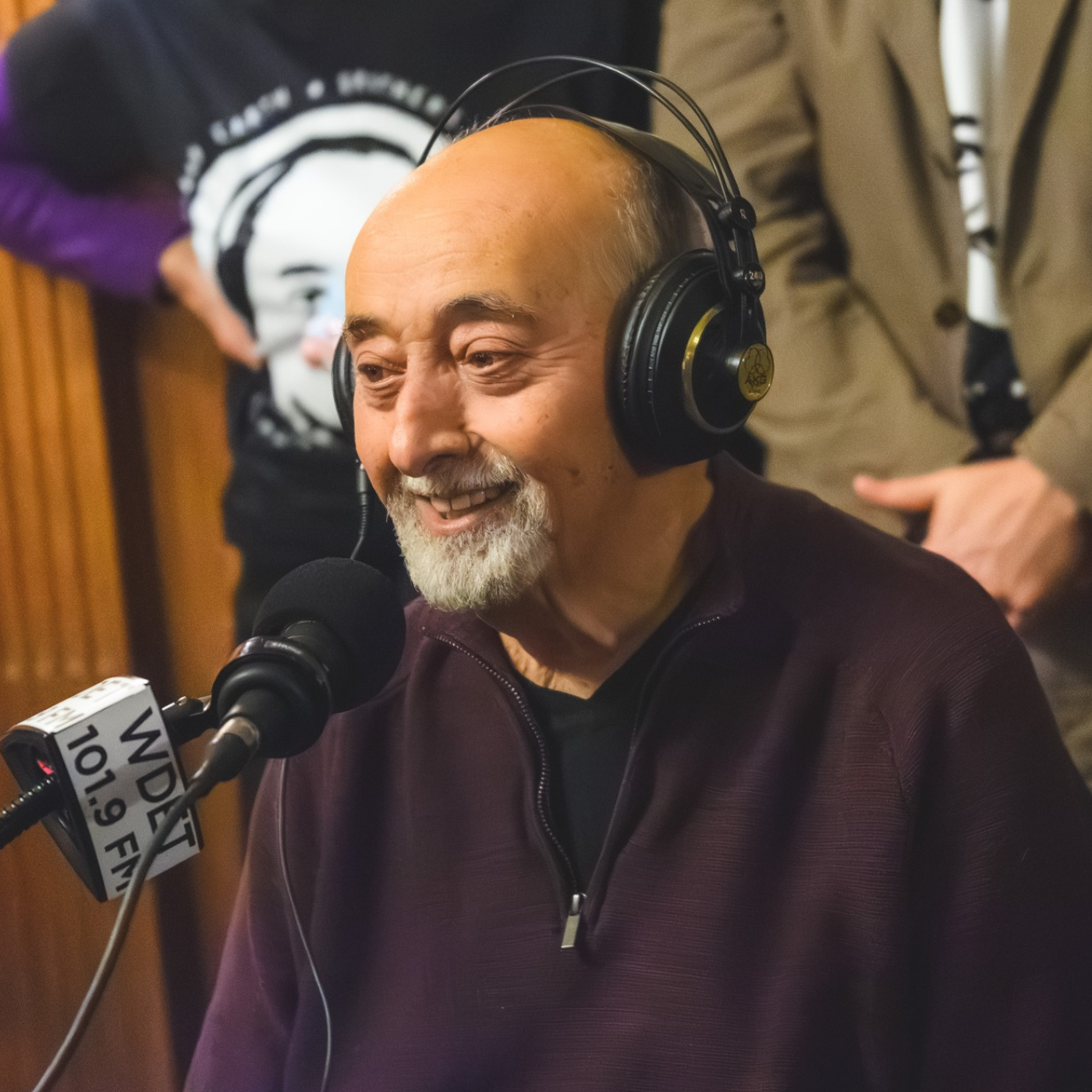
Ismael Ahmed’s life was rooted in community and guided by the belief that people are stronger when brought together. Born in 1947 to a working-class Arab immigrant family, he grew up in Dearborn’s South End, shaped by factory work, public education, and a commitment to justice that defined his life’s work.
He co-founded the Arab Community Center for Economic and Social Services (ACCESS), helped establish the Arab American National Museum, and later served as Michigan’s first Arab American cabinet member. Music was central to his activism. Through founding the Concert of Colors and hosting This Island Earth on WDET, Ahmed used music to break down barriers and connect people across cultures.
Ismael Ahmed died January 31, 2026. He was 78 years old.
A few highlights from Ismael Ahmed’s life
Raised in Dearborn’s South End in a working-class Arab immigrant family.
Served his country in South Korea during the Vietnam War-era.
Organized Arab auto workers in Detroit at a time when their voices often went unheard.
Co-founded Arab Community Center for Economic and Social Services (ACCESS).
Helped establish the Arab American National Museum.
Served in state government and higher education.
Hosted This Island Earth on WDET, sharing music beyond borders.
Founded and led the Concert of Colors until the day he died.
Left a lasting mark on culture, community and public service.
Transit agencies across Southeast Michigan say the system has stabilized after years of disruption. Host Robyn Vincent speaks with Noah Kincade of Detroit Documenters about how recovery is being defined, what riders are experiencing, and why documenting public meetings matters as transit enters its next phase.
Since 1941, the Wayne State University Press has published over 2,000 titles that explore a number of topics from literature, to history to politics.
Senior Director Stephanie Williams joined the program to discuss its offerings this season.
To counter President Donald Trump's agenda, liberals aren't discussing democracy. They're talking about the issue of affordability.
In November, Democrats ran across the country — and won — on reducing the cost of living. Last month, Senate Democratic Leader Chuck Schumer unveiled a plan to make America more affordable.
But what, exactly, is an affordability agenda? And how are politicians trying to resolve the affordability crisis?
EJ Dionne is a New York Times opinion writer, a professor at Georgetown University, and a senior fellow at the Brookings Institution. He joined Robyn Vincent to discuss.
Affordability. That’s the word that’s been buzzing around politics. In November, Democrats across the country won on the promise of reducing the cost of living. But it’s not just liberals that are embracing an “affordability agenda.” Conservatives and libertarians are latching on as well.
Jarrett Skorup is the vice president of marketing and communications at the Mackinac Center for Public Policy, which appreciates the free market and criticizes government regulation. In this conversation, The Metro's Sam Corey spoke with him about why he thinks unregulated capitalism can help free people from the burden of rising costs.
The McDougall-Hunt Neighborhood on Detroit's east side has been home to the Heidelberg Project since 1986, when artist Tyree Guyton came back to the neighborhood he was raised in and began turning empty lots and abandoned houses into works of art.
The installation celebrates 40 years this year, preserving the history of the space and while reimaging the neighborhood where three generations of his family lived.
Tyree Guyton is a life-long Detroiter, a painter and visionary place maker and this year's Kresge Eminent Artist. At 70 years old, he's being honored for his life’s work improving community through the arts.
Guyton and the former manager of The Heidelberg Project Jeanne Whitefield joined The Metro to talk about life, legacy and the future of Detroit Heidelberg Project.
Many have been actively engaging and organizing against federal immigration enforcement and the killings of Americans at the hands of immigration agents. It’s been true in Minneapolis, where thousands have taken to the streets. And it’s spread from there to Detroit and many other places across the nation. All these actions have us wondering: What has been the efficacy of these protests against ICE thus far? And, when, exactly, is a protest successful?
Gloria J. Browne-Marshall is a professor of constitutional law at John Jay College of Criminal Justice. She’s also the author of “A Protest History of the United States.” She joined Robyn Vincent to discuss.
Of all the architects in Detroit, one of the best known may be Albert Kahn. He designed some of the city’s most treasured buildings, including the Belle Isle Conservancy, the Fisher Building, and the Detroit Athletic Club.
Even still, a lot of people don’t know that much about Kahn. They don’t know how or why his work changed architecture in Detroit, or any of his design preferences.
Chris Meister is the author of the new book, “Albert Kahn's Daylight: An Architect Reconsidered.” He spoke with The Metro’s Sam Corey about why much of Kahn’s work prioritized natural light.
For decades, Native American children in Michigan were taken from their families and sent to boarding schools designed to erase their languages, cultures, and identities. Many of these schools remained open far longer than the public understands, leaving deep and lasting harm across generations.
In this episode of The Metro, Leora Tadgerson — director of Reparations and Justice for the Episcopal Diocese of Northern Michigan and co-chair of Michigan’s Truth, Justice, and Healing Commission — discusses the history of Native boarding schools in the state, their enduring impacts on families and Tribal nations, and why this legacy continues to resonate amid contemporary debates over family separation, government power, and accountability.
Detroit and art go hand-in-hand. It’s held in the same regard as the automotive industry as one of the city’s great exports. But unlike the auto and manufacturing industries, the work can be a lot less stable, the recognition can be less visible, and the pay can be inconsistent.
So what does an artist in Metro Detroit striving to make a life here do? What supports exist and is it enough? Artists Sydney James and Halima Cassells join the program to discuss.
Over the past decade, homelessness has been down in Oakland County. But over the last three years, it’s been trending up again. The 2024 point-in-time count found that about 1,700 people were homeless in Oakland County. Last week, the locality conducted its latest count while Wayne County had one on Wednesday.
We don’t have the official results yet from either count yet, but, according to Ryan Hertz, the number of families that are homeless is on the rise even as chronically homeless individuals are getting housing more often. The Metro's Sam Corey spoke with the CEO and president of the anti-poverty organization, Lighthouse, to learn more
The Detroit Office of Arts, Culture and Entrepreneurship or ACE is the city’s department that oversees its investment in the arts, and supports the city’s creative workforce, including the city's poet laureate, composer laureate, and Alley Walls program.
Artists in Detroit largely depend on support from charitable organizations and government funding. So what does that support look like? And how can artists and city government come together to make art happen?
Lacey Holmes, the Project Manager for Detroit ACE joins us now to help us understand the city’s role in this conversation.
In the wake of ICE killings in Minneapolis, questions about immigration enforcement have moved into the national spotlight. Legal scholar César Cuauhtémoc García Hernández joined The Metro's Robyn Vincent to walk us through how immigration enforcement was built and how it came to resemble criminal policing.
The Wayne County Airport Authority (WCAA) does not have contracts with U.S. Immigration and Customs Enforcement (ICE), but that doesn't mean deportation flights won't continue out of Willow Run Airport.
Chad Newtown, CEO of the Wayne County Airport Authority told attendees at the WCAA board of director's meeting last week that ICE operations in and out of Willow Run Airport are between airline carriers and the federal agency.
Noah Kincade, coordinator for Detroit Documenters by Outlier Media, joined The Metro to discuss the recent Wayne County Airport Authority meeting.
Shiva Shahmir is a Detroit Documenter who attended that meeting and contributed to this story.
The next Wayne County Airport Authority board of directors meeting is February 18, 2026.
Detroit Documenters by Outlier Media trains and pays citizens to attend public meetings and monitor local government and elected officials.
Yesterday, President Donald Trump said he is going to “de-escalate a little bit” in Minnesota. But the protests against ICE in that state have continued as federal officers have remained on the ground.
One of the larger demonstrations in Minneapolis occurred last Friday. That’s when businesses closed and thousands of people took to the streets. It was also the day before Alex Pretti was shot and killed by federal agents.
Interim Executive Director for The Detroit Jews for Justice Lisa Tencer was in Minneapolis on Friday. The Metro's Sam Corey spoke with her about why she went, and what she saw.
What does it look like when a city organizes itself under pressure? Reporting from Minneapolis during a tense winter, journalist Hamilton Nolan shares what he saw among neighbors, protesters and organizers — and what Detroit might take from that example.

Comments

Download from Google Play

Download from App Store
 United States