


 Claim Ownership
Bad at Goodbyes
Subscribed: 0Played: 20
Subscribe

© Copyright 2025 Bad at Goodbyes
Description
On Bad At Goodbyes, we offer a calm, clear-eyed, creative look at plants and animals from the IUCN Critically Endangered Red List. Research-based, we share species details, behaviors, habitat, and conservation information. And then at the end of each show we perform an ambient soundscape, to hold space for contemplation, delight, awe and perhaps grief. Without dedicated conservation action, some of these species will not survive the 21st century. And so, though listening and learning, perhaps we might acknowledge that journey with a moment of our attention, in recognition of our kinship. Thanks for listening.
72 Episodes
Reverse
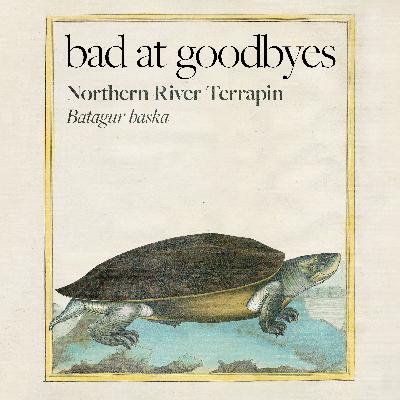
Northern River Terrapin :: Batagur baskaBad at Goodbyes :: Episode 071On today’s show we learn about the Northern River Terrapin, a critically endangered reptile native to South Asia, in the Sundarbans, in the Ganges River Delta in India and Bangladesh. Its scientific name is Batagur baska and it was first described in 1830.(00:05) Intro(02:05) Species Information(26:50) Citations(28:55) Music(35:39) PledgeFor more information about Northern River Terrapin conservation please see the People’s Trust for Endangered Species at https://ptes.org/grants/worldwide-projects/northern-river-terrapins/Research for today’s show was compiled from:Alam, Md. Shafiul, Nasrin Sultana Bristy, Mohammad Firoj Jaman, A. S. M. Morshed, Md. Shariar Rahman, Ebtesamul Haque Mim, and S. M. Mahbubul Alam. 2021. "Feeding Ecology and Growth Performance of the Critically Endangered Batagur baska in Captivity." Herpetological Conservation and Biology 16 (2): 452–460. – https://www.herpconbio.org/contents_vol16_issue2.htmlBalan Raveendran, A., Nath, A., Ahmad, A., Das, A. (2025). Conservation Strategies for Northern River Terrapin Batagur baska: Habitat Assessment and Reintroduction prospects. Global Ecology and Conservation. 62. e03763. – https://doi.org/10.1016/j.gecco.2025.e03763Davenport, John, Tat Meng Wong, and John East. 1992. "Feeding and digestion in the omnivorous estuarine turtle Batagur baska (Gray)." Herpetological Journal 2 (4): 133–139 – https://www.thebhs.org/publications/the-herpetological-journal/volume-2-number-4-october-1992/1298-06-feeding-and-digestion-in-the-omnivorous-estuarine-turtle-batagur-baska-grayDedieu, A., Scherzer, N., Paumann T., Morshed A.G.J., Weissenbacher A., Walzer C., and Preininger, D. "Camera Traps Provide First Insights into the Nesting Behavior of the Critically Endangered Northern River Terrapin (Batagur baska)," Chelonian Conservation and Biology 22(1), 46-57, (14 March 2023). – https://doi.org/10.2744/CCB-1543.1Jorgewich-Cohen, G., Wheatley, M., Gaspar, L., Praschag, P., Lubberink, N., Ming, K., Rodriguez, N. and Ferrara, C. (2024), Prehatch Calls and Coordinated Birth in Turtles. Ecology and Evolution, 14: e70410. – https://doi.org/10.1002/ece3.70410Kumar, A., Sharma, A., Negi, N. et al. Unveiling the contemporary genetic diversity and population demography of the critically endangered northern river terrapin (Batagur baska) in the sundarbans. Molecular Biology Reports 53, 48 (2026). – https://doi.org/10.1007/s11033-025-11208-5Mim, Ebtisamul Zannat, Mohammad Firoj Jaman, AGJ Morshed, Md Mahabub Alam, and Nasrin Akter Bristy. 2022. “Breeding Biology of Northern River Terrapin Batagur Baska in Captivity in Bangladesh”. Dhaka University Journal of Biological Sciences 31(1):67-78. – https://doi.org/10.3329/dujbs.v31i1.57917Nawani, S., Balan Raveendran, A., Bashir, A., Kolipakam, V., Das, A., Mondol, S. (2025). Assessment of critically endangered Northern River Terrapin (Batagur baska) phylogeny through next-generation sequencing-based mitogenome analyses. bioRxiv 2025.02.03.636247. – https://doi.org/10.1101/2025.02.03.636247People’s Trust for Endangered Species – https://ptes.org/grants/worldwide-projects/northern-river-terrapins/Praschag, P. & Singh, S. 2019. Batagur baska. The IUCN Red List of Threatened Species 2019: e.T97358453A2788691. – https://dx.doi.org/10.2305/IUCN.UK.2019-1.RLTS.T97358453A2788691.enSpitzweg, C., Praschag, P., DiRuzzo, S., Fritz, U. (2018). Conservation genetics of the northern river terrapin (Batagur baska) breeding project using a microsatellite marker system. Salamandra, 54(1), 63–70. – http://www.salamandra-journal.com/index.php/contents/2018-vol-54?category[0]=95Sundarban Tiger Reserve. (2023). Annual Report 2022–23. Directorate of Forests, Government of West Bengal. – https://sundarbantigerreserve.org/web/pdf/an_report/2022_23_annual_report.pdfWeissenbacher, A., Preininger, D., Ghosh, R., Morshed, A.G.J. and Praschag, P. (2015), Vienna Zoo & Bangladesh: Northern River Terrapin Conservation. International Zoo Yearbook. 49: 31-41. – https://doi.org/10.1111/izy.12070Wikipedia - https://en.wikipedia.org/wiki/Northern_river_terrapinPlease find us on the web at Bad at Goodbyes and on instagram. Please subscribe and rate/review Bad at Goodbyes wherever you listen to podcasts. Please help spread the word about the show and about the species we feature. Please take care of each other, and all of our fellow travelers.A note on accuracy: I strive for it! These episodes are well-researched and built from scholarly sources, hoping to provide an informed and accurate portrait of these species. That said, I’m a musician! I am not an academic and have limited scientific background. I may get things wrong! If you are using this podcast for scholarship of any kind, please see the cited sources and double-check all information.
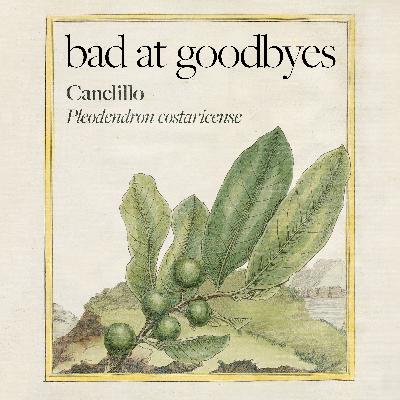
Canelillo :: Pleodendron costaricenseBad at Goodbyes :: Episode 070On today’s show we learn about the Canelillo, a critically endangered broadleaf evergreen rainforest tree native to the Pacific coast of Costa Rica in Central America. Its scientific name is Pleodendron costaricense and it was first described in 2005.(00:05) Intro(02:05) Species Information(21:02) Citations(22:57) Music(27:41) PledgeFor more information about Canelillo conservation see Osa Conservation at https://osa-arboretum.org.Research for today’s show was compiled from:Bezanson S, Curtis S, Mata-Quiros M, Mata-Quiros MJ, Durst T (2024) Phytochemistry of the Fruit of the Critically Endangered Tree Pleodendron Costaricense (Canellaceae). JSM Environmental Science and Ecology 12(1): 1091. – https://www.jscimedcentral.com/jounal-article-info/JSM-Environmental-Science-and-Ecology/Phytochemistry-of-the-Fruit-of-the-Critically-Endangered-Tree-Pleodendron-Costaricense-(Canellaceae)--11736#Endress, P. K. (2010). The evolution of floral biology in basal angiosperms. Philosophical Transactions of the Royal Society B: Biological Sciences, 365(1539), 411–421. – https://doi.org/10.1098/rstb.2009.0228Hammel, Barry E., and Nelson A. Zamora. 2005. "Pleodendron costaricense (Canellaceae), a New Species for Costa Rica." Lankesteriana 5 (3): 211–218. – https://doi.org/10.15517/lank.v5i3.19758Mata, M., & Calvo Guerrero, M. Preformulación teórica de un producto natural antifúngico a partir de extractos obtenidos de las hojas del árbol Pleodendron costaricense. Revista Ciencia Y Salud, 6(6). – https://doi.org/10.34192/cienciaysalud.v6i6.554Müller, Sebastian, Karsten Salomo, Jackeline Salazar, Julia Naumann, M. Alejandra Jaramillo, Christoph Neinhuis, Taylor S. Feild, and Stefan Wanke. 2015. "Intercontinental Long-Distance Dispersal of Canellaceae from the New to the Old World Revealed by a Nuclear Single Copy Gene and Chloroplast Loci." Molecular Phylogenetics and Evolution 84 (March): 205–19. – https://doi.org/10.1016/j.ympev.2014.12.010Osa Arboretum. n.d. "Pleodendron costaricense." – https://osa-arboretum.org/plant/pleodendron-costaricense/Pillco Huarcaya R, López Morales M, Álvarez-Alcázar L, Whitworth A. The First Ex-Situ Germination and Dispersal Mechanisms of the Rare, Critically Endangered Tree, Pleodendron costaricense. Tropical Conservation Science. 15 (1). 2022.– https://doi.org/10.1177/19400829221104572Rivers, M.C. 2019. Pleodendron costaricense. The IUCN Red List of Threatened Species 2019: e.T136055038A136055040. – https://dx.doi.org/10.2305/IUCN.UK.2019-3.RLTS.T136055038A136055040.enRoque, Roger Moya; Salazar, Manuel Morales; Wiemann, Michael C.; Alvarez, Luis Poveda. 2007. Wood anatomy of Pleodendron costaricense (Canellaceae) from Southern Pacific, Costa Rica. Brenesia. Vol. 68 (2007): p. 25-28. - https://www.fpl.fs.usda.gov/documnts/pdf2007/fpl_2007_roque001.pdfSmith, Paul. 2021. “The Need for Horticulturist Expertise in Plant Conservation: Challenges and Opportunities”. Sibbaldia: The International Journal of Botanic Garden Horticulture, no. 20 (June): 45-56. – https://doi.org/10.24823/Sibbaldia.2021.316Zimmer, Elizabeth A., Y Suh, and Kenneth G Karol. 2012. “Phylogenetic Placement of a Recently Described Taxon of the Genus Pleodendron (Canellaceae).” Phytologia 94 (3): 404--412. – https://www.biodiversitylibrary.org/part/184468Please find us on the web at Bad at Goodbyes and on instagram. Please subscribe and rate/review Bad at Goodbyes wherever you listen to podcasts. Please help spread the word about the show and about the species we feature. Please take care of each other, and all of our fellow travelers.A note on accuracy: I strive for it! These episodes are well-researched and built from scholarly sources, hoping to provide an informed and accurate portrait of these species. That said, I’m a musician! I am not an academic and have limited scientific background. I may get things wrong! If you are using this podcast for scholarship of any kind, please see the cited sources and double-check all information.
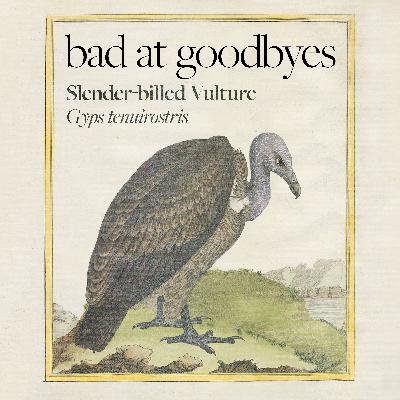
Slender-billed Vulture :: Gyps tenuirostrisBad at Goodbyes :: Episode 069On today’s show we learn about the Slender-billed Vulture, a critically endangered avian raptor, a bird of prey, native to South and Southeast Asia, specifically Nepal, India, Bangladesh, Myanmar, Cambodia, and Laos. Its scientific name is Gyps tenuirostris and it was first described in 1844.(00:05) Intro(02:05) Species Information(27:51) Citations(29:43) Music(37:03) PledgeFor more information about Slender-billed Vulture conservation please see Saving Asia’s Vultures from Extinction at https://save-vultures.org.Research for today’s show was compiled from:BirdLife International. 2021. Gyps tenuirostris. The IUCN Red List of Threatened Species 2021: e.T22729460A204781113. – https://dx.doi.org/10.2305/IUCN.UK.2021-3.RLTS.T22729460A204781113.enBirdLife International (2021). Species factsheet: Slender-billed Vulture Gyps tenuirostris. – https://datazone.birdlife.org/species/factsheet/slender-billed-vulture-gyps-tenuirostris 25/02/2026del Hoyo, J., N. Collar, and J. S. Marks (2020). Slender-billed Vulture (Gyps tenuirostris), version 1.0. In Birds of the World (J. del Hoyo, A. Elliott, J. Sargatal, D. A. Christie, and E. de Juana, Editors). Cornell Lab of Ornithology, Ithaca, NY, USA.– https://doi.org/10.2173/bow.slbvul1.01Hille, Sabine M., Fränzi Korner-Nievergelt, Maarten Bleeker, and Nigel J. Collar. “Foraging Behaviour at Carcasses in an Asian Vulture Assemblage: Towards a Good Restaurant Guide.” Bird Conservation International 26, no. 3 (2016): 263–72. – https://doi.org/10.1017/S0959270915000349Jackson, A. L., Ruxton, G. D., & Houston, D. C. (2008). The effect of social facilitation on foraging success in vultures: a modelling study. Biology letters, 4(3), 311–313. – https://doi.org/10.1098/rsbl.2008.0038Mundy, P. J., 2022. Measurements and shape of the Slender-billed Vulture Gyps tenuirostris. Indian BIRDS 18 (3): 82–85. – https://indianbirds.in/vol-18-no-3/The Peregrine Fund. n.d. “Slender-billed Vulture.” Explore Raptors. – https://peregrinefund.org/explore-raptors-species/vultures/slender-billed-vulturePrakash, Vibhu, Hemant Bajpai, Soumya S. Chakraborty, Manan Singh Mahadev, John W. Mallord, Nikita Prakash, Sachin P. Ranade, Rohan N. Shringarpure, Christopher G. R. Bowden, and Rhys E. Green. “Recent Trends in Populations of Critically Endangered Gyps Vultures in India.” Bird Conservation International 34 (2024): e1. – https://doi.org/10.1017/S0959270923000394Ranade, Sachin P. 2025. “Time Activity Budget of White-Rumped Vulture and Slender-Billed Vulture During Breeding in Captivity.” bioRxiv. – https://doi.org/10.64898/2025.12.09.693217Sound Recording by Phil Gregory. 2024. Xeno-Canto. XC899521 – xeno-canto.org/899521Virani, M., P.C. Benson, M. Gilbert, and S. Thomsett. 2004. A survey of the reproductive activities at some Gyps vulture nests in Kanha, Bandhavgarh and Ranthambhore National Parks, India, in the 2002/2003 breeding season. Pages 263-268 in R.D. Chancellor and B.-U. Meyburg (Eds.) Raptors Worldwide. World Working Group on Birds of Prey and Owls, Berlin and MME/BirdLife Hungary, Budapest. – https://assets.peregrinefund.org/docs/pdf/research-library/2004/2004-Virani-vultures.pdfWikipedia – https://en.wikipedia.org/wiki/Slender-billed_vultureWildlife Institute of India (2018). National Studbook of Gyps Vultures (Gyps bengalensis, G. indicus and G. tenuirostris), Wildlife Institute of India, Dehradun and Central Zoo Authority, New Delhi.TR. No2018/38 Pages: 142. – https://cza.nic.in/uploads/documents/studbooks/hindi/Gyps%20Vultures%20(Gyps%20spp).pdfPlease find us on the web at Bad at Goodbyes and on instagram. Please subscribe and rate/review Bad at Goodbyes wherever you listen to podcasts. Please help spread the word about the show and about the species we feature. Please take care of each other, and all of our fellow travelers.A note on accuracy: I strive for it! These episodes are well-researched and built from scholarly sources, hoping to provide an informed and accurate portrait of these species. That said, I’m a musician! I am not an academic and have limited scientific background. I may get things wrong! If you are using this podcast for scholarship of any kind, please see the cited sources and double-check all information.
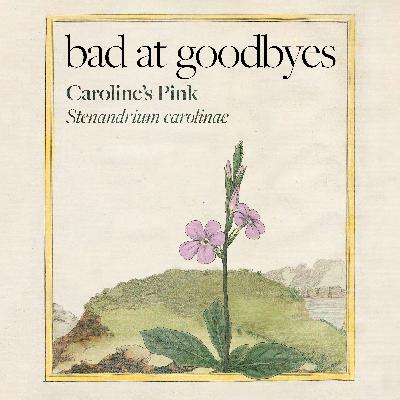
Caroline's Pink :: Stenandrium carolinaeBad at Goodbyes :: Episode 068On today’s show we learn about the Caroline's Pink, a critically endangered flowering herbaceous perennial plant native to North Caicos and Middle Caicos, islands in the Turks and Caicos archipelago, a British Overseas Territory in the Caribbean region, in the Atlantic Ocean. Its scientific name is Stenandrium carolinae and it was first described in 1960.(00:05) Intro(02:05) Species Information(20:16) Citations(22:18) Music(28:28) PledgeFor more information about conservation on the Turks and Caicos islands please see the UK Overseas Territories Conservation Forum at https://www.ukotcf.org.Research for today’s show was compiled from:Earle-Mundil, H., Manco, B., Hamilton, M. & Clubbe, C. 2012. Stenandrium carolinae. The IUCN Red List of Threatened Species 2012: e.T16726348A16727210. – https://dx.doi.org/10.2305/IUCN.UK.2012-1.RLTS.T16726348A16727210.enFranck, Alan R., and Thomas F. Daniel. 2015. "Taxonomic and Nomenclatural Notes on Six Genera of Acanthaceae in the West Indies." Proceedings of the California Academy of Sciences, Series 4, 62 (10): 309–29. – https://www.researchgate.net/publication/285235613_Taxonomic_and_Nomenclatural_Notes_on_Six_Genera_of_Acanthaceae_in_the_West_IndiesInstitute for Regional Conservation. n.d. "Stenandrium carolinae." Plants of the Bahama Archipelago. – https://regionalconservation.org/ircs/database/plants/PlantPageBAH.asp?TXCODE=StencaroLeonard, Emery C. 1960. "Acanthaceae Americanae Novae vel Criticae." Wrightia 2: 75–82. – https://www.biodiversitylibrary.org/page/766031Long, Robert W. 1970. “The Genera of Acanthaceae in the Southeastern United States.” Journal of the Arnold Arboretum 51 (3): 257--309. – https://doi.org/10.5962/bhl.part.7043.May, Christopher, Samuel Pike, Katie Medcalf, B. Naqqi Manco, Dodly Prosper, and Junel Blaise. 2024. "Conservation and Resilience." Times of the Islands, Spring 2024. – https://www.timespub.tc/2024/03/conservation-and-resilience/Pelembe, T., and G. Cooper, eds. UK Overseas Territories and Crown Dependencies: 2011 Biodiversity Snapshot. Peterborough, UK: Joint Nature Conservation Committee, 2011. – https://jncc.gov.uk/resources/e5d8c245-e94d-4043-b1b8-f353c27cd9b4#ot-biodiversity2011-turks-caicos-appendices.pdfPienkowski, Mike, ed. 2002. Plan for Biodiversity Management and Sustainable Development around Turks & Caicos Ramsar Site. Version 1.00. Turks & Caicos National Trust and UK Overseas Territories Conservation Forum. – https://www.ukotcf.org.uk/wp-content/uploads/2020/04/TCIRamsarSiteManPlan.pdfUK Overseas Territories Conservation Forum. n.d. "Turks and Caicos Islands." – https://www.ukotcf.org.uk/wider-caribbean/turks-and-caicos-islands/Sanchez, Michele Dani, Bryan Naqqi Manco, Junel Blaise, Marcella Corcoran, Martin Allen Hamilton. 2019. "Conserving and Restoring the Caicos Pine Forests: The First Decade." Plant Diversity 41 (2): 75–83. https://doi.org/10.1016/j.pld.2018.05.002Please find us on the web at Bad at Goodbyes and on instagram. Please subscribe and rate/review Bad at Goodbyes wherever you listen to podcasts. Please help spread the word about the show and about the species we feature. Please take care of each other, and all of our fellow travelers.A note on accuracy: I strive for it! These episodes are well-researched and built from scholarly sources, hoping to provide an informed and accurate portrait of these species. That said, I’m a musician! I am not an academic and have limited scientific background. I may get things wrong! If you are using this podcast for scholarship of any kind, please see the cited sources and double-check all information.
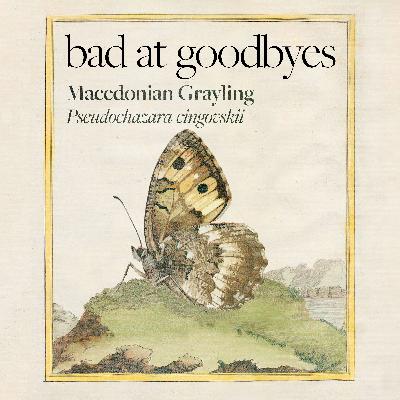
Macedonian Grayling :: Pseudochazara cingovskiiBad at Goodbyes :: Episode 067On today’s show we learn about the Macedonian Grayling, a critically endangered butterfly native to the white marble mountains of North Macedonia in southeastern Europe. Its scientific name is Pseudochazara cingovskii and it was first described in 1973.(00:05) Intro(02:05) Species Information(24:52) Citations(26:43) Music(33:28) PledgeFor more information about protecting species like the Macedonian Grayling from illegal trade please see the International Fund for Animal Welfare at https://www.ifaw.org/.Research for today’s show was compiled from:Apelblat, Mose. "How Legal Loopholes Make EU a Destination for Illegal Wildlife Trade." The Brussels Times, October 7, 2025 – https://www.brusselstimes.com/1781595/animal-welfare-how-legal-loopholes-make-eu-a-destination-for-illegal-wildlife-tradeBrown, J. 1976. "A Review of the Genus Pseudochazara de Lesse, 1951 (Lep., Satyridae) in Greece." Entomologist's Gazette 27: 85–90. – https://biodiversity.unitir.edu.al/Documenten/Brown_1976_Pseudochazara_tisiphone_amymone.pdfGullan, P. J., and P. S. Cranston. The Insects: An Outline of Entomology. 5th ed. Oxford: Wiley-Blackwell, 2014. – https://archive.org/details/TheInsectsAnOutlineOfEntomology_201902Institute of Communication Studies. "Nature for Sale." YouTube video, 25:38. Posted by "Дома / Doma," May 7, 2024. – https://www.youtube.com/watch?v=9wNzxEW1w3wInternational Fund for Animal Welfare. "Legal Loopholes Make EU a Prime Destination for Stolen Wildlife Trade." Press release, November 22, 2022. – https://www.ifaw.org/press-releases/legal-loopholes-eu-prime-destination-stolen-wildlife-tradeMiddleton-Welling, J., Dapporto, L., García-Barros, E. et al. A new comprehensive trait database of European and Maghreb butterflies, Papilionoidea. Scientific Data 7, 351 (2020). – https://doi.org/10.1038/s41597-020-00697-7Ministry of Environment and Physical Planning. Fifth National Report to the Convention on Biological Diversity of the Republic of Macedonia. Skopje: Ministry of Environment and Physical Planning, 2014. https://www.cbd.int/doc/world/mk/mk-nr-05-en.pdfTakáts, Kornél, and Morten Mølgaard. "Partial mtCOI-sequences of Balkanic species of Pseudochazara (Lepidoptera: Nymphalidae, Satyrinae) reveal three well-differentiated lineages." Entomologica romanica 19 (2014): 21–40. – https://entomologica-romanica.reviste.ubbcluj.ro/19_2014_2015/ER1920141504_Takats_et_Molgaard.pdfvan Swaay, C., Ellis, S. & Warren, M. 2025. Pseudochazara cingovskii. The IUCN Red List of Threatened Species 2025: e.T160595A841785. – https://dx.doi.org/10.2305/IUCN.UK.2025-1.RLTS.T160595A841785.enVerovnik, Rudi & Micevski, Branko & Maes, Dirk & Wynhoff, Irma & Swaay, Chris & Warren, Martin. (2013). Conserving Europe's most endangered butterfly: The Macedonian Grayling (Pseudochazara cingovskii). Journal of Insect Conservation. 17. – https://doi.org/10.1007/s10841-013-9576-6Verovnik R, Wiemers M (2016) Species delimitation in the Grayling genus Pseudochazara (Lepidoptera, Nymphalidae, Satyrinae) supported by DNA barcodes. ZooKeys 600: 131-154. – https://doi.org/10.3897/zookeys.600.7798Wikipedia – https://en.wikipedia.org/wiki/Pseudochazara_cingovskiiPlease find us on the web at Bad at Goodbyes and on instagram. Please subscribe and rate/review Bad at Goodbyes wherever you listen to podcasts. Please help spread the word about the show and about the species we feature. Please take care of each other, and all of our fellow travelers.A note on accuracy: I strive for it! These episodes are well-researched and built from scholarly sources, hoping to provide an informed and accurate portrait of these species. That said, I’m a musician! I am not an academic and have limited scientific background. I may get things wrong! If you are using this podcast for scholarship of any kind, please see the cited sources and double-check all information.
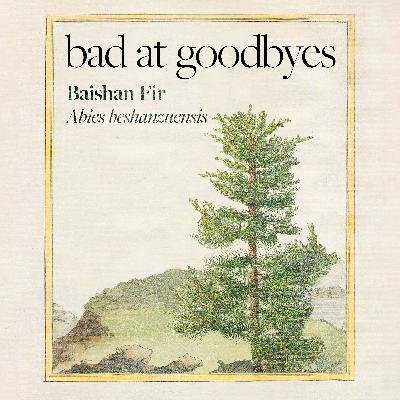
Baishan Fir :: Abies beshanzuensisBad at Goodbyes :: Episode 066On today’s show we learn about the Baishan Fir, a critically endangered evergreen conifer native to east Asia, specifically the Zhejiang Province in southeastern China, on the slopes of Mt. Baishanzu.(00:05) Intro(02:05) Species Information(18:37) Citations(20:20) Music(27:03) PledgeResearch for today’s show was compiled from:Christian, T. (2021), “Abies beshanzuensis”. Trees and Shrubs Online. – http://treesandshrubsonline.org/articles/abies/abies-beshanzuensisFarm, Wanli Forest, and Chekiang Chingyuan County. "Abies beshanzuensis MH Wu—A new species of Abies from Chekiang." Journal of Systematics and Evolution 14, no. 2 (1976): 15. – https://www.jse.ac.cn/EN/Y1976/V14/I2/15Hu, Rui, Yajing Liu, Jiaxin Zhang, Hua Xing, Sha Jiang, and Yu Liu. 2022. "Auxiliary Seed Treatment Is Necessary to Increase Recruitment of a Critically Endangered Species, Abies beshanzuensis (Pinaceae)". Forests 13, no. 6: 961. – https://doi.org/10.3390/f13060961Hu, X. 2021. Abies beshanzuensis. The IUCN Red List of Threatened Species 2021: e.T32318A150298372. – https://dx.doi.org/10.2305/IUCN.UK.2021-3.RLTS.T32318A150298372.enLifang Zhang, Yougui Wu, Jie Feng, Yang Zhang, Aya Hafsi, Donghao Wu, Jinliang Liu, Boliang Wei, Hongfei Lv, Mingjian Yu. “Obstacles affecting seedling germination and reproductive success of the critically endangered species Abies beshanzuensis.” Global Ecology and Conservation, v. 56, 2024. – https://doi.org/10.1016/j.gecco.2024.e03317Liu, Bin, Ke Liu, Xiaorong Chen, Duohong Xiao, Tingjin Wang, Yang Yang, Hui Shuai, Sumei Wu, Lu Yuan, and Liping Chen. 2023. "Comparative Transcriptome Analysis Reveals the Interaction of Sugar and Hormone Metabolism Involved in the Root Hair Morphogenesis of the Endangered Fir Abies beshanzuensis" Plants 12, no. 2: 276. - https://doi.org/10.3390/plants12020276Liu, K., Xiao, D., Xiong, Y. et al. Grafting enhances growth vigor and photosynthetic capacity in the progeny of critically endangered Abies beshanzuensis. BMC Plant Biology 26, 56 (2026). – https://doi.org/10.1186/s12870-025-07708-yShao, S., Jin, Z. & Weng, Y.H. “Lignin characteristics of Abies beshanzuensis, a critically endangered tree species”. Journal of Wood Science v. 54, 81–86 (2008). – https://doi.org/10.1007/s10086-007-0918-4Wikipedia – https://en.wikipedia.org/wiki/Abies_beshanzuensisYang Ling, Liang Siqi, Pan Jiaming, Wei Jinxin, Ding Tao, Jiang Rihong, Shao Yizhen, Zhang Xianchun, Liu Yongbo, Xiang Qiaoping. “Species classification of endangered plants Baishanzu fir and resource fir and the protection of their genetic resources”. Chinese Journal of Plant Ecology v. 47 no.12: 1629-1645. (2023). – https://dx.doi.org/10.17521/cjpe.2022.0295Y.Yang, D.Zhang, D.Luscombe, W-b Liao, A.Farjon, T.Katsuki, Q.Xiang, N.Li and K.Rushforth, 2019, “Abies beshanzuensis”. Threatened Conifers of The World. – https://threatenedconifers.rbge.org.uk/conifers/abies-beshanzuensisZhao, L., Li, T., Chen, X. et al. Resistance mechanism of Abies beshanzuensis under heat stress was elucidated through the integration of physiological and transcriptomic analyses. BMC Plant Biology 25, 621 (2025). – https://doi.org/10.1186/s12870-025-06641-4Please find us on the web at Bad at Goodbyes and on instagram. Please subscribe and rate/review Bad at Goodbyes wherever you listen to podcasts. Please help spread the word about the show and about the species we feature. Please take care of each other, and all of our fellow travelers.A note on accuracy: I strive for it! These episodes are well-researched and built from scholarly sources, hoping to provide an informed and accurate portrait of these species. That said, I’m a musician! I am not an academic and have limited scientific background. I may get things wrong! If you are using this podcast for scholarship of any kind, please see the cited sources and double-check all information.
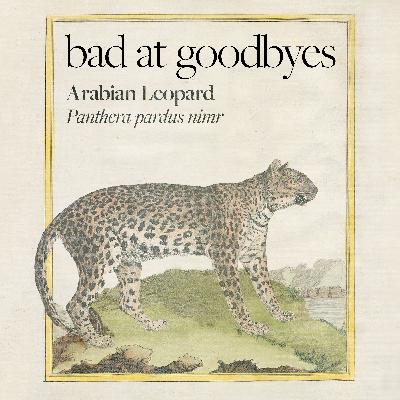
Arabian Leopard :: Panthera pardus nimrBad at Goodbyes :: Episode 065On today’s show we learn about the Arabian Leopard, a critically endangered big cat, a carnivorous feline native to Oman and Yemen.(00:05) Intro(02:05) Species Information(26:13) Citations(28:01) Music(32:06) PledgeResearch for today’s show was compiled from:Al Hikmani, H., Aboalfotooh, A.A.H., Alghafis, S., Almubarak, Z., Baeshen, O., Budd, J., Dunford, C., Ferreira, J.D., Gallacher, E., Mann, G., Shobrak, M. & Spalton, A. 2025. Panthera pardus ssp. nimr (Green Status assessment). The IUCN Red List of Threatened Species 2025: e.T15958A1595820252. – https://iucnredlist.org/species/15958/274968998Al Hikmani, Hadi, and Khalid Al Hikmani. “Northward Expansion of the Critically Endangered Arabian Leopard in Dhofar, Oman.” Oryx 58, no. 6 (2024): 710–14. – https://doi.org/10.1017/S0030605324001662Al Hikmani, H., Spalton, A., Zafar-ul Islam, M., al-Johany, A., Sulayem, M., Al-Duais, M. & Almalki, A. 2025. Panthera pardus ssp. nimr (amended version of 2024 assessment). The IUCN Red List of Threatened Species 2025: e.T15958A274968998. – https://dx.doi.org/10.2305/IUCN.UK.2025-1.RLTS.T15958A274968998.enAlqahtani, Fahad H., Ion I. Măndoiu, Badr M. Al-Shomrani, Sulaiman Al-Hashmi, Fatemeh Jamshidi-Adegani, Juhaina Al-Kindi, Andrzej Golachowski, Barbara Golachowska, Abdulaziz K. Al-Jabri, and Manee M. Manee. 2025. "First Mitogenome of the Critically Endangered Arabian Leopard (Panthera pardus nimr)" Animals 15, no. 11: 1562. – https://doi.org/10.3390/ani15111562A.M.H. Al-Johany. "Distribution and conservation of the Arabian Leopard Panthera pardus nimr in Saudi Arabia." Journal of Arid Environments. Volume 68, Issue 1, Pages 20-30. 2007. – https://doi.org/10.1016/j.jaridenv.2006.04.002Dunford, Carolyn E., J. Philip B. Faure, Michael D. Ross, J. Andrew Spalton, Marine Drouilly, Kai J.P. Pryce-Fitchen, Ross De Bruin, et al. “Searching for Spots: A Comprehensive Survey for the Arabian Leopard Panthera Pardus Nimr in Saudi Arabia.” Oryx 58, no. 3 (2024): 351–62. – https://doi.org/10.1017/S0030605323000807Panthera – https://panthera.org/blog-post/qa-arabian-leopards, https://panthera.org/arabian-leopard-initiativeSpalton, James Andrew, Hadi Musalam al Hikmani, David Willis, and Ali Salim Bait Said. “Critically Endangered Arabian Leopards Panthera Pardus Nimr Persist in the Jabal Samhan Nature Reserve, Oman.” Oryx 40, no. 3 (2006): 287–94. – https://doi.org/10.1017/S0030605306000743Species Survival Commission Cat Specialist Group. Arabian Leopard. 2024. – https://www.catsg.org/arabianleopardTimna, Yotam, and Reuven Yosef. "A historic perspective 1: The diet of the Arabian Leopard (Panthera pardus nimr) in Israel", Israel Journal of Ecology and Evolution 71, 4 (2025): 171-183. – https://doi.org/10.1163/22244662-bja10112Timna, Yotam, and Reuven Yosef. "A historic perspective 2: Scent, Sound, and Space in the extinct Arabian Leopard (Panthera pardus nimr) in Israel", Israel Journal of Ecology and Evolution 71, 4 (2025): 184-196. – https://doi.org/10.1163/22244662-bja10111Wikipedia – https://en.wikipedia.org/wiki/Arabian_leopardFor more information about Arabian Leopard conservation and big cat conservation in general, please see Panthera at https://panthera.orgPlease find us on the web at Bad at Goodbyes and on instagram. Please subscribe and rate/review Bad at Goodbyes wherever you listen to podcasts. Please help spread the word about the show and about the species we feature. Please take care of each other, and all of our fellow travelers.A note on accuracy: I strive for it! These episodes are well-researched and built from scholarly sources, hoping to provide an informed and accurate portrait of these species. That said, I’m a musician! I am not an academic and have limited scientific background. I may get things wrong! If you are using this podcast for scholarship of any kind, please see the cited sources and double-check all information.
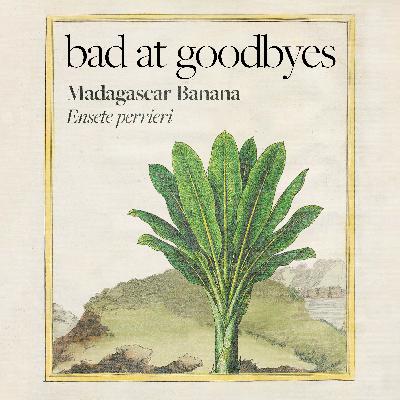
Madagascar Banana :: Ensete perrieriBad at Goodbyes :: Episode 064On today’s show we learn about the Madagascar Banana, a critically endangered flowering plant native to the island nation of Madagascar roughly 250 miles off the southeastern coast of the African mainland.(00:05) Intro(02:05) Species Information(21:33) Citations(22:58) Music(29:37) PledgeResearch for today’s show was compiled from:Allen, R. 2018. Ensete perrieri. The IUCN Red List of Threatened Species 2018: e.T98249345A98249347. – https://dx.doi.org/10.2305/IUCN.UK.2018-1.RLTS.T98249345A98249347.enAllen, Richard; Clarkson, James J; Ralimanana, Hélène (6 July 2018). "The critically endangered Madagascar Banana". Kew Royal Botanic Gardens. - https://www.kew.org/read-and-watch/madagascan-bananaBorrell, James S et al. “Enset in Ethiopia: a poorly characterized but resilient starch staple.” Annals of Botany v.123, no.5 (2019): 747-766. - https://doi.org/10.1093/aob/mcy214Grubb, Peter J. “Interpreting some outstanding features of the flora and vegetation of Madagascar.” Perspectives in Plant Ecology, Evolution and Systematics v.6 no.1-2. p 125-146. 2003. – https://doi.org/10.1078/1433-8319-00046Humbert, H., and Jean-François Leroy. 1936. Flore de Madagascar et Des Comores : Plantes Vasculaires. Tananarive: Imprimerie officielle. – https://www.biodiversitylibrary.org/page/8099122IUCN (International Union for Conservation of Nature). Andrefana Dry Forests - 2025 Conservation Outlook Assessment. IUCN World Heritage Outlook. October 11, 2025. – https://worldheritageoutlook.iucn.org/explore-sites/andrefana-dry-forestsMusée colonial de Marseille. 1907. Annales du Muśee colonial de Marseille. Vol. ser. 2 v. 7. Marseille: Faculté des sciences de Marseille, Musée colonial. – https://www.biodiversitylibrary.org/page/45311062UN Environment World Conservation Monitoring Centre. World Heritage Datasheet: Tsingy De Bemaraha Strict Nature Reserve. - http://world-heritage-datasheets.unep-wcmc.org/datasheet/output/site/tsingy-de-Bemaraha-strict-nature-reserve/Tsingy de Bemaraha National Park. Madagascar National Parks. - https://parcs-madagascar.com/en/parc/tsingy-de-Bemaraha-2/Wikipedia – https://en.wikipedia.org/wiki/Ensete_perrieriPlease find us on the web at Bad at Goodbyes and on instagram. Please subscribe and rate/review Bad at Goodbyes wherever you listen to podcasts. Please help spread the word about the show and about the species we feature. Please take care of each other, and all of our fellow travelers.A note on accuracy: I strive for it! These episodes are well-researched and built from scholarly sources, hoping to provide an informed and accurate portrait of these species. That said, I’m a musician! I am not an academic and have limited scientific background. I may get things wrong! If you are using this podcast for scholarship of any kind, please see the cited sources and double-check all information.
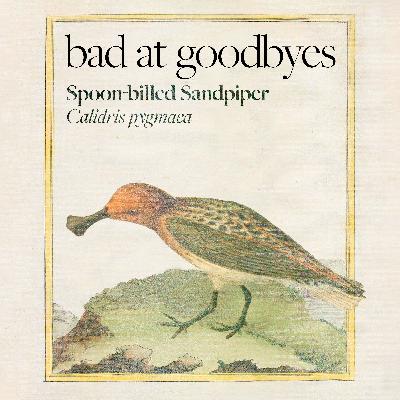
Spoon-billed Sandpiper :: Calidris pygmaeaBad at Goodbyes :: Episode 063On today’s show we learn about the Spoon-billed Sandpiper, a critically endangered migratory avian, a bird native to breeding ground in far northeastern Russia in the Chukotka autonomous district, that migrates to summer in Southeast Asia, in Bangladesh, Thailand, Myanmar and China.(00:05) Intro(02:05) Species Information(25:24) Citations(27:20) Music(35:19) PledgeFor more information about Spoon-billed Sandpiper conservation see the Wildfowl and Wetlands Trust at https://wwt.org.uk/.Research for today’s show was compiled from:Animal Diversity Web at the University of Michigan. Labuda, C. 2023. "Eurynorhynchus pygmeus". https://animaldiversity.org/accounts/Eurynorhynchus_pygmeus/Bird Conservation International v.20, no. 2 (2010): 95–111. Zöckler, Christoph, Evgeny E. Syroechkovskiy, And Philip W. Atkinson. “Rapid and Continued Population Decline in the Spoon-Billed Sandpiper Eurynorhynchus Pygmeus Indicates Imminent Extinction Unless Conservation Action Is Taken.” – https://doi.org/10.1017/S0959270910000316Bird Conservation International v.26, no. 4 (2016): 476–89. Zöckler, Christoph, Alison E. Beresford, Gillian Bunting, Sayam U. Chowdhury, Nigel A. Clark, Vivian Wing Kan Fu, Tony Htin Hla, et al. “The Winter Distribution of the Spoon-Billed Sandpiper Calidris Pygmaeus.” – https://doi.org/10.1017/S0959270915000295Bird Conservation International v.28, no. 2 (2018): 251–62. Chowdhury, Sayam U., Mohammad Foysal, M Abdullah Abu Diyan, And Sakib Ahmed. “Discovery of an Important Wintering Site of the Critically Endangered Spoon-Billed Sandpiper Calidris Pygmaea in the Meghna Estuary, Bangladesh.” – https://doi.org/10.1017/S0959270917000247Birds of the World. Cornell Lab of Ornithology, Ithaca, NY, USA. van Gils, J., P. Wiersma, C. J. Sharpe, and G. M. Kirwan (2020). Spoon-billed Sandpiper (Calidris pygmaea), version 1.0. In Birds of the World (J. del Hoyo, A. Elliott, J. Sargatal, D. A. Christie, and E. de Juana, Editors). – https://doi.org/10.2173/bow.spbsan1.01Diversity v. 15, no. 4: 584. Loktionov, Egor Y., Roland A. Digby, Nickolay N. Yakushev, Ivan A. Shepelev, Jodie P. Clements, Pavel S. Tomkovich, Nigel S. Jarrett, Nigel A. Clark, Rhys E. Green, Elena G. Lappo, and et al. 2023. "Evaluating the Impact of Headstarting on the Critically Endangered Spoon-Billed Sandpiper Calidris pygmaea". – https://doi.org/10.3390/d15040584Frontiers in Marine Science. v. 9 (2022). Lu Xiuyuan, Yang Hongyan, Piersma Theunis, Sun Lili, Chen Qing, Jia Yifei, Lei Guangchun, Cheng Li, Rao Xinpeng. ”Food resources for Spoon-billed Sandpipers (Calidris pygmaea) in the mudflats of Leizhou Bay, southern China”. – https://doi.org/10.3389/fmars.2022.1005327Global Ecology and Conservation Volume 35, 2022, e02077. Pyae Phyo Aung, Graeme M. Buchanan, Philip D. Round, Christoph Zöckler, Chris Kelly, Naruemon Tantipisanuh, George A. Gale. “Foraging microhabitat selection of Spoon-billed Sandpiper in the Upper Gulf of Mottama, Myanmar.” – https://doi.org/10.1016/j.gecco.2022.e02077IUCN – https://www.iucnredlist.org/species/22693452/154738156Oryx 52, no. 1 (2018): 137–46. Clark, Nigel A., Guy Q. A. Anderson, Jing Li, Evgeny E. Syroechkovskiy, Pavel S. Tomkovich, Christoph Zöckler, Rebecca Lee, and Rhys E. Green. “First Formal Estimate of the World Population of the Critically Endangered Spoon-Billed Sandpiper Calidris Pygmaea.” – https://doi.org/10.1017/S0030605316000806Oryx 54, no. 1 (2020): 23–29. Aung, Pyae-Phyo, Saw Moses, Nigel A. Clark, Guy Q.A. Anderson, Geoff M. Hilton, Graeme M. Buchanan, Christoph Zöckler, and Rhys E. Green. “Recent Changes in the Number of Spoon-Billed Sandpipers Calidris Pygmaea Wintering on the Upper Gulf of Mottama in Myanmar.” – https://doi.org/10.1017/S0030605318000698Sound Recordings. Xeno-Canto. Jens Kirkeby, XC486596 – http://xeno-canto.org/486596Wader Study. v. 124. 99-104. Kelly, Chris & Zöckler, Christoph & Scampion, Baz & Syroechkovskiy, Evgeny. (2017). Hammer, filter or microphone: How does the Spoon-billed Sandpiper Calidris pygmaea use its bill to feed?. – http://dx.doi.org/10.18194/ws.00076Wildfowl and Wetlands Trust – https://www.wwt.org.uk/our-work/projects/spoon-billed-sandpipersWikipedia – https://en.wikipedia.org/wiki/Spoon-billed_sandpiperPlease find us on the web at Bad at Goodbyes and on instagram. Please subscribe and rate/review Bad at Goodbyes wherever you listen to podcasts. Please help spread the word about the show and about the species we feature. Please take care of each other, and all of our fellow travelers.A note on accuracy: I strive for it! These episodes are well-researched and built from scholarly sources, hoping to provide an informed and accurate portrait of these species. That said, I’m a musician! I am not an academic and have limited scientific background. I may get things wrong! If you are using this podcast for scholarship of any kind, please see the cited sources and double-check all information.
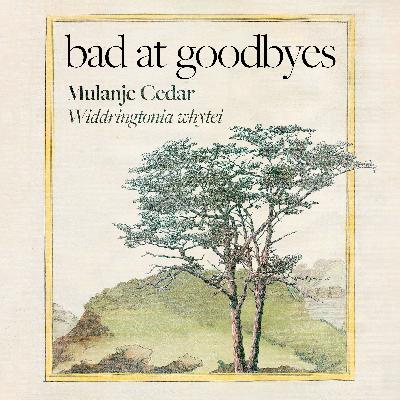
Mulanje Cedar :: Widdringtonia whyteiBad at Goodbyes :: Episode 062On today’s show we learn about the Mulanje Cedar, a critically endangered conifer tree native to the African nation of Malawi, specifically to Mount Mulanje in the southeast.(00:05) Intro(02:05) Species Information(23:53) Citations(25:52) Music(32:02) PledgeFor more information about Mount Mulanje conservation, please see the Mulanje Mountain Conservation Trust at https://mountmulanje.org.mwResearch for today’s show was compiled from:Bayliss, Julian, Steve Makungwa, Joy Hecht, David Nangoma, and Carl Bruessow. “Saving the Island in the Sky: The Plight of the Mount Mulanje Cedar Widdringtonia Whytei in Malawi.” Oryx 41, no. 1 (2007): 64–69. – https://doi.org/10.1017/S0030605307001548Burger, Niel. “Disturbance ecology and size-class structure of the Mulanje cedar of Malawi, Widdringtonia whytei, and associated broadleaved forest.” Botany honours project 2010. University of Cape Town. – http://hdl.handle.net/11427/24397Chanyenga, Tembo F., Coert J. Geldenhuys, and Gudeta W. Sileshi. “Effect of Population Size, Tree Diameter and Crown Position on Viable Seed Output per Cone of the Tropical Conifer Widdringtonia Whytei in Malawi.” Journal of Tropical Ecology 27, no. 5 (2011): 515–20. – https://doi.org/10.1017/S0266467411000204Chanyenga, T., Shaw, K. & Mitole, I. 2019. “Widdringtonia whytei.” The IUCN Red List of Threatened Species 2019: e.T33216A126090798. – https://dx.doi.org/10.2305/IUCN.UK.2019-3.RLTS.T33216A126090798.enCNN. “Saving Malawi’s Mulanje Cedar.” October 2025. Inside Africa S21 E21. – https://www.youtube.com/watch?v=sTNGckdP7kkEarle, Christopher J., ed. "Widdringtonia whytei." The Gymnosperm Database. February 10, 2025. – https://conifers.org/cu/Widdringtonia_whytei.php.Farjon, A. 2019. “Widdringtonia whytei.” Threatened Conifers of The World – https://threatenedconifers.rbge.org.uk/conifers/widdringtonia-whyteiFrank, Fred & Mwabumba, Lusayo & Mhango, Jarret & Missanjo, Edward & Kadzuwa, Henry & Likoswe, Michael. (2023). “Genetic and Phenotypic Parameters for Growth Traits of Widdringtonia whytei-Rendle Translocation Provenance Trials in Malawi.” Journal of Global Ecology and Environment. Volume 17, Issue 4. 32-48. – https://doi.org/10.56557/jogee/2023/v17i48222Martin, Emma, and Burgess, Neil. "Mulanje Montane Forest-Grassland." One Earth. September 23, 2020. – https://www.oneearth.org/ecoregions/mulanje-montane-forest-grasslandMitrani, Leila. 2017. “Reproduction and establishment of two endangered African cedars, Widdringtonia cedarbergensis and Widdringtonia whytei.” Masters Thesis. University of Cape Town. – http://hdl.handle.net/11427/25431Missanjo, Edward & Frank, Fred. (2015). “Restoration and Survival Trend of Widdringtonia whytei Forest at Chambe Basin, Mulanje Mountain.” Journal of Basic and Applied Research International (JOBARI). 3 (2). 54-58. – https://ikprress.org/index.php/JOBARI/article/view/3135Mulanje Mountain Conservation Trust – https://mountmulanje.org.mwPauw, C. Anton and Linder, Peter H. “Tropical African cedars (Widdringtonia, Cupressaceae): systematics, ecology and conservation status.” Botanical Journal of the Linnean Society, Volume 123, Issue 4, April 1997, Pages 297–319. – https://doi.org/10.1111/j.1095-8339.1997.tb01421.xSmith, Paul. “Saving Malawi’s National Tree.” BGjournal 12, no. 2 (2015): 34–36. – https://www.jstor.org/stable/24811438Wikipedia – https://en.wikipedia.org/wiki/Widdringtonia_whyteiPlease find us on the web at Bad at Goodbyes and on instagram. Please subscribe and rate/review Bad at Goodbyes wherever you listen to podcasts. Please help spread the word about the show and about the species we feature. Please take care of each other, and all of our fellow travelers.A note on accuracy: I strive for it! These episodes are well-researched and built from scholarly sources, hoping to provide an informed and accurate portrait of these species. That said, I’m a musician! I am not an academic and have limited scientific background. I may get things wrong! If you are using this podcast for scholarship of any kind, please see the cited sources and double-check all information.
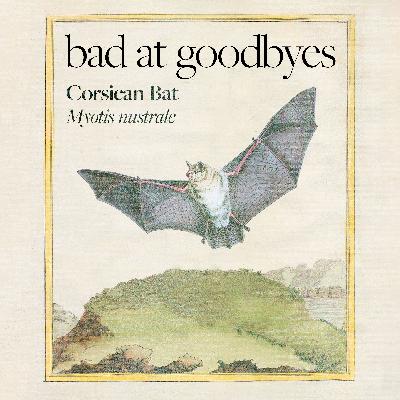
Corsican Bat :: Myotis NustraleBad at Goodbyes :: Episode 061On today’s show we learn about the Corsican Bat, a critically endangered flying mammal native to the French island territory of Corsica in the Mediterranean Ocean.(00:05) Intro(02:05) Species Information(30:46) Citations(32:42) Music(40:26) PledgeFor more information about Corsican Bat conservation see the Corsica Bat Group, in French: Groupe Chiroptères Corse at https://chauvesouriscorse.frBig thanks and deep gratitude to Kate Derrick at the Corsica Bat Group for sharing her expertise, insights and her work with us. It was so inspiring to speak with her.Research for today’s show was compiled from:Aulagnier, S., Beuneux, G. & Russo, D. 2024. Myotis nustrale. The IUCN Red List of Threatened Species 2024: e.T248107314A248107503. – https://dx.doi.org/10.2305/IUCN.UK.2024-2.RLTS.T248107314A248107503.enDerrick, K. Groupe Chiroptères Corse (Community Manager, Communications Manager, Scientific Officer). Interview by Joshua Dumas, October 30, 2025Derrick, K. and Beuneux, G. 2024. L’espèce endémique de Corse, Myotis nustrale, enfin décrite officiellement ! Envol des Chiros 36: 12-13. – https://www.sfepm.org/sites/default/files/inline-files/EDC36.pdfGroupe chiroptères Corse, 2019 - Programme d'étude concernant l'amélioration des connaissances sur l'écologie d'une nouvelle espèce de chauve-souris endémique à la Corse : Myotis sp. C (ex - Myotis nattereri) - Année 2018 – https://gaia.oec.fr/documents/39037ba8a97630e6c387281c39766ece.pdfJavier Juste, Manuel Ruedi, Sébastien J. Puechmaille, Irene Salicini, Carlos Ibáñez "Two New Cryptic Bat Species within the Myotis nattereri Species Complex (Vespertilionidae, Chiroptera) from the Western Palaearctic," Acta Chiropterologica, 20(2), 285-300, (14 February 2019) – https://doi.org/10.3161/15081109ACC2018.20.2.001Martinetti, Jean-Michel dir. Belle de Nuit. France 3 Corse ViaStella and Mediterranean Dream Productions, 2024. 52 min – https://www.france.tv/france-3/corse-viastella/corsica-salvatica/6717952-regards-croises-sur-le-monde-animal.htmlOffice de l'Environnement de la Corse. Faune Sauvage de Corse. Murin de Corse. – https://faunesauvagedecorse.oec.fr/Espece_mpage_224_idtaxon,4905.htmOne Earth – https://www.oneearth.org/ecoregions/corsican-montane-broadleaf-and-mixed-forests/Schmidbauer, P., & Denzinger, A. (2019). Social calls of Myotis nattereri during swarming: Call structure mirrors the different behavioral context. PloS one, 14(9), e0221792. – https://doi.org/10.1371/journal.pone.0221792Sébastien J. Puechmaille, Benjamin Allegrini, Emma S.M. Boston, Marie-Jo Dubourg-Savage, Allowen Evin, Alexandre Knochel, Yann Le Bris, Vincent Lecoq, Michèle Lemaire, Delphine Rist, Emma C. Teeling. Genetic analyses reveal further cryptic lineages within the Myotis nattereri species complex. Mammalian Biology, Volume 77, Issue 3, 2012, Pages 224-228. – https://doi.org/10.1016/j.mambio.2011.11.004Sébastien J. Puechmaille, Serena Dool, Gregory Beuneux, Manuel Ruedi "Newly described and already endangered: a new mammal species endemic to Corsica," Revue suisse de Zoologie, 130(2), 335-351, (18 October 2023) – https://doi.org/10.35929/RSZ.0108Stoecklé, Tanguy and Amiguet, Marie, dir. Les Ailes du Maquis. Stéphane Quinson and Les Films du Tambour de Soie, 2021. 52 min. – https://www.youtube.com/watch?v=MDDDnAfMbFQPlease find us on the web at Bad at Goodbyes and on instagram. Please subscribe and rate/review Bad at Goodbyes wherever you listen to podcasts. Please help spread the word about the show and about the species we feature. Please take care of each other, and all of our fellow travelers.A note on accuracy: I strive for it! These episodes are well-researched and built from scholarly sources, hoping to provide an informed and accurate portrait of these species. That said, I’m a musician! I am not an academic and have limited scientific background. I may get things wrong! If you are using this podcast for scholarship of any kind, please see the cited sources and double-check all information.
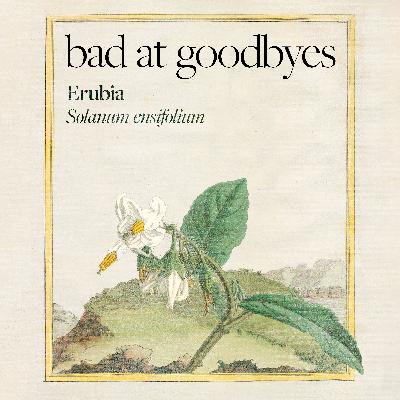
Erubia :: Solanum ensifoliumBad at Goodbyes :: Episode 060On today’s show we learn about the Erubia, a critically endangered flowering shrub native to the US island territory of Puerto Rico in the Caribbean Sea.(00:05) Intro(02:05) Species Information(19:24) Citations(21:02) Music(26:42) PledgeFor more information about conservation in Puerto Rico, please visit Para la Naturaleza at https://paralanaturaleza.orgResearch for today’s show was compiled from:Eastern Connecticut State University – https://www.easternct.edu/news/_stories-and-releases/2025/01-january/easterns-greenhouse-is-a-sanctuary-for-imperiled-plants.htmlGann, G.D. 2024. Solanum ensifolium. The IUCN Red List of Threatened Species 2024: e.T212065930A253642712. – https://dx.doi.org/10.2305/IUCN.UK.2024-2.RLTS.T212065930A253642712.enGraham, M.R., Kaur, N., Jones, C.S. et al. A phoenix in the greenhouse: characterization and phylogenomics of complete chloroplast genomes sheds light on the putatively extinct-in-the-wild Solanum ensifolium (Solanaceae). BMC Plant Biology 25, 320 (2025). – https://doi.org/10.1186/s12870-025-06338-8The Institute for Regional Conservation – https://www.regionalconservation.org/ircs/database/plants/PlantPagePR.asp?TXCODE=SolaensiJankauski Mark, Ferguson Riggs, Russell Avery and Buchmann Stephen. 2022. Structural dynamics of real and modelled Solanum stamens: implications for pollen ejection by buzzing bees. Journal of the Royal Society Interface. Volume 19 Issue 188. 1920220040 – http://doi.org/10.1098/rsif.2022.0040National Science Foundation’s Solanaceae Source – https://solanaceaesource.myspecies.info/content/solanum-ensifoliumPascarella, John & Aide, T. Mitchell & Serrano, Mayra & Zimmerman, Jess. (2000). Land-Use History and Forest Regeneration in the Cayey Mountains, Puerto Rico. Ecosystems. 3. 217-228. – https://doi.org/10.1007/s100210000021Rosario, Lumariz Hernandez, Juan O. Rodríguez Padilla, Desiree Ramos Martínez, Alejandra Morales Grajales, Joel A. Mercado Reyes, Gabriel J. Veintidós Feliu, Benjamin Van Ee, and Dimuth Siritunga. "DNA Barcoding of the Solanaceae Family in Puerto Rico Including Endangered and Endemic Species." Journal of the American Society for Horticultural Science 144, no. 5 (2019): 363–374. – https://doi.org/10.21273/JASHS04735-19Strickland-Constable, R., Schneider, H., Ansell, S.W., Russell, S.J. and Knapp, S. (2010), Species identity in the Solanum bahamense species group (Solanaceae, Solanum subgenus Leptostemonum). Taxon. 59. 209-226. – https://doi.org/10.1002/tax.591020U.S. Fish & Wildlife Service – https://ecos.fws.gov/ecp/species/817Please find us on the web at Bad at Goodbyes and on instagram. Please subscribe and rate/review Bad at Goodbyes wherever you listen to podcasts. Please help spread the word about the show and about the species we feature. Please take care of each other, and all of our fellow travelers.A note on accuracy: I strive for it! These episodes are well-researched and built from scholarly sources, hoping to provide an informed and accurate portrait of these species. That said, I’m a musician! I am not an academic and have limited scientific background. I may get things wrong! If you are using this podcast for scholarship of any kind, please see the cited sources and double-check all information.
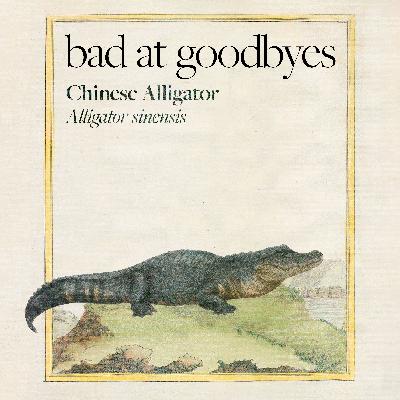
Chinese Alligator :: Alligator sinensisBad at Goodbyes :: Episode 059On today’s show we learn about the Chinese Alligator, critically endangered reptile native to the Yangtze River system in the Anhui Province of southeastern China.(00:05) Intro(02:05) Species Information(29:21) Citations(31:12) Music(38:25) PledgeFor more information about Chinese Alligator conservation, see the IUCN-SSC Crocodile Specialist Group at https://www.iucncsg.org.Research for today’s show was compiled from:Encyclopedia Britannica – https://www.britannica.com/animal/Chinese-alligatorGroppi, L. 2006. "Alligator sinensis" (On-line), Animal Diversity Web. – https://animaldiversity.org/accounts/Alligator_sinensis/Jiang, H.-X. & Wu, X. 2018. Alligator sinensis. The IUCN Red List of Threatened Species 2018: e.T867A3146005. - https://dx.doi.org/10.2305/IUCN.UK.2018-1.RLTS.T867A3146005.enKabir, Ashraful. Chinese Alligator (Alligator sinensis) (Fauvel, 1879) (Reptilia: Alligatoridae): Captive Breeding as Well as its Rehabilitation. International Journal of Research Studies in Zoology. Volume 8, Issue 2, 2024, PP 5-8. – https://doi.org/10.20431/2454-941X.0802002Lau, Erika Y. X., Josh A. Hodge, Jonathan P. Rio, Tao Pan, Philip D. Mannion, and Samuel T. Turvey. “Using Local Ecological Knowledge to Identify Land-Use Threats to the Last Wild Population of the Chinese Alligator Alligator Sinensis.” Oryx, 21 February 2025, 1–10. – https://doi.org/10.1017/S0030605324000978Liu, V. H. (2013). Chinese Alligators: Observations at Changxing Nature Reserve & Breeding Center. Reptiles & Amphibians, 20(4), 172-183. – https://doi.org/10.17161/randa.v20i4.13965Smithsonian's National Zoo and Conservation Biology Institute. (n.d.). Chinese alligator. – https://nationalzoo.si.edu/animals/chinese-alligatorSun, K., Li, M., Wang, Z., Sun, S., Yang, J., Wu, X., & Pan, T. (2025). Habitat Integrity Challenges for the Chinese Alligator Amid Land Occupation by Human: Pathways for Protection. Ecology and Evolution, 15 (3), e71113. – https://doi.org/10.1002/ece3.71113Thorbjarnarson, John, and Wang Xiaoming. “The Conservation Status of the Chinese Alligator.” Oryx 33, no. 2 (1999): 152–59. – https://doi.org/10.1046/j.1365-3008.1999.00051.xThorbjarnarson, John & Wang, Xiaoming & He, Lijun. (2001). Reproductive Ecology of the Chinese Alligator (Alligator sinensis) and Implications for Conservation. Journal of Herpetology. 35 (4). 553. – https://doi.org/10.2307/1565892Xianyan Wang, Ding Wang, Xiaobing Wu, Renping Wang, Chaolin Wang. 1 May 2007. Acoustic signals of Chinese alligators (Alligator sinensis): Social communication. The Journal of the Acoustical Society of America. 121 (5): 2984–2989. – https://doi.org/10.1121/1.2714910Yang, H. & Zhao, Lan & Han, Qun-Hua & Fang, S.. (2017). Nest site preference and fidelity of chinese alligator (Alligator sinensis). Asian Herpetological Research. 8. 244-252. – https://doi.org/10.16373/j.cnki.ahr.170066Please find us on the web at Bad at Goodbyes and on instagram. Please subscribe and rate/review Bad at Goodbyes wherever you listen to podcasts. Please help spread the word about the show and about the species we feature. Please take care of each other, and all of our fellow travelers.A note on accuracy: I strive for it! These episodes are well-researched and built from scholarly sources, hoping to provide an informed and accurate portrait of these species. That said, I’m a musician! I am not an academic and have limited scientific background. I may get things wrong! If you are using this podcast for scholarship of any kind, please see the cited sources and double-check all information.
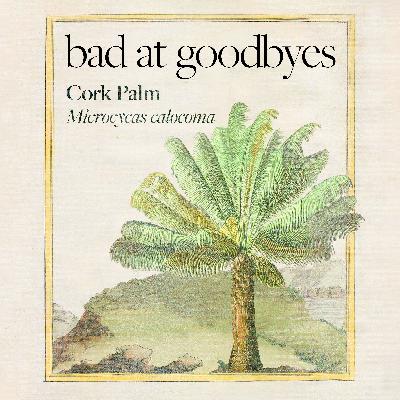
Cork Palm :: Microcycas CalocomaBad at Goodbyes :: Episode 058On today’s show we learn about the Cork Palm, a critically endangered tree native to the island of Cuba in the Caribbean Sea.(00:05) Intro(02:05) Species Information(23:01) Citations(24:23) Music(32:42) PledgeResearch for today’s show was compiled from:Ania Pinares, Jorge González-Astorga, Andrew P. Vovides, Julio Lazcano, Wagner A. Vendrame, Genetic diversity of the endangered endemic Microcycas calocoma (Miq.) A. DC (Zamiaceae, Cycadales): Implications for conservation. Biochemical Systematics and Ecology, Volume 37, Issue 4, 2009, Pages 385-394. – https://doi.org/10.1016/j.bse.2009.07.006Botanical Gazette v.44 no.2, 118-141. (1907). “Microcycas Calocoma". Otis W. Caldwell. – https://doi.org/10.1086/329295 Botanical Gazette v. 47 no.2, 139-147. (1909). “Vascular Anatomy of the Seedling of Microcycas calocoma”. Helen Angela Dorety. – https://doi.org/10.1086/329818 Botanical Journal of the Linnean Society, Volume 125, Issue 3, November 1997, Pages 201–210. “Pollination of endangered Cuban cycad Microcycas calocoma (Miq.) A.DC,”. Andrew P. Vovides, Nisao Ogata, Victoria Sosa, Esperanza Peña-García. – https://doi.org/10.1111/j.1095-8339.1997.tb02254.x Bösenberg, J.D. 2022. Microcycas calocoma (errata version published in 2023). The IUCN Red List of Threatened Species 2022: e.T42107A243384251. https://dx.doi.org/10.2305/IUCN.UK.2022-1.RLTS.T42107A243384251.enCycad Newsletter Vol. 14, No. 2 (November 1991) “Microcycas calocoma: Portrait of a Species”. Garrie Landry. – https://cycad.org/content/newsletter/ Horttechnology. v. 21. 474-481. “Palma Corcho: A Case Study in Botanic Garden Conservation Horticulture and Economics. “ Kay, Judy & Strader, Arantza & Murphy, Vickie & Nghiem-Phu, Lan & Calonje, Michael & Griffith, M.. (2011). – http://dx.doi.org/10.21273/HORTTECH.21.4.474Insecta Mundi. v. 70. "A new species of Pharaxonotha (Coleoptera: Erotylidae), probable pollinator of the endangered Cuban cycad, Microcycas calocoma (Zamiaceae)". Chavez, Ramiro and Genaro, Julio A. (2005). – https://digitalcommons.unl.edu/insectamundi/70 Wikipedia – https://en.wikipedia.org/wiki/Microcycas Please find us on the web at Bad at Goodbyes and on instagram. Please subscribe and rate/review Bad at Goodbyes wherever you listen to podcasts. Please help spread the word about the show and about the species we feature. Please take care of each other, and all of our fellow travelers.A note on accuracy: I strive for it! These episodes are well-researched and built from scholarly sources, hoping to provide an informed and accurate portrait of these species. That said, I’m a musician! I am not an academic and have limited scientific background. I may get things wrong! If you are using this podcast for scholarship of any kind, please see the cited sources and double-check all information.
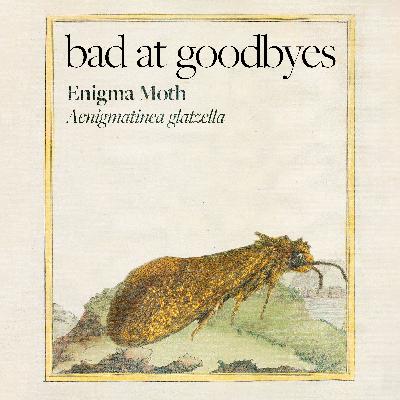
Enigma Moth :: Aenigmatinea glatzellaBad at Goodbyes :: Episode 057On today’s show we learn about the Enigma Moth, a critically endangered insect native to Kangaroo Island off the southern coast of Australia.(00:05) Intro(02:05) Species Information(21:20) Citations(22:49) Music(27:51) PledgeResearch for today’s show was compiled from:Enigma Moth Factsheet. Landscape Board South Australia – https://www.landscape.sa.gov.au/ki/native-plants-and-animals/supporting-biodiversityGlatz, R. & Young, D.A. 2021. Aenigmatinea glatzella. The IUCN Red List of Threatened Species 2021: e.T189533430A195997220. – https://dx.doi.org/10.2305/IUCN.UK.2021-3.RLTS.T189533430A195997220.enHill, Robert & Scriven, L.J.. (1998). The fossil record of conifers in Australia. Flora of Australia. 48. 527-537. - https://www.researchgate.net/publication/284428816_The_fossil_record_of_conifers_in_AustraliaGlatz, R. V., Fagan-Jeffries, E. P., Tetley, S. P. & Austin, A. D. (2022) Enigma moth parasitoid: a new Australian cyclostome genus and species, Ovaustra aurantia Tetley, Glatz & Fagan Jeffries, gen. et sp. nov. (Hymenoptera: Braconidae) from Kangaroo Island. Austral Entomology, 61: 420–432. – https://doi.org/10.1111/aen.12627Taylor, G. S., Braby, M. F., Moir, M. L., Harvey, M. S., Sands, D. P. A., New, T. R., Kitching, R. L., McQuillan, P. B., Hogendoorn, K., Glatz, R. V., Andren, M., Cook, J. M., Henry, S. C., Valenzuela, I., and Weinstein, P. (2018) Strategic national approach for improving the conservation management of insects and allied invertebrates in Australia. Austral Entomology, 57: 124–149. https://doi.org/10.1111/aen.12343Tensen, N.P., Hilton, D.J., Kallies, A., Milla, L., Rota, J., Wahlberg, N., Wilcox, S.A., Glatz, R.V., Young, D.A., Cocking, G., Edwards, T., Gibbs, G.W. And Halsey, M. (2015), A New Extant Family Of Primitive Moths From Kangaroo Island, Australia, And Its Significance For Understanding Early Lepidoptera Evolution. Systematic Entomology, 40 (1): 5-16. – https://doi.org/10.1111/syen.12115Tressider, V. The Commonwealth Scientific and Industrial Research Organisation. 10 March 2015. Small, beautiful, new and very old: meet the Enigma moth. – https://www.csiro.au/en/news/all/articles/2015/march/small-beautiful-new-and-very-old-meet-the-enigma-mothWarne, K. National Geographic. January 17, 2020. 60 hours on burning Kangaroo Island. – https://www.nationalgeographic.com/animals/article/kangaroo-island-wildfires-dispatchWikipedia – https://en.wikipedia.org/wiki/Kangaroo_Island & https://en.wikipedia.org/wiki/AenigmatineidaePlease find us on the web at Bad at Goodbyes and on instagram. Please subscribe and rate/review Bad at Goodbyes wherever you listen to podcasts. Please help spread the word about the show and about the species we feature. Please take care of each other, and all of our fellow travelers.A note on accuracy: I strive for it! These episodes are well-researched and built from scholarly sources, hoping to provide an informed and accurate portrait of these species. That said, I’m a musician! I am not an academic and have limited scientific background. I may get things wrong! If you are using this podcast for scholarship of any kind, please see the cited sources and double-check all information.
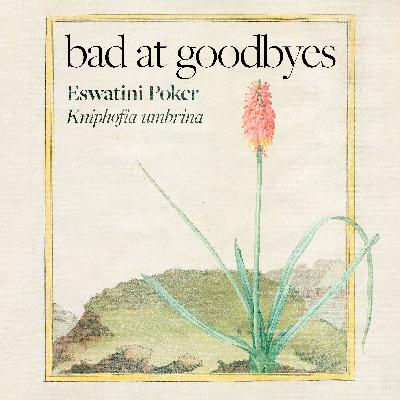
Eswatini Poker :: Kniphofia umbrinaBad at Goodbyes :: Episode 056On today’s show we learn about the Eswatini Poker, a critically endangered flowering plant native to southeastern Africa, to the country of Eswatini.(00:05) Intro(02:05) Species Information(19:22) Citations(20:37) Music(26:12) PledgeResearch for today’s show was compiled from:Eswatini Biodiversity – http://eswatinibiodiversity.com/biodiversity/endemics2.aspBraun, K. & Loffler, L. 2024. Kniphofia umbrina. The IUCN Red List of Threatened Species 2024: e.T221350018A221361752. – https://dx.doi.org/10.2305/IUCN.UK.2024-1.RLTS.T221350018A221361752.en“The IUCN plant red data book : comprising Red data sheets on 250 selected plants threatened on a world scale.” Synge, Hugh. Switzerland: IUCN, 1978. – https://portals.iucn.org/library/node/5780 JSTOR Global Plants Database – https://plants.jstor.org/compilation/Kniphofia.umbrina Loffler, L. 2021. PlantLife SouthAfrica Volume 51.7, July 2021. Eight new plant locality records for Eswatini from Malolotja Nature Reserve. – https://plantlifesouthafrica.blogspot.com/2021/07/plantlife-volume-517-july-2021-eight.htmlRamsar Sites of Wetlands of International Importance – https://rsis.ramsar.org/ris/2121?language=en South African Journal of Science. v.97. no. 11-12 609-616. “Conservation biology of Kniphofia umbrina, a critically endangered Swaziland serpentine endemic.” Witkowski, E. & Dahlmann, L.A. & Boycott, R.C. (2001). – https://hdl.handle.net/10520/EJC97233 Wikipedia – https://en.wikipedia.org/wiki/Kniphofia_umbrina Please find us on the web at Bad at Goodbyes and on instagram. Please subscribe and rate/review Bad at Goodbyes wherever you listen to podcasts. Please help spread the word about the show and about the species we feature. Please take care of each other, and all of our fellow travelers.A note on accuracy: I strive for it! These episodes are well-researched and built from scholarly sources, hoping to provide an informed and accurate portrait of these species. That said, I’m a musician! I am not an academic and have limited scientific background. I may get things wrong! If you are using this podcast for scholarship of any kind, please see the cited sources and double-check all information.
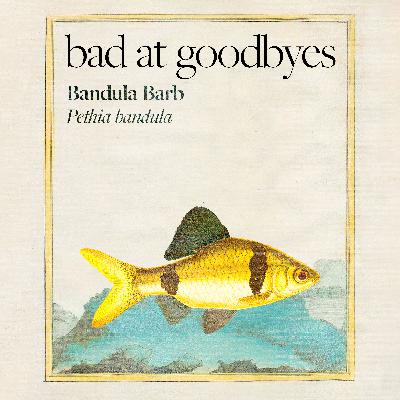
Bandula Barb :: Pethia bandulaBad at Goodbyes :: Episode 055On today’s show we learn about the Brown's Banksia, a critically endangered flowering shrub native to southwestern Australia, about 200 miles south of Perth in the state of Western Australia.(00:05) Intro(02:05) Species Information(22:56) Citations(24:25) Music(30:38) PledgeResearch for today’s show was compiled from:Chamod, Janindu & Amarakoon, Vihanga & Gunasekara, Vimukthi & Dayawansa, Nihal. (2023). The Role Of Selected Abiotic And Biotic Factors In Changing The Abundance Of Critically Endangered, Point Endemic Pethia Bandula. Proceedings of the Postgraduate Institute of Science Research Congress: University of Peradeniya, Sri LankaFernado, M., Kotagama, O. & de Alwis Goonatilake, S. 2019. Pethia bandula (errata version published in 2020). The IUCN Red List of Threatened Species 2019: e.T18905A174839322. - https://dx.doi.org/10.2305/IUCN.UK.2019-3.RLTS.T18905A174839322.enKortmulder, Koenraad & Wiele, Peter. (2023). Feeding behaviour, species associations and natural diets of 10 Cyprinid fish species from South-West Sri Lanka. bioRxiv 2023.07.12.548677 – https://doi.org/10.1101/2023.07.12.548677R, Wickremasinghe & S, Muthunayake & R, Wickremasinghe & Weerakoon, Devaka & Goonatilake, Sampath & R, Ranatunge & H, Kiel & Perera, Naalin & A, Wadugodapitiya. (2021). Ecology and recovery of Pethia bandula (Pisces: Cyprinidae), a globally threatened point endemic freshwater fish in Sri Lanka.. Journal of the Sri Lanka Branch of the Royal Asiatic Society. 66 (2). 27-54. https://www.jstor.org/stable/48828122Sudasinghe, H., Ranasinghe, T., Herath, J. et al. Molecular phylogeny and phylogeography of the freshwater-fish genus Pethia (Teleostei: Cyprinidae) in Sri Lanka. BMC Ecology and Evolution volume 21, 203 (2021). – https://doi.org/10.1186/s12862-021-01923-5Surasinghe, Thilina, Ravindra Kariyawasam, Hiranya Sudasinghe, and Suranjan Karunarathna. 2020. "Challenges in Biodiversity Conservation in a Highly Modified Tropical River Basin in Sri Lanka" Water 12, no. 1: 26. – https://doi.org/10.3390/w12010026Wickramasinghe, Kamanthi. 6 June 2025. Sri Lanka reaches a milestone in a decades’ long conservation effort. Daily Mirror (Sri Lanka) – https://www.dailymirror.lk/news-features/Sri-Lanka-reaches-a-milestone-in-a-decades-long-conservation-effort/131-310807 or https://web.archive.org/web/20251005015550/https://www.dailymirror.lk/news-features/Sri-Lanka-reaches-a-milestone-in-a-decades-long-conservation-effort/131-310807Wikipedia – https://en.wikipedia.org/wiki/Bandula_barbPlease find us on the web at Bad at Goodbyes and on instagram. Please subscribe and rate/review Bad at Goodbyes wherever you listen to podcasts. Please help spread the word about the show and about the species we feature. Please take care of each other, and all of our fellow travelers.A note on accuracy: I strive for it! These episodes are well-researched and built from scholarly sources, hoping to provide an informed and accurate portrait of these species. That said, I’m a musician! I am not an academic and have limited scientific background. I may get things wrong! If you are using this podcast for scholarship of any kind, please see the cited sources and double-check all information.
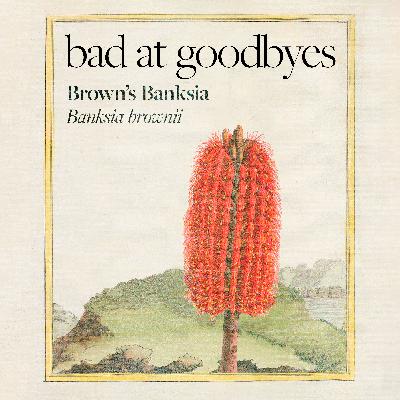
Brown’s Banksia :: Banksia browniiBad at Goodbyes :: Episode 054On today’s show we learn about the Brown's Banksia, a critically endangered flowering shrub native to southwestern Australia, about 200 miles south of Perth in the state of Western Australia.(00:05) Intro(02:05) Species Information(24:04) Citations(26:01) Music(31:33) PledgeFor more information about Brown’s Banksia conservation please see the Australian government’s Department of Climate Change, Energy, the Environment and Water - https://www.dcceew.gov.auResearch for today’s show was compiled from:Australian Government’s Department of Climate Change, Energy, the Environment and Water – http://www.environment.gov.au/cgi-bin/sprat/public/publicspecies.pl?taxon_id=8277Barrett, S., Atkins, K., George, A. & Keith, D. 2020. Banksia brownii. The IUCN Red List of Threatened Species 2020: e.T112520669A113306481. – https://dx.doi.org/10.2305/IUCN.UK.2020-2.RLTS.T112520669A113306481.enCoates, D., Dillon, R., & Barrett, S. 2018. “Threatened Plant Translocation Case Study: ‘Banksia Brownii’ (Feather Leaved Banksia), Proteaceae.” Australasian Plant Conservation: Journal of the Australian Network for Plant Conservation 27 (1): 3-6. – https://doi.org/10.5962/p.373741Coates, D.J., McArthur, S. L., Byrne, M. 2015. Significant genetic diversity loss following pathogen driven population extinction in the rare endemic Banksia brownii (Proteaceae), Biological Conservation, Volume 192, 2015, Pages 353-360. – https://doi.org/10.1016/j.biocon.2015.10.013Day, D.A., Collins, B.G., Rees, R.G. (1997), Reproductive biology of the rare and endangered Banksia brownii Baxter ex R. Br. (Proteaceae). Australian Journal of Ecology, 22: 307-315. – https://doi.org/10.1111/j.1442-9993.1997.tb00676.xDillon, R., Coates D., Standish, R., Monks, L., Waycott, M. (2023) Assessing plant translocation success: common metrics mask high levels of inbreeding in a recently established Banksia brownii (Proteaceae) population. Australian Journal of Botany 71, 79-92. – https://doi.org/10.1071/BT22071Gilfillan, Sandra & Barrett, S.R.. Feather-Leaved Banksia (Banksia Brownii) Interim Recovery Plan 2005-2010. – https://www.dcceew.gov.au/environment/biodiversity/threatened/recovery-plans/feather-leaved-banksia-banksia-brownii-2005-2010Lamont Byron B., Enright Neal J., Witkowski E. T. F., Groeneveld J. (2007) Conservation biology of banksias: insights from natural history to simulation modelling. Australian Journal of Botany 55, 280-292. – https://doi.org/10.1071/BT06024Renshaw, Adrian. The reproductive biology of four Banksia L.f. species with contrasting life histories. Doctor of Philosophy thesis. University of Western Sydney. 2005. – https://researchers-admin.westernsydney.edu.au/ws/portalfiles/portal/94886836/uws_3687.pdfSampson JF, Collins BG, Coates DJ (1994) Mixed Mating in Banksia brownii Baxter ex R. Br. (Proteaceae). Australian Journal of Botany 42, 103-111. – https://doi.org/10.1071/BT9940103Wikipedia – https://en.wikipedia.org/wiki/Banksia_browniiPlease find us on the web at Bad at Goodbyes and on instagram. Please subscribe and rate/review Bad at Goodbyes wherever you listen to podcasts. Please help spread the word about the show and about the species we feature. Please take care of each other, and all of our fellow travelers.A note on accuracy: I strive for it! These episodes are well-researched and built from scholarly sources, hoping to provide an informed and accurate portrait of these species. That said, I’m an ambient musician! I am not an academic and have limited scientific background. I may get things wrong! If you are using this podcast for scholarship of any kind, please see the cited sources and double-check all information.
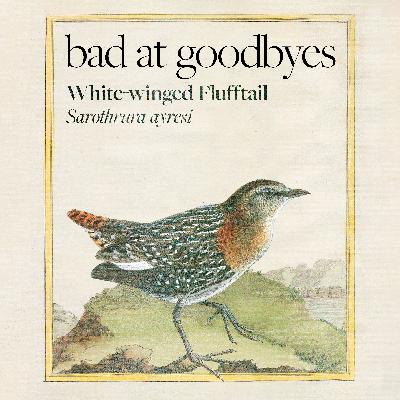
White-winged Flufftail :: Sarothrura ayresiBad at Goodbyes :: Episode 053On today’s show we learn about the White-winged Flufftail, a critically endangered avian native to Africa, specifically Ethiopia and South Africa.(00:05) Intro(02:05) Species Information(22:47) Citations(24:52) Music(32:03) PledgeFor more information about White-winged Flufftail conservation see BirdLife South Africa at https://www.birdlife.org.za/red-list/white-winged-flufftail/Research for today’s show was compiled from:African-Eurasian Migratory Waterbird Agreement. International Working Group for the White-winged Flufftail – https://whitewingedflufftail-archieve.aewa.info/Bird, Jeremy, and Martin, Robert, and Akcakaya, H. Resit, and Gilroy, James, and Burfield, Ian, and Garnett, Stephen, and Symes, Andy, and Taylor, Joe. and Sekercioglu, Cagan, and Butchart, Stuart. (2020). Generation lengths of the world's birds and their implications for extinction risk. Conservation Biology. 34. – https://doi.org/10.1111/cobi.13486BirdLife International. 2021. Sarothrura ayresi. The IUCN Red List of Threatened Species 2021: e.T22692245A179602552. – https://dx.doi.org/10.2305/IUCN.UK.2021-3.RLTS.T22692245A179602552.enCallahan, David. 2023. An African enigma: conserving one of the world’s rarest waterbirds. BirdLife International. – https://www.birdlife.org/news/2023/02/21/an-african-enigma-conserving-one-of-the-worlds-rarest-waterbirds/Colyn, Robin B., Alastair Campbell, And Hanneline A. Smit-Robinson. “Camera-Trapping Successfully and Non-Invasively Reveals the Presence, Activity and Habitat Choice of the Critically Endangered White-Winged Flufftail Sarothrura Ayresi in a South African High-Altitude Wetland.” Bird Conservation International 29, no. 3 (2019): 463–78. – https://doi.org/10.1017/S0959270918000400Colyn, R. B., A. Campbell, and H. A. Smit-Robinson. 2020. The use of a camera trap and acoustic survey design to ascertain the vocalization and breeding status of the highly elusive White-winged Flufftail, Sarothrura ayresi. Avian Conservation and Ecology 15(2):12. – https://doi.org/10.5751/ACE-01681-150212Colyn, Robin, and Whitecross, Melissa, and Howes, Caroline, and Smit-Robinson, Hanneline. (2020). Restricted breeding habitat of the Critically Endangered White-winged Flufftail in Ethiopia and its conservation implications. Ostrich - Journal of African Ornithology. 91. 1-10. – http://dx.doi.org/10.2989/00306525.2020.1737259Davies, Gregory & Smit-Robinson, Hanneline & Drummond, Malcolm & Gardner, Brett & Rautenbach, S. & Stuyvenberg, Dirk & Nattrass, C. & Pretorius, M. & Pietersen, Darren & Symes, Craig. (2014). Recent records of the White-winged Flufftail Sarothrura ayresi (Aves, Sarothruridae) in South Africa. Durban Natural Science Museum Novitates 37. 62-75. – https://www.researchgate.net/publication/296695998_Recent_records_of_the_White-winged_Flufftail_Sarothrura_ayresi_Aves_Sarothruridae_in_South_AfricaLepage, Denis. "White-winged Flufftail (Sarothrura ayresi)." Avibase - The World Bird Database, Birds Canada, 2025. - https://avibase.ca/534D524CMarais, A. J., Lloyd, K., Smit-Robinson, H. A., & Brown, L. R. (2021). A vegetation classification and description of white-winged flufftail (Sarothrura ayresi) habitat at selected high-altitude peatlands in South Africa. Royal Society Open Science, 8(11), 211482. – https://doi.org/10.1098/rsos.211482Taylor, B., G. M. Kirwan, and C. J. Sharpe (2020). White-winged Flufftail (Sarothrura ayresi), version 1.0. In Birds of the World (J. del Hoyo, A. Elliott, J. Sargatal, D. A. Christie, and E. de Juana, Editors). Cornell Lab of Ornithology, Ithaca, NY, USA. – https://doi.org/10.2173/bow.whwflu1.01Wikipedia – https://en.wikipedia.org/wiki/White-winged_flufftailPlease find us on the web at Bad at Goodbyes and on instagram. Please subscribe and rate/review Bad at Goodbyes wherever you listen to podcasts. Please help spread the word about the show and about the species we feature. Please take care of each other, and all of our fellow travelers.A note on accuracy: I strive for it! These episodes are well-researched and built from scholarly sources, hoping to provide an informed and accurate portrait of these species. That said, I’m an ambient musician! I am not an academic and have limited scientific background. I may get things wrong! If you are using this podcast for scholarship of any kind, please see the cited sources and double-check all information.
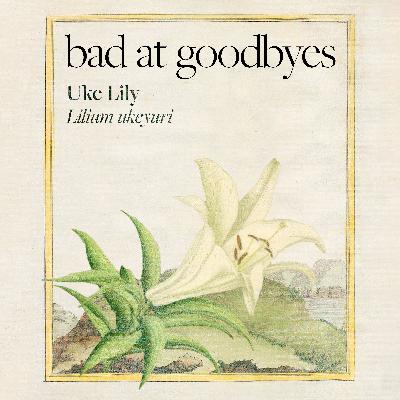
Uke Lily :: Lilium ukeyuriBad at Goodbyes :: Episode 052On today’s show we learn about the Uke Lily, a critically endangered flowering plant native to eastern Asia, specifically the Amami Islands of Japan.(00:05) Intro(02:05) Species Information(18:19) Citations(19:42) Music(26:35) PledgeResearch for today’s show was compiled from:Amagi Town History, Culture, Industry and Science Information Center Yui no Yate - https://jmapps.ne.jp/amagi/det.html?data_id=5799Compton, J. (2021), Two Endemic And Critically Endangered Ryukyu Island Lilies Lilium Nobilissimum And Lilium Ukeyuri (Liliaceae). Curtis's Botanical Magazine, 38: 240-259. – https://doi.org/10.1111/curt.12385Hogg, Robert. 1880. “A New Lillium”. The Journal of Horticulture, Cottage Gardener, and Home Farmer : A Chronicle of Country Pursuits and Country Life, Including Poultry, Pigeon and Bee-Keeping. Series 3. Vol. 27. 1893. London. – https://www.biodiversitylibrary.org/page/55535067Horizon (Amami). Futoshi Hamada. “Endemic Plants of Amami”. - https://amami-horizon.com/en/nature/plant/rare-plantsJournal of Phytogeography and Taxonomy 57 : 77-87, 2009. Maeda, Yoshiyuki, Miyamoto, Junko, Ozaki, Kemurio, Moriguchi, Mitsuru, Kakishita, Ai. “Natural distribution of Lilium alexandrae (Liliaceae) in Amami Islands of Ryukyu Archipelago, Japan”. - https://doi.org/10.24517/00053418Ministry of the Environment, Japan. 2022. Lilium ukeyuri (errata version published in 2022). The IUCN Red List of Threatened Species 2022: e.T90230615A223035828. – https://dx.doi.org/10.2305/IUCN.UK.2022-1.RLTS.T90230615A223035828.enMinistry of the Environment Government of Japan (JCN1000012110001). Kyushu Okinawa Amami Nature Conservation Office. “Amamigunto National Park” – https://www.env.go.jp/en/nature/nps/park/amami/point/index.htmlWikipedia – https://en.wikipedia.org/wiki/Amami_Islands & https://ja.wikipedia.org/wiki/ウケユリPlease find us on the web at Bad at Goodbyes and on instagram. Please subscribe and rate/review Bad at Goodbyes wherever you listen to podcasts. Please help spread the word about the show and about the species we feature. Please take care of each other, and all of our fellow travelers.A note on accuracy: I strive for it! These episodes are well-researched and built from scholarly sources, hoping to provide an informed and accurate portrait of these species. That said, I’m an ambient musician! I am not an academic and have limited scientific background. I may get things wrong! If you are using this podcast for scholarship of any kind, please see the cited sources and double-check all information.

Comments

Download from Google Play

Download from App Store
 United States