


 Claim Ownership
The Data Flowcast: Mastering Apache Airflow ® for Data Engineering and AI
Subscribed: 99Played: 1,450
Subscribe

© All rights reserved
Description
Welcome to The Data Flowcast: Mastering Apache Airflow ® for Data Engineering and AI— the podcast where we keep you up to date with insights and ideas propelling the Airflow community forward.
Join us each week, as we explore the current state, future and potential of Airflow with leading thinkers in the community, and discover how best to leverage this workflow management system to meet the ever-evolving needs of data engineering and AI ecosystems.
Podcast Webpage: https://www.astronomer.io/podcast/
Join us each week, as we explore the current state, future and potential of Airflow with leading thinkers in the community, and discover how best to leverage this workflow management system to meet the ever-evolving needs of data engineering and AI ecosystems.
Podcast Webpage: https://www.astronomer.io/podcast/
91 Episodes
Reverse
In this episode, Karan Alang, Principal Software Engineer at Versa Networks, joins the conversation to discuss how Airflow can be used to automate threat intelligence in modern cybersecurity environments. He explains the growing scale of cloud computing, the profitability of hacking and the shortage of SOC analysts. Karan also outlines a novel architecture that combines Airflow, XDR, graph databases and LLMs to orchestrate automated threat detection and response.Key Takeaways:00:00 Introduction.05:00 Organizations face massive log volumes and a shortage of SOC analysts.07:00 The solution integrates Airflow, XDR, Neo4j graph databases and LLMs into one architecture.08:00 MITRE ATT&CK provides a global framework for mapping tactics and techniques.11:00 Airflow acts as the orchestration backbone for ingestion graph transformation and LLM workflows.13:00 Graph databases provide a full relationship view of attackers’ systems and entities.14:00 LLMs automate mapping activity to MITRE ATT&CK and assign explainable risk scores.17:00 Traditional signature-based detection allows lateral movement and exfiltration before teams can react.18:00 End-to-end automation is essential to mitigating modern cybersecurity threats.20:00 Future opportunities include deeper LLM integration as first-class citizens within Airflow.Resources Mentioned:Karan Alanghttps://www.linkedin.com/in/karan-alang-4173437Versa Networks | LinkedInhttps://www.linkedin.com/company/versa-networksVersa Networks | Websitehttps://versa-networks.comGoogle Cloud Composer (Managed Airflow on GCP)https://cloud.google.com/composerMicrosoft Defender XDR https://www.microsoft.com/es-es/security/business/siem-and-xdr/microsoft-defender-xdrNeo4j (Graph Database)https://neo4j.comMITRE ATT&CK Frameworkhttps://attack.mitre.orgThanks for listening to “The Data Flowcast: Mastering Apache Airflow® for Data Engineering and AI.” If you enjoyed this episode, please leave a 5-star review to help get the word out about the show. And be sure to subscribe so you never miss any of the insightful conversations.#AI #Automation #Airflow #MachineLearning
In this episode, we explore how teams scale Apache Airflow in complex environments and what it takes to make orchestration work across many stakeholders. We look at real-world challenges around visibility, ownership and predictability as data platforms grow.Egor Tarasenko, Data and AI Engineer at Ponder Labs, joins us to share how Ponder Labs customizes Airflow for education organizations using plugins, event-driven architectures and AI-powered tooling. He explains how his team supports large charter school networks and why structure, consistency and extensibility become critical at scale.Key Takeaways:00:00 Introduction.01:21 Ponder Labs helps education organizations bring data from many systems together so it becomes useful for teachers, school leaders and administrators.03:10 Airflow serves as the backbone for orchestrating ingestion, transformation and reverse ETL across client data platforms.05:43 Everything is triggered from Airflow to maintain dependency, visibility and a single operational picture.09:05 Managing hundreds of DAGs requires a focus on structure, visibility and consistency across teams.09:51 Treating DAGs like APIs helps teams scale without needing deep knowledge of upstream logic.12:00 Custom plugins like schedule insights help predict DAG run times across layered dependencies.15:00 AI-powered Airflow chat enables non-technical stakeholders to understand DAG ownership dependencies and cluster activity.22:06 Migrating plugins to Airflow 3 improves developer experience through cleaner APIs and faster extensibility.Resources Mentioned:Egor Tarasenkohttps://www.linkedin.com/in/egorseno/Apache Airflowhttps://airflow.apache.orgdbthttps://www.getdbt.comAstronomer Astro Platformhttps://www.astronomer.ioEgor Tarasenko on Substack https://egortarasenko.substack.comThanks for listening to “The Data Flowcast: Mastering Apache Airflow® for Data Engineering and AI.” If you enjoyed this episode, please leave a 5-star review to help get the word out about the show. And be sure to subscribe so you never miss any of the insightful conversations.#AI #Automation #Airflow
Modern data orchestration at scale demands reliability, speed and thoughtful adoption of new tooling. As organizations grow, keeping pipelines efficient while supporting more teams becomes a critical challenge.In this episode, we’re joined by Ethan Shalev, Data Engineer at Wix, to discuss how Wix operates Airflow at massive scale, migrates to Airflow 3 and uses AI to accelerate development.Key Takeaways:00:00 Introduction.02:13 Wix structures data engineering across multiple product-focused organizations.03:40 Migrating nearly 8,000 DAGs to Airflow 3 requires careful planning.04:31 Migration creates an opportunity to remove long-standing legacy Airflow code.05:32 Internal playbooks and Cursor rules standardize and speed up DAG migrations.07:39 Airflow 3 introduces backfills, DAG versioning and asset-aware scheduling.09:16 Deferrable operators reduce scheduler congestion in large Airflow environments.12:54 AI-generated code still requires review and strong testing practices.14:52 Moving to managed Airflow reduces operational burden on internal platform teams.15:57 Improving multi-tenancy and UI personalization remains a key Airflow need.Resources Mentioned:Ethan Shalevhttps://www.linkedin.com/in/eshalev/Wix | LinkedInhttps://www.linkedin.com/company/wix-com/Wix | Websitehttps://www.wix.com/Apache Airflowhttps://airflow.apache.org/Astronomerhttps://www.astronomer.io/Trinohttps://trino.io/Apache Iceberghttps://iceberg.apache.org/Cursorhttps://cursor.sh/Airflow Summithttps://airflowsummit.org/Thanks for listening to “The Data Flowcast: Mastering Apache Airflow® for Data Engineering and AI.” If you enjoyed this episode, please leave a 5-star review to help get the word out about the show. And be sure to subscribe so you never miss any of the insightful conversations.#AI #Automation #Airflow
Strong data orchestration is as much about culture and visibility as it is about technology. As data platforms scale, teams need systems that reduce cognitive load while increasing reliability and observability.In this episode, Carlos Daniel Puerto Niño, Senior Analytics Engineer and Data Analyst at Addi, joins us to share how Addi uses Airflow to support batch orchestration, manage organizational complexity and improve monitoring across its data platform.Key Takeaways:00:00 Introduction.01:25 Changes in company strategy increase data platform complexity over time.04:00 Centralized data teams help manage organizational and technical change.06:08 Scalable architectures support growing data volumes and use cases.09:10 Adopting orchestration tools introduces operational and maintenance challenges.14:43 Abstraction layers lower technical barriers for onboarding new team members.15:36 Modularity and visibility improve the reliability of data pipelines.18:14 Integrated monitoring supports faster incident response and resolution.22:19 Limited access to orchestration metadata constrains proactive analysis.Resources Mentioned:Carlos Daniel Puerto Niñohttps://www.linkedin.com/in/carlospuertoni%C3%B1o/Addi | LinkedInhttps://www.linkedin.com/company/addicol/Addi | Websitehttps://www.addi.comApache Airflowhttps://airflow.apache.org/Astronomerhttps://www.astronomer.io/Databrickshttps://www.databricks.com/dbthttps://www.getdbt.com/Grafanahttps://grafana.com/Slackhttps://slack.com/Thanks for listening to “The Data Flowcast: Mastering Apache Airflow® for Data Engineering and AI.” If you enjoyed this episode, please leave a 5-star review to help get the word out about the show. And be sure to subscribe so you never miss any of the insightful conversations.#AI #Automation #Airflow
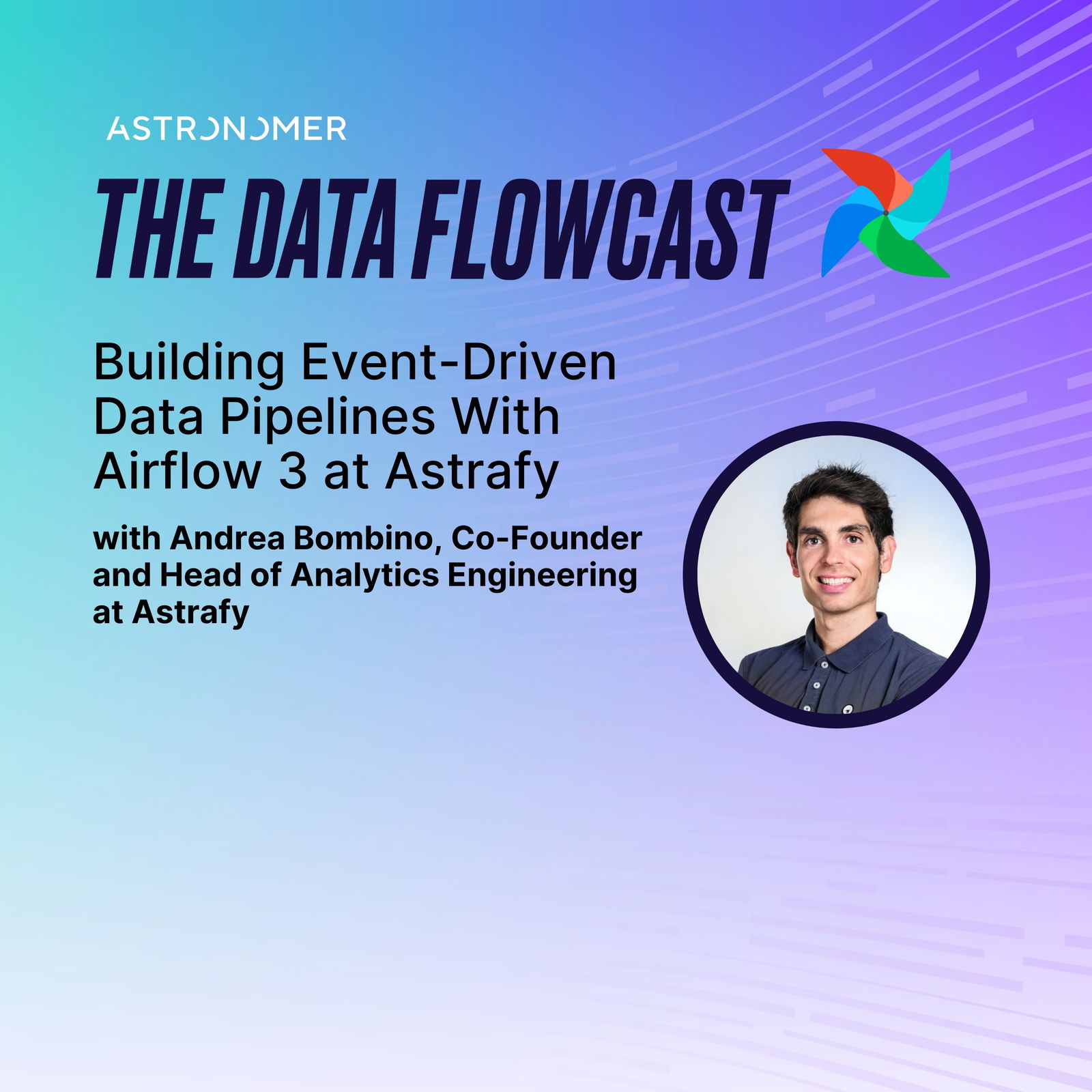
Real-time data expectations are reshaping how modern data teams think about orchestration and dependencies. As event-driven architectures become more common, teams need to rethink how pipelines react to data changes, rather than schedules.In this episode, Andrea Bombino, Co-Founder and Head of Analytics Engineering at Astrafy, joins us to discuss how event-driven scheduling in Airflow is evolving and how Astrafy applies it to deliver faster, more responsive data pipelines.Key Takeaways:00:00 Introduction.02:02 Astrafy’s role in guiding clients across the modern data stack.03:15 Strong DAG dependencies create challenges for time-based scheduling.04:48 Event-driven pipelines respond to increasing real-time data demands.05:30 Airflow 3 introduces native support for event-driven orchestration.06:27 Sensor-based workflows reveal scalability and efficiency limitations.11:32 Event-driven assets improve efficiency and pipeline elegance.14:45 Governance and cross-instance coordination emerge as ongoing challenges.Resources Mentioned:Andrea Bombinohttps://www.linkedin.com/in/andrea-bombino/Astrafy | LinkedInhttps://www.linkedin.com/company/astrafy/Astrafy | Websitehttps://www.astrafy.ioApache Airflowhttps://airflow.apache.org/Google Cloudhttps://cloud.google.com/Google Pub/Subhttps://cloud.google.com/pubsubGoogle BigQueryhttps://cloud.google.com/bigqueryThanks for listening to “The Data Flowcast: Mastering Apache Airflow® for Data Engineering and AI.” If you enjoyed this episode, please leave a 5-star review to help get the word out about the show. And be sure to subscribe so you never miss any of the insightful conversations.#AI #Automation #Airflow
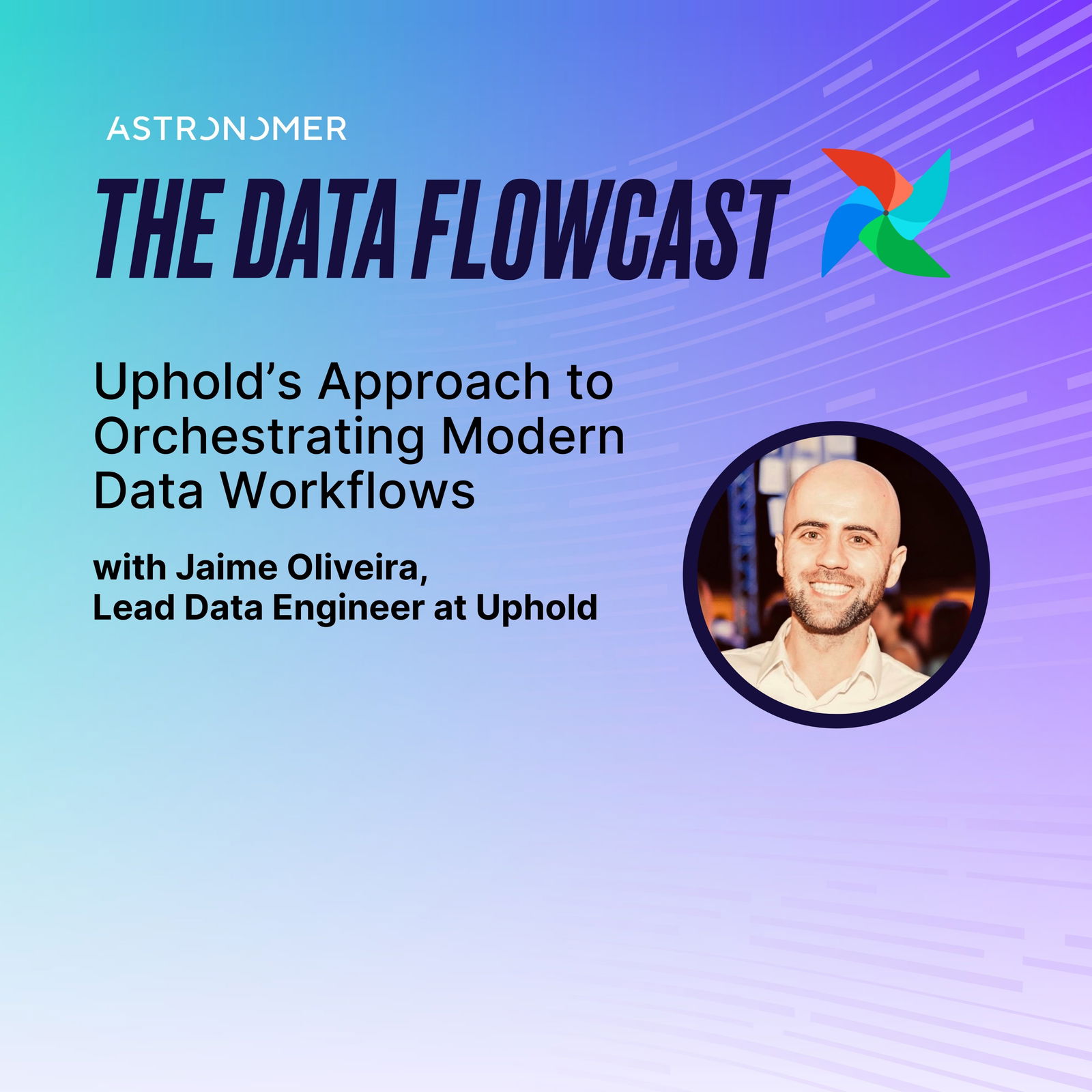
A strong data-driven mindset underpins how fintech teams scale analytics, infrastructure and decision-making across the business.In this episode, Jaime Oliveira, Lead Data Engineer at Uphold, joins us to discuss how Uphold structures its data organization and orchestration strategy. Jaime shares how the team uses Airflow and dbt to support analytics, reporting and data activation while evolving their approach as the stack grows.Key Takeaways:00:00 Introduction.01:23 A data-driven mindset supports product development and business decisions.02:55 Diverse ingestion pipelines enable scalable analytics.04:18 A single orchestration platform simplifies analytics workflows.05:17 Early experience with orchestration tools shapes engineering practices.08:16 Analytics orchestration works best when aligned with transformation workflows.09:25 Infrastructure choices involve tradeoffs in testing, visibility and overhead.16:39 More collaborative workflow tools could improve accessibility and autonomy.Resources Mentioned:Jaime Oliveirahttps://www.linkedin.com/in/jaime-oliveira-b075855a/Uphold | LinkedInhttps://www.linkedin.com/company/upholdinc/Uphold | Websitehttps://uphold.comApache Airflowhttps://airflow.apache.orgdbthttps://www.getdbt.comSnowflakehttps://www.snowflake.comKuberneteshttps://kubernetes.ioAstronomer Cosmoshttps://astronomer.github.io/astronomer-cosmosCosmos e-bookhttps://www.astronomer.io/ebooks/orchestrating-dbt-with-airflow-using-cosmos/Thanks for listening to “The Data Flowcast: Mastering Apache Airflow® for Data Engineering and AI.” If you enjoyed this episode, please leave a 5-star review to help get the word out about the show. And be sure to subscribe so you never miss any of the insightful conversations.#AI #Automation #Airflow
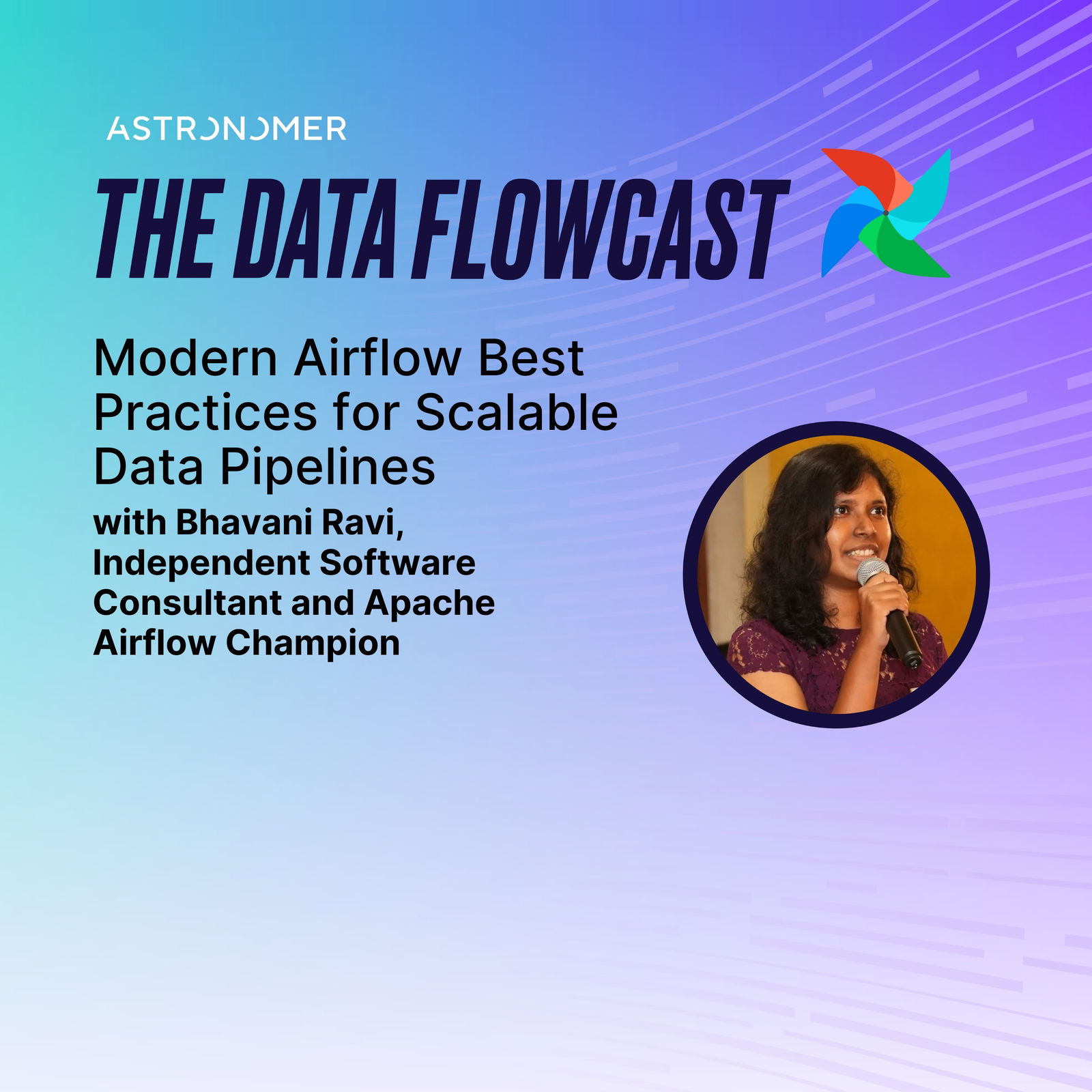
Building reliable data pipelines at scale requires more than writing code. It depends on thoughtful design, infrastructure trade-offs and an understanding of how orchestration platforms evolve over time.In this episode, Airflow best practices shaped by real-world implementation are examined. Bhavani Ravi, Independent Software Consultant and Apache Airflow Champion, shares lessons on pipeline design, architectural decisions and the evolution of the Airflow ecosystem in modern data environments.Key Takeaways:00:00 Introduction.01:30 Independent consulting supports effective Airflow adoption.02:38 Early challenges shaped modern Airflow practices.03:21 Airflow setup has become significantly simpler.04:30 New features expanded workflow capabilities.06:03 Frequent releases support long-term sustainability.07:34 Community and providers strengthen the ecosystem.10:03 Pipeline design should come before coding.10:55 Decoupling logic requires careful trade-offs.13:30 Plugins extend Airflow into new use cases.Resources Mentioned:Bhavani Ravihttps://www.linkedin.com/in/bhavanicodes/Apache Airflowhttps://airflow.apache.org/Kuberneteshttps://kubernetes.io/Azure Fabrichttps://learn.microsoft.com/en-us/fabric/Thanks for listening to “The Data Flowcast: Mastering Apache Airflow® for Data Engineering and AI.” If you enjoyed this episode, please leave a 5-star review to help get the word out about the show. And be sure to subscribe so you never miss any of the insightful conversations.#AI #Automation #Airflow
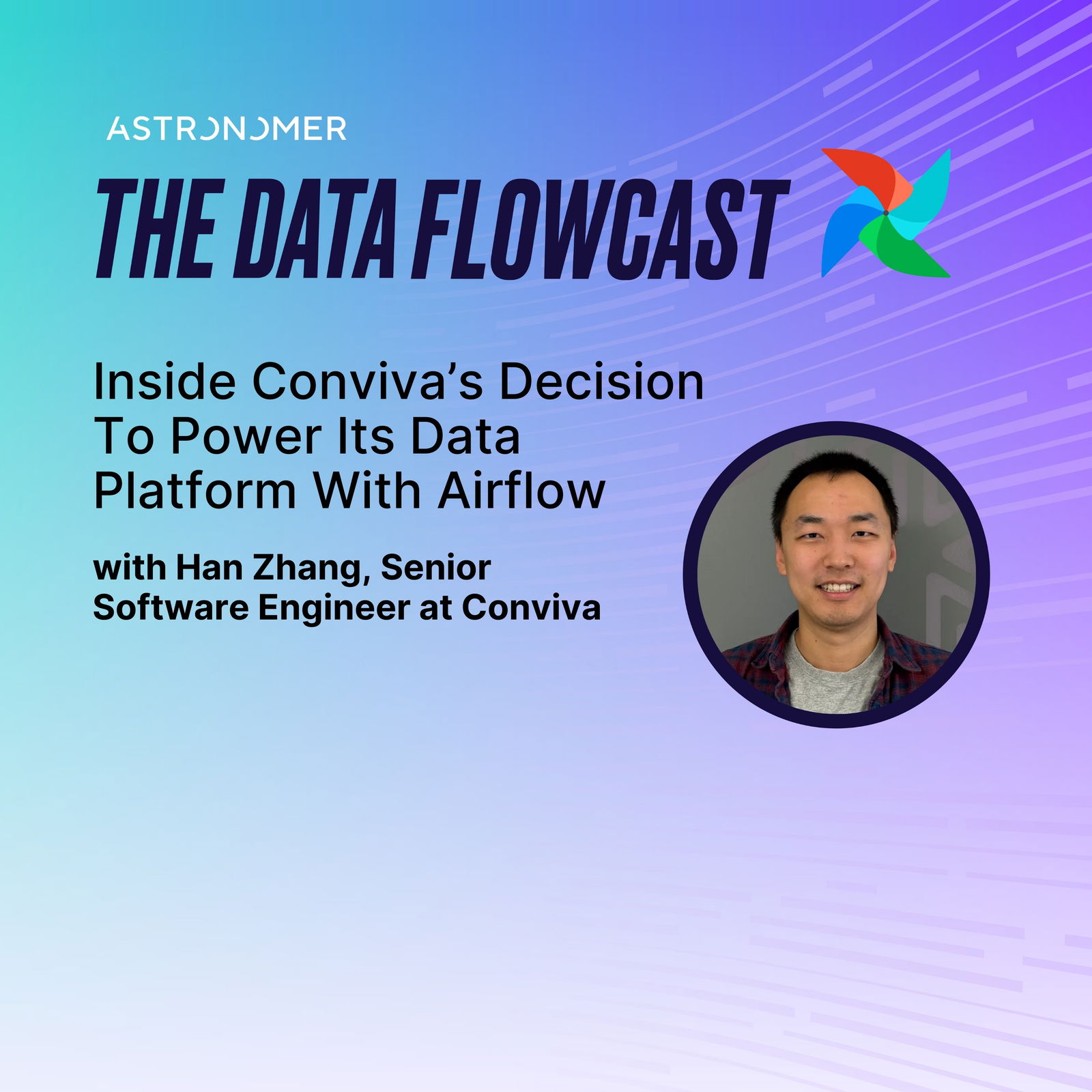
Conviva operates at a massive scale, delivering outcome-based intelligence for digital businesses through real-time and batch data processing. As new use cases emerged, the team needed a way to extend a streaming-first architecture without rebuilding core systems.In this episode, Han Zhang joins us to explain how Conviva uses Apache Airflow as the orchestration backbone for its batch workloads, how the control plane is designed and what trade-offs shaped their platform decisions.Key Takeaways:00:00 Introduction.01:17 Large-scale data platforms require low-latency processing capabilities.02:08 Batch workloads can complement streaming pipelines for additional use cases.03:45 An orchestration framework can act as the core coordination layer.06:12 Batch processing enables workloads that streaming alone cannot support.08:50 Ecosystem maturity and observability are key orchestration considerations.10:15 Built-in run history and logs make failures easier to diagnose.14:20 Platform users can monitor workflows without managing orchestration logic.17:08 Identity, secrets and scheduling present ongoing optimization challenges.19:59 Configuration history and change visibility improve operational reliability.Resources Mentioned:Han Zhanghttps://www.linkedin.com/in/zhanghan177Conviva | Websitehttp://www.conviva.comApache Airflowhttps://airflow.apache.org/Celeryhttps://docs.celeryq.dev/Temporalhttps://temporal.io/Kuberneteshttps://kubernetes.io/LDAPhttps://ldap.com/Thanks for listening to “The Data Flowcast: Mastering Apache Airflow® for Data Engineering and AI.” If you enjoyed this episode, please leave a 5-star review to help get the word out about the show. And be sure to subscribe so you never miss any of the insightful conversations.#AI #Automation #Airflow
Data platforms are moving from batch-first pipelines to near real-time systems where orchestration, observability, scalability and governance all have to work together.In this episode, Arun Karthik, Director, Data Solutions Engineering at Condé Nast Technology Lab, joins us to share how data engineering evolves from relational databases and ETL into distributed processing, modern orchestration with Apache Airflow and managed Airflow with Astronomer.Key Takeaways:00:00 Introduction.02:13 Early data systems rely heavily on relational databases and batch-oriented processing models.07:01 Scheduling requirements evolve beyond fixed time windows as dependencies increase.10:14 Ease of use and developer experience influence adoption of orchestration frameworks.13:22 Operating open source orchestration tools requires ongoing engineering effort.14:45 Managed services help teams reduce infrastructure and maintenance responsibilities.17:27 Observability improves confidence in pipeline execution and system health.19:12 Governance considerations grow in importance as data platforms mature.20:46 Building data systems requires balancing speed, reliability and long-term sustainability.Resources Mentioned:Arun Karthikhttps://www.linkedin.com/in/earunkarthik/Condé Nast Technology Lab | LinkedInhttps://www.linkedin.com/company/conde-nast-technology-lab/Condé Nast Technology Lab | Websitehttps://www.condenast.com/Apache Airflowhttps://airflow.apache.org/Astronomerhttps://www.astronomer.io/Apache Sparkhttps://spark.apache.org/Apache Hadoophttps://hadoop.apache.org/Jenkinshttps://www.jenkins.io/dbt Labshttps://www.getdbt.com/product/what-is-dbtAmazon Web Serviceshttps://aws.amazon.com/free/?trk=54026797-7540-48d8-9f6b-0db2c3a0040c&sc_channel=ps&trk=54026797-7540-48d8-9f6b-0db2c3a0040c&sc_channel=ps&ef_id=CjwKCAiAmp3LBhAkEiwAJM2JUKIc3E2I-hDlF6fRWgZn5n2-RWX-kEDAVApJYd88wwlsiyosV71VixoCmRoQAvD_BwE:G:s&s_kwcid=AL!4422!3!785574063524!e!!g!!amazon%20web%20services!23291338728!189486861095&gad_campaignid=23291338728&gbraid=0AAAAADjHtp813XNbg7azDj5QMwJPbGNqZ&gclid=CjwKCAiAmp3LBhAkEiwAJM2JUKIc3E2I-hDlF6fRWgZn5n2-RWX-kEDAVApJYd88wwlsiyosV71VixoCmRoQAvD_BwEThanks for listening to “The Data Flowcast: Mastering Apache Airflow® for Data Engineering and AI.” If you enjoyed this episode, please leave a 5-star review to help get the word out about the show. And be sure to subscribe so you never miss any of the insightful conversations.#AI #Automation #Airflow
The integration of data orchestration and machine learning is critical to operational efficiency in healthcare tech. Vivian Health leverages Airflow to power both its ETL pipelines and ML workflows while maintaining strict compliance standards.Max Calehuff, Lead Data Engineer at Vivian Health, joins us to discuss how his team uses Airflow for ML ops, regulatory compliance and large-scale data orchestration. He also shares insights into upgrading to Airflow 3 and the importance of balancing flexibility with security in a healthcare environment.Key Takeaways:00:00 Introduction.04:21 The role of Airflow in managing ETL pipelines and ML retraining.06:23 Using AWS SageMaker for ML training and deployment.07:47 Why Airflow’s versatility makes it ideal for MLOps.10:50 The importance of documentation and best practices for engineering teams.13:44 Automating anonymization of user data for compliance.15:30 The benefits of remote execution in Airflow 3 for regulated industries.18:16 Quality-of-life improvements and desired features in future Airflow versions.Resources Mentioned:Max Calehuffhttps://www.linkedin.com/in/maxwell-calehuff/Vivian Health | LinkedInhttps://www.linkedin.com/company/vivianhealth/Vivian Health | Websitehttps://www.vivian.comApache Airflowhttps://airflow.apache.org/Astronomerhttps://www.astronomer.io/AWS SageMakerhttps://www.google.com/aclk?sa=L&ai=DChsSEwj3-fbz1tiQAxWXlKYDHXUBBVoYACICCAEQABoCdGI&ae=2&aspm=1&co=1&ase=2&gclid=Cj0KCQiA5abIBhCaARIsAM3-zFWbfj2olUvX4dqoiYNaE3q2fMf_ZifRjmbKNQCVX7D6ZMClaUXUkFkaAuwmEALw_wcB&cid=CAASQuRoMccxWhBvMq-1Uez3XOZti1ul7mTDotKvSMoDHv0q2xCsyS2FzMptO5dJf3tmfkLRu22TtD8ChTmdjvs6YetTjQ&cce=2&category=acrcp_v1_35&sig=AOD64_2xE2xolEEVbpDb56qXQluxTzs-Aw&q&nis=4&adurl&ved=2ahUKEwj7le3z1tiQAxWXcvUHHfZePbAQ0Qx6BAgUEAEdbtLabshttps://www.getdbt.com/Cosmoshttps://github.com/astronomer/astronomer-cosmosSplithttps://www.split.io/Snowflakehttps://www.snowflake.com/en/Thanks for listening to “The Data Flowcast: Mastering Apache Airflow® for Data Engineering and AI.” If you enjoyed this episode, please leave a 5-star review to help get the word out about the show. And be sure to subscribe so you never miss any of the insightful conversations.#AI #Automation #Airflow
The evolution of Intercom’s data infrastructure reveals how a well-built orchestration system can scale to serve global needs. With thousands of DAGs powering analytics, AI and customer operations, the team’s approach combines technical depth with organizational insight.In this episode, András Gombosi, Senior Engineering Manager of Data Infra and Analytics Engineering, and Paul Vickers, Principal Engineer, both at Intercom, share how they built one of the largest Airflow deployments in production and enabled self-serve data platforms across teams.Key Takeaways:00:00 Introduction.04:24 Community input encourages confident adoption of a common platform.08:50 Self-serve workflows require consistent guardrails and review.09:25 Internal infrastructure support accelerates scalable deployments.13:26 Batch LLM processing benefits from a configuration-driven design.15:20 Standardized development environments enable effective AI-assisted work.19:58 Applied AI enhances internal analysis and operational enablement.27:27 Strong test coverage and staged upgrades protect stability.30:36 Proactive observability and on-call ownership improve outcomes.Resources Mentioned:András Gombosihttps://www.linkedin.com/in/andrasgombosi/Paul Vickershttps://www.linkedin.com/in/paul-vickers-a22b76a3/Intercom | LinkedInhttps://www.linkedin.com/company/intercom/Intercom | Websitehttps://www.intercom.comApache Airflowhttps://airflow.apache.org/dbtLabshttps://www.getdbt.com/Snowflake Cortex AIhttps://www.snowflake.com/en/product/features/cortex/Datadoghttps://www.datadoghq.com/Thanks for listening to “The Data Flowcast: Mastering Apache Airflow® for Data Engineering and AI.” If you enjoyed this episode, please leave a 5-star review to help get the word out about the show. And be sure to subscribe so you never miss any of the insightful conversations.#AI #Automation #Airflow
Building scalable, reproducible workflows for scientific computing often requires bridging the gap between research flexibility and enterprise reliability.In this episode, Anja MacKenzie, Expert for Cheminformatics at Covestro, explains how her team uses Airflow and Kubernetes to create a shared, self-service platform for computational chemistry.Key Takeaways:00:00 Introduction.06:19 Custom scripts made sharing and reuse difficult.09:29 Workflows are manually triggered with user traceability.10:38 Customization supports varied compute requirements.12:48 Persistent volumes allow tasks to share large amounts of data.14:25 Custom operators separate logic from infrastructure.16:43 Modified triggers connect dependent workflows.18:36 UI plugins enable file uploads and secure access.Resources Mentioned:Anja MacKenziehttps://www.linkedin.com/in/anja-mackenzie/Covestro | LinkedInhttps://www.linkedin.com/company/covestro/Covestro | Websitehttps://www.covestro.comApache Airflowhttps://airflow.apache.org/Kuberneteshttps://kubernetes.io/Airflow KubernetesPodOperatorhttps://airflow.apache.org/docs/apache-airflow-providers-cncf-kubernetes/stable/operators.htmlAstronomerhttps://www.astronomer.io/Airflow Academy by Marc Lambertihttps://www.udemy.com/user/lockgfg/?utm_source=adwords&utm_medium=udemyads&utm_campaign=Search_DSA_GammaCatchall_NonP_la.EN_cc.ROW-English&campaigntype=Search&portfolio=ROW-English&language=EN&product=Course&test=&audience=DSA&topic=&priority=Gamma&utm_content=deal4584&utm_term=_._ag_169801645584_._ad_700876640602_._kw__._de_c_._dm__._pl__._ti_dsa-1456167871416_._li_9061346_._pd__._&matchtype=&gad_source=1&gad_campaignid=21341313808&gbraid=0AAAAADROdO1_-I2TMcVyU8F3i1jRXJ24K&gclid=Cj0KCQjwvJHIBhCgARIsAEQnWlC1uYHIRm3y9Q8rPNSuVPNivsxogqfczpKHwhmNho2uKZYC-y0taNQaApU2EALw_wcBAirflow Documentationhttps://airflow.apache.org/docs/Airflow Pluginshttps://airflow.apache.org/docs/apache-airflow/1.10.9/plugins.htmlThanks for listening to “The Data Flowcast: Mastering Apache Airflow® for Data Engineering and AI.” If you enjoyed this episode, please leave a 5-star review to help get the word out about the show. And be sure to subscribe so you never miss any of the insightful conversations.#AI #Automation #Airflow
The use of Apache Airflow in financial services demands a balance between innovation and compliance. Agile Engine’s approach to orchestration showcases how secure, auditable workflows can scale even within the constraints of regulatory environments.In this episode, Valentyn Druzhynin, Senior Data Engineer at AgileEngine, discusses how his team leverages Airflow for ETF calculations, data validation and workflow reliability within tightly controlled release cycles.Key Takeaways:00:00 Introduction.03:24 The orchestrator ensures secure and auditable workflows.05:13 Validations before and after computation prevent errors.08:24 Release freezes shape prioritization and delivery plans.11:14 Migration plans must respect managed service constraints.13:04 Versioning, backfills and event triggers increase reliability.15:08 UI and integration improvements simplify operations.18:05 New contributors should start small and seek help.Resources Mentioned:Valentyn Druzhyninhttps://www.linkedin.com/in/valentyn-druzhynin/AgileEngine | LinkedInhttps://www.linkedin.com/company/agileengine/AgileEngine | Websitehttps://agileengine.com/Apache Airflowhttps://airflow.apache.org/Astronomerhttps://www.astronomer.io/AWS Managed Airflowhttps://aws.amazon.com/managed-workflows-for-apache-airflow/Google Cloud Composer (Managed Airflow)https://cloud.google.com/composerAirflow Summithttps://airflowsummit.org/Thanks for listening to “The Data Flowcast: Mastering Apache Airflow® for Data Engineering and AI.” If you enjoyed this episode, please leave a 5-star review to help get the word out about the show. And be sure to subscribe so you never miss any of the insightful conversations.#AI #Automation #Airflow #MachineLearning
The life sciences industry relies on data accuracy, regulatory insight and quality intelligence. Building a unified system that keeps these elements aligned is no small feat.In this episode, we welcome Shankar Mahindar, Senior Data Engineer II at Redica Systems. We discuss how the team restructures its data platform with Airflow to strengthen governance, reduce compliance risk and improve customer experience.Key Takeaways:00:00 Introduction.01:53 A focused analytics platform reduces compliance risk in life sciences.07:31 A centralized warehouse orchestrated by Airflow strengthens governance.09:12 Managed orchestration keeps attention on analytics and outcomes.10:32 A modern transformation stack enables scalable modeling and operations.11:51 Event-driven pipelines improve data freshness and responsiveness.14:13 Asset-oriented scheduling and versioning enhance reliability and change control.16:53 Observability and SLAs build confidence in data quality and freshness.21:04 Priorities include partitioned assets and streamlined developer tooling.Resources Mentioned:Shankar Mahindarhttps://www.linkedin.com/in/shankar-mahindar-83a61b137/Redica Systems | LinkedInhttps://www.linkedin.com/company/redicasystems/Redica Systems | Websitehttps://redica.comApache Airflowhttps://airflow.apache.org/Astronomerhttps://www.astronomer.io/Snowflakehttps://www.snowflake.com/AWShttps://aws.amazon.com/Thanks for listening to “The Data Flowcast: Mastering Apache Airflow® for Data Engineering and AI.” If you enjoyed this episode, please leave a 5-star review to help get the word out about the show. And be sure to subscribe so you never miss any of the insightful conversations.#AI #Automation #Airflow #MachineLearning
The Financial Times leverages Airflow and AI to uncover powerful stories hidden within vast, unstructured data.In this episode, Zdravko Hvarlingov, Senior Software Engineer at the Financial Times, discusses building multi-tenant Airflow systems and AI-driven pipelines that surface stories that might otherwise be missed. Zdravko walks through entity extraction and fuzzy matching, linking the UK Register of Members’ Financial Interests with Companies House, and how this work cuts weeks of manual analysis to minutes.Key Takeaways:00:00 Introduction.02:12 What computational journalism means for day-to-day newsroom work.05:22 Why a shared orchestration platform supports consistent, scalable workflows.08:30 Tradeoffs of one centralized platform versus many separate instances.11:52 Using pipelines to structure messy sources for faster analysis.14:14 Turning recurring disclosures into usable data for investigations.16:03 Applying lightweight ML and matching to reveal entities and links.18:46 How automation reduces manual effort and shortens time to insight.20:41 Practical improvements that make backfilling and reliability easier.Resources Mentioned:Zdravko Hvarlingovhttps://www.linkedin.com/in/zdravko-hvarlingov-3aa36016b/Financial Times | LinkedInhttps://www.linkedin.com/company/financial-times/Financial Times | Websitehttps://www.ft.com/Apache Airflowhttps://airflow.apache.org/UK Register of Members’ Financial Interestshttps://www.parliament.uk/mps-lords-and-offices/standards-and-financial-interests/parliamentary-commissioner-for-standards/registers-of-interests/register-of-members-financial-interests/UK Companies Househttps://www.gov.uk/government/organisations/companies-houseDopplerhttps://www.doppler.com/Kuberneteshttps://kubernetes.io/Airflow Kubernetes Executorhttps://airflow.apache.org/docs/apache-airflow/stable/executor/kubernetes.htmlGitHubhttps://github.com/Thanks for listening to “The Data Flowcast: Mastering Apache Airflow® for Data Engineering and AI.” If you enjoyed this episode, please leave a 5-star review to help get the word out about the show. And be sure to subscribe so you never miss any of the insightful conversations.#AI #Automation #Airflow #MachineLearning
The shift from monolithic to decentralized data workflows changes how teams build, connect and scale pipelines.In this episode, we feature Oscar Ligthart, Lead Data Engineer, and Rodrigo Loredo, Lead Analytics Engineer, both at Vinted, as we unpack their YAML-driven abstraction that generates Airflow DAGs and standardizes cross-team orchestration.Key Takeaways:00:00 Introduction.05:28 Challenges of decentralization.06:45 YAML-based generator standardizes pipelines and dependencies.12:28 Declarative assets and sensors align cross-DAG dependencies.17:29 Task-level callbacks enable auto-recovery and clear ownership.21:39 Standardized building blocks simplify upgrades and maintenance.24:52 Platform focus frees domain work.26:49 Container-only standardization prevents sprawl.Resources Mentioned:Oscar Ligtharthttps://www.linkedin.com/in/oscar-ligthart/Rodrigo Loredohttps://www.linkedin.com/in/rodrigo-loredo-410a16134/Vinted | LinkedInhttps://www.linkedin.com/company/vinted/Vinted | Websitehttps://www.vinted.com/?srsltid=AfmBOor87MGR_eLOauCO93V9A-aLDaAhGYx9cnu_oN8s1SAXMlCRuhW7Apache Airflowhttps://airflow.apache.org/Kuberneteshttps://kubernetes.io/dbthttps://www.getdbt.com/Google Cloud Vertex AIhttps://cloud.google.com/vertex-aiAirflow Datasets & Assets (concepts)https://www.astronomer.io/docs/learn/airflow-datasetsAirflow Summithttps://airflowsummit.org/Thanks for listening to “The Data Flowcast: Mastering Apache Airflow® for Data Engineering and AI.” If you enjoyed this episode, please leave a 5-star review to help get the word out about the show. And be sure to subscribe so you never miss any of the insightful conversations.#AI #Automation #Airflow #MachineLearning
The shift from simple cron jobs to orchestrated AI-powered workflows is reshaping how startups scale. For a small team, these transitions come with unique challenges and big opportunities.In this episode, Naseem Shah, Head of Engineering at Xena Intelligence, shares how he built data pipelines from scratch, adopted Apache Airflow and transformed Amazon review analysis with LLMs.Key Takeaways:00:00 Introduction.03:28 The importance of building initial products that support growth and investment.06:16 The process of adopting new tools to improve reliability and efficiency.09:29 Approaches to learning complex technologies through practice and fundamentals.13:57 Trade-offs small teams face when balancing performance and costs.18:40 Using AI-driven approaches to generate insights from large datasets.22:38 How unstructured data can be transformed into actionable information.25:55 Moving from manual tasks to fully automated workflows.28:05 Orchestration as a foundation for scaling advanced use cases.Resources Mentioned:Naseem Shahhttps://www.linkedin.com/in/naseemshah/Xena Intelligence | LinkedInhttps://www.linkedin.com/company/xena-intelligence/Xena Intelligence | Websitehttps://xenaintelligence.com/Apache Airflowhttps://airflow.apache.org/Google Cloud Composerhttps://cloud.google.com/composerTechstarshttps://www.techstars.com/Dockerhttps://www.docker.com/AWS SQShttps://aws.amazon.com/sqs/PostgreSQLhttps://www.postgresql.org/Thanks for listening to “The Data Flowcast: Mastering Apache Airflow® for Data Engineering and AI.” If you enjoyed this episode, please leave a 5-star review to help get the word out about the show. And be sure to subscribe so you never miss any of the insightful conversations.#AI #Automation #Airflow #MachineLearning
 1
1Using Airflow to orchestrate geospatial data pipelines unlocks powerful efficiencies for data teams. The combination of scalable processing and visual observability streamlines workflows, reduces costs and improves iteration speed.In this episode, Alex Iannicelli, Staff Software Engineer at Overture Maps Foundation, and Daniel Smith, Senior Solutions Architect at Wherobots, join us to discuss leveraging Apache Airflow and Apache Sedona to process massive geospatial datasets, build reproducible pipelines and orchestrate complex workflows across platforms.Key Takeaways:00:00 Introduction.03:22 How merging multiple data sources supports comprehensive datasets.04:20 The value of flexible configurations for running pipelines on different platforms.06:35 Why orchestration tools are essential for handling continuous data streams.09:45 The importance of observability for monitoring progress and troubleshooting issues.11:30 Strategies for processing large, complex datasets efficiently.13:27 Expanding orchestration beyond core pipelines to automate frequent tasks.17:02 Advantages of using open-source operators to simplify integration and deployment.20:32 Desired improvements in orchestration tools for usability and workflow management.Resources Mentioned:Alex Iannicellihttps://www.linkedin.com/in/atiannicelli/Overture Maps Foundation | LinkedInhttps://www.linkedin.com/company/overture-maps-foundation/Overture Maps Foundation | Websitehttps://overturemaps.orgDaniel Smithhttps://www.linkedin.com/in/daniel-smith-analyst/Wherobots | LinkedInhttps://www.linkedin.com/company/wherobotsWherobots | Websitehttps://www.wherobots.comApache Airflowhttps://airflow.apache.org/Apache Sedonahttps://sedona.apache.org/Github repohttps://github.com/wherobots/airflow-providers-wherobotsThanks for listening to “The Data Flowcast: Mastering Apache Airflow® for Data Engineering and AI.” If you enjoyed this episode, please leave a 5-star review to help get the word out about the show. And be sure to subscribe so you never miss any of the insightful conversations.#AI #Automation #Airflow #MachineLearning
PepsiCo’s data platform drives insights across finance, marketing and data science. Delivering stability, scalability and developer delight is central to its success, and engineering leadership plays a key role in making this possible.In this episode, Kunal Bhattacharya, Senior Manager of Data Platform Engineering at PepsiCo, shares how his team manages Airflow at scale while ensuring security, performance and cost efficiency.Key Takeaways:00:00 Introduction.02:31 Enabling developer delight by extending platform capabilities.03:56 Role of Snowflake, dbt and Airflow in PepsiCo’s data stack.06:10 Local developer environments built using official Airflow Helm charts.07:13 Pre-staging and PR environments as testing playgrounds.08:08 Automating labeling and resource allocation via DAG factories.12:16 Cost optimization through pod labeling and Datadog insights.14:01 Isolating dbt engines to improve performance across teams.16:12 Wishlist for Airflow 3: Improved role-based grants and database modeling.Resources Mentioned:Kunal Bhattacharyahttps://www.linkedin.com/in/kunaljubce/PepsiCo | LinkedInhttps://www.linkedin.com/company/pepsico/PepsiCo | Websitehttps://www.pepsico.comApache Airflowhttps://airflow.apache.org/Snowflakehttps://www.snowflake.comdbthttps://www.getdbt.comKuberneteshttps://kubernetes.ioGreat Expectationshttps://greatexpectations.ioMonte Carlohttps://www.montecarlodata.comThanks for listening to “The Data Flowcast: Mastering Apache Airflow® for Data Engineering and AI.” If you enjoyed this episode, please leave a 5-star review to help get the word out about the show. And be sure to subscribe so you never miss any of the insightful conversations.#AI #Automation #Airflow #MachineLearning
The orchestration of data workflows at scale requires both flexibility and security. At Pattern, decoupling scheduling from orchestration has reshaped how data teams manage large-scale pipelines.In this episode, we are joined by William Graham, Senior Data Engineer at Pattern, who explains how his team leverages Apache Airflow alongside their open-source tool Heimdall to streamline scheduling, orchestration and access management.Key Takeaways:00:00 Introduction.02:44 Structure of Pattern’s data teams across acquisition, engineering and platform.04:27 How Airflow became the central scheduler for batch jobs.08:57 Credential management challenges that led to decoupling scheduling and orchestration.12:21 Heimdall simplifies multi-application access through a unified interface.13:15 Standardized operators in Airflow using Heimdall integration.17:13 Open-source contributions and early adoption of Heimdall within Pattern.21:01 Community support for Airflow and satisfaction with scheduling flexibility.Resources Mentioned:William Grahamhttps://www.linkedin.com/in/willgraham2/Pattern | LinkedInhttps://www.linkedin.com/company/pattern-hq/Pattern | Websitehttps://pattern.comApache Airflowhttps://airflow.apache.orgHeimdall on GitHubhttps://github.com/patterninc/heimdallNetflix Geniehttps://netflix.github.io/genie/Thanks for listening to “The Data Flowcast: Mastering Apache Airflow® for Data Engineering and AI.” If you enjoyed this episode, please leave a 5-star review to help get the word out about the show. And be sure to subscribe so you never miss any of the insightful conversations.#AI #Automation #Airflow #MachineLearning

Comments

Download from Google Play

Download from App Store
 United States