


 Claim Ownership
Rebalance Earth Podcast
Subscribed: 2Played: 19
Subscribe

© Copyright 2025 All rights reserved.
Description
Welcome to the Rebalance Earth podcast. We’re excited to introduce you to this new platform where we’ll explore innovative ideas, thought leadership, and the future of nature as an investible asset class.
Throughout this podcast, we’ll dive into the critical role nature plays in building resilient businesses, cities, and societies. Each episode will feature experts and leaders who are driving change in sustainability, finance, and climate innovation. Our mission is to challenge traditional business paradigms and shine a light on the opportunities to invest in nature.
So whether you’re an investor, a corporate leader, or just passionate about to make Nature an investible asset class, stay tuned for insightful conversations that can help us all rethink the future of business and nature.
Throughout this podcast, we’ll dive into the critical role nature plays in building resilient businesses, cities, and societies. Each episode will feature experts and leaders who are driving change in sustainability, finance, and climate innovation. Our mission is to challenge traditional business paradigms and shine a light on the opportunities to invest in nature.
So whether you’re an investor, a corporate leader, or just passionate about to make Nature an investible asset class, stay tuned for insightful conversations that can help us all rethink the future of business and nature.
18 Episodes
Reverse
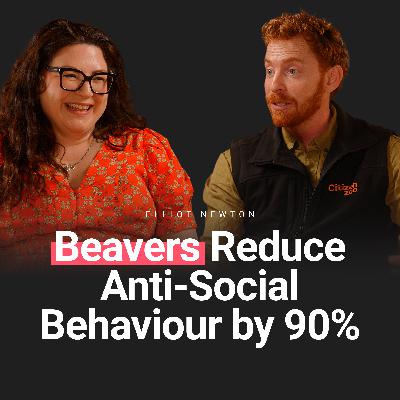
Elliot Newton did a sports science degree because nobody at school told him conservation was a career you could actually have. After some time driving ambulances for the South East Ambulance Service he returned to Imperial in his mid-twenties for a master's in conservation science. It was there that he met Lucas and the two of them founded Citizen Zoo.
Wildlife isn’t always found in wild places. Sometimes it can be found in those areas where we least expect it, such as a derelict retail car park in Ealing with an underpass nobody wanted to walk through. Here we take a look at the transformation that happened when five beavers that had been causing chaos on a Scottish farm were moved in.
Greenford Station, next to the site, flooded every year for over a decade. Since the beavers arrived three years ago, it hasn't flooded once. The council had previously costed a formal engineering fix at over a million pounds. The beavers did it for a fraction of that, with added flood alleviation, drought resilience and cleaner water as a bonus.
Kirsty and Elliot talk through why 84% of the UK lives in cities, and why rewilding has to happen where people actually live rather than far away places they occasionally visit. They get into how beavers build the dams and wetlands that turn single sites into habitat for birds, bats and invertebrates, and about the site's equivalent in Berlin, where over a hundred beaver territories have re-colonised the city on their own.
They also cover the numbers behind the Ealing Beaver Project, with more than 6,000 people engaged in physical activities on site in five months alone, as well as the UK's first urban beaver officer. It’s also the only fully publicly accessible beaver enclosure in the country, located in such a way that schoolchildren now walk through it on their way to class.
As Elliot puts it, we're in charge of designing our urban environment. We can make a conscious choice to have more nature in our cities.

Neil Entwistle spent years earning his stripes as one of the UK's most credible voices on river restoration, only to find out the science was never the hard part. He's now Head of Science at Rebalance Earth, spending most of his time trying to convince finance people to invest in restoring rivers.
This isn't a story about a scientist crossing over into money. It's about what happens when you've spent your whole career knowing exactly what nature needs, but the obstacle in the way is that nobody has figured out how to sustainably fund it.
Kirsty and Neil get into why straightened, dredged rivers are one of the reasons behind both floods and droughts, why bringing Sphagnum moss back into a peatland beats planting trees on it, and why sometimes the job is doing just 10% of the restoration while letting the landscape do the other 90%.
They talk through the Alpine Glacier Project, which Neil and CEO Rob Gardner have followed since their student days under the late Professor David Collins. It consists of 52 years of hard data that turns climate change from theory into the study of a glacier that's literally disappearing before our eyes.
And they lay out the commercial case behind the need to invest in river restoration, and what will happen if we don't. Flooded supply chains. Homes that can't get insured once Flood Re winds down in 2039. Customers who switch supermarkets once because their local is flooded, and never go back.
They also talk about giving rivers their voice back, why "messy" is the best thing you can say about a landscape, and what it's like translating gravity and hydrology for people who only care about the financial return.
As Neil puts it: "We already know what we need to do. The biggest question is how do we finance that."

Lou Meadows was never capped as an England player.
Yet she didn't let that stop her becoming the first woman to coach a men's national side, then attack coach for the Red Roses, helping deliver a home Rugby World Cup gold against Canada. Weeks later, at what should have been the peak of her career, she left the Red Roses to become attack coach for the USA Eagles.
This isn't a story about riding a winning high. It's about the weeks after a World Cup final, when the medal's won and no one can really tell you what comes next. About walking away from a team you love, mid-momentum, because you believe investment is what builds success, and you want to go build it somewhere else before the window closes.
Kirsty and Lou talk about holding a team together through home World Cup pressure without it cracking, what it actually means to "bond" with players you're also competing against for a place, and what it takes to coach internationally with two young kids at home. They get into why USA Eagles won her over and why she thinks the barrier for women in coaching was never talent, it's a system with no roadmap built for them.
As Lou puts it: "You need to invest."
It's a philosophy she lived by winning a World Cup, and one she's now betting on all over again.

Zena Couppey left school at 16 with no degree, no female role models, and no blueprint. Today she runs Altum as CEO, having grown it from £11 billion to £72 billion in assets under six years, with a 60% female senior leadership team and Dame Helena Morrissey as chair.
This isn't a story about having it all figured out, but rather about what happens when you stop waiting for permission and get on with building the culture you wish you'd had. About making enough right calls under pressure, that eventually the numbers speak for themselves.
Kirsty and Zena talk about what authentic leadership actually looks like inside a fast-growing, PE-backed business. They dive into the AI transformation that's already underway, Altum's incredibly low staff turnover, and the very human cost of running a household with two CEOs, two children, and six offices across multiple continents. It's about discipline, leading with authenticity and creating the structures that allow people to thrive.
When we create the space and support mechanisms for people to do their best work, we can therefore, as Zena puts it, focus on "winning together".

He helped build one of the most influential pensions and investment consulting firms in the UK.
Then he walked away from it.
In this episode of the Rebalance Earth Podcast, entrepreneur and bestselling author Daniel Priestley turns the tables and puts his long-time friend Rob Gardner in the hot seat.
The two have known each other for more than 15 years. Over that time they have both built successful businesses, navigated the realities of entrepreneurship, and seen firsthand what it takes to turn big ideas into companies that actually work.
But Rob’s latest venture may be the most ambitious yet.
Rebalance Earth is built around a simple but radical idea.
What if Nature wasn’t treated as a cost to be protected, but as infrastructure that investors can fund and earn returns from?
In this wide-ranging conversation, Dan pulls apart the origin story behind the company. Why Rob left a successful career helping shape institutional investment through Redington and managing billions of pounds of investments at St. James’s Place. What he saw at COP26 that convinced him the financial system was missing something fundamental. And why he believes the next major asset class could be nature itself.
They explore how restored landscapes can reduce flood risk for railways and cities and how pension funds are beginning to invest in ecosystems in the same way they once invested in renewable energy infrastructure.
But this conversation is also a deep dive into entrepreneurship.
About the moment you decide to leave a comfortable career and start again. About building teams, convincing sceptics, and turning a seemingly impossible idea into something that can actually work in the real world.
Because if Rob Gardner is right, the next generation of infrastructure will not be built from steel and concrete, but grown.
And the entrepreneurs who are able to figure out how to finance it will reshape the entire global economy.

Comments

Download from Google Play

Download from App Store
 United States