


 Claim Ownership
The Rock and Turner Investment Podcast
Subscribed: 3Played: 74
Subscribe

© Rock & Turner Investment Partnership
Description
The podcast for the intellectually curious, with analytical minds who like to challenge conventional wisdom.
Join us for a deep and open-ended exploration into the often-overlooked facets of investing. The podcast is designed to introduce anyone in the investment community to fresh mental models and unique perspectives, empowering them to navigate the complex investment landscape with greater confidence. Whether they’re a seasoned investor or just starting out, our discussions will equip them with the tools needed to enhance their decision-making and improve their chances of achieving favourable investment outcomes. The podcast will discuss a wide range of subject matter from analyzing individual companies to exploring macro-economics and timeless investment principles.
rockandturner.substack.com
Join us for a deep and open-ended exploration into the often-overlooked facets of investing. The podcast is designed to introduce anyone in the investment community to fresh mental models and unique perspectives, empowering them to navigate the complex investment landscape with greater confidence. Whether they’re a seasoned investor or just starting out, our discussions will equip them with the tools needed to enhance their decision-making and improve their chances of achieving favourable investment outcomes. The podcast will discuss a wide range of subject matter from analyzing individual companies to exploring macro-economics and timeless investment principles.
rockandturner.substack.com
23 Episodes
Reverse

Slowly, the market seems to be waking up to a major issue that the likes of Michael Burry, Warren Buffett and Terry Smith have been warning about for years.The issue was highlighted in a recent article in The Wall Street Journal entitled Meta Rakes It In, Yet Still Borrows Billions for AI.Stock based compensation is not the villain most investors think it is. Used with discipline it conserves cash and can strengthen long term returns.But the problems start when discipline fades.The danger begins when equity issuance becomes so aggressive that companies are compelled to spend billions buying back stock simply to mask the damage being done.Per share numbers look healthy, but the underlying economics tell a different story.Corporate stewardship becomes less about durable compounding and more about financial engineering.These companies are increasingly being run for the benefit of insiders and at the expense of the extrernal investors. The Wall Street Journal summed it up well:“Meta’s employees and executives captured the bulk of the rewards from last year’s free cash flow."Worse still, as the result of nuances in accounting standards, this corporate behaviour is not reliably reflected in the 10-Q or 10-K financial reports. In fact, the true economic earnings and free cash flow of these business become significantly distorted. Both are often far lower in reality than reported figures imply.If investors never adjust for this properly, it leads to flawed valuation models, investments made at the wrong price and asset bubbles.Most investors don’t adjust for this at all. Most don’t understand how to adjust for it.This is what Michael Burry has been shouting about recently. He sees the market as broken with corporate valuations being streched, supported by structural flows and accounting optics rather than fundamentals. It’s why he chose to return capital to his investors and then withdraw from the market.The dynamic described by the Wall Street Journal runs through some of the largest companies in the market. Not only Meta Platforms (META), but also Alphabet (GOOG)(GOOGL), Microsoft (MSFT), NVIDIA (NVDA), Palantir (PLTR), Tesla (TSLA) and Apple (AAPL). All rely heavily on stock based compensation alongside large buyback programs. These are exceptional businesses. But capital allocation matters and it’s not being done well.Only one of the magnificent-7 appears to do things differently: Amazon (AMZN). It’s approach is refreshingly honest and transparent.In “The Dangerous Game Investors Are Playing”, we dive deep into the numbers, we break down how this works, how it distorts valuations, what adjustments serious investors must make to avoid overpaying, and how to protect yourself before the music stops!This episode features Professor Kevin Koharki who holds a B.Sc. (Accounting), M.B.A. (Finance), and Ph.D. (Accounting). He serves as an Associate Professor at Purdue University, where he lectures on financial statement analysis, he is the founder of CAE Consulting, which advises the C-Suite of Fortune 100 companies and he is a keynote speaker.DISCLAIMER & DISCLOSURE: The author holds a position in Amazon at the date of publication but that may change. The views expressed are those of the author and his guests and may change without notice. The author and his guests have no duty or obligation to update this information. Some content is sourced from third parties believed to be reliable, but accuracy is not guaranteed. Forward-looking statements involve assumptions, risks, and uncertainties, meaning actual outcomes may differ from those envisaged in this analysis. Past performance is not indicative of future results. All investments carry risk, including financial loss. This analysis is for educational purposes only and does not constitute investment advice or recommendations of any kind. Conduct your own research and seek professional advice before investing. Get full access to Rock & Turner Investment Analysis at rockandturner.substack.com/subscribe

DISCLAIMER & DISCLOSURE: The author holds a position in Kingsway Financial Services at the date of publication but that may change. The views expressed are those of the author and may change without notice. The author has no duty or obligation to update this information. Some content is sourced from third parties believed to be reliable, but accuracy is not guaranteed. Forward-looking statements involve assumptions, risks, and uncertainties, meaning actual outcomes may differ from those envisaged in this analysis. Past performance is not indicative of future results. All investments carry risk, including financial loss. This analysis is for educational purposes only and does not constitute investment advice or recommendations of any kind. Conduct your own research and seek professional advice before investing.This podcast/video interview focuses on a company that almost nobody understands correctly, which is exactly why it’s so interesting.This is not a stock that currently screens well. It’s misunderstood and financial metrics are misleading. So don’t get lost in the numbers. This is a qualitative investment thesis.The business piqued my interest because I am particulalry focused on companies with an opportunity to reinvest capital at high accretive rates of return over the long-term, and which have first class management teams. This one ticked both of those boxes.Here’s what you really need to understand:* ‘Search Funds’ are a niche “entrepreneurship through acquisition” (ETA) model.* Stanford professor Irv Grousbeck (not merely an academic, but successful entrepreneur with a net worth of a couple of billion dollars, and co-owner of NBA Boston Celtics) and Will Thorndike (author of ‘The Outsiders’ book and seasoned investor himself) helped popularise the ETA model.* ETA involves backing talented early-career CEOs (often MBAs) to find, acquire and manage an acquired business.* Acquisitions are private mom-and-pop type lifestyle businesses which are capital light, enjoy recurring revenues and have no customer concentration risk, but which have been operated as lifestyle businesses and starved of growth capital. Without succession plans in place, founders ultimately look to cash out. This generally means that they are available to buy at low single digit multiples.* Investments are typically too small for traditional PE firms, but too complex for individual investors.* In 1994, Thorndike founded Housatonic Partners, a fund focused on the ETA model and he enjoyed enormous success. He has quietly been one of the most significant investors in this model for decades.* Thorndike is on the Advisory Board for the International Search Fund Center at IESE Business School and frequently lectures at Stanford and Harvard.* The Center for Entrepreneurial Studies at Stanford Graduate School of Business conducts biennial studies of all core search funds. Its findings reveal that, since 1984, the ETA model has generated steady IRRs ~35% through various economic cycles.Now that I have your attention, please be aware that until now there have been a few issues with search funds:* The ETA model has, until now, been the preserve of wealthy private investors. Retail and other public market investors had no way to access search funds.* Each search fund focused on the acquisition of one company and so there was a high level of concentration risk.* Without the liquidity of a public market, private investments in search funds require an expiry date so that investors know when to expect a return on their money. This forces short-term thinking and exit decisions at inopportune moments.* Thorndike has conducted his own analysis that many of these search fund businesses have been sold too early and go on to achieve outsized returns over the medium to longer term, meaning too much vaue has been given away historically.The answer to all of these challenges is to create a publicly listed permanent capital vehicle focused on deploying the search fund model, building a diverse portfolio of search fund businesses, owning them for extended periods (maybe even forever) and enabling public market investors access to this asset class for the first time.Kingsway Financial Services is the only such business.It is run by CEO JT Fitzgerald, himself a search fund veteran. Will Thorndike is both an investor and a member of the advisory board. And if that hasn’t captured your imagination, so too is Tom Joyce, previously CEO at Danaher and the architect of the acclaimed Danaher Business System (DBS), a version of which Kingsway is deploying itself.In this interview with JT Fizgerald (CEO of Kingsway), we breaking down how Kingsway is using that playbook to build a programmatic acquisition engine, why accounting quirks are actively hiding the real economics and how a shifting business mix could make the financials suddenly “snap into focus.”This is a story about misunderstood numbers, hidden compounding, no analyst coverage, a wonderful business flying completely under the radar and valuation multiples that don’t reflect what’s actually being built. At the moment it is merely a micro-cap, capitalized at ~$400 million, but it has an enormous growth runway ahead.Oh, and one more thing. It has over $600 million of NOLs on its balance sheet from legacy operations when this company used to operate as an insurer prior to the GFC. It has entirely reinvented itself, with a completely new model and management team and so while the legacy issues are in the distant past, all earnings and capital gains over the next 5+ years will be entirely tax free.Ignore this opportunity at your peril.For further reading:Receive more like this direct to your inbox:Highlights from the Interview*Not a verbatim transcript, so please do listen to the recordingThe Evolution: From Insurance Co. to Public Vehicle for Search FundsJames Emanuel: I’m James Emanuel, and joining me today is JT Fitzgerald, CEO of the U.S.-listed business Kingsway Financial Services (KFS). This may be one of the most exciting companies that most people have never heard of. It has a market capitalization of just shy of $400 million and a very interesting story.It is a new company and an old company at the same time. Founded in 1989 as a niche insurance business, Kingsway thrived for nearly two decades. However, the Great Financial Crisis hit the company hard, leading to large losses that became an existential threat. These net operating losses (NOLs) became an attractive asset because they can be used to shield future returns from tax.At that point, Joseph Stilwell, an activist banking investor, stepped in to exploit those NOLs and turn Kingsway into a merchant bank. Insurance operations were shut down, but the merchant bank struggled as a public vehicle. In 2016, JT Fitzgerald entered the stage to explore the introduction of warranty operations, with very attractive commercial attributes, within the business. However, JT had experienced success with search funds, having launched his own company, Argo Management Group. He had the idea to transform Kingsway into a publicly listed search fund business.It took time to convince the board to dispose of legacy assets and restructure, but ultimately, JT became the CEO. He has proven that this model works and is an effective way to exploit those net operating losses. The first search fund launched within Kingsway delivered a 10-times cash return on investment in just over four years. Since then, the company has gone from strength to strength. JT, welcome.JT Fitzgerald: Thank you, James. Happy to be here.James Emanuel: For those unfamiliar with search funds, would you explain the model?JT Fitzgerald: In essence, the search fund model is an investment and acquisition strategy where a group of investors partner with a talented, early-career entrepreneur to search for and acquire small operating businesses. After the acquisition, the entrepreneur transitions into the day-to-day management of the company, typically transitioning out the retiring founder.James Emanuel: This model was spawned out of U.S. business schools where MBA students were anxious to embark on a career, and private equity investors provided the funding. They find a “mom-and-pop” shop with great potential where the founder has no succession plan. The search fund buys out the owners, and the MBA student steps in as the new CEO to scale the business. Is that fair?JT Fitzgerald: That’s right, with one distinction: the model existed long before it was formally called a search fund. The term started to come into existence roughly 30 years ago, spawned out of Stanford and Harvard. One distinction is that the equity supporters generally have gone down this path themselves. It’s not private equity in the traditional sense. I view it as “craft investing” in the artisan-apprentice sense. The folks backing today’s searchers typically have been operators themselves.The Thesis of Permanent CapitalJames Emanuel: In the past, these search funds were the remit of private investors. You saw an opportunity to launch this model within a listed entity to give you access to a permanent capital vehicle. This allows you to grow a diverse portfolio while providing investors the liquidity of the public market with no lock-in periods. Was that your perspective when you joined in 2016?JT Fitzgerald: When I came to Kingsway, the thesis was the attractiveness of the platform as a permanent capital vehicle. Research shows that search fund return profiles have been very good. However, if you look at the returns to the people who acquired those businesses when the searcher exited, the next seven-to-ten-year returns have been just as good. This means that, historically, searchers and their investors have been exiting too soon.The idea of a platform where you could own those businesses for a longer period and continue to compound capital was very attractive. In a private investment context, there’s often a hard-wired requirement to generate
Judges Scientific Plc (JDG.L), listed on AIM, has built its entire identity around one thing: a disciplined and highly effective buy-and-build strategy. Over the years, that strategy has turned the company into a respected specialist in high-end, niche scientific instruments: pieces of mission-critical kit used by universities, research labs, manufacturers and regulators around the world.Since its founding in 2002 and its first acquisition in 2005, Judges has become one of the most successful consolidators in a fragmented industry. It targets high-quality businesses with dependable sales, profits and cash flow, and once they’re brought into the group, they benefit from steady operational support and the financial stability of a larger organisation. Their cash generation then fuels debt reduction and funds the next round of acquisitions. It’s a flywheel that has been spinning for two decades, helping the company deliver an impressive 24% compound annual growth rate since its IPO in 2003.But the last 18 months have tested that model in ways investors haven’t seen for years. The share price has fallen more than 50%, not because the strategy has failed, but because several challenges arrived all at once.First, the company’s valuation had simply run too hot. After years of near-flawless execution, the stock was priced for perfection, and that left no room for disappointment. The disappointment came in the form of a major acquisition that didn’t perform as expected in its first year, triggering a profits warning and shaking confidence.Then came external pressures. China shifted its procurement policies in favour of domestic suppliers, creating an abrupt slowdown in demand for Judges’ instruments. Meanwhile, in the US, delays and cuts in federal research budgets put pressure on university spending, squeezing order flow from another key region.And layered on top of all of this was the news that long-standing CEO and founder David Cicurel will step down in February 2026. Any leadership transition naturally results in uncertainty and anxiety among investors.Taken together, it was a perfect storm.Yet storms pass, and in Judges’ case, many of the clouds already appear to be clearing. The valuation multiple is now roughly half its peak, creating a far more reasonable starting point for new investors. The large acquisition that stumbled out of the gate is showing clear signs of recovery in its second year. Chinese demand is beginning to rebound, and US university funding conditions are improving. More particularly, the succession plan looks solid: Cicurel will move into the role of Non-Executive Chairman, while incoming CEO Dr Tim Prestidge, currently Group Business Development Director, offers continuity rather than disruption.Crucially, the earnings power of the business hasn’t deteriorated. If anything, the cadence of acquisitions means its long-term potential is stronger than ever. For some investors, the recent sell-off may look less like a red flag and more like an opportunity.Judges Scientific remains a business with a proven model, a strong culture and a two-decade track record of compounding growth. To dive deeper into the company’s history, challenges and prospects, enjoy this podcast conversation with Chris Waller of Plural Investing, author of the Hidden Gems Substack and a former Goldman Sachs Asset Management professional with an MBA from Columbia Business School. Get full access to Rock & Turner Investment Analysis at rockandturner.substack.com/subscribe

In this short 10 minute interview, Sundar Pichai, CEO of Google owner Alphabet (GOOG)(GOOGL), emphasizes the importance, and dangers, of AI.Cautiously optimistic, is the best way to sum up his views. He is realistic as he declares that not even Google is immune if the AI bubble bursts.Well worth a listen. Get full access to Rock & Turner Investment Analysis at rockandturner.substack.com/subscribe

Show NotesIn this podcast, we explore the fascinating intersection of psychology and investing — why our brains are wired to crave instant gratification and how that shapes our behaviour, valuations and investment decisions. With reference to the behavioural economics concept of hyperbolic discounting, we explore how this can create excellent trading opportunities. We also examine why the type of shareholders a company attracts can define its destiny, showing that investing isn’t just about picking the right business, it’s about understanding who you are getting into bed with.This 16 minute podcast may help you fine tune your investment approach and improve your returns. Have a listen… nothing to lose!Receive more like this direct to your inbox:TranscriptHave you ever wondered why some companies seem to command absolutely astronomical valuations while others, seemingly just as solid, trade at bargain-basement prices?It’s all about the quirky, often irrational ways our brains process time and money.While traditional finance models rely on neat, orderly exponential discounting, where every future period gets discounted at the same steady rate, the reality of human psychology is far messier and infinitely more interesting.Hyperbolic discounting is a fascinating concept, borrowed from behavioural economics, which helps us better understand how investors think and why equities are priced as they are.Economics has long been dubbed the “imperfect science” for good reason. Human psychology doesn’t follow mathematical formulas and our pricing models need to account for these beautifully irrational behavioural quirks.Consider this scenario: I owe you $10,000 and offer you a deal. Instead of paying you back today, how about I give you $11,000 a year from now? Your gut reaction is almost certainly a firm, “no way.” You want your money now, you want instant gratification. You’ve already planned how you’ll spend that money and it simply can’t wait.Now imagine you have a savings account that can either pay out $10,000 one year from now, or $11,000 in two years. Suddenly, waiting for that extra thousand seems like a no-brainer. The math is identical, a 10% annualized return in both cases, yet your willingness to wait changes dramatically based on proximity to the present moment. Immediate gratification is no longer a factor, it doesn’t cloud your judgement and your decision becomes more rational.This isn’t a flaw in your reasoning; it’s a fundamental feature of human psychology. We systematically undervalue future rewards when immediate gratification is within our reach, but we become surprisingly rational when dealing with future-only scenarios. It’s the same phenomenon that makes you promise to start that diet tomorrow while reaching for another slice of cake today.Our modern world has turned this psychological quirk into a business model. Ever notice how online retailers charge premium prices for next-day delivery? Or how people line up to pay top dollar for the latest iPhone on release day, knowing full well the price will plummet in six months? We’re literally paying extra to pull gratification forward in time and companies have figured out how to monetize our impatience.As Charlie Munger wisely observed, “Investing requires a lot of delayed gratification.” This simple statement captures the essence of why most people struggle with long-term wealth building. We’re wired to want results now, even when waiting would serve us far better.Our trade-off between today and tomorrow is not the same and we value them differently.This impatience epidemic extends far beyond consumer goods. If people were purely logical, wouldn’t they budget carefully, live modestly and secure a comfortable tomorrow? Yet in reality, many drive expensive cars, wear designer clothes and fancy jewelry - all while burdened with ugly debts and barely any savings.We buy things we don’t need, with money we often don’t have, to impress people we don’t even know. It’s not stupidity, it’s human nature in all its gloriously inconsistent beauty. This is where hyperbolic discounting is most valuable. Not as a new valuation methodology, but as a lens for understanding the investor’s relationship with value.When you recognize that most market participants are trapped by their need for instant gratification, you begin to see opportunities everywhere.When a company tells a good story about its future prospects, people buy into that narrative. There’s insufficient attention paid to long-term risk and competitive threats, so distant future cash flows are under-discounted and over valued. This leads to what Alan Greenspan referred to as “over exuberance”, where stock prices become too inflated - as can be seen in the premium on the long tail of the hyperbolic discounting curve.Worse still, most investors ignore the long-term reality as they are obsessed with the short-term. Their focus is on the next quarterly earnings report.People become focused on beating short-term expectations rather than building long-term value, and their impatience creates a negative feedback loop. When a company reports disappointing quarterly results, its stock price gets crushed as the investors rush for the exits. The market tends to price short-term earnings quickly but often misses the gradual, multi-year improvements. They’re not necessarily wrong about the immediate pain and lack of immediate gratification, but they’re often spectacularly wrong about the long-term opportunity. This creates a “present bias” where immediate outcomes are too heavily weighted. It’s like judging a marathon runner’s potential based on their performance in the first hundred meters.Since the share price was initially over-valued, the sudden pendulum swing in the opposite direction looks even more dramatic, causing short-term panic and often leading to a significant under-valuation. This is where patient investors with a deeper understanding of hyperbolic discounting can find their greatest opportunities.The beautiful irony is that by understanding and working against our natural hyperbolic discounting tendencies, we can capture the value left on the table by those seeking instant gratification. Companies with durable competitive advantages and predictable long-term cash flows are often available at attractive prices, precisely because most investors struggle to properly value the future and place too heavy a weighting on the present.When you can train yourself to think beyond the next quarter, to see through the noise of short-term volatility, and to properly value businesses based on their long-term potential rather than their immediate prospects, you’re essentially arbitraging human psychology. You’re buying what others can’t properly value and holding what others lack the patience to own.In essence, hyperbolic discounting doesn’t just explain market behavior, it reveals the path to potentially superior returns. The key is recognizing that investing, like so many aspects of life, is ultimately a battle between our immediate desires and our long-term interests. The winners are usually those who can consistently choose delayed gratification over instant satisfaction, turning one of humanity’s greatest psychological biases into their greatest competitive advantage.But the story doesn’t end there. It’s not just about investing in a company at the right price. The real plot twist comes when you realize you’re not just buying shares in a business, you’re climbing into bed with a cast of characters who might have wildly different ideas about where this relationship should go.When we analyze potential investments, we dive deep into all the usual suspects. We scrutinize the market dynamics, dissect customer loyalty, examine supplier relationships, and evaluate management quality. Some of us even peek behind the curtain to gauge employee sentiment. But there’s one critical group of stakeholders that most investors completely overlook: the other shareholders.Who are they?What are their objectives?Are they helping or hindering the business?Are they exerting undue influence on management?Why has the company attracted this type of investor? Are the interests of these people aligned with yours?These questions matter far more than most investors realize, because the answers can make or break your investment returns.Sometimes, two investors analyzing the same company, will see it completely differently. This could be because one is looking at it through a microscope, while the other is using a telescope.The investor with the microscope zooms in on spreadsheets, hunts for hidden value in the numbers, searches for any statistical anomaly that screams “bargain!” This is precision investing: surgical, calculated, and decidedly short-term. The second investor prefers a telescope, scanning the horizon for companies with visionary leadership, sustainable competitive advantages and business models built to weather decades of change. This type of investor isn’t looking for quick wins; they’re seeking businesses they’d be comfortable owning forever. They may not have found a bargain, but that’s not the point. What matters is whether management can grow the business, reinvest wisely and compound value. For this kind of investor, management quality, culture, vision, passion and a competitive edge are everything.Here’s where it gets interesting: neither approach is inherently right or wrong, but they’re fundamentally incompatible when forced to coexist in the same company’s shareholder base.The microscope investor lives in a world of catalysts and special situations. They’re betting on near-term events: regulatory changes, management shake-ups, spin-offs, or market sentiment shifts - anything that could trigger a stock rerating. They’re seeking that immediate gratification we discussed earlier. They want aggressive share buybacks, regardless of valuation, because they’ll inflate earnings per-share. They would welcome cost-cutting to ampli

This podcast continues our investigative journey on the theme of programmatic and serial acquirers. Links to the other episodes in this series are:* The Secret of Investing in Programmatic Acquirers podcast - [unlocked]* Relais Group investment analysis - [unlocked]* Teqnion - [unlocked]* Fairfax India (podcast/video presentation) - [unlocked]* Topicus - [45 day partial paywall, after which it will be unlocked]* Valuing Programmatic Acquirers* » Watch this space, more to come «Receive future episodes directly to your inbox:This Episode - Gateway to IndiaIndia is proving to be a highly compelling investment opportunity, and its story echoes the economic rise of China, with a massive, young workforce and a fast-growing middle class.The country has also positioned itself as a resilient and rapidly expanding economy, especially during its G20 presidency where it moved from a global participant to a key architect of international cooperation. This strong foundation is supported by significant legal, tax and regulatory reforms, as well as tremendous progress in physical and digital infrastructure.For foreign investors, however, the Indian market can be challenging to navigate due to issues like withholding taxes, restrictions on capital movement and language/cultural barriers. Not only that, but some of the best investment opportunities exist among private businesses rather than the hyped and often overpriced publicly listed companies. So how does a non-Indian investor play this wonderful opportunity?A potential answer is proposed in this podcast which first unpacks why India is so attractive right now, but also focusses on a programmatic acquirer, a holding company named Fairfax India Holdings Corporation ($FIH), listed in Canada, it provides foreign investors with exposure to the dynamic Indian market while bypassing these complexities. Ben Watsa, Chairman of Fairfax India and son of the great investor and entrepreneur Prem Watsa, explains why he likes India right now:As a permanent capital vehicle, it focuses on long-term investments in high-quality Indian businesses, leveraging decades of experience from its hugely successful parent company, Fairfax Financial.In one packaged investment, you and I are able to gain exposure to a portfolio of first class Indian businesses, 70% of which are private, in a range of sectors from banking and finance; transport, logistics and storage services; manufacturing; and most important of all, critical infrastructure.Best of all, while almost all of the top performing programmatic acquirers trade at eye-watering premiums to intrinsic value, this one is a rare exception, available at a discount to its net asset value.Listen to, or watch, the podcast to learn more. The video version - on YouTube and the Rock & Turner Substack has images to accompany the narrative.DISCLAIMER & DISCLOSURE: The author has a position in Fairfax India at the time of publication, but that may change. The views expressed are those of the author at the time of publication and may change without notice. The author has no duty or obligation to update this information. Some content is sourced from third parties believed to be reliable, but accuracy is not guaranteed. Forward-looking statements involve assumptions, risks, and uncertainties, meaning actual outcomes may differ from those envisaged in this analysis. Past performance is not indicative of future results. All investments carry risk, including financial loss. This analysis is for educational purposes only and does not constitute investment advice or recommendations of any kind. Conduct your own research and seek professional advice before investing. Get full access to Rock & Turner Investment Analysis at rockandturner.substack.com/subscribe
Acquisition-as-a-Business (AaaB)This podcast continues our investigative journey on the theme of programmatic and serial acquirers. The first episode in this series was an Introduction to the AaaB model. It explains the compounding power of the AaaB business model and distinguishes between serial and programmatic acquirers. Despite many using these terms interchangeably, they are not the same and it is important to understand the difference. If you haven’t listened to the first episode, I would encourage you to do so before listening to this one.This episode focuses on two lesser known but very interesting acquirers. The first is Teqnion, a programmatic acquirer in Sweden, and the second is Relais Group, a serial acquirer in Finland.The series so far:* The Secret of Investing in Programmatic Acquirers podcast - [unlocked]* Relais Group investment analysis - [unlocked]* Teqnion - [unlocked]* Fairfax India (podcast/video presentation) - [unlocked]* Topicus - [45 day partial paywall, after which it will be unlocked]* Valuing Programmatic Acquirers* » Watch this space, more to come «Receive future episodes directly to your inbox:DISCLAIMER & DISCLOSURE: The author has no position in companies mentioned in this podcast at the time of publication, but that may change. The views expressed are those of the author at the time of publication and may change without notice. The author has no duty or obligation to update this information. Some content is sourced from third parties believed to be reliable, but accuracy is not guaranteed. Forward-looking statements involve assumptions, risks, and uncertainties, meaning actual outcomes may differ from those envisaged in this analysis. Past performance is not indicative of future results. All investments carry risk, including financial loss. This analysis is for educational purposes only and does not constitute investment advice or recommendations of any kind. Conduct your own research and seek professional advice before investing. Get full access to Rock & Turner Investment Analysis at rockandturner.substack.com/subscribe
Acquisition-as-a-Business (AaaB)This is now the first post in the ‘AaaB’ series. If you missed the others, here are the links:* The Secret of Investing in Programmatic Acquirers podcast* Relais Group investment analysis* Teqnion* Fairfax India (podcast/video presentation)* Topicus - Part 1* Valuing Programmatic Acquirers* Topicus - Part 2 - How to value Topicus* Judges Sceintic (podcast)* Fairfax India analysis to compliment (4) aboveShow NotesMost mergers and acquisitions destroy shareholder value: that's not opinion, it's documented fact. Harvard Business Review analyzed 2,500 deals and found over 60% destroyed value, with legendary failures like Microsoft's Nokia acquisition and Google's Motorola disaster serving as expensive reminders. Yet despite these terrible odds, companies continue pursuing M&A as their primary growth strategy.But there's a rare breed of company that has cracked the code. Programmatic acquirers like Constellation Software, Danaher, and several Swedish firms have turned high-risk M&A into systematic value creation machines. Constellation has delivered 37,500% stock appreciation since 2006 through over 900 acquisitions, while Lagercrantz has compounded at 21% annually for 25 years. These aren't lucky streaks, they're the result of treating acquisition as a disciplined business model rather than an occasional strategic tool.This deep dive explores what separates programmatic acquirers from serial acquirers and private equity firms, why they focus on overlooked niche businesses rather than headline-grabbing deals, and how their decentralized operating models create sustainable competitive advantages. We examine cautionary tales like Judges Scientific's costly deviation from proven strategies, analyze the complex accounting challenges that make these companies difficult to compare, and identify emerging European opportunities that might offer exposure to this powerful model at reasonable valuations.Key Companies Discussed: Constellation Software ($CSU), Danaher ($DHR), Lifco ($LIFCO-B), Lagercrantz ($LAGR-B), Berkshire Hathaway ($BKRA, $BRKB), Judges Scientific ($JDG), Brown & Brown ($BRO), Chapters Group ($CHG), Heico ($HEI), Transdigm ($TDG), Addtech ($ADDT-B), Teqnion ($TEQ), Roko ($ROKO-B), Bergman & Beving ($BERG-B), Halma ($HLMA).Next Episode Preview: We'll examine specific emerging programmatic acquirers in detail, analyzing their management teams, acquisition strategies, financial structures, and long-term value creation potential. Get full access to Rock & Turner Investment Analysis at rockandturner.substack.com/subscribe

Bogumil Baranowski interviews James Emanuel for his Talking Billions podcast. Their conversation leads them into discussions on a wide range of fascinating topics including:* personality traits of a successful investor* stock selection criteria* red flags* concentrated portfolios* buy and hold strategies* long-term investing* compounding* dividends* stock based compensationEnjoy!And please leave your thoughts in the comments section. Get full access to Rock & Turner Investment Analysis at rockandturner.substack.com/subscribe

DISCLAIMER & DISCLOSURE: The author, James Emanuel, holds a position in Enterprise Group, but that may change. The views expressed are those of the author and may change without notice. The author has no duty or obligation to update this information. Some content is sourced from third parties believed to be reliable, but accuracy is not guaranteed. Forward-looking statements involve assumptions, risks, and uncertainties, meaning actual outcomes may differ from those envisaged in this analysis. Past performance is not indicative of future results. All investments carry risk, including financial loss. This analysis is for educational purposes only and does not constitute investment advice or recommendations of any kind. Conduct your own research and seek professional advice before investing.Last October I analyzed a fast growing Canadian company - Enterprise Group:Enterprise Group (Toronto, TRX:E) has been on quite a journey in recent years, with a series of big moves that have reshaped its business. Things really took off with the acquisition of Evolution Power a few years ago, which marked a major shift into supplying power generators. And the momentum hasn’t slowed - this year’s acquisition of FlexEnergy Canada is set to push growth even further.The company’s approach to site infrastructure is built on three main pillars: mobile power systems, mobile office and command structures, and lighting solutions. These offerings are particularly crucial for clients operating in remote, challenging environments such as northern Canada, where extended periods of darkness and extreme cold demand robust, reliable infrastructure. While mobile power solutions are at the forefront, the company’s comprehensive suite of ancillary equipment and services sets it apart from competitors, enabling it to deliver end-to-end infrastructure solutions.Enterprise Group has made a bold move with its recent acquisition of Flex Canada, paying $20 million for a business that, on paper, appeared to fetch a premium price at about 4.3x trailing three-year EBITDA. That’s notably higher than Enterprise’s historical ceiling of 3x. But scratch beneath the surface and the numbers tell a different story. The real driver behind the deal was Enterprise’s urgent need to expand its fleet of power generators, with very few available for purchase. By acquiring Flex Canada, the company gained instant access to 17 turbine units,each of which would cost around $900,000 if bought new, putting the value of the physical assets at roughly $15 million. That suggests the actual price paid for FlexCanada’s operating business was closer to $5 million, or just over 1x EBITDA. Given the added benefits, service contracts, and strategic foothold it brings, this looks like a bargain.The acquisition is immediately accretive. Not only does it grow Enterprise’s fleet by 17 turbine generators, but it also introduces advanced 2.0-megawatt units, enhancing power generation capabilities and positioning the company for future growth. At the end of 2024, Enterprise had about 30 power generators. By the close of 2025, that number will more than double to approximately 61, thanks to the 17 acquired units, 10 new turbines on order from FlexEnergy, and additional ex-rental units expected to come off lease. As these turbines are deployed, likely by 2026, the company’s earnings capacity will more than double, with incremental improvements expected along the way.Yes, the equity raise diluted shareholders by just under 20%, but the capital has been put to effective use. With the turbine fleet doubling, shareholders essentially swapped 100% of the old Enterprise for 80% of a significantly larger and more profitable version. It’s a trade that’s likely to pay off handsomely.Until now, about 17% of the generator fleet consisted of Capstone units, which have shown limited reliability in the harsh Canadian environment. These units struggled with extreme cold and had narrow fuel tolerance, making them ill-suited for remote field work. In contrast, FlexEnergy turbines have proven highly effective, even in minus 52°C conditions, and can operate on a wide range of field gases. They’ll now form the backbone of the fleet, which will vastly improve operational efficiency and earnings power. From here on, all new generators will be FlexEnergy models and the Capstone units will be marginalized and earmarked for special use cases.FlexEnergy’s technology is known for its reliability, low emissions, and exceptional fuel flexibility. It gives Enterprise a critical competitive edge, especially when competing for contracts that demand dependable and environmentally responsible alternatives to diesel. And it’s not just about tech: FlexEnergy only manufactured about 30 turbines a year, with Enterprise snapping up a third of them. Now, with FlexEnergy expanding its production capacity, Enterprise will be able to secure more units as it scales up.The acquisition has also positioned Enterprise as the exclusive supplier, renter, and servicer of FlexEnergy turbines in Canada. This cements its leadership in natural gas-to-electric power solutions, a market that’s booming across sectors such as remote power, manufacturing, and the energy-hungry AI data center space.What’s more, the deal includes several long-term lease and service contracts tied to turbines already in the field, generating a reliable stream of recurring revenue. Enterprise also gains access to a skilled team of Flex specialists, ensuring continuity and excellence in turbine operations, both temporary and permanent installations. This strengthens the company’s ability to scale across Canada and serve a broader customer base with flexible, cost-effective power solutions.While some investors were frustrated that few shares were repurchased under the Normal Course Issuer Bid, it was largely a matter of timing. A dip in the stock price, triggered by U.S. tariffs on Canada, coincided with blackout periods surrounding the acquisition and the Q1 results release. Now that the dust has settled, and with the market recognizing the strategic value of the deal, the share price is already rebounding. Still, management has made it clear: if the stock dips again, they’re ready to step in.For now, though, capital is better deployed into growth. This is a capital-light business where turbines pay for themselves in as little as 18 months and generate income for two decades or more. Reinvesting in expansion is the smart play, but management hasn’t ruled out share buybacks down the line as cash flow builds.Enterprise is also broadening its horizons. Historically rooted in Alberta and British Columbia’s oil and gas sector, it’s now exploring opportunities in new geographies and industries - from First Nations partnerships to mining and AI-driven data centers. In September 2024, it hired a Vice President of Business Development in Calgary to accelerate sales and marketing in these new markets.Despite some short-term pain from project delays at a major LNG facility - impacting Q4 results - the outlook is strong. That project is now back on track, set to begin operations by mid-2025. Enterprise had an exceptional Q1 in 2024, and against the odds, Q1 2025 came close to matching it. With an expanded fleet and the LNG ramp-up imminent, Enterprise is busy responding to a wave of RFPs. Even winning half of those would make H2 a record period, with Q3 likely to surpass Q1.Management expects to maintain gross margins around 50% and EBITDA margins above 40%, with financial flexibility enhanced by a new $41 million credit facility from BMO. That facility consolidated existing debt and slashed financing costs by 400 basis points - another boost to margins.Insiders, who already own about 28% of the company, continue to build their positions - clear evidence of confidence in the road ahead.In short, the investment thesis remains not just intact, but stronger than ever. And with the share price still 10% below where major investors bought in during the last capital raise - before any acquisitions were announced - Enterprise today represents a bigger, stronger, and more profitable business, available at an even better price.Listen to this podcast at the top of this page to learn more. Get full access to Rock & Turner Investment Analysis at rockandturner.substack.com/subscribe

DISCLAIMER & DISCLOSURE: This interview was recorded for the MOI Global investment community, but is reproduced here on James’ own Substack for the benefit of his subscribers. James and Cristiano may hold positions in the companies discussed. The views expressed are those of the participants and may change without notice. Past performance is not indicative of future results. All investments carry risk, including financial loss. This analysis is for educational purposes only and does not constitute investment advice or recommendations of any kind. Conduct your own research and seek professional advice before investing.__________________________Fireside Chat with Cristiano SouzaIn today’s podcast, James interviews one of the best investors you’ve probably never heard of — Cristiano Souza.He’s quietly delivered stunning returns — consistently in the high teens to low 20% range — for decades. And despite a remarkable 30-year career, Cristiano has kept a low profile. In fact, before this conversation, he’d only ever done two interviews: one in English, one in Portuguese. So we are honored that he agreed to join us for this fireside chat.Cristiano’s journey began in Brazil, where he earned a degree in Economics from Candido Mendes University in Rio. At just 19, he joined the legendary investment firm Dynamo. Over nearly three decades there, he rose to become a senior partner and co-managed Dynamo Cougar — a fund that compounded at an incredible 24% annually.In 2015, he helped launch Dynamo’s UK office. That eventually led to a spin-off: Zeno Equity Partners, where he now leads the fund management team.Based in London, Zeno is a long-only, low-turnover, high-conviction fund investing across the Americas and Europe. Since its inception, it’s compounded at an impressive 19% a year.Cristiano’s approach is refreshingly disciplined. He looks for dominant businesses with deep moats, aligned incentives, and enduring cultures. His investment strategy revolves around three key pillars:* Market Power — Can the business sustain or grow a dominant position?* Reinvestment Opportunity — Can it reinvest excess profits at high returns?* Founder Mindset — Do the leaders think and act like true owners?In just over an hour, this episode dives into Cristiano’s philosophy, his approach to finding great businesses, and his broader thoughts on investing.Enjoy the conversation.Books discussed in this interview:* Mastery, by Robert Greene* Range, by David Epstein* One Up On Wall Street, by Peter Lynch* Fabric of Success, by James Emanuel Get full access to Rock & Turner Investment Analysis at rockandturner.substack.com/subscribe

Annie Lennox, the singer-songwriter from Eurythmics, achieved great success in the 1980s. One of her songs, ‘Sisters Are Doin’ It for Themselves’, includes the famous line: “Behind every great man, there’s a great woman.”While I can’t speak to the accuracy of that sentiment, I firmly believe that behind every great company is a great CEO.Take Apple, for example. Under John Sculley, the company was on the brink of bankruptcy, with only 90 days of cash remaining. Then Steve Jobs returned and propelled Apple into the stratosphere.IBM followed a similar pattern. Thomas Watson built it into one of the world’s most powerful companies, but when Lou Gerstner took over, the company suffered irreparable damage.Intel, once a market leader under Noyce, Moore and Grove, has struggled to remain relevant under new management.There are plenty of stories like these, but you get the idea.“The same company, with different management, is no longer the same company.” As investors, we are not looking for the next Apple, the next IBM or the next Intel. Instead we are looking for the next Steve Jobs, the next Thomas Watson and the next Noyce, Moore and Grove combination.“Invest in the right people or it could cost you everything.”Every time management changes, shareholders are essentially rolling the dice on their investment and with each roll, there’s always the risk of a bad outcome. The question is - how many times are you willing to take that gamble?Now, consider this: the average CEO of a public company in the U.S. serves for just over four years. For buy-and-hold investors this presents a significant challenge as it requires rolling the dice many times over a long-term holding period. Yet, most investors pay little or no attention to this risk when evaluating a company as an investment.A long-term CEO, often a founder, with real skin in the game is always good to see. But that alone is insufficient. To be a truly outstanding leader, the person steering the corporate ship requires a set of very specific character traits.This video/podcast explores eight key leadership qualities with reference to eight exceptional CEOs - those featured in Will Thorndike’s highly acclaimed book, The Outsiders:* Independence ~ Henry Singleton* Adaptability ~ Bill Anders* Conviction ~ Katharine Graham* Contrarianism ~ Warren Buffett* Practicality ~ John Malone* Frugality ~ Tom Murphy* Integrity ~ Dick Smith* Opportunism ~ Bill StiritzEach of these is highlighted in this short inspirational video at the top of this page - I promise you that watching it will be 18 minutes well spent.Enjoy! Get full access to Rock & Turner Investment Analysis at rockandturner.substack.com/subscribe

Disclaimer: This is for information purposes only. It is not investment advice. The author has a position in the securities discussed. Seek professional advice before investing.I posted some analysis on Monday of this week on a small and largely unknown business which I believe is ridiculously mispriced. That analysis seems to have gone viral and so for the benefit of anyone who missed it, here is a short podcast with highlights from that analysis, showcasing this extraordinary investment opportunity. Manolete Partners (London: MANO) stock traded at 72p on 20th January (last week). Since publishing my analysis the stock has shot up to 96p today (+33%), yet this is only the start of a very long journey. In my opinion, these are a buy and hold for the long-term. My price target is over 300p, returning to where this stock traded in May 2022 - the company is far stronger today than it was back then.* Founder owns 10% and still serves as CEO 16 years after founding* A long track record of success* An investment firm able to compound at ~17% annually* Niche market - 67% market share - barriers to entry* Huge growth runway ahead* Share price only a fraction of intrinsic value* A Covid-19 headwind has turned into a strong tailwind propelling growth* Next 12 month EV/EBITDA <1x“The impact of Covid-19, and its consequences on the global economy, is likely to underpin Manolete's strong growth prospects for the foreseeable future".Steven Cooklin, CEOHaving followed this company for several years and recently met with its CEO, I understand how 2025 will deliver the catalysts that will undoubtedly deliver a re-rating of the stock.For a detailed analysis, be sure to read the full report that inspired this podcast:https://rockandturner.substack.com/p/manolete-partners-special-investmentRock and Turner Investment Analysis is a reader-supported publication. To receive new posts and support my work, consider becoming a free or paid subscriber. Get full access to Rock & Turner Investment Analysis at rockandturner.substack.com/subscribe

Best Ideas 2025 is the thirteenth edition of a fully online investment conference, hosted by MOI Global.A small number of investors were chosen to pitch strong conviction investment ideas to the MOI community and the video/podcast above includes my pitch focused on Haivision. There is also a bonus section included in this video which features the CEO of Haivision, Mirko Wicha, explaining the company’s heritage, business model and prospects for the future.For further reading, it was based on the Substack post below:Receive future investment pitches direct to your inbox:If you enjoyed this, please share it with others: Get full access to Rock & Turner Investment Analysis at rockandturner.substack.com/subscribe
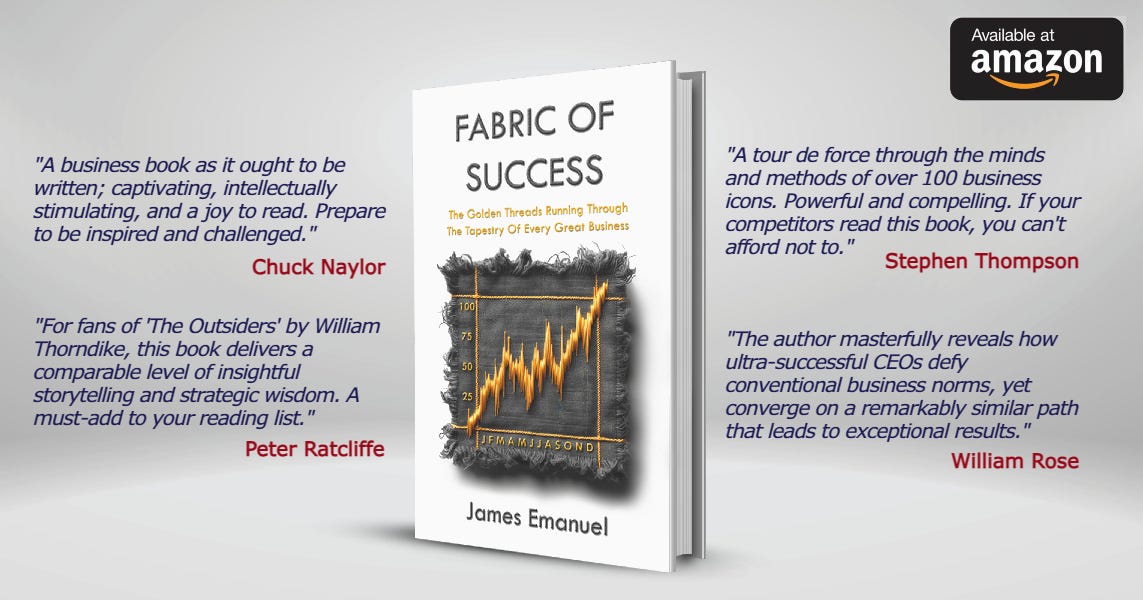
Ben Claremon, of Devonshire Partners, hosts the Compounders podcast. He recently published an episode featuring an interview with me which he kindly allowed me to reproduce here.We discussed risk management, geographic diversification, the nuances of investing in Japan and China, dividend policies, stock based compensation, factors distorting the markets, relative valuations of US and European companies and we explored the attributes of Dutch company Adyen that make it an interesting investment opportunity.We also discussed the book, Fabric of Success:Enjoy the interview and feel free to share it with others.If you are not already a member of the Rock and Turner investment community, please sign up:Disclaimer & Disclosure: Participants may have positions in the businesses mentioned in this interview. This post is for informational purposes only and should not be construed as investment advice. Conduct your own due diligence and seek professional investment advice before making any investment decisions. Get full access to Rock & Turner Investment Analysis at rockandturner.substack.com/subscribe

This is a special podcast, capturing an interview that I gave to MOI Global. In it, we discuss the book, Fabric of Success and investing themes more generally, including the importance of management, capital allocation, the importance of location, dividend policy and so much more. Enjoy!About MOI GlobalMOI Global, which originated from ‘The Manual of Ideas’ over a decade ago, has evolved into an exclusive, invitation-only community for intelligent investors passionate about lifelong learning.The community, created by John Mihaljevic, aims to support its members throughout their investing journey and remains committed to building a unique environment for high-caliber investors to connect, learn, and grow together.Initially focused on content creation for value-oriented investors, the organization recognized the strength of the tight-knit value investing community and expanded its offerings to include member publications, online events, and offline experiences. Today, MOI Global provides a platform for exceptional investors to share their wisdom, fosters a global network of like-minded individuals, and offers a range of benefits to its members, including access to curated investment idea presentations, conferences, and local chapter meetings worldwide.It is an exclusive, invitation only, membership body in which members have typically introduced others if they believe that they are able to add value to the community. However, it closed its doors to new members in 2017, although it does maintain a waiting list for those interested in membership.About the Book, “Fabric of Success”Most businesses are mediocre at best, but a small percentage stand out as exceptional. One thing distinguishes one type from the other – the management.In 1997, Apple was on the brink of collapse with less than 90 days of cash flow remaining, yet today it stands as one of the greatest businesses on the planet. The pivot occurred when Steve Jobs took over from John Sculley. The same company, with different management, produced dramatically different outcomes.Similarly, while most airlines struggle with profitability and often succumb to bankruptcy, Southwest Airlines achieved 40 years of uninterrupted profitability, making it best in class by a country mile. Its secret was Herb Kelleher, its brilliant and unconventional CEO.This pattern repeats in every industry from freight, textile mills and car rentals, to tire-fitting, technology and fashion. The book unravels the golden threads that run through the tapestry of all of these wonderful businesses. Get full access to Rock & Turner Investment Analysis at rockandturner.substack.com/subscribe

This podcast is the latest in our series on mental models. Part 3 focuses on what gives a business a durable advantage. It isn’t about being incrementally better than the competition, but fundamentally different.Be sure to read the full article: Get full access to Rock & Turner Investment Analysis at rockandturner.substack.com/subscribe

In today's special episode we're exploring the BRICS summit in Kazan, Russia, happening from October 22nd to 24th, 2024. This summit brings together leaders from Brazil, Russia, India, China, and South Africa to discuss a bold initiative: reducing the bloc's dependence on the US dollar.Amidst ongoing efforts to reshape the global financial landscape, Russia and Iran are leading the charge toward a new financial system that aims to be independent of Western influence. While China's support adds momentum to the initiative, India's cautious stance highlights the complexities within the BRICS bloc. The inclusion of Iran adds an intriguing ideological element, raising questions about how economic priorities and political differences will play out.Join us as we break down the diverse motivations driving each member, the potential impacts on the global order, and what this push for a more multipolar world could mean for the future.SHOW NOTESThe 16th annual BRICS summit will be held in Kazan, Russia, from October 22-24, 2024. This year's summit is especially concerning, given its objectives amidst escalating geopolitical tensions that have been mounting since the COVID-19 pandemic. These tensions include the war in Ukraine, conflicts in the Middle East, and disputes over Taiwan. While appearing isolated in nature, these events are all connected. We explore the potential implications, including the destabilization of the existing global order, the erosion of the globalization framework that has served us well for decades, and the undermining of the current financial system.The BRICS bloc, consisting of Brazil, Russia, India, China, and South Africa, has launched efforts to challenge the dominance of the U.S. dollar in global finance. Russia, with strong backing from Iran, is leading this initiative, seeking to create a financial system that operates independently of Western influence. The upcoming BRICS summit in Kazan will feature leaders from over 24 countries discussing plans to establish a new payments infrastructure, possibly including digital currencies or a BRICS-based currency. The primary goal is to reduce dependence on the dollar and diminish the geopolitical power the U.S. wields through its financial system.Russia's motivation stems largely from the economic consequences of Western sanctions following its invasion of Ukraine, which have significantly disrupted its economy. By advancing the BRICS initiative, Russia hopes to weaken the U.S.-dominated global financial architecture that facilitates sanctions and political leverage. The group's expansion and focus on financial independence signal a more determined effort to challenge the existing financial order, particularly as other BRICS members share an interest in creating alternatives to the dollar.The responses of BRICS members to this initiative vary. China supports it as it aligns with its strategy to internationalize the yuan and reduce vulnerability to U.S. sanctions. China has already been developing alternatives to dollar-based systems through digital payment platforms and currency agreements. Meanwhile, India is more cautious, especially regarding proposals for a common BRICS currency, due to concerns about China's influence and differing geopolitical interests. This reflects the internal complexities of achieving consensus within BRICS.The involvement of new members like Saudi Arabia, the UAE, Argentina, and Egypt adds further diversity to the group. While these nations are attracted to the idea of diversifying away from the dollar, they may approach the initiative cautiously because of their longstanding economic ties with the U.S., especially regarding oil and trade. Brazil and South Africa, on the other hand, see the initiative as an opportunity to secure economic growth, diversify trade, and advocate for a fairer financial system that benefits developing countries. Each participant has unique motivations, yet they share a general desire to reform the global financial system and reduce the dollar's dominance.Iran's involvement brings an additional ideological dimension to the BRICS initiative. For Iran, challenging the U.S.-led financial system is not just a geopolitical move but also a religious and ideological one. Iran’s leadership views resistance to Western influence as a moral and religious duty, connected to its revolutionary ideology that opposes U.S. hegemony. Iran sees financial independence from the dollar as a way to further its vision of Islamic governance and reduce Western economic control. This ideological stance makes Iran more willing to push for confrontational approaches within the BRICS framework.The potential clash between Iran's religiously motivated goals and the more pragmatic objectives of other BRICS members could pose risks to the initiative. While countries like Russia may share Iran's desire to weaken U.S. influence, other members, such as China and India, are more focused on economic and strategic interests than ideological conflict. China, in particular, values its economic ties with Western countries and may not want to be associated with Iran's anti-Western rhetoric. Similarly, India balances its relationship with Iran alongside partnerships with the U.S. and Israel, making it cautious about aligning with Iran’s ideological goals.Iran's religious ideology also affects its approach to regional conflicts. It aims to use any financial gains from the BRICS initiative to support its proxies across the middle east including Hezbollah in Lebanon and Hamas in Gaza, both recognized by the West as terrorist organizations, Shia militias in Iraq, and the Houthi movement in Yemen. This could provoke concerns among other members wary of exacerbating tensions with the West. The risk of appearing to support Iran's agenda could alienate members like Brazil and South Africa, who are focused on economic development and prefer to avoid entangling the BRICS initiative in ideological disputes. This divergence in objectives underscores the potential challenges in maintaining the group's cohesion.Despite these internal differences, BRICS remains united in its desire to establish a more multipolar financial order that reduces Western influence. Establishing a new financial system involves significant challenges, including ensuring liquidity, regulatory cooperation, and governance structures. Geopolitical distrust, particularly between China and India, could complicate efforts to implement a unified strategy. While Iran’s ideological stance might motivate stronger efforts to challenge the West, other members may advocate for more incremental changes to avoid confrontation.Russia, Iran, China, South Africa, and Brazil each have distinct endgames. Russia seeks to erode U.S. financial dominance and reassert itself as a global power. Iran aims for greater financial freedom to support its regional ambitions, driven by both geopolitical and religious objectives. China’s long-term goal is to internationalize the yuan and reduce its reliance on the dollar, positioning itself as the world’s leading economic power. South Africa and Brazil prioritize economic diversification and regional leadership, driven by practical considerations rather than ideological ones. These varied motivations illustrate the complexity of the BRICS initiative.In conclusion, while the BRICS financial initiative is broadly aimed at reforming the global financial system, Iran’s religious and ideological agenda adds a unique layer to the group’s objectives. This dimension could create tensions, especially if Iran pushes for a more confrontational approach than what other members are willing to support. Nonetheless, the initiative highlights a shared interest among emerging economies in challenging the current order and signals a shift toward a world where the balance of power is increasingly contested. The future of the BRICS initiative will depend on how well the group can navigate these differences and implement a coherent strategy.Politically, the world appears to be in its most fragile state since the end of the cold war in 1991. Thirty four years of peace and prosperity may be coming to an end. We should all sit up and take notice because we are now sailing through uncharted waters and have no idea of the dangers that may lie ahead. Get full access to Rock & Turner Investment Analysis at rockandturner.substack.com/subscribe

This podcast accompanies the series of articles exploring mental models. This one "The Democratization of Goods and Services" is a podcast based on a post of the same title (click here).It explores the idea that a company's success is more dependent on reaching a broad customer base than on the quality of its products or services. Drawing on Charlie Munger's concept of a latticework of mental models, the author illustrates how companies that prioritize accessibility and affordability tend to be more profitable than those focusing on exclusivity and high margins.The discussion highlights that companies democratizing their industries - by making their products and services widely accessible - benefit from increased market reach, innovation, positive brand associations, and contribute to economic growth. Get full access to Rock & Turner Investment Analysis at rockandturner.substack.com/subscribe

This podcast focuses on a speech that Charlie Munger gave back in 1994 at the University of Southern California, entitled ‘The Art of Stock Picking’. It explains the approach that he and Warren Buffett deployed to achieve outstanding results. It’s not complicated, and easy to follow, but most people do the exact opposite.If you want to do more reading, the podcast was based on text that may be found if you click here.Bookmark on Apple podcasts: Get full access to Rock & Turner Investment Analysis at rockandturner.substack.com/subscribe

Comments

Download from Google Play

Download from App Store
 United States