


 Claim Ownership
Ivey Impact Podcast
Subscribed: 2Played: 2
Subscribe

© 2024 Ivey Business School at Western University
Description
The Ivey Impact Podcast is the flagship series of Ivey Business School, one of Canada’s top institutions for business education. Tailored for modern leaders, each brief yet impactful episode brings the expertise and innovative thinking of Ivey’s globally recognized faculty to the forefront. The dynamic discussions tackle today’s most critical issues, from start-ups and sustainability to AI-integration, responsible leadership, and more. Released monthly, Ivey Impact Podcast is the source for leaders seeking exclusive insights and actionable ideas that ignite change.
20 Episodes
Reverse
We talk a lot about the “future of work,” but few leaders are prepared for just how radically work is changing beneath their feet.Today, creativity and critical thinking drive results – yet they remain the hardest kinds of work to see, measure, or manage. That’s why modern leaders must rethink traditional management models. Stick with outdated approaches, and you risk slowing innovation, misreading performance, and overlooking standout talent hiding in plain sight.So where should leaders start?In this episode of Dialogue with the Dean, Julian Birkinshaw sits down with Rob Austin, Professor of Information Systems and Ivey’s Evolution of Work Chair, for a thought-provoking conversation about what leaders need to understand about modern work. Together, they explore why knowledge work resists measurement, how creative breakthroughs often stem from “productive accidents,” what AI can and can’t replace, and why neuroinclusion is emerging as a powerful catalyst for capability building.Insightful, candid, and deeply relevant for anyone navigating rapid technological and cultural change, this episode offers clear and compelling insights for building workplaces where people – and ideas – can truly thrive.In this episode: 1:20: Origins of a modern work visionary 2:07: What really is knowledge work? 3:22: Evaluating the work you can’t see 8:05: Human vs. AI: Who’s really doing the thinking? 12:05: Things that make you go hmmm 16:39: Finding the sweet spot between home and office 20:07: Redesigning work for every brain 27:52: The power of people who give a damnTo learn more about the research discussed in this episode, please visit: How Neuroinclusion Builds Organizational Capabilitieshttps://sloanreview.mit.edu/article/how-neuroinclusion-builds-organizational-capabilities/Computers as Creative Collaborators for Businesses?https://cmr.berkeley.edu/2023/09/computers-as-creative-collaborators-for-businesses/ The advantages and challenges of neurodiversity employment in organizationshttps://www.cambridge.org/core/journals/journal-of-management-and-organization/article/advantages-and-challenges-of-neurodiversity-employment-in-organizations/E00D823A30F04CA4EA502014329C1CE9 Accidental innovation: Supporting valuable unpredictability in the creative processhttps://pubsonline.informs.org/doi/10.1287/orsc.1110.0681Performance-based incentives in knowledge work: are agency models relevant?https://www.inderscienceonline.com/doi/abs/10.1504/IJBPM.2000.66 Knowledge Workhttps://www.researchgate.net/publication/394911987_Knowledge_work
Technological disruption has become the defining challenge for modern business. And perhaps no one understands this better than legacy firms. Too often, they’re cast as casualties of change, bound by old strategies and outdated thinking. But what if that narrative is wrong? What if established companies aren’t victims of disruption at all? In this thought-provoking episode of Dialogue with the Dean, Tima Bansal, Ivey Professor of Sustainability and Strategy, interviews Julian Birkinshaw about his new book Resurgent, coauthored with John Fallon, former CEO of Pearson. Together, they unpack the surprising finding that over 95 per cent of pre-internet Fortune 500 firms still exist today, and explore why resilience, not reinvention, may be the true hallmark of enduring success. Their conversation also looks closely at why some firms falter in the face of digital change while others embrace disruption, pivot successfully, and emerge stronger. From the evolution of companies like Fujifilm and the New York Times to the rise of AI, Birkinshaw reflects on what it takes for leaders – including those in business schools – to guide their organizations through uncertainty. Engaging, personal and relevant, this episode reveals how businesses, and business leaders, can face disruption head-on – and come out stronger. In this episode:0000 – Digging into Resurgent0838 – Is there something fundamentally different with artificial intelligence1457 – What do business schools need to do to cope with digital disruption2223 – How is Julian so productive? To learn more about the topics discussed in this episode, please visit:Inside Resurgent: How legacy companies stay in the gamehttps://www.ivey.uwo.ca/impact/read/2025/07/inside-resurgent-how-legacy-companies-stay-in-the-game/ Julian Birkinshaw | Resurgenthttps://www.julianbirkinshaw.com/resurgent.html

We like to think workplace harassment is a problem of the past – but the numbers tell a different story.In Canada, nearly half of women and almost a third of men report experiencing harassment or assault at work. Despite major investments in training, it’s clear that too few programs drive real engagement or meaningful cultural change.So where are we falling short, and what will it take to move the needle?In this episode of Dialogue with the Dean, Julian Birkinshaw sits down with Shannon Rawski, Ivey Assistant Professor of Organizational Behaviour and a leading scholar on workplace sexual harassment, to explore why harassment training so often misses the mark – and how organizations can build cultures that truly make a difference.Drawing on more than two decades of research, Rawski reveals how workplace cultures can normalize harmful behaviour under the guise of “just joking,” why compliance-driven programs can backfire, and how immersive tools like virtual reality (VR) can help employees better recognize and respond to harassment.The discussion extends to Rawski’s latest book, What the #MeToo Movement Highlights and Hides about Workplace Sexual Harassment: Spotlights and Shadows, an in-depth examination of how #MeToo advanced the dialogue on workplace harassment but left important blind spots unaddressed.Honest, urgent, and deeply practical, this conversation challenges business leaders to move beyond checkbox compliance and instead build cultures of genuine respect, accountability, and safety.If you are experiencing sexual harassment in the workplace, please remember that you are not alone and that support is available. The following resources can provide guidance and assistance:- Your Company’s HR team- The Ontario Human Rights Commission- Ontario Network of Sexual Assault/Domestic Violence Treatment Centres- Assaulted Women’s HelplineIn this episode: 1:19: A scholar ahead of her time 3:15: It’s all fun and games…until someone gets hurt 6:17: What to do when humor crosses the line 9:25: The problem with most harassment training 13:17: Could VR be the future of harassment training? 17:09: When VR enters the Ivey classroom 18:45: Why we still need to talk about #MeToo 21:43: How to step in as a bystander – at every levelTo learn more about the research discussed in this episode, please visit: The Devil is in the Details: Sexual Harassment e-Training Design Choices and Perceived Messenger Integrity:https://link.springer.com/article/10.1007/s10551-023-05479-wIt’s All Fun and Games Until Someone Gets Hurt: An Interactional Framing Theory of Work Social Sexual Behavior: https://papers.ssrn.com/sol3/papers.cfm?abstract_id=3976535 Sexual Harassment Bystander Training Effectiveness: Experimentally Comparing 2D Video to Virtual Reality Practice:https://journals.aom.org/doi/10.5465/AMBPP.2022.139 The direct and indirect effects of organizational tolerance for sexual harassment on the effectiveness of sexual harassment investigation training for HR managers:https://onlinelibrary.wiley.com/doi/full/10.1002/hrdq.21329
From railways to highways and power grids, Canada has a proud history of building big things. Yet in the last decade, progress has slowed substantially, with major projects bogged down in red tape, stakeholder conflicts, and political hesitation. Now, with the recent passage of Bill C-5, the One Canadian Economy Act, the country is once again talking about pipelines, ports, mines, and clean energy corridors. But can Canada actually seize this moment? Can we put shovels in the ground, or will familiar obstacles stall another generation of nation-building? In this episode of Dialogue with the Dean, Julian Birkinshaw sits down with Adam Fremeth, Associate Professor of Business, Economics and Public Policy at Ivey Business School, to explore why it’s so hard to build anything big in Canada. Together, they discuss the tension between growth and gridlock, what Bill C-5 could mean in practice, and how business leaders can find opportunity in an era of complexity. Engaging and thought-provoking, this episode sheds light on the political, economic, and social dynamics that will determine whether Canada’s next big building boom ever gets off the ground. In this episode:0000 – Intro0917 – Putting Bill C-5 into context1535 – Engaging with stakeholders early and often2023 – Teaching the concept of perspective taking To learn more about the research discussed in this episode, please visit:One Canadian Economy Act:https://www.canada.ca/en/one-canadian-economy.html
For centuries, business thrived by taking from the earth. But that profit has come at a cost: a biodiversity crisis threatening our future. In response, a new financial model is emerging – one where returns come not from depletion, but from restoration.To explore what this transformation means for business and society, Julian Birkinshaw is joined on Dialogue with the Dean by Diane-Laure Arjaliès, Associate Professor of Managerial Accounting and Control & Sustainability at Ivey Business School, founder of School’s Sustainable Finance Lab, and a global leader in sustainable finance.Together, they discuss the role of sustainable finance, pushing the boundaries of capitalism, and the development of the Deshkan Ziibi Conservation Impact Bond. A first-of-its-kind financial model, the Bond is already transforming outcomes in Canada – and sparking global change. The key to its success? “Two-Eyed seeing,” a powerful approach that weaves Western finance with Indigenous knowledge to restore balance with the natural world.Thought-provoking and hopeful, this conversation reveals how finance, reconciliation, and business can move beyond extraction to create solutions that heal the land, empower communities, and redefine the very meaning of value.In this episode: 1:26: Can nature pay dividends? 5:01: Breaking down Conservation Impact Bonds 11:01: Why planting more may not equal conservation success 15:35: Is Two-Eyed Seeing the key to better decisions? 18:17: How Two-Eyed Seeing transforms the classroom 21:51: The future of business is sharedTo learn more about the research discussed in this episode, please visit: ‘Let's Go to the Land Instead’: Indigenous Perspectives on Biodiversity and the Possibilities of Regenerative Capital: https://onlinelibrary.wiley.com/doi/10.1111/joms.13141The Deshkan Ziibi Conservation Impact Bond Project: On Conservation Finance, Decolonization, and Community-Based Participatory Research: https://papers.ssrn.com/sol3/papers.cfm?abstract_id=3976535 Can Financialization Save Nature? The Case of Endangered Species:https://onlinelibrary.wiley.com/doi/10.1111/1911-3846.12810 Celebrating the End of Enlightenment: Organization Theory in the Age of the Anthropocene and Gaia (and why Neither is the Solution to Our Ecological Crisis:https://papers.ssrn.com/sol3/papers.cfm?abstract_id=3875545 The Motivations and Practices of Impact Assessment in Socially Responsible Investing: The French Case and its Implications for the Accounting and Impact Investing Communities https://www.tandfonline.com/doi/full/10.1080/0969160X.2022.2032239
From financial fraud to environmental violations, stories of corporate misconduct are hitting the headlines with unsettling frequency. More troubling still, those are just the cases we see. Behind the scenes, countless smaller lapses unfold quietly, reshaping workplaces in ways that often go unnoticed.So how do we move beyond the headlines and build ethical business cultures that last? In the season two premiere of Dialogue with the Dean, Julian Birkinshaw speaks with Hayden Woodley, Assistant Professor of Organizational Behaviour at Ivey Business School, about his eye-opening new research on emotional intelligence and ethics. He explains how stronger EI can lead to better decisions, how ethical behavior can be “contagious” across teams, and what leaders can do – from smarter hiring to intentional training – to create cultures of integrity.Drawing on his expertise in team dynamics, Hayden also reveals how to create teams that disagree productively, foster true inclusivity, and avoid the traps of laissez-faire leadership.Engaging and practical, this episode offers clear strategies for turning ethics from an overhyped buzzword into a real competitive advantage.In this episode: 2:17: What do winning teams have in common? 9:21: The surprising role of emotional intelligence in ethics 12:33: Why confidence turns ethics into action 15:23: Can tomorrow’s leaders train their emotional intelligence today? 21:14: The power of example 24:30: Ethics: The blue pill or red pill?To learn more about the research discussed in this episode, please visit: Emotional Intelligence and Business Ethics: Feeling Confident in Doing the Right Thing: https://link.springer.com/article/10.1007/s10551-025-06044-3Mapping the traits desired in followers and leaders onto fundamental dimensions of social evaluation.https://psycnet.apa.org/record/2025-07509-001?doi=1 Constructive Controversy and Reflexivity Training Promotes Effective Conflict Profiles and Team Functioning in Student Learning Teams: https://journals.aom.org/doi/10.5465/amle.2015.0183 The Structure and Function of Team Conflict State Profiles: https://journals.sagepub.com/doi/10.1177/0149206315581662The Emergence of Group Potency and Its Implications for Team Effectiveness https://www.frontiersin.org/journals/psychology/articles/10.3389/fpsyg.2019.00992/full Examining Equity Sensitivity: An Investigation Using the Big Five and HEXACO Models of Personality: https://www.frontiersin.org/journals/psychology/articles/10.3389/fpsyg.2015.02000/full

The Ivey Impact Podcast is back this September with Season 2 of Dialogue with the Dean! Join Ivey Business School Dean Julian Birkinshaw as he welcomes a new lineup of the School’s top thought leaders into the hot seat for conversations on the research and insights reshaping business and society.
Volatile markets, political upheaval, and economic uncertainty have left even seasoned investors wondering how to respond. But is there really such a thing as a “perfect” investment strategy? In this episode of Dialogue with the Dean, Julian Birkinshaw speaks with Steve Foerster, finance professor at Ivey and author of two acclaimed books that blend behavioral finance, history, and practical wisdom. Together, they explore the psychology behind investor decision-making, the myths and realities of portfolio theory, and how timeless lessons can guide us through modern-day market chaos. Packed with insight and perspective, this conversation offers practical guidance for investors looking to learn from history, develop their own philosophy, and make smarter decisions in uncertain times. In this episode: 3:16 In Pursuit of the Perfect Portfolio5:08 Harry Markowitz9:46 William Sharpe12:58 John (Jack) Bogle18:50 Interviewing investing luminaries20:27 Trailblazers, Heroes and Crooks20:46 Ronaldo and Coca-Cola stock shock23:09 Mastering inactivity26:12 Power of keeping emotions in check29:31 Upcoming biography on William Sharpe To learn more about the research discussed in this episode, please visit:Trailblazers, Heroes and Crookshttps://www.ivey.uwo.ca/impact/read/2024/10/trailblazers-heroes-crooks-and-smart-investing/ In Pursuit of the Perfect Portfoliohttps://www.ivey.uwo.ca/news/news-ivey/2021/august/new-book-in-pursuit-of-the-perfect-portfolio/ Lessons on Learning from failure from a Nobel Prize winning economisthttps://www.ivey.uwo.ca/news/news-ivey/2024/may/lessons-on-learning-from-failure-from-a-nobel-prize-winning-economist/ Impact Live – Market Mayhem: Investing amid chaoshttps://www.ivey.uwo.ca/impact/watch/2025/03/impact-live-market-mayhem-investing-amid-chaos/
How can post-secondary institutions prepare students – and society – for a future defined by rapid technological shifts, geopolitical uncertainty, and unprecedented global connectivity?In this special episode of “Dialogue with the Dean,” Julian Birkinshaw, Dean of Ivey Business School at Western University, sits down with Alan Shepard, Western’s eleventh President & Vice-Chancellor, to explore the evolving role of higher education. Together, they examine how universities can foster innovation, adapt to the rise of AI, and champion entrepreneurship through dynamic initiatives, like the Morrissette Institute for Entrepreneurship. The conversation also highlights why a diverse international student body is essential for post-secondary learning and how Ivey’s Bold Ambition is reimagining experiential business learning for a rapidly changing world. In this episode: 2:12: How do universities evolve without losing themselves?10:15: Why global perspectives belong in every classroom14:44: Finding the balance between the three Ps: People, Planet, Profit24:29: The rise of entrepreneurship at Western University27:38: How Ivey is reimagining business educationTo learn more about the initiatives discussed in this episode, please visit: Towards Western 150: https://strategicplan.uwo.ca/ Morrissette Institute for Entrepreneurship: https://entrepreneurship.uwo.ca/ Ivey’s Bold Ambition: https://www.ivey.uwo.ca/about/strategic-plan/
Planning for the future of clean energy involves balancing affordability, reliability, and sustainability - but can the global energy sector achieve ambitious climate change targets while keeping the lights on?In this episode of Dialogue with the Dean, Julian Birkinshaw speaks with Brandon Schaufele, Associate Professor of Business, Economics and Public Policy, Director of the Ivey Energy Management Centre, about his research on how economic forces and government regulation shape our energy future. Schaufele explains the importance of energy on Canada’s economic well-being, the uncertainty in forecasting electricity demands, and how Canada is responding to changes in the U.S.Charging the conversation are critical questions about this complex landscape: How does AI usage impact energy capacity? How should Canada frame the importance of the oil and gas sector? And more profoundly, should we be thinking about clean energy sources as just “different kinds of dirty”?In this episode:2:18 - How do we address climate change and keep the lights on?5:15 - Do electric vehicles contribute to climate change?7:28 - What is the state of Ontario energy?11:30 - The influence of Canada’s oil and gas economy on federal and provincial energy policies13:50 - Industry incentives and the federal carbon tax16:00 - How is Canada responding to changes in the U.S.?19:00 - Is AI usage threatening energy capacity?22:28 - Research on flaring and venting regulations To learn more about the research discussed in this episode, please visit: Policy Brief, November 2024: How Confident Should we be in Ontario’s Electricity Forecasts?iveyenergycentre_policybrief_2025_iesoforecast.pdf Ontario Should Tax Electricity Exports, Not Cut-Off EnergyOntario Should Tax Electricity Exports, Not Cut-Off Energy Policy Brief, January 2025: Electricity Demand and Oversight in Ontario’s Hybrid Marketiveyenergycentre_policybrief_2025_riskuncertainty.pdf Canadians know climate change is happening, but do they care?Canadians know climate change is happening, but do they care? - Western News Experts root for agrivoltaics to solve clean energy, agricultural needsExperts root for agrivoltaics to solve clean energy, agricultural needs - Western News
Range-anxiety about electric vehicles is especially felt amongst North American consumers. Two key initiatives have the power to dispel Canadians’ hesitancy in going electric: accessible public charging and worthwhile policy incentives. Julian Birkinshaw sparks discussion with Gal Raz, Associate Professor of Operations Management and Sustainability, and a Fellow at the Lawrence National Centre for Policy and Management, to weigh in on the challenges and barriers to EV adoption in this episode of Dialogue with the Dean. Raz explains how lessons from Norway and China could help Canada meet its zero-emission goals—and what Trump’s tariffs and Tesla’s polarized reputation could mean for the future of EV manufacturing. In this episode:2:17 - Canada’s progress on zero emission targets3:45 – Is range anxiety the biggest turn-off for consumers?5:23 – What can we learn from Norway’s world-leading EV policies?8:12 – How China is becoming a top competitor in the EV industry13:30 – Examining two types of EV policy incentives17:44 – EV manufacturing investments in Canada and the impact of tariffs22:52 - What is the future of Tesla?26:34 - Advice for Canadian consumers and policymakers on EVs To learn more about the research discussed in this episode, please visit: From Roadblocks to Roadmaps: Diving into Canada’s EV readinessFrom Roadblocks to Roadmaps: Diving into Canada’s EV readiness | Ivey ImpactShaping Canada’s EV Future: Insights from the 2025 Ivey Idea ForumShaping Canada’s EV Future: Insights from the 2025 Ivey Idea Forum | Lawrence National Centre for Policy and ManagementEV adoption to power the green transportation revolutionEV adoption to power the green transportation revolution | Ivey Impact LNC Affiliated Faculty Awarded SSHRC Insight Grant to Conduct Multi-Year Research on EV AdoptionLNC Affiliated Faculty Awarded SSHRC Insight Grant to Conduct Multi-Year Research on EV Adoption | Lawrence National Centre for Policy and Management
Nicknames are everywhere—from “Beemer” and “Tarzhay” in the branding world, to quirky workplace monikers passed around the office. But while they often signal familiarity and fun, new research reveals a more complicated story. In this episode of Dialogue with the Dean, Julian Birkinshaw speaks with Zhe Zhang, assistant professor of marketing at Ivey, whose latest research examines the double-edged sword of nickname usage by firms and also in the workplace. Together, they unpack how adopting consumer-generated nicknames can unintentionally weaken a brand’s authority, and why power dynamics matter when nicknames are used between bosses and employees. In this episode: 2:07 Understanding the challenges of corporate nickname usage7:49 When can embracing corporate nicknames be beneficial?12:34 Examining nicknames in the workplace21:54 What is the future of nickname research? To learn more about the research discussed in this episode, please visit: From Beemer to Tarjay: How nicknames impact iconic brandshttps://www.ivey.uwo.ca/impact/read/2024/12/from-beemer-to-tarjay-how-nicknames-impact-iconic-brands/ The power (and peril) of office nicknameshttps://www.ivey.uwo.ca/impact/watch/2025/03/the-power-and-peril-of-office-nicknames/ Research: The Rules of Using Playful Nicknames at Workhttps://hbr.org/2024/10/research-the-rules-of-using-playful-nicknames-at-work BMW Is Powerful, Beemer Is Not: Nickname Branding Impairs Brand Performancehttps://journals.sagepub.com/doi/10.1177/00222429241266586
Are DEI efforts in business losing ground? In this episode of Dialogue with the Dean, Julian Birkinshaw sits down with Zoe Kinias, Associate Professor of Organizational Behaviour and the John F. Wood Chair for Innovation in Business Education, to explore the evolving landscape of diversity, equity, and inclusion (DEI) in organizations.As some companies scale back on DEI initiatives, Zoe unpacks the pressing question: Can inclusion be more than a checkbox and instead serve as a catalyst for innovation and long-term success? Drawing from her research, she delves into the impact of stereotype threat on women’s career progression, the role of social support in fostering inclusive workplaces, and the key strategies leaders can adopt to create environments where everyone can thrive.The conversation also tackles the broader cultural and political shifts influencing DEI in business, including whether terms like “DEI” and “woke” have become misunderstood or weaponized. With insights from groundbreaking studies and real-world examples, this episode offers a compelling look at the future of workplace inclusion and what leaders can do to drive meaningful change. In this episode: 1:25: How conscious and unconscious stereotypes shape women's career paths 10:05: The power of social support on the DEI landscape 13:20: Why “innovation” is more than just a word at Ivey’s John F. Wood Centre 15:56: Are organizations scared of being too woke? To learn more about the research discussed in this episode, please visit: Adding Fuel to the Collective Fire: Stereotype Threat, Solidarity, and Support for Change: https://journals.sagepub.com/doi/full/10.1177/01461672231202630Stereotype Threat and Women’s Work Satisfaction: The Importance of Role Models: https://psycnet.apa.org/fulltext/2019-71044-001.htmlReceiving Social Support Motivates Long-Term Prosocial Behavior: https://link.springer.com/article/10.1007/s10551-024-05743-7
Blockchain is often associated with Bitcoin, but its impact stretches far beyond digital currency. In this episode of Dialogue with the Dean, Julian Birkinshaw is joined by Hubert Pun, Professor of Management Science, J. Allyn Taylor & Arthur H. Mingay Chair, and an expert in blockchain applications, to uncover its potential for businesses worldwide. They explore how blockchain enhances trust and security, curbs counterfeiting of luxury goods, and has the ability to reshape healthcare records. Despite Canada’s early leadership in blockchain innovation, Pun warns that the country is now at risk of falling behind. What should business leaders know about blockchain’s future, and how can Canada regain its competitive edge? Whether you’re an enthusiast or just blockchain-curious, this episode offers a clear and insightful breakdown of one of the most transformative technologies of our time.

When shopping online, whether for cars, real estate, or collectibles, consumers rely on more than just photos. The words used to describe a product can shape perceptions, influence decisions, and even drive valuations. But which words matter most? And in what combination? In this episode of “Dialogue with the Dean,” Julian Birkinshaw speaks with Fredrik Ødegaard, Associate Professor of Management Science, about his first-of-its-kind research on the power of language in pricing and market dynamics – and how AI is helping us decode it.In the study, “Giving Deep Attention to Consumer Preferences with Large Language Models,” Fredrik and Joshua Foster, Ivey Assistant Professor of Business, Economics and Public Policy, along with Aysajan Eziz, Assistant Professor of Management Science, and Brad Hackinen, Assistant Professor of Business, Economics and Public Policy, develop a novel application of generative AI to gain insight on how text descriptions – like those in online car auctions – drive consumer valuation, which in turn can be used for predicting market prices. Even more compelling, the study shows that specific words, and in specific combinations, can increase an item’s value, uncovering the hidden impact of language in digital marketplaces.Julian and Fredrik also explore how AI can be used more creatively in business and education, moving beyond automation to unlock deeper insights.Tune in to discover how words shape consumer behavior – and how AI is redefining the way we buy and sell.
Can leaders truly succeed without character? In this episode of Dialogue with the Dean, Julian Birkinshaw sits down with Dusya Vera, Professor of Strategy and Executive Director of the Ian O. Ihnatowycz Institute for Leadership, to explore the role of leader character in business and beyond.Drawing from her expertise, Dusya breaks down what character really means, why it’s essential for effective leadership, and how it can be developed. The conversation also tackles a pressing paradox: Why do some leaders without strong character still rise to power? From business boardrooms to political arenas, this discussion unpacks the risks of character gaps and the long-term consequences for organizations and society.Whether you’re a business leader, aspiring executive, or simply intrigued by what makes great leaders, this episode offers a thought-provoking look at the critical link between character and success.To learn more about the research discussed in this episode, please visit: Leader Character in Engineering Projects: A Case Study of Character Activation, Contagion, and Embeddedness: https://ieeexplore.ieee.org/document/10168287 Character-enabled improvisation and the new normal: A paradox perspective: https://journals.sagepub.com/doi/full/10.1177/13505076221118840

What drives us to consume, and who shapes our choices – parents, peers, or culture? In this episode of Dialogue with the Dean, Julian Birkinshaw sits down with June Cotte, Kraft Professor of Marketing at Ivey, to unravel the surprising forces behind consumer behaviour.Spotlighting key research from June’s distinguished career, this lively discussion uncovers surprising ways parents influence innovation adoption, reveals smart strategies for entrepreneurs seeking crowdfunding success, and unpacks the influence of online reviews. It also explores AI’s transformative role in academia and highlights the market trends shaping not just today, but the future.Whether you’re a business leader or simply curious about what drives our decisions, this episode offers a compelling lens into the evolving world of consumer behaviour.
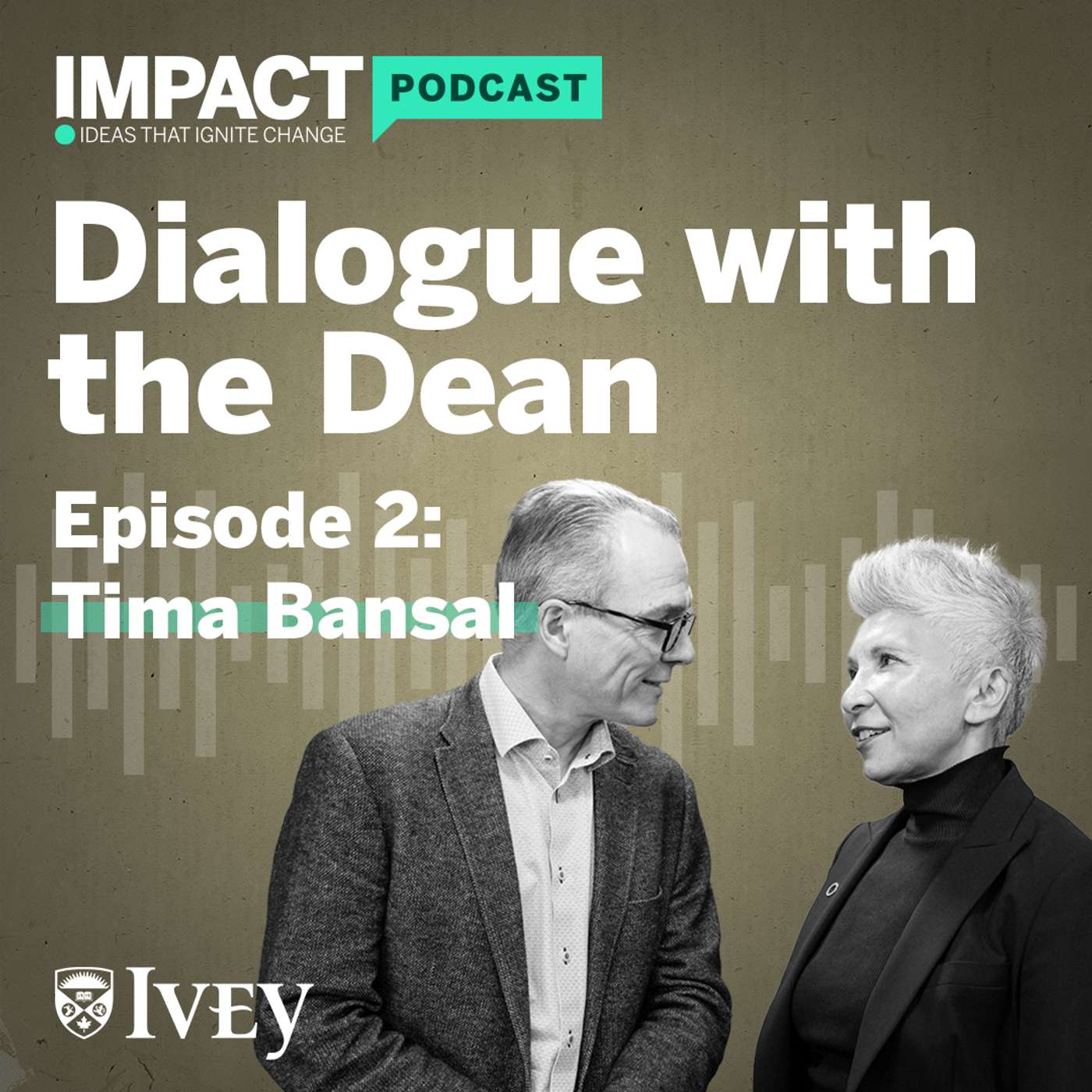
Can success and sustainability truly coexist, or is it just wishful thinking? In this episode of Dialogue with the Dean, Julian Birkinshaw dives into this critical question with Tima Bansal, founder of Innovation North, Powered by Ivey and a trailblazer in business sustainability. Together, they explore how companies can break free from the pressures of quarterly gains to build lasting resilience and make a real societal impact. This engaging conversation covers the shifting landscape of sustainability, the pitfalls of short-term thinking, and how systems thinking can unlock new possibilities for business leaders striving to do well and do good.

What does it take to be a successful entrepreneur today? In the inaugural episode of Dialogue with the Dean, Julian Birkinshaw and Eric Morse, Executive Director of Western’s Morrissette Institute for Entrepreneurship, Powered by Ivey, explore the age-old question: Are entrepreneurs born, or can they be made? Through a dynamic conversation, they explore how entrepreneurs think differently, the role failure plays in growth, Canada’s entrepreneurial landscape, and the best advice to offer those ready to take the leap into entrepreneurship.

Welcome to the Ivey Impact Podcast, where we will share the knowledge and innovative thinking of the Ivey Business School with leaders seeking relevant and actionable insights. Julian Birkinshaw, Dean of Ivey and host of our first season, sits down with Ivey's globally recognized faculty for open dialogue on the issues that matter most to today's leaders - covering everything from start ups and sustainability to AI integration, responsible leadership, and more. Short and impactful, every episode brings you exclusive insights and ideas that will ignite change.
Comments

Download from Google Play

Download from App Store
 United States